


Ruth 1:11
Bible text: King James Version (1769 Blayney text) · Public domain
Bible text: Berean Standard Bible · Public domain
Bible text: American Standard Version (1901) · Public domain
Bible text: World English Bible, Messianic edition · Public domain
Bible text: Geneva Bible (1599) · Public domain
Bible text: Young's Literal Translation · Public domain
- וַתֹּאמֶרva·To·merand she saidH559Conj-w ¦ V-Qal-ConsecImperf-3fsVerb Qal Consecutive Imperfect 3rd Singular Feminineוַandתֹּאמֶרshe said
- נָעֳמִיno·'o·MiNaomiH5281N-proper-fNoun Proper Feminine
- שֹׁבְנָהShoe·nahgo backH7725V-Qal-Imp-2fpVerb Qal Imperative 2nd Plural Feminine
- בְנֹתַיve·no·Taimy O daughtersH1323N-fpc ¦ 1csNoun Plural Feminine ConstructבְנֹתַO daughtersיmy
- לָמָּהLa·mah<to> why?H4100Prep-l ¦ InterrogPronoun Interrogativeלָ<to>מָּהwhy?
- תֵלַכְנָהte·Lakh·nahwill you goH1980V-Qal-Imperf-2fpVerb Qal Imperfect 2nd Plural Feminine
- עִמִּי'i·Miwith meH5973Prep ¦ 1csPreposition Definiteעִמִּwithיme
- הַעוֹדha·'od¿ stillH5750Interrog ¦ Adj-msAdjective Numerical Singular Masculine Absoluteהַ¿עוֹדstill
- לִיli[belong] to <the> mePrep-l ¦ 1csSuffix Personal 1st Singular common genderלִ[belong] to <the>יme
- בָנִיםva·Nim[do] sonsH1121N-mpNoun Plural Masculine Absolute
- בְּמֵעַיbe·me·'Aiin my inward partsH4578Prep-b ¦ N-mpc ¦ 1csNoun Plural Masculine Constructבְּinמֵעַinward partsיmy
- וְהָיוּve·ha·Yuand they will becomeH1961Conj-w ¦ V-Qal-ConsecPerf-3cpVerb Qal Consecutive Perfect 3rd Plural common genderוְandהָיוּthey will become
- לָכֶםla·Khemof youPrep-l ¦ 2mpSuffix Personal 2nd Plural Masculineלָofכֶםyou
- לַאֲנָשִׁיםla·'a·na·Shim<into> husbandsH582Prep-l ¦ N-mpNoun Plural Masculine Absoluteלַ<into>אֲנָשִׁיםhusbands
English is a literal word-by-word gloss of the Hebrew, not the KJV's wording. Why?
This is the original text the KJV's translators worked from — each Hebrew word with its own literal English meaning in this verse, prepared by scholars at Tyndale House, Cambridge. The KJV translates whole sentences, not word by word, so its wording differs: one Hebrew word can become several English words, and the KJV may choose “the LORD” where the gloss reads “Yahweh”. Both are faithful — they answer different questions. For the KJV's own rendering, switch to the KJV text.
Details
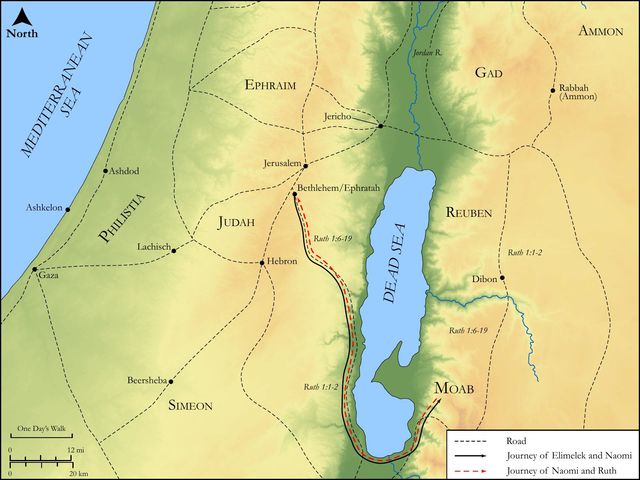
See on the biblical-era map
Study this verse
Public-domain commentary
Matthew Henry
From his Commentary on the Whole Bible. Henry comments on passages, not single verses — this entry covers Ruth 1:6–18. His four-level outline is real structure in the source text, so it is rendered as structure.
See here, I. The good affection Naomi bore to the land of Israel, Rut 1:6. Though she could not stay in it while the famine lasted, she would not stay out of it when the famine ceased. Though the country of Moab had afforded her shelter and supply in a time of need, yet she did not intend it should be her rest for ever; no land should be that but the holy land, in which the sanctuary of God was, of which he had said, This is my rest for ever. Observe,
1.God, at last, returned in mercy to his people; for, though he contend long, he will not contend always. As the judgment of oppression, under which they often groaned in the time of the judges, still came to an end, after a while, when God had raised them up a deliverer, so here the judgment of famine: At length God graciously visited his people in giving them bread. Plenty is God's gift, and it is his visitation which by bread, the staff of life, holds our souls in life. Though this mercy be the more striking when it comes after famine, yet if we have constantly enjoyed it, and never knew what famine meant, we are not to think it the less valuable.
2.Naomi then returned, in duty to her people. She had often enquired of their state, what harvests they had and how the markets went, and still the tidings were discouraging; but like the prophet's servant, who, having looked seven times and seen no sign of rain, at length discerned a cloud no bigger than a man's hand, which soon overspread the heavens, so Naomi at last has good news brought her of plenty in Bethlehem, and then she can think of no other than returning thither again. Hew new alliances in the country of Moab could not make her forget her relation to the land of Israel. Note, Though there be a reason for our being in bad places, yet, when the reason ceases, we must by no means continue in them. Forced absence from God's ordinances, and forced presence with wicked people, are great afflictions; but when the force ceases, and such a situation is continued of choice, then it becomes a great sin. It should seem she began to think of returning immediately upon the death of her two sons,
(1.)Because she looked upon that affliction to be a judgment upon her family for lingering in the country of Moab; and hearing this to be the voice of the rod, and of him that appointed it, she obeys and returns. Had she returned upon the death of her husband, perhaps she might have saved the life of her sons; but, when God judgeth he will overcome, and, if one affliction prevail not to awaken us to a sight and sense of sin and duty, another shall. When death comes into a family it ought to be improved for the reforming of what is amiss in the family: when relations are taken away from us we are put upon enquiry whether, in some instance or other, we are not out of the way of our duty, that we may return to it. God calls our sins to remembrance, when he slays a son, Kg1 17:18. And, if he thus hedge up our way with thorns, it is that he may oblige us to say, We will go and return to our first husband, as Naomi here to her country, Hos 2:7.
(2.)Because the land of Moab had now become a melancholy place to her. It is with little pleasure that she can breathe in that air in which her husband and sons had expired, or go on that ground in which they lay buried out of her sight, but not out of her thoughts; now she will go to Canaan again. Thus God takes away from us the comforts we stay ourselves too much upon and solace ourselves too much in, here in the land of our sojourning, that we may think more of our home in the other world, and by faith and hope may hasten towards it. Earth is embittered to us, that heaven may be endeared.
II.The good affection which her daughters-in-law, and one of them especially, bore to her, and her generous return of their good affection.
1.They were both so kind as to accompany her, some part of the way at least, when she returned towards the land of Judah. Her two daughters-in-law did not go about to persuade her to continue in the land of Moab, but, if she was resolved to go home, would pay her all possible civility and respect at parting; and this was one instance of it: they would bring her on her way, at least to the utmost limits of their country, and help her to carry her luggage as far as they went, for it does not appear that she had any servant to attend her, Rut 1:7. By this we see both that Naomi, as became an Israelite, had been very kind and obliging to them and had won their love, in which she is an example to all mothers-in-law, and that Orpah and Ruth had a just sense of her kindness, for they were willing to return it thus far. It was a sign they had dwelt together in unity, though those were dead by whom the relation between them came. Though they retained an affection for the gods of Moab (Rut 1:15), and Naomi was still faithful to the God of Israel, yet that was no hindrance to either side from love and kindness, and all the good offices that the relation required. Mothers-in-law and daughters-in-law are too often at variance (Mat 10:35), and therefore it is the more commendable if they live in love; let all who sustain this relation aim at the praise of doing so.
2.When they had gone a little way with her Naomi, with a great deal of affection, urged them to go back (Rut 1:8, Rut 1:9): Return each to her mother's house. When they were dislodged by a sad providence from the house of their husbands it was a mercy to them that they had their parents yet living, that they had their houses to go to, where they might be welcome and easy, and were not turned out to the wide world. Naomi suggests that their own mothers would be more agreeable to them than a mother-in-law, especially when their own mothers had houses and their mother-in-law was not sure she had a place to lay her head in which she could call her own. She dismisses them,
(1.)With commendation. This is a debt owing to those who have conducted themselves well in any relation, they ought to have the praise of it: You have dealt kindly with the dead and with me, that is, "You were good wives to your husbands that are gone, and have been good daughters to me, and not wanting to your duty in either relation." Note, When we and our relations are parting, by death or otherwise, it is very comfortable if we have both their testimony and the testimony of our own consciences for us that while we were together we carefully endeavoured to do our duty in the relation. This will help to allay the bitterness of parting; and, while we are together, we should labour so to conduct ourselves as that when we part we may not have cause to reflect with regret upon our miscarriages in the relation.
(2.)With prayer. It is very proper for friends, when they part, to part with prayer. She sends them home with her blessing; and the blessing of a mother-in-law is not to be slighted. In this blessing she twice mentions the name Jehovah, Israel's God, and the only true God, that she might direct her daughters to look up to him as the only fountain of all good. To him she prays in general that he would recompense to them the kindness they had shown to her and hers. It may be expected and prayed for in faith that God will deal kindly with those that have dealt kindly with their relations. He that watereth shall be watered also himself. And, in particular, that they might be happy in marrying again: The Lord grant that you may find rest, each of you in the house of her husband. Note,
[1.]It is very fit that, according to the apostle's direction (Ti1 5:14), the younger women, and he speaks there of young widows, should marry, bear children, and guide the house. And it is a pity that those who have approved themselves good wives should not again be blessed with good husbands, especially those that, like these widows, have no children.
[2.]The married state is a state of rest, such rest as this world affords, rest in the house of a husband, more than can be expected in the house of a mother or a mother-in-law.
[3.]This rest is God's gift. If any content and satisfaction be found in our outward condition, God must be acknowledged in it. There are those that are unequally yoked, that find little rest even in the house of a husband. Their affliction ought to make those the more thankful to whom the relation is comfortable. Yet let God be the rest of the soul, and no perfect rest thought of on this side heaven.
(3.)She dismissed them with great affection: She kissed them, wished she had somewhat better to give them, but silver and gold she had none. However, this parting kiss shall be the seal of such a true friendship as (though she never see them more) she will, while she lives, retain the pleasing remembrance of. If relations must part, let them thus part in love, that they may (if they never meet again in this world) meet in the world of everlasting love.
3.The two young widows could not think of parting with their good mother-in-law, so much had the good conversation of that pious Israelite won upon them. They not only lifted up their voice and wept, as loth to part, but they professed a resolution to adhere to her (Rut 1:10): "Surely we will return with thee unto thy people, and take our lot with thee." It is a rare instance of affection to a mother-in-law and an evidence that they had, for her sake, conceived a good opinion of the people of Israel. Even Orpah, who afterwards went back to her gods, now seemed resolved to go forward with Naomi. The sad ceremony of parting, and the tears shed on that occasion, drew from her this protestation, but it did not hold. Strong passions, without a settled judgment, commonly produce weak resolutions.
4.Naomi sets herself to dissuade them from going along with her, Rut 1:11-13.
(1.)Naomi urges her afflicted condition. If she had had any sons in Canaan, or any near kinsmen, whom she could have expected to marry the widows, to raise up seed to those that were gone, and to redeem the mortgaged estate of the family, it might have been some encouragement to them to hope for a comfortable settlement at Bethlehem. But she had no sons, nor could she think of any near kinsman likely to do the kinsman's part, and therefore argues that she was never likely to have any sons to be husbands for them, for she was too old to have a husband; it became here age to think of dying and going out of the world, not of marrying and beginning the world again. Or, if she had a husband, she could not expect to have children, nor, if she had sons, could she think that these young widows would stay unmarried till her sons that should yet be born would grow up to be marriageable. Yet this was not all: she could not only not propose to herself to marry them like themselves, but she knew not how to maintain them like themselves. The greatest grievance of that poor condition to which she was reduced was that she was not in a capacity to do for them as she would: It grieveth me more for your sakes than for my own that the hand of the Lord has gone out against me. Observe,
[1.]She judges herself chiefly aimed at in the affliction, that God's quarrel was principally with her: "The hand of the Lord has gone out against me. I am the sinner; it is with me that God has a controversy; it is with me that he is contending; I take it to myself." This well becomes us when we are under affliction; though many others share in the trouble, yet we must hear the voice of the rod as if it spoke only against us and to us, not billeting the rebukes of it at other people's houses, but taking them to ourselves.
[2.]She laments most the trouble that redounded to them from it. She was the sinner, but they were the sufferers: It grieveth me much for your sakes. A gracious generous spirit can better bear its own burden than it can bear to see it a grievance to others, or others in any way drawn into trouble by it. Naomi could more easily want herself than see her daughters want. "Therefore turn again, my daughters, for, alas! I am in no capacity to do you any kindness." But,
(2.)Did Naomi do well thus to discourage her daughters from going with her, when, by taking them with her, she might save them from the idolatry of Moab and bring them to the faith and worship of the God of Israel? Naomi, no doubt, desired to do so. But,
[1.]If they did come with her, she would not have them to come upon her account. Those that take upon them a profession of religion only in complaisance to their relations, to oblige their friends, or for the sake of company, will be converts of small value and of short continuance.
[2.]If they did come with her, she would have them to make it their deliberate choice, and to sit down first and count the cost, as it concerns those to do that may take up a profession of religion. It is good for us to be told the worst. Our Saviour took this course with him who, in the heat of zeal, spoke that bold word, Master, I will follow thee whithersoever thou goest. "Come, come," says Christ, "canst thou fare as I fare? The Son of man has not where to lay his head; know this, and then consider whether thou canst find in thy heart to take thy lot with him," Mat 8:19, Mat 8:20. Thus Naomi deals with her daughters-in-law. Thoughts ripened into resolves by serious consideration are likely to be kept always in the imagination of the heart, whereas what is soon ripe is soon rotten.
5.Orpah was easily persuaded to yield to her own corrupt inclination, and to go back to her country, her kindred, and her father's house, now when she stood fair for an effectual call from it. They both lifted up their voice and wept again (Rut 1:14), being much affected with the tender things that Naomi had said. But it had a different effect upon them: to Orpah it was a savour of death unto death; the representation Naomi had made of the inconveniences they must count upon if they went forward to Canaan sent her back to the country of Moab, and served her as an excuse for her apostasy; but, on the contrary, it strengthened Ruth's resolution, and her good affection to Naomi, with whose wisdom and goodness she was never so charmed as she was upon this occasion; thus to her it was a savour of life unto life.
(1.)Orpah kissed her mother-in-law, that is, took an affectionate leave of her, bade her farewell for ever, without any purpose to follow her hereafter, as he that said he would follow Christ when he had buried his father or bidden those farewell that were at home. Orpah's kiss showed she had an affection for Naomi and was loth to part from her; yet she did not love her well enough to leave her country for her sake. Thus many have a value and affection for Christ, and yet come short of salvation by him, because they cannot find in their hearts to forsake other things for him. They love him and yet leave him, because they do not love him enough, but love other things better. Thus the young man that went away from Christ went away sorrowful, Mat 19:22. But,
(2.)Ruth clave unto her. Whether, when she came from home, she was resolved to go forward with her or no does not appear; perhaps she was before determined what to do, out of a sincere affection for the God of Israel and to his law, of which, by the good instructions of Naomi, she had some knowledge.
6.Naomi persuades Ruth to go back, urging, as a further inducement, her sister's example (Rut 1:15): Thy sister-in-law has gone back to her people, and therefore of course gone back to her gods; for, whatever she might do while she lived with her mother-in-law, it would be next to impossible for her to show any respect to the God of Israel when she went to live among the worshippers of Chemosh. Those that forsake the communion of saints, and return to the people of Moab, will certainly break off their communion with God, and embrace the idols of Moab. Now, return thou after thy sister, that is, "If ever thou wilt return, return now. This is the greatest trial of thy constancy; stand this trial, and thou art mine for ever." Such offences as that of Orpah's revolt must needs come, that those who are perfect and sincere may be made manifest, as Ruth was upon this occasion.
7.Ruth puts an end to the debate by a most solemn profession of her immovable resolution never to forsake her, nor to return to her own country and her old relations again, Rut 1:16, Rut 1:17.
(1.)Nothing could be said more fine, more brave, than this. She seems to have had another spirit, and another speech, now that her sister had gone, and it is an instance of the grace of God inclining the soul to the resolute choice of the better part. Draw me thus, and we will run after thee. Her mother's dissuasions made her the more resolute; as when Joshua said to the people, You cannot serve the Lord, they said it with the more vehemence, Nay, but we will.
[1.]She begs of her mother-in-law to say no more against her going: "Entreat me not to leave thee, or to return from following after thee; for all thy entreaties now cannot shake that resolution which thy instructions formerly have wrought in me, and therefore let me hear no more of them." Note, It is a great vexation and uneasiness to those that are resolved for God and religion to be tempted and solicited to alter their resolution. Those that would not think of it would not hear of it. Entreat me not. The margin reads it, Be not against me. Note, We are to reckon those against us, and really our enemies, that would hinder us in our way to the heavenly Canaan. Our relations they may be, but they cannot be our friends, that would dissuade us from and discourage us in the service of God and the work of religion.
[2.]She is very particular in her resolution to cleave to her and never to forsake her; and she speaks the language of one resolved for God and heaven. She is so in love, not with her mother's beauty, or riches, or gaiety (all these were withered and gone), but with her wisdom, and virtue, and grace, which remained with her, even in her present poor and melancholy condition, that she resolves to cleave to her. First, She will travel with her: Whither thou goest I will go, though to a country I never saw and in a low and ill opinion of which I have been trained up; though far from my own country, yet with thee every road shall be pleasant. Secondly, She will dwell with her: "Where thou lodgest I will lodge, though it be in a cottage, nay, though it be no better a lodging than Jacob had when he had the stones for his pillow. Where thou settest up thy staff I will set up mine, be it where it may." Thirdly, She will twist interest with her: Thy people shall be my people. From Naomi's character she concludes certainly that the great nation was a wise and an understanding people. She judges of them all by her good mother, who, wherever she went, was a credit to her country (as all those should study to be who profess relation to the better country, that is, the heavenly), and therefore she will think herself happy if she may be reckoned one of them. "Thy people shall be mine to associate with, to be conformable to, and to be concerned for." Fourthly, She will join in religion with her. Thus she determined to be hers usque ad aras - to the very altars: "Thy God shall be my God, and farewell to all the gods of Moab, which are vanity and a lie. I will adore the God of Israel, the only living and true God, trust in him alone, serve him, and in every thing be ruled by him;" this is to take the Lord for our God. Fifthly, She will gladly die in the same bed: Where thou diest will I die. She takes it for granted they must both die, and that in all probability Naomi, as the elder, would die first, and resolves to continue in the same house, if it might be, till her days also were fulfilled, intimating likewise a desire to partake of her happiness in death; she wishes to die in the same place, in token of her dying after the same manner. "Let me die the death of righteous Naomi, and let my last end be like hers." Sixthly, She will desire to be buried in the same grave, and to lay her bones by hers: There will I be buried, not desiring to have so much as her dead body carried back to the country of Moab, in token of any remaining kindness for it; but, Naomi and she having joined souls, she desires they may mingle dust, in hopes of rising together, and being together for ever in the other world.
[3.]She backs her resolution to adhere to Naomi with a solemn oath: The Lord do so to me, and more also (which was an ancient form of imprecation), if aught but death part thee and me. An oath for confirmation was an end of this strife, and would leave a lasting obligation upon her never to forsake that good way she was now making choice of. First, It is implied that death would separate between them for a time. She could promise to die and be buried in the same place, but not at the same time; it might so happen that she might die first, and this would part them. Note, Death parts those whom nothing else will part. A dying hour is a parting hour, and should be so thought of by us and prepared for. Secondly, It is resolved that nothing else should part them; not any kindness from her own family and people, nor any hope of preferment among them, not any unkindness from Israel, nor the fear of poverty and disgrace among them. "No, I will never leave thee." Now,
(2.)This is a pattern of a resolute convert to God and religion. Thus must we be at a point. [1.] We must take the Lord for our God. "This God is my God for ever and ever; I have avouched him for mine." [2.] When we take God for our God we must take his people for our people in all conditions; though they be a poor despised people, yet, if they be his, they must be ours. [3.] Having cast in our lot among them, we must be willing to take our lot with them and to fare as they fare. We must submit to the same yoke and draw in it faithfully, take up the same cross and carry it cheerfully, go where God will have us to go, though it should be into banishment, and lodge where he will have us to lodge, though it be in a prison, die where he will have us die, and lay our bones in the graves of the upright, who enter into peace and rest in their beds, though they be but the graves of the common people. [4.] We must resolve to continue and persevere, and herein our adherence to Christ must be closer than that of Ruth to Naomi. She resolved that nothing but death should separate them; but we must resolve that death itself shall not separate us from our duty to Christ, and then we may be sure that death itself shall not separate us from our happiness in Christ. [5.] We must bind our souls with a bond never to break these pious resolutions, and swear unto the Lord that we will cleave to him. Fast bind, fast find. He that means honestly does not startle at assurances.
8.Naomi is hereby silenced (Rut 1:18): When she saw that Ruth was stedfastly minded to go with her (which was the very thing she aimed at in all that she had said, to make her of a stedfast mind in going with her), when she saw that she had gained her point, she was well satisfied, and left off speaking to her. She could desire no more than that solemn protestation which Ruth had just now made. See the power of resolution, how it puts temptation to silence. Those that are unresolved, and go in religious ways without a stedfast mind, tempt the tempter, and stand like a door half open, which invites a thief; but resolution shuts and bolts the door, resists the devil, and forces him to flee.
The Chaldee paraphrase thus relates the debate between Naomi and Ruth: - Ruth said, Entreat me not to leave thee, for I will be a proselyte. Naomi said, We are commanded to keep sabbaths and good days, on which we may not travel above 2000 cubits - a sabbath-day's journey. Well, said Ruth, whither thou goest I will go. Naomi said, We are commanded not to tarry all night with Gentiles. Well, said Ruth, where thou lodgest I will lodge. Naomi said, We are commanded to keep 613 precepts. Well, said Ruth, whatever thy people keep I will keep, for they shall be my people. Naomi said, We are forbidden to worship any strange god. Well, said Ruth, thy God shall be my God. Naomi said, We have four sorts of deaths for malefactors, stoning, burning, strangling, and slaying with the sword. Well, said Ruth, where thou diest I will die. We have, said Naomi, houses of sepulchre. And there, said Ruth, will I be buried.
Continue studying Ruth 1:11 across the web’s major study libraries — every link below opens this exact verse, chapter, or book on the destination site.
Read & Compare
 BibleGatewayThis verse in more than 200 translations and 70 languages.
 Bible.comThe YouVersion reader — hundreds of translations, reading plans, and highlights.
 ESV.orgCrossway's official English Standard Version reader.
 NET BibleThe NET translation with 60,000+ translators' notes on every rendering decision.
 STEP BibleTyndale House's free study tool — original text, vocabulary, and scholarly resources.
 BibliaLogos Bible Software's free web reader.
 USCCBThe New American Bible (Revised Edition) with the U.S. bishops' study notes.
Commentaries
 BibleHub CommentariesDozens of classic commentaries on this verse, gathered on one page.
 StudyLightMore than 100 commentary sets — the largest collection on the web.
 BibleRefPlain-English commentary on what this verse means, verse by verse.
 Enduring WordDavid Guzik's free commentary on this chapter, widely used by Bible teachers.
 Bible Study ToolsVerse commentary alongside Greek and Hebrew study aids.
Original Language & Research
- BibleHub InterlinearThe verse word by word — original language, transliteration, and English.
- BibleHub LexiconEvery word's original-language definition and Strong's entry.
 Blue Letter BibleDeep-study tools — Strong's numbers, concordance, and word studies.
 SefariaThe Hebrew text with Rashi and centuries of Jewish commentary.
Sermons, Hymns & Audio


TrulyRandomVerse is not affiliated with these sites and doesn’t control their content. They’re linked because they’re genuinely useful.
Summary
Ruth 1:11 captures a profoundly poignant and pivotal moment in the narrative, as a grief-stricken Naomi, having endured the devastating loss of her husband and two sons, earnestly implores her Moabite daughters-in-law, Orpah and Ruth, to abandon their journey with her and return to their own people. Her rhetorical question, "are there yet any more sons in my womb, that they may be your husbands?", serves as a powerful expression of her profound despair, the stark and insurmountable reality of her inability to provide for their future, and the grim societal expectations concerning the continuation of family lines through the custom of levirate marriage in ancient Israel.
Context
ShowHideLiterary Context
This verse is strategically placed at a critical juncture in the opening chapter of the Book of Ruth, following a decade of tragedy for Naomi. The narrative begins by establishing a severe famine in Judah, compelling Elimelech, Naomi's husband, to relocate his family from Bethlehem to Moab. After approximately ten years, a series of devastating losses occur: Elimelech dies, followed by both their sons, Mahlon and Chilion, leaving Naomi, Orpah, and Ruth as childless widows. Upon hearing that the Lord had "visited His people in giving them bread" in Judah (Ruth 1:6), Naomi resolves to return home. As they embark on the journey, Naomi feels a deep, loving obligation to release her daughters-in-law from any further commitment to her, recognizing the bleak prospects their future holds if they remain tied to an elderly, impoverished widow. Her initial plea in Ruth 1:8, where she blesses them and encourages them to return, is met with their tears and refusal to leave. Ruth 1:11 represents Naomi's second, more forceful and reasoned attempt at persuasion, highlighting the practical and biological impossibility of their situation if they remain with her.
Historical & Cultural Context
In Israel, immense importance was placed on family lineage, the perpetuation of the male line, and the continuation of a family's name and inheritance. Widows, especially those who were childless, occupied an extremely vulnerable position, often lacking financial security, social standing, and protection without a male guardian. The custom of levirate marriage (from Latin levir, "husband's brother"), known in Hebrew as yibbum, was a crucial legal and social institution designed to address this vulnerability and ensure the perpetuation of a deceased man's line. As outlined in Deuteronomy 25:5-10, if a man died without an heir, his brother (or, as the Book of Ruth later demonstrates, a close male relative) was obligated to marry the widow and raise up offspring in the deceased's name. Naomi's rhetorical question in Ruth 1:11 directly references this custom, emphasizing her advanced age and physical inability to bear more sons who could fulfill this sacred obligation for Orpah and Ruth, thereby reinforcing the utter hopelessness of their situation from a human perspective.
Key Themes
ShowHideThis verse powerfully underscores several critical themes within the Book of Ruth and the broader biblical narrative. Firstly, it highlights Naomi's profound grief and realistic assessment of her dire circumstances. Her words are not merely a statement of fact but an authentic expression of deep sorrow and the perceived impossibility of her providing for her daughters-in-law through the culturally accepted means of levirate marriage. Secondly, it vividly illuminates the vulnerability of widows in Israel, whose security and future were intrinsically linked to male provision and the continuation of family lines. This precarious position sets the stage for God's providential and redemptive care later in the narrative. Thirdly, despite her overwhelming despair, Naomi demonstrates remarkable selfless compassion, prioritizing the well-being and future prospects of Orpah and Ruth over her own desperate need for companionship or support. Her plea, though born of sorrow, is an act of profound love. Finally, the verse subtly introduces the critical theme of redemption and the kinsman-redeemer (go'el), as Naomi's seemingly insurmountable problem ultimately necessitates the intervention of a relative who can fulfill the levirate duty, foreshadowing God's greater redemptive plan for His people, as seen in passages like Isaiah 43:1.
Exposition and Analysis
ShowHideKey Word Analysis
ShowHideVerse Breakdown
ShowHide"And Naomi said, Turn again, my daughters:"
This opening phrase reiterates Naomi's persistent and loving plea. The affectionate address "my daughters" conveys a deep maternal bond and genuine care, even as she issues a command born of perceived necessity. Her instruction to "turn again" is a desperate call for them to reverse their course, prioritizing their future over her own needs.
"why will ye go with me?"
This rhetorical question highlights the perceived futility and complete lack of benefit for Orpah and Ruth if they continue accompanying Naomi. She implies there is no logical or practical reason for them to stay, as she can offer them nothing in terms of security or future prospects within Israelite society. It underscores her selfless desire for their well-being.
"[are] there yet [any more] sons in my womb, that they may be your husbands?"
This is the core of Naomi's argument, the crux of her despair, and the dramatic turning point of her plea. It directly references the levirate marriage custom and her physical inability to bear more children. The question is designed to elicit an obvious "no," thereby emphasizing the absolute impossibility of her providing them with the means to secure their future and perpetuate their deceased husbands' names. It powerfully conveys her profound grief, her realistic assessment of her dire situation, and her selfless desire for their well-being, even at her own expense.
Literary Devices
ShowHideRuth 1:11 is rich with profound literary devices that amplify its emotional and thematic weight. The most prominent is Rhetorical Question, as Naomi asks, "are there yet any more sons in my womb, that they may be your husbands?" She knows the answer is a definitive "no," using the question not to seek information but to powerfully emphasize the utter impossibility of her bearing more sons who could fulfill the levirate duty for her daughters-in-law. This device masterfully conveys her despair and the bleakness of their prospects from a human vantage point. Repetition is also evident in the repeated use of the imperative "Turn again" (שׁוּבוּ, shuvu') throughout this chapter (Ruth 1:8, Ruth 1:11, Ruth 1:12). This repetition underscores Naomi's earnestness and the immense weight of her plea, highlighting her persistent desire for her daughters-in-law's welfare. Furthermore, the verse is imbued with profound Pathos, evoking deep sympathy and empathy for Naomi's tragic circumstances. Her words convey not only her logical reasoning but also her immense grief, powerlessness, and selfless love, drawing the reader deeply into her emotional plight and the human cost of her losses.
Theological and Thematic Connections
ShowHideRuth 1:11, though steeped in Naomi's profound despair and the articulation of human impossibility, subtly yet powerfully sets the stage for the unfolding of God's sovereign providence. Naomi's words articulate a situation utterly without human solution, creating a vacuum into which divine intervention will ultimately flow. Her inability to provide "sons" for her daughters-in-law highlights humanity's inherent limitations, its vulnerability, and its profound dependence on a higher power. This moment of profound human hopelessness is precisely where God's unexpected and miraculous plan begins to unfold, demonstrating that His ways are indeed higher than our ways (Isaiah 55:8-9), and His ability to work is not limited by our perceived impossibilities. It foreshadows the truth that true redemption and provision often come from sources and in ways we cannot foresee, orchestrate, or even imagine, as seen in God's provision for His people throughout salvation history (Genesis 22:14).
Reflection and Application
ShowHideNaomi's selfless concern for her daughters-in-law, even in her own overwhelming grief and despair, offers a profound and challenging lesson in empathy and sacrificial love. In moments of personal crisis, deep sorrow, or perceived impossibility, it is a natural human tendency to become consumed by our own suffering and needs. Yet, Naomi, in her utter brokenness and perceived destitution, prioritizes the well-being of others, demonstrating a remarkable capacity for compassion and selflessness. This verse challenges us to deeply consider how we respond when our carefully laid plans crumble, when tragedy strikes, or when circumstances seem utterly bleak and without human remedy. Do we succumb to despair and self-pity, or do we, like Naomi, confront harsh realities while still seeking the best for those around us, even if it means personal sacrifice? Ultimately, while Naomi saw no human solution, her very act of releasing her daughters-in-law, born of love, inadvertently creates the space for Ruth's unwavering loyalty and God's surprising, redemptive provision. This reminds us that even in our deepest valleys of hopelessness, God is sovereignly at work, often in ways we cannot comprehend, orchestrating circumstances for His redemptive purposes. Our task is to cultivate a spirit of trust in His providence, even when the path ahead seems utterly closed off and our human understanding fails.
Questions for Reflection
ShowHideFAQ
ShowHideWhat was the purpose of levirate marriage in ancient Israel?
ShowHideLevirate marriage was a vital custom (derived from the Mosaic Law, specifically Deuteronomy 25:5-10) designed to preserve the name, lineage, and inheritance of a man who died without leaving an heir. If a man died childless, his brother (or, as the Book of Ruth illustrates with Boaz, a close male relative) was obligated to marry the widow. The first son born from this union would then be legally considered the heir of the deceased, ensuring the continuation of his family line, his name, and the retention of his property within the family. Beyond its legal and genealogical function, it also provided crucial social and economic security for the widow, who would otherwise be highly vulnerable and destitute in Israel.
Why did Naomi emphasize her inability to bear more sons?
ShowHideNaomi emphasized her inability to bear more sons to highlight the practical, biological, and cultural impossibility of fulfilling the levirate custom for Orpah and Ruth. By stating that she had no more sons in her womb, she was logically demonstrating that she could not provide them with new husbands who could raise up an heir for their deceased husbands. This stark reality was her strongest and most compelling argument for why her daughters-in-law should return to Moab, where they might find new husbands and security within their own culture. It underscored her profound grief, her realistic assessment of their bleak prospects if she remained with her, and her selfless desire to release them from any perceived obligation or futile hope.
How does this verse relate to the overall theme of God's providence in the Book of Ruth?
ShowHideRuth 1:11, with Naomi's despairing and seemingly hopeless words, serves as a powerful setup for the unfolding of God's hidden yet active providence throughout the Book of Ruth. From a purely human perspective, Naomi's situation is utterly hopeless; she sees no way for her or her daughters-in-law to find security, provision, or continuation of their family lines. However, this very moment of human impossibility creates the vacuum into which God's divine plan unfolds. Naomi's inability to provide a "redeemer" son for her daughters-in-law ultimately leads to Ruth's unwavering loyalty, their journey to Bethlehem, and the eventual intervention of Boaz, the kinsman-redeemer. Thus, Naomi's despair and the perceived human dead-end become the catalyst for God's miraculous provision, demonstrating that His sovereign hand is always at work, even when circumstances seem most bleak and human solutions are exhausted, orchestrating events for His redemptive purposes and the fulfillment of His promises, as He did for Abraham and his descendants Genesis 12:1-3.
Christ-Centered Fulfillment
ShowHideNaomi's desperate rhetorical question in Ruth 1:11, highlighting her utter inability to provide "sons" for her daughters-in-law to continue their family lines and secure their future, serves as a poignant foreshadowing of humanity's own inherent inability to redeem itself or secure its eternal future. Just as Naomi could not produce a kinsman-redeemer from her own "womb" to fulfill the levirate duty, so too humanity, by its own efforts, is utterly incapable of overcoming the spiritual death, bondage to sin, and alienation from God caused by the Fall (Romans 3:23). The levirate custom, which Naomi references, points to the profound need for a "kinsman-redeemer" (Hebrew: go'el) to raise up a name and inheritance for the deceased. This concept finds its ultimate, perfect, and glorious fulfillment in Jesus Christ. He is our true Kinsman-Redeemer, who, being fully God and fully man (Hebrews 2:14-18), was born into humanity's lineage (a lineage that Ruth, by God's providence, helps establish, as seen in Matthew 1:5) to redeem us from the curse of the law and the power of sin (Galatians 4:4-5). Through His sacrificial death on the cross and His glorious resurrection, Christ "raises up seed" for us, not through physical offspring, but through spiritual rebirth, making us children of God by adoption (John 1:12-13) and granting us an eternal, imperishable inheritance in Him (Ephesians 1:7). Where Naomi saw only barrenness, impossibility, and a dead end, Christ offers abundant life, spiritual fruitfulness, and an everlasting family in God's kingdom (John 10:10).