


Genesis 22:14
Bible text: King James Version (1769 Blayney text) · Public domain
Bible text: Berean Standard Bible · Public domain
Bible text: American Standard Version (1901) · Public domain
Bible text: World English Bible, Messianic edition · Public domain
Bible text: Geneva Bible (1599) · Public domain
Bible text: Young's Literal Translation · Public domain
- וַיִּקְרָאvai·yik·Ra'and he calledH7121Conj-w ¦ V-Qal-ConsecImperf-3msVerb Qal Consecutive Imperfect 3rd Singular Masculineוַandיִּקְרָאhe called
- אַבְרָהָם'av·ra·HamAbrahamH85N-proper-mNoun Proper Masculine
- שֵׁםshem[the] name ofH8034N-mscNoun Singular Masculine Construct
- הַמָּקוֹםha·ma·Komthe placeH4725Art ¦ N-msNoun Singular Masculine Absoluteהַtheמָּקוֹםplace
- הַהוּאha·Hu'<the> thatH1931Art ¦ Pro-3msPronoun Personal 3rd Singular Masculineהַ<the>הוּאthat
- יְהוָהYah·wehYahwehH3068N-properNoun Proper Title
- יִרְאֶהyir·'Ehhe will seeH7200V-Qal-Imperf-3msVerb Qal Imperfect 3rd Singular Masculine
- אֲשֶׁר'a·SherthatH834RelParticle Relative
- יֵאָמֵרye·'a·Merit is saidH559V-Niphal-Imperf-3msVerb Niphal Imperfect 3rd Singular Masculine
- הַיּוֹםhai·Yomthis dayH3117Art ¦ N-msNoun Singular Masculine Absoluteהַthisיּוֹםday
- בְּהַרbe·Haron [the] mountain ofH2022Prep-b ¦ N-mscNoun Singular Masculine Constructבְּonהַר[the] mountain of
- יְהוָהYah·wehYahwehH3068N-properNoun Proper Title
- יֵרָאֶהye·ra·'Ehit will be seenH7200V-Niphal-Imperf-3msVerb Niphal Imperfect 3rd Singular Masculine
English is a literal word-by-word gloss of the Hebrew, not the KJV's wording. Why?
This is the original text the KJV's translators worked from — each Hebrew word with its own literal English meaning in this verse, prepared by scholars at Tyndale House, Cambridge. The KJV translates whole sentences, not word by word, so its wording differs: one Hebrew word can become several English words, and the KJV may choose “the LORD” where the gloss reads “Yahweh”. Both are faithful — they answer different questions. For the KJV's own rendering, switch to the KJV text.
Details
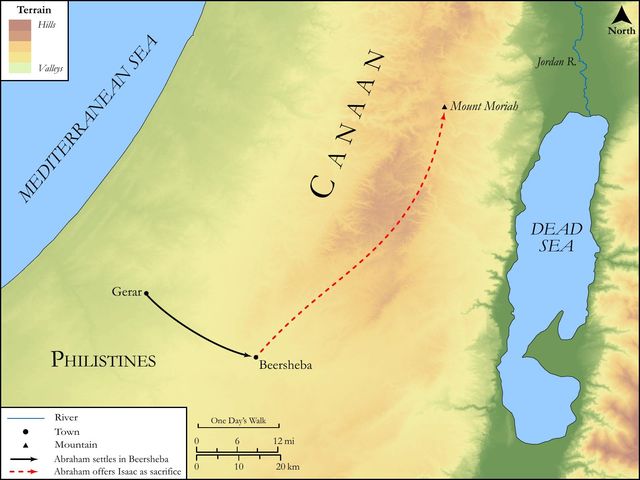
See on the biblical-era maps


Study this verse
Public-domain commentary
Matthew Henry
From his Commentary on the Whole Bible. Henry comments on passages, not single verses — this entry covers Genesis 22:11–14. His two-level outline is real structure in the source text, so it is rendered as structure.
Hitherto this story has been very melancholy, and seemed to hasten towards a most tragical period; but here the sky suddenly clears up, the sun breaks out, and a bright and pleasant scene opens. The same hand that had wounded and cast down here heals and lifts up; for, though he cause grief, he will have compassion. The angel of the Lord, that is, God himself, the eternal Word, the angel of the covenant, who was to be the great Redeemer and comforter, he interposed, and gave a happy issue to this trial.
I.Isaac is rescued, Gen 22:11, Gen 22:12.
The command to offer him was intended only for trial, and it appearing, upon trial, that Abraham did indeed love God better than he loved Isaac, the end of the command was answered; and therefore the order is countermanded, without any reflection at all upon the unchangeableness of the divine counsels: Lay not thy hand upon the lad. Note,
1.Our creature-comforts are most likely to be continued to us when we are most likely to be continued to us when we are most willing to resign them up to God's will.
2.God's time to help and relieve his people is when they are brought to the greatest extremity. The more imminent the danger is, and the nearer to be put in execution, the more wonderful and the more welcome is the deliverance.
II.Abraham is not only approved, but applauded.
He obtains an honourable testimony that he is righteous: Now know I that thou fearest God. God knew it before, but now Abraham had given a most memorable evidence of it. He needed do no more; what he had done was sufficient to prove the religious regard he had to God and his authority. Note,
1.When God, by his providence, hinders the performance of our sincere intentions in his services, he graciously accepts the will for the deed, and the honest endeavour, though it come short of finishing.
2.The best evidence of our fearing God is our being willing of serve and honour him with that which is dearest to us, and to part with all to him or for him.
III.Another sacrifice is provided instead of Isaac, Gen 22:13.
Now that the altar was built, and the wood laid in order, it was necessary that something should be offered. For,
1.God must be acknowledged with thankfulness for the deliverance of Isaac; and the sooner the better, when here is an altar ready.
2.Abraham's words must be made good: God will provide himself a lamb. God will not disappoint those expectations of his people which are of his own raising; but according to their faith it is to them. Thou shalt decree a thing, and it shall be established.
3.Reference must be had to the promised Messiah, the blessed seed. (1.) Christ was sacrificed in our stead, as this ram instead of Isaac, and his death was our discharge. "Here am I (said he,) let these go their way." (2.) Though that blessed seed was lately promised, and now typified by Isaac, yet the offering of him up should be suspended till the latter end of the world: and in the mean time the sacrifice of beasts should be accepted, as this ram was, as a pledge of that expiation which should one day be made by that great sacrifice. And it is observable that the temple, the place of sacrifice, was afterwards built upon this mount Moriah (Ch2 3:1); and mount Calvary, where Christ was crucified, was not far off.
IV.A new name is given to the place, to the honour of God, and for the encouragement of all believers, to the end of the world, cheerfully to trust in God in the way of obedience: Jehovah-jireh, The Lord will provide (Gen 22:14), probably alluding to what he had said (Gen 22:8), God will provide himself a lamb. I was not owing to any contrivance of Abraham, nor was it in answer to his prayer, though he was a distinguished intercessor; but it was purely the Lord's doing. Let it be recorded for the generations to come,
1.That the Lord will see; he will always have his eye upon his people in their straits and distresses, that he may come in with seasonable succour in the critical juncture.
2.That he will be seen, be seen in the mount, in the greatest perplexities of his people. He will not only manifest, but magnify, his wisdom, power, and goodness, in their deliverance. Where God sees and provides, he should be seen and praised. And, perhaps, it may refer to God manifest in the flesh.
Historical interpretation
Two Centuries of Reception
2 surviving comments on this verse. Each one is dated, so this reads as a timeline rather than a list.
Select a marker to jump to its quote. Markers stagger vertically where authors wrote within a few decades of each other.
A clear way of spiritual understanding is opened for those who know how to hear these words. For everything that has been done reaches to the vision, for it is said that “the Lord saw.” But the vision that “the Lord saw” is in the spirit so that you too might see these things in the spirit which are written. And, just as there is nothing corporeal in God, so also you might perceive nothing corporeal in all these things. Rather, you too might beget a son Isaac in the spirit when you begin to have “the fruit of the Spirit, joy, peace.” … Now you beget joy if “you count it all joy when you fall into various temptations” and you offer that joy in sacrifice to God.For when you have approached God joyfully, he again gives back to you what you have offered and says to you, “You will see me again, and your heart shall rejoice, and no man shall take your joy from you.” So, therefore, what you have offered to God you shall receive back multiplied. Something like this, although in another figure, is related in the Gospels when in a parable someone is said to have received a pound that he might engage in business, and the master of the house demanded the money. But if you have caused five to be multiplied to ten, they themselves are given to you, they are granted to you. For hear what Scripture says: “Take his pound, and give it to him who has ten pounds.”57
So, therefore, we appear at least to engage in business for the Lord, but the profits of the business go to us. And we appear to offer victims to the Lord, but the things we offer are given back to us. For God needs nothing, but he wishes us to be rich; he desires our progress through each individual thing.
(Verse 14) And Abraham called the name of that place, The Lord will see: so that they say to this day, In the mount the Lord will be seen. For because he hath seen in this place, in the Hebrew tongue it is said, He shall be seen. And this hath passed into a proverb with the Hebrews, so that when they are in distress and desire the Lord's aid, they say, In the mount the Lord will be seen: that is, as He pitied Abraham, so will He have pity on us. Wherefore, even now, they are wont also to blow the horn for a sign when the ram is given.
Continue studying Genesis 22:14 across the web’s major study libraries — every link below opens this exact verse, chapter, or book on the destination site.
Read & Compare
 BibleGatewayThis verse in more than 200 translations and 70 languages.
 Bible.comThe YouVersion reader — hundreds of translations, reading plans, and highlights.
 ESV.orgCrossway's official English Standard Version reader.
 NET BibleThe NET translation with 60,000+ translators' notes on every rendering decision.
 STEP BibleTyndale House's free study tool — original text, vocabulary, and scholarly resources.
 BibliaLogos Bible Software's free web reader.
 USCCBThe New American Bible (Revised Edition) with the U.S. bishops' study notes.
Commentaries
 BibleHub CommentariesDozens of classic commentaries on this verse, gathered on one page.
 StudyLightMore than 100 commentary sets — the largest collection on the web.
 BibleRefPlain-English commentary on what this verse means, verse by verse.
 Enduring WordDavid Guzik's free commentary on this chapter, widely used by Bible teachers.
 Bible Study ToolsVerse commentary alongside Greek and Hebrew study aids.
Original Language & Research
- BibleHub InterlinearThe verse word by word — original language, transliteration, and English.
- BibleHub LexiconEvery word's original-language definition and Strong's entry.
 Blue Letter BibleDeep-study tools — Strong's numbers, concordance, and word studies.
 SefariaThe Hebrew text with Rashi and centuries of Jewish commentary.
Sermons, Hymns & Audio


TrulyRandomVerse is not affiliated with these sites and doesn’t control their content. They’re linked because they’re genuinely useful.
Summary
Genesis 22:14 records Abraham's profound act of naming the location of Isaac's near-sacrifice "Jehovahjireh," meaning "The LORD will provide." This name commemorates God's miraculous intervention and the provision of a substitute ram, transforming a moment of ultimate test into an enduring testament to divine faithfulness. The accompanying proverb, "In the mount of the LORD it shall be seen," became a lasting declaration, affirming God's consistent ability to foresee and sovereignly meet the needs of His people, ultimately foreshadowing His supreme provision in Jesus Christ.
Context
ShowHideLiterary Context
Genesis 22:14 culminates one of the most poignant and pivotal narratives in the Old Testament: the "Akedah," or the binding of Isaac. This chapter details God's extraordinary command to Abraham to offer his beloved son, Isaac, as a burnt offering on Mount Moriah. The preceding verses meticulously build the tension, showcasing Abraham's unwavering and silent obedience as he prepares to fulfill God's seemingly impossible directive. Just as Abraham raises the knife, God intervenes through an angel, preventing the sacrifice and providing a ram caught in a thicket as a substitute. This verse, therefore, is Abraham's immediate and profound response to God's miraculous provision, solidifying the theological significance of the event and the character of God for future generations. It marks the climax of Abraham's test and the ultimate demonstration of his faith.
Historical & Cultural Context
Among the nations of that day, child sacrifice, though abhorrent, was practiced by some pagan peoples as a means of appeasing their gods or securing blessings. God's command to Abraham, therefore, would have been understood within a cultural milieu where extreme religious devotion, even to the point of human sacrifice, was not entirely unknown, though it stood in stark contrast to the emerging monotheistic faith of Israel. However, God's intervention in Genesis 22 emphatically distinguishes the God of Israel from pagan deities, demonstrating that He does not demand human sacrifice but provides for it. The naming of places after significant events was a common practice, serving as a memorial and a pedagogical tool for future generations. "Mount Moriah" itself would later become the traditional site for the Temple in Jerusalem (2 Chronicles 3:1), imbuing Abraham's experience with profound historical and theological continuity for Israel.
Key Themes
ShowHideThis pivotal narrative in Genesis 22 contributes to several overarching themes within the book of Genesis and the broader biblical narrative. Firstly, it powerfully underscores the theme of Divine Testing and Obedience, demonstrating the depth of Abraham's faith and his willingness to obey God without reservation, even when the command seemed to contradict God's earlier promises regarding Isaac. Secondly, it highlights God's Sovereign Provision, establishing Him as "Jehovahjireh," the God who sees and provides. This theme is crucial, as it assures believers that God is always aware of their needs and capable of meeting them, often in unexpected ways, as seen in the provision of the ram (Genesis 22-13). Thirdly, the event reinforces Covenant Faithfulness, as God reaffirms His promises to Abraham immediately after the test, swearing by Himself due to Abraham's obedience (Genesis 22-15-18). Finally, and perhaps most profoundly, the narrative serves as a significant Foreshadowing of Christ, prefiguring God's ultimate provision of His own Son as the perfect sacrifice, a theme that resonates throughout the New Testament.
Exposition and Analysis
ShowHideKey Word Analysis
ShowHideThis is a compound name for God, derived from YHWH (Jehovah/LORD) and the verb ra'ah. According to H3070, it means "Jehovah will see (to it)." This name encapsulates both God's omniscience—His ability to "see" or discern the need—and His active intervention—His commitment to "provide." It is not merely a passive observation but an active, providentially arranged response to a dire situation, signifying that God's seeing leads directly to His providing.
This primitive root is rich in meaning, encompassing literal sight, but also foresight, discernment, experience, and provision. In the context of "In the mount of the LORD it shall be seen," the verb carries a passive sense, implying that God's provision will be made visible or manifest. It suggests that God's pre-arranged plan and provision will be revealed at the appointed time and place, making His faithfulness evident to all who observe.
This word refers to a mountain or range of hills. In biblical contexts, mountains often symbolize places of divine encounter, revelation, and significant events. "The mount of the LORD" specifically refers to Mount Moriah, the site of Abraham's test. This designation elevates the location to sacred status, marking it as a place where God's character, particularly His provision, is uniquely displayed and remembered. It is a place of divine appointment and manifestation.
Verse Breakdown
ShowHide"And Abraham called the name of that place Jehovahjireh:"
Following God's miraculous intervention and the provision of the ram, Abraham, in an act of worship and commemoration, bestows a new name upon the specific location. This naming is a declarative statement of faith, encapsulating the profound truth he had just experienced: God is the one who sees and provides. It transforms a place of potential tragedy into a memorial of divine faithfulness.
"as it is said to this day,"
This parenthetical phrase indicates that Abraham's naming of the place was not a fleeting personal observation but became a well-known and enduring proverb or saying among the Israelites. It signifies that the truth embodied in "Jehovahjireh"—God's foresight and provision—was a foundational and continually affirmed aspect of their understanding of God's character, passed down through generations. It grounds the historical event in the ongoing experience of God's people.
"In the mount of the LORD it shall be seen."
This is the proverbial statement itself, explaining the significance of "Jehovahjireh." "The mount of the LORD" refers to Mount Moriah, the sacred place where this divine provision occurred. The phrase "it shall be seen" implies that God's provision, His faithfulness, and His ultimate plan will be revealed or made manifest at this divinely designated location. It is a prophetic declaration that God's character as Provider will perpetually be evident there, serving as a beacon of hope and trust for all who look to Him.
Literary Devices
ShowHideGenesis 22:14 masterfully employs several literary devices to convey its profound theological message. Symbolism is prominent, with the "mount of the LORD" symbolizing a sacred place of divine encounter and revelation, where God's character is uniquely displayed. The ram, provided as a substitute, is a powerful symbol of God's provision and, significantly, a foreshadowing of the ultimate substitutionary sacrifice of Christ. The phrase "as it is said to this day" functions as an idiom or proverb, indicating that the event and its theological truth became a lasting, communal saying, cementing its importance in the collective memory and faith of Israel. This use of a proverb also serves as a literary frame, connecting the ancient event to the contemporary audience of the biblical text, affirming the timeless relevance of God's character as "Jehovahjireh."
Theological and Thematic Connections
ShowHideGenesis 22:14 stands as a monumental declaration of God's character as the ultimate Provider. It profoundly reveals that God's "seeing" is not merely passive observation but an active, sovereign foresight that leads to timely and perfect provision. Abraham's experience on Mount Moriah teaches that in moments of extreme testing and apparent impossibility, God is already aware of the need and has meticulously prepared the solution. This truth invites believers across all generations to cultivate radical trust in God's ability to meet their deepest needs, whether spiritual, emotional, or physical, reminding them that His resources are infinite and His faithfulness unwavering. The narrative assures us that God's provision is not accidental but integral to His divine plan and covenant promises, always unfolding according to His perfect will.
Reflection and Application
ShowHideFor believers today, Genesis 22:14 serves as an enduring anchor of hope and a profound call to trust in the unfailing character of God. In a world often marked by scarcity, uncertainty, and overwhelming challenges, the declaration "Jehovahjireh" resonates with timeless power. When faced with seemingly insurmountable obstacles—be it financial strain, health crises, relational brokenness, or spiritual barrenness—we are invited to remember Abraham's experience on Mount Moriah. Just as God intervened precisely at the point of greatest need for Abraham, He promises to be our faithful provider, seeing our needs and making a way where there appears to be none. This verse encourages us to cultivate a posture of radical dependence, releasing our anxieties and trusting in God's sovereign foresight and boundless resources. It reminds us that our God is not distant or unaware, but intimately involved in our lives, always working for our good and His glory, often providing in ways far beyond our human comprehension or expectation.
Questions for Reflection
ShowHideFAQ
ShowHideWhat does "Jehovahjireh" mean and why is it significant?
ShowHide"Jehovahjireh" (or Yahweh Yireh) is a Hebrew compound name for God, meaning "The LORD will see" or "The LORD will provide." It is profoundly significant because it encapsulates God's character as the one who foresees the needs of His people and actively intervenes to meet them. This was powerfully demonstrated when God provided a ram as a substitute sacrifice for Isaac on Mount Moriah. The name became a proverbial statement among the Israelites, serving as a constant reminder of God's consistent faithfulness and His active role in the lives of His covenant people.
How does Genesis 22:14 relate to the concept of God's omniscience?
ShowHideGenesis 22:14 implicitly highlights God's omniscience, or His perfect and complete knowledge of all things—past, present, and future. The phrase "In the mount of the LORD it shall be seen" suggests that God not only knew Abraham's obedience beforehand but had also meticulously pre-arranged the provision of the ram before Abraham even set out for Moriah. This demonstrates that God's provision is not a reaction to an unforeseen crisis, but the unfolding of His sovereign plan, rooted in His perfect awareness of every circumstance and need. He "sees" the end from the beginning, and thus His provision is always timely and perfect.
Christ-Centered Fulfillment
ShowHideThe profoundly moving narrative of Abraham's test on Mount Moriah in Genesis 22 serves as one of the Old Testament's most vivid and poignant prophetic foreshadowings of Christ. Just as God provided a substitute ram for Isaac, sparing Abraham's beloved son from sacrifice, so too did God, in His infinite love and wisdom, provide His own beloved Son, Jesus Christ, as the ultimate and perfect substitute sacrifice for the sins of humanity. The "mount of the LORD" where provision was "seen" points forward with stunning clarity to Golgotha, where God's supreme provision for salvation would be truly "seen" and accomplished through Christ's atoning death on the cross. Jesus is the true Lamb of God who takes away the sin of the world, fulfilling the promise of "Jehovahjireh" in the most complete, redemptive, and eternally significant sense. Through His sacrifice, God provided salvation where humanity was utterly incapable of providing for itself, demonstrating His boundless love (John 3:16) and securing eternal redemption for all who believe (Hebrews 9:12).