


Exodus 17:15
Bible text: King James Version (1769 Blayney text) · Public domain
Bible text: Berean Standard Bible · Public domain
Bible text: American Standard Version (1901) · Public domain
Bible text: World English Bible, Messianic edition · Public domain
Bible text: Geneva Bible (1599) · Public domain
Bible text: Young's Literal Translation · Public domain
- וַיִּבֶןvai·Yi·venand he builtH1129Conj-w ¦ V-Qal-ConsecImperf-3msVerb Qal Consecutive Imperfect 3rd Singular Masculineוַandיִּבֶןhe built
- מֹשֶׁהmo·ShehMosesH4872N-proper-mNoun Proper Masculine
- מִזְבֵּחַmiz·Be·achan altarH4196N-msNoun Singular Masculine Absolute
- וַיִּקְרָאvai·yik·Ra'and he calledH7121Conj-w ¦ V-Qal-ConsecImperf-3msVerb Qal Consecutive Imperfect 3rd Singular Masculineוַandיִּקְרָאhe called
- שְׁמוֹshe·Moits nameH8034N-msc ¦ 3msNoun Singular Masculine Constructשְׁמnameוֹits
- יְהוָהYah·wehYahwehH3068N-properNoun Proper Title
- נִסִּיni·Si[is] my standardH5251N-msc ¦ 1csNoun Singular Masculine Constructנִסִּ[is] standardיmy
English is a literal word-by-word gloss of the Hebrew, not the KJV's wording. Why?
This is the original text the KJV's translators worked from — each Hebrew word with its own literal English meaning in this verse, prepared by scholars at Tyndale House, Cambridge. The KJV translates whole sentences, not word by word, so its wording differs: one Hebrew word can become several English words, and the KJV may choose “the LORD” where the gloss reads “Yahweh”. Both are faithful — they answer different questions. For the KJV's own rendering, switch to the KJV text.
Details
See on the biblical-era maps

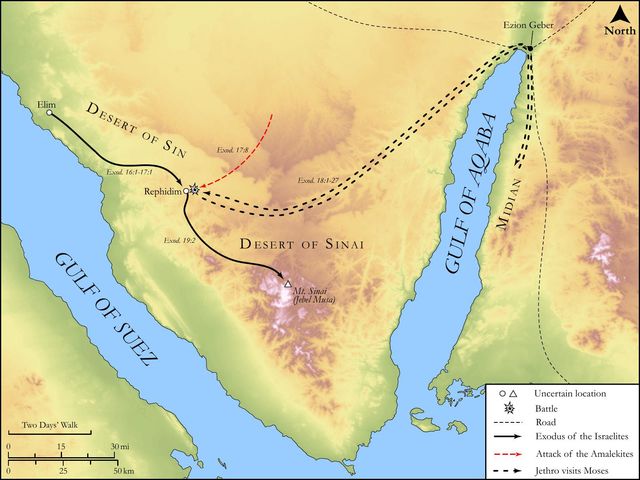
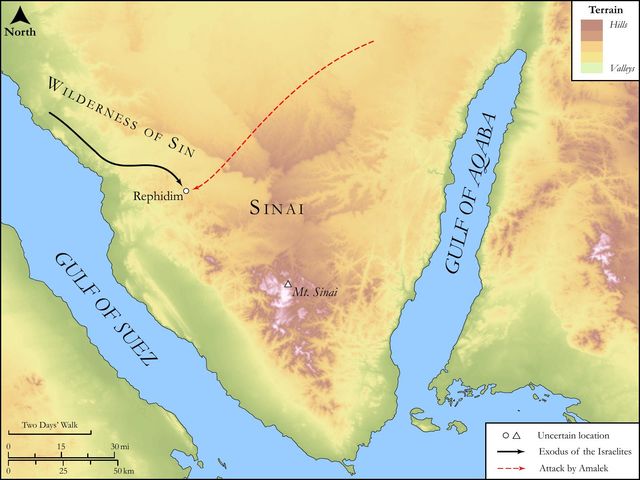
Study this verse
Public-domain commentary
Matthew Henry
From his Commentary on the Whole Bible. Henry comments on passages, not single verses — this entry covers Exodus 17:8–16. His three-level outline is real structure in the source text, so it is rendered as structure.
We have here the story of the war with Amalek, which, we may suppose, was the first that was recorded in the book of the wars of the Lord, Num 21:14. Amalek was the first of the nations that Israel fought with, Num 24:20. Observe,
I.Amalek's attempt:
They came out, and fought with Israel, Exo 17:8. The Amalekites were the posterity of Esau, who hated Jacob because of the birthright and blessing, and this was an effort of the hereditary enmity, a malice that ran in the blood, and perhaps was now exasperated by the working of the promise towards an accomplishment. Consider this,
1.As Israel's affliction. They had been quarrelling with Moses (Exo 17:2), and now God sends Amalekites to quarrel with them; wars abroad are the just punishment of strifes and discontents at home.
2.As Amalek's sin; so it is reckoned, Deu 25:17, Deu 25:18. They did not boldly front them as a generous enemy, but without any provocation given by Israel, or challenge given to them, basely fell upon their rear, and smote those that were faint and feeble and could neither make resistance nor escape. Herein they bade defiance to that power which had so lately ruined the Egyptians; but in vain did they attack a camp guarded and victualled by miracles: verily they knew not what they did.
II.Israel's engagement with Amalek, in their own necessary defence against the aggressors. Observe,
1.The post assigned to Joshua, of whom this is the first mention: he is nominated commander-in-chief in this expedition, that he might be trained up to the services he was designed for after the death of Moses, and be a man of war from his youth. He is ordered to draw out a detachment of choice men from the thousands of Israel and to drive back the Amalekites, Exo 17:9. When the Egyptians pursued them Israel must stand still and see what God would do; but now it was required that they should bestir themselves. Note, God is to be trusted in the use of means.
2.The post assumed by Moses: I will stand on the top of the hill with the rod of God in my hand, Exo 17:9. See how God qualifies his people for, and calls them to, various services for the good of his church: Joshua fights, Moses prays, and both minister to Israel. Moses went up to the top of the hill, and placed himself, probably, so as to be seen by Israel; there he held up the rod of God in his hand, that wonder-working rod which had summoned the plagues of Egypt, and under which Israel had passed out of the house of bondage. This rod Moses held up to Israel, to animate them; the rod was held up as the banner to encourage the soldiers, who might look up, and say, "Yonder is the rod, and yonder the hand that used it, when such glorious things were wrought for us." Note, It tends much to the encouragement of faith to reflect upon the great things God has done for us, and review the monuments of his favours. Moses also held up this rod to God, by way of appeal to him: "Is not the battle the Lord's? Is not he able to help, and engaged to help? Witness this rod, the voice of which, thus held up, is (Isa 51:9, Isa 51:10), Put on strength, O arm of the Lord; art not thou it that hath cut Rahab?" Moses was not only a standard-bearer, but an intercessor, pleading with God for success and victory. Note, When the host goes forth against the enemy earnest prayers should be made to the God of hosts for his presence with them. It is here the praying legion that proves the thundering legion. There, in Salem, in Sion where prayers were made, there the victory was won, there broke the arrows of the bow, Psa 76:2, Psa 76:3. Observe,
(1.)How Moses was tired (Exo 17:12): His hands were heavy. The strongest arm will fail with being long extended; it is God only whose hand is stretched out still. We do not find that Joshua's hands were heavy in fighting, but Moses's hands were heavy in praying. The more spiritual any service is the more apt we are to fail and flag in it. Praying work, if done with due intenseness of mind and vigour of affection, will be found hard work, and, though the spirit be willing, the flesh will be weak. Our great Intercessor in heaven faints not, nor is he weary, though he attends continually to this very thing.
(2.)What influence the rod of Moses had upon the battle (v. 11): When Moses held up his hand in prayer (so the Chaldee explains it) Israel prevailed, but, when he let down his hand from prayer, Amalek prevailed. To convince Israel that the hand of Moses (with whom they had just now been chiding) contributed more to their safety than their own hands, his rod than their sword, the success rises and falls as Moses lifts up or lets down his hands. It seems, the scale wavered for some time, before it turned on Israel's side. Even the best cause must expect disappointments as an alloy to its successes; though the battle be the Lord's, Amalek may prevail for a time. The reason was, Moses let down his hands. Note, The church's cause is, commonly, more or less successful according as the church's friends are more or less strong in faith and fervent in prayer.
(3.)The care that was taken for the support of Moses. When he could not stand any longer he sat down, not in a chair of state, but upon a stone (v. 12); when he could not hold up his hands, he would have them held up. Moses, the man of God, is glad of the assistance of Aaron his brother, and Hur, who, some think, was his brother-in-law, the husband of Miriam. We should not be shy either of asking help from others or giving help to others, for we are members one of another. Moses's hands, thus stayed, were steady till the going down of the sun; and, though it was with much ado that he held out, yet his willing mind was accepted. No doubt it was a great encouragement to the people to see Joshua before them in the field of battle and Moses above them upon the top of the hill: Christ is both to us - our Joshua, the captain of our salvation who fights our battles, and our Moses, who, in the upper world, ever lives making intercession, that our faith fail not.
III.The defeat of Amalek.
Victory had hovered awhile between the camps; sometimes Israel prevailed and sometimes Amalek, but Israel carried the day, v. 13. Though Joshua fought with great disadvantages - his soldiers undisciplined, ill-armed, long inured to servitude, and apt to murmur; yet by them God wrought a great salvation, and made Amalek pay dearly for his insolence. Note, Weapons formed against God's Israel cannot prosper long, and shall be broken at last. The cause of God and his Israel will be victorious. Though God gave the victory, yet it is said, Joshua discomfited Amalek, because Joshua was a type of Christ, and of the same name, and in him it is that we are more than conquerors. It was his arm alone that spoiled principalities and powers, and routed all their force.
IV.The trophies of this victory set up.
1.Moses took care that God should have the glory of it (v. 15); instead of setting up a triumphal arch, to the honour of Joshua (though it had been a laudable policy to put marks of honour upon him), he builds an altar to the honour of God, and we may suppose it was not an altar without sacrifice; but that which is most carefully recorded is the inscription upon the altar, Jehovah-nissi - The Lord is my banner, which probably refers to the lifting up of the rod of God as a banner in this action. The presence and power of Jehovah were the banner under which they enlisted, by which they were animated and kept together, and therefore which they erected in the day of their triumph. In the name of our God we must always lift up our banners, Psa 20:5. It is fit that he who does all the work should have all the praise.
2.God took care that posterity should have the comfort and benefit of it: "Write this for a memorial, not in loose papers, but in a book, write it, and then rehearse it in the ears of Joshua, let him be entrusted with this memorial, to transmit it to the generations to come." Moses must now begin to keep a diary or journal of occurrences; it is the first mention of writing that we find in scripture, and perhaps the command was not given till after the writing of the law upon the tables of stone: "Write it in perpetuam rei memoriam - that the event may be had in perpetual remembrance; that which is written remains." (1.) "Write what has been done, what Amalek has done against Israel; write in gall their bitter hatred, write in blood their cruel attempts, let them never be forgotten, nor yet what God has done for Israel in saving them from Amalek. Let ages to come know that God fights for his people, and he that touches them touches the apple of his eye." (2.) Write what shall be done. [1.] That in process of time Amalek shall be totally ruined and rooted out (Exo 17:14), that he shall be remembered only in history." Amalek would have cut off the name of Israel, that it might be no more in remembrance (Psa 83:4, Psa 83:7); and therefore God not only disappoints him in this, but cuts off his name. "Write it for the encouragement of Israel, whenever the Amalekites are an annoyance to them, that Israel will at last undoubtedly triumph in the fall of Amalek." This sentence was executed in part by Saul (1 Sa. 15), and completely by David (ch. 30; Sa2 1:1; Sa2 8:12); after his time we never read so much as of the name of Amalek. [2.] This is the mean time God would have a continual controversy with him (v. 16): Because his hand is upon the throne of the Lord, that is, against the camp of Israel in which the Lord ruled, which was the place of his sanctuary, and is therefore called a glorious high throne from the beginning (Jer 17:12); therefore the Lord will have war with Amalek from generation to generation. This was written for direction to Israel never to make any league with the Amalekites, but to look upon them as irreconcilable enemies, doomed to ruin. Amalek's destruction was typical of the destruction of all the enemies of Christ and his kingdom. Whoever make war with the Lamb, the Lamb will overcome them.
Continue studying Exodus 17:15 across the web’s major study libraries — every link below opens this exact verse, chapter, or book on the destination site.
Read & Compare
 BibleGatewayThis verse in more than 200 translations and 70 languages.
 Bible.comThe YouVersion reader — hundreds of translations, reading plans, and highlights.
 ESV.orgCrossway's official English Standard Version reader.
 NET BibleThe NET translation with 60,000+ translators' notes on every rendering decision.
 STEP BibleTyndale House's free study tool — original text, vocabulary, and scholarly resources.
 BibliaLogos Bible Software's free web reader.
 USCCBThe New American Bible (Revised Edition) with the U.S. bishops' study notes.
Commentaries
 BibleHub CommentariesDozens of classic commentaries on this verse, gathered on one page.
 StudyLightMore than 100 commentary sets — the largest collection on the web.
 BibleRefPlain-English commentary on what this verse means, verse by verse.
 Enduring WordDavid Guzik's free commentary on this chapter, widely used by Bible teachers.
 Bible Study ToolsVerse commentary alongside Greek and Hebrew study aids.
Original Language & Research
- BibleHub InterlinearThe verse word by word — original language, transliteration, and English.
- BibleHub LexiconEvery word's original-language definition and Strong's entry.
 Blue Letter BibleDeep-study tools — Strong's numbers, concordance, and word studies.
 SefariaThe Hebrew text with Rashi and centuries of Jewish commentary.
Sermons, Hymns & Audio


TrulyRandomVerse is not affiliated with these sites and doesn’t control their content. They’re linked because they’re genuinely useful.
Summary
Moses' construction of an altar and its naming "Jehovahnissi" after Israel's decisive victory over the Amalekites at Rephidim serves as a profound theological declaration. This immediate act of worship memorializes God's active presence and intervention as the sole source of Israel's triumph, signifying Him as their divine banner and rallying standard in battle. It underscores the foundational truth that the Lord Himself fights for His people, providing both protection and the guarantee of victory against formidable foes.
Context
ShowHideLiterary Context
Exodus 17:15 stands near the close of the narrative of Israel's first major military engagement following their exodus from Egypt. Preceding this verse, the account in Exodus 17:8-13 details the unprovoked attack by the Amalekites at Rephidim. The victory hinged not on Israel's military might, but on Moses' intercessory posture, with his hands uplifted, supported by Aaron and Hur. When Moses' hands were up, Israel prevailed; when they dropped, Amalek gained the upper hand. This divine dependency, culminating in Joshua's successful leadership on the battlefield, sets the stage for Moses' immediate response of worship and memorialization, acknowledging God as the true victor and the source of their strength. The subsequent Exodus 17:16 reveals God's perpetual enmity towards Amalek, further emphasizing the spiritual significance of this conflict and the lasting nature of God's commitment to His people.
Historical & Cultural Context
The Amalekites were a nomadic, predatory people, descendants of Esau (as seen in Genesis 36:12), known for their fierce and opportunistic attacks on vulnerable travelers. Their assault on the rear of the weary Israelite camp, targeting the weakest (as noted in Deuteronomy 25:17-18), was a direct challenge to God's covenant people and His protective presence. Among the patriarchs and their descendants, altars were common structures for worship, sacrifice, and commemoration, often built at significant locations to mark divine encounters or major events, as when Jacob built an altar and called it Elelohe-Israel. The naming of a monument or place after a divine attribute or event was also a customary practice, serving as a perpetual reminder of a deity's character or action. Moses' action aligns with these cultural norms, but imbues them with a unique theological significance, declaring the specific character of Yahweh as Israel's "Banner" in a manner that would resonate deeply with a people constantly facing threats in the wilderness.
Key Themes
ShowHideThis verse contributes significantly to several overarching themes within Exodus and the broader Pentateuch. It powerfully illustrates the theme of Divine Sovereignty and Intervention, demonstrating that Israel's success in battle is not a result of human strength or strategy, but solely dependent on God's active presence and power. It also highlights the critical role of Intercession, as Moses' uplifted hands were instrumental in securing the victory, emphasizing the necessity of prayer in spiritual warfare. Furthermore, the naming of the altar "Jehovahnissi" establishes the theme of God as Protector and Warrior, revealing Him as the one who fights for His people against their enemies. This event serves as a foundational moment in Israel's understanding of God's Covenant Faithfulness, reinforcing His commitment to defend and lead His chosen nation through the wilderness, as promised to their forefathers (e.g., Genesis 15:18). It also sets the stage for future encounters and the ongoing spiritual battle against forces hostile to God and His people, a theme that continues through books like Numbers and Deuteronomy.
Exposition and Analysis
ShowHideKey Word Analysis
ShowHideThis primitive root signifies the act of constructing or establishing, both literally and figuratively. In this context, it refers to Moses physically erecting the altar. However, the act of "building" here also carries a theological weight, implying the establishment of a memorial and a place of worship that would endure and signify God's enduring presence and faithfulness.
Derived from a root meaning "to sacrifice," an altar was a sacred structure where offerings were made to God. Its construction immediately after the battle underscores that the victory was a divine act, requiring a response of worship and thanksgiving. It serves as a tangible point of encounter and remembrance, indicating that the place and event were consecrated by God's intervention.
This compound name, meaning "Jehovah (is) my banner," is the theological heart of the verse. "Jehovah" (YHWH) is the personal, covenant name of God, emphasizing His self-existence and faithfulness. "Nissi" (from nes) refers to a banner, standard, or ensign—a rallying point in battle, a symbol of identity, direction, and victory. By naming the altar "Jehovahnissi," Moses declares that God Himself is Israel's true rallying standard, the visible sign of His presence, the source of their courage, and the guarantor of their triumph, not merely in this battle, but for all time.
Verse Breakdown
ShowHide"And Moses built an altar,"
This opening clause describes a foundational act of worship and commemoration. The immediate construction of an altar signifies Israel's recognition that the preceding victory was not by their own might, but by divine intervention. An altar was a sacred space for communion with God, sacrifice, and remembrance, establishing a lasting physical memorial to God's saving power and faithfulness at this specific location.
"and called the name of it Jehovahnissi:"
This second clause is the theological climax of the verse. The naming of the altar "Jehovahnissi" (The LORD is my Banner) encapsulates the profound truth revealed in the battle against Amalek. It is a declarative statement of faith and worship, proclaiming that God Himself was the standard around which Israel rallied, the source of their strength, and the one who secured their victory. This name serves as a perpetual testimony to God's character as the protector, leader, and ultimate deliverer of His people in all forms of warfare.
Literary Devices
ShowHideThe verse employs several significant literary devices. Symbolism is prominent, with the altar serving as a tangible symbol of worship, remembrance, and divine encounter. Its very construction points to the sacred nature of the event and the need to acknowledge God's hand in the victory. The name "Jehovahnissi" itself is a powerful metaphor, portraying God as a "banner" or "standard." This metaphor evokes imagery of a military standard, a rallying point that provides identity, direction, and courage to an army. It implies that God is the visible sign of His presence, the source of victory, and the one around whom His people gather for protection and triumph. Furthermore, the act of naming the altar is a form of commemoration, ensuring that the memory of God's deliverance and His character as "Jehovahnissi" would be preserved and passed down through generations, serving as a perpetual reminder of His faithfulness.
Theological and Thematic Connections
ShowHideExodus 17:15 profoundly reveals God's active involvement in the battles of His people, establishing Him as the ultimate source of victory and protection. The naming of the altar "Jehovahnissi" is a theological declaration that God Himself is the "Banner" around which His people rally, signifying His leadership, presence, and the guarantee of triumph. This concept extends beyond physical warfare to encompass all forms of spiritual and personal struggle, teaching believers to look to the Lord as their standard and refuge. It also highlights the importance of worship and remembrance as appropriate responses to divine deliverance, ensuring that God's faithfulness is not forgotten but celebrated and passed on.
Reflection and Application
ShowHideThe declaration "Jehovahnissi" resonates deeply with believers today, offering profound insights into God's unchanging character and our posture of faith. In a world fraught with challenges—be they spiritual battles, personal struggles, or societal pressures—this verse calls us to remember where our true strength and victory lie. We are not to rely on our own might, wisdom, or resources, but to rally around the Lord, acknowledging Him as our supreme standard and the one who fights on our behalf. Just as Moses built a physical altar of remembrance, we are called to establish "altars" in our lives—practices of worship, gratitude, and intentional reflection—that remind us of God's past faithfulness and strengthen our trust for future trials. This name encourages us to live in a posture of dependence, knowing that when we face daunting opposition, we can confidently declare, "The LORD is my Banner," and find our identity, protection, and ultimate triumph in Him alone.
Questions for Reflection
ShowHideFAQ
ShowHideWhat is the significance of Moses building an altar after the battle?
ShowHideThe building of the altar by Moses immediately after the victory over the Amalekites in Exodus 17:8-13 was an act of profound worship and commemoration. In ancient Israelite practice, altars were places of sacrifice and encounter with God. By building this altar, Moses was not merely creating a monument to a military success, but rather acknowledging that the victory was entirely God's doing. It served as a tangible, lasting memorial to God's intervention, power, and faithfulness on behalf of His people, ensuring that future generations would remember that it was the Lord who fought for them, not their own strength or strategy. It marked the place as sacred, consecrated by God's saving action.
Does the name "Jehovahnissi" appear elsewhere in the Bible?
ShowHideThe specific compound name "Jehovahnissi" (or Yahweh Nissi) only appears once in the Bible, in Exodus 17:15. However, the underlying concept of God as a "banner," "standard," or "refuge" is a recurring theme throughout Scripture. For example, Psalm 60:4 speaks of God giving a banner to those who fear Him. The prophet Isaiah frequently refers to the Messiah as an "ensign" or "banner" for the nations, indicating His role as a rallying point for all peoples (e.g., Isaiah 11:10 and Isaiah 49:22). This demonstrates that while the precise name is unique to this event, the theological truth it conveys is foundational and pervasive throughout biblical revelation.
Why was the victory over Amalek so significant that it warranted this special naming?
ShowHideThe victory over Amalek was profoundly significant for several reasons, warranting the special naming of the altar. Firstly, it was Israel's first major military engagement as a free nation, an unprovoked attack on their vulnerable rear (as noted in Deuteronomy 25:17-18). The manner of the victory, dependent on Moses' uplifted hands and divine intervention, clearly demonstrated that God was actively fighting for His people. This established a critical precedent for Israel's wilderness journey and future conquests, teaching them that their success relied entirely on God's presence and power. Furthermore, God declared perpetual war against Amalek (Exodus 17:16), signifying Amalek as a symbol of spiritual opposition to God's people throughout history. Thus, "Jehovahnissi" became a foundational statement about God's character as the divine warrior and protector against all spiritual enemies.
Christ-Centered Fulfillment
ShowHideThe altar named "Jehovahnissi" in Exodus 17:15 powerfully foreshadows the ultimate "Banner" for humanity in Jesus Christ. Just as the standard of "Jehovahnissi" rallied Israel to victory against a formidable foe, Christ is the divine standard around whom all believers gather for salvation and triumph over sin, death, and the devil. His cross, lifted up on Calvary, serves as the ultimate banner, drawing all people to Himself, as He declared in John 12:32. He is our true rallying point, the one who fights our spiritual battles and guarantees our victory, not through human strength, but through His perfect sacrifice and resurrection, triumphing over principalities and powers in Colossians 2:15. In Christ, we find our identity, our protection, and our eternal hope. He is the "Root of Jesse" who stands as an "ensign for the peoples," fulfilling the ancient prophecy in Isaiah 11:10, and inviting all nations to find refuge and victory under His sovereign rule. Our worship and remembrance, like Moses' altar, are now directed to Him, recognizing Him as our conquering Lord, our ever-present help, and the Lamb of God who takes away the sin of the world.