


Genesis 33:20
- וַיַּצֶּבvai·ya·tzevand he set upH5324Conj-w ¦ V-Hiphil-ConsecImperf-3msVerb Hiphil Consecutive Imperfect 3rd Singular Masculineוַandיַּצֶּבhe set up
- שָׁםshamthereH8033AdvAdverb
- מִזְבֵּחַmiz·Be·achan altarH4196N-msNoun Singular Masculine Absolute
- וַיִּקְרָאvai·Yik·ra'and he calledH7121Conj-w ¦ V-Qal-ConsecImperf-3msVerb Qal Consecutive Imperfect 3rd Singular Masculineוַandיִּקְרָאhe called
- לוֹlo<to> <the> itPrep-l ¦ 3msSuffix Personal 3rd Singular Masculineל<to> <the>וֹit
- אֵל'elElH410N-mscNoun Singular Masculine Construct
- אֱלֹהֵי'e·lo·HeiEloheH430N-mpcNoun Plural Masculine Construct
- יִשְׂרָאֵלYis·ra·'ElIsraelH3290N-properNoun Proper Location
English is a literal word-by-word gloss of the Hebrew, not the KJV's wording. Why?
This is the original text the KJV's translators worked from — each Hebrew word with its own literal English meaning in this verse, prepared by scholars at Tyndale House, Cambridge. The KJV translates whole sentences, not word by word, so its wording differs: one Hebrew word can become several English words, and the KJV may choose “the LORD” where the gloss reads “Yahweh”. Both are faithful — they answer different questions. For the KJV's own rendering, switch to the KJV text.
Details
See on the biblical-era map


Study this verse
Public-domain commentary
Matthew Henry
From his Commentary on the Whole Bible. Henry comments on passages, not single verses — this entry covers Genesis 33:16–20.
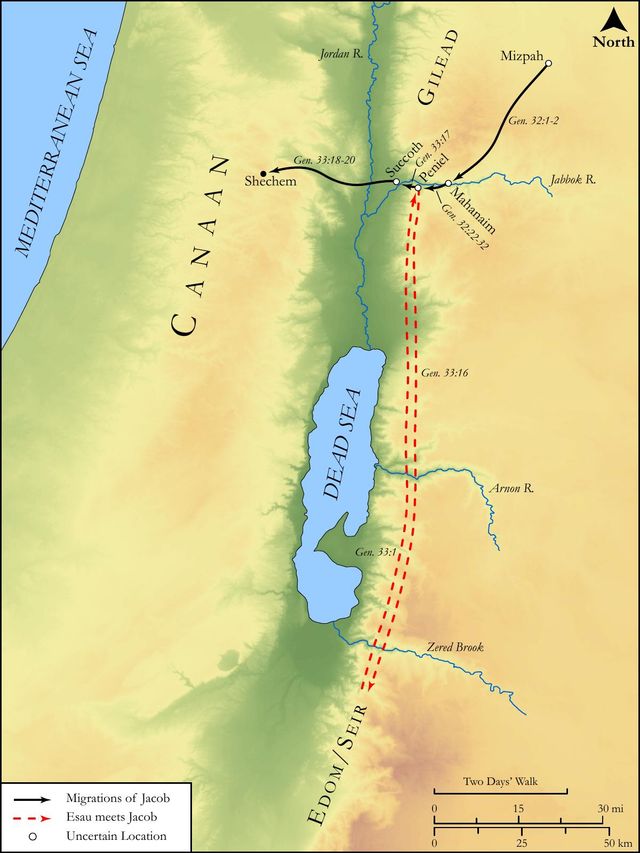
Here, 1. Jacob comes to Succoth. Having in a friendly manner parted with Esau, who had gone to his own country (Gen 33:16), he comes to a place where, it should seem, he rested for some time, set up booths for his cattle, and other conveniences for himself and family. The place was afterwards known by the name of Succoth, a city in the tribe of Gad, on the other side Jordan (it signifies booths), that when his posterity afterwards dwelt in houses of stone, they might remember that the Syrian ready to perish was their father, who was glad of booths (Deu 26:5); such was the rock whence they were hewn. 2. He comes to Shechem; we read it, to Shalem, a city of Shechem; the critics generally incline to read it appellatively: he came safely, or in peace, to the city of Shechem. After a perilous journey, in which he had met with many difficulties, he came safely, at last, into Canaan. Note, Diseases and dangers should teach us how to value health and safety, and should help to enlarge our hearts in thankfulness, when our going out and coming in have been signally preserved. Here, (1.) He buys a field, Gen 33:19. Though the land of Canaan was his by promise, yet, the time for taking possession not having yet come, he is content to pay for his own, to prevent disputes with the present occupants. Note, Dominion is not founded in grace. Those that have heaven on free-cost must not expect to have earth so. (2.) He builds an altar, Gen 33:20. [1.] In thankfulness to God, for the good hand of his providence over him. He did not content himself with verbal acknowledgments of God's favour to him, but made real ones: [2.] That he might keep up religion, and the worship of God, in his family. Note, Where we have a tent God must have an altar, where we have a house he must have a church in it. He dedicated this altar, where we have a house he must have a church in it. He dedicated this altar to the honour of El-elohe-Israel - God, the God of Israel, to the honour of God, in general, the only living and true God, the best of beings and first of causes; and to the honour of the God of Israel, as a God in covenant with him. Note, In our worship of God we must be guided and governed by the joint-discoveries both of natural and revealed religion. God had lately called him by the name of Israel, and now he calls God the God of Israel; though he is styled a prince with God, God shall still be a prince with him, his Lord and his God. Note, Our honours then become honours indeed to us when they are consecrated to God's honour; Israel's God is Israel's glory.
Continue studying Genesis 33:20 across the web’s major study libraries — every link below opens this exact verse, chapter, or book on the destination site.
Read & Compare
 BibleGatewayThis verse in more than 200 translations and 70 languages.
 Bible.comThe YouVersion reader — hundreds of translations, reading plans, and highlights.
 ESV.orgCrossway's official English Standard Version reader.
 NET BibleThe NET translation with 60,000+ translators' notes on every rendering decision.
 STEP BibleTyndale House's free study tool — original text, vocabulary, and scholarly resources.
 BibliaLogos Bible Software's free web reader.
 USCCBThe New American Bible (Revised Edition) with the U.S. bishops' study notes.
Commentaries
 BibleHub CommentariesDozens of classic commentaries on this verse, gathered on one page.
 StudyLightMore than 100 commentary sets — the largest collection on the web.
 BibleRefPlain-English commentary on what this verse means, verse by verse.
 Enduring WordDavid Guzik's free commentary on this chapter, widely used by Bible teachers.
 Bible Study ToolsVerse commentary alongside Greek and Hebrew study aids.
Original Language & Research
- BibleHub InterlinearThe verse word by word — original language, transliteration, and English.
- BibleHub LexiconEvery word's original-language definition and Strong's entry.
 Blue Letter BibleDeep-study tools — Strong's numbers, concordance, and word studies.
 SefariaThe Hebrew text with Rashi and centuries of Jewish commentary.
Sermons, Hymns & Audio


TrulyRandomVerse is not affiliated with these sites and doesn’t control their content. They’re linked because they’re genuinely useful.
Summary
Following his transformative encounter with God and the peaceful reconciliation with his brother Esau, Jacob settles in the land of Canaan, near the city of Shechem. There, he erects a significant altar and dedicates it "Elelohe-Israel," a profound declaration meaning "God, the God of Israel." This act serves as a public testament to his renewed faith, deep gratitude for divine protection and faithfulness, and a full embrace of his divinely bestowed new identity, solidifying his commitment to the covenant God of his ancestors.
Context
ShowHideLiterary Context
Genesis 33:20 concludes a pivotal chapter in Jacob's life, marking a significant transition from a period of fear and uncertainty to one of peace and settlement. Immediately preceding this verse is the long-feared, yet ultimately peaceful, reunion between Jacob and his estranged brother Esau, a reconciliation that defied Jacob's expectations of retribution. This reunion was itself a direct outcome of Jacob's profound all-night wrestling match with God at Peniel in Genesis 32, where his name was miraculously changed from Jacob ("supplanter") to Israel ("he struggles with God" or "prince with God"). Having navigated these intensely personal and spiritual challenges, Jacob's act of building an altar signifies a moment of stability, thanksgiving, and public worship, establishing his presence in the land promised to his forefathers and acknowledging God's faithfulness throughout his arduous journey.
Historical & Cultural Context
In the ancient Near East, the erection of altars was a common practice for patriarchs like Abraham, Isaac, and Jacob, serving multiple purposes. These structures were typically built at significant locations where a divine encounter occurred, a covenant was made, or a major journey concluded. They functioned as places for offering sacrifices, engaging in prayer, and commemorating God's presence and intervention. By purchasing a plot of land near Shechem (which would later become a significant tribal center for Israel, as seen in Joshua 24), Jacob was not merely settling but also establishing a legal and spiritual foothold in the promised land, asserting his claim and dedicating it to the God of his covenant. This act was a public declaration of his allegiance to Yahweh, distinguishing his worship from the surrounding pagan practices of the Canaanites.
Key Themes
ShowHideGenesis 33:20 powerfully contributes to several overarching themes within the book of Genesis and the broader biblical narrative. It underscores the theme of God's Covenant Faithfulness, demonstrating how God fulfills His promises to Jacob, bringing him safely back to Canaan as declared in Genesis 28:15. The naming of the altar "Elelohe-Israel" highlights the theme of Transformation and Identity, emphasizing Jacob's embrace of his new name and the profound shift in his relationship with God, moving from a self-reliant schemer to "Israel," one who struggles with and prevails with God. Furthermore, the act of building an altar signifies Public Worship and Witness, establishing a pattern of acknowledging God's sovereignty and goodness in a tangible way before others, a practice foundational to the nascent nation of Israel. This act also reinforces the theme of God's Personal and Relational Nature, as Jacob specifically names God as "the God of Israel," emphasizing a unique, intimate bond.
Exposition and Analysis
ShowHideJacob's construction of an altar and its subsequent naming in Genesis 33:20 is a profoundly significant act of worship, marking a pivotal moment in his spiritual journey and the unfolding narrative of God's covenant people. This is not merely an architectural endeavor but a deeply symbolic and theological statement.
Key Word Analysis
ShowHideThis verb signifies "to station, to set up, to establish." In this context, it implies a deliberate and purposeful act of setting up something permanent or significant. Jacob is not just casually placing stones; he is establishing a lasting monument to God's faithfulness and his own commitment. This word emphasizes the intentionality and foundational nature of Jacob's act of worship, marking a new phase of his life rooted in God's presence.
Derived from a root meaning "to sacrifice," an altar is a consecrated place for offering sacrifices to God. In the patriarchal period, altars were often built at sites of divine revelation or significant events, serving as memorials and places of communion with God. For Jacob, this altar represents a tangible expression of gratitude, a place for worship, and a public acknowledgment of God's deliverance and covenant faithfulness, especially after his reconciliation with Esau and safe return to Canaan.
This composite Hebrew phrase translates to "God, the God of Israel" or "El, the God of Israel." It combines "El" (a general term for God, emphasizing power and transcendence), "Elohe" (the construct form of "Elohim," meaning "God of"), and "Israel" (Jacob's divinely bestowed new name). This name is a theological declaration, affirming that the God Jacob worships is not a generic deity but the specific, personal, and covenant-keeping God who transformed him and is uniquely bound to the people who will bear his new name. It distinguishes Yahweh from the pagan gods of the surrounding cultures and solidifies Jacob's embrace of his new identity.
Verse Breakdown
ShowHide"And he erected there an altar"
This clause describes Jacob's physical act of building a structure for worship. The location "there" refers to the land he purchased near Shechem, signifying his intention to settle and establish a presence in the promised land. The erection of an altar, a common practice among the patriarchs, was a foundational act of worship, a public declaration of faith, and a memorial to God's faithfulness and presence in his life, particularly after the profound experiences of Peniel and the reunion with Esau.
"and called it Elelohe-Israel"
This second clause reveals the profound spiritual significance of Jacob's act. The naming of the altar is a theological statement, not merely a label. "Elelohe-Israel" means "God, the God of Israel." By giving the altar this name, Jacob publicly affirms that the God he serves is the unique and sovereign God who has entered into a personal covenant relationship with him, transforming his identity from "Jacob" (the supplanter) to "Israel" (the one who strives with God). It is a testament to God's specific and personal relationship with His chosen people, distinguishing Him from all other deities.
Literary Devices
ShowHideThe verse primarily employs Symbolism and Naming. The altar itself is a powerful symbol. It is not merely a pile of stones but a physical representation of Jacob's renewed commitment to God, his gratitude for divine protection, and a public declaration of his faith. It symbolizes a meeting place between humanity and the divine, a site of sacrifice, prayer, and remembrance. The act of Naming the altar "Elelohe-Israel" is also highly symbolic and significant. Names in the ancient world carried deep meaning, often reflecting character, destiny, or a defining event. By naming the altar after his new identity ("Israel") and associating it directly with God ("Elelohe"), Jacob symbolically links his transformed self to the God who transformed him, making a public, enduring statement about his allegiance and the unique nature of his God. This naming serves as a theological marker, distinguishing the God of Jacob from all other gods.
THEOLOGICAL AND THEMATIC CONNECTIONS
ShowHideGenesis 33:20 stands as a powerful testament to God's enduring covenant faithfulness and the transformative power of a genuine encounter with the Divine. Jacob's act of building and naming the altar is a profound response to God's grace and protection, marking a pivotal moment where his new identity as "Israel" is publicly affirmed and consecrated. This action underscores that true worship flows from a heart transformed by God's presence and a life lived in conscious acknowledgment of His sovereignty and unique relationship with His people. It sets a precedent for the nation of Israel, emphasizing that their identity and purpose are intrinsically linked to "God, the God of Israel."
Reflection and Application
ShowHideJacob's act in Genesis 33:20 offers profound lessons for contemporary believers. Just as Jacob erected a physical altar as a memorial to God's faithfulness and a declaration of his transformed identity, we are called to build "spiritual altars" in our lives. These altars are not made of stone but of intentional acts of worship, gratitude, and public witness to God's goodness. After navigating our own "Peniels" – seasons of wrestling with God, fear, or reconciliation – our response should be one of profound thanksgiving and renewed commitment. Embracing our new identity in Christ means living as "new creations," publicly acknowledging Him as "God, our God," and allowing our lives to be a testament to His transformative power. This involves cultivating a lifestyle of worship, remembering His past faithfulness, and confidently declaring His sovereignty in all circumstances, thereby creating enduring spiritual memorials that remind us and others of His unwavering presence and grace.
Questions for Reflection
ShowHideFAQ
ShowHideWhy did Jacob build an altar specifically at Shechem?
ShowHideJacob built the altar at Shechem because it was the first significant place he settled after his return to the land of Canaan and his peaceful reconciliation with Esau. This marked a crucial moment of stability and peace after years of wandering and fear. By purchasing a plot of land from the sons of Hamor, Jacob established a legal foothold in the promised land, demonstrating his intention to settle and honor God there. The altar served as a public declaration of his faith and a consecration of the land to the God of his covenant, setting a precedent for future Israelite presence in this historically significant area, as later seen in Joshua 24.
What is the significance of the name "Elelohe-Israel"?
ShowHide"Elelohe-Israel" is a profound theological statement meaning "God, the God of Israel." Its significance lies in Jacob's public declaration that the God he worships is not a generic deity but the one true God who personally entered into a covenant relationship with him. This name explicitly links God to Jacob's divinely bestowed new identity as "Israel," signifying that his very being and the future nation that would bear his name are defined by their unique relationship with this specific, covenant-keeping God. It distinguishes Yahweh from the pagan deities of the surrounding cultures and affirms the intimate, personal bond between God and His chosen people.
Does this altar imply a permanent settlement for Jacob?
ShowHideWhile Jacob's act of purchasing land and building an altar at Shechem certainly indicated an intention to settle and establish a presence, his time there was not entirely permanent or without future challenges. The biblical narrative later records difficulties with the inhabitants of Shechem (as detailed in Genesis 34), which ultimately led Jacob to move on to Bethel and eventually Hebron. Nevertheless, the altar at Shechem marked a significant, foundational act of worship and commitment to the land and God's covenant, even if his stay was not lifelong. It was a crucial step in his journey back to the heartland of the promised land.
Christ-Centered Fulfillment
ShowHideGenesis 33:20, with Jacob's transformed identity and his dedication of an altar to "God, the God of Israel," powerfully foreshadows the person and work of Jesus Christ. Jacob's change from "supplanter" to "Israel" prefigures the radical new identity believers receive through Christ, where we are no longer defined by our old sinful nature but by our union with Him, becoming "new creations" (as described in 2 Corinthians 5:17). Just as Jacob erected an altar as a declaration of a personal covenant relationship with the God of Israel, Christ is the ultimate fulfillment of that covenant. He is the true and living "Altar" (as hinted in Hebrews 13:10) upon whom the perfect and final sacrifice for sin was made. Through His atoning work on the cross, we gain access to God as our personal Father (as taught in Romans 5:1-2), enabling us to offer spiritual sacrifices of worship and praise (as encouraged in 1 Peter 2:5), acknowledging Him as "God, our God." Christ establishes a new, eternal covenant relationship, not based on human works or animal sacrifices, but on His grace and perfect obedience, making us truly "Israel," the people of God, by faith in Him (as explained in Galatians 3:29).