


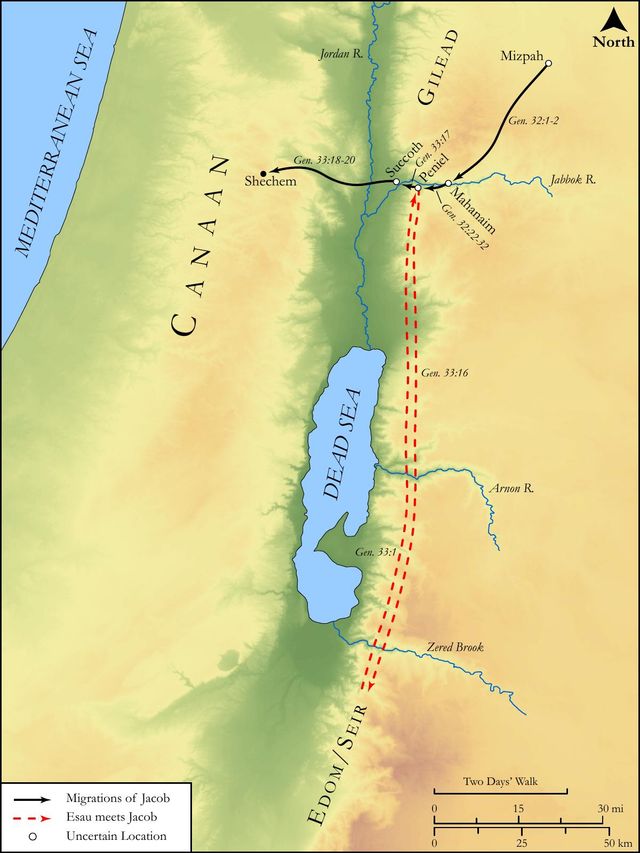
Genesis 33:16
Bible text: King James Version (1769 Blayney text) · Public domain
Bible text: Berean Standard Bible · Public domain
Bible text: American Standard Version (1901) · Public domain
Bible text: World English Bible, Messianic edition · Public domain
Bible text: Geneva Bible (1599) · Public domain
Bible text: Young's Literal Translation · Public domain
- וַיָּשָׁבvai·ya·Shavand he returnedH7725Conj-w ¦ V-Qal-ConsecImperf-3msVerb Qal Consecutive Imperfect 3rd Singular Masculineוַandיָּשָׁבhe returned
- בַּיּוֹםbai·Yomon the dayH3117Prep-b ¦ N-msNoun Singular Masculine Absoluteבַּon theיּוֹםday
- הַהוּאha·Hu'<the> thatH1931Art ¦ Pro-3msPronoun Personal 3rd Singular Masculineהַ<the>הוּאthat
- עֵשָׂו'e·SavEsauH6215N-proper-mNoun Proper Masculine
- לְדַרְכּוֹle·dar·Koto his wayH1870Prep-l ¦ N-csc ¦ 3msNoun Singular common gender Constructלְtoדַרְכּwayוֹhis
- שֵׂעִירָהse·'I·rahSeir towardsH8165N-proper ¦ SfxNoun Proper LocationשֵׂעִירָSeirהtowards
English is a literal word-by-word gloss of the Hebrew, not the KJV's wording. Why?
This is the original text the KJV's translators worked from — each Hebrew word with its own literal English meaning in this verse, prepared by scholars at Tyndale House, Cambridge. The KJV translates whole sentences, not word by word, so its wording differs: one Hebrew word can become several English words, and the KJV may choose “the LORD” where the gloss reads “Yahweh”. Both are faithful — they answer different questions. For the KJV's own rendering, switch to the KJV text.
Details
See on the biblical-era maps


Study this verse
Public-domain commentary
Matthew Henry
From his Commentary on the Whole Bible. Henry comments on passages, not single verses — this entry covers Genesis 33:16–20.
Here, 1. Jacob comes to Succoth. Having in a friendly manner parted with Esau, who had gone to his own country (Gen 33:16), he comes to a place where, it should seem, he rested for some time, set up booths for his cattle, and other conveniences for himself and family. The place was afterwards known by the name of Succoth, a city in the tribe of Gad, on the other side Jordan (it signifies booths), that when his posterity afterwards dwelt in houses of stone, they might remember that the Syrian ready to perish was their father, who was glad of booths (Deu 26:5); such was the rock whence they were hewn. 2. He comes to Shechem; we read it, to Shalem, a city of Shechem; the critics generally incline to read it appellatively: he came safely, or in peace, to the city of Shechem. After a perilous journey, in which he had met with many difficulties, he came safely, at last, into Canaan. Note, Diseases and dangers should teach us how to value health and safety, and should help to enlarge our hearts in thankfulness, when our going out and coming in have been signally preserved. Here, (1.) He buys a field, Gen 33:19. Though the land of Canaan was his by promise, yet, the time for taking possession not having yet come, he is content to pay for his own, to prevent disputes with the present occupants. Note, Dominion is not founded in grace. Those that have heaven on free-cost must not expect to have earth so. (2.) He builds an altar, Gen 33:20. [1.] In thankfulness to God, for the good hand of his providence over him. He did not content himself with verbal acknowledgments of God's favour to him, but made real ones: [2.] That he might keep up religion, and the worship of God, in his family. Note, Where we have a tent God must have an altar, where we have a house he must have a church in it. He dedicated this altar, where we have a house he must have a church in it. He dedicated this altar to the honour of El-elohe-Israel - God, the God of Israel, to the honour of God, in general, the only living and true God, the best of beings and first of causes; and to the honour of the God of Israel, as a God in covenant with him. Note, In our worship of God we must be guided and governed by the joint-discoveries both of natural and revealed religion. God had lately called him by the name of Israel, and now he calls God the God of Israel; though he is styled a prince with God, God shall still be a prince with him, his Lord and his God. Note, Our honours then become honours indeed to us when they are consecrated to God's honour; Israel's God is Israel's glory.
Continue studying Genesis 33:16 across the web’s major study libraries — every link below opens this exact verse, chapter, or book on the destination site.
Read & Compare
 BibleGatewayThis verse in more than 200 translations and 70 languages.
 Bible.comThe YouVersion reader — hundreds of translations, reading plans, and highlights.
 ESV.orgCrossway's official English Standard Version reader.
 NET BibleThe NET translation with 60,000+ translators' notes on every rendering decision.
 STEP BibleTyndale House's free study tool — original text, vocabulary, and scholarly resources.
 BibliaLogos Bible Software's free web reader.
 USCCBThe New American Bible (Revised Edition) with the U.S. bishops' study notes.
Commentaries
 BibleHub CommentariesDozens of classic commentaries on this verse, gathered on one page.
 StudyLightMore than 100 commentary sets — the largest collection on the web.
 BibleRefPlain-English commentary on what this verse means, verse by verse.
 Enduring WordDavid Guzik's free commentary on this chapter, widely used by Bible teachers.
 Bible Study ToolsVerse commentary alongside Greek and Hebrew study aids.
Original Language & Research
- BibleHub InterlinearThe verse word by word — original language, transliteration, and English.
- BibleHub LexiconEvery word's original-language definition and Strong's entry.
 Blue Letter BibleDeep-study tools — Strong's numbers, concordance, and word studies.
 SefariaThe Hebrew text with Rashi and centuries of Jewish commentary.
Sermons, Hymns & Audio


TrulyRandomVerse is not affiliated with these sites and doesn’t control their content. They’re linked because they’re genuinely useful.
Summary
Genesis 33:16 provides the quiet yet profoundly significant conclusion to the highly anticipated and potentially volatile reunion between Jacob and Esau. Following two decades of separation marked by Jacob's deep-seated fear and Esau's initial wrath, this verse definitively confirms Esau's peaceful departure. It signals that the reconciliation was genuine, complete, and that both brothers were now free to pursue their distinct, divinely appointed paths, marking a pivotal moment of resolved conflict in the patriarchal narrative.
Context
ShowHideLiterary Context
This verse serves as the narrative's resolution to the dramatic and long-standing conflict between Jacob and Esau, which began even before their birth with the prophecy of two nations from Rebekah's womb Genesis 25:23. The immediate preceding chapters detail Jacob's elaborate preparations and profound fear as he anticipated meeting his brother, whom he had wronged by deceiving Isaac for the birthright and blessing. Jacob's desperate prayer for deliverance Genesis 32:9-12 and his strategic sending of gifts Genesis 32:13-21 underscore the immense tension. The actual meeting, however, defied all expectations, transforming into a tearful embrace and a demonstration of Esau's unexpected grace and forgiveness Genesis 33:4. Verse 16, therefore, solidifies this reconciliation, showing Esau's peaceful return to his own territory, thus allowing Jacob to continue his journey toward Canaan unhindered and without lingering animosity.
Historical & Cultural Context
The patriarchal period in which this event occurs placed immense value on birthright and blessing, making Jacob's actions against Esau particularly egregious. Feuds over such matters could last generations and often resulted in bloodshed. The custom of a larger entourage, such as Esau's 400 men, could signify either a formidable military force or a retinue befitting a powerful chieftain, adding to Jacob's apprehension. The exchange of gifts (minḥah) was a common diplomatic practice, often intended to appease or secure favor, which Jacob employed. Esau's rejection of the gifts initially, then his acceptance, symbolized his genuine forgiveness and the restoration of peace, negating the need for appeasement. The separate dwelling places, with Esau returning to Seir (Edom) and Jacob continuing to Canaan, reflects the patriarchal practice of distinct tribal territories, foreshadowing the development of two separate nations, Edom and Israel, from these brothers.
Key Themes
ShowHideThe verse contributes significantly to several overarching themes within Genesis and the broader biblical narrative. Foremost is the theme of Reconciliation and Forgiveness, demonstrating God's capacity to transform hearts and mend broken relationships, even those deeply fractured by past wrongs. It powerfully illustrates Divine Providence, as God sovereignly intervened in Esau's heart, turning potential wrath into compassion, thereby answering Jacob's desperate prayers and fulfilling His covenant promises to protect Jacob Genesis 28:15. Furthermore, the peaceful parting underscores the theme of Separate Destinies, as Esau returns to his designated land of Seir, the future home of Edom Genesis 36:8, while Jacob continues his journey towards Canaan, the land promised to his descendants, the Israelites. This separation allows each brother's divinely ordained lineage and national identity to unfold independently, fulfilling the prophecy given to Rebekah in [Genesis 25-23 "Prophecy of Two Nations"].
Exposition and Analysis
ShowHideThe KJV rendering of Genesis 33:16, "¶ So Esau returned that day on his way unto Seir," is concise yet carries profound narrative and theological weight. The paragraph mark (¶) often found in older translations like the KJV, indicates a new narrative segment or a significant shift in focus, here signaling the definitive conclusion of the reunion and the commencement of separate journeys for the brothers. The Hebrew text is straightforward, emphasizing the finality of Esau's action.
Key Word Analysis
ShowHideThis primitive root signifies "to turn back," "to retreat," or "to go back." In this context, it emphasizes Esau's physical departure from Jacob's presence and his return to his own territory. It conveys a sense of finality to the encounter, indicating that the reconciliation was complete and there was no lingering reason for him to remain with Jacob or pursue him further. The verb choice subtly reinforces the idea of a resolved situation, allowing for separate, peaceful paths.
Derived from a root meaning "to be hot," this word refers to a literal day (sunrise to sunset) or a defined period. The phrase "that day" highlights the immediacy of Esau's departure after the reunion. It underscores that the reconciliation was not a drawn-out process but a decisive event, and the brothers' paths diverged promptly, preventing any potential for renewed tension or entanglement. This immediacy contributes to the sense of closure.
From a root meaning "to tread," this word denotes a "road," "path," or "journey." Figuratively, it can also refer to a "course of life" or "mode of action." Here, it literally describes Esau's physical route back to Seir. However, it also carries the metaphorical implication of distinct "ways" or "paths of life" for the two brothers. Their physical separation on their respective "ways" symbolizes their divergent destinies and the establishment of two separate nations.
Verse Breakdown
ShowHide"¶ So Esau returned that day"
This clause marks the immediate and definitive end of the direct interaction between Jacob and Esau. The "¶" (paragraph mark) visually separates this action as a distinct narrative development, signaling the resolution of the intense suspense surrounding their meeting. Esau's "return" signifies his acceptance of the reconciliation and his decision to depart peacefully, rather than lingering or pursuing any further claim against Jacob. The phrase "that day" emphasizes the swiftness of this resolution, highlighting that the emotional reunion was followed by an immediate and clear establishment of separate paths.
"on his way unto Seir"
This specifies Esau's destination and reinforces the theme of distinct territories and destinies. Seir was the region where Esau and his descendants, the Edomites, would settle and establish their nation. This peaceful departure to his own land confirms that the animosity has genuinely dissipated, allowing both brothers to move forward without lingering fear or resentment. It underscores the divinely ordained separation of their lineages, as Jacob would continue his journey towards Canaan, the promised land for his descendants, Israel.
Literary Devices
ShowHideThe verse employs Conciseness and Understatement to convey a profound outcome. Despite the immense build-up and Jacob's deep fear, the resolution of the conflict is presented with remarkable brevity, a single sentence encapsulating Esau's departure. This understatement allows the reader to appreciate the depth of the reconciliation without overly dramatic prose. The phrase "that day" functions as a Temporal Marker, emphasizing the immediacy and finality of the separation. Furthermore, the verse serves as a Narrative Fulcrum, pivoting the story from the intense personal drama of the brothers' reunion to the unfolding of their distinct national destinies, subtly foreshadowing the future nations of Israel and Edom.
Theological and Thematic Connections
ShowHideGenesis 33:16 serves as a powerful testament to the transformative power of divine grace and human reconciliation. It portrays a resolution that defied all human expectation, turning a potentially violent encounter into a moment of profound peace. This peaceful parting underscores God's sovereign ability to soften hearts and direct human affairs, demonstrating that His purposes will prevail even amidst human sin and conflict. The verse also subtly reinforces the theme of distinct covenantal paths, as Esau returns to his land, while Jacob continues his journey towards the land of promise, securing the lineage through which God's redemptive plan would unfold.
Reflection and Application
ShowHideGenesis 33:16 offers profound lessons for believers today, particularly concerning the transformative power of forgiveness and the importance of healthy boundaries in relationships. Jacob's experience reminds us that even when facing the daunting consequences of our past mistakes or deep-seated fears, God can intervene in miraculous ways to bring about peaceful resolutions beyond our imagination. This encourages us to trust in His sovereign providence and to approach difficult reconciliations with humility and prayer, rather than despair. Furthermore, the peaceful parting of Jacob and Esau, despite their reconciliation, illustrates the wisdom of respecting separate paths and establishing healthy boundaries, even within restored relationships. This allows each individual to pursue their God-given direction and purpose without entanglement or renewed conflict, fostering long-term peace and mutual respect. We are called to be peacemakers, seeking reconciliation where possible, but also recognizing when distinct paths are necessary for the flourishing of all parties involved.
Questions for Reflection
ShowHideFAQ
ShowHideWhy is Esau's return to Seir significant for the narrative?
ShowHideEsau's return to Seir is profoundly significant because it confirms the finality and sincerity of the reconciliation between the brothers, bringing a peaceful resolution to decades of animosity. It also underscores their distinct, divinely ordained paths. By returning to Seir, Esau establishes his lineage in Edom, a separate nation, fulfilling the prophecy of two nations from Rebekah's womb Genesis 25:23. This peaceful separation allows the narrative of God's covenant with Jacob (Israel) to unfold without the ongoing threat or entanglement of his relationship with Esau, ensuring that the focus remains on the development of the chosen nation through whom the Messiah would come.
Christ-Centered Fulfillment
ShowHideThe reconciliation between Jacob and Esau, culminating in Esau's peaceful departure in Genesis 33:16, serves as a powerful type and shadow of the ultimate reconciliation offered through Jesus Christ. Just as God sovereignly turned Esau's heart from wrath to grace, overriding Jacob's deepest fears, Christ's atoning work on the cross turns God's righteous wrath away from humanity, offering forgiveness and peace to those who were once estranged and hostile to Him Romans 5:10. Through Christ, we who were once enemies of God are now reconciled and brought near by His blood Ephesians 2:13. While Jacob and Esau's separation marked distinct earthly destinies, Christ's work establishes a new spiritual family, reconciling believers not only to God but also to one another, transcending all earthly divisions of race, social status, or past animosity Galatians 3:28. He is the ultimate peacemaker, fulfilling the promise of a new covenant where former enemies become brothers and sisters in the truest sense, united in Him and walking together on the "way" of salvation John 14:6.