


Genesis 33:4
Bible text: King James Version (1769 Blayney text) · Public domain
Bible text: Berean Standard Bible · Public domain
Bible text: American Standard Version (1901) · Public domain
Bible text: World English Bible, Messianic edition · Public domain
Bible text: Geneva Bible (1599) · Public domain
Bible text: Young's Literal Translation · Public domain
- וַיָּרָץvai·Ya·rotzand he ranH7323Conj-w ¦ V-Qal-ConsecImperf-3msVerb Qal Consecutive Imperfect 3rd Singular Masculineוַandיָּרָץhe ran
- עֵשָׂו'e·SavEsauH6215N-proper-mNoun Proper Masculine
- לִקְרָאתוֹlik·ra·Toto meet himH7122Prep-l ¦ V-Qal-Inf ¦ 3msVerb Qal Infinitive Constructלִtoקְרָאתmeetוֹhim
- וַיְחַבְּקֵהוּvay·cha·be·Ke·huand he embraced himH2263Conj-w ¦ V-Piel-ConsecImperf-3ms ¦ 3msVerb Piel Consecutive Imperfect 3rd Singular Masculineוַandיְחַבְּקֵhe embracedהוּhim
- וַיִּפֹּלvai·yi·Poland he fellH5307Conj-w ¦ V-Qal-ConsecImperf-3msVerb Qal Consecutive Imperfect 3rd Singular Masculineוַandיִּפֹּלhe fell
- עַל'alonH5921PrepPreposition
- צַוָּארָיוtza·va·Ravhis neckH6677N-mpc ¦ 3msNoun Plural Masculine Constructצַוָּארָיneckוhis
- וַׄיִּׄשָּׁׄקֵׄהׄוּׄvai·yi·sha·Ke·huand he kissed himH5401Conj-w ¦ V-Qal-ConsecImperf-3ms ¦ 3msVerb Qal Consecutive Imperfect 3rd Singular Masculineוַׄandיִּׄשָּׁׄקֵׄhe kissedהׄוּׄhim
- וַיִּבְכּוּvai·yiv·Kuand they weptH1058Conj-w ¦ V-Qal-ConsecImperf-3mpVerb Qal Consecutive Imperfect 3rd Plural Masculineוַandיִּבְכּוּthey wept
English is a literal word-by-word gloss of the Hebrew, not the KJV's wording. Why?
This is the original text the KJV's translators worked from — each Hebrew word with its own literal English meaning in this verse, prepared by scholars at Tyndale House, Cambridge. The KJV translates whole sentences, not word by word, so its wording differs: one Hebrew word can become several English words, and the KJV may choose “the LORD” where the gloss reads “Yahweh”. Both are faithful — they answer different questions. For the KJV's own rendering, switch to the KJV text.
Details
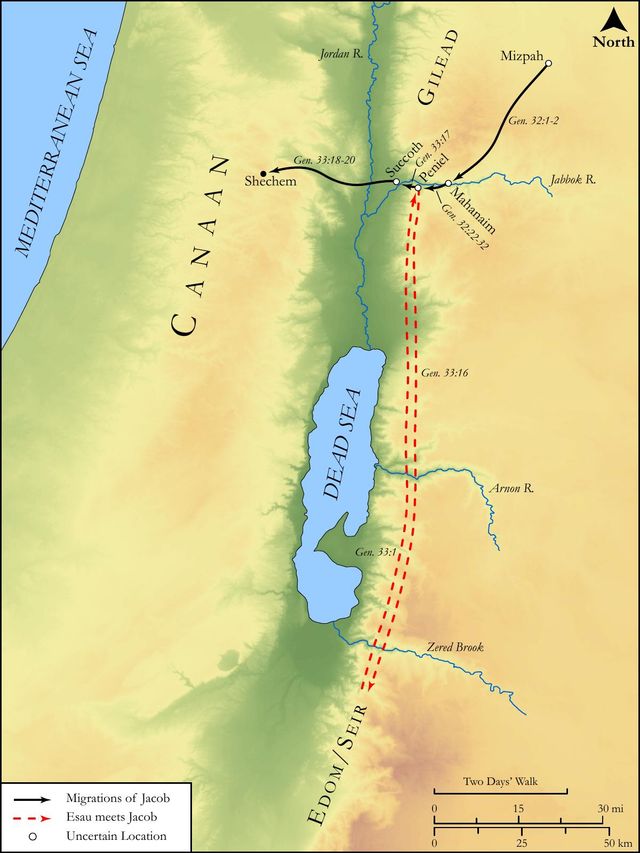
See on the biblical-era maps


Study this verse
Public-domain commentary
Matthew Henry
From his Commentary on the Whole Bible. Henry comments on passages, not single verses — this entry covers Genesis 33:1–4. His three-level outline is real structure in the source text, so it is rendered as structure.
Here, I. Jacob discovered Esau's approach, Gen 33:1. Some think that his lifting up his eyes denotes his cheerfulness and confidence, in opposition to a dejected countenance; having by prayer committed his case to God, he went on his way, and his countenance was no more sad, Sa1 1:18. Note, Those that have cast their care upon God may look before them with satisfaction and composure of mind, cheerfully expecting the issue, whatever it may be; come what will, nothing can come amiss to him whose heart is fixed, trusting in God. Jacob sets himself upon his watch-tower to see what answer God will give to his prayers, Hab 2:1.
II.He put his family into the best order he could to receive him, whether he should come as a friend or as an enemy, consulting their decency if he came as a friend and their safety if he came as an enemy, Gen 33:1, Gen 33:2. Observe what a different figure these two brothers made. Esau is attended with a guard of 400 men, and looks big; Jacob is followed by a cumbersome train of women and children that are his care, and he looks tender and solicitous for their safety; and yet Jacob had the birthright, and was to have the dominion, and was every way the better man. Note, It is no disparagement to very great and good men to give a personal attendance to their families, and to their family affairs. Jacob, at the head of his household, set a better example than Esau at the head of his regiment.
III.At their meeting, the expressions of kindness were interchanged in the best manner that could be between them.
1.Jacob bowed to Esau, Gen 33:3. Though he feared Esau as an enemy, yet he did obeisance to him as an elder brother, knowing and remembering perhaps that when Abel was preferred in God's acceptance before his elder brother Cain, yet God undertook for him to Cain that he should not be wanting in the duty and respect owing by a younger brother. Unto thee shall be his desire, and thou shalt rule over him, Gen 4:7. Note,
(1.)The way to recover peace where it has been broken is to do our duty, and pay our respects, upon all occasions, as if it had never been broken. It is the remembering and repeating of matters that separates friends and perpetuates the separation.
(2.)A humble submissive carriage goes a great way towards the turning away of wrath. Many preserve themselves by humbling themselves: the bullet flies over him that stoops.
2.Esau embraced Jacob (Gen 33:4): He ran to meet him, not in passion, but in love; and, as one heartily reconciled to him, he received him with all the endearments imaginable, embraced him, fell on his neck, and kissed him. Some think that when Esau came out to meet Jacob it was with no bad design, but that he brought his 400 men only for state, that he might pay so much the greater respect to his returning brother. It is certain that Jacob understood the report of his messengers otherwise, Gen 32:5, Gen 32:6. Jacob was a man of prudence and fortitude, and we cannot suppose him to admit of a groundless fear to such a degree as he did this, nor that the Spirit of God would stir him up to pray such a prayer as he did for deliverance from a merely imaginary danger: and, if there was not some wonderful change wrought upon the spirit of Esau at this time, I see not how wrestling Jacob could be said to obtain such power with men as to denominate him a prince. Note,
(1.)God had the hearts of all men in his hands, and can turn them when and how he pleases, by a secret, silent, but resistless power. He can, of a sudden, convert enemies into friends, as he did two Sauls, one by restraining grace (Sa1 26:21, Sa1 26:25), the other by renewing grace, Act 9:21, Act 9:22.
(2.)It is not in vain to trust in God, and to call upon him in the day of trouble; those that do so often find the issue much better than they expected.
3.They both wept. Jacob wept for joy, to be thus kindly received by his brother whom he had feared; and Esau perhaps wept for grief and shame, to think of the bad design he had conceived against his brother, which he found himself strangely and unaccountably prevented from executing.
Historical interpretation
Historical reception
1 surviving comment on this verse from the historical church.
At the end of time our Lord Jesus Christ will be reconciled with Israel, his ancient persecutor, just as Jacob kissed Esau after his return from Haran. No one who listens to the words of holy Scripture can actually doubt that with the passing of time Israel also will have to be received again into the love of Christ through faith. The Lord proclaims to everybody through the voice of one of the holy prophets: “For the children of Israel shall abide many days without a king, and without a prince, and without a sacrifice, and without an altar, and without priesthood and without manifestations. And afterward the children of Israel shall return and shall seek the Lord, their God, and David, their king, and shall be amazed at the Lord and at his goodness in the latter days.” While Christ, the Savior of us all, gathers believers from the nations, Israel is deserted, since it has no law to elect its leaders, and it cannot offer to the divine altar the sacrifices prescribed by the laws. It therefore awaits Christ’s return from his action of converting the nations, so that he may receive it as well and unite it with the law of his love to the others. See how Jacob, who rejoiced in the generation of his children and in his numerous herds of sheep, came back from Haran and received again Esau into his friendship. In time Israel itself will be converted after the calling of the nations and will admire these riches in Christ.
Continue studying Genesis 33:4 across the web’s major study libraries — every link below opens this exact verse, chapter, or book on the destination site.
Read & Compare
 BibleGatewayThis verse in more than 200 translations and 70 languages.
 Bible.comThe YouVersion reader — hundreds of translations, reading plans, and highlights.
 ESV.orgCrossway's official English Standard Version reader.
 NET BibleThe NET translation with 60,000+ translators' notes on every rendering decision.
 STEP BibleTyndale House's free study tool — original text, vocabulary, and scholarly resources.
 BibliaLogos Bible Software's free web reader.
 USCCBThe New American Bible (Revised Edition) with the U.S. bishops' study notes.
Commentaries
 BibleHub CommentariesDozens of classic commentaries on this verse, gathered on one page.
 StudyLightMore than 100 commentary sets — the largest collection on the web.
 BibleRefPlain-English commentary on what this verse means, verse by verse.
 Enduring WordDavid Guzik's free commentary on this chapter, widely used by Bible teachers.
 Bible Study ToolsVerse commentary alongside Greek and Hebrew study aids.
Original Language & Research
- BibleHub InterlinearThe verse word by word — original language, transliteration, and English.
- BibleHub LexiconEvery word's original-language definition and Strong's entry.
 Blue Letter BibleDeep-study tools — Strong's numbers, concordance, and word studies.
 SefariaThe Hebrew text with Rashi and centuries of Jewish commentary.
Sermons, Hymns & Audio


TrulyRandomVerse is not affiliated with these sites and doesn’t control their content. They’re linked because they’re genuinely useful.
Summary
Genesis 33:4 powerfully depicts the long-anticipated reunion of Jacob and Esau, two brothers estranged for two decades by profound deception and simmering resentment. This pivotal verse captures Esau's unexpected and eager embrace of Jacob, a deeply moving demonstration of radical forgiveness and the mending of a severe family wound, orchestrated by divine providence despite Jacob's past actions and profound fears.
Context
ShowHideLiterary Context
This verse serves as the climactic resolution to a twenty-year narrative arc initiated by Jacob's deception of his brother Esau and their father Isaac, which led to Jacob's flight from Esau's wrath (Genesis 27:41-45). Jacob's return to Canaan is fraught with anxiety, as he anticipates a hostile encounter with his brother, whom he believes still harbors murderous intent. His elaborate preparations—dividing his camp, sending appeasing gifts ahead, and wrestling with God at Peniel where his name was changed to Israel (Genesis 32:22-32)—all underscore the immense tension leading up to this moment. The narrative carefully builds suspense, making Esau's warm reception a dramatic and unexpected turn, highlighting God's sovereign hand in transforming potential conflict into profound reconciliation.
Historical & Cultural Context
In the households of the patriarchs, the concepts of birthright, patriarchal blessing, and family honor were paramount. Jacob's theft of the birthright and blessing (Genesis 25:29-34 and Genesis 27:1-40) was not merely a personal slight but a profound violation of social and familial order, often warranting a blood feud or severe retribution. Esau's initial vow to kill Jacob upon Isaac's death (Genesis 27:41) was a culturally understandable response. The customary greeting between men, especially brothers after a long separation, might involve a respectful bow or embrace, but the intensity of Esau's actions—running, falling on the neck, and kissing—transcends mere custom, signifying a deeply personal and complete act of forgiveness, challenging the expected cultural norms of retribution.
Key Themes
ShowHideGenesis 33:4 powerfully contributes to several overarching themes within the book of Genesis and the broader biblical narrative. It is a profound demonstration of Divine Faithfulness and Sovereignty, showing how God can soften hearts and orchestrate peace even in the face of deep-seated animosity, fulfilling His promises to Jacob despite Jacob's past failures and present fears (Genesis 28:15). The verse also highlights the theme of Reconciliation and Forgiveness, presenting a vivid example of genuine restoration between estranged parties. Furthermore, it speaks to Transformation, not only of Jacob's character through his encounter at Peniel, but also of Esau's disposition, implying a divine work in his heart. Finally, it underscores the triumph of Brotherly Love over resentment, a recurring motif in Genesis, often marked by conflict (e.g., Cain and Abel in Genesis 4).
Exposition and Analysis
ShowHideKey Word Analysis
ShowHideThis word (H7323) signifies a primitive root meaning "to run," often conveying urgency or haste. In this context, Esau's action is not a hostile charge but an eager, swift advance, completely defying Jacob's expectations of a slow, measured approach or an attack. It immediately signals a disposition of welcome rather than confrontation.
Derived from H2263, this verb means "to clasp" or "to embrace." It denotes a close, intimate physical act of welcome and affection, illustrating a profound personal connection and acceptance. This gesture directly counters the years of estrangement and the anticipated animosity, signifying a warm, unreserved reception.
This primitive root means "to weep" or "to bemoan." The shared tears of Jacob and Esau represent a cathartic outpouring of profound emotion. For Jacob, it was likely relief from fear and guilt; for Esau, it was joy and the release of any lingering bitterness. It signifies a moment of deep emotional healing and the restoration of a broken relationship.
Verse Breakdown
ShowHide"And Esau ran to meet him"
This opening phrase immediately shatters Jacob's carefully constructed expectations of a hostile encounter. The verb "ran" (Hebrew: vayyaratz) conveys a sense of eager haste and urgency, indicating that Esau's intent was not aggressive but welcoming, surprising Jacob and the reader alike with his unexpected warmth.
"and embraced him"
Following his rapid approach, Esau's embrace (Hebrew: vaychabkehu) signifies a profound act of intimacy and acceptance. This gesture is a powerful physical expression of reconciliation, indicating a desire for closeness and the mending of the long-standing rift between the brothers.
"and fell on his neck"
This action emphasizes the depth and intensity of Esau's embrace. To "fall on one's neck" (Hebrew: vayyipol al-tzavva'rav) is a Hebrew idiom for a passionate and unreserved display of affection, often seen in reunions between close family members. It underscores the overwhelming emotion and genuine welcome Esau extended.
"and kissed him"
The act of kissing (Hebrew: vayyishakehu) in this context is highly significant. While a kiss could sometimes be a sign of betrayal, here, combined with the other actions, it unequivocally denotes a heartfelt reconciliation and genuine affection. It signifies the burying of past grievances and the restoration of brotherly love.
"and they wept"
The shared weeping (Hebrew: vayyivku) marks the culmination of this emotional reunion. It is a cathartic release of two decades of tension, fear, guilt, and resentment. These tears are not merely of sorrow but of profound relief, joy, and the healing of a deep family wound, signifying a complete and mutual emotional release that seals their reconciliation.
Literary Devices
ShowHideThe narrative of Genesis 33:4 masterfully employs several literary devices to heighten its impact. Irony is prominent, as Jacob, who meticulously prepared for a hostile confrontation, is met instead with overwhelming affection, directly contrasting his fears with the reality. This ironic reversal underscores the unpredictability of divine intervention and human hearts. Symbolism is rich in Esau's actions: his running symbolizes eagerness and forgiveness; his embrace and kiss symbolize intimate reconciliation and the breaking down of barriers; and the shared weeping symbolizes a cathartic emotional release and the complete healing of a fractured relationship. The rapid succession of verbs ("ran," "embraced," "fell," "kissed," "wept") creates a sense of immediate, overwhelming emotion and swift resolution, building a powerful emotional crescendo that leaves no doubt about the genuineness of the reconciliation.
Theological and Thematic Connections
ShowHideGenesis 33:4 stands as a profound testament to the power of forgiveness, divine sovereignty, and the possibility of radical reconciliation. Esau's unexpected and overwhelming display of affection, despite having every human reason to harbor resentment, serves as a powerful illustration of grace and the capacity for the human heart to let go of past hurts. This reunion is not merely a human achievement but a clear demonstration of God's active hand in the lives of His people, fulfilling His promises to Jacob and softening Esau's heart in a way that defied all human expectation. It underscores that God's plan for His covenant people will prevail, often through means unforeseen by human logic, bringing about peace where only conflict seemed possible.
Reflection and Application
ShowHideGenesis 33:4 offers profound lessons for believers today, particularly concerning the pursuit of reconciliation and the radical trust in God's ability to transform hearts and circumstances. It challenges us to extend forgiveness, even when it feels impossible or undeserved, just as Esau forgave Jacob, reminding us that we are called to forgive others as Christ has forgiven us (Colossians 3:13). When facing strained relationships or daunting interpersonal conflicts, this verse encourages us to step out in faith, as Jacob did, trusting in God's sovereign power to soften hearts and bring about reconciliation beyond our wildest expectations. While Esau initiated the physical embrace, Jacob had made significant efforts to prepare and humble himself before his brother, highlighting the importance of taking concrete steps, however small, towards healing broken relationships, confident that God can meet our efforts with His transforming grace.
Questions for Reflection
ShowHideFAQ
ShowHideWhat prompted Esau's surprising forgiveness and warmth towards Jacob?
ShowHideThe biblical text does not explicitly detail Esau's internal thought process, but the narrative strongly implies divine intervention. Jacob had fervently prayed for deliverance from Esau's hand (Genesis 32:9-12), and had just experienced a transformative encounter wrestling with God at Peniel, where his name was changed to Israel, signifying his struggle with God and men (Genesis 32:28). The sudden and radical transformation of Esau's disposition, from a feared avenger to a loving brother, is widely understood as God's direct answer to Jacob's prayer and a powerful demonstration of His sovereign power to soften hearts and orchestrate peace, fulfilling His covenant promises to Jacob.
Does the shared weeping indicate mutual guilt or just overwhelming emotion?
ShowHideThe shared weeping in Genesis 33:4 primarily indicates an overwhelming release of emotion for both brothers, encompassing profound relief, joy, and the cathartic shedding of years of tension, fear, and unresolved issues. For Jacob, it was undoubtedly relief from the immense fear and guilt he carried for his past deception. For Esau, it was likely relief from any lingering bitterness and the pure joy of reuniting with his long-lost brother, whom he had not seen in two decades. It signifies a powerful moment of emotional healing and the restoration of a deeply broken relationship, rather than an admission of mutual guilt. It is a shared expression of a profound turning point.
Christ-Centered Fulfillment
ShowHideThe dramatic reconciliation between Jacob and Esau in Genesis 33:4 serves as a poignant foreshadowing of the ultimate reconciliation offered to humanity through Jesus Christ. Just as Esau, despite having every human reason for anger and retribution, extended lavish, unmerited grace and an embracing welcome to Jacob, so too does God, in Christ, extend boundless forgiveness and reconciliation to a humanity estranged from Him by sin. Christ is the supreme reconciler, who, through His sacrificial death on the cross, bridged the vast chasm between a holy God and sinful humanity, breaking down all walls of hostility and creating peace (Ephesians 2:14-16). The unexpected embrace and the tears of joy between the brothers prefigure the profound joy and peace found in the new covenant, where those who were once enemies of God are brought near and embraced as beloved children through faith in the atoning work of Christ, becoming part of God's reconciled family (2 Corinthians 5:18-19).