


Genesis 32:28
Bible text: King James Version (1769 Blayney text) · Public domain
Bible text: Berean Standard Bible · Public domain
Bible text: American Standard Version (1901) · Public domain
Bible text: World English Bible, Messianic edition · Public domain
Bible text: Geneva Bible (1599) · Public domain
Bible text: Young's Literal Translation · Public domain
- וַיֹּאמֶרvai·Yo·merand he saidH559Conj-w ¦ V-Qal-ConsecImperf-3msVerb Qal Consecutive Imperfect 3rd Singular Masculineוַandיֹּאמֶרhe said
- לֹאlo'notH3808NegParticle Negative
- יַעֲקֹבya·'a·KoJacobH3290N-proper-mNoun Proper Masculine
- יֵאָמֵרye·'a·Merit will be calledH559V-Niphal-Imperf-3msVerb Niphal Imperfect 3rd Singular Masculine
- עוֹד'OdagainH5750Adj-msAdjective Numerical Singular Masculine Absolute
- שִׁמְךָshim·Khayour nameH8034N-msc ¦ 2msNoun Singular Masculine Constructשִׁמְnameךָyour
- כִּיkithatH3588PrtParticle Conditional
- אִם'imexceptH518PrtParticle Conditional
- יִשְׂרָאֵלYis·ra·'ElIsraelH3478N-proper-mNoun Proper Masculine
- כִּיkiforH3588PrtParticle Conditional
- שָׂרִיתָsa·Ri·tayou have struggledH8280V-Qal-Perf-2msVerb Qal Perfect 2nd Singular Masculine
- עִם'imwithH5973PrepPreposition
- אֱלֹהִים'E·lo·HimGodH430N-mpNoun Plural Masculine Absolute
- וְעִםve·'imand withH5973Conj-w ¦ PrepPrepositionוְandעִםwith
- אֲנָשִׁים'a·na·ShimpeopleH582N-mpNoun Plural Masculine Absolute
- וַתּוּכָלva·tu·Khaland you have prevailedH3201Conj-w ¦ V-Qal-ConsecImperf-2msVerb Qal Consecutive Imperfect 2nd Singular Masculineוַandתּוּכָלyou have prevailed
English is a literal word-by-word gloss of the Hebrew, not the KJV's wording. Why?
This is the original text the KJV's translators worked from — each Hebrew word with its own literal English meaning in this verse, prepared by scholars at Tyndale House, Cambridge. The KJV translates whole sentences, not word by word, so its wording differs: one Hebrew word can become several English words, and the KJV may choose “the LORD” where the gloss reads “Yahweh”. Both are faithful — they answer different questions. For the KJV's own rendering, switch to the KJV text.
Details
See on the biblical-era maps


Study this verse
Public-domain commentary
Matthew Henry
From his Commentary on the Whole Bible. Henry comments on passages, not single verses — this entry covers Genesis 32:24–32. His two-level outline is real structure in the source text, so it is rendered as structure.
We have here the remarkable story of Jacob's wrestling with the angel and prevailing, which is referred to, Hos 12:4. Very early in the morning, a great while before day, Jacob had helped his wives and his children over the river, and he desired to be private, and was left alone, that he might again more fully spread his cares and fears before God in prayer. Note, We ought to continue instant in prayer, always to pray and not to faint: frequency and importunity in prayer prepare us for mercy. While Jacob was earnest in prayer, stirring up himself to take hold on God, an angel takes hold on him. Some think this was a created angel, the angel of his presence (Isa 63:9), one of those that always behold the face of our Father and attend on the shechinah, or the divine Majesty, which probably Jacob had also in view. Others think it was Michael our prince, the eternal Word, the angel of the covenant, who is indeed the Lord of the angels, who often appeared in a human shape before he assumed the human nature for a perpetuity; whichsoever it was, we are sure God's name was in him, Exo 23:21. Observe,
I.How Jacob and this angel engaged, Gen 32:24.
It was a single combat, hand to hand; they had neither of them any seconds. Jacob was now full of care and fear about the interview he expected, next day, with his brother, and, to aggravate the trial, God himself seemed to come forth against him as an enemy, to oppose his entrance into the land of promise, and to dispute the pass with him, not suffering him to follow his wives and children whom he had sent before. Note, Strong believers must expect divers temptations, and strong ones. We are told by the prophet (Hos 12:4) how Jacob wrestled: he wept, and made supplication; prayers and tears were his weapons. It was not only a corporal, but a spiritual, wrestling, by the vigorous actings of faith and holy desire; and thus all the spiritual seed of Jacob, that pray in praying, still wrestle with God.
II.What was the success of the engagement.
1.Jacob kept his ground; though the struggle continued long, the angel, prevailed not against him (Gen 32:25), that is, this discouragement did not shake his faith, nor silence his prayer. It was not in his own strength that he wrestled, nor by his own strength that he prevailed, but in and by strength derived from Heaven. That of Job illustrates this (Job 23:6), Will he plead against me with his great power? No (had the angel done so, Jacob had been crushed), but he will put strength in me; and by that strength Jacob had power over the angel, Hos 12:4. Note, We cannot prevail with God but in his own strength. It is his Spirit that intercedes in us, and helps our infirmities, Rom 8:26.
2.The angel put out Jacob's thigh, to show him what he could do, and that it was God he was wrestling with, for no man could disjoint his thigh with a touch. Some think that Jacob felt little or no pain from this hurt; it is probable that he did not, for he did not so much as halt till the struggle was over (Gen 32:31), and, if so, this was an evidence of a divine touch indeed, which wounded and healed at the same time. Jacob prevailed, and yet had his thigh put out. Note, Wrestling believers may obtain glorious victories, and yet come off with broken bones; for when they are weak then are they strong, weak in themselves, but strong in Christ, Co2 12:10. Our honours and comforts in this world have their alloys.
3.The angel, by an admirable condescension, mildly requests Jacob to let him go (Gen 32:26), as God said to Moses (Exo 32:10), Let me alone. Could not a mighty angel get clear of Jacob's grapples? He could; but thus he would put an honour on Jacob's faith and prayer, and further try his constancy. The king is held in the galleries (Sol 7:5); I held him (says the spouse) and would not let him go, Sol 3:4. The reason the angel gives why he would be gone is because the day breaks, and therefore he would not any longer detain Jacob, who had business to do, a journey to go, a family to look after, which, especially in this critical juncture, called for his attendance. Note, Every thing is beautiful in its season; even the business of religion, and the comforts of communion with God, must sometimes give way to the necessary affairs of this life: God will have mercy, and not sacrifice.
4.Jacob persists in his holy importunity: I will not let thee go, except thou bless me; whatever becomes of his family and journey, he resolves to make the best he can of this opportunity, and not to lose the advantage of his victory: he does not mean to wrestle all night for nothing, but humbly resolves he will have a blessing, and rather shall all his bones be put out of joint than he will go away without one. The credit of a conquest will do him no good without the comfort of a blessing. In begging this blessing he owns his inferiority, though he seemed to have the upper hand in the struggle; for the less is blessed of the better. Note, Those that would have the blessing of Christ must be in good earnest, and be importunate for it, as those that resolve to have no denial. It is the fervent prayer that is the effectual prayer.
5.The angel puts a perpetual mark of honour upon him, by changing his name (Gen 32:27, Gen 32:28): "Thou art a brave combatant" (says the angel), "a man of heroic resolution; what is thy name?" "Jacob," says he, a supplanter; so Jacob signifies: "Well," says the angel, "be thou never so called any more; henceforth thou shalt be celebrated, not for craft and artful management, but for true valour; thou shalt be called Israel, a prince with God, a name greater than those of the great men of the earth." He is a prince indeed that is a prince with God, and those are truly honourable that are mighty in prayer, Israels, Israelites indeed. Jacob is here knighted in the field, as it were, and has a title of honour given him by him that is the fountain of honour, which will remain, to his praise, to the end of time. Yet this was not all; having power with God, he shall have power with men too. Having prevailed for a blessing from heaven, he shall, no doubt, prevail for Esau's favour. Note, Whatever enemies we have, if we can but make God our friend, we are well off; those that by faith have power on earth as they have occasion for.
6.He dismisses him with a blessing, Gen 32:29. Jacob desired to know the angel's name, that he might, according to his capacity, do him honour, Jdg 13:17. But that request was denied, that he might not be too proud of his conquest, nor think he had the angel at such an advantage as to oblige him to what he pleased. No, "Wherefore dost thou ask after my name? What good will it do thee to know that?" The discovery of that was reserved for his death-bed, upon which he was taught to call him Shiloh. But, instead of telling him his name, he gave him his blessing, which was the thing he wrestled for: He blessed him there, repeated and ratified the blessing formerly given him. Note, Spiritual blessings, which secure our felicity, are better and much more desirable than fine notions which satisfy our curiosity. An interest in the angel's blessing is better than an acquaintance with his name. The tree of life is better than the tree of knowledge. Thus Jacob carried his point; a blessing he wrestled for, and a blessing he had; nor did ever any of his praying seed seek in vain. See how wonderfully God condescends to countenance and crown importunate prayer: those that resolve, though God slay them, yet to trust in him, will, at length, be more than conquerors.
7.Jacob gives a new name to the place; he calls it Peniel, the face of God (Gen 32:30), because there he had seen the appearance of God, and obtained the favour of God. Observe, The name he gives to the place preserves and perpetuates, not the honour of his valour or victory, but only the honour of God's free grace. He does not say, "In this place I wrestled with God, and prevailed;" but, "In this place I saw God face to face, and my life was preserved;" not, "It was my praise that I came off a conqueror, but it was God's mercy that I escaped with my life." Note, It becomes those whom God honours to take shame to themselves, and to admire the condescensions of his grace to them. Thus David did, after God had sent him a gracious message (Sa2 7:18), Who am I, O Lord God?
8.The memorandum Jacob carried of this in his bones: He halted on his thigh (Gen 32:31); some think he continued to do so to his dying-day; and, if he did, he had no reason to complain, for the honour and comfort he obtained by this struggle were abundantly sufficient to countervail the damage, though he went limping to his grave. He had no reason to look upon it as his reproach thus to bear in his body the marks of the Lord Jesus (Gal 6:17); yet it might serve, like Paul's thorn in the flesh, to keep him from being lifted up with the abundance of the revelations. Notice is taken of the sun's rising upon him when he passed over Penuel; for it is sunrise with that soul that has communion with God. The inspired penman mentions a traditional custom which the seed of Jacob had, in remembrance of this, never to eat of that sinew, or muscle, in any beast, by which the hip-bone is fixed in its cup: thus they preserved the memorial of this story, and gave occasion to their children to enquire concerning it; they also did honour to the memory of Jacob. And this use we may still make of it, to acknowledge the mercy of God, and our obligations to Jesus Christ, that we may now keep up our communion with God, in faith, hope, and love, without peril either of life or limb.
Historical interpretation
Two Centuries of Reception
5 surviving comments on this verse. Each one is dated, so this reads as a timeline rather than a list.
Select a marker to jump to its quote. Markers stagger vertically where authors wrote within a few decades of each other.
A man, Scripture says, wrestled with Jacob. If he is a mere man, who is he? Where did he come from? Why does he struggle and wrestle with Jacob? What had come between them? What had happened? What was the cause of so great a conflict and struggle as that? Moreover, why is it that Jacob proves to be the stronger even to the holding of the man with whom he was struggling? And why still, because the morning star was rising, is it he who, on that account, asks a blessing from him whom he held? It can only mean that this struggle was prefiguring that future contention between Christ and the sons of Jacob, which is said to have had its completion in the gospel. For Jacob’s people struggled against this man and proved to be more powerful in the conflict, because they obtained the triumph of their own unrighteousness over Christ. Then, on account of the crime they had perpetrated, they began to limp very badly in the gait of their own faith and salvation, stumbling and slipping in their course. Though Jacob’s people proved superior by their condemnation of Christ, they still need his mercy and still need his blessing. Now this man who wrestled with Jacob says to him, “Your name shall no longer be called Jacob, but Israel shall be your name.” And if Israel is a man who “sees God,” then the Lord was showing in an elegant manner that he who wrestled with Jacob was not only man but also God. Undoubtedly Jacob saw God with whom he wrestled, though it was a man whom he held in his grip. That there might not remain any doubt, he himself gave the interpretation when he said, “For you have prevailed with God, and with men you are powerful.” That is why this same Jacob, understanding now the meaning of the prefiguration and realizing the authority of him with whom he had wrestled, called the name of the place where he had wrestled “Vision of God.” Furthermore, Jacob added his reason for giving his interpretation of God: “I have seen God face to face, and my soul has been saved.” For he saw God with whom he wrestled, as though he were wrestling with a man; but while as if victor he held the man, as an inferior he asked a blessing of him, as one would of God. Thus he wrestled with God and with man. Now if this struggle was then prefigured and has been actually fulfilled in the gospel between Christ and Jacob’s people—a struggle in which the people proved superior yet were found to be inferior because of their guilt—who will hesitate to acknowledge that Christ in whom this figure of a struggle was fulfilled was not only human but also God, when that very figure of a struggle seems to have proved that he is both God and human?
O holy and blessed patriarch, Jacob, be with me, be with me now by the spirit of your faith against the poisonous hissing of infidelity, and, while you prevail in the struggle with the man, plead with him as the stronger to bless you. What is this that you are asking from one who is weak? What do you expect from one who is feeble? This one for whose blessing you pray is the one whom you, as the more powerful, weaken by your embrace. The activity of your soul is not in harmony with the deeds of your body, for you think differently from the way you act. By your bodily motions during this struggle you keep this man helpless, but this man is for you the true God, not in name but in nature. You do not ask to be sanctified by adoptive but by true blessings. You struggle with a man, but you behold God face to face. You do not see with your bodily eyes what you perceive with the glance of your faith. In comparison with you he is a feeble man, but your soul has been saved by the vision of God.During this struggle you are Jacob, but after your faith in the blessing for which you prayed you are Israel. The man is subject to you according to the flesh in anticipation of the sufferings in the flesh. You recognize God in the weakness of his flesh in order to foreshadow the mystery of his blessing in the spirit. His appearance does not prevent you from remaining steadfast in the fight, nor does his weakness deter you from seeking his blessing. Nor does the man bring it about that he is not God who is man, nor is he who is God not the true God, because he who is God cannot but be the true God by the blessing, the transfer and the name.
Do you see how God revealed the complete explanation of why he demonstrated such considerateness? At the same time God taught this good man [Jacob] through the imposition of the name [Israel] who it was that he had seen and had been allowed to hold on to. Recall the text says, “You will no longer be called Jacob but Israel.” Now Israel means “seeing God.” “Since you are privileged to see God, insofar as it is possible for a human being to see him, hence I also give you this name so that it may be clear to everyone in future that you were accorded a vision.” And he added, “For you have fought with God and will thus be powerful in dealing with human beings.” No longer have any fear or expect to suffer any harm from anyone. Having gained such might in the first place as to succeed in wrestling with God, much more will you prevail over human beings and prove superior to all.
(Verse 27 and 28.) And he said to him: What is your name? He said, Jacob. And he said to him: Your name shall no longer be called Jacob, but your name shall be called Israel: for you have wrestled with God, and have prevailed with men. Josephus, in the first book of Antiquities, thinks that Israel was called so because he wrestled with an angel. I carefully examined this, but I could not find it at all in Hebrew. And why should I seek the opinions of individuals, when the one who gave the name explains the etymology himself? He said, 'Your name will no longer be Jacob, but Israel will be your name.' Why? Aquila interprets it as 'because you have begun with God,' Symmachus as 'because I will start towards God,' the Septuagint and Theodotio as 'because you have prevailed with God.' Sarith (which is derived from the word Israel) means 'prince.' Therefore, the meaning is: Your name will not be supplanter, that is, Jacob, but your name will be prince with God, that is, Israel. For just as I am a prince, so you, who were able to wrestle with me, shall be called a prince. But if you were able to wrestle with me, who am God or an angel (for many interpret it differently), how much more so with humans, that is, with Esau, whom you should not fear! However, that which is interpreted as 'Israel' in the book of Numbers, 'a man who sees God' or 'a mind that sees God', seems to me to have been interpreted not so truly, but rather forcefully, in the common speech. For here Israel, as it is written in these letters, is spelled Iod, Sin, Res, Aleph, Lamed, which means Prince of God, or Direct of God, that is, εὐθύτατος Θεοῦ. But the word for "seeing" God is spelled Aleph, Iod, Sin, so that it is written with three letters and pronounced Is (), while "seeing" is spelled with three letters, Res, Aleph, He, and pronounced Raa (). And El () is formed by two letters, Aleph and Lamed, and it means God, or strong. Although, therefore, they are of great authority, and the shadow of their eloquence oppresses us, who have transformed the man, or rather the mind perceiving God, into the Israel: we are rather led by the authority of Scripture, and of the Angels, or of God, who called him Israel, than by any worldly eloquence. That which also follows afterwards:
Now, as I said just a little while ago, Jacob was also called Israel, which was the name generally borne by the people descended from him. This name was given him by the angel who wrestled with him when Jacob was on his way back from Mesopotamia. This angel obviously presents a type of Christ. For the fact that Jacob “prevailed over” him (the angel, of course, being a willing loser to symbolize the hidden meaning) represents the passion of Christ, in which the Jews seemed to prevail over him. And yet Jacob obtained a blessing from the very angel whom he had defeated; thus the giving of the name was the blessing. Now “Israel” means “seeing God,” and the vision of God will be the reward of all the saints at the end of the world. Moreover, the angel also touched the apparent victor on the broad part of his thigh and thus made him lame. And so the same man, Jacob, was the same time blessed and lame—blessed in those who among this same people of Israel have believed in Christ and crippled in respect of those who do not believe. For the broad part of the thigh represents the general mass of the race. For in fact it is to the majority of that stock that the prophetic statement applies, “They have limped away from their paths.”
Continue studying Genesis 32:28 across the web’s major study libraries — every link below opens this exact verse, chapter, or book on the destination site.
Read & Compare
 BibleGatewayThis verse in more than 200 translations and 70 languages.
 Bible.comThe YouVersion reader — hundreds of translations, reading plans, and highlights.
 ESV.orgCrossway's official English Standard Version reader.
 NET BibleThe NET translation with 60,000+ translators' notes on every rendering decision.
 STEP BibleTyndale House's free study tool — original text, vocabulary, and scholarly resources.
 BibliaLogos Bible Software's free web reader.
 USCCBThe New American Bible (Revised Edition) with the U.S. bishops' study notes.
Commentaries
 BibleHub CommentariesDozens of classic commentaries on this verse, gathered on one page.
 StudyLightMore than 100 commentary sets — the largest collection on the web.
 BibleRefPlain-English commentary on what this verse means, verse by verse.
 Enduring WordDavid Guzik's free commentary on this chapter, widely used by Bible teachers.
 Bible Study ToolsVerse commentary alongside Greek and Hebrew study aids.
Original Language & Research
- BibleHub InterlinearThe verse word by word — original language, transliteration, and English.
- BibleHub LexiconEvery word's original-language definition and Strong's entry.
 Blue Letter BibleDeep-study tools — Strong's numbers, concordance, and word studies.
 SefariaThe Hebrew text with Rashi and centuries of Jewish commentary.
Sermons, Hymns & Audio


TrulyRandomVerse is not affiliated with these sites and doesn’t control their content. They’re linked because they’re genuinely useful.
Summary
Genesis 32:28 marks a profound and transformative moment in Jacob's life, where, after an arduous, all-night struggle with a divine being, his name is divinely changed from "Jacob" to "Israel." This renaming signifies a radical shift in his character and destiny, moving him from a "supplanter" who relied on cunning to a "prince" who prevailed with God and humanity, establishing him as the patriarch through whom God's covenant promises would be fulfilled for the nation that would bear his new, significant name.
Context
ShowHideLiterary Context
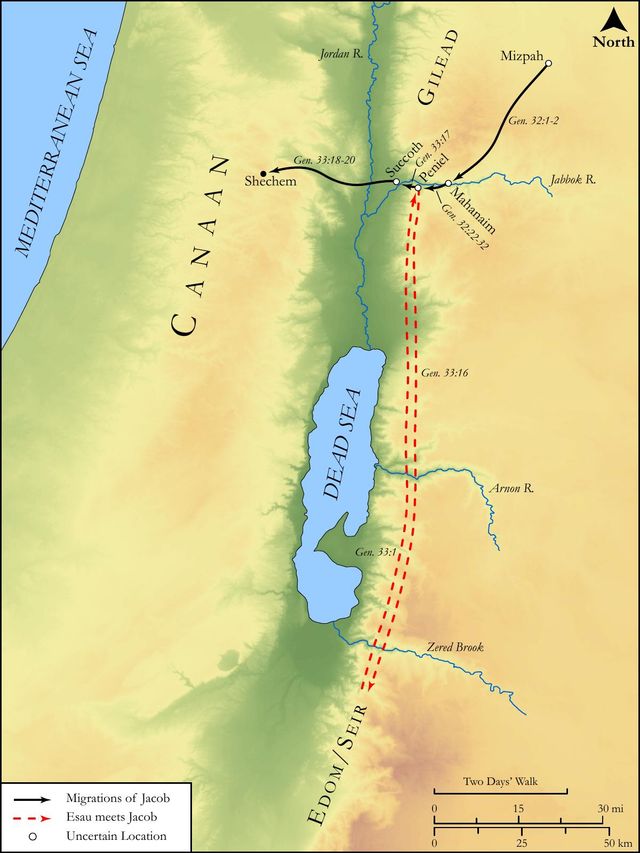
This pivotal verse is the climax of Jacob's solitary and mysterious encounter at the ford of Jabbok, detailed in Genesis 32:22-32. Jacob has sent his family and possessions ahead, choosing to remain alone on the eve of his terrifying reunion with his estranged brother, Esau. His fear and anxiety, stemming from his past deception of Esau to obtain the birthright and blessing (Genesis 27:36), are palpable. The wrestling match serves as a spiritual crucible, a moment of profound personal crisis and confrontation, preparing Jacob not only for the impending reconciliation with Esau but also for his immense responsibilities as the progenitor of God's chosen people. The narrative immediately following this encounter, Jacob's reunion with Esau in Genesis 33, demonstrates the tangible outcome of this spiritual transformation.
Historical & Cultural Context
Among the patriarchs, names were not merely labels but often conveyed a person's character, destiny, or a significant life event. A divine name change, as seen with Abram to Abraham (Genesis 17:5) and Sarai to Sarah (Genesis 17:15), signified a new identity, a new covenant relationship, and a redefined purpose ordained by God. The act of "wrestling" (physical or spiritual) was also a recognized metaphor for intense struggle, perseverance, or even legal contention. For Jacob, this struggle at Jabbok occurred at a liminal space, a ford, symbolizing a transition point in his life, and his physical injury (a dislocated hip) served as a permanent reminder of the encounter and his reliance on divine grace, rather than his own strength or cunning.
Key Themes
ShowHideGenesis 32:28 encapsulates several profound themes central to the book of Genesis and the broader biblical narrative. Firstly, it highlights the theme of Divine Sovereignty and Providence, demonstrating God's active involvement in the lives of His chosen, even amidst their flaws and fears, to fulfill His covenant promises. Secondly, it powerfully illustrates Transformation and New Identity, as Jacob's character is refined through struggle, moving from a deceiver to a prevailer who walks by faith. This transformation is marked by the name change, a recurring motif for God's redemptive work. Thirdly, the passage underscores the importance of Perseverance in Faith and Prayer, as Jacob's refusal to release his divine opponent until blessed exemplifies a tenacious and desperate reliance on God, a model for spiritual earnestness. Finally, it establishes the Foundational Identity of God's Covenant People, as the name "Israel" becomes the enduring identity for Jacob's descendants, signifying a people defined by their unique, often challenging, relationship and struggle with God, as seen throughout their history (e.g., Exodus 19:5-6).
Exposition and Analysis
ShowHideGenesis 32:28 records the divine pronouncement that fundamentally redefines Jacob's identity and future: "And he said, Thy name shall be called no more Jacob, but Israel: for as a prince hast thou power with God and with men, and hast prevailed."
Key Word Analysis
ShowHideThis name, derived from the Hebrew root for "heel" (עָקַב), literally means "heel-catcher" or, by extension, "supplanter." It perfectly described Jacob's character and actions from birth, as he was born grasping Esau's heel (Genesis 25:26) and later supplanted his brother by cunningly obtaining the birthright and blessing (Genesis 27:36). The name reflected his reliance on human manipulation and deceit.
This new, divinely bestowed name is a compound of שָׂרָה (sârâh, "to rule as a prince" or "to strive") and אֵל (ʼĕlôhîym, "God"). Thus, it literally means "he will rule as God" or "he strives with God," commonly interpreted as "God strives," "one who strives with God," or "prince of God." It encapsulates the struggle and triumph of Jacob's encounter, symbolizing his new relationship with God and his future role as the progenitor of the nation that would bear this name.
A primitive root meaning "to prevail" or "to have power (as a prince)." This word is crucial as it directly links to the root of the new name "Israel" (Yisrâʼêl), emphasizing that Jacob's new identity is rooted in his prevailing, princely power in his struggle with the divine. It signifies a new authority and standing that he has gained through his tenacious engagement.
Verse Breakdown
ShowHide"And he said, Thy name shall be called no more Jacob, but Israel"
This clause signifies a profound divine declaration of a new identity. The change from "Jacob" (the deceiver, the supplanter) to "Israel" (one who strives with God, a prince of God) marks a complete spiritual transformation. It indicates that Jacob's past, characterized by human cunning and self-reliance, is being superseded by a new nature and destiny defined by his relationship and struggle with God. This is not merely a label change but a redefinition of his very being and purpose.
"for as a prince hast thou power with God and with men"
This explanatory phrase elucidates the meaning of "Israel." The term "prince" (שָׂר) implies authority, nobility, and dominion. Jacob's "power" (שָׂרָה) is not one of physical might over God, but rather a spiritual prevailing, a tenacious holding on, and an earnest pleading that resulted in a blessing. This struggle, which was "with God," also granted him new standing "with men," suggesting that his spiritual victory would manifest in his earthly relationships, particularly his impending reconciliation with Esau. It highlights that true authority comes through humble, persistent engagement with the divine.
"and hast prevailed"
This final phrase confirms the outcome of the wrestling match. Jacob's refusal to let go until he received a blessing demonstrated a persistent faith and a deep, desperate desire for divine favor. His "prevailing" (יָכֹל) was not about winning a physical contest, but about enduring a spiritual trial, confronting his fears, and clinging to God until a blessing was secured. This struggle refined his character, deepened his faith, and ultimately led to his transformation and the divine blessing that prepared him for his future role.
Literary Devices
ShowHideThe passage employs several potent literary devices. Symbolism is paramount, as the name change itself is a powerful symbol of spiritual transformation and new identity. Jacob's wrestling match is a Metaphor for the intense spiritual struggle and internal conflict he experienced, confronting his past, his fears, and his relationship with God. The dislocated hip serves as a physical Symbol of his weakness and reliance on God, a permanent reminder of the encounter. The entire narrative also functions as Foreshadowing, setting the stage for the future nation of Israel—a people often characterized by their wrestling with God, their struggles, and their ultimate dependence on divine grace for their identity and survival.
Theological and Thematic Connections
ShowHideGenesis 32:28 powerfully illustrates God's redemptive work in transforming flawed individuals into instruments of His divine purpose. It underscores that true spiritual growth often emerges from intense personal struggles, where human weakness meets divine power, leading to a deeper reliance on God rather than self-effort. The renaming of Jacob to Israel signifies a new covenant identity, demonstrating God's faithfulness to His promises despite human failings, and establishing the foundational character of His chosen people—a people defined by their unique, often challenging, relationship with the Almighty. This transformation highlights that God redefines us not by our past shortcomings but by His grace and our renewed relationship with Him.
Reflection and Application
ShowHideThe profound narrative of Jacob's renaming in Genesis 32:28 offers timeless lessons for contemporary believers. Just as Jacob received a new name and identity, we, through faith in Christ, are granted a new identity, no longer defined by our past sins, failures, or self-reliance, but by our union with God through Christ. This passage powerfully encourages us to embrace spiritual perseverance, holding fast to God in earnest prayer and unwavering faith, especially during times of intense struggle, uncertainty, or when confronting our deepest fears and past mistakes. It serves as a potent reminder that God often uses our trials and our "wrestling" moments to refine our character, deepen our faith, and bring about profound transformation, demonstrating His boundless grace and power to redeem even our weaknesses for His divine and glorious purposes. We are called to live out this new identity, walking in humility and dependence on Him, rather than our own strength or cunning.
Questions for Reflection
ShowHideFAQ
ShowHideWhat is the significance of God changing Jacob's name?
ShowHideThe name change from Jacob to Israel signifies a fundamental transformation of character and destiny, marking a pivotal moment in salvation history. "Jacob" (meaning "supplanter" or "heel-catcher") reflected his past actions of cunning and deceit, particularly in relation to his brother Esau (Genesis 27:36). In contrast, "Israel" (meaning "one who strives with God" or "prince of God") marked his new identity as one who had prevailed with God and men through tenacious faith and struggle. It symbolized God's redemptive work in his life, preparing him to be the patriarch of the nation that would bear this significant name, emphasizing a new relationship of dependence and favor with God.
Does Jacob's wrestling imply a physical struggle with God?
ShowHideWhile the text describes a physical struggle that resulted in Jacob's dislocated hip, the encounter is primarily understood as a profound spiritual wrestling match. Jacob was not literally overpowering God, but rather engaging in a desperate, tenacious plea for blessing and a confrontation with his own fears, past, and identity. The physical manifestation served as a tangible representation of his inner spiritual turmoil, his persistent faith, and his refusal to let go until he received a divine blessing. This struggle was a test and a refining process, revealing the depth of his desire for God's favor and ultimately transforming his character, as evidenced by his new name and his subsequent reconciliation with Esau (Genesis 33:4).
Christ-Centered Fulfillment
ShowHideJacob's transformation from "supplanter" to "Israel," the one who prevails with God, powerfully foreshadows the ultimate transformation offered through Jesus Christ. Just as Jacob received a new identity through a divine encounter marked by struggle and grace, believers in Christ are given a radical new identity, becoming "new creations" (2 Corinthians 5:17) no longer defined by their old sinful nature but by their union with Him. Christ Himself is the ultimate "Israel," the true and perfect Son who perfectly strove with God in obedience and prevailed over sin, death, and the powers of darkness, not through a physical wrestling match but through His perfect life, atoning sacrifice on the cross, and victorious resurrection (Colossians 2:15). His victory enables us to "prevail" over our own spiritual struggles, granting us access to God, a reconciled relationship, and a place in His eternal kingdom as co-heirs with Christ (Romans 8:17). Through Him, we are empowered to live out our new identity as God's beloved children, reflecting His character and purpose in the world.