


Genesis 32:6
Bible text: King James Version (1769 Blayney text) · Public domain
Bible text: Berean Standard Bible · Public domain
Bible text: American Standard Version (1901) · Public domain
Bible text: World English Bible, Messianic edition · Public domain
Bible text: Geneva Bible (1599) · Public domain
Bible text: Young's Literal Translation · Public domain
- וַיָּשֻׁבוּvai·ya·Shu·vuand they returnedH7725Conj-w ¦ V-Qal-ConsecImperf-3mpVerb Qal Consecutive Imperfect 3rd Plural Masculineוַandיָּשֻׁבוּthey returned
- הַמַּלְאָכִיםha·mal·'a·Khimthe messengersH4397Art ¦ N-mpNoun Plural Masculine Absoluteהַtheמַּלְאָכִיםmessengers
- אֶל'eltoH413PrepPreposition
- יַעֲקֹבya·'a·KoJacobH3290N-proper-mNoun Proper Masculine
- לֵאמֹרle·Mor<to> sayingH559Prep-l ¦ V-Qal-InfVerb Qal Infinitive Constructלֵ<to>אמֹרsaying
- בָּאנוּBa·nuwe wentH935V-Qal-Perf-1cpVerb Qal Perfect 1st Plural common gender
- אֶל'eltoH413PrepPreposition
- אָחִיךָ'a·Chi·khayour brotherH251N-msc ¦ 2msNoun Singular Masculine Constructאָחִיbrotherךָyour
- אֶל'eltoH413PrepPreposition
- עֵשָׂו'e·SavEsauH6215N-proper-mNoun Proper Masculine
- וְגַםve·Gamand alsoH1571Conj-w ¦ AdvAdverbוְandגַםalso
- הֹלֵךְho·Lekh[he is] comingH1980V-Qal-Prtcpl-msVerb Qal Participle Singular Masculine Absolute
- לִקְרָאתְךָlik·ra·te·Chato meet youH7122Prep-l ¦ V-Qal-Inf ¦ 2msVerb Qal Infinitive Constructלִtoקְרָאתְmeetךָyou
- וְאַרְבַּעve·'ar·ba'and fourH702Conj-w ¦ Adj-cscAdjective Numerical Singular common gender Constructוְandאַרְבַּעfour
- מֵאוֹתme·'othundred<s>H3967Adj-fpAdjective Numerical Plural Feminine Absolute
- אִישׁ'ishmanH376N-msNoun Singular Masculine Absolute
- עִמּוֹi·Mo[are] with himH5973Prep ¦ 3msPreposition Definiteעִמּ[are] withוֹhim
English is a literal word-by-word gloss of the Hebrew, not the KJV's wording. Why?
This is the original text the KJV's translators worked from — each Hebrew word with its own literal English meaning in this verse, prepared by scholars at Tyndale House, Cambridge. The KJV translates whole sentences, not word by word, so its wording differs: one Hebrew word can become several English words, and the KJV may choose “the LORD” where the gloss reads “Yahweh”. Both are faithful — they answer different questions. For the KJV's own rendering, switch to the KJV text.
Details
See on the biblical-era maps


Study this verse
Public-domain commentary
Matthew Henry
From his Commentary on the Whole Bible. Henry comments on passages, not single verses — this entry covers Genesis 32:3–8. His two-level outline is real structure in the source text, so it is rendered as structure.
Now that Jacob was re-entering Canaan God, by the vision of angels, reminded him of the friends he had when he left it, and thence he takes occasion to remind himself of the enemies he had, particularly Esau. It is probable that Rebekah had sent him word of Esau's settlement in Seir, and of the continuance of his enmity to him. What shall poor Jacob do? He longs to see his father, and yet he dreads to see his brother. He rejoices to see Canaan again, and yet cannot but rejoice with trembling because of Esau.
I.He sends a very kind and humble message to Esau.
It does not appear that his way lay through Esau's country, or that he needed to ask his leave for a passage; but his way lay near it, and he would not go by him without paying him the respect due to a brother, a twin-brother, an only brother, an elder brother, a brother offended. Note,
1.Though our relations fail in their duty to us, yet we must make conscience of doing our duty to them.
2.It is a piece of friendship and brotherly love to acquaint our friends with our condition, and enquire into theirs. Acts of civility may help to slay enmities. Jacob's message to him is very obliging, v. 4, 5. (1.) He calls Esau his lord, himself his servant, to intimate that he did not insist upon the prerogatives of the birthright and blessing he had obtained for himself, but left it to God to fulfil his own purpose in his seed. Note, Yielding pacifies great offences, Ecc 10:4. We must not refuse to speak in a respectful an submissive manner to those that are ever so unjustly exasperated against it (2.) He gives him a short account of himself, that he was not a fugitive and a vagabond, but, though long absent, had had a certain dwelling-place, with his own relations: I have sojourned with Laban, and staid there till now; and that he was not a beggar, nor did he come home, as the prodigal son, destitute of necessaries and likely to be a charge to his relations; no, I have oxen and asses. This he knew would (if any thing) recommend him to Esau's good opinion. And, (3.) He courts his favour: I have sent, that I might find grace in thy sight. Note, It is no disparagement to those that have the better cause to become petitioners for reconciliation, and to sue for peace as well as right.
II.He receives a very formidable account of Esau's warlike preparations against him (Gen 32:6), not a word, but a blow, a very coarse return to his kind message, and a sorry welcome home to a poor brother: He comes to meet thee, and four hundred men with him. He is now weary of waiting for the days of mourning for this good father, and even before they come he resolves to slay his brother.
1.He remembers the old quarrel, and will now be avenged on him for the birthright and blessing, and, if possible, defeat Jacob's expectations from both. Note, malice harboured will last long, and find an occasion to break out with violence a great while after the provocations given. Angry men have good memories.
2.He envies Jacob what little estate he had, and, though he himself was now possessed of a much better, yet nothing will serve him but to feed his eyes upon Jacob's ruin, and fill his fields with Jacob's spoils. Perhaps the account Jacob sent him of his wealth did but provoke him the more.
3.He concludes it easy to destroy him, now that he was upon the road, a poor weary traveller, unfixed, and (as he thinks) unguarded. Those that have the serpent's poison have commonly the serpent's policy, to take the first and fairest opportunity that offers itself for revenge.
4.He resolves to do it suddenly, and before Jacob had come to his father, lest he should interpose and mediate between them. Esau was one of those that hated peace; when Jacob speaks, speaks peaceably, he is for war, Psa 120:6, Psa 120:7. Out he marches, spurred on with rage, and intent on blood and murders; four hundred men he had with him, probably such as used to hunt with him, armed, no doubt, rough and cruel like their leader, ready to execute the word of command though ever so barbarous, and now breathing nothing but threatenings and slaughter. The tenth part of these were enough to cut off poor Jacob, and his guiltless helpless family, root and branch. No marvel therefore that it follows (Gen 32:7), then Jacob was greatly afraid and distressed, perhaps the more so from having scarcely recovered the fright Laban had put him in. Note, Many are the troubles of the righteous in this world, and sometimes the end of one is but the beginning of another. The clouds return after the rain. Jacob, though a man of great faith, yet was now greatly afraid. Note, A lively apprehension of danger, and a quickening fear arising from it, may very well consist with a humble confidence in God's power and promise. Christ himself, in his agony, was sorely amazed.
III.He puts himself into the best posture of defence that his present circumstances will admit.
It was absurd to think of making resistance, all his contrivance is to make an escape, Gen 32:7, Gen 32:8. He thinks it prudent not to venture all in one bottom, and therefore divides what he had into two companies, that, if one were smitten, the other might escape. Like a tender careful master of a family, he is more solicitous for their safety than for his own. He divided his company, not as Abraham (Gen 14:15), for fight, but for flight.
Historical interpretation
Historical reception
2 surviving comments on this verse. Each one is dated, so this reads as a timeline rather than a list.
Select a marker to jump to its quote. Markers stagger vertically where authors wrote within a few decades of each other.
See how this was sufficient to aggravate the good man’s fear. Far from realizing precisely his brother’s intent, Jacob was terrified to learn the number of those approaching and suspected that they were bent on hostilities and so wanted to catch up with him. Note the text says, “Jacob was in a state of fear and perplexity.” Fear disturbed his thinking, and instead of knowing what to do, he was at a loss; hence Jacob was terrified of almost everything, and, with the prospect of death before him, “he divided all the people with him into two camps.” You see, he said, “If he comes upon one camp and attacks it, the other will have the chance of being saved.” While it was Jacob’s fear and great terror that suggested this, … seeing himself caught in a trap he had recourse to the invincible Lord and invoked the promises made him by the God of all, as if to say to him, “Now the time has come for a good man to enjoy your complete assistance on account of the virtue of his forebears and the promises made by you.”
(Verse 6) Hear us, O Lord, you are our king from God, bury your dead in our chosen sepulcher. For a king is called a prince in Hebrew, or a leader. For a leader is called not a king, but a duke.
Continue studying Genesis 32:6 across the web’s major study libraries — every link below opens this exact verse, chapter, or book on the destination site.
Read & Compare
 BibleGatewayThis verse in more than 200 translations and 70 languages.
 Bible.comThe YouVersion reader — hundreds of translations, reading plans, and highlights.
 ESV.orgCrossway's official English Standard Version reader.
 NET BibleThe NET translation with 60,000+ translators' notes on every rendering decision.
 STEP BibleTyndale House's free study tool — original text, vocabulary, and scholarly resources.
 BibliaLogos Bible Software's free web reader.
 USCCBThe New American Bible (Revised Edition) with the U.S. bishops' study notes.
Commentaries
 BibleHub CommentariesDozens of classic commentaries on this verse, gathered on one page.
 StudyLightMore than 100 commentary sets — the largest collection on the web.
 BibleRefPlain-English commentary on what this verse means, verse by verse.
 Enduring WordDavid Guzik's free commentary on this chapter, widely used by Bible teachers.
 Bible Study ToolsVerse commentary alongside Greek and Hebrew study aids.
Original Language & Research
- BibleHub InterlinearThe verse word by word — original language, transliteration, and English.
- BibleHub LexiconEvery word's original-language definition and Strong's entry.
 Blue Letter BibleDeep-study tools — Strong's numbers, concordance, and word studies.
 SefariaThe Hebrew text with Rashi and centuries of Jewish commentary.
Sermons, Hymns & Audio


TrulyRandomVerse is not affiliated with these sites and doesn’t control their content. They’re linked because they’re genuinely useful.
Summary
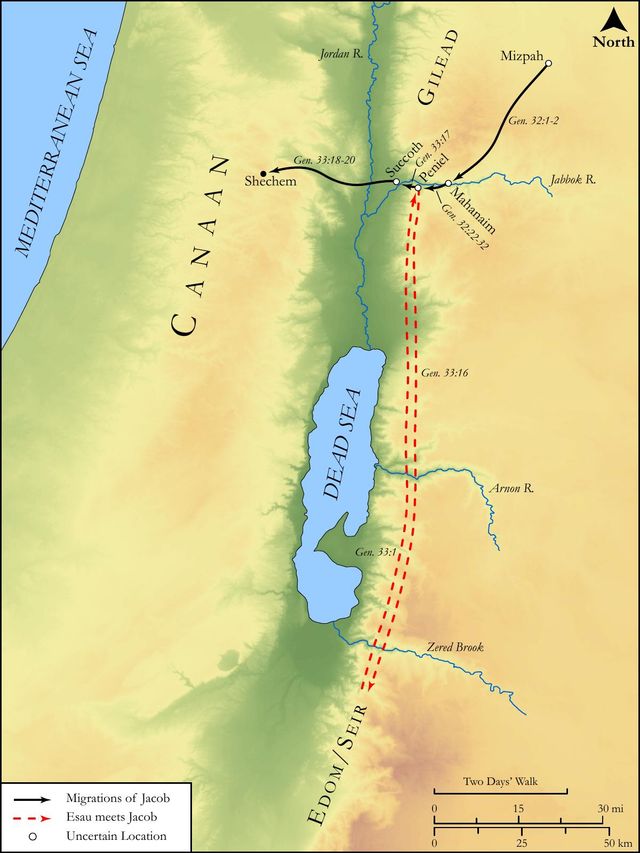
Genesis 32:6 marks a pivotal and terrifying moment for Jacob as messengers return with news of his estranged brother, Esau. After two decades of exile, Jacob is journeying back to Canaan, having cautiously sent envoys ahead to assess Esau's disposition. The report delivered here shatters any hope of an easy reunion, revealing Esau's approach with a formidable retinue of four hundred men, instantly transforming Jacob's anticipated reconciliation into a perceived existential threat and setting the stage for one of the most dramatic and faith-testing encounters in the patriarchal narrative.
Context
ShowHideLiterary Context
This verse immediately follows Jacob's strategic decision to send messengers to Esau in the land of Seir, Edom, a move made out of both prudence and apprehension regarding their unresolved past (Genesis 32:3-5). The preceding chapter, Genesis 31, details Jacob's tense departure from Laban, highlighting his increasing independence and God's faithfulness in delivering him from one difficult situation. However, the narrative quickly pivots from Laban's pursuit to the looming confrontation with Esau, underscoring that Jacob's greatest challenge lies not behind him, but ahead, in the land he is destined to inherit. The news in Genesis 32:6 directly precipitates Jacob's profound fear, his elaborate defensive strategies, and his desperate, wrestling prayer, which are detailed in the subsequent verses of Genesis 32:7-32.
Historical & Cultural Context
In the lands of the patriarchs, a large retinue of "four hundred men" (H3967, H376) was not merely a traveling party; it signified a substantial armed force, often indicative of a military expedition or a chieftain's formidable power. For Jacob, who had fled Esau's murderous rage years earlier (Genesis 27:41), such a force would immediately suggest hostile intent, a long-delayed act of revenge, rather than a peaceful welcome. The custom of sending messengers (H4397) ahead was a common diplomatic practice to announce one's arrival and gauge the reception, but the scale of Esau's response would have been deeply alarming. Jacob's past actions—his deception to secure the birthright and blessing (Genesis 27:36)—were a profound breach of familial and societal norms, carrying the potential for blood feud, making Esau's approach with a large company a culturally significant and terrifying prospect.
Key Themes
ShowHideGenesis 32:6 powerfully contributes to several key themes within the broader narrative of Jacob and the book of Genesis. It highlights the consequences of past actions, demonstrating that unaddressed sin and conflict can resurface with significant impact, demanding a reckoning. It also serves as a critical moment in the theme of divine sovereignty amidst human fear, as Jacob's overwhelming terror forces him to confront his dependence on God's promises, particularly the one given at Bethel (Genesis 28:15). Furthermore, the verse sets the stage for the theme of reconciliation and transformation, as Jacob is pushed to the brink, leading to a night of wrestling that reshapes his identity and prepares him for a surprising, grace-filled encounter with Esau (Genesis 33:4).
Exposition and Analysis
ShowHideThe return of Jacob's messengers in Genesis 32:6 delivers news that is concise yet devastating, instantly shattering any illusions Jacob might have held about an easy or peaceful reunion with his estranged brother.
Key Word Analysis
ShowHideMeaning "a messenger; specifically, of God, i.e. an angel (also a prophet, priest or teacher)." While here it refers to human envoys, the term itself carries a weight of divine communication in other contexts, subtly hinting at the providential nature of this report, however terrifying it might be to Jacob. These are the very individuals Jacob dispatched, and their return signifies the completion of his initial diplomatic overture, albeit with an unexpected and alarming outcome.
A primitive root meaning "to turn back (hence, away) transitively or intransitively, literally or figuratively)." The act of returning signifies the completion of their mission and the delivery of their findings. The verb implies a reversal of direction, and for Jacob, this return signals a reversal of his hopes for a calm re-entry into Canaan, as the news they bring immediately turns his anticipation into dread.
A primitive root meaning "to walk (in a great variety of applications, literally and figuratively); to come, go." This verb describes Esau's active movement towards Jacob. While "coming to meet" (H7125, qirʼâh) can be neutral, the addition of "four hundred men" imbues Esau's "coming" with a menacing, purposeful advance, transforming a simple encounter into a potential confrontation.
Verse Breakdown
ShowHide"And the messengers returned to Jacob, saying,"
This opening clause establishes the critical moment of information delivery. The return of the messengers (H4397, mălʼâk) signifies the culmination of Jacob's initial cautious outreach to Esau. The act of "saying" (H559, ʼâmar) introduces the verbal report, which will immediately shift the narrative's tone from hopeful anticipation to profound alarm.
"We came to thy brother Esau,"
This part of the report confirms that contact was successfully made, fulfilling Jacob's primary objective of assessing Esau's disposition. The phrase "thy brother Esau" (H251, ʼâch; H6215, ʻÊsâv) might have initially offered a fleeting glimmer of hope for a fraternal welcome, emphasizing the familial bond, however strained. This confirmation sets the stage for the crucial, subsequent detail.
"and also he cometh to meet thee,"
This clause indicates Esau's active movement towards Jacob. The Hebrew phrase liqrātəḵā (לִקְרָאתְךָ), translated "to meet thee" (H7125, qirʼâh), is inherently neutral, capable of meaning "to encounter" in either a friendly or hostile manner. However, in this specific context, especially when paired with the following information, it takes on a deeply ominous and threatening tone for Jacob, suggesting an impending confrontation rather than a peaceful reunion.
"and four hundred men with him."
This is the most critical and alarming detail of the entire report. The mention of "four hundred men" (H3967, mêʼâh; H376, ʼîysh) immediately transforms the potential meeting into a perceived military confrontation. This substantial number represents a formidable armed force in that day, far exceeding a typical retinue for a peaceful encounter. For Jacob, this detail instantly confirms his deepest fears, suggesting that Esau is approaching not for reconciliation, but for revenge, triggering his profound distress and elaborate preparations.
Literary Devices
ShowHideThe verse employs several potent literary devices to heighten the dramatic tension and convey Jacob's impending crisis. Foreshadowing is evident as the news of Esau's approach with 400 men immediately hints at a significant, potentially violent, confrontation, setting the stage for the wrestling match and the eventual reunion. The Juxtaposition of "thy brother Esau" with "four hundred men" creates a stark contrast, emphasizing the familial bond alongside the perceived military threat, thereby amplifying Jacob's fear. There is also a strong element of Suspense, as the messengers' report leaves the specific intent of Esau's large company ambiguous, forcing Jacob (and the reader) to grapple with the terrifying possibilities. The "four hundred men" function as a powerful Symbol of Esau's potential power and Jacob's vulnerability, embodying the unresolved past and the looming threat of retribution.
Theological and Thematic Connections
ShowHideGenesis 32:6 serves as a profound theological touchstone, illustrating the inescapable consequences of past actions and the crucible of faith. Jacob's deep-seated fear is a natural human response to a perceived threat rooted in his own deceit, highlighting that while God forgives, the ripple effects of sin often demand a painful reckoning. This moment forces Jacob to move beyond his habitual reliance on cunning and self-preservation, driving him to a desperate dependence on God's promises, particularly those made at Bethel. It underscores that true transformation often occurs when human strength and strategies are exhausted, paving the way for divine intervention and the surprising grace that can emerge even from the most fraught circumstances. The encounter with Esau, initiated by this alarming news, becomes a pivotal test of Jacob's faith and a testament to God's faithfulness in fulfilling His covenant, even through Jacob's profound fear and flawed character.
Reflection and Application
ShowHideThe news delivered to Jacob in Genesis 32:6 is a powerful mirror for our own lives, reflecting the anxieties we face when confronting the unresolved issues of our past or the daunting uncertainties of our future. Jacob's immediate reaction of profound fear and distress is profoundly relatable; we, too, often dread facing the consequences of our actions or stepping into situations that seem overwhelming and potentially hostile. This narrative encourages us to acknowledge that we cannot perpetually outrun the past; eventually, we must confront the repercussions of our choices, whether they stem from our own sin or from circumstances beyond our control. However, Jacob's subsequent actions—dividing his camp, praying fervently, and preparing gifts—demonstrate a vital blend of human prudence and desperate reliance on God. This serves as a powerful reminder that faith does not negate wise planning, but rather empowers it. We are called to prepare diligently, to take responsible actions, and then, most importantly, to cast our anxieties upon God, trusting in His sovereignty and His promises even when circumstances seem dire and provoke intense fear. This story challenges us to lean into God's character when our human resources are exhausted, finding peace not in the absence of threat, but in the presence of the Almighty.
Questions for Reflection
ShowHideFAQ
ShowHideWhy was Jacob so afraid of Esau's approach with 400 men?
ShowHideJacob's fear was deeply rooted in his past actions. Years earlier, he had cunningly deceived his blind father, Isaac, to steal the birthright and the patriarchal blessing from his older brother, Esau. This betrayal ignited Esau's murderous rage, leading him to vow revenge against Jacob (Genesis 27:41). The news in Genesis 32:6 that Esau was approaching with a company of 400 men—a significant armed force in that era—immediately suggested a hostile intent. For Jacob, this was not a friendly reunion but a potential military confrontation, reigniting his long-held fear that Esau was finally coming to exact his promised revenge.
What is the significance of the "four hundred men" mentioned in this verse?
ShowHideThe number 400 (H3967, mêʼâh) represents a substantial armed force in the lands of the patriarchs, far exceeding a typical traveling retinue or a small escort for a chieftain. For Jacob, this detail was critically important because it transformed the prospect of a family reunion into a perceived military confrontation. It suggested that Esau was not coming for a peaceful greeting or a simple encounter (H7125, qirʼâh), but possibly to attack Jacob and his entire family, thereby escalating Jacob's fear and prompting his immediate, elaborate defensive and appeasement strategies, including dividing his camp and preparing extensive gifts. This number underscored the severity of the perceived threat.
Christ-Centered Fulfillment
ShowHideJacob's profound fear and desperate need for reconciliation with Esau in Genesis 32:6 powerfully prefigure humanity's far greater estrangement from God due to sin. Just as Jacob faced a formidable, potentially hostile brother whose approach with "four hundred men" signaled judgment, humanity stands before a holy and righteous God, whose justice could justly condemn our rebellion. However, Christ is the ultimate mediator and reconciler, fulfilling the deeper longing for restoration that Jacob sought. Unlike Esau, who initially appears as a formidable threat but ultimately shows surprising grace and embraces Jacob (Genesis 33:4), Christ, though perfectly righteous, came not to condemn the world but to save it (John 3:17). His "meeting" with humanity on the cross was not one of judgment for those who believe, but of atonement and peace, overcoming the "four hundred men" of sin, death, and the law's condemnation that stood between us and God (Colossians 2:13-14). Through His sacrifice, He brings true reconciliation and peace between God and humanity, offering a welcome that far surpasses any earthly reunion and inviting us into a relationship of grace rather than fear (Romans 5:10-11).