


Genesis 33:1
Bible text: King James Version (1769 Blayney text) · Public domain
Bible text: King James Version with Strong's numbers · Public domain
Bible text: Berean Standard Bible · Public domain
Bible text: American Standard Version (1901) · Public domain
Bible text: World English Bible, Messianic edition · Public domain
Bible text: Geneva Bible (1599) · Public domain
Bible text: Young's Literal Translation · Public domain
- וַיִּשָּׂאvai·yi·Sa'and he lifted upH5375Conj-w ¦ V-Qal-ConsecImperf-3msVerb Qal Consecutive Imperfect 3rd Singular Masculineוַandיִּשָּׂאhe lifted up
- יַעֲקֹבya·'a·KoJacobH3290N-proper-mNoun Proper Masculine
- עֵינָיו'ei·Navhis eyesH5869N-fdc ¦ 3msNoun Dual Feminine Constructעֵינָיeyesוhis
- וַיַּרְאvai·yaR'and he sawH7200Conj-w ¦ V-Qal-ConsecImperf-3msVerb Qal Consecutive Imperfect 3rd Singular Masculineוַandיַּרְאhe saw
- וְהִנֵּהve·hi·Nehand there!H2009Conj-w ¦ PrtParticle Interjectionוְandהִנֵּהthere!
- עֵשָׂו'e·SavEsauH6215N-proper-mNoun Proper Masculine
- בָּאBa'[was] comingH935V-Qal-Prtcpl-msVerb Qal Participle Singular Masculine Absolute
- וְעִמּוֹve·'i·Moand [were] with himH5973Conj-w ¦ Prep ¦ 3msPreposition Definiteוְandעִמּ[were] withוֹhim
- אַרְבַּע'ar·Ba'fourH702Adj-cscAdjective Numerical Singular common gender Construct
- מֵאוֹתme·'othundred<s>H3967Adj-fpAdjective Numerical Plural Feminine Absolute
- אִישׁ'IshmanH376N-msNoun Singular Masculine Absolute
- וַיַּחַץvai·Ya·chatzand he dividedH2673Conj-w ¦ V-Qal-ConsecImperf-3msVerb Qal Consecutive Imperfect 3rd Singular Masculineוַandיַּחַץhe divided
- אֶת'et<obj.>H853DirObjMParticle Object Indicator
- הַיְלָדִיםhay·la·Dimthe childrenH3206Art ¦ N-mpNoun Plural Masculine Absoluteהַtheיְלָדִיםchildren
- עַל'alwithH5921PrepPreposition
- לֵאָהle·'AhLeahH3812N-proper-fNoun Proper Feminine
- וְעַלve·'aland withH5921Conj-w ¦ PrepPrepositionוְandעַלwith
- רָחֵלra·ChelRachelH7354N-proper-fNoun Proper Feminine
- וְעַלve·'Aland withH5921Conj-w ¦ PrepPrepositionוְandעַלwith
- שְׁתֵּיshe·Tei[the] twoH8147Adj-fdcAdjective Numerical Dual Feminine Construct
- הַשְּׁפָחוֹתha·she·fa·Chotthe maidservantsH8198Art ¦ N-fpNoun Plural Feminine Absoluteהַtheשְּׁפָחוֹתmaidservants
English is a literal word-by-word gloss of the Hebrew, not the KJV's wording. Why?
This is the original text the KJV's translators worked from — each Hebrew word with its own literal English meaning in this verse, prepared by scholars at Tyndale House, Cambridge. The KJV translates whole sentences, not word by word, so its wording differs: one Hebrew word can become several English words, and the KJV may choose “the LORD” where the gloss reads “Yahweh”. Both are faithful — they answer different questions. For the KJV's own rendering, switch to the KJV text.
Details
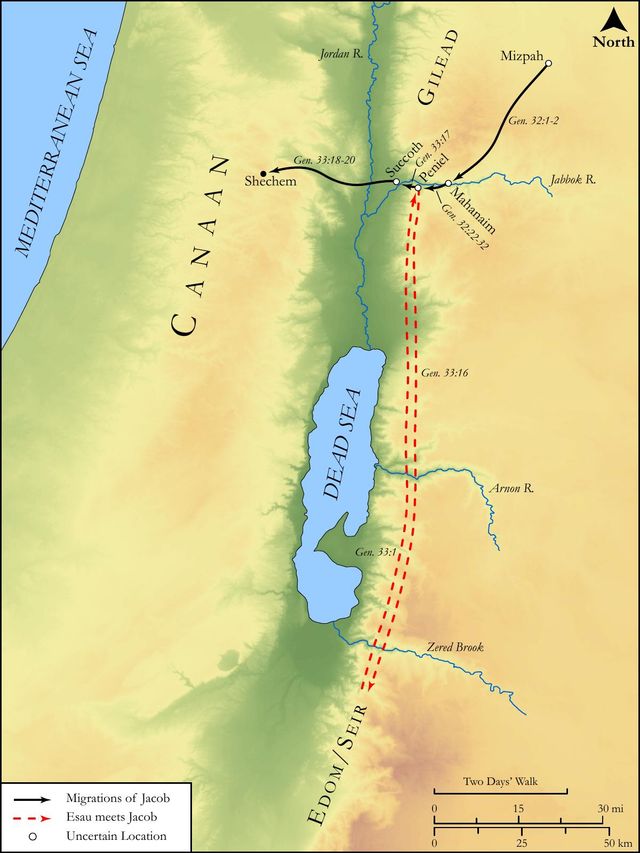
See on the biblical-era maps


Study this verse
Public-domain commentary
Matthew Henry
From his Commentary on the Whole Bible. Henry comments on passages, not single verses — this entry covers Genesis 33:1–4. His three-level outline is real structure in the source text, so it is rendered as structure.
Here, I. Jacob discovered Esau's approach, Gen 33:1. Some think that his lifting up his eyes denotes his cheerfulness and confidence, in opposition to a dejected countenance; having by prayer committed his case to God, he went on his way, and his countenance was no more sad, Sa1 1:18. Note, Those that have cast their care upon God may look before them with satisfaction and composure of mind, cheerfully expecting the issue, whatever it may be; come what will, nothing can come amiss to him whose heart is fixed, trusting in God. Jacob sets himself upon his watch-tower to see what answer God will give to his prayers, Hab 2:1.
II.He put his family into the best order he could to receive him, whether he should come as a friend or as an enemy, consulting their decency if he came as a friend and their safety if he came as an enemy, Gen 33:1, Gen 33:2. Observe what a different figure these two brothers made. Esau is attended with a guard of 400 men, and looks big; Jacob is followed by a cumbersome train of women and children that are his care, and he looks tender and solicitous for their safety; and yet Jacob had the birthright, and was to have the dominion, and was every way the better man. Note, It is no disparagement to very great and good men to give a personal attendance to their families, and to their family affairs. Jacob, at the head of his household, set a better example than Esau at the head of his regiment.
III.At their meeting, the expressions of kindness were interchanged in the best manner that could be between them.
1.Jacob bowed to Esau, Gen 33:3. Though he feared Esau as an enemy, yet he did obeisance to him as an elder brother, knowing and remembering perhaps that when Abel was preferred in God's acceptance before his elder brother Cain, yet God undertook for him to Cain that he should not be wanting in the duty and respect owing by a younger brother. Unto thee shall be his desire, and thou shalt rule over him, Gen 4:7. Note,
(1.)The way to recover peace where it has been broken is to do our duty, and pay our respects, upon all occasions, as if it had never been broken. It is the remembering and repeating of matters that separates friends and perpetuates the separation.
(2.)A humble submissive carriage goes a great way towards the turning away of wrath. Many preserve themselves by humbling themselves: the bullet flies over him that stoops.
2.Esau embraced Jacob (Gen 33:4): He ran to meet him, not in passion, but in love; and, as one heartily reconciled to him, he received him with all the endearments imaginable, embraced him, fell on his neck, and kissed him. Some think that when Esau came out to meet Jacob it was with no bad design, but that he brought his 400 men only for state, that he might pay so much the greater respect to his returning brother. It is certain that Jacob understood the report of his messengers otherwise, Gen 32:5, Gen 32:6. Jacob was a man of prudence and fortitude, and we cannot suppose him to admit of a groundless fear to such a degree as he did this, nor that the Spirit of God would stir him up to pray such a prayer as he did for deliverance from a merely imaginary danger: and, if there was not some wonderful change wrought upon the spirit of Esau at this time, I see not how wrestling Jacob could be said to obtain such power with men as to denominate him a prince. Note,
(1.)God had the hearts of all men in his hands, and can turn them when and how he pleases, by a secret, silent, but resistless power. He can, of a sudden, convert enemies into friends, as he did two Sauls, one by restraining grace (Sa1 26:21, Sa1 26:25), the other by renewing grace, Act 9:21, Act 9:22.
(2.)It is not in vain to trust in God, and to call upon him in the day of trouble; those that do so often find the issue much better than they expected.
3.They both wept. Jacob wept for joy, to be thus kindly received by his brother whom he had feared; and Esau perhaps wept for grief and shame, to think of the bad design he had conceived against his brother, which he found himself strangely and unaccountably prevented from executing.
Historical interpretation
Historical reception
1 surviving comment on this verse from the historical church.
(Chapter 33, verses 1 and 2.) And he divided the children over Leah and over Rachel, and over the two maidservants, and he placed the maidservants and their firstborn sons: but Leah and her youngest sons, and Rachel and Joseph the youngest. And he himself went before them. No, as most people think, he did not make three groups, but two. In conclusion, where we have it, he divided, Aquila placed, halfed, that is, halved: so that he would make one group of maidservants with their little ones, and another of Leah and Rachel, who were free, with their sons: and he made the maidservants go first and the free women second: but he himself went before both groups, to meet his brother and pay homage.
Continue studying Genesis 33:1 across the web’s major study libraries — every link below opens this exact verse, chapter, or book on the destination site.
Read & Compare
 BibleGatewayThis verse in more than 200 translations and 70 languages.
 Bible.comThe YouVersion reader — hundreds of translations, reading plans, and highlights.
 ESV.orgCrossway's official English Standard Version reader.
 NET BibleThe NET translation with 60,000+ translators' notes on every rendering decision.
 STEP BibleTyndale House's free study tool — original text, vocabulary, and scholarly resources.
 BibliaLogos Bible Software's free web reader.
 USCCBThe New American Bible (Revised Edition) with the U.S. bishops' study notes.
Commentaries
 BibleHub CommentariesDozens of classic commentaries on this verse, gathered on one page.
 StudyLightMore than 100 commentary sets — the largest collection on the web.
 BibleRefPlain-English commentary on what this verse means, verse by verse.
 Enduring WordDavid Guzik's free commentary on this chapter, widely used by Bible teachers.
 Bible Study ToolsVerse commentary alongside Greek and Hebrew study aids.
Original Language & Research
- BibleHub InterlinearThe verse word by word — original language, transliteration, and English.
- BibleHub LexiconEvery word's original-language definition and Strong's entry.
 Blue Letter BibleDeep-study tools — Strong's numbers, concordance, and word studies.
 SefariaThe Hebrew text with Rashi and centuries of Jewish commentary.
Sermons, Hymns & Audio


TrulyRandomVerse is not affiliated with these sites and doesn’t control their content. They’re linked because they’re genuinely useful.
Summary
Genesis 33:1 marks the dramatic and long-anticipated climax of Jacob's return to Canaan, as he lifts his eyes to behold his estranged brother Esau approaching with a formidable retinue of four hundred men. This sight, confirming Jacob's deepest fears of a vengeful confrontation, immediately prompts him to strategically divide his family—his children, wives, and handmaids—into separate groups, positioning them in an order designed to mitigate potential harm and maximize their chances of survival in what he perceives as an imminent and perilous encounter.
Context
ShowHideLiterary Context
This verse is the pivotal moment in a narrative arc that began with Jacob's flight from Esau's wrath in Genesis 27. After two decades in Haran, serving Laban and building a large family and fortune, Jacob is commanded by God to return to his homeland (Genesis 31:3). His journey is fraught with apprehension, culminating in his desperate prayer for deliverance from Esau (Genesis 32:9-12) and the transformative, all-night wrestling match at Peniel, where he receives the new name Israel (Genesis 32:24-32). Genesis 33:1 directly follows these spiritual preparations, setting the stage for the physical manifestation of the threat Jacob has so diligently prepared for and feared. The immediate sight of Esau with 400 men tests the very faith and blessing Jacob had just received.
Historical & Cultural Context
Among the chieftains of that day, the presence of a large retinue, such as Esau's four hundred men, could signify various things: a chieftain's personal guard, a display of wealth and power, or a war party. Given the history between Jacob and Esau—specifically Esau's vow of vengeance in Genesis 27:41—Jacob's interpretation of this large company as a military threat was entirely reasonable within the cultural norms of the time. Patriarchal societies often resolved disputes through force, and the protection of one's household, including wives, children, and possessions, was a paramount concern. Jacob's strategic division of his family reflects a common ancient tactical maneuver to minimize losses in the face of a superior force, placing the most vulnerable or cherished members in a relatively safer position.
Key Themes
ShowHideGenesis 33:1 brings several key themes to the forefront. Firstly, it highlights the theme of divine faithfulness versus human fear. Despite God's explicit command for Jacob to return and His promise of protection (Genesis 28:15), Jacob's human apprehension remains palpable. Secondly, the passage underscores the consequences of past actions; Jacob's deceit of Esau decades earlier is now forcing a reckoning. Thirdly, it sets the stage for the theme of reconciliation and forgiveness, as the anticipated conflict gives way to an unexpected embrace in the verses that follow. Finally, the narrative continues the theme of God's sovereign control over seemingly insurmountable human challenges, demonstrating His ability to orchestrate outcomes beyond human expectation or fear, even as Jacob takes prudent human precautions.
Exposition and Analysis
ShowHideKey Word Analysis
ShowHideA primitive root meaning to lift, in a great variety of applications, literal and figurative. In this context, it signifies a deliberate action of raising his gaze, emphasizing the intentionality and significance of Jacob's observation. It's not a casual glance but a focused, apprehensive look towards the approaching threat.
A primitive root meaning to see, literally or figuratively. This word denotes the act of perceiving or discerning. Paired with "lifted up his eyes," it emphasizes Jacob's direct and immediate visual confirmation of Esau's approach, solidifying his fears and prompting his swift, strategic response.
A primitive root meaning to cut or split in two; to halve. This term precisely describes Jacob's tactical maneuver of separating his household into distinct groups. It highlights his calculated and decisive action to mitigate risk, reflecting his shrewdness and deep concern for his family's safety in the face of perceived danger.
Verse Breakdown
ShowHide"And Jacob lifted up his eyes, and looked,"
This opening phrase immediately places the reader into Jacob's perspective, emphasizing his direct and intentional observation of the approaching situation. The idiom "lifted up his eyes" suggests a moment of heightened awareness and apprehension, as he scans the horizon for the brother he has dreaded meeting for two decades. The act of "looking" confirms his fears, bringing the long-anticipated encounter into sharp, terrifying focus.
"and, behold, Esau came, and with him four hundred men."
The interjection "behold" (Hebrew hinneh) serves to heighten the dramatic tension, signaling a sudden and impactful revelation. The sight of Esau, not alone, but accompanied by a formidable force of "four hundred men," immediately confirms Jacob's worst fears. This large retinue would have been interpreted by Jacob as a military escort, a clear sign of hostile intent, and a powerful display of strength, underscoring the perceived danger and the potential for a violent confrontation.
"And he divided the children unto Leah, and unto Rachel, and unto the two handmaids."
Jacob's immediate response to this daunting sight is a pragmatic and strategic one. He "divided" his family, a tactical maneuver to minimize potential casualties in the event of an attack. The specific order of division—handmaids and their children first, then Leah and her children, and finally Rachel and Joseph (implied by the subsequent verses)—reflects Jacob's prioritization of safety, placing those he valued most (Rachel and her son) in the rear, furthest from the initial point of contact and potential danger. This action underscores both his human fear and his shrewd, protective instincts.
Literary Devices
ShowHideThe verse employs several significant literary devices. The phrase "Jacob lifted up his eyes, and looked" is a biblical idiom that emphasizes a deliberate and significant act of observation, often preceding a crucial event or revelation. The use of the interjection "behold" (Hebrew hinneh) creates a sense of immediate dramatic impact and urgency, drawing the reader's attention to the sudden and formidable appearance of Esau and his men. This also contributes to foreshadowing, as Jacob's fear and strategic division of his family hint at an impending conflict, though the actual outcome will later reveal dramatic irony in Esau's unexpected embrace. The "four hundred men" serve as a symbol of power and potential threat, representing the magnitude of Jacob's apprehension and the perceived danger. Finally, Jacob's act of "dividing" his family is a clear example of pragmatism and strategic planning in the face of perceived adversity.
Theological and Thematic Connections
ShowHideGenesis 33:1 is a powerful testament to the tension between human fear and divine sovereignty. Jacob's meticulous preparations and palpable dread highlight the natural human response to anticipated danger, especially when facing the consequences of past sin. Yet, the narrative, read in its broader context, subtly underscores God's unwavering faithfulness to His covenant promises, even when His people act in fear or doubt. This encounter becomes a profound illustration of how God can orchestrate surprising reconciliation and grace, turning what appears to be an inevitable confrontation into a moment of restoration, demonstrating His power to redeem even the most fractured relationships. It reminds us that God's plans often transcend our anxieties and human calculations.
Reflection and Application
ShowHideGenesis 33:1 offers profound insights into the human condition when confronted with long-dreaded circumstances and the anxieties they provoke. Jacob's immediate and strategic response to the sight of Esau's formidable company—dividing his family for protection—is a relatable portrayal of human prudence and fear. This passage encourages us to acknowledge our fears and to take wise, practical steps in preparation for challenges, just as Jacob did. However, it also subtly reminds us that even our most careful planning operates within the larger framework of God's sovereign will. Jacob had just wrestled with God and received a blessing, yet his fear remained. This teaches us that spiritual encounters do not always remove immediate anxieties, but they equip us to face them with a deeper trust in God's ultimate control. We are called to pray fervently, prepare diligently, and then, like Jacob, step forward in faith, trusting that God's faithfulness will prevail, often in ways we least expect.
Questions for Reflection
ShowHideFAQ
ShowHideWhy did Esau come with four hundred men?
ShowHideThe biblical text does not explicitly state Esau's intentions for bringing four hundred men, leading to various interpretations. From Jacob's perspective, given their history and Esau's past vow of vengeance (Genesis 27:41), this large company would have been reasonably interpreted as a military threat or a show of force. However, among the chieftains of that day, a large retinue could also signify a chieftain's wealth, power, and status, or simply be his extended household and followers. The narrative's subsequent events, where Esau embraces Jacob (Genesis 33:4), suggest that his intentions were not hostile, but rather a demonstration of his status and perhaps a desire for reconciliation.
Why did Jacob divide his family in that specific order?
ShowHideJacob's strategic division of his family was a tactical maneuver designed to minimize potential losses in the event of an attack. The order—first the two handmaids (Bilhah and Zilpah) and their children, then Leah and her children, and finally Rachel and Joseph (her only son at that time)—reflects Jacob's deep affection and prioritization. By placing Rachel and Joseph, his most beloved wife and her son, at the very rear, he positioned them furthest from the immediate danger, providing them with the best chance of escape if the initial groups were overwhelmed. This arrangement demonstrates Jacob's shrewdness and his profound desire to protect those dearest to him.
How does Jacob's wrestling match with God relate to this encounter?
ShowHideJacob's wrestling match at Peniel (meaning "Face of God") immediately precedes his encounter with Esau and is intrinsically linked to it. This transformative spiritual experience, where Jacob wrestled with God (or an angel), received a new name, Israel ("he struggles with God"), and was blessed, served as a crucial spiritual preparation. Despite the physical manifestation of his fear in Genesis 33:1, the Peniel encounter provided Jacob with a renewed sense of God's presence, power, and faithfulness. It underscored that even in his human weakness (symbolized by his lasting limp), God was with him, strengthening him to face his greatest earthly fear and ultimately leading to an unexpected reconciliation rather than the anticipated conflict.
Christ-Centered Fulfillment
ShowHideGenesis 33:1 powerfully prefigures the profound reconciliation and unmerited grace found in Christ. Jacob, the deceiver and supplanter, faces the long-dreaded consequences of his past sin, anticipating deserved judgment from his wronged brother Esau. This mirrors humanity's estranged state from a holy God due to sin, where we might anticipate divine wrath. Yet, just as Jacob receives an unexpected, loving embrace from Esau in the subsequent verses, so too does humanity receive unmerited reconciliation and peace through the atoning work of Jesus Christ. Christ is the ultimate Reconciler, who, through His sacrifice on the cross, disarms the "enmity" between God and humanity (Ephesians 2:14-16), turning anticipated judgment into a loving, gracious welcome into God's family. Jacob's deliverance from a seemingly insurmountable threat points to the ultimate deliverance from sin, death, and the power of the adversary offered by Jesus, who has overcome the world (John 16:33) and brings us into a relationship of profound peace with God (Romans 5:1).