


Acts 9:21
- ἐξίσταντοexistantoWere amazedG1839V-IMI-3PVerb Imperfect Middle Indicative 3rd Plural
- δὲdethenG1161CONJConjunction
- πάντεςpantesallG3956A-NPMAdjective Nominative Plural Masculine
- οἱhoithoseG3588T-NPMDefinite article Nominative Plural Masculine
- ἀκούοντεςakouonteshearingG191V-PAP-NPMVerb Present Active Participle Nominative Plural Masculine
- καὶkaiandG2532CONJConjunction
- ἔλεγον·elegonwere sayingG3004V-IAI-3PVerb Imperfect Active Indicative 3rd Plural
- οὐχouchSurelyG3756PRT-NNegative Particle Negative
- οὗτόςhoutosthisG3778D-NSMDemonstrative pronoun Nominative Singular Masculine
- ἐστινestinisG1510V-PAI-3SVerb Present Active Indicative 3rd Singular
- ὁhothe [one]G3588T-NSMDefinite article Nominative Singular Masculine
- πορθήσαςporthēsashaving caused havocG4199V-AAP-NSMVerb Aorist Active Participle Nominative Singular Masculine
- εἰςeisinG1519PREPPreposition
- ἸερουσαλὴμIerousalēmJerusalemG2419N-ASF-LNoun Accusative Singular Feminine Location
- τοὺςtousthoseG3588T-APMDefinite article Accusative Plural Masculine
- ἐπικαλουμένουςepikaloumenouscalling onG1941V-PMP-APMVerb Present Middle Participle Accusative Plural Masculine
- τὸto<the>G3588T-ASNDefinite article Accusative Singular Neuter
- ὄνομαonomanameG3686N-ASNNoun Accusative Singular Neuter
- τοῦτο;toutothis?G3778D-ASNDemonstrative pronoun Accusative Singular Neuter
- καὶkaiAndG2532CONJConjunction
- ὧδεhōdehereG5602ADVAdverb
- εἰςeisforG1519PREPPreposition
- τοῦτοtoutothisG3778D-ASNDemonstrative pronoun Accusative Singular Neuter
- ἐληλύθειelēlutheihe had comeG2064V-2LAI-3SVerb 2nd Pluperfect Active Indicative 3rd Singular
- ἵναinathatG2443CONJConjunction
- δεδεμένουςdedemenousboundG1210V-RPP-APMVerb Perfect Passive Participle Accusative Plural Masculine
- αὐτοὺςautousthemG846P-APMPersonal pronoun Accusative Plural Masculine
- ἀγάγῃagagēhe may bringG71V-2AAS-3SVerb 2nd Aorist Active Subjunctive 3rd Singular
- ἐπὶepitoG1909PREPPreposition
- τοὺςtoustheG3588T-APMDefinite article Accusative Plural Masculine
- ἀρχιερεῖςarchiereischief priestsG749N-APMNoun Accusative Plural Masculine
English is a literal word-by-word gloss of the Greek, not the KJV's wording. Why?
This is the original text the KJV's translators worked from — each Greek word with its own literal English meaning in this verse, prepared by scholars at Tyndale House, Cambridge. The KJV translates whole sentences, not word by word, so its wording differs: one Greek word can become several English words, and the KJV may choose “charity” where the gloss reads “love”. Both are faithful — they answer different questions. For the KJV's own rendering, switch to the KJV text.
Details
See on the biblical-era map
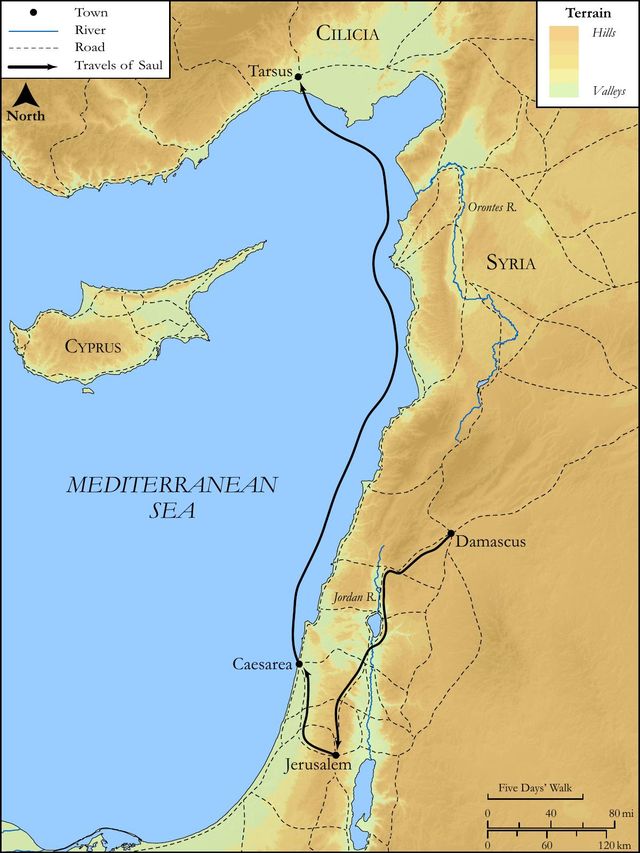
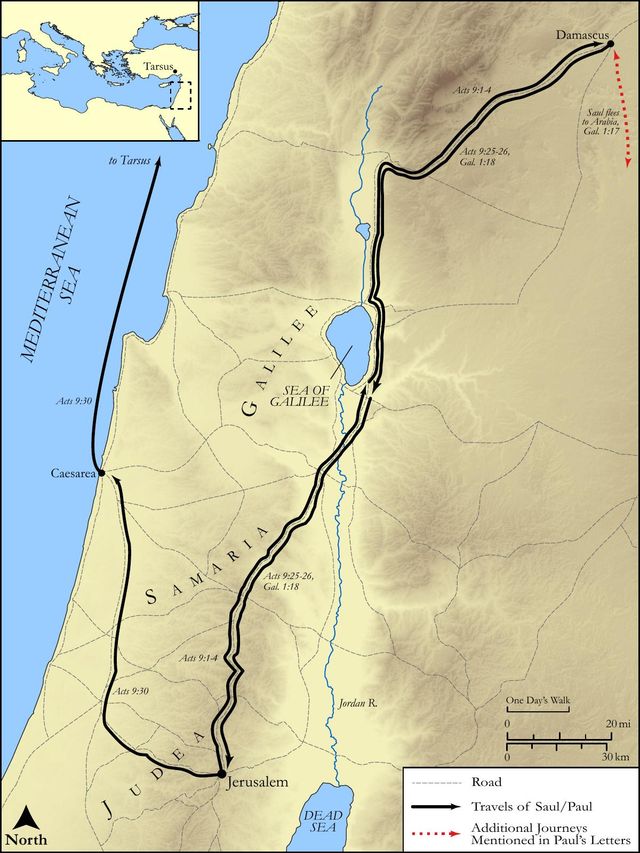
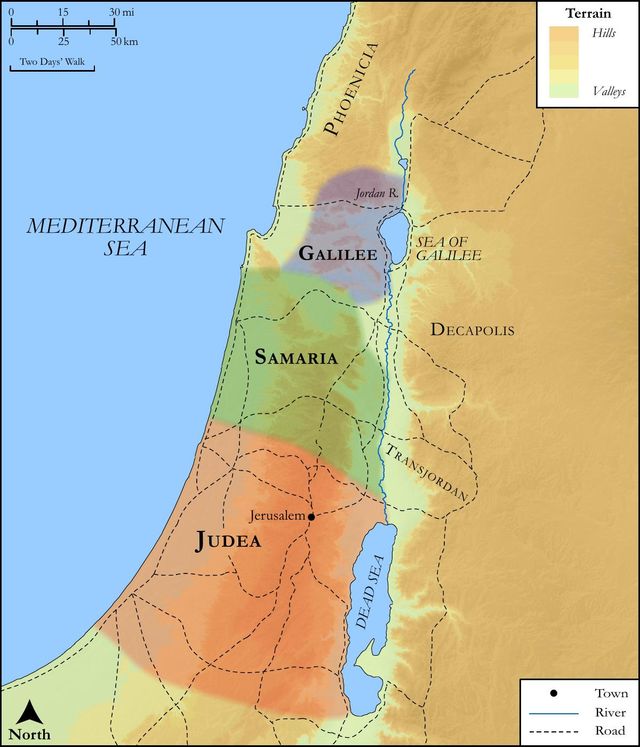
Study this verse
Public-domain commentary
Matthew Henry
From his Commentary on the Whole Bible. Henry comments on passages, not single verses — this entry covers Acts 9:10–22. His four-level outline is real structure in the source text, so it is rendered as structure.
As for God, his work is perfect; if he begin, he will make an end: a good work was begun in Saul, when he was brought to Christ's feet, in that word, Lord, what wilt thou have me to do? And never did Christ leave any that were brought to that. Though Saul was sadly mortified when he lay three days blind, yet he was not abandoned. Christ here takes care of the work of his own hands. He that hath torn will heal - that hath smitten will bind up - that hath convinced will comfort.
I.Ananias is here ordered to go and look after him, to heal and help him; for he that causeth grief will have compassion.
1.The person employed is Ananias, a certain disciple at Damascus, not lately driven thither from Jerusalem, but a native of Damascus; for it is said (Act 22:12) that he had a good report of all the Jews who dwelt there, as a devout man according to the law; he had lately embraced the gospel, and given up his name to Christ, and, as it should seem, officiated as a minister, at least pro hac vice - on this occasion, though it does not appear that he was apostolically ordained. But why were not some of the apostles from Jerusalem sent for upon this great occasion, or Philip the evangelist, who had lately baptized the eunuch, and might have been fetched hither by the Spirit in a little time? Surely, because Christ would employ variety of hands in eminent services, that the honours might not be monopolized nor engrossed by a few - because he would put work into the hands, and thereby put honour upon the heads, of those that were mean and obscure, to encourage them - and because he would direct us to make much of the ministers that are where our lot is cast, if they have ordained mercy to be faithful, though they are not of the most eminent.
2.The direction given him is to go and enquire at such a house, probably an inn, for one Saul of Tarsus. Christ, in a vision, called to Ananias by name, Act 9:10. It is probable it was not the first time that he had heard the words of God, and seen the visions of the Almighty; for, without terror or confusion, he readily answers, "Behold I am here, Lord, ready to go wherever thou sendest me, and to do whatever thou biddest me." Go then, saith Christ, into the street which is called Straight, and enquire in the house of Judas (where strangers used to lodge) for one called Saul of Tarsus. Note, Christ very well knows where to find out those that are his, in their distresses: when their relations, it may be, know not what is become of them, they have a friend in heaven, that knows in what street, in what house, nay, and which is more, in what frame they are: he knows their souls in adversity.
3.Two reasons are given him why he must go and enquire for this stranger, and offer him his service -
(1.)Because he prays, and his coming to him must answer his prayer. This is a reason,
[1.]Why Ananias needed not to be afraid of him, as we find he was, Act 9:13, Act 9:14. There is no question, saith Christ, but he is a true convert, for behold he prayeth. Behold denotes the certainty of it: "Assure thyself it is so; go and see." Christ was so pleased to find Paul praying that he must have others to take notice of it: Rejoice with me, for I have found the sheep which I had lost. It denotes also the strangeness of it: "Behold, and wonder, that he who but the other day breathed nothing but threatenings and slaughter, now breathes nothing but prayer." But was it such a strange thing for Saul to pray? Was he not a Pharisee? and have we not reason to think he did, as the rest of them did, make long prayers in the synagogues and the corners of the streets? Yes; but now he began to pray after another manner than he had done; then he said his prayers, now he prayed them. Note, Regenerating grace evermore sets people on praying; you may as soon find a living man without breath as a living Christian without prayer; if breathless, lifeless; and so, if prayerless, graceless.
[2.]As a reason why Ananias must go to him with all speed. It is no time to linger, for behold he prayeth: if the child cry, the tender nurse will hasten to it with the breast. Saul here, like Ephraim, is bemoaning himself, as a bullock unaccustomed to the yoke, and kicking against the goad. "Oh! go to him quickly, and tell him he is a dear son, a pleasant child, and since I spoke against him, for persecuting me, I do earnestly remember him still." Jer 31:18-20. Observe what condition Saul was now in. He was under conviction of sin, trembling and astonished; the setting of sin in order before us should drive us to prayer. He was under a bodily affliction, blind and sick; and, Is any afflicted? Let him pray. Christ had promised him that it should be further told him what he should do (Act 9:6), and he prays that one may be sent to him to instruct him. Note, What God has promised we must pray for; he will for this be enquired of, and particularly for divine instruction.
(2.)Because he hath seen in a vision such a man coming to him, to restore him to his sight; and Ananias's coming to him must answer his dream, for it was of God (Act 9:12): He hath seen in a vision a man named Ananias, and just such a man as thou art, coming in seasonably for his relief, and putting his hand on him that he might receive his sight. Now this vision which Paul had may be considered,
[1.]As an immediate answer to his prayer, and the keeping up of that communion with God which he had entered into by prayer. He had, in prayer, spread the misery of his own case before God, and God presently manifests himself and the kind intentions of his grace to him; and it is very encouraging to know God's thoughts to us-ward.
[2.]As designed to raise his expectations, and to make Ananias's coming more welcome to him. He would readily receive him as a messenger from God when he was told beforehand, in vision, that one of that name would come to him. See what a great thing it is to bring a spiritual physician and his patient together: here were two visions in order to it. When God, in his providence, does it without visions, brings a messenger to the afflicted soul, an interpreter, one among a thousand, to show unto man his uprightness, it must be acknowledged with thankfulness to his praise.
II.Ananias objects against going to him, and the Lord answers the objection. See how condescendingly the Lord admits his servant to reason with him.
1.Ananias pleads that this Saul was a notorious persecutor of the disciples of Christ, Act 9:13, Act 9:14. (1.) He had been so at Jerusalem: "Lord, I have heard by many of this man, what a malicious enemy he is to the gospel of Christ: all those that were scattered upon the late persecution, many of whom are come to Damascus, tell how much evil he hath done to thy saints in Jerusalem, that he was the most virulent, violent persecutor of all, and a ringleader in the mischief - what havoc he has made in the church: there was no man they were more afraid of, no, not the high priest himself, than of Saul; nay," (2.) "His errand to Damascus at this time is to persecute us Christians: Here he has authority from the chief priests to bind all that call on thy name, to treat the worshippers of Christ as the worst of criminals." Now, why does Ananias object this. Not, "Therefore I do not owe him so much service. Why should I do him a kindness who has done and designed us so much unkindness?" No, Christ has taught us another lesson, to render good for evil, and pray for our persecutors; but if he be such a persecutor of Christians, [1.] Will it be safe for Ananias to go to him? Will he not throw himself like a lamb into the mouth of a lion? And, if he thus bring himself into trouble, he will be blamed for his indiscretion. [2.] Will it be to any purpose to go to him? Can such a hard heart ever be softened, or such an Ethiopian ever change his skin?
2.Christ overrules the objection (Act 9:15, Act 9:16): "Do not tell me how bad he has been, I know it very well; but go thy way with all speed, and give him all the help thou canst, for he is a chosen vessel, or instrument, unto me; I design to put confidence in him, and then thou needest not fear him." He was a vessel in which the gospel-treasure should be lodged, in order to the conveyance of it to many; an earthen vessel (Co2 4:7), but a chosen vessel. The vessel God uses he himself chooses; and it is fit he should himself have the choosing of the instruments he employs (Joh 15:16): You have not chosen me, but I have chosen you. He is a vessel of honour, and must not be neglected in his present forlorn condition, nor thrown away as a despised broken vessel, or a vessel in which there is no pleasure. He is designed,
(1.)For eminent services: He is to bear my name before the Gentiles, is to be the apostle of the Gentiles, and to carry the gospel to heathen nations. Christ's name is the standard to which souls must be gathered, and under which they must be enlisted, and Saul must be a standard-bearer. He must bear Christ's name, must bear witness to it before kings, king Agrippa and Caesar himself; nay, he must bear it before the children of Israel, though there were so many hands already at work about them.
(2.)For eminent sufferings (Act 9:16): I will show him how great things he must suffer for my name's sake. He that has been a persecutor shall be himself persecuted. Christ's showing him this intimates either his bringing him to these trials (as Psa 60:3), Thou hast shown thy people hard things, or his giving notice of them beforehand, that they might be no surprise to him. Note, Those that bear Christ's name must expect to bear the cross for his name; and those that do most for Christ are often called out to suffer most for him. Saul must suffer great things. This, one would think, was a cold comfort for a young convert; but it is only like telling a soldier of a bold and brave spirit, when he is enlisted, that he shall take the field, and enter upon action, shortly. Saul's sufferings for Christ shall redound so much to the honour of Christ and the service of the church, shall be so balanced with spiritual comforts and recompensed with eternal glories, that it is no discouragement to him to be told how great things he must suffer for Christ's name's sake.
III.Ananias presently goes on Christ's errand to Saul, and with good effect.
He had started an objection against going to him, but, when an answer was given to it, he dropped it, and did not insist upon it. When difficulties are removed, what have we to do but to go on with our work, and not hang upon an objection?
1.Ananias delivered his message to Saul, Act 9:17. Probably he found him in bed, and applied to him as a patient.
(1.)He put his hands on him. It was promised, as one of the signs that should follow those that believe, that they should lay hands on the sick, and they should recover (Mar 16:18), and it was for that intent that he put his hands on him. Saul came to lay violent hands upon the disciples at Damascus, but here a disciple lays a helping healing hand upon him. The blood-thirsty hate the upright, but the just seek his soul.
(2.)He called him brother, because he was made a partaker of the grace of God, though not yet baptized; and his readiness to own him as a brother intimated to him God's readiness to own him as a son, though he had been a blasphemer of God and a persecutor of his children.
(3.)He produces his commission from the same hand that had laid hold on him by the way, and now had him in custody. "That same Jesus that appeared unto thee in the way as thou camest, and convinced thee of thy sin in persecuting him, has now sent me to thee to comfort thee." Una eademque manus vulnus opemque tulit - The hand that wounded heals. "His light struck thee blind, but he hath sent me to thee that thou mightest receive thy sight; for the design was not to blind thine eyes, but to dazzle them, that thou mightest see things by another light: he that then put clay upon thine eyes hath sent me to wash them, that they may be cured." Ananias might deliver his message to Saul very appositely in the prophet's words (Hos 6:1, Hos 6:2): Come and turn to the Lord, for he hath torn and he will heal thee; he hath smitten, and he will bind thee up; now after two days he will revive thee, and the third day he will raise thee up, and thou shalt live in his sight. Corrosives shall be no more applied, but lenitives.
(4.)He assures him that he shall not only have his sight restored, but be filled with the Holy Ghost: he must himself be an apostle, and must in nothing come behind the chief of the apostles, and therefore must receive the Holy Ghost immediately, and not, as others did, by the interposition of the apostles; and Ananias's putting his hands upon him before he was baptized was for the conferring of the Holy Ghost.
2.Ananias saw the good issue of his mission.
(1.)In Christ's favour to Saul. At the word of Ananias, Saul was discharged from his confinement by the restoring of his sight; for Christ's commission to open the prison to those that were bound (Isa 61:1) is explained by the giving of sight to the blind, Luk 4:18; Isa 42:7. Christ's commission is to open the blind eyes, and to bring out the prisoners from the prison. Saul is delivered from the spirit of bondage by receiving sight (Act 9:18), which was signified by the falling of scales from his eyes; and this immediately, and forthwith: the cure was sudden, to show that it was miraculous. This signified the recovering of him,
[1.]From the darkness of his unconverted state. When he persecuted the church of God, and walked in the spirit and way of the Pharisees, he was blind; he saw not the meaning either of the law or of the gospel, Rom 7:9. Christ often told the Pharisees that they were blind, and could not make them sensible of it; they said, We see, Joh 9:41. Saul is saved from his Pharisaical blindness, by being made sensible of it. Note, Converting grace opens the eyes of the soul, and makes the scales to fall from them (Act 26:18), to open men's eyes, and turn them from darkness to light: this was what Saul was sent among the Gentiles to do, by the preaching of the gospel, and therefore must first experience it in himself.
[2.]From the darkness of his present terrors, under the apprehension of guilt upon his conscience, and the wrath of God against him. This filled him with confusion, during those three days he sat in darkness, like Jonah for three days in the belly of hell; but now the scales fell from his eyes, the cloud was scattered, and the Sun of righteousness rose upon his soul, with healing under his wings.
(2.)In Saul's subjection to Christ: He was baptized, and thereby submitted to the government of Christ, and cast himself upon the grace of Christ. Thus he was entered into Christ's school, hired into his family, enlisted under his banner, and joined himself to him for better for worse. The point was gained: it is settled; Saul is now a disciple of Christ, not only ceases to oppose him, but devotes himself entirely to his service and honour.
IV.The good work that was begun in Saul is carried on wonderfully; this new-born Christian, though he seemed as one born out of due time, yet presently comes to maturity.
1.He received his bodily strength, Act 9:19. He had continued three days fasting, which, with the mighty weight that was all that time upon his spirits, had made him very weak; but, when he had received meat, he was strengthened, Act 9:19. The Lord is for the body, and therefore care must be taken of it, to keep it in good plight, that it may be fit to serve the soul in God's service, and that Christ may be magnified in it, Phi 1:20.
2.He associated with the disciples that were at Damascus, fell in with them, conversed with them, went to their meetings, and joined in communion with them. He had lately breathed out threatenings and slaughter against them, but now breathes love and affection to them. Now the wolf dwells with the lamb, and the leopard lies down with the kid, Isa 11:6. Note, Those that take God for their God take his people for their people. Saul associated with the disciples, because now he saw an amiableness and excellency in them, because he loved them, and found that he improved in knowledge and grace by conversing with them; and thus he made profession of his Christian faith, and openly declared himself a disciple of Christ, by associating with those that were his disciples.
3.He preached Christ in the synagogues, Act 9:20. To this he had an extraordinary call, and for it an extraordinary qualification, God having immediately revealed his Son to him and in him, that he might preach him, Gal 1:15, Gal 1:16. He was so full of Christ himself, that the Spirit within him constrained him to preach him to others, and, like Elihu, to speak that he might be refreshed, Job 32:20. Observe,
(1.)Where he preached - in the synagogues of the Jews, for they were to have the first offer made them. The synagogues were their places of concourse; there he met with them together, and there they used to preach against Christ and to punish his disciples, by the same token that Paul himself had punished them oft in every synagogue (Act 26:11), and therefore there he would face the enemies of Christ where they were most daring, and openly profess Christianity where he had most opposed it.
(2.)What he preached: He preached Christ. When he began to be a preacher, he fixed this for his principle, which he stuck to ever after: We preach not ourselves, but Christ Jesus our Lord; nothing but Christ, and him crucified. He preached concerning Christ, that he is the Son of God, his beloved Son, in whom he is well pleased, and with us in him, and not otherwise.
(3.)How people were affected with it (Act 9:21): All that heard him were amazed, and said, "Is not this he that destroyed those who called on this name in Jerusalem, and now does he call on this name himself, and persuade others to call upon it, and strengthen the hands of those that do?" Quantum mutatus ab illo - Oh how changed! Is Saul also among the prophets? Nay, did he not come hither for that intent, to seize all the Christians he could find, and bring them bound to the chief priests? Yes, he did. Who would have thought then that he would ever preach Christ as he does? Doubtless this was looked upon by many as a great confirmation of the truth of Christianity, that one who had been such a notorious persecutor of it came, on a sudden, to be such an intelligent, strenuous, and capacious preacher of it. This miracle upon the mind of such a man outshone the miracles upon men's bodies; and giving a man such another heart was more than giving men to speak with other tongues.
4.He confuted and confounded those that opposed the doctrine of Christ, Act 9:22. He signalized himself, not only in the pulpit, but in the schools, and showed himself supernaturally enabled, not only to preach the truth, but to maintain and defend it when he had preached it.
(1.)He increased in strength. He became more intimately acquainted with the gospel of Christ, and his pious affections grew more strong. He grew more bold and daring and resolute in defence of the gospel: He increased the more for the reflections that were cast upon him (Act 9:21), in which his new friends upbraided him as having been a persecutor, and his old friends upbraided him as being now a turncoat; but Saul, instead of being discouraged by the various remarks made upon his conversion, was thereby so much the more emboldened, finding he had enough at hand wherewith to answer the worst they could say to him.
(2.)He ran down his antagonists, and confounded the Jews who dwelt in Damascus; he silenced them, and shamed them - answered their objections to the satisfaction of all indifferent persons, and pressed them with arguments which they could make no reply to. In all his discourses with the Jews he was still proving that this Jesus is very Christ, is the Christ, the anointed of God, the true Messiah promised to the fathers. He was proving it, sumbibazōn - affirming it and confirming it, teaching with persuasion. And we have reason to think he was instrumental in converting many to the faith of Christ, and building up the church at Damascus, which he went thither to make havoc of. Thus out of the eater came forth meat, and out of the strong sweetness.
Historical interpretation
Historical reception
1 surviving comment on this verse from the historical church.
"But all that heard him were amazed, and said: Is not this he that destroyed them which called on this name in Jerusalem, and came hither for that intent, that he might bring them bound unto the chief priests?" And with this very thing, he put all in fear: for, said they, Hither also is he come for this very thing. They were reduced to utter incredulity. And yet they ought not to have wondered only, but to worship and reverence. "Is not this he," etc. He had not merely been a persecutor, but "destroyed them which called on this Name"-they did not say, "on Jesus;" for hatred, they could not bear even to hear His name-and what is more marvellous still, "and came hither for this purpose," etc. "We cannot say, that he associated with the Apostles before." See by how many witnesses he is confessed to have been of the number of the enemies!
Continue studying Acts 9:21 across the web’s major study libraries — every link below opens this exact verse, chapter, or book on the destination site.
Read & Compare
 BibleGatewayThis verse in more than 200 translations and 70 languages.
 Bible.comThe YouVersion reader — hundreds of translations, reading plans, and highlights.
 ESV.orgCrossway's official English Standard Version reader.
 NET BibleThe NET translation with 60,000+ translators' notes on every rendering decision.
 STEP BibleTyndale House's free study tool — original text, vocabulary, and scholarly resources.
 BibliaLogos Bible Software's free web reader.
 USCCBThe New American Bible (Revised Edition) with the U.S. bishops' study notes.
Commentaries
 BibleHub CommentariesDozens of classic commentaries on this verse, gathered on one page.
 StudyLightMore than 100 commentary sets — the largest collection on the web.
 BibleRefPlain-English commentary on what this verse means, verse by verse.
 Enduring WordDavid Guzik's free commentary on this chapter, widely used by Bible teachers.
 Bible Study ToolsVerse commentary alongside Greek and Hebrew study aids.
Original Language & Research
- BibleHub InterlinearThe verse word by word — original language, transliteration, and English.
- BibleHub LexiconEvery word's original-language definition and Strong's entry.
 Blue Letter BibleDeep-study tools — Strong's numbers, concordance, and word studies.
 CNTR CollationThe earliest Greek manuscripts of this verse, collated letter by letter.
Sermons, Hymns & Audio


TrulyRandomVerse is not affiliated with these sites and doesn’t control their content. They’re linked because they’re genuinely useful.
Summary
Acts 9:21 powerfully captures the profound astonishment and disbelief of those in Damascus who witnessed Saul of Tarsus, the notorious persecutor of the nascent Christian movement, suddenly and boldly proclaiming Jesus as the Son of God. This verse serves as a dramatic testament to the immediate and undeniable evidence of Saul's radical, divinely orchestrated transformation, leaving his former victims and colleagues utterly bewildered by his stunning reversal of allegiance and mission.
Context
ShowHideLiterary Context
This verse immediately follows the dramatic account of Saul's conversion on the road to Damascus, detailed in Acts 9:1-19. After his blinding encounter with the risen Christ, Saul spent three days in darkness, neither eating nor drinking. God then sent Ananias, a disciple in Damascus, to restore Saul's sight and fill him with the Holy Spirit (Acts 9:17-18). Rather than continuing his initial mission to arrest and persecute believers, Saul, now transformed, immediately began to preach in the synagogues of Damascus, asserting that Jesus is indeed the Son of God. The astonishment expressed in Acts 9:21 is the direct, logical human reaction to this utterly unexpected and radical shift in Saul's behavior and message, given his well-known reputation as a zealous opponent of "this Way" (Acts 9:1-2).
Historical & Cultural Context
In the 1st century AD, Damascus was a significant city with a substantial Jewish population and a growing community of Christian believers. The Jewish authorities in Jerusalem, particularly the Sanhedrin, held considerable power and influence over Jewish communities throughout the Diaspora, including the right to issue letters of extradition for those deemed heretical, as seen in Acts 9:1-2. Saul, a Pharisee and zealous persecutor, was acting under this authority. The phrase "bring them bound unto the chief priests" highlights the severe legal and physical consequences faced by early Christians. To be "bound" meant to be arrested and potentially transported back to Jerusalem for trial and punishment, which could include imprisonment, flogging, or even death, as exemplified by Stephen's martyrdom in Acts 7:54-60 and Saul's own involvement in the persecution described in Acts 8:3.
Key Themes
ShowHideThe central theme highlighted in Acts 9:21 is Radical Transformation. Saul's complete reversal from persecutor to preacher vividly demonstrates the unparalleled power of God's grace to utterly change a human heart and redirect a life's purpose. This transformation is so profound that it defies human understanding, leading to widespread amazement among those who knew his past. Another prominent theme is Divine Sovereignty and Power. The events surrounding Saul's conversion underscore God's absolute ability to intervene in human affairs, choosing even the most unlikely individuals to fulfill His purposes. This also speaks to the Power of Witness, as Saul's immediate and fearless proclamation of Jesus, despite his notorious past, served as an incredibly compelling testimony. His changed life was, in itself, a powerful sermon that left his hearers utterly astounded, validating the truth of the gospel message. Finally, the verse subtly touches upon the theme of Persecution and Faith, reminding us of the immense courage required by early believers to "call on this name" in the face of severe opposition.
Exposition and Analysis
ShowHideKey Word Analysis
ShowHideThis word, derived from "out of" and "to stand," literally means "to put (stand) out of wits." It conveys a sense of being utterly astounded, astonished, or even beside oneself with wonder or bewilderment. In the context of Acts 9:21, it perfectly describes the profound shock and mental disarray of the hearers who could not reconcile Saul's past actions with his present proclamation.
This verb means "to ravage" or "to sack," often used in the context of military destruction. Figuratively, as used here, it emphasizes the intensity and severity of Saul's persecution against the early Christians. He was not merely disagreeing with them; he was actively and violently seeking to dismantle and obliterate the movement, treating it as an enemy to be utterly devastated.
This term signifies "to bind" or "to tie," whether literally with ropes or figuratively in terms of legal obligation or imprisonment. In this verse, it refers to the physical act of arresting and restraining individuals, implying their capture and subjugation for transport back to Jerusalem. It underscores the coercive and punitive nature of Saul's original mission.
Verse Breakdown
ShowHide"But all that heard [him] were amazed, and said"
This opening clause highlights the universal and immediate reaction of the audience to Saul's preaching. The conjunction "But" (G1161, dé) emphasizes the stark contrast between their expectation of Saul and the reality of his actions. Their amazement (G1839, exístēmi) indicates a profound sense of shock and disbelief, a reaction so strong it compelled them to verbalize their bewilderment.
"Is not this he that destroyed them which called on this name in Jerusalem"
This is a rhetorical question, expressing utter incredulity. The hearers recognized Saul as the infamous persecutor (G4199, porthéō), known for his violent opposition to Christians, particularly those "who called on this name" (G1941, epikaléomai G3686, ónoma), a common early identifier for believers in Jesus. The mention of "Jerusalem" (G2419, Hierousalḗm) connects Saul's current actions to his well-documented past, emphasizing the widespread nature of his persecution.
"and came hither for that intent, that he might bring them bound unto the chief priests?"
This final clause elaborates on the specific, well-known purpose of Saul's journey to Damascus. His "intent" (G1519, eis G5124, toûto) was not to preach Christ, but to arrest believers ("bring them bound," G71, ágō G1210, déō) and return them to the Jewish high court in Jerusalem ("unto the chief priests," G1909, epí G749, archiereús) for judgment and punishment. This stark contrast between his original mission and his current proclamation underscores the miraculous nature of his conversion.
Literary Devices
ShowHideActs 9:21 is rich with Irony, which is the most prominent literary device. The profound irony lies in Saul, the chief persecutor, becoming the chief preacher of the very faith he sought to destroy. This unexpected reversal creates a powerful dramatic effect. Closely related is Contrast, as the verse explicitly juxtaposes Saul's violent past ("destroyed them") with his present, unexpected mission ("preaching Christ"). The question posed by the crowd is a Rhetorical Question, designed not to elicit information but to express the speaker's astonishment and to emphasize the incongruity of the situation. The phrase "destroyed them" can also be seen as a form of Hyperbole, emphasizing the extreme zeal and severity of Saul's persecution, though it was certainly destructive in its impact.
Theological and Thematic Connections
ShowHideActs 9:21 stands as a powerful testament to the boundless and transformative grace of God. It demonstrates that no individual, regardless of their past enmity towards God or their zealous opposition to His people, is beyond the reach of divine intervention and radical conversion. Saul's story profoundly illustrates God's sovereign power to change hearts, not through human persuasion or effort, but through a direct, supernatural encounter with the risen Christ. This event highlights that God often chooses the most unlikely instruments to accomplish His purposes, turning enemies into fervent advocates, thereby magnifying His glory and power. It also underscores the authenticity of the gospel message, as a life so dramatically altered serves as undeniable proof of its truth and power.
Reflection and Application
ShowHideActs 9:21 offers profound lessons for believers and skeptics alike. Firstly, it provides immense hope, reminding us that God's transformative power knows no bounds. If God could radically convert Saul, the most zealous persecutor of the early church, then no one is beyond the reach of His redeeming grace. This should encourage us to pray for and share the gospel with those who seem most resistant or even hostile to the faith. Secondly, the astonishment of the crowd underscores the powerful impact of a genuinely changed life. Saul's transformation was not merely an internal shift; it was outwardly visible and undeniable, serving as a compelling witness to the truth of the gospel. Our own transformed lives, marked by Christ, can be powerful testimonies that cause others to marvel and question, prompting them to consider the reality of God's work. Finally, this verse encourages us not to limit God in our expectations or assumptions about how He might work, or through whom.
Questions for Reflection
ShowHideFAQ
ShowHideWhy were people so amazed by Saul's preaching?
ShowHidePeople were amazed because Saul's preaching was a complete and utter reversal of everything they knew about him. He was infamous as a fierce persecutor of Christians, having come to Damascus specifically to arrest believers and bring them back to Jerusalem for trial (Acts 9:1-2). His sudden proclamation of Jesus as the Son of God was so contrary to his known character and mission that it defied all human explanation, leading to profound astonishment and disbelief. It was an undeniable sign of a supernatural intervention.
What does "called on this name" signify in the context of early Christianity?
ShowHideThe phrase "called on this name" (referring to the name of Jesus) was an early and significant way to identify believers in Christ. It signified a public acknowledgment, devotion, reliance, and invocation of Jesus as Lord. To "call on His name" meant to confess Him, appeal to Him for salvation, worship Him, and identify oneself publicly with Him. It indicated a profound personal relationship and allegiance to Jesus, and it was precisely this public identification that Saul had been actively trying to suppress and punish (Acts 8:3).
What was Saul's original intent in coming to Damascus?
ShowHideSaul's original intent in coming to Damascus was to continue his relentless persecution of Christians. He had obtained letters from the chief priests in Jerusalem, authorizing him to arrest any followers of "the Way" he found there, whether men or women, and bring them "bound unto the chief priests" for judgment and punishment (Acts 9:1-2). His mission was one of suppression and destruction, not proclamation.
Christ-Centered Fulfillment
ShowHideThe radical transformation of Saul, as witnessed and expressed in Acts 9:21, is a powerful demonstration of the fulfilling power of Christ's resurrection and ongoing redemptive work. Saul's conversion is not merely a change of mind, but a profound spiritual rebirth, made possible by the victorious Christ who conquered sin and death. His encounter with the risen Jesus on the Damascus road (Acts 9:3-6) shattered his old identity and purpose, replacing it with a new creation in Christ (2 Corinthians 5:17). This event foreshadows the universal reach of the gospel, demonstrating that Christ's power extends even to the most hardened hearts and fiercest opponents, transforming them into zealous proponents of His Kingdom. Saul's life, from this point forward, became a living testimony to Christ's ability to redeem, reconcile, and empower individuals for His divine purposes, illustrating the very essence of the gospel message: that through faith in Him, even the chief of sinners can find mercy and be used for God's glory (1 Timothy 1:15-16). His story perfectly encapsulates the truth that Christ came not to condemn the world, but that the world through Him might be saved (John 3:17).