


Matthew 13:54
Bible text: King James Version (1769 Blayney text) · Public domain
Bible text: King James Version with Strong's numbers · Public domain
Bible text: Berean Standard Bible · Public domain
Bible text: American Standard Version (1901) · Public domain
Bible text: World English Bible, Messianic edition · Public domain
Bible text: Geneva Bible (1599) · Public domain
Bible text: Young's Literal Translation · Public domain
- καὶkaiAndG2532CONJConjunction
- ἐλθὼνelthōnhaving comeG2064V-2AAP-NSMVerb 2nd Aorist Active Participle Nominative Singular Masculine
- εἰςeisintoG1519PREPPreposition
- τὴνtēntheG3588T-ASFDefinite article Accusative Singular Feminine
- πατρίδαpatridaregionG3968N-ASFNoun Accusative Singular Feminine
- αὐτοῦautouof HimG846P-GSMPersonal pronoun Genitive Singular Masculine
- ἐδίδασκενedidaskenHe was teachingG1321V-IAI-3SVerb Imperfect Active Indicative 3rd Singular
- αὐτοὺςautousthemG846P-APMPersonal pronoun Accusative Plural Masculine
- ἐνeninG1722PREPPreposition
- τῇtēatheG3588T-DSFDefinite article Dative Singular Feminine
- συναγωγῇsunagōgēasynagogueG4864N-DSFNoun Dative Singular Feminine
- αὐτῶνautōnof themG846P-GPMPersonal pronoun Genitive Plural Masculine
- ὥστεhōsteso thatG5620CONJConjunction
- ἐκπλήσσεσθαιekplēssesthaito be astonishedG1605V-PPNVerb Present Passive Infinitive
- αὐτοὺςautoustheyG846P-APMPersonal pronoun Accusative Plural Masculine
- καὶkaiandG2532CONJConjunction
- λέγειν·legeinto sayG3004V-PANVerb Present Active Infinitive
- πόθενpothenFrom where [came]G4159ADV-IAdverb Interrogative
- τούτῳtoutōto this [man]G3778D-DSMDemonstrative pronoun Dative Singular Masculine
- ἡhē<the>G3588T-NSFDefinite article Nominative Singular Feminine
- σοφίαsophiawisdomG4678N-NSFNoun Nominative Singular Feminine
- αὕτηhautēthisG3778D-NSFDemonstrative pronoun Nominative Singular Feminine
- καὶkaiandG2532CONJConjunction
- αἱhaitheG3588T-NPFDefinite article Nominative Plural Feminine
- δυνάμεις;dunameismiraculous powers?G1411N-NPFNoun Nominative Plural Feminine
English is a literal word-by-word gloss of the Greek, not the KJV's wording. Why?
This is the original text the KJV's translators worked from — each Greek word with its own literal English meaning in this verse, prepared by scholars at Tyndale House, Cambridge. The KJV translates whole sentences, not word by word, so its wording differs: one Greek word can become several English words, and the KJV may choose “charity” where the gloss reads “love”. Both are faithful — they answer different questions. For the KJV's own rendering, switch to the KJV text.
Details
See on the biblical-era maps

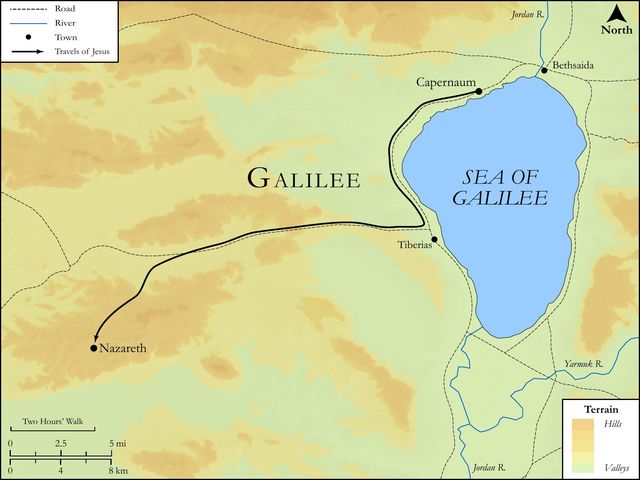
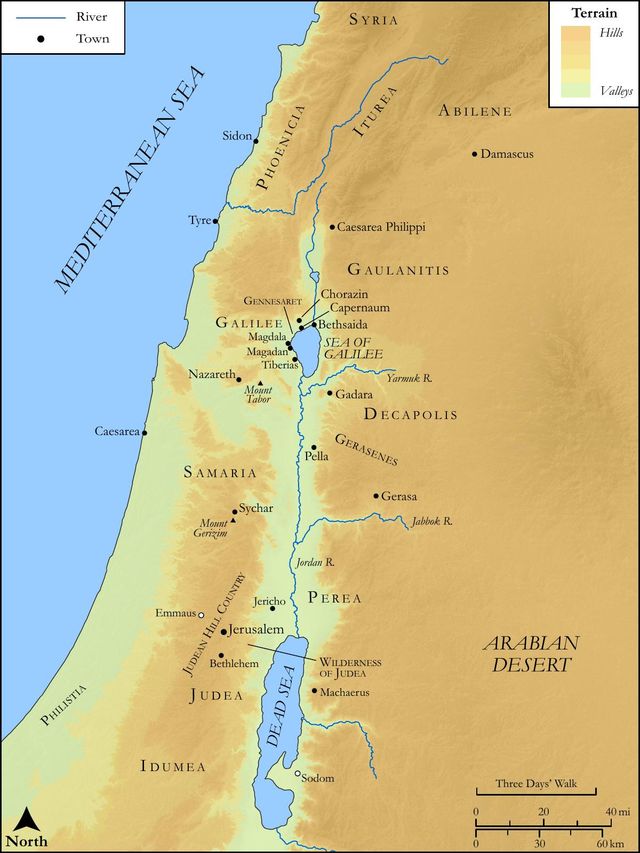
Study this verse
Public-domain commentary
Matthew Henry
From his Commentary on the Whole Bible. Henry comments on passages, not single verses — this entry covers Matthew 13:53–58. His three-level outline is real structure in the source text, so it is rendered as structure.
We have here Christ in his own country. He went about doing good, yet left not any place till he had finished his testimony there at that time. His own countrymen had rejected him once, yet he came to them again. Note, Christ does not take refusers at their first word, but repeats his offers to those who have often repulsed them. In this, as in other things, Christ was like his brethren; he had a natural affection to his own country; Patriam quisque amat, non quia pulchram, sed quia suam - Every one loves his country, not because it is beautiful, but because it is his own. Seneca. His treatment this time was much the same as before, scornful and spiteful. Observe,
I.How they expressed their contempt of him.
When he taught them in their synagogue, they were astonished; not that they were taken with his preaching, or admired his doctrine in itself, but only that it should be his; looking upon him as unlikely to be such a teacher. Two things they upbraided him with.
1.His want of academical education. They owned that he had wisdom, and did mighty works; but the question was, Whence he had them: for they knew that he was not brought up at the feet of the rabbin: he had never been at the university, nor taken his degree, nor was called of men, Rabbi, Rabbi. Note, Mean and prejudiced spirits are apt to judge of men by their education, and to enquire more into their rise than into their reasons. "Whence has this man these mighty works? Did he come honestly by them? Has he not been studying the black art?" Thus they turned that against him which was really for him; for if they had not been wilfully blind, they must have concluded him to be divinely assisted and commissioned, who without the help of education gave such proofs of extraordinary wisdom and power.
2.The meanness and poverty of his relations, Mat 13:55, Mat 13:56.
(1.)They upbraid him with his father. Is not this the carpenter's son? Yes, it is true he was reputed so: and what harm in that? No disparagement to him to be the son of an honest tradesman. They remember not (though they might have known it) that this carpenter was of the house of David (Luk 1:27), a son of David (Mat 1:20); though a carpenter, yet a person of honour. Those who are willing to pick quarrels will overlook that which is worthy and deserving, and fasten upon that only which seems mean. Some sordid spirits regard no branch, no not the Branch from the stem of Jesse (Isa 11:1), if it be not the top branch.
(2.)They upbraid him with his mother; and what quarrel have they with her? Why, truly, his mother is called Mary, and that was a very common name, and they all knew her, and knew her to be an ordinary person; she was called Mary, not Queen Mary, nor Lady Mary, nor so much as Mistress Mary, but plain Mary; and this is turned to his reproach, as if men had nothing to be valued by but foreign extraction, noble birth, or splendid titles; poor things to measure worth by.
(3.)They upbraid him with his brethren, whose names they knew, and had them ready enough to serve this turn; James, and Joses, and Simon, and Judas, good men but poor men, and therefore despised; and Christ for their sakes. These brethren, it is probable, were Joseph's children by a former wife; or whatever their relation was to him, they seem to have been brought up with him in the same family. And therefore of the calling of three of these, who were of the twelve, to that honour (James, Simon, and Jude, the same with Thaddeus), we read not particularly, because they needed not such an express call into acquaintance with Christ who had been the companions of his youth.
(4.)His sisters too are all with us; they should therefore have loved him and respected him the more, because he was one of themselves, but therefore they despised him. They were offended in him: they stumbled at these stumbling-stones, for he was set for a sign that should be spoken against, Luk 2:34; Isa 8:14.
II.See how he resented this contempt, Mat 13:57, Mat 13:58.
1.It did not trouble his heart. It appears he was not much concerned at it; he despised the shame, Heb 12:2. Instead of aggravating the affront, or expressing an offence at it, or returning such an answer to their foolish suggestions as they deserved, he mildly imputes it to the common humour of the children of men, to undervalue excellences that are cheap, and common, and home-bred. It is usually so. A prophet is not without honour, save in his own country. Note,
(1.)Prophets should have honour paid them, and commonly have; men of God are great men, and men of honour, and challenge respect. It is strange indeed if prophets have not honour.
(2.)Notwithstanding this, they are commonly least regarded and reverenced in their own country, nay, and sometimes are most envied. Familiarity breeds contempt.
2.It did for the present (to speak with reverence), in effect, tie his hands: He did not many mighty works there, because of their unbelief. Note, Unbelief is the great obstruction to Christ's favours. All things are in general possible to God (Mat 19:26), but then it is to him that believes as to the particulars, Mar 9:23. The gospel is the power of God unto salvation, but then it is to every one that believes, Rom 1:16. So that if mighty works be not wrought in us, it is not for want of power or grace in Christ, but for want of faith in us. By grace ye are saved, and that is a mighty work, but it is through faith, Eph 2:8.
Historical interpretation
Nine Centuries of Reception
13 surviving comments on this verse. Each one is dated, so this reads as a timeline rather than a list.
Select a marker to jump to its quote. Markers stagger vertically where authors wrote within a few decades of each other.
(non occ. cf. Serm. 135. App.) For the Father of Christ is that Divine Workman who made all these works of nature, who set forth Noah's ark, who ordained the tabernacle of Moses, and instituted the Ark of the covenant; that Workman who polishes the stubborn mind, and cuts down the proud thoughts.
As the case stood, however, it was actually the ordinary condition of His terrene flesh which made all things else about Him wonderful, as when they said, "Whence hath this man this wisdom and these mighty works? " Thus spake even they who despised His outward form.
And this was the carpenter's son who subdues iron by means of fire, who tries the virtue of this world in the judgment, and forms the rude mass to every work of human need; the figure of our bodies, for example, to the divers ministrations of the limbs, and all the actions of life eternal.
Thus the Lord is held in no honour by His own; and though the wisdom of His teaching, and the power of His working raised their admiration, yet do they not believe that He did these things in the name of the Lord, and they cast His father's trade in His teeth. Amid all the wonderful works which He did, they were moved with the contemplation of His Body, and hence they ask, Whence hath this man these things? And thus they were offended in him.
Further, He makes this answer, that a Prophet is without honour in his own country, because it was in Judæa that He was to be condemned to the sentence of the cross; and forasmuch as the power of God is for the faithful alone, He here abstained from works of divine power because of their unbelief; whence it follows, And he did not there many mighty works because of their unbelief.
The Lord is dishonored by his own. Although his wisdom in teaching and his mighty works excited admiration, their faithlessness held them back from true discernment. For they did not believe that God was doing these things in a man. Moreover, they referred to his father, his mother, brothers and sisters and took offense at him.But clearly this was the son of the carpenter who was subduing iron with fire, melting away all the might of the world with good judgment and forming the mass into every work that was humanly useful. He was molding the formless material of our bodies into members for different ministries and for every work of eternal life. They all became irritated at these things. Among the many astonishing things he did, they were most deeply moved by his contemplativeness and his bodily self-control. The Lord said to them that a prophet is without honor in his own country, because he was to be despised in Judea until the final fate of the cross. And since God’s power is only with those who are faithful, he abstained from all works of divine power while he was there, because of their unbelief.
(Hom. xlviii.) By his own country here, He means Nazareth; for it was not there but in Capharnaum that, as is said below, He wrought so many miracles; but to these He shows His doctrine, causing no less wonder than His miracles.
Therefore were they in all things insensate, seeing they lightly esteemed Him on account of him who was regarded as His father, notwithstanding the many instances in old times of sons illustrious sprung from ignoble fathers; as David was the son of a husbandman, Jesse; Amos the son of a shepherd, himself a shepherd. And they ought to have given Him more abundant honour, because, that coming of such parents, He spake after such manner; clearly showing that it came not of human industry, but of divine grace.
Observe Christ's mercifulness; He is evil spoken of, yet He answers with mildness; Jesus said unto them, A prophet is not without honour, but in his own country, and in his own house.
But if His miracles raised their wonder, why did He not work many? Because He looked not to display of Himself, but to what would profit others; and when that did not result, He despised what pertained only to Himself that He might not increase their punishment. Why then did He even these few miracles? That they should not say, We should have believed had any miracles been done among us.
And what doth he now call His country? As it seems to me, Nazareth. "For He did not many mighty works there," it is said, but in Capernaum He did miracles: wherefore He said also, "And thou, Capernaum, which art exalted unto Heaven, shalt be brought down to hell; for if the mighty works, which have been done in thee, had been done in Sodom, it would have remained until this day."
But having come there, while He slackens somewhat in His miracles; so as not to inflame them unto more envy, nor to condemn them more grievously, by the aggravation of their unbelief: He yet puts forth a doctrine, having no less of wonder in it than the miracles. For these utterly senseless men, when they ought to have marvelled, and to have been amazed at the power of His words, they on the contrary hold Him cheap, because of him who seemed to be His father; yet we know they had many examples of these things in the former times, and from fathers of no note had seen illustrious children. For so David was the son of a certain mean husbandman, Jesse; and Amos, the child of a goatherd, and himself a goatherd; and Moses too, the lawgiver, had a father very inferior to himself. When they therefore, for this especially, ought to adore and be amazed, that being of such parents He spake such things, it being quite manifest, that so it was not of man's care, but of God's grace: yet they, what things they should admire Him for, for those they despise Him.
He is moreover continually frequenting the synagogues, lest if He were always abiding in the wilderness, they should the more accuse Him as making a schism, and fighting against their polity. Being amazed therefore, and in perplexity, they said, "Whence hath this man this wisdom, and these powers?" either calling the miracles powers, or even the wisdom itself.
(Verse 53, 54.) And it came to pass, when Jesus had finished these parables, that he departed from there. And coming into his own country, he taught them in their synagogue, so that they marveled and said. After the parables that he spoke to the people, and that only the apostles understood, he went to his own country to teach more openly there.
Where does this wisdom and these virtues come from? The Nazarenes marvel at where he gets his wisdom and virtue; but the error is obvious, for they suspect that he is the son of a carpenter.
After the parables which the Lord spake to the people, and which the Apostles only understand, He goes over into His own country that He may teach there also.
Wonderful folly of the Nazarenes! They wonder whence Wisdom itself has wisdom, whence Power has mighty works! But the source of their error is at hand, because they regard Him as the Son of a carpenter; as they say, Is not this the carpenter's son?
And when they are mistaken in His Father, no wonder if they are also mistaken in His brethren. Whence it is added, Is not his mother Mary, and his brethren, James, and Joseph, and Simon, and Judas? And his sisters, are they not all with us?
(in Helvid. 14.) Those who are here called the Lord's brethren, are the sons of a Mary, His Mother's sister; she is the mother of this James and Joseph, that is to say, Mary the wife of Cleophas, and this is the Mary who is called the mother of James the Less.
This error of the Jews is our salvation, and the condemnation of the heretics, for they perceived Jesus Christ to be man so far as to think Him the son of a carpenter.
For it is almost natural for citizens to be jealous towards one another; for they do not look to the present works of the man, but remember the frailties of his childhood; as if they themselves had not passed through the very same stages of age to their maturity.
Not that because they did not believe He could not do His mighty works; but that He might not by doing them be condemning His fellow-citizens in their unbelief.
Or we may understand it otherwise, that Jesus is despised in His own house and country, signifies in the Jewish people; and therefore He did among them few miracles, that they might not be altogether without excuse; but among the Gentiles He does daily greater miracles by His Apostles, not so much in healing their bodies, as in saving their souls.
The synagogues could not be his. A malicious and disbelieving crowd gathered there. A people full of hate rather than love came together. A group of ill-disposed and ill-mannered people assembled. “He began to teach in their synagogues, so that they were astonished.” They were astonished because of indignation and not because of grace. They were amazed because of envy and not because of praise. They raged because what the proud seated on the floor were unable to discern, humility on its feet was thoroughly teaching.
“So that they were astonished, and said, ‘Where did he get this wisdom?’ ” The one who speaks this way does not know God, from whom is wisdom and from whom are mighty works. Solomon points to that source of wisdom. While still young, he accepted the highest honor of the kingdom so he might rule the people entrusted to him with virtue and not with arrogance, with wisdom and not with pride, with his heart and not with his head. He wanted wisdom from God, earnestly asked for it and received it. “Where did he get this wisdom and these mighty works?” The mighty power that gives eyesight denied by nature, that restores hearing to those drowned in silence, that unscrambles the words of those who are mute, that enables the lame to walk again and that orders souls headed for the realm of the dead to return to their bodies is from God, unless someone envious of salvation should deny it.
He taught in their synagogues where great numbers were met, because it was for the salvation of the multitude that He came from heaven upon earth. It follows; So that they marvelled, and said, Whence hath this man this wisdom, and these many mighty works? His wisdom is referred to His doctrine, His mighty works to His miracles.
He calls Himself a Prophet, as Moses also declares, when he says, A Prophet shall God raise up unto you of your brethren. (Deut. 18:18.) And it should be known, that not Christ only, who is the Head of all the Prophets, but Jeremiah, Daniel, and the other lesser Prophets, had more honour and regard among strangers than among their own citizens.
(ubi sup.) Otherwise; The things old are, that the human race for its sin should suffer in eternal punishment; the things new, that they should be converted and live in the kingdom. First, He brought forward a comparison of the kingdom to a treasure found and a pearl of price; and after that, narrated the punishment of hell in the burning of the wicked, and then concluded with Therefore every Scribe, &c. as if He had said, He is a learned preacher in the Church who knows to bring forth things new concerning the sweetness of the kingdom, and to speak things old concerning the terror of punishment; that at least punishment may deter those whom rewards do not excite.
. Matthew says "these parables" because in a short time He would tell them other ones. He departed so that He could benefit others by His presence. "His own country" means Nazareth, for He was raised there. He was teaching in the synagogue, speaking openly in public, that they might not later have grounds to claim that He was teaching things contrary to the law.
Continue studying Matthew 13:54 across the web’s major study libraries — every link below opens this exact verse, chapter, or book on the destination site.
Read & Compare
 BibleGatewayThis verse in more than 200 translations and 70 languages.
 Bible.comThe YouVersion reader — hundreds of translations, reading plans, and highlights.
 ESV.orgCrossway's official English Standard Version reader.
 NET BibleThe NET translation with 60,000+ translators' notes on every rendering decision.
 STEP BibleTyndale House's free study tool — original text, vocabulary, and scholarly resources.
 BibliaLogos Bible Software's free web reader.
 USCCBThe New American Bible (Revised Edition) with the U.S. bishops' study notes.
Commentaries
 BibleHub CommentariesDozens of classic commentaries on this verse, gathered on one page.
 StudyLightMore than 100 commentary sets — the largest collection on the web.
 BibleRefPlain-English commentary on what this verse means, verse by verse.
 Enduring WordDavid Guzik's free commentary on this chapter, widely used by Bible teachers.
 Bible Study ToolsVerse commentary alongside Greek and Hebrew study aids.
Original Language & Research
- BibleHub InterlinearThe verse word by word — original language, transliteration, and English.
- BibleHub LexiconEvery word's original-language definition and Strong's entry.
 Blue Letter BibleDeep-study tools — Strong's numbers, concordance, and word studies.
 CNTR CollationThe earliest Greek manuscripts of this verse, collated letter by letter.
Sermons, Hymns & Audio


TrulyRandomVerse is not affiliated with these sites and doesn’t control their content. They’re linked because they’re genuinely useful.
Summary
Matthew 13:54 describes Jesus' return to His hometown of Nazareth, where He taught in the local synagogue. His teaching and the reports of His miraculous deeds profoundly astonished the inhabitants, who, despite their familiarity with His humble origins, were forced to acknowledge the extraordinary wisdom and power He displayed. Their rhetorical questions about the source of His authority reveal their perplexity and the initial seeds of skepticism that would soon lead to rejection.
Context
ShowHideLiterary Context
This verse marks a pivotal transition point in Matthew's Gospel, concluding a significant section of parables (Matthew 13:1-53) and setting the stage for Jesus' subsequent rejection in His hometown (Matthew 13:55-58). Immediately preceding this verse, Jesus has just finished explaining the parables of the kingdom to His disciples, emphasizing the hidden nature of the kingdom's truths and the varying responses to them. His return to Nazareth, His "own country," highlights the stark contrast between the receptive audiences in other regions and the skepticism He would face among those who knew Him best. The narrative flow moves from public teaching and private explanation to a direct confrontation with the familiar, revealing the challenge of receiving divine truth from an unexpected source.
Historical & Cultural Context
Nazareth was a small, unassuming village in Galilee, largely insignificant in the broader Roman-Jewish world. Jesus had grown up there, known as the son of Joseph, a carpenter (Matthew 13:55). Synagogues served as the central hub for Jewish community life, functioning as places of worship, education, and social gathering. It was customary for visiting rabbis or respected men to be invited to read from the Scriptures and offer commentary, which Jesus did. The astonishment of the Nazarenes stems from their deep-seated cultural expectations: they knew Jesus as an ordinary local, lacking formal rabbinic training or aristocratic lineage. For such a person to display profound wisdom and perform "mighty works" (miracles) challenged their understanding of how God typically worked, leading to a crisis of belief rooted in their familiarity and social hierarchy.
Key Themes
ShowHideThis verse introduces and develops several crucial themes. Firstly, it underscores the astonishment at Jesus' authority and power, as the Nazarenes explicitly acknowledge His "wisdom" and "mighty works." This highlights the undeniable impact of His ministry, even on those predisposed to doubt. Secondly, it foreshadows the theme of rejection due to familiarity, as their initial wonder quickly gives way to offense (as seen in Matthew 13:57). This illustrates the prophetic truth that "a prophet is not without honor except in his own town" (Matthew 13:57). Finally, the verse subtly touches on the mystery of Jesus' identity, as the people grapple with reconciling His humble origins with His divine capabilities, a question that permeates much of the Gospels, particularly in passages like John 7:15.
Exposition and Analysis
ShowHideKey Word Analysis
ShowHideThis verb signifies the act of instructing or imparting knowledge. In this context, it refers to Jesus' authoritative and insightful communication of divine truth, which went beyond mere recitation and conveyed profound understanding and spiritual depth.
Derived from words meaning "out" and "to strike," this term describes a powerful emotional reaction of being struck with amazement or wonder, often to the point of being overwhelmed or dumbfounded. It indicates that Jesus' teaching and reported works were utterly unexpected and profoundly impressive to His audience.
This noun refers to inherent power, force, or ability, specifically miraculous power. In the New Testament, it frequently denotes the supernatural deeds performed by Jesus, which served as tangible demonstrations of divine authority and the presence of God's kingdom.
Verse Breakdown
ShowHide"And when he was come into his own country,"
This clause establishes the setting: Jesus' return to Nazareth, the place of His upbringing. The phrase "his own country" emphasizes the personal connection and the expectations that would naturally arise from His familiar background.
"he taught them in their synagogue,"
This describes Jesus' action. Consistent with His practice throughout Galilee, He engaged in public instruction within the established religious gathering place, demonstrating His commitment to sharing the message of the kingdom within the Jewish community.
"insomuch that they were astonished,"
This highlights the immediate and profound reaction of the Nazarenes. Their astonishment indicates that Jesus' teaching was not ordinary; it possessed an authority and insight that transcended what they expected from a local carpenter's son.
"and said, Whence hath this [man] this wisdom, and [these] mighty works?"
This rhetorical question reveals the core of their perplexity and the nascent seeds of their unbelief. They acknowledged both His profound "wisdom" (deep understanding and insight) and His ability to perform "mighty works" (miracles), but they could not reconcile these divine attributes with His humble, familiar origins. Their question implies a challenge to His authority, wondering how an ordinary man could possess such extraordinary power.
Literary Devices
ShowHideMatthew 13:54 employs several literary devices to convey its message. The most prominent is the Rhetorical Question ("Whence hath this [man] this wisdom, and [these] mighty works?"), which, while seemingly seeking information, primarily serves to express the Nazarenes' profound bewilderment and their inability to explain Jesus' power within their preconceived notions. This question also creates Dramatic Irony, as the audience (readers) knows Jesus' true divine origin, while the Nazarenes, despite witnessing His power, remain ignorant. There is also a strong element of Contrast between Jesus' humble, familiar origins and the extraordinary, divine power and wisdom He demonstrates, setting up the subsequent narrative of rejection. Finally, the verse contains Foreshadowing, as the astonishment and questioning quickly lead to offense and unbelief in the following verses, illustrating a pattern of rejection Jesus would face.
Theological and Thematic Connections
ShowHideMatthew 13:54 powerfully illustrates the human tendency to stumble over the unexpected manifestations of God's power and wisdom. The Nazarenes' astonishment, quickly followed by skepticism, reveals a common human failing: judging divine truth by earthly standards and allowing familiarity to breed contempt. This passage underscores the truth that God often chooses to work through channels that defy human expectations, challenging our preconceived notions of power, authority, and wisdom. It highlights the profound mystery of the Incarnation, where the divine Son of God took on humble flesh, leading many to overlook His true identity because of His ordinary appearance. The questions posed by the Nazarenes reflect a deeper theological struggle, questioning the source of Jesus' authority—a theme that recurs throughout the Gospels as people try to categorize or dismiss Him.
Reflection and Application
ShowHideThis passage serves as a poignant reminder that our perception of God's work can often be hindered by our own biases and assumptions. Just as the people of Nazareth struggled to reconcile Jesus' humble background with His divine power, we too can fall into the trap of dismissing truth or potential because it doesn't fit our expectations. We must cultivate a spiritual humility that allows us to recognize God's hand in unexpected places and through unexpected people. Are we open to wisdom that comes from sources we might deem ordinary or unqualified? Do we allow our familiarity with someone's past or social status to blind us to the profound work God might be doing through them? This verse challenges us to look beyond the superficial and to discern the genuine power and wisdom of God, regardless of the vessel. It calls us to examine our own hearts for any preconceived notions that might prevent us from fully embracing divine truth or witnessing God's transformative work in our midst.
Questions for Reflection
ShowHideFAQ
ShowHideWhy were the people of Nazareth astonished by Jesus' teaching and works?
ShowHideThe people of Nazareth were astonished because they knew Jesus as an ordinary local, the son of a carpenter, who had grown up among them. They were familiar with His earthly origins and had no record of Him receiving formal rabbinic training or having any special status. Therefore, when He taught with profound wisdom and performed "mighty works" (miracles) that clearly demonstrated supernatural power, it defied all their expectations and understanding of who He was. Their astonishment stemmed from the stark contrast between the humble man they thought they knew and the divine authority and power He displayed, leading them to question the source of these extraordinary abilities, as seen in Matthew 13:55-56.
Christ-Centered Fulfillment
ShowHideMatthew 13:54, depicting Jesus' rejection in His hometown, profoundly foreshadows the broader pattern of His life and ministry: the world's inability to recognize and receive its Creator. The Nazarenes' question, "Whence hath this [man] this wisdom, and [these] mighty works?" encapsulates the central dilemma of humanity regarding Christ. They saw the evidence of divine power and wisdom, yet their familiarity with His humble humanity became a stumbling block. This mirrors the irony described in John 1:10-11: "He was in the world, and the world was made by him, and the world knew him not. He came unto his own, and his own received him not." Jesus, the very wisdom of God and the power of God (1 Corinthians 1:24), chose to humble Himself, taking on the form of a servant and growing up in an obscure village. His life perfectly fulfilled the prophecy of a Messiah who would be "despised and rejected of men" (Isaiah 53:3), precisely because His divine glory was veiled in ordinary flesh. Thus, Nazareth's astonishment and subsequent rejection serve as a microcosm of the world's response to the incarnate Christ, revealing that true spiritual sight requires looking beyond outward appearances to perceive the divine reality within.