


Mark 6:1
Bible text: King James Version (1769 Blayney text) · Public domain
Bible text: Berean Standard Bible · Public domain
Bible text: American Standard Version (1901) · Public domain
Bible text: World English Bible, Messianic edition · Public domain
Bible text: Geneva Bible (1599) · Public domain
Bible text: Young's Literal Translation · Public domain
- ΚαὶKaiAndG2532CONJConjunction
- ἐξῆλθενexēlthenHe went outG1831V-2AAI-3SVerb 2nd Aorist Active Indicative 3rd Singular
- ἐκεῖθενekeithenfrom thereG1564ADVAdverb
- καὶkaiandG2532CONJConjunction
- ἔρχεταιerchetaicameG2064V-PNI-3SVerb Present Middle Or Passive Deponent Indicative 3rd Singular
- εἰςeisintoG1519PREPPreposition
- τὴνtēntheG3588T-ASFDefinite article Accusative Singular Feminine
- πατρίδαpatridahometownG3968N-ASFNoun Accusative Singular Feminine
- αὐτοῦautouof HimG846P-GSMPersonal pronoun Genitive Singular Masculine
- καὶkaiandG2532CONJConjunction
- ἀκολουθοῦσινakolouthousinfollowG190V-PAI-3PVerb Present Active Indicative 3rd Plural
- αὐτῷautōHimG846P-DSMPersonal pronoun Dative Singular Masculine
- οἱhoitheG3588T-NPMDefinite article Nominative Plural Masculine
- μαθηταὶmathētaidisciplesG3101N-NPMNoun Nominative Plural Masculine
- αὐτοῦautouof HimG846P-GSMPersonal pronoun Genitive Singular Masculine
English is a literal word-by-word gloss of the Greek, not the KJV's wording. Why?
This is the original text the KJV's translators worked from — each Greek word with its own literal English meaning in this verse, prepared by scholars at Tyndale House, Cambridge. The KJV translates whole sentences, not word by word, so its wording differs: one Greek word can become several English words, and the KJV may choose “charity” where the gloss reads “love”. Both are faithful — they answer different questions. For the KJV's own rendering, switch to the KJV text.
Details
See on the biblical-era maps
Study this verse
Public-domain commentary
Matthew Henry
From his Commentary on the Whole Bible. Henry comments on passages, not single verses — this entry covers Mark 6:1–6. His two-level outline is real structure in the source text, so it is rendered as structure.
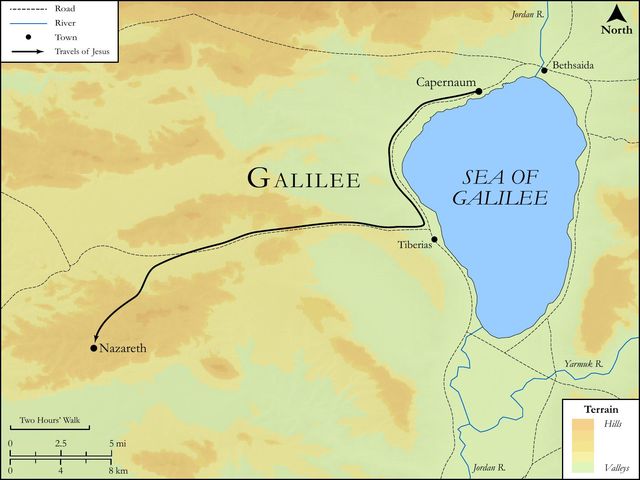
Here, I. Christ makes a visit to his own country, the place not of his birth, but of his education; that was Nazareth; where his relations were. He had been in danger of his life among them (Luk 4:29), and yet he came among them again; so strangely doth he wait to be gracious, and seek the salvation of his enemies. Whither he went, though it was into danger, his disciples followed him (Mar 6:1); for they had left all, to follow him whithersoever he went.
II.There he preached in their synagogue, on the sabbath day, Mar 6:2.
It seems, there was not such flocking to him there as in other places, so that he had no opportunity of preaching till they came together on the sabbath day; and then he expounded a portion of scripture with great clearness. In religious assemblies, on sabbath days, the word of God is to be preached according to Christ's example. We give glory to God by receiving instruction from him.
III.They could not but own that which was very honourable concerning him.
1.That he spoke with great wisdom, and that this wisdom was given to him, for they knew he had no learned education.
2.That he did mighty works, did them with his own hands, for the confirming of the doctrine he taught. They acknowledged the two great proofs of the divine original of his gospel - the divine wisdom that appeared in the contrivance of it, and the divine power that was exerted for the ratifying and recommending of it; and yet, though they could not deny the premises, they would not admit the conclusion.
IV.They studied to disparage him, and to raise prejudices in the minds of people against him, notwithstanding.
All this wisdom, and all these mighty works, shall be of no account, because he had a home-education, had never travelled, nor been at any university, or bred up at the feet of any of their doctors (Mar 6:3); Is not this the Carpenter? In Matthew, they upbraid him with being the carpenter's son, his supposed father Joseph being of that trade. But, it seems, they could say further, Is not this the Carpenter? our Lord Jesus, it is probable, employing himself in that business with his father, before he entered upon his public ministry, at least, sometimes in journey-work.
1.He would thus humble himself, and make himself of no reputation, as one that had taken upon him the form of a servant, and came to minister. Thus low did our Redeemer stoop, when he came to redeem us out of our low estate.
2.He would thus teach us to abhor idleness, and to find ourselves something to do in this world; and rather to take up with mean and laborious employments, and such as no more is to be got by than a bare livelihood, than indulge ourselves in sloth. Nothing is more pernicious for young people than to get a habit of sauntering. The Jews had a good rule for this - that their young men who were designed for scholars, were yet bred up to some trade, as Paul was a tent-maker, that they might have some business to fill up their time with, and, if need were, to get their bread with.
3.He would thus put an honour upon despised mechanics, and encourage those who eat the labour of their hands, though great men look upon them with contempt.
Another thing they upbraided him with, was, the meanness of his relations; "He is the son of Mary; his brethren and sisters are here with us; we know his family and kindred;" and therefore, though they were astonished at his doctrine (Mar 6:2), yet they were offended at his person (Mar 6:3), were prejudiced against him, and looked upon him with contempt; and for that reason would not receive his doctrine, though ever so well recommended. May we think that if they had not known his pedigree, but he had dropped among them from the clouds, without father, without mother, and without descent, they would have entertained him with any more respect? Truly, no; for in Judea, where this was not know, that was made an objection against him (Joh 9:29); As for this fellow, we know not from whence he is. Obstinate unbelief will never want excuses.
V.Let us see how Christ bore this contempt.
1.He partly excused it, as a common thing, and what might be expected, though not reasonably or justly (Mar 6:4); A prophet is not despised any where but in his own country. Some exceptions there may be to this rule; doubtless many have got over this prejudice, but ordinarily it holds good, that ministers are seldom so acceptable and successful in their own country as among strangers; familiarity in the younger years breeds a contempt, the advancement of one that was an inferior begets envy, and men will hardly set those among the guides of their souls whose fathers they were ready to set with the dogs of their flock; in such a case therefore it must not be thought hard, it is common treatment, it was Christ's, and wisdom is profitable to direct to other soil.
2.He did some good among them, notwithstanding the slights they put upon him, for he is kind even to the evil and unthankful; He laid his hands upon a few sick folks, and healed them. Note, It is generous, and becoming the followers of Christ, to content themselves with the pleasure and satisfaction of doing good, though they be unjustly denied the praise of it.
3.Yet he could there do no such mighty works, at least not so many, as in other places, because of the unbelief that prevailed among the people, by reason of the prejudices which their leaders instilled into them against Christ, Mar 6:5. It is a strange expression, as if unbelief tied the hands of omnipotence itself; he would have done as many miracles there as he had done elsewhere, but he could not, because people would not make application to him, nor sue for his favours; he could have wrought them, but they forfeited the honour of having them wrought for them. Note, By unbelief and contempt of Christ men stop the current of his favours to them, and put a bar in their own door.
4.He marvelled because of their unbelief, Mar 6:6. We never find Christ wondering but at the faith of the Gentiles that were strangers, as the centurion (Mat 8:10), and the woman of Samaria, and at the unbelief of Jews that were his own countrymen. Note, The unbelief of those that enjoy the means of grace, is a most amazing thing.
5.He went round about the village, teaching. If we cannot do good where we would, we must do it where we can, and be glad if we may have any opportunity, though but in the villages, of serving Christ and souls. Sometimes the gospel of Christ finds better entertainment in the country villages, where there is less wealth, and pomp, and mirth, and subtlety, than in the populous cities.
Historical interpretation
Nine Centuries of Reception
6 surviving comments on this verse. Each one is dated, so this reads as a timeline rather than a list.
Select a marker to jump to its quote. Markers stagger vertically where authors wrote within a few decades of each other.
Jesus is called the son of a workman, of that one, however, whose work was the morning and the sun, that is, the first and second Church, as a figure of which the woman and the damsel are healed.
Oftentimes also the origin of a man brings him contempt, as it is written, (1 Sam. 25:10. Ps. 138:6) Who is the son of Jesse? for the Lord hath respect unto the lowly; as to the proud, He beholdeth them afar off.
If, however, there be any one who, like Plato, supposes that two souls cannot, more than two bodies could, co-exist in the same individual, I, on the contrary, could show him not merely the co-existence of two souls in one person, as also of two bodies in the same womb, but likewise the combination of many other things in natural connection with the soul-for instance, of demoniacal possession; and that not of one only, as in the case of Socrates' own demon; but of seven spirits as in the case of the Magdalene; and of a legion in number, as in the Gadarene. Now one soul is naturally more susceptible of conjunction with another soul, by reason of the identity of their substance, than an evil spirit is, owing to their diverse natures.
How can he be said to go out and to come in, whom no space can enclose? What country can be his, who made, and who possesses, the whole universe? In truth, Christ goes out and comes in not of himself, nor for himself, but in you, and on behalf of you, until he recovers you from your exile, and calls you home from your captivity.
(in Marc. 2, 23) He means by His country, Nazareth, in which He was brought up. But how great the blindness of the Nazarenes! they despise Him, Who by His words and deeds they might know to be the Christ, solely on account of His kindred. It goes on, And when the sabbath day was come, he began to teach in the synagogue: and many hearing him were astonished, saying, From whence hath this man these things? and what wisdom is this which is given unto him, that even such mighty works are wrought by his hands? By wisdom is meant His doctrine, by powers, the cures and miracles which He did. It goes on, Is not this the carpenter, the son of Mary?
(ubi sup.) For although human things are not to be compared with divine, still the type is complete, because the Father of Christ works by fire and spirit. It goes on, The brother of James, and Joses, of Jude, and, of Simon. And are not his sisters here with us? They bear witness that His brothers and sisters were with Him, who nevertheless are not to be taken for the sons of Joseph or of Mary, as heretics say, but rather, as is usual in Scripture, we must understand them to be His relations, as Abraham and Lot are called brothers, though Lot was brother's son to Abraham. And they were offended at him. The stumbling and the error of the Jews is our salvation, and the condemnation of heretics. For so much did they despise the Lord Jesus Christ, as to call Him a carpenter, and son of a carpenter. It goes on, And Jesus said unto them, A prophet is not without honour, but in his own country. Even Moses bears witness that the Lord is called a Prophet in the Scripture, for predicting His future Incarnation to the sons of Israel, he says, A Prophet shall the Lord raise up unto you of your brethren. (Acts 7:37) But not only He Himself, Who is Lord of prophets, but also Elias, Jeremiah, and the remaining lesser prophets, were worse received in their own country than in strange cities, for it is almost natural for men to envy their fellow-townsmen; for they do not consider the present works of the man, but they remember the weakness of His infancy.
(ubi sup.) Not as if He Who knows all things before they are done, wonders at what He did not expect or look forward to, but knowing the hidden things of the heart, and wishing to intimate to men that it was wonderful, He openly shows that He wonders. And indeed the blindness of the Jews is wonderful, for they neither believed what their prophets said of Christ, nor would in their own persons believe on Christ, Who was born amongst them. Mystically again; Christ is despised in His own house and country, that is, amongst the people of the Jews, and therefore He worked few miracles there, lest they should become altogether inexcusable. But He performs greater miracles every day amongst the Gentiles, not so much in the healing of their bodies, as in the salvation of their souls.
And he went out from there and came into his own country, and his disciples followed him; and when the Sabbath came, he began to teach in the synagogue. And many hearing him were amazed at his teaching, saying: Where did this man get all these things? And what wisdom is this that is given to him, and such mighty works performed by his hands? He calls his country Nazareth, in which he was brought up. But how great is the blindness of the Nazarenes, who, if their minds were not obtuse, could have recognized him as the Christ through his words and deeds, yet they despise him solely because of knowing his family. They refer wisdom to teaching and power to healings and miracles that he performed. Which distinction the Apostle recalls aptly and beautifully, saying: Jews demand signs, and Greeks seek wisdom; but we preach Christ crucified, a stumbling block to Jews and foolishness to Gentiles. But to those who are called, both Jews and Greeks, Christ is the power of God and the wisdom of God (1 Corinthians 1). In this context, he refers power to signs because of the Jews and wisdom to teaching because of the Greeks, that is, the Gentiles.
After the miracles which have been related, the Lord returns into His own country, not that He was ignorant that they would despise Him, but that they might have no reason to say, If Thou hadst come, we had believed Thee; wherefore it is said, And he went out from thence, and came into his own country.
Or again, if the prophet has noble relations, his countrymen hate them, and on that account do not honour the prophet. There follows, And he could there do no mighty work, &c. What, however, is here expressed by He could not, we must take to mean, He did not choose, because it was not that He was weak, but that they were faithless; He does not therefore work any miracles there, for he spared them, lest they should be worthy of greater blame, if they believed not, even with miracles before their eyes. Or else, for the working of miracles, not only the power of the Worker is necessary, but the faith of the recipient, which was wanting in this case: therefore Jesus did not choose to work any signs there. There follows, And he marvelled at their unbelief.
Continue studying Mark 6:1 across the web’s major study libraries — every link below opens this exact verse, chapter, or book on the destination site.
Read & Compare
 BibleGatewayThis verse in more than 200 translations and 70 languages.
 Bible.comThe YouVersion reader — hundreds of translations, reading plans, and highlights.
 ESV.orgCrossway's official English Standard Version reader.
 NET BibleThe NET translation with 60,000+ translators' notes on every rendering decision.
 STEP BibleTyndale House's free study tool — original text, vocabulary, and scholarly resources.
 BibliaLogos Bible Software's free web reader.
 USCCBThe New American Bible (Revised Edition) with the U.S. bishops' study notes.
Commentaries
 BibleHub CommentariesDozens of classic commentaries on this verse, gathered on one page.
 StudyLightMore than 100 commentary sets — the largest collection on the web.
 BibleRefPlain-English commentary on what this verse means, verse by verse.
 Enduring WordDavid Guzik's free commentary on this chapter, widely used by Bible teachers.
 Bible Study ToolsVerse commentary alongside Greek and Hebrew study aids.
Original Language & Research
- BibleHub InterlinearThe verse word by word — original language, transliteration, and English.
- BibleHub LexiconEvery word's original-language definition and Strong's entry.
 Blue Letter BibleDeep-study tools — Strong's numbers, concordance, and word studies.
 CNTR CollationThe earliest Greek manuscripts of this verse, collated letter by letter.
Sermons, Hymns & Audio


TrulyRandomVerse is not affiliated with these sites and doesn’t control their content. They’re linked because they’re genuinely useful.
Summary
Mark 6:1 marks a pivotal transition in Jesus's ministry, as He departs from the regions where He has recently performed powerful miracles and returns to His childhood home of Nazareth. This deliberate journey, undertaken with His disciples in tow, sets the stage for a significant encounter with those who knew Him best, contrasting the widespread acceptance He received elsewhere with the skepticism and lack of honor He would face in His familiar "own country."
Context
ShowHideLiterary Context
Mark 6:1 immediately follows a series of remarkable miracles in Mark 5, including the healing of the Gerasene demoniac, the raising of Jairus's daughter (Mark 5:21-43), and the healing of the woman with a chronic issue of blood. These events demonstrate Jesus's unparalleled authority and power, leading to widespread recognition and awe. The movement "from thence" (likely Capernaum or the surrounding region) to "his own country" (Nazareth) represents a deliberate geographical and narrative shift. This transition sets up the dramatic contrast between the faith encountered in the previous chapter and the profound unbelief Jesus will face in His hometown, leading to the proverb about a prophet's honor in Mark 6:4.
Historical & Cultural Context
Nazareth was a small, obscure village in Galilee, not a prominent center of Jewish life. Jesus was known there not as a traveling rabbi or miracle worker, but as "the carpenter, the son of Mary" (Mark 6:3). In ancient Jewish culture, a person's identity and status were often tied to their family and place of origin. For someone to rise above their perceived station or to claim divine authority while being so intimately known from childhood was culturally challenging. This familiarity often bred skepticism, as people struggled to reconcile the miraculous claims of Jesus with their mundane knowledge of His upbringing. The common proverb, "A prophet is not without honor except in His own country, among His own relatives, and in His own house," reflects this cultural phenomenon.
Key Themes
ShowHideMark 6:1 contributes to several key themes within the Gospel of Mark. Firstly, it highlights the Humanity of Jesus, showing Him returning to His earthly roots and the place of His upbringing, underscoring His full identification with humanity. Secondly, the phrase "and His disciples follow Him" emphasizes the Nature of Discipleship as a continuous, committed accompaniment. The disciples are constant observers of Jesus's ministry, learning from His actions and teachings in diverse settings, including those marked by resistance. This continuous presence reinforces the active and constant nature of following Christ. Thirdly, this verse subtly introduces the theme of Rejection and Unbelief, foreshadowing the profound lack of faith Jesus would encounter in Nazareth. It sets up the narrative of limited miracles performed there due to the people's unbelief, a stark contrast to the powerful works seen in Mark 5.
Exposition and Analysis
ShowHideKey Word Analysis
ShowHideThis verb (G1831) signifies a literal departure or issuing forth. In this context, it emphasizes Jesus's deliberate movement away from the previous location of His ministry, indicating a purposeful change of setting. It implies a strategic relocation rather than a casual stroll.
The term (G3968) literally means "fatherland" or "native town." It carries a deep sense of personal belonging and origin. By using this word, Mark emphasizes that Jesus is returning to the very place where He grew up, where His family resided, and where His personal history was known, making the subsequent events all the more poignant.
This verb (G190) means "to be in the same way with" or "to accompany," especially in the context of a disciple following a teacher. It denotes active and continuous accompaniment, signifying the disciples' unwavering commitment and their role as constant witnesses to Jesus's ministry, even as He enters challenging or familiar territory.
Verse Breakdown
ShowHide"¶ And he went out from thence,"
This clause indicates a clear geographical departure by Jesus from the area where He had just performed significant miracles (likely Capernaum or the surrounding region of Galilee). The "thence" points back to the immediate preceding narrative, signaling a change of scene and a new phase of His ministry.
"and came into his own country;"
This signifies Jesus's arrival in Nazareth, His hometown. The phrase "his own country" underscores the personal and familial connection Jesus had to this specific place, setting the stage for an encounter with those who had known Him since childhood and would struggle to accept His divine authority.
"and his disciples follow him."
This final clause highlights the continuous presence and unwavering commitment of Jesus's disciples. Their accompaniment signifies their ongoing training, their role as witnesses to His ministry, and their shared journey with Him into all circumstances, including those that would prove difficult or unreceptive.
Literary Devices
ShowHideMark 6:1 employs several literary devices to set the stage for the subsequent narrative. It functions as a crucial Transition, moving the geographical focus of Jesus's ministry from the successful, miracle-laden regions of Mark 5 to the familiar, yet resistant, territory of His hometown. This shift also serves as a powerful instance of Foreshadowing, subtly hinting at the rejection Jesus will face in Nazareth, which is explicitly articulated in Mark 6:4. The verse also implicitly uses Contrast, juxtaposing the widespread faith and powerful works seen in the preceding chapter with the anticipated skepticism and limited miracles that will characterize His visit to Nazareth. This sets up a dramatic tension that underscores the theme of unbelief.
Theological and Thematic Connections
ShowHideMark 6:1, though seemingly a simple geographical transition, carries profound theological weight. It demonstrates Jesus's unwavering commitment to His mission, even to those who might be least receptive. His return to "his own country" underscores His full humanity and His rootedness in a specific historical and cultural context, yet it also highlights the tragic paradox that familiarity can sometimes breed contempt, hindering the recognition of divine truth. This verse sets the stage for a critical lesson on the nature of faith and unbelief, revealing that even the most intimate knowledge of a person's background can become a stumbling block to acknowledging God's work through them. It reminds us that God often works in unexpected ways and through unexpected people, challenging our preconceived notions.
Reflection and Application
ShowHideMark 6:1 offers a powerful invitation to self-reflection regarding our own openness to spiritual truth, particularly when it comes from familiar sources. We are often prone to allowing our preconceived notions, based on a person's background or our long-standing relationship with them, to hinder our ability to perceive God's anointing or message through them. This verse challenges us to cultivate a humble and discerning spirit, recognizing that God can use anyone, regardless of their past or our personal history with them, to deliver His message or manifest His power. Furthermore, the steadfastness of the disciples in following Jesus into what would prove to be a challenging and unreceptive environment serves as a model for our own discipleship. It calls us to commit to following Christ not just in moments of triumph and widespread acceptance, but also into situations marked by resistance, skepticism, or discomfort, trusting that His presence and purpose remain constant.
Questions for Reflection
ShowHideFAQ
ShowHideWhy did Jesus return to Nazareth?
ShowHideJesus returned to Nazareth, His hometown, as part of His ongoing mission to proclaim the good news of the Kingdom of God. It was customary for Him to teach in synagogues, and He likely sought to bring the message of salvation and healing to the very community where He grew up. His return, however, served to highlight the profound principle that "a prophet is not without honor except in His own country" (Mark 6:4).
What does "his own country" refer to in this verse?
ShowHideIn Mark 6:1, "his own country" (Greek: patrís) refers specifically to Nazareth, the small Galilean village where Jesus spent His childhood and young adult years. It was His "fatherland" or "hometown," the place where His family and early life were known to the community.
What is the significance of the disciples following him?
ShowHideThe detail that "his disciples follow him" is significant because it underscores the continuous and unwavering commitment of Jesus's followers. They were constant companions, observing His actions, learning from His teachings, and witnessing His interactions in various settings, including the challenging environment of His own familiar territory. This reinforces the active and constant nature of discipleship, where followers are called to accompany their Lord into all circumstances, even those marked by resistance or skepticism, as seen in Luke 9:23).
Christ-Centered Fulfillment
ShowHideMark 6:1, with Jesus's return to "his own country," profoundly foreshadows the broader narrative of Christ's rejection by "his own" people, Israel, even as He came as their promised Messiah. Just as His hometown failed to recognize Him beyond His familiar human origins, so too did many within Israel stumble over His humble beginnings and unconventional ministry, failing to see Him as the Son of God. This echoes the poignant truth declared in John 1:11: "He came to His own, and His own did not receive Him." Yet, Jesus's willingness to go to Nazareth, despite knowing the likely outcome, exemplifies His unwavering commitment to His redemptive mission, a mission that would culminate in His ultimate sacrifice on the cross for the sins of the world. He is the prophet rejected by His own, who nevertheless becomes the cornerstone of God's new temple (Psalm 118:22; Acts 4:11). The disciples' faithful following also prefigures the church's enduring call to follow the rejected Christ, carrying His message of salvation to all nations, even in the face of unbelief, as commissioned in Matthew 28:19-20.