


Matthew 13:58
Bible text: King James Version (1769 Blayney text) · Public domain
Bible text: Berean Standard Bible · Public domain
Bible text: American Standard Version (1901) · Public domain
Bible text: World English Bible, Messianic edition · Public domain
Bible text: Geneva Bible (1599) · Public domain
Bible text: Young's Literal Translation · Public domain
- καὶkaiAndG2532CONJConjunction
- οὐκouknotG3756PRT-NNegative Particle Negative
- ἐποίησενepoiēsenHe didG4160V-AAI-3SVerb Aorist Active Indicative 3rd Singular
- ἐκεῖekeithereG1563ADVAdverb
- δυνάμειςdunameismiraclesG1411N-APFNoun Accusative Plural Feminine
- πολλὰςpollasmanyG4183A-APFAdjective Accusative Plural Feminine
- διὰdiabecause ofG1223PREPPreposition
- τὴνtēntheG3588T-ASFDefinite article Accusative Singular Feminine
- ἀπιστίανapistianunbeliefG570N-ASFNoun Accusative Singular Feminine
- αὐτῶνautōnof themG846P-GPMPersonal pronoun Genitive Plural Masculine
English is a literal word-by-word gloss of the Greek, not the KJV's wording. Why?
This is the original text the KJV's translators worked from — each Greek word with its own literal English meaning in this verse, prepared by scholars at Tyndale House, Cambridge. The KJV translates whole sentences, not word by word, so its wording differs: one Greek word can become several English words, and the KJV may choose “charity” where the gloss reads “love”. Both are faithful — they answer different questions. For the KJV's own rendering, switch to the KJV text.
Details
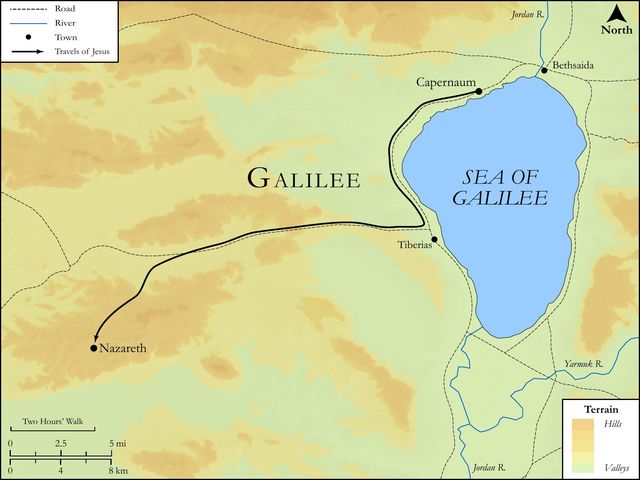
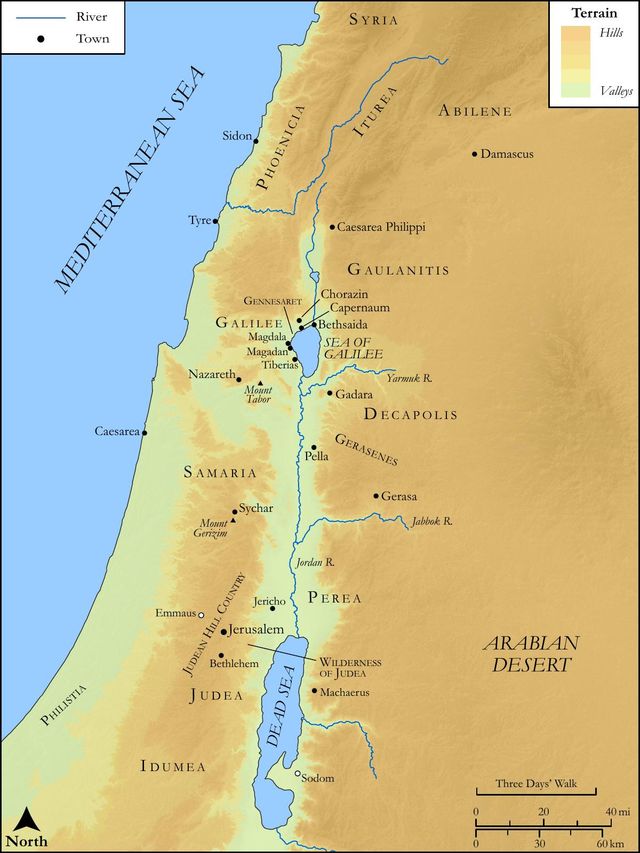
See on the biblical-era maps

Study this verse
Public-domain commentary
Matthew Henry
From his Commentary on the Whole Bible. Henry comments on passages, not single verses — this entry covers Matthew 13:53–58. His three-level outline is real structure in the source text, so it is rendered as structure.
We have here Christ in his own country. He went about doing good, yet left not any place till he had finished his testimony there at that time. His own countrymen had rejected him once, yet he came to them again. Note, Christ does not take refusers at their first word, but repeats his offers to those who have often repulsed them. In this, as in other things, Christ was like his brethren; he had a natural affection to his own country; Patriam quisque amat, non quia pulchram, sed quia suam - Every one loves his country, not because it is beautiful, but because it is his own. Seneca. His treatment this time was much the same as before, scornful and spiteful. Observe,
I.How they expressed their contempt of him.
When he taught them in their synagogue, they were astonished; not that they were taken with his preaching, or admired his doctrine in itself, but only that it should be his; looking upon him as unlikely to be such a teacher. Two things they upbraided him with.
1.His want of academical education. They owned that he had wisdom, and did mighty works; but the question was, Whence he had them: for they knew that he was not brought up at the feet of the rabbin: he had never been at the university, nor taken his degree, nor was called of men, Rabbi, Rabbi. Note, Mean and prejudiced spirits are apt to judge of men by their education, and to enquire more into their rise than into their reasons. "Whence has this man these mighty works? Did he come honestly by them? Has he not been studying the black art?" Thus they turned that against him which was really for him; for if they had not been wilfully blind, they must have concluded him to be divinely assisted and commissioned, who without the help of education gave such proofs of extraordinary wisdom and power.
2.The meanness and poverty of his relations, Mat 13:55, Mat 13:56.
(1.)They upbraid him with his father. Is not this the carpenter's son? Yes, it is true he was reputed so: and what harm in that? No disparagement to him to be the son of an honest tradesman. They remember not (though they might have known it) that this carpenter was of the house of David (Luk 1:27), a son of David (Mat 1:20); though a carpenter, yet a person of honour. Those who are willing to pick quarrels will overlook that which is worthy and deserving, and fasten upon that only which seems mean. Some sordid spirits regard no branch, no not the Branch from the stem of Jesse (Isa 11:1), if it be not the top branch.
(2.)They upbraid him with his mother; and what quarrel have they with her? Why, truly, his mother is called Mary, and that was a very common name, and they all knew her, and knew her to be an ordinary person; she was called Mary, not Queen Mary, nor Lady Mary, nor so much as Mistress Mary, but plain Mary; and this is turned to his reproach, as if men had nothing to be valued by but foreign extraction, noble birth, or splendid titles; poor things to measure worth by.
(3.)They upbraid him with his brethren, whose names they knew, and had them ready enough to serve this turn; James, and Joses, and Simon, and Judas, good men but poor men, and therefore despised; and Christ for their sakes. These brethren, it is probable, were Joseph's children by a former wife; or whatever their relation was to him, they seem to have been brought up with him in the same family. And therefore of the calling of three of these, who were of the twelve, to that honour (James, Simon, and Jude, the same with Thaddeus), we read not particularly, because they needed not such an express call into acquaintance with Christ who had been the companions of his youth.
(4.)His sisters too are all with us; they should therefore have loved him and respected him the more, because he was one of themselves, but therefore they despised him. They were offended in him: they stumbled at these stumbling-stones, for he was set for a sign that should be spoken against, Luk 2:34; Isa 8:14.
II.See how he resented this contempt, Mat 13:57, Mat 13:58.
1.It did not trouble his heart. It appears he was not much concerned at it; he despised the shame, Heb 12:2. Instead of aggravating the affront, or expressing an offence at it, or returning such an answer to their foolish suggestions as they deserved, he mildly imputes it to the common humour of the children of men, to undervalue excellences that are cheap, and common, and home-bred. It is usually so. A prophet is not without honour, save in his own country. Note,
(1.)Prophets should have honour paid them, and commonly have; men of God are great men, and men of honour, and challenge respect. It is strange indeed if prophets have not honour.
(2.)Notwithstanding this, they are commonly least regarded and reverenced in their own country, nay, and sometimes are most envied. Familiarity breeds contempt.
2.It did for the present (to speak with reverence), in effect, tie his hands: He did not many mighty works there, because of their unbelief. Note, Unbelief is the great obstruction to Christ's favours. All things are in general possible to God (Mat 19:26), but then it is to him that believes as to the particulars, Mar 9:23. The gospel is the power of God unto salvation, but then it is to every one that believes, Rom 1:16. So that if mighty works be not wrought in us, it is not for want of power or grace in Christ, but for want of faith in us. By grace ye are saved, and that is a mighty work, but it is through faith, Eph 2:8.
Historical interpretation
Nine Centuries of Reception
11 surviving comments on this verse. Each one is dated, so this reads as a timeline rather than a list.
Select a marker to jump to its quote. Markers stagger vertically where authors wrote within a few decades of each other.
(non occ. cf. Serm. 135. App.) For the Father of Christ is that Divine Workman who made all these works of nature, who set forth Noah's ark, who ordained the tabernacle of Moses, and instituted the Ark of the covenant; that Workman who polishes the stubborn mind, and cuts down the proud thoughts.
It seems to me that the production of miracles is similar in some ways to the case of physical things. Cultivation is not sufficient to produce a harvest of fruits unless the soil, or rather the atmosphere, cooperates to this end. And the atmosphere of itself is not sufficient to produce a harvest without cultivation. The one who providentially orders creation did not design things to spring up from the earth without cultivation. Only in the first instance did he do so when he said, “Let the earth bring forth vegetation, with the seed sowing according to its kind and according to its likeness.”It is just this way in regard to the production of miracles. The complete work resulting in a healing is not displayed without those being healed exercising faith. Faith, of whatever quality it might be, does not produce a healing without divine power.
And this was the carpenter's son who subdues iron by means of fire, who tries the virtue of this world in the judgment, and forms the rude mass to every work of human need; the figure of our bodies, for example, to the divers ministrations of the limbs, and all the actions of life eternal.
Thus the Lord is held in no honour by His own; and though the wisdom of His teaching, and the power of His working raised their admiration, yet do they not believe that He did these things in the name of the Lord, and they cast His father's trade in His teeth. Amid all the wonderful works which He did, they were moved with the contemplation of His Body, and hence they ask, Whence hath this man these things? And thus they were offended in him.
Further, He makes this answer, that a Prophet is without honour in his own country, because it was in Judæa that He was to be condemned to the sentence of the cross; and forasmuch as the power of God is for the faithful alone, He here abstained from works of divine power because of their unbelief; whence it follows, And he did not there many mighty works because of their unbelief.
(Hom. xlviii.) By his own country here, He means Nazareth; for it was not there but in Capharnaum that, as is said below, He wrought so many miracles; but to these He shows His doctrine, causing no less wonder than His miracles.
Therefore were they in all things insensate, seeing they lightly esteemed Him on account of him who was regarded as His father, notwithstanding the many instances in old times of sons illustrious sprung from ignoble fathers; as David was the son of a husbandman, Jesse; Amos the son of a shepherd, himself a shepherd. And they ought to have given Him more abundant honour, because, that coming of such parents, He spake after such manner; clearly showing that it came not of human industry, but of divine grace.
Observe Christ's mercifulness; He is evil spoken of, yet He answers with mildness; Jesus said unto them, A prophet is not without honour, but in his own country, and in his own house.
But if His miracles raised their wonder, why did He not work many? Because He looked not to display of Himself, but to what would profit others; and when that did not result, He despised what pertained only to Himself that He might not increase their punishment. Why then did He even these few miracles? That they should not say, We should have believed had any miracles been done among us.
What then saith Christ unto them? "A prophet," saith He, "is not without honor, save in his own country, and in his own house: and He did not," it is said, "many mighty works, because of their unbelief." But Luke saith, "And He did not there many miracles." And yet it was to be expected He should have done them. For if the feeling of wonder towards Him was gaining ground (for indeed even there He was marvelled at), wherefore did He not do them? Because He looked not to the display of Himself, but to their profit. Therefore when this succeeded not, He overlooked what concerned Himself, in order not to aggravate their punishment.
And yet see after how long a time He came to them, and after how great a display of miracles: but not even so did they endure it, but were inflamed again with envy.
Wherefore then did He yet do a few miracles? That they might not say, "Physician, heal thyself." That they might not say, "He is a foe and an enemy to us, and overlooks His own;" that they might not say, "If miracles had been wrought, we also should have believed." Therefore He both wrought them, and stayed: the one, that He might fulfill His own part; the other, that He might not condemn them the more.
And consider thou the power of His words, herein at least, that possessed as they were by envy, they did yet admire. And as with regard to His works, they do not find fault with what is done, but feign causes which have no existence, saying, "In Beelzebub He casteth out the devils;" even so here too, they find no fault with the teaching, but take refuge in the meanness of His race.
But mark thou, I pray thee, the Master's gentleness, how He reviles them not, but with great mildness saith, "A prophet is not without honor, save in his own country." And neither here did He stop, but added, "And in his own house." To me it appears, that with covert reference to His very own brethren, He made this addition.
But in Luke He puts examples also of this, saying, that neither did Elias come unto His own, but to the stranger widow; neither by Eliseus was any other leper healed, but the stranger Naaman; and Israelites neither received benefit, nor conferred benefit, but the foreigners. And these things He saith, signifying in every instance their evil disposition, and that in His case nothing new is taking place.
(Verse 58) And he did not do many miracles there because of their unbelief. Not because he was unable to do many miracles for them, who were unbelieving; but rather because in doing many miracles he would condemn the unbelieving citizens. It can also be understood in another way, that Jesus is despised in his own home and country, that is, among the Jewish people. And therefore, he performed only a few signs there, so that they would not become completely without excuse. But he performs greater signs daily among the nations through his apostles, not so much in the healing of bodies, but in the salvation of souls.
After the parables which the Lord spake to the people, and which the Apostles only understand, He goes over into His own country that He may teach there also.
Wonderful folly of the Nazarenes! They wonder whence Wisdom itself has wisdom, whence Power has mighty works! But the source of their error is at hand, because they regard Him as the Son of a carpenter; as they say, Is not this the carpenter's son?
And when they are mistaken in His Father, no wonder if they are also mistaken in His brethren. Whence it is added, Is not his mother Mary, and his brethren, James, and Joseph, and Simon, and Judas? And his sisters, are they not all with us?
(in Helvid. 14.) Those who are here called the Lord's brethren, are the sons of a Mary, His Mother's sister; she is the mother of this James and Joseph, that is to say, Mary the wife of Cleophas, and this is the Mary who is called the mother of James the Less.
This error of the Jews is our salvation, and the condemnation of the heretics, for they perceived Jesus Christ to be man so far as to think Him the son of a carpenter.
For it is almost natural for citizens to be jealous towards one another; for they do not look to the present works of the man, but remember the frailties of his childhood; as if they themselves had not passed through the very same stages of age to their maturity.
Not that because they did not believe He could not do His mighty works; but that He might not by doing them be condemning His fellow-citizens in their unbelief.
Or we may understand it otherwise, that Jesus is despised in His own house and country, signifies in the Jewish people; and therefore He did among them few miracles, that they might not be altogether without excuse; but among the Gentiles He does daily greater miracles by His Apostles, not so much in healing their bodies, as in saving their souls.
Christ indeed came to his own country, because it was written, “He came among his own, and his own did not receive him.” In plain fact, when he says, “A prophet is not without honor except in his own country,” he is teaching that it is a painful situation to have influence among his own. To stand out among the local denizens is similar to an inflammation. A near relation’s glory burns the near relations. If neighbors have to pay homage to a neighbor, they consider it servitude. “And he did not do many mighty works there, because of their unbelief.” Power has no effect where unbelief does not deserve it. And while Christ does not demand a reward when he heals, he becomes indignant when injustice is shown to him instead of honor.
He taught in their synagogues where great numbers were met, because it was for the salvation of the multitude that He came from heaven upon earth. It follows; So that they marvelled, and said, Whence hath this man this wisdom, and these many mighty works? His wisdom is referred to His doctrine, His mighty works to His miracles.
He calls Himself a Prophet, as Moses also declares, when he says, A Prophet shall God raise up unto you of your brethren. (Deut. 18:18.) And it should be known, that not Christ only, who is the Head of all the Prophets, but Jeremiah, Daniel, and the other lesser Prophets, had more honour and regard among strangers than among their own citizens.
(ubi sup.) Otherwise; The things old are, that the human race for its sin should suffer in eternal punishment; the things new, that they should be converted and live in the kingdom. First, He brought forward a comparison of the kingdom to a treasure found and a pearl of price; and after that, narrated the punishment of hell in the burning of the wicked, and then concluded with Therefore every Scribe, &c. as if He had said, He is a learned preacher in the Church who knows to bring forth things new concerning the sweetness of the kingdom, and to speak things old concerning the terror of punishment; that at least punishment may deter those whom rewards do not excite.
See how Christ did not insult them, but said meekly, "A prophet is not without honour." For it is our human habit to despise those who are familiar, and to give a friendly welcome strangers. He added "and in his own house" because even His brothers who were of the same house bore Him ill-will. "He did not many mighty works there" because of their unbelief, sparing them further punishment lest they remain unbelieving even after the miracles which He might have done there. "He did not many mighty works," but He did perform a few, that they might not have excuse to say later, "If He had done something, we would have believed." You, O reader, understand this: to this day Jesus is without honor in His own country, that is, among the Jews. But we who are foreigners give Him honor.
Continue studying Matthew 13:58 across the web’s major study libraries — every link below opens this exact verse, chapter, or book on the destination site.
Read & Compare
 BibleGatewayThis verse in more than 200 translations and 70 languages.
 Bible.comThe YouVersion reader — hundreds of translations, reading plans, and highlights.
 ESV.orgCrossway's official English Standard Version reader.
 NET BibleThe NET translation with 60,000+ translators' notes on every rendering decision.
 STEP BibleTyndale House's free study tool — original text, vocabulary, and scholarly resources.
 BibliaLogos Bible Software's free web reader.
 USCCBThe New American Bible (Revised Edition) with the U.S. bishops' study notes.
Commentaries
 BibleHub CommentariesDozens of classic commentaries on this verse, gathered on one page.
 StudyLightMore than 100 commentary sets — the largest collection on the web.
 BibleRefPlain-English commentary on what this verse means, verse by verse.
 Enduring WordDavid Guzik's free commentary on this chapter, widely used by Bible teachers.
 Bible Study ToolsVerse commentary alongside Greek and Hebrew study aids.
Original Language & Research
- BibleHub InterlinearThe verse word by word — original language, transliteration, and English.
- BibleHub LexiconEvery word's original-language definition and Strong's entry.
 Blue Letter BibleDeep-study tools — Strong's numbers, concordance, and word studies.
 CNTR CollationThe earliest Greek manuscripts of this verse, collated letter by letter.
Sermons, Hymns & Audio


TrulyRandomVerse is not affiliated with these sites and doesn’t control their content. They’re linked because they’re genuinely useful.
Summary
Matthew 13:58 concludes Jesus' visit to His hometown of Nazareth, revealing a profound principle concerning the interaction between divine power and human receptivity. Despite Jesus' inherent ability to perform miracles, His works were significantly limited in Nazareth, not due to any deficiency in His power, but because of the pervasive skepticism and unwillingness of the people to believe in Him. This verse underscores the critical role of faith in experiencing God's miraculous intervention, serving as a poignant illustration of how human unbelief can hinder the manifestation of divine activity.
Context
ShowHideLiterary Context
Matthew 13:58 serves as the climactic conclusion to a significant section of Jesus' ministry, specifically following His extensive teaching through parables about the Kingdom of Heaven (Matthew 13:1-53). After these profound teachings, Jesus returns to His familiar hometown of Nazareth. The preceding verses (Matthew 13:54-57) describe the initial astonishment of the people in the synagogue at His wisdom and "mighty works," quickly followed by their dismissive questions: "Whence hath this man this wisdom, and these mighty works? Is not this the carpenter's son? is not his mother called Mary? and his brethren, James, and Joses, and Simon, and Judas? And his sisters, are they not all with us? Whence then hath this man all these things?" Their familiarity with His earthly origins led them to take offense at His claims and authority, setting the stage for the limited display of His power described in Matthew 13:58. This narrative highlights a stark contrast between Jesus' divine authority and the human resistance He encountered.
Historical & Cultural Context
Nazareth was a small, obscure village in Galilee, not a center of Jewish religious or political power. The people of Nazareth would have known Jesus from His childhood, His family, and His work as a carpenter. In ancient Jewish society, a person's identity and status were often tied to their family and place of origin. For the Nazarenes, Jesus was simply "the carpenter's son," a local boy. Their cultural expectations and preconceived notions about His humble background made it difficult, if not impossible, for them to accept His extraordinary wisdom and miraculous power. This "familiarity breeding contempt" was a common human tendency, especially in tightly-knit communities, and it created a spiritual barrier that even the Son of God chose not to override with an overwhelming display of force. The synagogue was the heart of Jewish community life, a place for teaching and worship, making their rejection of Jesus there particularly significant.
Key Themes
ShowHideThis verse powerfully illustrates several key themes prevalent in Matthew's Gospel and throughout the New Testament. Firstly, it underscores the hindrance of unbelief, demonstrating how human skepticism and a lack of receptive faith can act as a significant barrier to the manifestation of God's power. It was not a lack of power on Jesus' part, but a spiritual resistance in the people that limited the miracles. Secondly, the passage highlights the intricate relationship between divine power and human faith. While God's power is absolute and sovereign, He often chooses to operate in response to human faith, particularly in the context of healing and miraculous intervention, as seen throughout Jesus' ministry (e.g., Matthew 9:22). Finally, it serves as a cautionary tale against familiarity breeding contempt. The people of Nazareth were too familiar with Jesus' human upbringing to accept His divine claims, allowing their preconceived notions and refusal to see beyond His earthly identity to prevent them from experiencing the full scope of His miraculous works. This theme resonates with the broader narrative of Israel's rejection of their Messiah found throughout the Gospels (e.g., John 1:11).
Exposition and Analysis
ShowHideKey Word Analysis
ShowHideThis term refers to inherent force or power, specifically miraculous power, often implying a miracle itself. In this context, it denotes the supernatural deeds and powerful acts that Jesus performed, which were clear demonstrations of divine ability. The use of "many" (G4183, polýs') emphasizes that it was not a complete absence of works, but a significant reduction in the number and scope of miracles compared to other places where faith was present.
This adverb specifies the location: Nazareth, Jesus' hometown. This geographical specificity underscores the personal nature of the rejection. It highlights that the limitation was localized to this particular place because of the specific attitude of its inhabitants, rather than a general inability on Jesus' part.
This preposition indicates the channel or cause of an act. Here, it explicitly states the reason for the limited miracles: the unbelief of the people. This is a crucial causal link, attributing the outcome directly to their spiritual posture rather than to Jesus' power.
This word signifies faithlessness, disbelief, or an unwillingness to believe. It's more than mere intellectual doubt; it implies a spiritual resistance, a lack of trust, or a refusal to accept the truth about Jesus' identity and authority. This "unbelief" was the direct impediment to the "mighty works."
Verse Breakdown
ShowHide"And he did not many mighty works there"
This clause describes the observed outcome of Jesus' visit to Nazareth. The phrase "did not many" (οὐκ ἐποίησεν πολλὰς) indicates a significant limitation, not an absolute cessation. It suggests that while some minor healings might have occurred (as implied in the parallel account in Mark 6:5-6, where He "laid his hands upon a few sick folk, and healed them"), the widespread, spectacular "mighty works" (δυνάμεις) that characterized His ministry elsewhere were notably absent. The word "there" (ἐκεῖ) emphasizes the specific location—His hometown—where this limitation was experienced. This is a striking statement, as Jesus is presented throughout the Gospels as possessing limitless divine power.
"because of their unbelief"
This is the crucial explanatory clause, providing the direct cause for the limited display of divine power. The preposition "because of" (διὰ) unequivocally links the absence of many miracles to the "unbelief" (ἀπιστία) of the Nazarenes. Their "unbelief" was not merely a lack of intellectual assent, but a deep-seated spiritual resistance, a refusal to acknowledge Jesus' divine authority and Messianic claims, rooted in their familiarity with His human origins. This highlights a profound theological principle: while God's power is sovereign, its manifestation can be conditioned by human receptivity and faith. It implies that God, in His wisdom, often chooses to work in cooperation with human faith, rather than overriding human will.
Literary Devices
ShowHideMatthew 13:58 employs several powerful literary devices. Cause and Effect is the most prominent, as the verse explicitly links the limited "mighty works" (the effect) to the people's "unbelief" (the cause). This direct causal statement underscores a fundamental theological principle about the interaction between divine power and human faith. There is also a strong element of Irony present; the Messiah, who performs astonishing miracles elsewhere, is met with skepticism and limited effectiveness in His own hometown, the very place where His identity should have been most clearly understood. This situation creates a poignant Contrast between Jesus' inherent, limitless power and the constrained expression of that power due to human spiritual resistance. The narrative also uses Understatement by stating "not many mighty works," which, given Jesus' usual ministry, implies a significant and unusual curtailment of His typical miraculous activity.
Theological and Thematic Connections
ShowHideMatthew 13:58 is a pivotal verse that reveals a profound theological truth: while God's power is infinite and unchallengeable, its manifestation in the world, particularly in miraculous intervention, is often conditioned by human faith. This does not imply that human faith creates divine power, but rather that faith serves as the necessary conduit or receptive posture through which God chooses to operate. The Nazarenes' unbelief acted as a spiritual barrier, preventing them from receiving the blessings and demonstrations of power that Jesus readily offered elsewhere. This principle underscores human responsibility in responding to God's presence and power, emphasizing that a closed heart, filled with skepticism and prejudice, can tragically limit the work of the divine. It challenges believers to cultivate a spirit of expectant faith, recognizing that our receptivity profoundly impacts our experience of God's transformative work.
Reflection and Application
ShowHideMatthew 13:58 stands as a powerful, yet sobering, reminder for believers today. It challenges us to honestly examine the state of our own faith and the collective faith within our communities. Are there areas in our lives, churches, or ministries where we might be inadvertently limiting God's power due to our own unbelief, skepticism, or preconceived notions about what God can or will do? Perhaps we are too familiar with God, reducing Him to a predictable formula, or allowing past disappointments to erode our trust in His miraculous ability. This verse calls us to cultivate a radical, expectant faith, a willingness to believe beyond what our senses or past experiences dictate. It encourages us to pray with boldness, to step out in obedience even when the path is unclear, and to genuinely anticipate God's supernatural intervention in our circumstances. When we open our hearts in genuine faith, we create an environment where God's mighty works can flourish, not because we compel Him, but because we align ourselves with His desire to display His power to those who believe.
Questions for Reflection
ShowHideFAQ
ShowHideDid Jesus lack power in Nazareth, or was His power diminished?
ShowHideNo, Jesus did not lack power, nor was His power diminished. The text explicitly states that He "did not many mighty works there because of their unbelief." This indicates that the limitation was not inherent to Jesus' divine ability, but rather a consequence of the spiritual climate of Nazareth. Jesus, in His wisdom and sovereignty, chose not to override the free will and hardened hearts of the people with an overwhelming display of force. His power remained absolute, but its manifestation was restrained in response to the pervasive lack of faith, highlighting the principle that God often works in cooperation with human receptivity. The parallel account in Mark 6:5 further clarifies that He "could there do no mighty work, save that he laid his hands upon a few sick folk, and healed them," emphasizing the profound impact of their unbelief on the scope of His miracles.
What kind of "unbelief" is being described here? Was it just intellectual doubt?
ShowHideThe "unbelief" (Greek: apistía) described in Matthew 13:58 is more than mere intellectual doubt; it signifies a deeper spiritual resistance and an unwillingness to trust or commit. The people of Nazareth knew Jesus personally, but their familiarity bred contempt. They could not reconcile the "carpenter's son" with the profound wisdom and miraculous power He demonstrated. Their unbelief was rooted in preconceived notions, prejudice, and a refusal to accept His divine claims based on His humble origins (as seen in Matthew 13:54-57). It was a hardened heart that prevented them from receiving what He offered, highlighting a spiritual blindness that actively hindered the flow of divine power and blessing.
Christ-Centered Fulfillment
ShowHideMatthew 13:58, though a sobering account of rejection, finds its Christ-centered fulfillment in the broader narrative of the Messiah's reception by His own people and the ultimate triumph of faith. Jesus, the Son of God, came to His own, yet "His own received Him not" (John 1:11). The unbelief in Nazareth foreshadows the wider rejection of Christ by many in Israel, culminating in His crucifixion. However, this verse also implicitly points to the necessity of faith for salvation and spiritual transformation. While the Nazarenes' unbelief limited the display of mighty works, it could not limit Jesus' ultimate redemptive work. His mission was not contingent on human faith for its completion, but the experience of His power and blessing in individual lives is profoundly linked to it. The "mighty works" Jesus performed were signs pointing to His identity as the Christ, and those who believed, regardless of their background, experienced His saving power (e.g., John 3:16). Thus, Matthew 13:58 serves as a stark reminder of the tragic consequences of unbelief, while simultaneously underscoring the New Covenant truth that through faith in Christ, all are invited to partake in the ultimate "mighty work" of redemption and new life, a work that no human unbelief can ultimately thwart for those who choose to believe. The call to "not harden your hearts" (Hebrews 3:12-19) echoes the lesson from Nazareth, urging all to embrace the transformative power of the living Christ through faith.