


1 Samuel 26:21
Bible text: King James Version (1769 Blayney text) · Public domain
Bible text: King James Version with Strong's numbers · Public domain
Bible text: Berean Standard Bible · Public domain
Bible text: American Standard Version (1901) · Public domain
Bible text: World English Bible, Messianic edition · Public domain
Bible text: Geneva Bible (1599) · Public domain
Bible text: Young's Literal Translation · Public domain
- וַיֹּאמֶרvai·yo·Merand he saidH559Conj-w ¦ V-Qal-ConsecImperf-3msVerb Qal Consecutive Imperfect 3rd Singular Masculineוַandיֹּאמֶרhe said
- שָׁאוּלsha·'UlSaulH7586N-proper-mNoun Proper Masculine
- חָטָאתִיcha·Ta·tiI have sinnedH2398V-Qal-Perf-1csVerb Qal Perfect 1st Singular common gender
- שׁוּבshuvreturnH7725V-Qal-Imp-2msVerb Qal Imperative 2nd Singular Masculine
- בְּנִיbe·nimy O sonH1121N-msc ¦ 1csNoun Singular Masculine ConstructבְּנִO sonיmy
- דָוִדda·VidDavidH1732N-proper-mNoun Proper Masculine
- כִּיkiforH3588PrtParticle Conditional
- לֹאlo'notH3808NegParticle Negative
- אָרַע'a·Ra'I will do harmH7489V-Hiphil-Imperf-1csVerb Hiphil Imperfect 1st Singular common gender
- לְךָle·Khato <the> youPrep-l ¦ 2msSuffix Personal 2nd Singular Masculineלְto <the>ךָyou
- עוֹדodagainH5750Adj-msAdjective Numerical Singular Masculine Absolute
- תַּחַתTa·chatbecauseH8478N-mscNoun Singular Masculine Construct
- אֲשֶׁר'a·SherthatH834RelParticle Relative
- יָקְרָהya·ke·Rahit was preciousH3365V-Qal-Perf-3fsVerb Qal Perfect 3rd Singular Feminine
- נַפְשִׁיnaf·Shimy lifeH5315N-fsc ¦ 1csNoun Singular Feminine Constructנַפְשִׁlifeיmy
- בְּעֵינֶיךָbe·'ei·Nei·khain your viewH5869Prep-b ¦ N-fdc ¦ 2msNoun Dual Feminine Constructבְּinעֵינֶיviewךָyour
- הַיּוֹםhai·Yomthe dayH3117Art ¦ N-msNoun Singular Masculine Absoluteהַtheיּוֹםday
- הַזֶּהha·Zeh<the> thisH2088Art ¦ PrtParticle Demonstrativeהַ<the>זֶּהthis
- הִנֵּהhi·Nehhere!H2009PrtParticle Interjection
- הִסְכַּלְתִּיhis·Kal·tiI have behaved foolishlyH5528V-Hiphil-Perf-1csVerb Hiphil Perfect 1st Singular common gender
- וָאֶשְׁגֶּהva·'esh·Gehand I have gone astrayH7686Conj-w ¦ V-Qal-ConsecImperf-1csVerb Qal Consecutive Imperfect 1st Singular common genderוָandאֶשְׁגֶּהI have gone astray
- הַרְבֵּהhar·BehgreatlyH7235V-Hiphil-InfAbsVerb Hiphil Infinitive Absolute
- מְאֹדme·'OdveryH3966Adj-msAdjective Numerical Singular Masculine Absolute
English is a literal word-by-word gloss of the Hebrew, not the KJV's wording. Why?
This is the original text the KJV's translators worked from — each Hebrew word with its own literal English meaning in this verse, prepared by scholars at Tyndale House, Cambridge. The KJV translates whole sentences, not word by word, so its wording differs: one Hebrew word can become several English words, and the KJV may choose “the LORD” where the gloss reads “Yahweh”. Both are faithful — they answer different questions. For the KJV's own rendering, switch to the KJV text.
Details
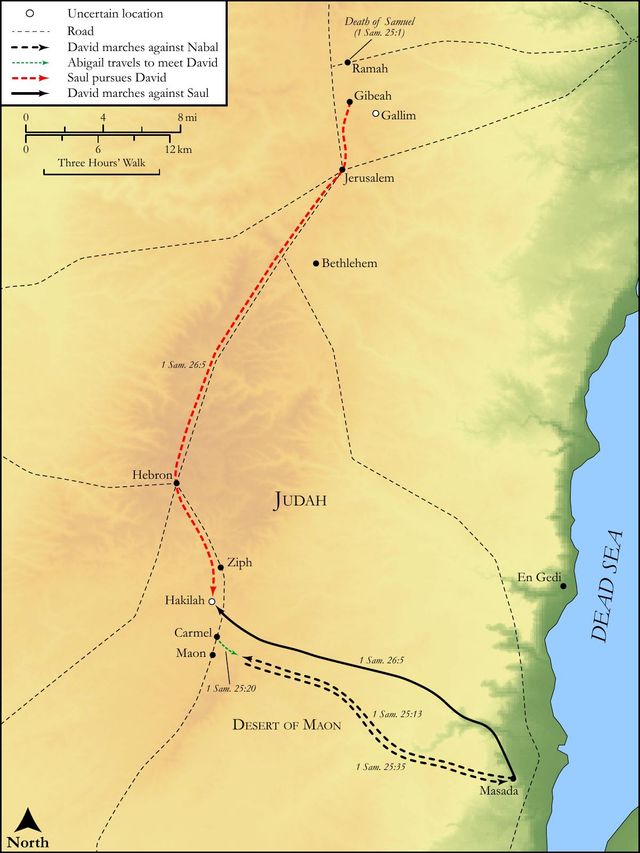
See on the biblical-era map
Study this verse
Public-domain commentary
Matthew Henry
From his Commentary on the Whole Bible. Henry comments on passages, not single verses — this entry covers 1 Samuel 26:21–25. His two-level outline is real structure in the source text, so it is rendered as structure.
Here is, I. Saul's penitent confession of his fault and folly in persecuting David and his promise to do so no more. This second instance of David's respect to him wrought more upon him than the former, and extorted from him better acknowledgements, Sa1 26:21. 1. He owns himself melted and quite overcome by David's kindness to him: "My soul was precious in thy eyes this day, which, I thought, had been odious!" 2. He acknowledges he has done very wrong to persecute him, that he has therein acted against God's law (I have sinned), and against his own interest (I have played the fool), in pursuing him as an enemy who would have been one of his best friends, if he could but have thought so. "Herein (says he) I have erred exceedingly, and wronged both thee and myself." Note, Those that sin play the fool and err exceedingly, those especially that hate and persecute God's people, Job 19:28. 3. He invites him to court again: Return, my son David. Those that have understanding will see it to be their interest to have those about them that behave themselves wisely, as David did, and have God with them. 4. He promises him that he will not persecute him as he has done, but protect him: I will no more do thee harm. We have reason to think, according to the mind he was now in, that he meant as he said, and yet neither his confession nor his promise of amendment came from a principle of true repentance.
II.David's improvement of Saul's convictions and confessions and the evidence he had to produce of his own sincerity.
He desired that one of the footmen might fetch the spear (Sa1 26:22), and then (Sa1 26:23),
1.He appeals to God as judge of the controversy: The Lord render to every man his righteousness. David, by faith, is sure that he will do it because he infallibly knows the true characters of all persons and actions and is inflexibly just to render to every man according to his work, and, by prayer, he desires he would do it. Herein he does, in effect, pray against Saul, who had dealt unrighteously and unfaithfully with him (Give them according to their deeds, Psa 28:4); but he principally intends it as a prayer for himself, that God would protect him in his righteousness and faithfulness, and also reward him, since Saul so ill requited him.
2.He reminds Saul again of the proof he had now given of his respect to him from a principle of loyalty: I would not stretch forth my hand against the Lord's anointed, intimating to Saul that the anointing oil was his protection, for which he was indebted to the Lord and ought to express his gratitude to him (had he been a common person David would not have been so tender of him), perhaps with this further implication, that Saul knew, or had reason to think, David was the Lord's anointed too, and therefore, by the same rule, Saul ought to be as tender of David's life as David had been of his.
3.Not relying much upon Saul's promises, he puts himself under God's protection and begs his favour (Sa1 26:24): "Let my life be much set by in the eyes of the Lord, how light soever thou makest of it." Thus, for his kindness to Saul, he takes God to be his paymaster, which those may with a holy confidence do that do well and suffer for it.
III.Saul's prediction of David's advancement.
He commends him (Sa1 26:25): Blessed be thou, my son David. So strong was the conviction Saul was now under of David's honesty that he was not ashamed to condemn himself and applaud David, even in the hearing of his own soldiers, who could not but blush to think that they had come out so furiously against a man whom their master, when he meets him, caresses thus. He foretels his victories, and his elevation at last: Thou shalt do great things. Note, Those who make conscience of doing that which is truly good may come, by the divine assistance, to do that which is truly great. He adds, "Thou shalt also still prevail, more and more," he means against himself, but is loth to speak that out. The princely qualities which appeared in David - his generosity in sparing Saul, his military authority in reprimanding Abner for sleeping, his care of the public good, and the signal tokens of God's presence with him - convinced Saul that he would certainly be advanced to the throne at last, according to the prophecies concerning him.
Lastly, A palliative cure being thus made of the wound, they parted friends. Saul returned to Gibeah re infect - without accomplishing his design, and ashamed of the expedition he had made; but David could not take his word so far as to return with him. Those that have once been false are not easily trusted another time. Therefore David went on his way. And, after this parting, it does not appear that ever Saul and David saw one another again.
Historical interpretation
Historical reception
1 surviving comment on this verse from the historical church.
And Saul said: I have sinned, etc. To David, who proposed two causes for his exile and inquired from Saul what was true, Saul himself, conscious of his own mind, responded that it was not by the Lord's incitement, but by his own foolishness that he had persecuted him. But now he begs him to return home, assuring that he will suffer no further harm from him. And many Jews, having confessed their crimes, took care to recall to themselves by faith the Lord whom they had driven away by their infidelity.
Continue studying 1 Samuel 26:21 across the web’s major study libraries — every link below opens this exact verse, chapter, or book on the destination site.
Read & Compare
 BibleGatewayThis verse in more than 200 translations and 70 languages.
 Bible.comThe YouVersion reader — hundreds of translations, reading plans, and highlights.
 ESV.orgCrossway's official English Standard Version reader.
 NET BibleThe NET translation with 60,000+ translators' notes on every rendering decision.
 STEP BibleTyndale House's free study tool — original text, vocabulary, and scholarly resources.
 BibliaLogos Bible Software's free web reader.
 USCCBThe New American Bible (Revised Edition) with the U.S. bishops' study notes.
Commentaries
 BibleHub CommentariesDozens of classic commentaries on this verse, gathered on one page.
 StudyLightMore than 100 commentary sets — the largest collection on the web.
 BibleRefPlain-English commentary on what this verse means, verse by verse.
 Enduring WordDavid Guzik's free commentary on this chapter, widely used by Bible teachers.
 Bible Study ToolsVerse commentary alongside Greek and Hebrew study aids.
Original Language & Research
- BibleHub InterlinearThe verse word by word — original language, transliteration, and English.
- BibleHub LexiconEvery word's original-language definition and Strong's entry.
 Blue Letter BibleDeep-study tools — Strong's numbers, concordance, and word studies.
 SefariaThe Hebrew text with Rashi and centuries of Jewish commentary.
Sermons, Hymns & Audio


TrulyRandomVerse is not affiliated with these sites and doesn’t control their content. They’re linked because they’re genuinely useful.
Summary
1 Samuel 26:21 captures a fleeting but profound moment of remorse from King Saul, who, after David's second act of mercy in sparing his life, confesses his sin, acknowledges David's integrity, and admits the profound foolishness of his relentless pursuit. This verse serves as a poignant, albeit temporary, turning point in the tumultuous relationship between Saul and David, highlighting the disarming power of grace in the face of persecution and the tragic, cyclical nature of Saul's spiritual decline.
Context
ShowHideLiterary Context
This verse serves as the emotional and theological climax of the second major narrative where David, despite being relentlessly pursued by Saul, has a clear opportunity to kill the king but refrains. This episode closely mirrors the earlier account in 1 Samuel 24, reinforcing David's unwavering respect for God's anointed and his commitment to allowing divine justice to prevail. In this specific instance, David and Abishai infiltrate Saul's sleeping camp, taking Saul's spear and water jug as irrefutable proof of their proximity and David's restraint. Saul's words in 1 Samuel 26:21 are his direct, emotional response to David's powerful appeal for justice and understanding, articulated in 1 Samuel 26:17-20. The chapter concludes with Saul returning home and David continuing his flight, underscoring the temporary and ultimately unfulfilled nature of Saul's repentance.
Historical & Cultural Context
The narrative is set against the backdrop of ancient Israel's transition from a tribal confederacy to a monarchy, a period marked by significant political and spiritual upheaval. Saul, as the first king, was God's chosen leader, yet his reign was increasingly marred by disobedience and spiritual decline. The concept of "the Lord's anointed" (מְשִׁיחַ יְהוָה, māšîaḥ Yahweh) carried immense weight; to harm the king, even a disobedient one, was considered an act against God's direct appointment. David's consistent refusal to lay a hand on Saul, despite Saul's murderous intent, was a profound demonstration of piety and adherence to this sacred principle, sharply contrasting with Saul's own disregard for divine commands, as evidenced in 1 Samuel 13 and 1 Samuel 15. David's precarious existence as a fugitive in the wilderness, often in places like the wilderness of Ziph, highlights the constant danger he faced and the divine protection he experienced.
Key Themes
ShowHideThis verse contributes significantly to several overarching themes within 1 Samuel. Firstly, it vividly illustrates the stark contrast between Saul's declining kingship and David's rising, righteous leadership. Saul's confession of foolishness and error stands in opposition to David's consistent integrity, patience, and trust in God's timing. Secondly, it powerfully underscores the theme of divine sovereignty and protection. Despite Saul's relentless and irrational attempts to kill David, God continually protects His chosen servant, often through David's own acts of mercy that disarm his enemy. Thirdly, the verse offers a poignant commentary on the nature of repentance. Saul's remorse, while seemingly genuine in the moment, proves to be fleeting, unable to break the destructive cycle of his jealousy and paranoia. This highlights the difference between sorrow for sin's consequences and true, lasting repentance from sin, which requires a transformed heart and a sustained turning to God, a transformation Saul ultimately fails to achieve, as seen in his continued pursuit of David and his tragic end in 1 Samuel 31.
Exposition and Analysis
ShowHideKey Word Analysis
ShowHideFrom the primitive root H2398, this verb properly means "to miss the mark." Figuratively and generally, it signifies to sin, to forfeit, lack, or transgress. Saul's declaration, "I have sinned," is a direct and explicit acknowledgment of his moral culpability and wrongdoing against David and, by extension, against God's will. It marks a rare moment of self-condemnation from the king, signifying a recognition of his deliberate deviation from righteousness.
From the primitive root H3365, this adjective means valuable, costly, esteemed, or dear. Saul's statement that his "soul was precious in thine eyes this day" reveals his recognition that David, despite being hunted, valued Saul's life and dignity. This acknowledgment underscores David's profound respect for human life and, specifically, for the life of the Lord's anointed, even when that anointed one was his persecutor. It highlights the powerful, disarming effect of David's mercy on Saul.
A verb meaning "to be silly." In this context, it signifies acting foolishly or stupidly, often implying a severe lack of moral discernment or prudence. Saul's use of this phrase is a profound admission of his irrational, morally bankrupt, and self-destructive behavior. He recognizes that his relentless pursuit of David was not only unjust but utterly senseless, driven by a foolish jealousy rather than wisdom or divine guidance, and that he has "erred exceedingly" (H7686, H3966) in doing so.
Verse Breakdown
ShowHide"¶ Then said Saul, I have sinned:"
This opening phrase marks Saul's immediate and explicit confession of guilt. It is a direct acknowledgment of his moral failure and wrongdoing against David, prompted by David's powerful demonstration of mercy and integrity. This is a rare moment of humility for the tormented king, breaking his pattern of self-justification.
"return, my son David:"
This is a plea for David to cease his flight and come back, signifying a temporary cessation of hostilities. The address "my son David" is a term of affection and reconciliation, indicating a desire to restore their broken relationship, at least for this moment, and perhaps to re-establish David's place in the court.
"for I will no more do thee harm,"
This is a solemn promise from Saul to cease his persecution of David. This declaration is a direct response to David's actions, recognizing that David's mercy has disarmed Saul's murderous intent. However, the tragic irony, known to the reader, is that this promise, like previous ones, will prove to be short-lived, reflecting Saul's inability to sustain true change.
"because my soul was precious in thine eyes this day:"
Saul's explanation for his change of heart. He acknowledges that David valued his life, despite Saul's malicious intent and repeated attempts to kill him. This recognition of David's profound mercy and respect for the Lord's anointed deeply impacts Saul, revealing the power of grace to momentarily penetrate even a hardened heart.
"behold, I have played the fool, and have erred exceedingly."
This is a powerful, dual confession of profound self-condemnation. Saul admits that his actions were not just mistakes but irrational, morally bankrupt, and gravely misguided. The intensity of "exceedingly" (H3966) emphasizes the depth of his self-awareness regarding the extent of his deviation from wisdom and righteousness, acknowledging a significant moral and spiritual wandering.
Literary Devices
ShowHideThe passage is rich with Irony, as Saul, the powerful king, is forced to confess his foolishness and sin to David, the hunted fugitive whom he relentlessly seeks to kill. David, the one pursued, demonstrates true kingly character through his mercy and restraint, while Saul, the actual king, acts with irrational, self-destructive folly. There is a strong Contrast between Saul's impulsive, envious, and disobedient nature and David's patient, God-fearing integrity. Saul's fleeting remorse stands in stark opposition to David's consistent righteousness and trust in divine justice. The phrase "played the fool, and have erred exceedingly" employs Parallelism and Emphasis, using two strong, synonymous verbs ("played the fool" and "erred") intensified by an adverb ("exceedingly") to underscore the profound depth of Saul's self-condemnation and the extensive nature of his moral wandering. Finally, the scene evokes Pathos, as the reader witnesses the tragic decline of Saul, a king once chosen by God, now reduced to admitting his own profound foolishness and error, yet seemingly unable to escape the cycle of his spiritual torment and ultimately unable to achieve lasting repentance.
Theological and Thematic Connections
ShowHideThis verse powerfully illustrates the tension between human will and divine sovereignty, and the profound impact of mercy. Saul's confession, though genuine in the moment, highlights the superficiality of a repentance not rooted in a truly transformed heart. It underscores that while external acts of grace can elicit temporary remorse, true change requires a deeper spiritual work. David's actions, however, exemplify a profound trust in God's justice and timing, refusing to take vengeance into his own hands. This trust is a theological statement, affirming God's ultimate control over the destiny of kings and the establishment of His kingdom. The scene also foreshadows the principle that mercy triumphs over judgment, and that responding to evil with good can, at times, disarm an enemy, even if only momentarily.
Reflection and Application
ShowHideSaul's confession in 1 Samuel 26:21 offers a profound reflection on the nature of sin, the complexities of repentance, and the transformative power of grace. It reminds us that even those who are deeply entrenched in sin can experience moments of clarity and remorse, acknowledging their wrongdoings. However, the tragedy of Saul's life is that these moments, though seemingly sincere, were fleeting, never leading to a lasting change of heart or a true turning away from his destructive path. For believers, David's response serves as a powerful model: to extend mercy even to those who persecute us, to trust God with justice and vindication, and to respond with integrity rather than retaliation. It challenges us to consider whether our confessions of sin lead to genuine transformation, marked by a sustained turning from our destructive patterns, or are merely temporary expressions of regret aimed at alleviating immediate discomfort. Ultimately, this passage calls us to cultivate a heart that values life, extends grace, and trusts in divine sovereignty, even when faced with injustice and personal harm, seeking to overcome evil with good.
Questions for Reflection
ShowHideFAQ
ShowHideWhy did Saul's repentance not last, given his seemingly sincere confession?
ShowHideSaul's confession, while emotionally charged and seemingly sincere in the moment, was ultimately superficial because it did not stem from a transformed heart or a genuine commitment to God's will. His remorse was primarily a reaction to David's overwhelming act of grace and proof of innocence, rather than a deep, internal conviction of sin against God. Throughout his reign, Saul demonstrated a pattern of impulsive behavior, jealousy, and disobedience to God's commands, as seen in his unauthorized sacrifice in 1 Samuel 13:8-14 and his failure to utterly destroy the Amalekites in 1 Samuel 15:1-9. His repentance was often conditional or self-serving, aimed at alleviating immediate distress or maintaining his public image, rather than pursuing true reconciliation with God and genuine change of character. This fleeting nature of his remorse highlights the critical difference between sorrow for consequences and true sorrow over sin, which leads to lasting transformation and a turning towards righteousness.
Christ-Centered Fulfillment
ShowHide1 Samuel 26:21, with Saul's confession and David's remarkable act of mercy, profoundly foreshadows the ultimate act of divine mercy found in Jesus Christ. David, the innocent one, hunted by a king consumed by jealousy and irrational hatred, responds not with vengeance but with grace, valuing the life of his persecutor. This points directly to Jesus, the true Son of David, who, though utterly innocent and perpetually persecuted by a fallen world, did not merely spare His enemies but laid down His life for them. Saul's admission, "my soul was precious in thine eyes this day," finds its ultimate fulfillment in Christ, whose very mission was to make our souls precious in the eyes of God through His atoning sacrifice. He did not just refrain from doing us harm; He absorbed the harm we deserved, becoming sin for us so that we might become the righteousness of God (2 Corinthians 5:21). Saul's confession, "behold, I have played the fool, and have erred exceedingly," echoes the universal human condition of sin and rebellion against God, a profound foolishness that alienates us from our Creator (Romans 3:23). Yet, unlike Saul's temporary remorse, Christ offers a path to genuine, lasting repentance and reconciliation. He is the Lamb of God who takes away the sin of the world, not merely acknowledging our foolishness but providing the wisdom and righteousness we lack. Through His death and resurrection, Jesus fulfills David's mercy by offering complete forgiveness and new life to those who were once His enemies, transforming their foolishness into the wisdom of God (1 Corinthians 1:25 and Colossians 1:21-22).