


1 Samuel 27:4
Bible text: King James Version (1769 Blayney text) · Public domain
Bible text: Berean Standard Bible · Public domain
Bible text: American Standard Version (1901) · Public domain
Bible text: World English Bible, Messianic edition · Public domain
Bible text: Geneva Bible (1599) · Public domain
Bible text: Young's Literal Translation · Public domain
- וַיֻּגַּדvai·yu·Gadand it was toldH5046Conj-w ¦ V-Hophal-ConsecImperf-3msVerb Hophal Consecutive Imperfect 3rd Singular Masculineוַandיֻּגַּדit was told
- לְשָׁאוּלle·sha·'Ulto SaulH7586Prep-l ¦ N-proper-mNoun Proper MasculineלְtoשָׁאוּלSaul
- כִּיkithatH3588PrtParticle Conditional
- בָרַחva·Rachhe had fledH1272V-Qal-Perf-3msVerb Qal Perfect 3rd Singular Masculine
- דָּוִדda·VidDavidH1732N-proper-mNoun Proper Masculine
- גַּתGatGathH1661N-properNoun Proper Location
- וְלֹאve·lo'and notH3808Conj-w ¦ NegParticle Negativeוְandלֹאnot
- יָסַףyo·safhe repeatedH3254V-Qal-Perf-3msVerb Qal Perfect 3rd Singular Masculine
- עוֹדodagainH5750Adj-msAdjective Numerical Singular Masculine Absolute
- לְבַקְשׁוֹle·vak·Shoto seek himH1245Prep-l ¦ V-Piel-Inf ¦ 3msVerb Piel Infinitive Constructלְtoבַקְשׁseekוֹhim
English is a literal word-by-word gloss of the Hebrew, not the KJV's wording. Why?
This is the original text the KJV's translators worked from — each Hebrew word with its own literal English meaning in this verse, prepared by scholars at Tyndale House, Cambridge. The KJV translates whole sentences, not word by word, so its wording differs: one Hebrew word can become several English words, and the KJV may choose “the LORD” where the gloss reads “Yahweh”. Both are faithful — they answer different questions. For the KJV's own rendering, switch to the KJV text.
Details
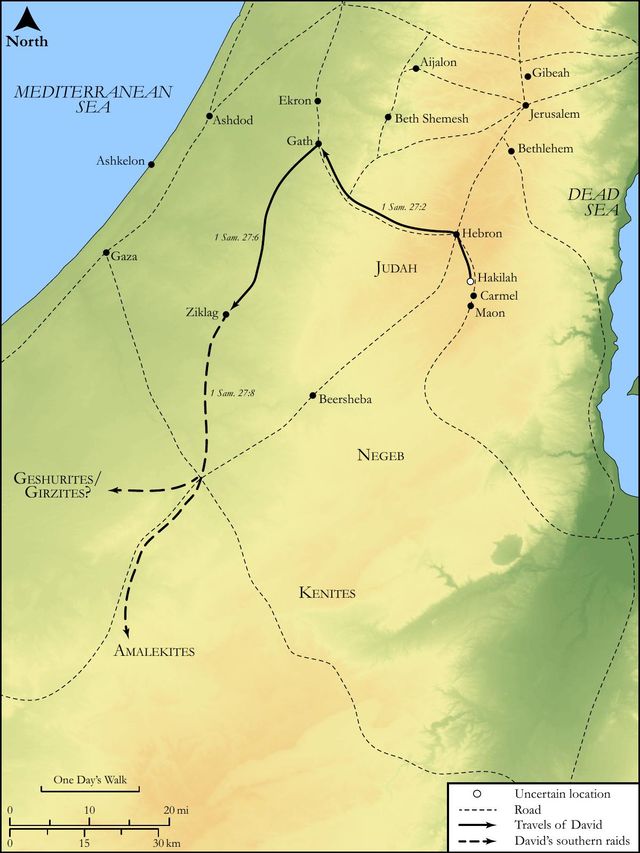
See on the biblical-era map
Study this verse
Public-domain commentary
Matthew Henry
From his Commentary on the Whole Bible. Henry comments on passages, not single verses — this entry covers 1 Samuel 27:1–7. His three-level outline is real structure in the source text, so it is rendered as structure.
Here is, I. The prevalency of David's fear, which was the effect of the weakness of his faith (Sa1 27:1): He said to his heart (so it may be read), in his communings with it concerning his present condition, I shall now perish one day by the hand of Saul. He represented to himself the restless rage and malice of Saul (who could not be wrought into a reconciliation) and the treachery of his own countrymen, witness that of the Ziphites, once and again; he looked upon his own forces, and observed how few they were, and that no recruits had come in to him for a great while, nor could he perceive that he got any ground; and hence, in a melancholy mood, he draws this dark conclusion: I shall one day perish by the hand of Saul. But, O thou of little faith! wherefore dost thou doubt? Was he not anointed to be king? Did not that imply an assurance that he should be preserved to the kingdom? Though he had no reason to trust Saul's promises, had he not all the reason in the world to trust the promises of God? His experience of the particular care Providence took of him ought to have encouraged him. He that has delivered does and will. But unbelief is a sin that easily besets even good men. When without are fightings, within are fears, and it is a hard matter to get over them. Lord, increase our faith!
II.The resolution he came to hereupon.
Now that Saul had, for this time, returned to his place, he determined to take this opportunity of retiring into the Philistines' country. Consulting his own heart only, and not the ephod or the prophet, he concludes, There is nothing better for me than that I should speedily escape into the land of the Philistines. Long trials are in danger of tiring the faith and patience even of very good men. Now,
1.Saul was an enemy to himself and his kingdom in driving David to this extremity. He weakened his own interest when he expelled from his service, and forced into the service of his enemies, so great a general as David was, and so brave a regiment as he had the command of.
2.David was no friend to himself in taking this course. God had appointed him to set up his standard in the land of Judah, Sa1 22:5. There God had wonderfully preserved him, and employed him sometimes for the good of his country; why then should he think of deserting his post? How could he expect the protection of the God of Israel if he went out of the borders of the land of Israel? Could he expect to be safe among the Philistines, out of whose hands he had lately escaped so narrowly by feigning himself mad? Would he receive obligations from those now whom he knew he must not return kindness to when he should come to be king, but be under an obligation to make war upon? Hereby he would gratify his enemies, who bade him go and serve other gods that they might have wherewith to reproach him, and very much weaken the hands of his friends, who would not have wherewith to answer that reproach. See what need we have to pray, Lord, lead us not into temptation.
III.The kind reception he had at Gath.
Achish bade him welcome, partly out of generosity, being proud of entertaining so brave a man, partly out of policy, hoping to engage him for ever to his service, and that his example would invite many more to desert and come over to him. No doubt he gave David a solemn promise of protection, which he could rely upon when he could not trust Saul's promises. We may blush to think that the word of a Philistine should go further than the word of an Israelite, who, if an Israelite indeed, would be without guile, and that the city of Gath should be a place of refuge for a good man when the cities of Israel refuse him a safe abode. David,
1.Brought his men with him (Sa1 27:2) that they might guard him, and might themselves be safe where he was, and to recommend himself the more to Achish, who hoped to have service out of him.
2.He brought his family with him, his wives and his household, so did all his men, Sa1 27:2, Sa1 27:3. Masters of families ought to take care of those that are committed to them, to protect and provide for those of their own house, and to dwell with them as men of knowledge.
IV.Saul's desisting from the further prosecution of him (Sa1 27:4):
He sought no more again for him; this intimates that notwithstanding the professions of repentance he had lately made, if he had had David in his reach, he would have aimed another blow. But, because he dares not come where he is, he resolves to let him alone. Thus many seem to leave their sins, but really their sins leave them; they would persist in them if they could. Saul sought no more for him, contenting himself with his banishment, since he could not have his blood, and hoping, it may be (as he had done, Sa1 18:25), that he would, some time or other, fall by the hand of the Philistines; and, though he would rather have the pleasure of destroying him himself, yet, if they do it, he will be satisfied, so that it be done effectually.
V.David's removal from Gath to Ziklag.
1.David's request for leave to remove was prudent and very modest, Sa1 27:5.
(1.)It was really prudent. David knew what it was to be envied in the court of Saul, and had much more reason to fear in the court of Achish, and therefore declines preferment there, and wishes for a settlement in the country, where he might be private, more within himself, and less in other people's way. In a town of his own he might have the more free exercise of his religion, and keep his men better to it, and not have his righteous soul vexed, as it was at Gath, with the idolatries of the Philistines.
(2.)As it was presented to Achish it was very modest. He does not prescribe to him what place he should assign him, only begs it may be in some town in the country, where he pleased (beggars must not be choosers); but he gives this for a reason, "Why should thy servant dwell in the royal city, to crowd thee, and disoblige those about thee?" Note, Those that would stand fast must not covet to stand high; and humble souls aim not to dwell in royal cities.
2.The grant which Achish made to him, upon that request, was very generous and kind (Sa1 27:6, Sa1 27:7): Achish gave him Ziklag. Hereby,
(1.)Israel recovered their ancient right; for Ziklag was in the lot of the tribe of Judah (Jos 15:31), and afterwards, out of that lot, was assigned, with some other cities, to Simeon, Jos 19:5. But either it was never subdued, or the Philistines had, in some struggle with Israel, made themselves masters of it. Perhaps they had got it unjustly, and Achish, being a man of sense and honour, took this occasion to restore it. The righteous God judgeth righteously.
(2.)David gained a commodious settlement, not only at a distance from Gath, but bordering upon Israel, where he might keep up a correspondence with his own countrymen, and whither they might resort to him at the revolution that was now approaching. Though we do not find that he augmented his forces at all while Saul lived (for, Sa1 30:10, he had but his six hundred men), yet, immediately after Saul's death, that was the rendezvous of his friends. Nay, it should seem, while he kept himself close because of Saul, multitudes resorted to him, at least to assure him of their sincere intentions, 1 Chr. 12:1-22. And this further advantage David gained, that Ziklag was annexed to the crown, at least the royalty of it pertained to the kings of Judah, ever after, Sa1 27:6. Note, There is nothing lost by humility and modesty, and a willingness to retire. Real advantages follow those that flee from imaginary honours. Here David continued for some days, even four months, as it may very well be read (Sa1 27:7), or some days above four months: the Septuagint reads it, some months; so long he waited for the set time of his accession to the throne; for he that believeth shall not make haste.
Historical interpretation
Historical reception
1 surviving comment on this verse from the historical church.
And Saul added no more to seek him. This signifies the present time of the Church; when the Jews, seeing it glorified among the nations, and also protected by the favor of secular kings, although they do not cease to hate it, have nevertheless lost all hope and intention of overcoming it altogether.
Continue studying 1 Samuel 27:4 across the web’s major study libraries — every link below opens this exact verse, chapter, or book on the destination site.
Read & Compare
 BibleGatewayThis verse in more than 200 translations and 70 languages.
 Bible.comThe YouVersion reader — hundreds of translations, reading plans, and highlights.
 ESV.orgCrossway's official English Standard Version reader.
 NET BibleThe NET translation with 60,000+ translators' notes on every rendering decision.
 STEP BibleTyndale House's free study tool — original text, vocabulary, and scholarly resources.
 BibliaLogos Bible Software's free web reader.
 USCCBThe New American Bible (Revised Edition) with the U.S. bishops' study notes.
Commentaries
 BibleHub CommentariesDozens of classic commentaries on this verse, gathered on one page.
 StudyLightMore than 100 commentary sets — the largest collection on the web.
 BibleRefPlain-English commentary on what this verse means, verse by verse.
 Enduring WordDavid Guzik's free commentary on this chapter, widely used by Bible teachers.
 Bible Study ToolsVerse commentary alongside Greek and Hebrew study aids.
Original Language & Research
- BibleHub InterlinearThe verse word by word — original language, transliteration, and English.
- BibleHub LexiconEvery word's original-language definition and Strong's entry.
 Blue Letter BibleDeep-study tools — Strong's numbers, concordance, and word studies.
 SefariaThe Hebrew text with Rashi and centuries of Jewish commentary.
Sermons, Hymns & Audio


TrulyRandomVerse is not affiliated with these sites and doesn’t control their content. They’re linked because they’re genuinely useful.
Summary
1 Samuel 27:4 marks a decisive turning point in the prolonged and bitter conflict between King Saul and David, signifying the definitive end of Saul's relentless pursuit. Upon receiving intelligence that David had sought refuge in Gath, a prominent Philistine city and a traditional adversary of Israel, Saul finally abandoned his obsessive quest to capture or kill the future king. This verse heralds a much-needed period of respite and security for David, enabling him to consolidate his position and prepare for the divine destiny that awaited him, free from the immediate and exhausting threat of Saul's jealous rage.
Context
ShowHideLiterary Context
This verse arrives after a protracted and arduous period of David's life as a fugitive, relentlessly pursued by King Saul. Despite David's repeated demonstrations of loyalty, including two distinct opportunities to kill Saul (first in the cave at En Gedi, as detailed in 1 Samuel 24, and again at Saul's camp in 1 Samuel 26), Saul's paranoia and deep-seated jealousy remained unchecked. David's decision to flee to Gath, recounted in 1 Samuel 27:1-3, arose from a moment of profound weariness and a pragmatic, though perhaps faith-testing, conclusion that he would eventually "perish one day by the hand of Saul." This desperate move to enemy territory, where he had previously feigned madness to escape (as seen in 1 Samuel 21:10-15), ultimately led to the cessation of Saul's pursuit described in this verse, thereby setting the stage for David's subsequent Philistine sojourn and the final events leading to Saul's demise.
Historical & Cultural Context
Gath was one of the five principal cities of the Philistines, a formidable and long-standing enemy of Israel. For an anointed Israelite leader like David to seek refuge in such a place was highly unusual, culturally shocking, and politically fraught. It implied a profound, albeit temporary, break with his own people and a desperate measure to secure safety. The Philistines, renowned for their military prowess and advanced iron technology, frequently clashed with Israel, as vividly exemplified by the famous battle where David slew Goliath, a champion from Gath (1 Samuel 17:4). For Saul to receive news that David had fled to Gath would have suggested a final, irreversible departure, perhaps even a defection or an act of desperation so extreme as to render further pursuit within Israelite territory futile or unnecessary. This strategic move, therefore, carried immense political and symbolic weight, significantly influencing Saul's decision to cease his relentless hunt.
Key Themes
ShowHideThe primary theme underscored by this verse is the sovereign protection of God and the cessation of persecution. After years of relentless pursuit, Saul's abandonment of the chase signifies a crucial turning point, providing David with a much-needed period of respite and preparation for his future kingship. This divinely orchestrated pause, though initiated by David's fearful flight to enemy territory, ultimately served God's overarching plan to protect His anointed and allow him to mature without the constant, immediate threat of Saul's madness. It also profoundly highlights Saul's spiritual decline and obsessive paranoia, as his inability to capture David, despite his vast resources and relentless efforts, eventually led to a weary surrender. This further illustrates his diminishing authority and God's progressive withdrawal of favor, a pervasive theme evident throughout the book of 1 Samuel.
Exposition and Analysis
ShowHideKey Word Analysis
ShowHideThe Hebrew verb נָגַד (nâgad) means "to front, to stand boldly out opposite; by implication, to manifest; figuratively, to announce (always by word of mouth to one present); specifically, to expose, predict, explain, praise." In this context, it signifies the direct and authoritative communication of information to Saul. The news of David's flight was not a rumor but a confirmed report, presented in a manner that compelled Saul to acknowledge its truth and act upon it. This verb emphasizes the clarity and certainty of the intelligence that reached the king, making the subsequent action of ceasing pursuit a deliberate response to verified facts.
The Hebrew verb בָּרַח (bârach) means "to bolt, i.e., figuratively, to flee suddenly; to chase (away); to drive away, make haste, run away." This word conveys the urgency, speed, and desperation of David's departure. It was not a leisurely journey but a hurried escape, driven by the immediate threat to his life. The use of bârach emphasizes David's state as a fugitive, constantly on the move, seeking to outmaneuver his pursuer. His flight to Gath was a decisive, desperate act of self-preservation, signaling a complete removal from Saul's immediate sphere of influence.
The Hebrew verb יָסַף (yâçaph) means "to add or augment (often adverbial, to continue to do a thing); to cease, to increase, to join." When used with a negative, as it is here ("no more again"), it emphatically signifies the cessation or discontinuation of an action. The phrase "sought no more again" (וְלֹא־הוֹסִיף עוֹד לְבַקְשׁוֹ, wĕlōʾ-hôsîp ʿôd lĕḇaqšô) literally means "he did not add again to seek him." This double negative powerfully conveys the absolute and final nature of Saul's decision. It was not a temporary pause but a definitive end to his relentless, long-standing pursuit, indicating a complete surrender of his will and resources in this particular endeavor.
Verse Breakdown
ShowHide"And it was told Saul that David was fled to Gath"
This clause establishes the critical piece of intelligence that reached King Saul. The passive voice "it was told" implies that the news was conveyed to him, likely by his scouts or informants, confirming David's desperate measure to escape his grasp. The destination, "Gath," a well-known Philistine stronghold, would have signified to Saul a decisive and perhaps permanent break. It indicated that David had truly left Israelite jurisdiction and sought refuge among Israel's traditional enemies, making further pursuit within Israel's borders futile.
"and he sought no more again for him"
This is the climactic statement of the verse, marking a dramatic and significant shift in the narrative. The phrase "sought no more again" emphatically conveys the absolute and final cessation of Saul's relentless pursuit. For years, Saul had been obsessive and unyielding in his hunt for David, but the news of David's flight to enemy territory, likely combined with exhaustion, futility, or a perceived shift in threat, finally broke his resolve. This cessation was not due to a change of heart or reconciliation, but a pragmatic decision based on David's perceived inaccessibility. Crucially, from a theological perspective, it was a divinely orchestrated pause, providing David with a much-needed period of peace and preparation.
Literary Devices
ShowHideThe verse effectively employs Irony and Foreshadowing. The profound Irony lies in the fact that David, the divinely anointed future king of Israel, finds safety and respite not within the secure borders of his own kingdom, nor under the protection of its reigning monarch, but in the heart of enemy territory, among the Philistines. Meanwhile, the reigning king of Israel, Saul, is so consumed by his own paranoia and spiritual decline that he effectively drives the legitimate heir into the arms of his adversaries. This paradoxical situation underscores the depth of Saul's spiritual sickness and the unconventional, often surprising, ways God works to protect and advance His chosen purposes. Furthermore, the cessation of Saul's pursuit serves as potent Foreshadowing, hinting at the eventual and inevitable end of Saul's reign and the imminent beginning of David's. This period of peace and relative security allowed David to consolidate his followers, gain valuable experience, and mature as a leader, preparing him for the throne he would soon inherit, thereby setting the stage for the fulfillment of God's covenant promise.
Theological and Thematic Connections
ShowHide1 Samuel 27:4 powerfully illustrates God's sovereign protection over His anointed, even when His servants act out of fear or desperation. David's flight to Gath, while seemingly a pragmatic, human-driven decision, ultimately served God's purpose by providing a period of respite from Saul's relentless persecution. This cessation of pursuit highlights the futility of human opposition against God's chosen plan and demonstrates that God can use unexpected circumstances, even those involving traditional enemies, to accomplish His will. It underscores the theme of divine faithfulness, showing that God never abandons those He has called, providing safety and rest in due season, even amidst the most trying circumstances. This divine intervention ensured David's survival and prepared him for the kingship, demonstrating God's meticulous care for His covenant promises and His ability to bring about His purposes through any means.
Reflection and Application
ShowHideThis verse offers profound encouragement for believers navigating seasons of intense trial, opposition, or spiritual weariness. Just as David endured years of relentless pursuit by Saul, we too may face periods of overwhelming pressure, persistent adversaries, or seemingly unending burdens. 1 Samuel 27:4 reminds us that even the most persistent and seemingly unending trials have an expiration date, often brought about by God's sovereign and unexpected intervention. It teaches us to trust in God's perfect timing for deliverance, recognizing that He can orchestrate circumstances in unconventional ways—even using our adversaries' exhaustion or opening unexpected avenues of refuge—to provide the necessary rest and protection. This period of cessation allowed David to regroup, mature, and prepare for his destiny, serving as a powerful reminder that God uses every season, even those of apparent setback or exile, to refine and equip us for His purposes. We are called to endure faithfully, knowing that God's hand is always at work, bringing about His perfect plan for our lives, and that His peace can be found even in the most unlikely places.
Questions for Reflection
ShowHideFAQ
ShowHideWhy did David flee to Gath, a Philistine city, given their enmity with Israel?
ShowHideDavid's decision to flee to Gath was a desperate, pragmatic move born out of extreme weariness and a perceived lack of options. After years of relentless pursuit by Saul, David concluded in 1 Samuel 27:1 that he would "perish one day by the hand of Saul." Seeking refuge in enemy territory was an act of last resort, a calculated risk to escape Saul's immediate reach. While unconventional and potentially fraught with danger, it provided a geographical and political barrier that Saul was unwilling or unable to cross, ultimately leading to the cessation of his pursuit. It also allowed David to build a formidable fighting force and establish a base of operations, as seen in 1 Samuel 27:2-3.
What does Saul's cessation of pursuit signify about his character or reign?
ShowHideSaul's decision to stop seeking David signifies his profound spiritual and emotional exhaustion, as well as the ultimate futility of his obsessive quest. It highlights the depth of his paranoia and jealousy, which had consumed him for years, diverting his focus from effectively leading Israel against its true enemies. His giving up on David, the divinely anointed future king, underscores his diminishing authority and God's progressive withdrawal of favor from him, a dominant theme prevalent throughout the book of 1 Samuel. It also suggests a recognition, perhaps subconscious, that his efforts were ultimately against God's will and therefore bound to fail, leading to a weary surrender of his personal vendetta.
Christ-Centered Fulfillment
ShowHide1 Samuel 27:4, depicting the cessation of David's relentless persecution, offers a profound foreshadowing of the ultimate peace and rest found in Christ. David, God's anointed king, was unjustly pursued and sought by a jealous earthly ruler, finding temporary refuge in an unexpected place. Similarly, Jesus, the true Anointed One and King of kings, faced relentless opposition and persecution from earthly authorities and religious leaders, culminating in His crucifixion. However, just as Saul's pursuit of David ultimately ceased, so too does the spiritual persecution and condemnation of those who are "in Christ" come to a definitive end. Through His atoning sacrifice, Jesus has provided ultimate refuge and rest from the relentless pursuit of sin, the condemnation of the law, and the dominion of death, as highlighted in Matthew 11:28, where He invites all who are weary and burdened to find rest in Him. His finished work on the cross means that for believers, the "seeking" of condemnation and the "pursuit" of sin's dominion have ceased. We are delivered from the domain of darkness and transferred to the kingdom of His beloved Son (Colossians 1:13), entering into a spiritual sabbath rest (Hebrews 4:9-10) that the temporary cessation of David's earthly persecution could only imperfectly prefigure.