


Old Testament · History · Book 9 of 66
1 Samuel
Samuel, the last of the judges, anoints Israel’s first two kings: Saul, rejected for disobedience, and David, the youngest son of Jesse, chosen in his place.
- 31 chapters
- 810 verses
- About 1.9 hours to read
- Samuel & King Saul, c. 1050–1010 BC
1 Samuel opens at Shiloh, where a childless wife pours out her soul before the LORD, and closes on mount Gilboa, where Israel’s first king falls upon his own sword. Between them Israel passes from the judges to the kings. Samuel, the son Hannah asked of the LORD, is the last of the judges and the prophet to whom “the LORD revealed himself” in Shiloh (3:21). When the elders ask, “make us a king to judge us like all the nations” (8:5), the LORD tells Samuel, “they have not rejected thee, but they have rejected me, that I should not reign over them” (8:7). He gives them Saul, taller than any of the people. When Saul will not obey, he sends Samuel to Bethlehem for the youngest son of Jesse, for “the LORD seeth not as man seeth” (16:7).
From there to the end David is anointed but not crowned. He is driven from Saul’s court into the wilderness, twice has the king in his power, and will not touch the LORD’s anointed. Hannah’s song had given the book its course before it began: “he bringeth low, and lifteth up” (2:7).
But the LORD said unto Samuel, Look not on his countenance, or on the height of his stature; because I have refused him: for the LORD seeth not as man seeth; for man looketh on the outward appearance, but the LORD looketh on the heart.
1 Samuel 16:7 KJV
Before you read
- Who wrote it
- Not named in the book, which records Samuel’s death (25:1). Traditionally Samuel wrote up to his death and Nathan and Gad the rest, from 1 Chronicles 29:29, which cites “the book of Samuel the seer,” “the book of Nathan the prophet” and “the book of Gad the seer.”
- When it was written
- No date is given. The book closes with Saul’s death, and was set down when Judah had kings: Ziklag “pertaineth unto the kings of Judah unto this day” (27:6).
- When it happens
- From Eli’s last years at Shiloh to Saul’s death on mount Gilboa (31:1–6). Paul counts the judges “until Samuel the prophet” and gives Saul “the space of forty years” (Acts 13:20–21). The Philistines press on Israel throughout; under Saul “there was no smith found throughout all the land of Israel” (13:19).
How 1 Samuel is laid out
8 movements · 124 passages · 810 verses
A son asked of the LORD
Chapters 1–3 · 85 verses
Hannah, childless and provoked by her rival, pours out her soul at Shiloh and vows her son to the LORD. Samuel is born, weaned and lent to the LORD, and Hannah sings of the God who brings low and lifts up. Eli’s sons rob the sacrifices, unrestrained by their father. A man of God, then the LORD’s first word to the child Samuel, pronounce judgment on Eli’s house.
12 passages
- 1:1–8 Elkanah and His Family at Ramah
- 1:9–18 Hannah’s Vow and Prayer
- 1:19–21 God Grants Hannah a Son
- 1:22–28 Dedication of Samuel to the Lord
- 2:1–10 Hannah's Song of Praise and Reversal
- 2:11–21 Samuel's Ministry Contrasted with Eli's Sons
- 2:22–26 Eli's Failed Rebuke and Samuel's Growth
- 2:27–36 Prophecy of Judgment Against Eli's House
- 3:1–3 The Word of the Lord Was Rare
- 3:4–10 The Lord Calls Samuel
- 3:11–18 God Pronounces Judgment on Eli's House
- 3:19–21 Samuel Established as a Prophet
The ark taken and returned
Chapters 4–7 · 72 verses
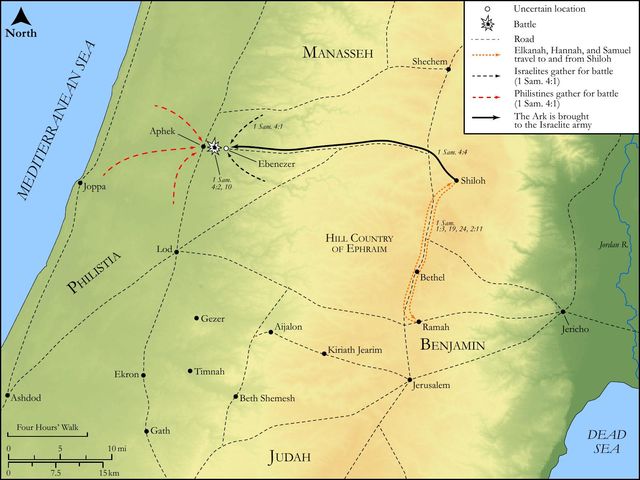
Israel carries the ark into battle and loses it; Eli and both his sons die that day. In Ashdod Dagon falls before the ark, and the LORD’s hand is heavy on each city that holds it, until the Philistines send it home on a new cart. Twenty years later Israel puts away its idols at Mizpeh, the LORD thunders on the Philistines, and Samuel sets up the stone Ebenezer.
14 passages
- 4:1–2 Israel Defeated at Ebenezer
- 4:3–11 The Ark Brought to Battle
- 4:12–18 News of the Defeat Reaches Eli
- 4:19–22 The Birth of Ichabod and the Loss of Glory
- 5:1–2 The Ark Brought to Ashdod
- 5:3–5 Dagon Humbled Before the Ark
- 5:6–7 Divine Judgment on Ashdod
- 5:8–12 The Ark Moved to Gath and Ekron
- 6:1–9 The Philistines Seek to Return the Ark
- 6:10–18 The Ark's Miraculous Journey to Beth-shemesh
- 6:19–7:2 Judgment on Beth-shemesh and the Ark's Relocation
- 7:3–6 Israel Repents and Gathers at Mizpeh
- 7:7–14 God Delivers Israel at Ebenezer
- 7:15–17 Samuel Judges Israel
Give us a king
Chapters 8–12 · 116 verses
Samuel’s sons take bribes, and the elders ask for a king like all the nations. The LORD grants it and has Samuel warn them what a king will take. Saul, out looking for his father’s asses, is anointed in secret, chosen by lot at Mizpeh, and proves himself by saving Jabesh-gilead. At Gilgal Samuel calls the people to witness his integrity, and the LORD sends thunder in wheat harvest.
The king rejected
Chapters 13–15 · 110 verses
At Gilgal Saul offers the burnt offering before Samuel comes, and hears that his kingdom shall not continue. Jonathan and his armourbearer rout a Philistine garrison, and Saul’s rash oath nearly costs Jonathan his life. Sent to carry out the LORD’s judgment on Amalek, Saul spares Agag and the best of the flocks. Samuel tells him the LORD has rejected him from being king.
12 passages
- 13:1–7 Saul's Early Reign and Conflict
- 13:8–14 Saul’s Disobedience and Rejection
- 13:15–23 The Philistine Economic Control
- 14:1–23 Jonathan Attacks the Philistine Garrison
- 14:24–35 Saul’s Rash Oath Troubles Israel
- 14:36–46 The Lot Identifies Jonathan’s Sin
- 14:47–52 Summary of Saul’s Reign and Family
- 15:1–9 Saul Commanded to Utterly Destroy Amalek
- 15:10–16 God Rejects Saul for Disobedience
- 15:17–23 Obedience Is Better Than Sacrifice
- 15:24–31 Saul's Partial Confession and Appeal
- 15:32–35 Samuel Executes Agag; Final Separation
The shepherd anointed
Chapters 16–17 · 81 verses
Samuel is sent to Bethlehem and passes over Jesse’s elder sons, for the LORD looks on the heart. David, the youngest, is anointed, and the Spirit of the LORD comes on him as it departs from Saul. He enters Saul’s service as a harpist. When Goliath of Gath defies the armies of Israel, David meets him with a sling, in the name of the LORD of hosts.
9 passages
- 16:1–5 Samuel Sent to Anoint a New King
- 16:6–13 God Chooses David, the Youngest
- 16:14–23 David Enters Saul's Service
- 17:1–11 The Philistine Challenge and Goliath's Defiance
- 17:12–30 David Arrives at the Camp
- 17:31–39 David Volunteers to Fight Goliath
- 17:40–47 The Confrontation: David's Declaration of Faith
- 17:48–54 The Victory and the Rout
- 17:55–58 Saul Inquires About David's Identity
Loved by Jonathan, hunted by Saul
Chapters 18–20 · 96 verses
Jonathan binds himself to David in covenant, and the women’s song, “David his ten thousands,” turns Saul to envy. Saul casts his javelin, sets a dowry meant to make David fall by the Philistines, and sends men to his house; Michal lets him down through a window. At Naioth Saul prophesies. At the new moon Jonathan learns his father means to kill David, and the friends part.
12 passages
- 18:1–5 Jonathan's Covenant with David
- 18:6–9 Saul's Jealousy Erupts
- 18:10–16 Saul Attempts Murder
- 18:17–30 Saul Sets a Trap with Marriage
- 19:1–7 Jonathan Intercedes for David
- 19:8–10 Saul Attempts to Kill David Again
- 19:11–17 Michal Saves David's Life
- 19:18–24 David Flees to Samuel; Saul Prophesies
- 20:1–11 David Seeks Confirmation of Saul's Intent
- 20:12–23 The Covenant Renewed and the Test Planned
- 20:24–34 Saul’s Fury at the New Moon Feast
- 20:35–42 Jonathan Confirms the Danger and They Part
Hunted in the wilderness
Chapters 21–26 · 158 verses
David takes the hallowed bread and Goliath’s sword at Nob, feigns madness at Gath, and gathers the distressed at Adullam. Saul has the priests of Nob slain, and Abiathar escapes to David. He saves Keilah; the Ziphites betray him. Twice he has Saul in his power, in a cave at Engedi and asleep in his camp, and spares him; between, Abigail keeps him from avenging himself on Nabal.
The fall of Saul
Chapters 27–31 · 92 verses
David takes refuge with Achish, who gives him Ziklag. When the Philistines gather against Israel, Saul, unanswered by the LORD, consults a woman with a familiar spirit at Endor and hears his doom. The Philistine lords send David back; he finds Ziklag burned, enquires of the LORD, and recovers all from the Amalekites. On mount Gilboa Saul and three sons fall, and the men of Jabesh-gilead bury them.
The words 1 Samuel turns on
Hannah asks for a son and Israel for a king. The ark fills chapters 4–7. Saul fails to obey, and the Spirit passes to David, the LORD’s anointed.
What 1 Samuel teaches
rûwm · lift up
He bringeth low, and lifteth up
Hannah’s song gives the book its pattern: “The LORD maketh poor, and maketh rich: he bringeth low, and lifteth up” (2:7). The childless woman is given a son, and the LORD’s word to Eli makes the pattern a rule: “them that honour me I will honour, and they that despise me shall be lightly esteemed” (2:30). Eli’s house falls and the ark is taken; in Ashdod, Dagon is found “fallen upon his face to the earth before the ark of the LORD” (5:3). Saul is lifted up when he is “little in thine own sight” (15:17), and brought low when he rejects the word of the LORD (15:23). David is fetched from keeping the sheep, because “the LORD looketh on the heart” (16:7).
shâmaʻ · obey
To obey is better than sacrifice
The child Samuel answers the LORD, “Speak; for thy servant heareth” (3:10). The word, shâmaʻ, is a hearing that obeys. The people refuse “to obey the voice of Samuel” and insist on a king (8:19). Saul spares the best of Amalek’s flocks, he says, “to sacrifice unto the LORD” (15:15). Samuel answers, “to obey is better than sacrifice, and to hearken than the fat of rams” (15:22), and Saul names the cause: “I feared the people, and obeyed their voice” (15:24). The LORD says, “It repenteth me that I have set up Saul to be king,” because Saul “is turned back from following me” (15:11). Yet “he is not a man, that he should repent” (15:29): Saul turned, and the LORD’s purpose did not. Augustine: even though God said ‘I repent,’ it is not to be taken according to the human sense
.
mâshîyach · anointed
The LORD’s anointed
Hannah’s song ends, before Israel has a king, on “the horn of his anointed” (2:10). The word is mâshîyach, the title John’s Gospel gives as “the Messias, which is, being interpreted, the Christ” (John 1:41). Samuel anoints Saul from a vial of oil (10:1) and David from the horn, “and the Spirit of the LORD came upon David from that day forward” (16:13); in the next verse the Spirit departs from Saul. From then on two men are anointed, and David will not lift his hand against the first. When he has cut off Saul’s skirt in the cave, his heart smites him: “The LORD forbid that I should do this thing unto my master, the LORD’S anointed” (24:5–6). In Saul’s camp he restrains Abishai: “who can stretch forth his hand against the LORD’S anointed, and be guiltless?” (26:9).
shâʼal · ask, enquire
Enquiring of the LORD
One word carries Hannah’s “petition which I asked of him” (1:27), the people’s sin “in asking you a king” (12:17), and enquiring of the LORD. David enquires and is answered (23:2; 30:8). Saul enquires, and “the LORD answered him not, neither by dreams, nor by Urim, nor by prophets” (28:6); he goes instead to the woman at Endor. The text says she “saw Samuel” (28:12), and the word spoken there came to pass (31:6). The Fathers differed over what she saw. Origen would not grant to a little demon such a great power that he can prophesy concerning Saul and the people of God
; Hippolytus held that it could be no difficult matter for the demon to conjure up the form of Samuel
. Chronicles counts the visit among Saul’s sins: “asking counsel of one that had a familiar spirit” (1 Chronicles 10:13).
Christ in 1 Samuel
Hannah’s song names the LORD’s king before Israel has one: “he shall give strength unto his king, and exalt the horn of his anointed” (2:10). Mary’s song takes hers up at the coming of Christ, “My soul doth magnify the Lord” (Luke 1:46), and sings the same reversal: “He hath put down the mighty from their seats, and exalted them of low degree” (Luke 1:52).
Paul, preaching at Antioch, tells this book in two sentences: “they desired a king: and God gave unto them Saul,” and when he had removed him, he raised up David, “a man after mine own heart.” Then he goes straight to Christ: “Of this man’s seed hath God according to his promise raised unto Israel a Saviour, Jesus” (Acts 13:21–23). When the Pharisees blamed his disciples for plucking corn on the sabbath, Jesus answered, “Have ye not read what David did, when he was an hungred” (Matthew 12:3–4), recalling the hallowed bread at Nob, and added, “in this place is one greater than the temple” (Matthew 12:6). Ephrem drew the parallel further: David was persecuted by Saul, just as the Son was by Herod.
People
By how many verses name them
- SaulA son of Kish; husband of Ahinoam and Rizpah241
- DavidSon of Jesse233
- SamuelA son of Elkanah and Hannah; father of Joel and Abijah110
- JonathanSon of Saul and Ahinoam; a brother of Abinadab, Malchi-shua, Merab and Michal60
- EliFather of Hophni, Phinehas29
- JesseA son of Obed24
- AchishA son of Maoch18
- NabalHusband of Abigail16
68 more are named.
Places
95 named
- RamahHannah’s home and Samuel’s; he judged from it and was buried there13
- GathGoliath’s city, where David twice sought refuge with Achish12
- GilgalWhere Saul was made king, and where Samuel rejected him12
- Keilah12
- Egypt10
- Gibeah10
- ShilohWhere the ark stood under Eli, and the LORD called Samuel9
- Beth-shemesh8
Where 1 Samuel reaches
The passages it leans on, and the ones that lean on it
Hannah’s song and Mary’s: each rejoices in God’s salvation and sings the mighty brought down and the lowly raised.
Samuel grows in favour with the LORD and with men, in the words Luke uses of the boy Jesus.
“A man after his own heart”: the word to Saul, recalled by Paul on the way from David to Jesus.
1 Samuel 15:2–3 Deuteronomy 25:17–19
The judgment on Amalek for falling on Israel’s feeble on the way out of Egypt, which Saul was sent to execute.
1 Samuel 15:22 Hosea 6:6 Matthew 9:13
Obedience before sacrifice: Samuel’s word to Saul returns in Hosea, and Jesus sends the Pharisees to learn it.
Books 1 Samuel links to most
The Church Fathers on 1 Samuel
893 quotations from 48 writers before AD 800 · the ten most quoted, in date order
- Tertullian220
- Origen253
- Gregory395
- Ambrose397
- Chrysostom407
- Jerome420
- Augustine430
- Cassiodorus585
- Gregory604
- Bede735
Theodoret on Dagon’s fall before the ark, staged so the Philistines might know the true God.
So Dagon who was adored as God by them (although he was a dumb, senseless idol) was made to fall before the ark, and God prepared to stage a spectacle for the spectators, so that the Philistines might perceive the difference between false god and true God.
Jerome on Samuel at Jesse’s house, mistaken at each son the LORD had not chosen.
He goes to Bethlehem and considers every son of Jesse to be the very person that the Lord was looking for.… He makes the same mistake in each case, and he is reproved in each case, giving evidence of the weakness of the human mind.
Paulinus of Nola on the faith that brought the giant down.
This is the faith that has prevailed over all weapons. This was the strength that made that slight boy great, for he grew stronger by spurning weapons and brought low the armed giant by the power of a stone.
Gregory of Nyssa on why David, already anointed, spared the king who hunted him.
… David, although he had been anointed to the office of king and knew that he would not otherwise partake of that position unless Saul were out of the way, judged it better to suffer ill patiently in his private low estate than to enter upon the kingship by satisfying his anger against the one who had caused him grief.
Keep studying
Articles