


Old Testament · History · Book 8 of 66
Ruth
A Moabite widow follows Naomi home to Bethlehem, and the kinsman who redeems the family’s land marries her and becomes David’s great-grandfather.
- 4 chapters
- 85 verses
- About 12 minutes to read
- The Judges & Ruth, c. 1380–1050 BC
Ruth begins with a famine and three graves in Moab and ends with a birth in Bethlehem and a genealogy. Nothing in between is miraculous, and no prophet speaks. A widow keeps her word, a landowner keeps the law of gleaning, and one kinsman declines a duty that another takes up at his own cost. Through these ordinary acts the LORD turns Naomi’s complaint, “the Almighty hath dealt very bitterly with me” (Ruth 1:20), into the blessing of the women of Bethlehem: “Blessed be the LORD, which hath not left thee this day without a kinsman” (Ruth 4:14).
The book also brings a Moabitess, from a people the law kept out of the congregation (Deuteronomy 23:3), into Israel by her own confession: “thy people shall be my people, and thy God my God.” It ends by setting her in the line of David, and Matthew names her in the line of Christ (Matthew 1:5).
And Ruth said, Intreat me not to leave thee, or to return from following after thee: for whither thou goest, I will go; and where thou lodgest, I will lodge: thy people shall be my people, and thy God my God:
Ruth 1:16 KJV
Before you read
- Who wrote it
- Not named in the book; traditionally Samuel. It was finished after David was known, since it ends with his name (Ruth 4:22).
- When it happens
- “In the days when the judges ruled” (Ruth 1:1). No judge is named. Matthew Henry placed it early in that period, because Boaz was the son of Rahab (Matthew 1:5).
How Ruth is laid out
4 movements · 14 passages · 85 verses
Out full, home empty
Chapter 1 · 22 verses
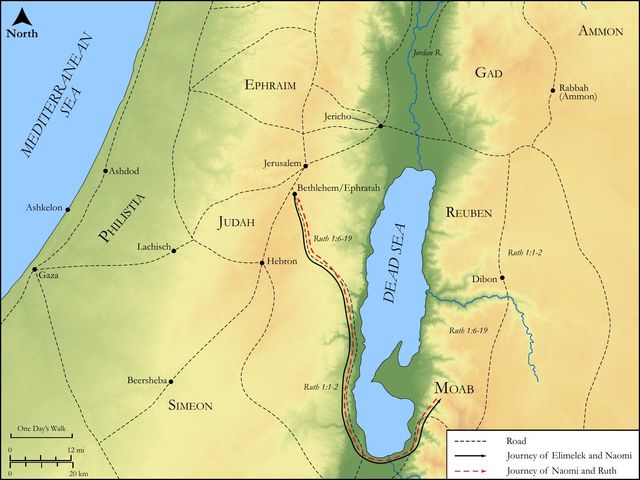
Famine drives Elimelech’s family from Bethlehem to Moab, where he and both sons die. Naomi turns home and urges her daughters-in-law to go back to their own people. Orpah does; Ruth will not, and binds herself to Naomi and to Naomi’s God. The two women reach Bethlehem at the beginning of barley harvest.
In the field of Boaz
Chapter 2 · 23 verses
Ruth goes out to glean, and “her hap was to light on” the field of Boaz, a kinsman of Elimelech. He has heard of her loyalty, lets her glean among the sheaves, feeds her, and blesses her under the LORD’s wings. Naomi recognises him as one of their near kinsmen.
At the threshing floor
Chapter 3 · 18 verses
Naomi seeks rest for Ruth and sends her to Boaz at the threshing floor by night. Ruth asks him to spread his skirt over her, “for thou art a near kinsman.” Boaz promises to do the kinsman’s part, but one kinsman stands nearer, and that must be settled first.
Redeemed at the gate
Chapter 4 · 22 verses
Before ten elders at the city gate, the nearer kinsman gives up his right rather than mar his own inheritance. Boaz buys Elimelech’s land and takes Ruth as his wife “to raise up the name of the dead.” Obed is born, Naomi’s neighbours rejoice, and the book closes on the line from Pharez to David.
The words Ruth turns on
Each movement has its own word: return fills chapter 1, glean chapter 2, and redeem the last two.
What Ruth teaches
chêçêd · kindness
Kindness beyond duty
Naomi’s first prayer for her daughters-in-law is that “the LORD deal kindly with you” (1:8). The book then shows that kindness given by people, as the answer to her prayer. Naomi blesses the LORD, “who hath not left off his kindness to the living and to the dead” (2:20), when she hears what Boaz has done, and Boaz tells Ruth, “thou hast shewed more kindness in the latter end than at the beginning” (3:10). Each does more than the law required. The law asked for gleanings, not meals, and no law bound Ruth to Naomi.
kânâph · wing
Under his wings
Boaz blesses Ruth in the name of “the LORD God of Israel, under whose wings thou art come to trust” (2:12). At the threshing floor she asks him to “spread therefore thy skirt over thine handmaid” (3:9), and the word for skirt is the same kânâph, a bird’s wing or the edge of a garment. She asks Boaz to be the answer to his own blessing. The image runs through Scripture: the Psalmist trusts under God’s wings (Psalm 91:4), and the LORD says to Jerusalem, “I spread my skirt over thee … and thou becamest mine” (Ezekiel 16:8).
gâʼal · redeem
A kinsman to redeem
The law gave a kinsman the right to buy back what a poor relative had sold (Leviticus 25:25), and gave a brother the duty of raising up a name for the dead (Deuteronomy 25:5). Ruth’s story joins the two. The nearer kinsman wants the field but not the widow: “I cannot redeem it for myself, lest I mar mine own inheritance” (4:6). Boaz redeems both at his own cost. Redemption here is not a figure of speech but a purchase, made by one who had the right because he was kin.
Christ in Ruth
Matthew’s genealogy of Jesus Christ runs through this book’s last verses: “Booz begat Obed of Ruth; and Obed begat Jesse” (Matthew 1:5). The elders at the gate prayed that Boaz would “be famous in Bethlehem” (Ruth 4:11). Micah named Bethlehem Ephratah as the town from which the ruler of Israel would come (Micah 5:2), and the scribes read that prophecy to Herod (Matthew 2:6).
The kinsman-redeemer points further. Boaz could redeem only because he was of Elimelech’s family. The Son of God “likewise took part of the same” flesh and blood as the children he came to save (Hebrews 2:14), becoming their kinsman so that he could redeem them. And Ruth the Moabitess, received by faith, has her name in the Messiah’s line.
People
By how many verses name them
- NaomiWife of Elimelech; mother of Mahlon and Chilion20
- BoazA son of Salmon and Rahab; husband of Ruth; father of Obed18
- RuthWife of Mahlon and Boaz; mother of Obed12
- ElimelechSon of Salma; husband of Naomi; father of Mahlon, Chilion6
- MahlonSon of Elimelech and Naomi; a brother of Chilion; husband of Ruth4
- ChilionSon of Elimelech and Naomi; a brother of Mahlon; husband of Orpah3
- ObedA son of Boaz and Ruth; father of Jesse3
- AmminadabA son of Ram; father of Elisheba and Nahshon2
12 more are named.
Where Ruth reaches
The passages it leans on, and the ones that lean on it
Deuteronomy 25:5–10 Ruth 4:1–10
The duty of the husband’s brother, and the shoe given up before the elders.
The kinsman’s right to buy back land a poor relative has sold.
Pharez, son of Tamar, at the head of the line Ruth’s genealogy traces.
Another foreigner’s oath: Ittai the Gittite pledges himself to David “whether in death or life.”
Ruth 4:11 Micah 5:2 Matthew 2:6
Bethlehem Ephratah, the town of the coming ruler.
Books Ruth links to most
The Church Fathers on Ruth
22 quotations from 8 writers before AD 800
Paulinus read the book as the hinge between two eras.
Next pass with eager eyes to Ruth, who with one short book separates eras—the end of the period of the judges and the beginning of Samuel.
Jerome, on what Ruth’s loyalty led to.
Ruth, a foreigner, did not leave Naomi’s side. See how much merit there is in standing by the deserted in solace. From her seed, Christ is born.
Chrysostom saw in Boaz a figure of Christ receiving the church.
Those things which happened to Ruth should be seen as figures. … Boaz, seeing her, did not despise her on account of her poverty … even as Christ received the church, who was both a stranger and laboring, in need of great good things.
Keep studying
Articles