


Ruth 3:2
Bible text: King James Version (1769 Blayney text) · Public domain
Bible text: Berean Standard Bible · Public domain
Bible text: American Standard Version (1901) · Public domain
Bible text: World English Bible, Messianic edition · Public domain
Bible text: Geneva Bible (1599) · Public domain
Bible text: Young's Literal Translation · Public domain
- וְעַתָּהve·'a·Tahand thereforeH6258Conj-w ¦ AdvAdverbוְandעַתָּהtherefore
- הֲלֹאha·Lo'¿ notH3808Interrog ¦ NegParticle Negativeהֲ¿לֹאnot
- בֹעַזvo·'az[is] BoazH1162N-proper-mNoun Proper Masculine
- מֹדַעְתָּנוּmo·da'·Ta·nuour relativeH4130N-fsc ¦ 1cpNoun Singular Feminine Constructמֹדַעְתָּrelativeנוּour
- אֲשֶׁר'a·SherwhomH834RelParticle Relative
- הָיִיתha·Yityou wereH1961V-Qal-Perf-2fsVerb Qal Perfect 2nd Singular Feminine
- אֶת'etwithH854PrepPreposition
- נַעֲרוֹתָיוna·'a·ro·Tavhis female servantsH5291N-fpc ¦ 3msNoun Plural Feminine Constructנַעֲרוֹתָיfemale servantsוhis
- הִנֵּהhi·nehthere!H2009PrtParticle Interjection
- הוּאHu'heH1931Pro-3msPronoun Personal 3rd Singular Masculine
- זֹרֶהzo·Reh[will be] winnowingH2219V-Qal-Prtcpl-msVerb Qal Participle Singular Masculine Absolute
- אֶת'et<obj.>H853DirObjMParticle Object Indicator
- גֹּרֶןGo·ren[the] threshing floor ofH1637N-fscNoun Singular Feminine Construct
- הַשְּׂעֹרִיםha·se·'o·Rimthe barley<s>H8184Art ¦ N-mpNoun Plural Masculine Absoluteהַtheשְּׂעֹרִיםbarley<s>
- הַלָּיְלָהha·La·ye·lahthis nightH3915Art ¦ N-msNoun Singular Masculine Absoluteהַthisלָּיְלָהnight
English is a literal word-by-word gloss of the Hebrew, not the KJV's wording. Why?
This is the original text the KJV's translators worked from — each Hebrew word with its own literal English meaning in this verse, prepared by scholars at Tyndale House, Cambridge. The KJV translates whole sentences, not word by word, so its wording differs: one Hebrew word can become several English words, and the KJV may choose “the LORD” where the gloss reads “Yahweh”. Both are faithful — they answer different questions. For the KJV's own rendering, switch to the KJV text.
Details
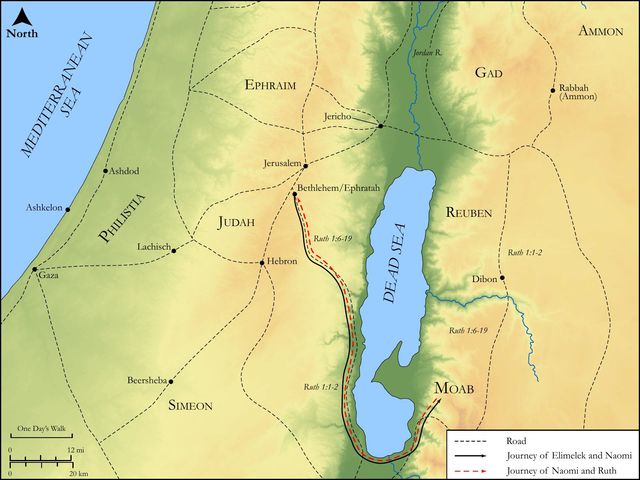
See on the biblical-era map
Study this verse
Public-domain commentary
Matthew Henry
From his Commentary on the Whole Bible. Henry comments on passages, not single verses — this entry covers Ruth 3:1–5. His two-level outline is real structure in the source text, so it is rendered as structure.
Here is, I. Naomi's care for her daughter's comfort is without doubt very commendable, and is recorded for imitation. She had no thoughts of marrying herself, Rut 1:12. But, though she that was old had resolved upon a perpetual widowhood, yet she was far from the thoughts of confining her daughter-in-law to it, that was young. Age must not make itself a standard to youth. On the contrary, she is full of contrivance how to get her well married. Her wisdom projected that for her daughter which her daughter's modesty forbade her to project for herself, Rut 3:1. This she did 1. In justice to the dead, to raise up seed to those that were gone, and so to preserve the family from being extinct. 2. In kindness and gratitude to her daughter-in-law, who had conducted herself very dutifully and respectfully to her. "My daughter" (said she, looking upon her in all respects as her own), "shall I not seek rest for thee," that is, a settlement in the married state; "shall I not get thee a good husband, that it may be well with thee," that is, "that thou mayest live plentifully and pleasantly, and not spend all thy days in the mean and melancholy condition we now live in?" Note, (1.) A married state is, or should be, a state of rest to young people. Wandering affections are then fixed, and the heart must be at rest. It is at rest in the house of a husband, and in his heart, Rut 1:9. Those are giddy indeed that marriage does not compose. (2.) That which should be desired and designed by those that enter into the married state is that it may be well with them, in order to which it is necessary that they choose well; otherwise, instead of being a rest to them, it may prove the greatest uneasiness. Parents, in disposing of their children, must have this in their eye, that it may be well with them. And be it always remembered that is best for us which is best for our souls. (3.) It is the duty of parents to seek this rest for their children, and to do all that is fit for them to do, in due time, in order to it. And the more dutiful and respectful they are to them, though they can the worse spare them, yet they should the rather prefer them, and the better.
II.The course she took in order to her daughter's preferment was very extraordinary and looks suspicious.
If there was any thing improper in it, the fault must lie upon Naomi, who put her daughter upon it, and who knew, or should know, the laws and usages of Israel better than Ruth.
1.It was true that Boaz, being near of kin to the deceased, and (for aught that Naomi knew to the contrary) the nearest of all now alive, was obliged by the divine law to marry the widow of Mahlon, who was the eldest son of Elimelech, and was dead without issue (Rut 3:2): "Is not Boaz of our kindred, and therefore bound in conscience to take care of our affairs?" This may encourage us to lay ourselves by faith at the feet of Christ, that he is our near kinsman; having taken our nature upon him, he is bone of our bone and flesh of our flesh.
2.It was a convenient time to remind him of it, now that he had got so much acquaintance with Ruth by her constant attendance on his reapers during the whole harvest, which was now ended; and he also, by the kindness he had shown to Ruth in smaller matters, had encouraged Naomi to hope that he would not be unkind, much less unjust, in this greater. And she thought it was a good opportunity to apply to him when he made a winnowing-feast at his threshing-floor (Rut 3:2), then and there completing the joy of the harvest, and treating his workmen like a kind master: He winnoweth barley tonight, that is, he makes his entertainment tonight. As Nabal and Absalom had feasts at their sheep-shearing, so Boaz at his winnowing.
3.Naomi thought Ruth the most proper person to do it herself; and perhaps it was the usage in that country that in this case the woman should make the demand; so much is intimated by the law, Deu 25:7-9. Naomi therefore orders her daughter-in-law to make herself clean and neat, not to make herself fine (Rut 3:3): "Wash thyself and anoint thee, not paint thee (as Jezebel), put on thy raiment, but not the attire of a harlot, and go down to the floor," whither, it is probable, she was invited to the supper there made; but she must not make herself known, that it, not make her errand known (she herself could not but be very well known among Boaz's reapers) till the company had dispersed and Boaz had retired. And upon this occasion she would have an easier access to him in private than she could have at his own house. And thus far was well enough. But,
4.Her coming to lie down at his feet, when he was asleep in his bed, had such an appearance of evil, was such an approach towards it, and might have been such an occasion of it, that we know not well how to justify it. Many expositors think it unjustifiable, particularly the excellent Mr. Poole. We must not to evil that good may come. It is dangerous to bring the spark and the tinder together; for how great a matter may a little fire kindle! All agree that it is not to be drawn into a precedent; neither our laws nor our times are the same that were then; yet I am willing to make the best of it. If Boaz was, as they presumed, the next kinsman, she was his wife before God (as we say), and there needed but little ceremony to complete the nuptials; and Naomi did not intend that Ruth should approach to him any otherwise than as his wife. She knew Boaz to be not only an old man (she would not have trusted to that alone in venturing her daughter-in-law so near him), but a grave sober man, a virtuous and religious man, and one that feared God. She knew Ruth to be a modest woman, chaste, and a keeper at home, Tit 2:5. The Israelites had indeed been once debauched by the daughters of Moab (Num 25:1), but this Moabitess was none of those daughters. Naomi herself designed nothing but what was honest and honourable, and her charity (which believeth all things and hopeth all things) banished and forbade all suspicion that either Boaz or Ruth would attempt any thing but what was likewise honest and honourable. If what she advised had been then as indecent and immodest (according to the usage of the country) as it seems now to us, we cannot think that if Naomi had had so little virtue (which yet we have no reason to suspect) she would also have had so little wisdom as to put her daughter upon it, since that alone might have marred the match, and have alienated the affections of so grave and good a man as Boaz from her. We must therefore think that the thing did not look so ill then as it does now. Naomi referred her daughter-in-law to Boaz for further directions. When she had thus made her claim, Boaz, who was more learned in the laws, would tell her what she must do. Thus must we lay ourselves at the feet of our Redeemer, to receive from him our doom. Lord, what wilt thou have me to do? Act 9:6. We may be sure, if Ruth had apprehended any evil in that which her mother advised her to, she was a woman of too much virtue and too much sense to promise as she did (Rut 3:5): All that thou sayest unto me I will do. Thus must the younger submit to the elder, and to their grave and prudent counsels, when they have nothing worth speaking of to object against it.
Historical interpretation
Historical reception
1 surviving comment on this verse from the historical church.
What does Naomi suggest to her daughter-in-law? When Ruth heard her mother-in-law saying, “Our neighbor is a true man,” she was reminded of his great kindness and thought to want him [to be] married to her in law, so that she might keep up the memory of the dead. Therefore, she [Naomi] suggests to her that she sleep at Boaz’s feet, not that she might sell her body (for the words of the narrative signify the opposite); rather, she trusts the man’s temperance and judgment. Moreover, the actions corroborate the words.
Continue studying Ruth 3:2 across the web’s major study libraries — every link below opens this exact verse, chapter, or book on the destination site.
Read & Compare
 BibleGatewayThis verse in more than 200 translations and 70 languages.
 Bible.comThe YouVersion reader — hundreds of translations, reading plans, and highlights.
 ESV.orgCrossway's official English Standard Version reader.
 NET BibleThe NET translation with 60,000+ translators' notes on every rendering decision.
 STEP BibleTyndale House's free study tool — original text, vocabulary, and scholarly resources.
 BibliaLogos Bible Software's free web reader.
 USCCBThe New American Bible (Revised Edition) with the U.S. bishops' study notes.
Commentaries
 BibleHub CommentariesDozens of classic commentaries on this verse, gathered on one page.
 StudyLightMore than 100 commentary sets — the largest collection on the web.
 BibleRefPlain-English commentary on what this verse means, verse by verse.
 Enduring WordDavid Guzik's free commentary on this chapter, widely used by Bible teachers.
 Bible Study ToolsVerse commentary alongside Greek and Hebrew study aids.
Original Language & Research
- BibleHub InterlinearThe verse word by word — original language, transliteration, and English.
- BibleHub LexiconEvery word's original-language definition and Strong's entry.
 Blue Letter BibleDeep-study tools — Strong's numbers, concordance, and word studies.
 SefariaThe Hebrew text with Rashi and centuries of Jewish commentary.
Sermons, Hymns & Audio


TrulyRandomVerse is not affiliated with these sites and doesn’t control their content. They’re linked because they’re genuinely useful.
Summary
Ruth 3:2 marks a pivotal moment in the narrative, as Naomi, demonstrating profound wisdom and strategic foresight, instructs Ruth on how to approach Boaz at the threshingfloor. This verse highlights Naomi's intimate knowledge of Boaz's character and activities, setting the stage for Ruth's bold action to secure her future and the continuation of Naomi's family line, initiating the process of levirate marriage and kinsman-redemption.
Context
ShowHideLiterary Context
This verse immediately follows Ruth's diligent and faithful gleaning in Boaz's fields throughout Ruth chapter 2, where Boaz's kindness, integrity, and protective nature were abundantly evident. Having observed Boaz's character and his generosity towards Ruth, Naomi recognizes him as a potential "kinsman-redeemer" (Hebrew: goel), though the term is not explicitly used until later. The instructions given in Ruth 3:3-4 are a direct consequence of this verse, outlining the specific, culturally nuanced actions Ruth is to take at the threshingfloor, leading to the dramatic and pivotal encounter described in Ruth 3:6-9. This verse serves as the strategic launchpad for Naomi's carefully orchestrated plan to secure a "resting place" (a secure home and husband) for Ruth, ensuring the continuation of her deceased husband's legacy in Bethlehem.
Historical & Cultural Context
The setting of the "threshingfloor" (Hebrew: goren) is crucial. In ancient Israel, threshingfloors were typically open, elevated areas outside the village, where the harvested grain was threshed and winnowed. This was a communal and often busy place during harvest season, but at night, landowners or their trusted servants would often sleep there to guard the valuable grain from theft and to complete the arduous task of winnowing. "Winnowing" (Hebrew: zarah) involved tossing the threshed grain into the air with a winnowing fork, allowing the wind to blow away the lighter chaff while the heavier grain fell to the ground. The mention of Boaz's kinship (Hebrew: moda'ath) subtly introduces the concept of the kinsman-redeemer (goel), a vital legal and social institution where a close male relative had the right and responsibility to redeem family land, buy back a relative sold into slavery, or marry a deceased kinsman's widow to perpetuate his name and lineage. Naomi's plan masterfully leverages these established cultural norms and the specific timing of the harvest to achieve her objective.
Key Themes
ShowHideThis verse powerfully contributes to several overarching themes in the Book of Ruth. It highlights Naomi's strategic wisdom and proactive love, demonstrating her deep care for Ruth's future and her shrewdness in navigating the social customs of the time. Her plan is not impulsive but calculated, leveraging her intimate knowledge of Boaz's character and the harvest season. The verse also reinforces Boaz's diligence and honorable character; as a wealthy landowner, his personal involvement in the arduous task of "winnowing barley to night" underscores his hands-on approach, integrity, and dedication to his work, making him an ideal candidate for Naomi's plan. Furthermore, the threshingfloor as a symbolic setting is crucial; it is a liminal space, a place of transition and decision, where the fate of Ruth and Naomi's family line will be determined. It signifies a place of hard work, abundance, and ultimately, divine provision working through human agency, setting the stage for the climactic events of Ruth chapter 3 and the broader narrative of redemption and lineage.
Exposition and Analysis
ShowHideKey Word Analysis
ShowHideDerived from the root יָדַע (yada') meaning "to know," this term refers to an acquaintance or a relative known to the family. While it doesn't carry the full legal weight of goel (kinsman-redeemer) on its own, its use here by Naomi emphasizes Boaz's close familial connection and his suitability as a potential redeemer. It highlights Naomi's intimate knowledge of their family ties and her strategic identification of Boaz as the one who can provide the necessary security and perpetuation of the family line.
This primitive root means "to toss about," and by implication, "to diffuse" or "winnow." It describes the laborious process of separating grain from chaff by tossing it into the air, allowing the wind to carry away the lighter impurities. The fact that Boaz himself is engaged in this work, and specifically "to night," underscores his diligence, hands-on involvement in his estate, and the importance of the harvest season. It also sets up the specific, private context for Ruth's approach, as the threshingfloor at night would be less crowded and more conducive to a discreet and significant encounter.
From an unused root meaning "to smooth," this term refers to a threshing-floor (as made even) or, by analogy, any open area. More than just a physical location, the threshingfloor often carried symbolic significance in biblical narratives. It was a place of abundance (the harvest), vulnerability (open to the elements and theft), and frequently, significant encounters or decisions (e.g., Genesis 50:10, 2 Samuel 24:18-24). In Ruth, it becomes the stage for a crucial, private negotiation that will determine the future of Naomi and Ruth's family, transforming from a place of labor to a place of destiny and the unfolding of divine providence.
Verse Breakdown
ShowHide"And now [is] not Boaz of our kindred, with whose maidens thou wast?"
Naomi opens with a rhetorical question, designed not to elicit new information but to confirm what Ruth already knows and to highlight Boaz's suitability for the plan. The phrase "of our kindred" (מֹדַעַת, moda'ath) emphasizes his close familial connection, making him a prime candidate for the role of kinsman-redeemer. The reminder "with whose maidens thou wast" subtly reinforces Ruth's prior positive experience with Boaz's household, recalling his kindness, generosity, and protective nature, thereby building Ruth's confidence and trust in the audacious plan Naomi is about to unfold. This question serves to establish Boaz's character and relationship to them as foundational to the ensuing strategy.
"Behold, he winnoweth barley to night in the threshingfloor."
This declarative statement provides the crucial logistical details for Naomi's carefully crafted plan. The word "Behold" (הִנֵּה, hinneh) draws immediate attention to the specific action and location, signaling the opportune moment. Boaz's activity of "winnowing barley" signifies the completion of the harvest, a time of both celebration and vulnerability, as the valuable grain is being processed. The detail "to night" is key, indicating a time when the threshingfloor would be less populated, offering privacy and discretion for Ruth's approach. This precise information demonstrates Naomi's thorough understanding of the agricultural practices and Boaz's personal habits, enabling her to orchestrate a discreet and opportune meeting that is both strategic and culturally appropriate.
Literary Devices
ShowHideRuth 3:2 employs several literary devices to enhance its meaning and dramatic impact. Naomi's opening statement, "And now [is] not Boaz of our kindred, with whose maidens thou wast?" functions as a powerful Rhetorical Question. It is not a true inquiry but a statement disguised as a question, designed to elicit immediate agreement and underscore the obvious suitability of Boaz for Naomi's plan, drawing Ruth into a shared understanding and commitment. The entire verse also serves as significant Foreshadowing, meticulously setting the stage for the dramatic and pivotal encounter between Ruth and Boaz at the threshingfloor, where their individual destinies and the future of Naomi's family line will intertwine. Furthermore, the Symbolism of the threshingfloor itself is profound; it is not merely a workplace but a liminal space where the raw materials of the harvest are transformed into sustenance, mirroring the impending transformation of Ruth's status from a vulnerable widow to a prospective wife and the continuation of a vital family lineage. This transition from hard labor to a place of destiny is central to the narrative's unfolding themes of redemption and provision.
Theological and Thematic Connections
ShowHideRuth 3:2 beautifully illustrates the interplay between divine providence and human agency. Naomi's meticulous planning and strategic action are not depicted as an attempt to circumvent God's will, but rather as a wise and faithful response to the opportunities God has already provided. Her initiative, rooted in a deep understanding of cultural norms and a discerning eye for character, highlights the biblical principle that God often works through the diligent efforts and wise counsel of His people. The verse underscores the theme of seeking "rest" or security, a concept often linked to God's provision and the establishment of a stable home. Just as Naomi seeks a secure future for Ruth, God's people are called to trust in His overarching plan while actively pursuing wisdom and acting responsibly in their circumstances, recognizing that faith is often expressed through prudent action.
Reflection and Application
ShowHideRuth 3:2 invites us to consider the importance of wise counsel, discerning opportune moments, and taking faithful, strategic action in our own lives. Naomi's proactive love for Ruth, her careful observation of Boaz's character, and her detailed planning provide a model for how we might seek the well-being of others, particularly those under our care or in vulnerable positions. It reminds us that while God is sovereign and provident, He often uses human diligence, wisdom, and courage to bring about His purposes. We are encouraged to be attentive to the "threshingfloors" in our own lives—those pivotal moments or settings where significant decisions must be made or opportunities seized, where the fruits of our labor meet divine appointment. This verse also subtly affirms the dignity of honest labor, as Boaz, a man of means, is personally engaged in the hard work of the harvest. For believers, this translates into a call to diligence and integrity in our vocations, trusting that God can use our ordinary efforts for extraordinary outcomes and that our faithfulness in small things can lead to great blessings.
Questions for Reflection
ShowHideFAQ
ShowHideWhy did Naomi send Ruth to the threshingfloor at night, and was this plan ethical?
ShowHideNaomi sent Ruth to the threshingfloor at night for several strategic reasons, all deeply rooted in the cultural practices of ancient Israel. Firstly, the threshingfloor was where the valuable harvest was processed and guarded; landowners or trusted servants often slept there to protect the grain from theft. This meant Boaz would be present and likely alone or with few others, offering a private and opportune setting for Ruth's approach. Secondly, winnowing was often done in the evening or at night when the breezes were more consistent, making it an ideal time for Boaz to be actively engaged in this final, critical stage of the harvest. As for the ethics, Naomi's plan, while bold and unconventional by modern standards, was designed entirely within the framework of ancient Israelite customs concerning marriage, family lineage, and the kinsman-redeemer (goel). Ruth's specific actions, as outlined in Ruth 3:3-4, were intended to make a formal, public request for Boaz to act as a kinsman-redeemer and husband, not to engage in illicit behavior. Boaz's reaction in Ruth 3:10-11 confirms the honorable intent of the action, as he commends Ruth for her loyalty and virtue, recognizing her pursuit of a legitimate marriage within the family rather than seeking a younger man. The plan was a calculated risk, but one aimed at securing Ruth's future and perpetuating the family line according to the law and custom, demonstrating both Naomi's shrewdness and Ruth's unwavering obedience and integrity.
Christ-Centered Fulfillment
ShowHideRuth 3:2, in setting the stage for Boaz's pivotal role as kinsman-redeemer, powerfully foreshadows the ultimate Redeemer, Jesus Christ. Just as Naomi meticulously planned for Ruth's security and "resting place" through Boaz, God the Father, in His divine wisdom and perfect timing, orchestrated the perfect plan for humanity's redemption through His Son. Boaz's willingness to leave his comfortable home and work diligently at the threshingfloor to secure his harvest parallels Christ's incarnation and His diligent work on earth to gather His elect and secure our eternal inheritance. The threshingfloor, a place of separation and purification where grain is separated from chaff, can be seen as a type of the work of Christ, who came to separate the righteous from the unrighteous and to purify His people (Matthew 3:12). Ultimately, Boaz's act of redemption, providing a secure future and a new identity for Ruth, points to Jesus, who, as our Kinsman-Redeemer, paid the ultimate price on the cross to redeem us from sin and death. Through His blood, we receive forgiveness and adoption into God's family (Ephesians 1:7 and Galatians 4:4-5). Through Christ, we find our ultimate "resting place," a secure and eternal home in God's presence, far surpassing any earthly provision.