


Ruth 3:1
Bible text: King James Version (1769 Blayney text) · Public domain
Bible text: Berean Standard Bible · Public domain
Bible text: American Standard Version (1901) · Public domain
Bible text: World English Bible, Messianic edition · Public domain
Bible text: Geneva Bible (1599) · Public domain
Bible text: Young's Literal Translation · Public domain
- וַתֹּאמֶרva·To·merand she saidH559Conj-w ¦ V-Qal-ConsecImperf-3fsVerb Qal Consecutive Imperfect 3rd Singular Feminineוַandתֹּאמֶרshe said
- לָהּlahto <the> herPrep-l ¦ 3fsSuffix Personal 3rd Singular Feminineלָto <the>הּher
- נָעֳמִיno·'o·MiNaomiH5281N-proper-fNoun Proper Feminine
- חֲמוֹתָהּcha·mo·Tahher mother-in-lawH2545N-fsc ¦ 3fsNoun Singular Feminine Constructחֲמוֹתָmother-in-lawהּher
- בִּתִּיbi·Timy O daughterH1323N-fsc ¦ 1csNoun Singular Feminine ConstructבִּתִּO daughterיmy
- הֲלֹאha·Lo'¿ notH3808Interrog ¦ NegParticle Negativeהֲ¿לֹאnot
- אֲבַקֶּשׁ'a·va·keshwill I seekH1245V-Piel-Imperf-1csVerb Piel Imperfect 1st Singular common gender
- לָךְlakhfor <the> youPrep-l ¦ 2fsSuffix Personal 2nd Singular Feminineלָfor <the>ךְyou
- מָנוֹחַma·No·acha resting placeH4494N-msNoun Singular Masculine Absolute
- אֲשֶׁר'a·SherthatH834RelParticle Relative
- יִיטַבyi·tavit will go wellH3190V-Qal-Imperf-3msVerb Qal Imperfect 3rd Singular Masculine
- לָךְLakhfor <the> youPrep-l ¦ 2fsSuffix Personal 2nd Singular Feminineלָfor <the>ךְyou
English is a literal word-by-word gloss of the Hebrew, not the KJV's wording. Why?
This is the original text the KJV's translators worked from — each Hebrew word with its own literal English meaning in this verse, prepared by scholars at Tyndale House, Cambridge. The KJV translates whole sentences, not word by word, so its wording differs: one Hebrew word can become several English words, and the KJV may choose “the LORD” where the gloss reads “Yahweh”. Both are faithful — they answer different questions. For the KJV's own rendering, switch to the KJV text.
Details
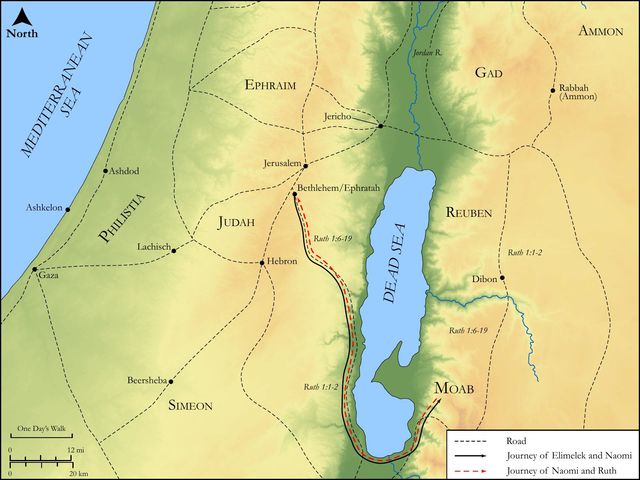
See on the biblical-era map
Study this verse
Public-domain commentary
Matthew Henry
From his Commentary on the Whole Bible. Henry comments on passages, not single verses — this entry covers Ruth 3:1–5. His two-level outline is real structure in the source text, so it is rendered as structure.
Here is, I. Naomi's care for her daughter's comfort is without doubt very commendable, and is recorded for imitation. She had no thoughts of marrying herself, Rut 1:12. But, though she that was old had resolved upon a perpetual widowhood, yet she was far from the thoughts of confining her daughter-in-law to it, that was young. Age must not make itself a standard to youth. On the contrary, she is full of contrivance how to get her well married. Her wisdom projected that for her daughter which her daughter's modesty forbade her to project for herself, Rut 3:1. This she did 1. In justice to the dead, to raise up seed to those that were gone, and so to preserve the family from being extinct. 2. In kindness and gratitude to her daughter-in-law, who had conducted herself very dutifully and respectfully to her. "My daughter" (said she, looking upon her in all respects as her own), "shall I not seek rest for thee," that is, a settlement in the married state; "shall I not get thee a good husband, that it may be well with thee," that is, "that thou mayest live plentifully and pleasantly, and not spend all thy days in the mean and melancholy condition we now live in?" Note, (1.) A married state is, or should be, a state of rest to young people. Wandering affections are then fixed, and the heart must be at rest. It is at rest in the house of a husband, and in his heart, Rut 1:9. Those are giddy indeed that marriage does not compose. (2.) That which should be desired and designed by those that enter into the married state is that it may be well with them, in order to which it is necessary that they choose well; otherwise, instead of being a rest to them, it may prove the greatest uneasiness. Parents, in disposing of their children, must have this in their eye, that it may be well with them. And be it always remembered that is best for us which is best for our souls. (3.) It is the duty of parents to seek this rest for their children, and to do all that is fit for them to do, in due time, in order to it. And the more dutiful and respectful they are to them, though they can the worse spare them, yet they should the rather prefer them, and the better.
II.The course she took in order to her daughter's preferment was very extraordinary and looks suspicious.
If there was any thing improper in it, the fault must lie upon Naomi, who put her daughter upon it, and who knew, or should know, the laws and usages of Israel better than Ruth.
1.It was true that Boaz, being near of kin to the deceased, and (for aught that Naomi knew to the contrary) the nearest of all now alive, was obliged by the divine law to marry the widow of Mahlon, who was the eldest son of Elimelech, and was dead without issue (Rut 3:2): "Is not Boaz of our kindred, and therefore bound in conscience to take care of our affairs?" This may encourage us to lay ourselves by faith at the feet of Christ, that he is our near kinsman; having taken our nature upon him, he is bone of our bone and flesh of our flesh.
2.It was a convenient time to remind him of it, now that he had got so much acquaintance with Ruth by her constant attendance on his reapers during the whole harvest, which was now ended; and he also, by the kindness he had shown to Ruth in smaller matters, had encouraged Naomi to hope that he would not be unkind, much less unjust, in this greater. And she thought it was a good opportunity to apply to him when he made a winnowing-feast at his threshing-floor (Rut 3:2), then and there completing the joy of the harvest, and treating his workmen like a kind master: He winnoweth barley tonight, that is, he makes his entertainment tonight. As Nabal and Absalom had feasts at their sheep-shearing, so Boaz at his winnowing.
3.Naomi thought Ruth the most proper person to do it herself; and perhaps it was the usage in that country that in this case the woman should make the demand; so much is intimated by the law, Deu 25:7-9. Naomi therefore orders her daughter-in-law to make herself clean and neat, not to make herself fine (Rut 3:3): "Wash thyself and anoint thee, not paint thee (as Jezebel), put on thy raiment, but not the attire of a harlot, and go down to the floor," whither, it is probable, she was invited to the supper there made; but she must not make herself known, that it, not make her errand known (she herself could not but be very well known among Boaz's reapers) till the company had dispersed and Boaz had retired. And upon this occasion she would have an easier access to him in private than she could have at his own house. And thus far was well enough. But,
4.Her coming to lie down at his feet, when he was asleep in his bed, had such an appearance of evil, was such an approach towards it, and might have been such an occasion of it, that we know not well how to justify it. Many expositors think it unjustifiable, particularly the excellent Mr. Poole. We must not to evil that good may come. It is dangerous to bring the spark and the tinder together; for how great a matter may a little fire kindle! All agree that it is not to be drawn into a precedent; neither our laws nor our times are the same that were then; yet I am willing to make the best of it. If Boaz was, as they presumed, the next kinsman, she was his wife before God (as we say), and there needed but little ceremony to complete the nuptials; and Naomi did not intend that Ruth should approach to him any otherwise than as his wife. She knew Boaz to be not only an old man (she would not have trusted to that alone in venturing her daughter-in-law so near him), but a grave sober man, a virtuous and religious man, and one that feared God. She knew Ruth to be a modest woman, chaste, and a keeper at home, Tit 2:5. The Israelites had indeed been once debauched by the daughters of Moab (Num 25:1), but this Moabitess was none of those daughters. Naomi herself designed nothing but what was honest and honourable, and her charity (which believeth all things and hopeth all things) banished and forbade all suspicion that either Boaz or Ruth would attempt any thing but what was likewise honest and honourable. If what she advised had been then as indecent and immodest (according to the usage of the country) as it seems now to us, we cannot think that if Naomi had had so little virtue (which yet we have no reason to suspect) she would also have had so little wisdom as to put her daughter upon it, since that alone might have marred the match, and have alienated the affections of so grave and good a man as Boaz from her. We must therefore think that the thing did not look so ill then as it does now. Naomi referred her daughter-in-law to Boaz for further directions. When she had thus made her claim, Boaz, who was more learned in the laws, would tell her what she must do. Thus must we lay ourselves at the feet of our Redeemer, to receive from him our doom. Lord, what wilt thou have me to do? Act 9:6. We may be sure, if Ruth had apprehended any evil in that which her mother advised her to, she was a woman of too much virtue and too much sense to promise as she did (Rut 3:5): All that thou sayest unto me I will do. Thus must the younger submit to the elder, and to their grave and prudent counsels, when they have nothing worth speaking of to object against it.
Historical interpretation
Historical reception
1 surviving comment on this verse from the historical church.
What does Naomi suggest to her daughter-in-law? When Ruth heard her mother-in-law saying, “Our neighbor is a true man,” she was reminded of his great kindness and thought to want him [to be] married to her in law, so that she might keep up the memory of the dead. Therefore, she [Naomi] suggests to her that she sleep at Boaz’s feet, not that she might sell her body (for the words of the narrative signify the opposite); rather, she trusts the man’s temperance and judgment. Moreover, the actions corroborate the words.
Continue studying Ruth 3:1 across the web’s major study libraries — every link below opens this exact verse, chapter, or book on the destination site.
Read & Compare
 BibleGatewayThis verse in more than 200 translations and 70 languages.
 Bible.comThe YouVersion reader — hundreds of translations, reading plans, and highlights.
 ESV.orgCrossway's official English Standard Version reader.
 NET BibleThe NET translation with 60,000+ translators' notes on every rendering decision.
 STEP BibleTyndale House's free study tool — original text, vocabulary, and scholarly resources.
 BibliaLogos Bible Software's free web reader.
 USCCBThe New American Bible (Revised Edition) with the U.S. bishops' study notes.
Commentaries
 BibleHub CommentariesDozens of classic commentaries on this verse, gathered on one page.
 StudyLightMore than 100 commentary sets — the largest collection on the web.
 BibleRefPlain-English commentary on what this verse means, verse by verse.
 Enduring WordDavid Guzik's free commentary on this chapter, widely used by Bible teachers.
 Bible Study ToolsVerse commentary alongside Greek and Hebrew study aids.
Original Language & Research
- BibleHub InterlinearThe verse word by word — original language, transliteration, and English.
- BibleHub LexiconEvery word's original-language definition and Strong's entry.
 Blue Letter BibleDeep-study tools — Strong's numbers, concordance, and word studies.
 SefariaThe Hebrew text with Rashi and centuries of Jewish commentary.
Sermons, Hymns & Audio


TrulyRandomVerse is not affiliated with these sites and doesn’t control their content. They’re linked because they’re genuinely useful.
Summary
Ruth 3:1 marks a profound turning point in the narrative, as Naomi, having observed Ruth's unwavering loyalty and diligent labor, transitions from her initial despair to a proactive, strategic pursuit of security and a permanent home for her beloved daughter-in-law. Recognizing the opportune time at the close of the harvest, Naomi initiates a plan to secure a settled future for Ruth, encapsulated in her tender and purposeful question, "My daughter, shall I not seek rest for thee, that it may be well with thee?" This verse powerfully underscores Naomi's deep maternal care and sets in motion the events that will lead to Ruth's marriage to Boaz, ensuring the continuation of their family line and a secure future for Ruth.
Context
ShowHideLiterary Context
Ruth 3:1 serves as the narrative hinge between Ruth's faithful gleaning in Boaz's fields (Ruth 2) and Naomi's strategic matchmaking efforts (Ruth 3). Chapter 2 concludes with Ruth's diligent work and return to Naomi, highlighting Boaz's kindness and the provision he extended, as well as Ruth's faithful reporting to her mother-in-law. This verse opens Chapter 3, signaling a crucial shift from Ruth's passive reception of provision to Naomi's active orchestration of a permanent solution for Ruth's future. It builds directly on the established relationship between Ruth and Boaz, leveraging the goodwill and favor that has been cultivated, and immediately foreshadows the dramatic encounter at the threshing floor, which is the climax of the chapter. The question posed by Naomi is not merely rhetorical but a clear declaration of intent, setting the stage for the climactic events that will follow.
Historical & Cultural Context
In ancient Israel, a woman's security, social standing, and economic well-being were intrinsically linked to her marital status and her place within a family household. Widows, especially those without male heirs, were particularly vulnerable, often relying on the kindness of relatives or the community for survival, as seen in the practice of gleaning (Deuteronomy 24:19). The concept of "rest" (Hebrew: menuchah) for a woman in this context primarily referred to the security, provision, and belonging found in a stable marriage and a home where she was protected and cared for. The harvest season was a time of intense labor but also communal celebration and often a period of increased social interaction. Threshing floors, typically located outside the village, became places of significant activity during the harvest, making them suitable, albeit unconventional, locations for Naomi's carefully devised plan to approach Boaz regarding Ruth's future.
Key Themes
ShowHideThis verse powerfully encapsulates several overarching themes of the Book of Ruth. Firstly, it highlights Naomi's profound and selfless care for Ruth, demonstrating a maternal love that transcends their initial shared grief and Naomi's personal bitterness (compare Ruth 1:20-21). Secondly, the quest for "rest" (מְנוּחָה, menuchah) is central, symbolizing not just physical repose but security, stability, and a settled home through marriage, which was the primary means of social and economic well-being for women in that era. This pursuit of menuchah is a recurring motif, representing the ultimate goal of the narrative for Ruth. Thirdly, Naomi's initiative demonstrates proactive faith and wisdom, showing that divine providence often works through the thoughtful and courageous actions of individuals. She doesn't passively wait but actively devises a plan, trusting that God will bless her efforts to secure Ruth's future within the covenant community, aligning with the broader theme of God's hidden hand at work throughout the book of Ruth.
Exposition and Analysis
ShowHideKey Word Analysis
ShowHideThis word (H1245) is a primitive root meaning "to search out (by any method, specifically in worship or prayer); by implication, to strive after; ask, beg, beseech, desire, enquire, get, make inquisition, procure, (make) request, require, seek (for)." In Naomi's utterance, "seek" indicates an active, intentional, and diligent pursuit. She is not merely wishing or hoping for Ruth's well-being; she is committing to a deliberate course of action to achieve this "rest" for Ruth. This verb highlights Naomi's agency and determination in securing Ruth's future, moving from a state of passive suffering to one of decisive intervention.
This word (H4494) derives from the root meaning "to rest" and signifies "quiet, i.e. (concretely) a settled spot, or (figuratively) a home; (place of) rest." This term is far richer than mere physical repose. Menuchah signifies a state of security, peace, a settled existence, and a stable home. In the context of a woman in ancient Israel, it specifically referred to the provision, protection, and belonging found within a secure marriage and family. Naomi's desire for Ruth is not just comfort, but a permanent, stable, and honorable place within society, a place of flourishing and fulfillment of purpose. It implies a cessation of the anxieties and uncertainties of widowhood and destitution.
This word (H3190) is a primitive root meaning "to be (causative) make well, literally (sound, beautiful) or figuratively (happy, successful, right); be accepted, amend, use aright, benefit, be (make) better, seem best, make cheerful, be comely, [phrase] be content, diligent(-ly), dress, earnestly, find favour, give, be glad, do (be, make) good(-ness), be (make) merry, please ([phrase] well), shew more (kindness), skilfully, [idiom] very small, surely, make sweet, thoroughly, tire, trim, very, be (can, deal, entreat, go, have) well (said, seen)." This word conveys a sense of goodness, prosperity, welfare, and flourishing. "That it may be well with thee" encapsulates Naomi's desire for Ruth's holistic well-being—physical, social, and emotional. It speaks to a life that is not just secure but also blessed and thriving, a stark contrast to the hardship and emptiness they experienced upon returning to Bethlehem.
Verse Breakdown
ShowHide"Then Naomi her mother in law said unto her"
This clause establishes Naomi's authority, initiative, and the pivotal nature of this moment. As the elder and the mother-in-law, she holds the position to guide Ruth, especially in matters of marriage and family security. Her speaking marks a significant turning point in the narrative, shifting the focus from Ruth's diligent labor to Naomi's strategic planning and active intervention.
"My daughter"
This tender address reveals the depth of Naomi's affection and the strong, maternal bond that has developed between the two women. It underscores the profound care Naomi feels for Ruth, treating her not merely as a daughter-in-law but as her own child, for whom she bears a deep sense of responsibility, love, and protection. This term of endearment sets a tone of intimacy and trust for the sensitive conversation that follows.
"shall I not seek rest for thee"
This rhetorical question is a powerful declaration of Naomi's unwavering commitment and a statement of her intent to act decisively. It implies that it is not only her duty but also her heartfelt desire to find a secure and settled future for Ruth. The "rest" she seeks is the stability and provision of a home and a husband, a fundamental need for women in that patriarchal society, especially for a widowed foreigner.
"that it may be well with thee?"
This final clause clarifies the ultimate purpose and motivation behind Naomi's quest. Her actions are driven by a desire for Ruth's complete welfare and flourishing. It encompasses not just physical security but also social standing, emotional peace, and the potential for a family and legacy, effectively reversing the tragedy of their earlier widowhood and destitution and pointing towards a future of blessing and fulfillment.
Literary Devices
ShowHideThe primary literary device at play in Ruth 3:1 is a Rhetorical Question. Naomi's query, "shall I not seek rest for thee, that it may be well with thee?", is not posed to elicit information but to affirm her resolute intention and to gain Ruth's assent for the intricate plan she is about to unveil. It functions as a powerful declaration of Naomi's protective love and proactive care, simultaneously engaging Ruth and signaling to the reader that a significant turn in the plot is imminent. Furthermore, there is a strong element of Foreshadowing, as Naomi's quest for "rest" for Ruth directly anticipates the resolution of Ruth's plight through marriage to Boaz, who will indeed provide that very security, provision, and a future. The verse also subtly employs Contrast, highlighting Naomi's transformative shift from her earlier bitterness, despair, and self-pity (as seen in Ruth 1:20-21) to a renewed sense of hope and agency, driven by her profound love and responsibility for Ruth.
Theological and Thematic Connections
ShowHideRuth 3:1 underscores the profound theological theme of divine providence working through human agency. Naomi's initiative, born out of love and wisdom, is not an act independent of God but rather an instrument through which God's overarching plan for Ruth and the lineage of Christ unfolds. Her seeking of "rest" for Ruth reflects a deep understanding of human need for security and belonging, echoing God's own desire to provide a "resting place" for His people. This verse beautifully illustrates how faithful individuals, acting with compassion and strategic foresight, become co-laborers with God in bringing about His redemptive purposes, even in seemingly ordinary domestic affairs. The pursuit of a secure home and future for Ruth also prefigures the ultimate security and "rest" found in God's covenant faithfulness, demonstrating that God often uses the wise and loving actions of His people to accomplish His sovereign will.
Reflection and Application
ShowHideNaomi's question to Ruth is a powerful testament to the transformative power of selfless love and proactive care. It challenges us to consider how we, too, can actively seek the well-being and "rest" of those entrusted to our care, whether family, friends, or those in our community. True love is not passive; it is observant, strategic, and willing to take courageous, sometimes unconventional, steps to ensure the flourishing of others. Naomi, despite her own past suffering and the bitterness she expressed upon returning to Bethlehem, channels her energy into securing a future for Ruth, reminding us that even in our brokenness, we can be instruments of healing and hope for others. This verse encourages us to identify the "rest" or security that others may lack—be it emotional, financial, spiritual, or relational—and to prayerfully and practically work towards providing it, trusting that God often works through our compassionate initiatives to bring about His good purposes.
Questions for Reflection
ShowHideFAQ
ShowHideWhat is the significance of Naomi seeking "rest" for Ruth, rather than Ruth seeking it for herself?
ShowHideThe significance lies deeply in the socio-cultural context of ancient Israel and Naomi's role as the elder kinswoman and mother-in-law. While Ruth had demonstrated incredible loyalty and initiative in gleaning (as seen in Ruth 2), the social customs of the time dictated that a woman's long-term security, particularly through marriage and the establishment of a household, would often be arranged or facilitated by her family, especially by a responsible male kinsman or, in this case, a wise female elder. Naomi, having observed Boaz's kindness and Ruth's favor in his eyes (as noted in Ruth 2:20), recognized the opportune moment and her duty to act. This highlights Naomi's profound love, wisdom, and strategic planning, as she moves beyond mere survival to actively secure a permanent, honorable, and flourishing life for Ruth, ensuring her integration and well-being within the community.
Christ-Centered Fulfillment
ShowHideNaomi's earnest quest to find "rest" (Hebrew: menuchah) for Ruth, a place of security, belonging, and flourishing within a family and home, beautifully foreshadows the ultimate "rest" provided by Jesus Christ, our true Kinsman-Redeemer. Just as Naomi sought a secure home for Ruth through a kinsman, so God, in His infinite love, sent His Son to secure an eternal home and true rest for humanity, who were otherwise lost and without hope in their spiritual widowhood. Jesus declares, "Come to me, all who labor and are heavy laden, and I will give you rest." He is the one who redeems us from the barrenness of sin and brings us into His eternal family, providing a secure inheritance and a place of belonging that far surpasses any earthly dwelling. Through His perfect life, atoning death, and glorious resurrection, Christ fulfills the deepest longing for menuchah, offering not just physical or social security, but spiritual peace, eternal life, and a permanent dwelling in God's presence, becoming the ultimate "rest" for our souls, as described in Hebrews 4:9-10. He is the ultimate Boaz of our salvation, providing ultimate provision, protection, and a secure future within the household of God.