


New Testament · Gospels · Book 42 of 66
Luke
An orderly account, written for Theophilus, of the birth, ministry, death, rising and ascension of Jesus, the Saviour come “to seek and to save that which was lost.”
- 24 chapters
- 1,151 verses
- About 2 hours to read
- The Life of Jesus, c. 6 BC – AD 30
Luke begins and ends in the temple. In the first chapter a priest goes in to burn incense (1:9); in the last, the disciples “were continually in the temple, praising and blessing God” (24:53). Between them Luke sets down “in order” (1:3) the birth, works, death and rising of Jesus, for Theophilus, “That thou mightest know the certainty of those things, wherein thou hast been instructed” (1:4). The angel’s “good tidings of great joy, which shall be to all people” (2:10) are answered at the close, when the disciples return to Jerusalem “with great joy” (24:52).
The book turns at 9:51, where Jesus “stedfastly set his face to go to Jerusalem.” Almost ten chapters of that journey follow, and much in them is told only by Luke: the good Samaritan, the lost coin and the lost son, the rich man and Lazarus, the Pharisee and the publican, Zacchaeus. Watch for “this day” and “to day”, when the promised salvation arrives: at the birth (2:11), at Nazareth (4:21), in Zacchaeus’ house (19:9) and on the cross (23:43).
For the Son of man is come to seek and to save that which was lost.
Luke 19:10 KJV
Before you read
- Who wrote it
- Not named in the book. The writer had his account from “eyewitnesses, and ministers of the word” (1:2), and wrote Acts as its sequel, to the same Theophilus (Acts 1:1). Traditionally Luke, “the beloved physician” (Colossians 4:14), whom Irenaeus calls
inseparable from Paul and his fellow laborer in the gospel
. - When it was written
- No date is given. It came before Acts, which calls it “the former treatise” (Acts 1:1) and ends with Paul at Rome, where he “dwelt two whole years in his own hired house” (Acts 28:30).
- When it happens
- Dated by its rulers: “in the days of Herod, the king of Judaea” (1:5), under a decree “from Caesar Augustus” (2:1), and in “the fifteenth year of the reign of Tiberius Caesar,” with Pontius Pilate governor of Judaea (3:1).
- To whom
- “Most excellent Theophilus” (1:3), who had already been “instructed” (1:4). Simeon’s song widens the circle: “A light to lighten the Gentiles, and the glory of thy people Israel” (2:32).
- About the text
- The KJV prints the angel and the bloody sweat in the garden (22:43–44), and the prayer from the cross, “Father, forgive them; for they know not what they do” (23:34). Faithful Christians differ on whether both stood in Luke’s own text.
Those who receive both passages as Luke’s own Luke wrote both. In the second century Justin reads in the memoirs
drawn up by His apostles and those who followed them
thatHis sweat fell down like drops of blood while He was praying
, and Irenaeus cites the prayer from the cross. The great majority of Greek copies carry both.Grounds Justin Martyr 165 · Dialogue with Trypho, Chapter CIIIIrenaeus 202 · Against Heresies Book IIILuke 22:44Luke 23:34
Those who hold both were added early Several of the oldest Greek copies lack both passages. Without the first, the prayer of 22:42 runs straight on to his rising from prayer (22:45); without the second, the crucifixion passes to the parting of his raiment. Both are taken as early additions to Luke’s text.
Grounds Luke 22:42Luke 22:45Luke 23:33
How Luke is laid out
8 movements · 145 passages · 1,151 verses
Two sons promised and born
Chapters 1–2 · 132 verses
Luke states his purpose to Theophilus. Gabriel promises Zacharias a son who will go before the Lord “in the spirit and power of Elias,” and promises Mary a Son who will reign over the house of Jacob. Mary and Zacharias praise God in song. Jesus is born in Bethlehem and shown to shepherds; Simeon and Anna greet him in the temple, where at twelve he is found among the doctors.
11 passages
- 1:1–4 Luke's Purpose and Prologue
- 1:5–25 The Birth Announcement of John the Baptist
- 1:26–38 The Annunciation to Mary
- 1:39–45 Mary Visits Elisabeth (The Visitation)
- 1:46–56 The Magnificat (Mary's Song)
- 1:57–66 The Birth and Naming of John
- 1:67–80 Zacharias's Prophecy (The Benedictus)
- 2:1–7 The Birth of Jesus
- 2:8–20 The Shepherds and the Angels
- 2:21–40 Jesus Presented at the Temple
- 2:41–52 The Boy Jesus in the Temple
Anointed with the Spirit
Chapters 3–4 · 82 verses
In the fifteenth year of Tiberius the word of God comes to John in the wilderness, and he preaches repentance. As Jesus prays at his baptism the Holy Ghost descends on him, and his line is traced to Adam. Led by the Spirit, he answers the devil’s temptations with Scripture. At Nazareth he reads, “The Spirit of the Lord is upon me,” and is thrust out of the city.
9 passages
- 3:1–6 The Ministry of John the Baptist Begins
- 3:7–14 John Preaches Repentance and Judgment
- 3:15–20 John Points to the Messiah
- 3:21–22 The Baptism of Jesus
- 3:23–38 The Genealogy of Jesus
- 4:1–13 The Temptation of Jesus
- 4:14–15 Jesus Begins Ministry in Galilee
- 4:16–30 The Rejection at Nazareth
- 4:31–44 Ministry in Capernaum
Who is this?
5:1–9:50 · 244 verses
Jesus calls Peter to catch men, forgives sins, eats with publicans and chooses the twelve. He blesses the poor and teaches love of enemies. He raises a widow’s son at Nain, forgives a sinful woman and stills the storm. Scribes, disciples and Herod ask who he is, until Peter answers, “The Christ of God,” and a voice from the cloud says, “This is my beloved Son: hear him.”
His face set toward Jerusalem
9:51–13:35 · 202 verses
Jesus “stedfastly set his face to go to Jerusalem.” A Samaritan village will not receive him. He sends out the seventy, tells of the good Samaritan, and teaches his disciples to pray. He warns against hypocrisy and covetousness, tells them to be ready for the Son of man, calls all to repent, and laments over Jerusalem, which kills the prophets.
Seeking that which was lost
14:1–19:27 · 205 verses
At a Pharisee’s table Jesus tells of the great supper. When the Pharisees murmur that he receives sinners, he tells of the lost sheep, the lost coin and the lost son. He warns of riches with the unjust steward and the rich man and Lazarus, heals ten lepers, and teaches persistent and humble prayer. At Jericho a blind man sees, and salvation comes to Zacchaeus’ house.
Teaching daily in the temple
19:28–21:38 · 106 verses
Jesus rides into Jerusalem amid his disciples’ praise and weeps over the city, because the things belonging to its peace are hid from its eyes. He cleanses the temple and teaches in it daily. He answers the chief priests, the Sadducees and the scribes, commends a widow’s two mites, and foretells Jerusalem “compassed with armies” and the Son of man coming in a cloud.
16 passages
- 19:28–40 The Triumphal Entry
- 19:41–44 Jesus Weeps Over Jerusalem
- 19:45–48 Cleansing the Temple Courts
- 20:1–8 Jesus's Authority Challenged
- 20:9–19 Parable of the Wicked Vinedressers
- 20:20–26 Tribute to Caesar
- 20:27–40 The Sadducees and the Resurrection
- 20:41–44 Whose Son is the Christ?
- 20:45–47 Warning Against the Scribes
- 21:1–4 The Widow's Offering
- 21:5–7 The Destruction of the Temple Foretold
- 21:8–19 Signs and Persecution
- 21:20–24 The Siege of Jerusalem
- 21:25–28 The Coming of the Son of Man
- 21:29–36 Watchfulness and Readiness
- 21:37–38 Jesus' Final Ministry Days
The Passover and the cross
Chapters 22–23 · 127 verses
Judas agrees to betray him. At the Passover Jesus gives the bread and the cup to the twelve, and prays that Peter’s faith fail not. He prays in agony on the mount of Olives, is taken and denied, and stands before the council, Pilate and Herod. Crucified between two malefactors, he prays for his enemies, promises paradise to one, and commends his spirit to his Father.
17 passages
- 22:1–6 The Plot to Kill Jesus and Judas's Betrayal
- 22:7–13 Preparations for the Passover
- 22:14–23 Institution of the Lord's Supper
- 22:24–30 Dispute Over Greatness
- 22:31–35 Jesus Predicts Peter's Denial
- 22:36–38 Readiness for the Coming Conflict
- 22:39–46 Jesus Prays on the Mount of Olives
- 22:47–53 The Arrest of Jesus
- 22:54–62 Peter Denies Jesus
- 22:63–71 Jesus Mocked and Examined
- 23:1–5 Jesus Before Pilate
- 23:6–12 Jesus Interrogated by Herod
- 23:13–25 Pilate Condemns Jesus
- 23:26–31 The Road to the Cross
- 23:32–43 The Crucifixion
- 23:44–49 Death of Jesus
- 23:50–56 The Burial
Risen, as he said
Chapter 24 · 53 verses
The women find the tomb empty, and two men in shining garments say, “He is not here, but is risen.” On the road to Emmaus Jesus opens the Scriptures to two disciples and is known in breaking of bread. He shows the eleven his hands and feet, eats before them, opens their understanding, and is carried up into heaven near Bethany.
The words Luke turns on
Each stands in more verses of Luke than of any other Gospel: good tidings and joy, the lost, prayer, to day, and what must be.
What Luke teaches
euangelízō · good tidings
Good tidings to the poor
At Nazareth Jesus reads that he is anointed “to preach the gospel to the poor” (4:18). The verb, euangelizō, stands in ten verses of Luke and in only one verse of the other three Gospels. The angel brings the shepherds “good tidings of great joy” (2:10), and John is sent word that “to the poor the gospel is preached” (7:22). Mary had already sung of it: “He hath put down the mighty from their seats, and exalted them of low degree” (1:52). So the poor are blessed and the rich warned (6:20–24), and the great supper is filled with “the poor, and the maimed, and the halt, and the blind” (14:21). The same rule is spoken over a publican who could only pray, “God be merciful to me a sinner”: “he that humbleth himself shall be exalted” (18:13–14).
apóllymi · lost
Seeking that which was lost
Luke 15 answers a complaint: “This man receiveth sinners, and eateth with them” (15:2). Jesus tells of a shepherd who goes “after that which is lost, until he find it,” a woman who sweeps the house for one coin, and a father whose son “was lost, and is found” (15:24). Each ends in rejoicing: “joy shall be in heaven over one sinner that repenteth” (15:7). At Jericho the same thing happens outside a parable. Jesus calls Zacchaeus down, “for to day I must abide at thy house,” and the crowd murmurs again (19:5–7). His answer is the sum of the book: “the Son of man is come to seek and to save that which was lost” (19:10). The LORD had said by Ezekiel, “I will seek that which was lost” (Ezekiel 34:16), and the Son of man does it in person.
proseúchomai · pray
Prayer and the promised Spirit
Luke shows Jesus at prayer where the other Gospels are silent: “praying” as the heaven opens at his baptism (3:21), “all night in prayer to God” before he chooses the twelve (6:12), “alone praying” before he asks who they say he is (9:18), and transfigured “as he prayed” (9:29). Seeing it, a disciple asks, “Lord, teach us to pray” (11:1), and the teaching closes on a promise: “how much more shall your heavenly Father give the Holy Spirit to them that ask him?” (11:13). The Spirit fills John, Elisabeth and Zacharias in the first chapter, descends on Jesus as he prays, and is upon him at Nazareth (4:18). At the end he is “the promise of my Father,” for which the disciples are to wait in Jerusalem (24:49).
Christ in Luke
Luke closes with Jesus teaching how the Scriptures speak of him. On the road to Emmaus, “beginning at Moses and all the prophets, he expounded unto them in all the scriptures the things concerning himself” (24:27); to the eleven he says that “all things must be fulfilled, which were written in the law of Moses, and in the prophets, and in the psalms, concerning me” (24:44). Earlier, Isaiah’s prophecy is fulfilled at Nazareth “This day” (4:21). At the Supper the cup is “the new testament in my blood, which is shed for you” (22:20), and Isaiah’s “he was reckoned among the transgressors” must be “accomplished in me” (22:37; Isaiah 53:12).
The genealogy runs past Abraham to “Adam, which was the son of God” (3:38), and Paul names Christ “the last Adam” (1 Corinthians 15:45). Paul’s account of the Supper agrees with Luke’s in words Matthew and Mark do not have, “this do in remembrance of me” (Luke 22:19; 1 Corinthians 11:24), and 1 Timothy sets the saying of Luke 10:7 beside a law of Moses under the words “the scripture saith” (1 Timothy 5:18).
People
By how many verses name them
- PeterSon of Jona (Matthew 16:17); a brother of Andrew24
- JohnA son of Zechariah and Elizabeth23
- AbrahamSon of Terah; a brother of Nahor, Haran and Sarah14
- DavidSon of Jesse12
- MaryWife of Joseph; mother of Jesus12
- Pilate12
- HerodSon of Herod 'the Great'10
- MosesSon of Amram and Jochebed; a brother of Aaron and Miriam; husband of Zipporah10
136 more are named.
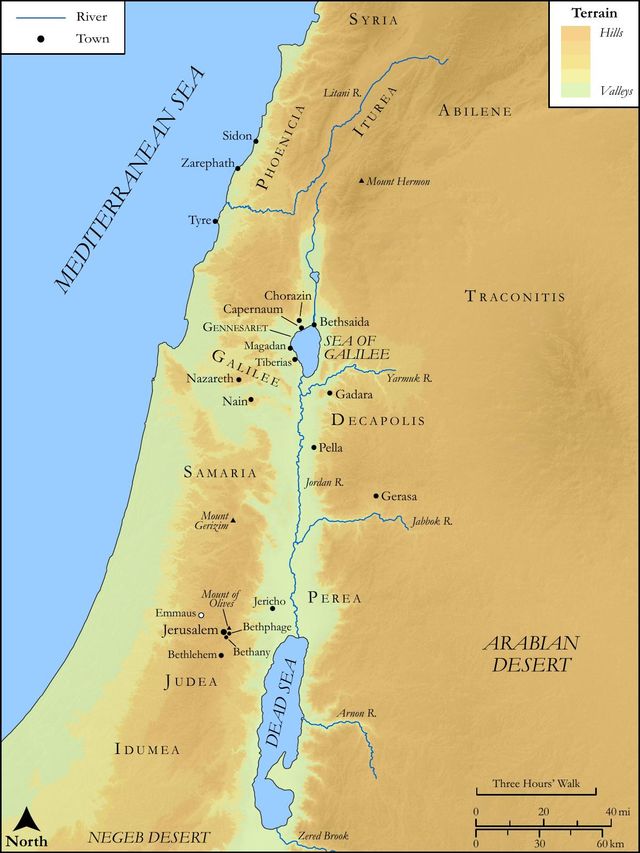
Places
31 named
- JerusalemWhere the book begins and ends; the goal of the journey30
- GalileeWhere Jesus grew up and first preached; the women followed from here13
- JudaeaHerod’s kingdom at the start; Pilate’s province when John preaches8
- NazarethMary’s city, where Jesus grew up and was thrust out8
- CapernaumWhere he teaches on the sabbath; later warned, “exalted to heaven”4
- SidonElias was sent to a widow of Sarepta, its city4
- JerichoOn the Samaritan’s road; the blind man and Zacchaeus3
- TyreWith Sidon, a coast that would have repented at his works3
Where Luke reaches
The passages it leans on, and the ones that lean on it
Two books to one Theophilus: the former treatise, and the sequel that begins where it ends.
John goes before the Lord “in the spirit and power of Elias,” to turn the hearts of the fathers.
Isaiah’s anointed preacher, read at Nazareth and declared fulfilled “This day.”
Ezekiel 34:11–16 Luke 15:4–7 Luke 19:10
The LORD will seek his lost sheep himself; Jesus tells of the shepherd, then says he has come to do it.
Psalms 31:5 Luke 23:46 Acts 7:59
The Psalm Jesus prays as he dies; Stephen, dying, commits his spirit to the Lord Jesus.
Books Luke links to most
The Church Fathers on Luke
5,189 quotations from 70 writers before AD 800 · the ten most quoted, in date order
- Irenaeus202
- Tertullian220
- Origen253
- Cyprian258
- Ambrose397
- Chrysostom407
- Augustine430
- Cyril444
- Gregory604
- Bede735
Irenaeus read Luke as the Gospel of priestly character, from Zacharias’ incense to the fatted calf.
According to Luke, having a priestly character, the Gospel began with the priest Zechariah offering incense to God. The fatted calf was already being prepared which was to be sacrificed for the finding of the younger son.
Gregory of Nazianzus set each lowly circumstance of the birth beside a sign of glory.
He was wrapped in swaddling bands, but at the resurrection he released the swaddling bands of the grave. He was laid in a manger but was praised by angels, disclosed by a star and adored by magi.
Cyril of Alexandria answers the Pharisees’ murmuring that opens chapter 15.
Tell me, O Pharisee, why do you grumble because Christ did not scorn to be with publicans and sinners, but purposely provided for them this means of salvation? To save people, he yielded himself to emptiness, became like us, and clothed himself in human poverty.
Ambrose on the promise to the thief: where Christ is, there is the kingdom.
He asked the Lord to remember him when He came into His kingdom, and the Lord said to him: Amen, I say to you, today you will be with me in Paradise. For to be with Christ is life; therefore, where Christ is, there is life, there is the kingdom.
Keep studying
Articles