


Luke 2:1
Bible text: King James Version (1769 Blayney text) · Public domain
Bible text: Berean Standard Bible · Public domain
Bible text: American Standard Version (1901) · Public domain
Bible text: World English Bible, Messianic edition · Public domain
Bible text: Geneva Bible (1599) · Public domain
Bible text: Young's Literal Translation · Public domain
- ἘγένετοEgenetoIt came to passG1096V-2ADI-3SVerb 2nd Aorist Middle Deponent Indicative 3rd Singular
- δὲdethenG1161CONJConjunction
- ἐνeninG1722PREPPreposition
- ταῖςtaistheG3588T-DPFDefinite article Dative Plural Feminine
- ἡμέραιςhēmeraisdaysG2250N-DPFNoun Dative Plural Feminine
- ἐκείναιςekeinaisthoseG1565D-DPFDemonstrative pronoun Dative Plural Feminine
- ἐξῆλθενexēlthenwent outG1831V-2AAI-3SVerb 2nd Aorist Active Indicative 3rd Singular
- δόγμαdogmaa decreeG1378N-NSNNoun Nominative Singular Neuter
- παρὰparafromG3844PREPPreposition
- ΚαίσαροςKaisarosCaesarG2541N-GSM-TNoun Genitive Singular Masculine Title
- ΑὐγούστουAugoustouAugustusG828N-GSM-PNoun Genitive Singular Masculine Individual
- ἀπογράφεσθαιapographesthaito registerG583V-PENVerb Present Middle Or Passive Infinitive
- πᾶσανpasanallG3956A-ASFAdjective Accusative Singular Feminine
- τὴνtēntheG3588T-ASFDefinite article Accusative Singular Feminine
- οἰκουμένηνoikoumenēnworldG3625N-ASFNoun Accusative Singular Feminine
English is a literal word-by-word gloss of the Greek, not the KJV's wording. Why?
This is the original text the KJV's translators worked from — each Greek word with its own literal English meaning in this verse, prepared by scholars at Tyndale House, Cambridge. The KJV translates whole sentences, not word by word, so its wording differs: one Greek word can become several English words, and the KJV may choose “charity” where the gloss reads “love”. Both are faithful — they answer different questions. For the KJV's own rendering, switch to the KJV text.
Details
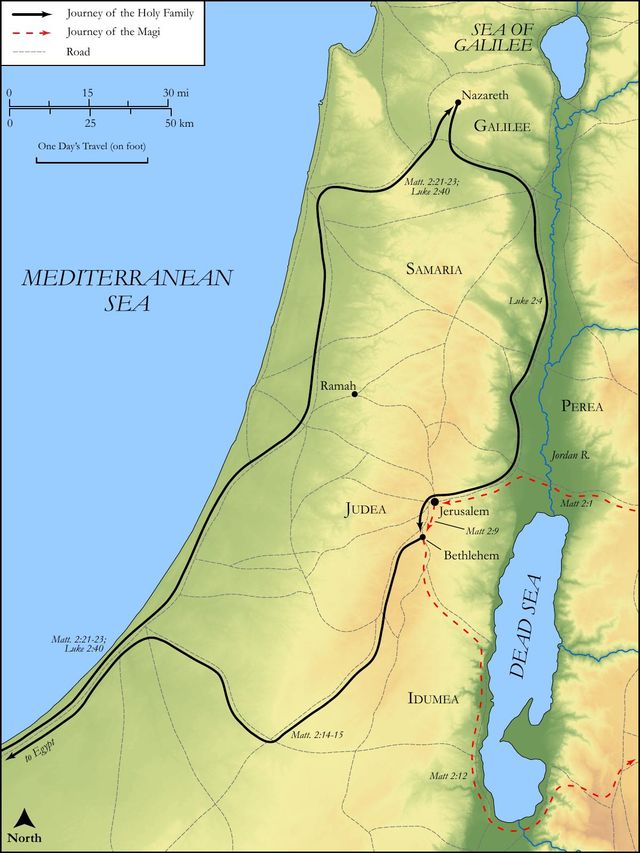
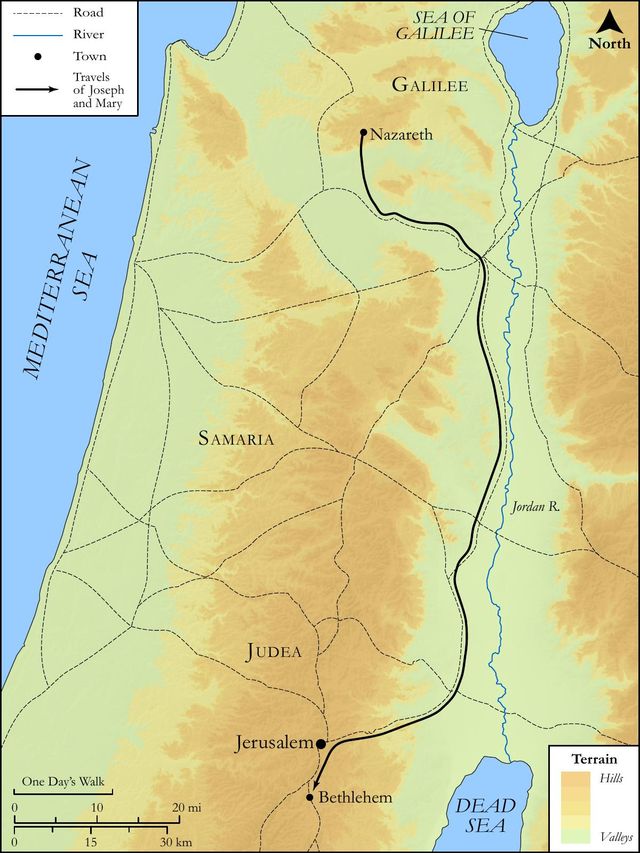
See on the biblical-era maps

Study this verse
Public-domain commentary
Matthew Henry
From his Commentary on the Whole Bible. Henry comments on passages, not single verses — this entry covers Luke 2:1–7. His four-level outline is real structure in the source text, so it is rendered as structure.
The fulness of time was now come, when God would send forth his Son, made of a woman, and made under the law; and it was foretold that he should be born at Bethlehem. Now here we have an account of the time, place, and manner of it.
I.The time when our Lord Jesus was born.
Several things may be gathered out of these verses which intimate to us that it was the proper time.
1.He was born at the time when the fourth monarchy was in its height, just when it was become, more than any of the three before it, a universal monarchy. He was born in the days of Augustus Caesar, when the Roman empire extended itself further than ever before or since, including Parthia one way, and Britain another way; so that it was then called Terraram orbis imperium - The empire of the whole earth; and here that empire is called all the world (Luk 2:1), for there was scarcely any part of the civilized world, but what was dependent on it. Now this was the time when the Messiah was to be born, according to Daniel's prophecy (Dan 2:44): In the days of these kings, the kings of the fourth monarchy, shall the God of heaven set up a kingdom which shall never be destroyed.
2.He was born when Judea was become a province of the empire, and tributary to it; as appears evidently by this, that when all the Roman empire was taxed, the Jews were taxed among the rest. Jerusalem was taken by Pompey the Roman general, about sixty years before this, who granted the government of the church to Hyrcanus, but not the government of the state; by degrees it was more and more reduced, till now at length it was quite subdued; for Judea was ruled by Cyrenius the Roman governor of Syria (Luk 2:2): the Roman writers call him Sulpitius Quirinus. Now just at this juncture, the Messiah was to be born, for so was dying Jacob's prophecy, that Shiloh should come when the sceptre was departed from Judah, and the lawgiver from between his feet, Gen 49:10. This was the first taxing that was made in Judea, the first badge of their servitude; therefore now Shiloh must come, to set up his kingdom.
3.There is another circumstance, as to the time, implied in this general enrolment of all the subjects of the empire, which is, that there was now universal peace in the empire. The temple of Janus was now shut, which it never used to be if any wars were on foot; and now it was fit for the Prince of peace to be born, in whose days swords should be beaten into plough-shares.
II.The place where our Lord Jesus was born is very observable.
He was born at Bethlehem; so it was foretold (Mic 5:2), the scribes so understood it (Mat 2:5, Mat 2:6), so did the common people, Joh 7:42. The name of the place was significant. Bethlehem signifies the house of bread; a proper place for him to be born in who is the Bread of life, the Bread that came down from heaven. But that was not all; Bethlehem was the city of David, where he was born, and therefore there he must be born who was the Son of David. Zion was also called the city of David (Sa2 5:7), yet Christ was not born there; for Bethlehem was that city of David where he was born in meanness, to be a shepherd; and this our Saviour, when he humbled himself, chose for the place of his birth; not Zion, where he ruled in power and prosperity, that was to be a type of the church of Christ, that mount Zion. Now when the virgin Mary was with child, and near her time, Providence so ordered it that, by order from the emperor, all the subjects of the Roman empire were to be taxed; that is, they were to give in their names to the proper officers, and they were to be registered and enrolled, according to their families, which is the proper signification of the word here used; their being taxed was but secondary. It is supposed that they made profession of subjection to the Roman empire, either by some set form of words, or at least by payment of some small tribute, a penny suppose, in token of their allegiance, like a man's atturning tenant. Thus are they vassals upon record, and may thank themselves.
According to this decree, the Jews (who were now nice in distinguishing their tribes and families) provided that in their enrolments particular care should be had to preserve the memory of them. Thus foolishly are they solicitous to save the shadow, when they had lost the substance.
That which Augustus designed was either to gratify his pride in knowing the numbers of his people, and proclaiming it to the world, or he did it in policy, to strengthen his interest, and make his government appear the more formidable; but Providence had another reach in it. All the world shall be at the trouble of being enrolled, only that Joseph and Mary may. This brought them up from Nazareth in Galilee to Bethlehem in Judea, because they were of the stock and lineage of David (Luk 2:4, Luk 2:5); and perhaps, being poor and low, they thought the royalty of their extraction rather than a burden and expense to them than a matter of pride. Because it is difficult to suppose that every Jew (women as well as men) was obliged to repair to the city of which their ancestors were, and there be enrolled, now, at a time when they kept not to the bounds of their tribes, as formerly, it may be offered as a conjecture that this great exactness was used only with the family of David, concerning which, it is probable, the emperor gave particular orders, it having been the royal family, and still talked of as designed to be so, that he might know its number and strength. Divers ends of Providence were served by this.
1.Hereby the virgin Mary was brought, great with child, to Bethlehem, to be delivered there, according to the prediction; whereas she had designed to lie in at Nazareth. See how man purposes and God disposes; and how Providence orders all things for the fulfilling of the scripture, and makes use of the projects men have for serving their own purposes, quite beyond their intention, to serve his.
2.Hereby it appeared that Jesus Christ was of the seed of David; for what brings his mother to Bethlehem now, but because she was of the stock and lineage of David? This was a material thing to be proved, and required such an authentic proof as this. Justin Martyr and Tertullian, two of the earliest advocates for the Christian religion, appeal to these rolls or records of the Roman empire, for the proof of Christ's being born of the house of David.
3.Hereby it appeared that he was made under the law; for he became a subject of the Roman empire as soon as he was born, a servant of rulers, Isa 49:7. Many suppose that, being born during the time of the taxing, he was enrolled as well as his father and mother, that it might appear how he made himself of no reputation, and took upon him the form of a servant. Instead of having kings tributaries to him, when he came into the world he was himself a tributary.
III.The circumstances of his birth, which were very mean, and under all possible marks of contempt.
He was indeed a first-born son; but it was a poor honour to be the first-born of such a poor woman as Mary was, who had no inheritance to which he might be entitled as first-born, but what was in nativity.
1.He was under some abasements in common with other children; he was wrapped in swaddling clothes, as other children are when they are new-born, as if he could be bound, or needed to be kept straight. He that makes darkness a swaddling band for the sea was himself wrapped in swaddling bands, Job 38:9. The everlasting Father became a child of time, and men said to him whose out-goings were of old from everlasting, We know this man, whence he is, Joh 7:27. The Ancient of days became an infant of a span long.
2.He was under some abasements peculiar to himself.
(1.)He was born at an inn. That son of David that was the glory of his father's house had no inheritance that he could command, no not in the city of David, no nor a friend that would accommodate his mother in distress with lodgings to be brought to bed in. Christ was born in an inn, to intimate that he came into the world but to sojourn here for awhile, as in an inn, and to teach us to do likewise. An inn receives all comers, and so does Christ. He hangs out the banner of love for his sign, and whoever comes to him, he will in no wise cast out; only, unlike other inns, he welcomes those that come without money and without price. All is on free cost.
(2.)He was born in a stable; so some think the word signifies which we translate a manger, a place for cattle to stand to be fed in. Because there was no room in the inn, and for want of conveniences, nay for want of necessaries, he was laid in a manger, instead of a cradle. The word which we render swaddling clothes some derive from a word that signifies to rend, or tear, and these infer that he was so far from having a good suit of child-bed linen, that his very swaddles were ragged and torn. His being born in a stable and laid in a manger was an instance,
[1.]Of the poverty of his parents. Had they been rich, room would have been made for them; but, being poor, they must shift as they could.
[2.]Of the corruption and degeneracy of manners in that age; that a woman in reputation for virtue and honour should be used so barbarously. If there had been any common humanity among them, they would not have turned a woman in travail into a stable.
[3.]It was an instance of the humiliation of our Lord Jesus. We were become by sin like an out-cast infant, helpless and forlorn; and such a one Christ was. Thus he would answer the type of Moses, the great prophet and lawgiver of the Old Testament, who was in his infancy cast out in an ark of bulrushes, as Christ in a manger. Christ would hereby put a contempt upon all worldly glory, and teach us to slight it. Since his own received him not, let us not think it strange if they receive us not.
Historical interpretation
Eleven Centuries of Reception
16 surviving comments on this verse. Each one is dated, so this reads as a timeline rather than a list.
Select a marker to jump to its quote. Markers stagger vertically where authors wrote within a few decades of each other.
"Away," says he, "with that eternal plaguey taxing of Caesar, and the scanty inn, and the squalid swaddling-clothes, and the hard stable. We do not care a jot for that multitude of the heavenly host which praised their Lord at night.
For He was from the native soil of Bethlehem, and from the house of David; as, among the Romans, Mary is described in the census, of whom is born Christ.
To those who attentively consider it, there seems to be expressed a kind of sacrament, in its being necessary that Christ should be put down in the registration of the whole world; in order that His name being written with all, He might sanctify all, and being placed in the census with the whole world, He might impart to the world the communion of Himself.
It was the forty second year of the reign of Augustus and twenty-eight years after the oppression of Egypt and the death of Antony and Cleopatra when Jesus was born in Bethlehem according to the prophecies concerning him. Flavius Josephus mentions this census in the time of Quirinius, adding another account about the sect of Galileans that arose at about the same time. Luke, among our writers, mentions this sect in Acts, saying, “After him Judas the Galilean arose in the days of the census and drew some people after him. He also perished, and all who followed him were scattered.”
He has rightly added the name of the governor, to mark the course of time. For if the names of the Consuls are affixed to the tables of prices, how much more ought the time to be noted down, of that event which was the redemption of all men?
There is described a secular registration, implied a spiritual, to be laid before the King not of earth but of Heaven; a registering of faith: a census of souls. For the old census of the Synagogue was abolished, a new census of the Church was preparing. And to decide that the census was not of Augustus, but of Christ, the whole world is ordered to be registered. For who could demand the registration of the whole world but He who had dominion over it, for the earth is not of Augustus, but the earth is the Lord's? (Ps. 24:1.)
This was then the first public enrolment of souls to the Lord, to Whom all enrol themselves not at the voice of the crier, but of the Prophet, who says, O clap your hands, all ye people. (Ps. 47:1.)
(in diem natal. Christi.) It was the Lord who directed Augustus to give this edict, that he might minister unto the coming of the Only-begotten; for it was this edict that brought Christ's mother into her country as the prophets had foretold, namely, to Bethlehem of Judæa, according to the word, to a city of David, which is called Bethlehem.
A feast day is about to arrive, and it is the most holy and awesome of all feasts. It would be no mistake to call it the chief and mother of all holy days. What feast is that? It is the day of Christ’s birth in the flesh.It is from this day that the feasts of the theophany, the sacred Pasch [Passover], the ascension and Pentecost had their source and foundation. Had Christ not been born in the flesh, he would not have been baptized, which is the theophany or manifestation. Nor would he have been crucified, which is the Pasch. Nor would he have sent down the Spirit, which is Pentecost. Therefore, just as different rivers arise from a single source, these other feasts have their beginnings in the birth of Christ.
When Augustus reigned alone upon earth, the many kingdoms of humankind came to end; and when you were made man of the pure Virgin, the many gods of idolatry were destroyed. The cities of the world passed under one single rule; and the nations came to believe in one sovereign Godhead. The peoples were enrolled by the decree of Caesar; and we, the faithful, were enrolled in the name of the Godhead, when you, our God, were made man. Great is your mercy: glory to you! Stichera of the Nativity of the Lord.
Christ therefore was born in Bethlehem at the time when Augustus Caesar gave orders that the first enrolment should be made. But what necessity was there, some one may perhaps say, for the very wise Evangelist to make special mention of this? Yes, I answer: it was both useful and necessary for him to mark the period when our Saviour was born: for it was said by the voice of the Patriarch: "The head shall not depart from Judah, nor a governor from his thighs until He come, for Whom it is laid up: and He is the expectation of the Gentiles." That we therefore might learn that the Israelites had then no king of the tribe of David, and that their own native governors had failed, with good reason he makes mention of the decrees of Caesar, as now having beneath his sceptre Judaea as well as the rest of the nations: for it was as their ruler that he commanded the census to be made.
(Hom. 8. in Ev.) But the registering of the whole world when our Lord was about to be born was mystical; for He appeared in the flesh Who should write down the names of His own elect in eternity.
What does it mean that the world is enrolled when the Lord is about to be born, except that this is openly shown: that he was coming in the flesh who would enroll his elect in eternity? Concerning the reprobate, by contrast, it is said through the Prophet: Let them be blotted out of the book of the living, and let them not be written with the just.
He chose a time of utmost peace as the time when he would be born because this was the reason for his being born in the world, that he might lead the human race back to the gifts of heavenly peace. And, indeed it is written: “For he is our peace, who has made us both one,” that is, he who as a kind mediator and reconciler has made one house of God of angels and humanity. Jesus was born in a time of peace, so that even by the circumstance of the time he might teach that he was the very one of whom the prophecy sent before him spoke: “His sovereignty will be multiplied, and there will be no end of peace.”
The Son of God, about to be born in the flesh, as by His birth of a virgin He showed that the grace of virginity was most pleasing in His sight, is therefore begotten in the most peaceful time of the world, because He taught men to seek peace, and condescends to visit those who follow it. But there could be no greater sign of peace than for the whole world to be brought together under one taxing, while its ruler Augustus reigned with so great peace for the twelve years, about the time of our Lord's nativity, that war having been quelled throughout the whole world, there seemed to be a literal fulfilment of the Prophet's prediction, They shall beat their swords into ploughshares, &c.
St. Luke points out, that this taxing was either the first of those which comprehended the whole world, for before this very many parts of the earth are often mentioned as having been taxed; or first began at that time when Cyrinus was sent into Syria.
Now the registration of property was so appointed by Divine guidance, that every one was ordered to go into his own country, as it follows, And they all went to be taxed, every one to his own city. Which so came to pass, in order that the Lord, conceived in one place, born in another, might the more easily escape the fury of the crafty Herod. Hence it follows: Now Joseph also went up from Galilee.
And He most perfectly fulfilled what the name Augustus signifies, in that He was both desirous and able to increase (augere) His own.
As at that time in the reign of Augustus and under the governorship of Cyrinus, every one went to his own city to make returns of his property; so now when Christ reigns through His teachers (the governors of the Church) ought we to make returns of righteousness.
Our city and country is the resting-place of the blessed, to which we ought to be travelling with daily increasing virtues. But day by day does Holy Church wait upon her Teacher, and going up from the course of worldly business (which the name of Galilee signifies) to the city of Judah, i. e. the city of confession and praise, make returns of her devotion to the Eternal King. She, after the example of the blessed Virgin Mary, a Virgin has conceived us of the Spirit. Though espoused to another, she is made fruitful by Him; and while visibly joined to the Pontiff who is placed over her, is invisibly filled with the graces of the Spirit. And hence Joseph is well interpreted increased, declaring by his very name, that the earnestness of the master speaking is of no avail, except he receive increasing help from above, that he may be heard.
Now it came to pass in those days, that there went out a decree from Caesar Augustus, that all the world should be taxed. The Son of God, about to be born in the flesh, chose for Himself His parents as He willed, and the place of His birth as He willed, and brought them to that place before He was born as He willed. Thus, also, at the time which He willed, indeed, which He, with the Father and the Holy Spirit, had decreed from ages, and had foretold through the mouths of the prophets, He entered the world to save it. For, just as He was born of a virgin mother, demonstrating that the glory of virginity and the angelic honor of purity was most pleasing to Him, so also, born at the most peaceful time of the world, He showed that He sought and loved peace greatly. He indicated that He would always deign to visit the followers of peace and love. Concerning this, He Himself promised to the faithful, saying: For where two or three are gathered together in my name, there am I in the midst of them (Matt. XVIII). For what greater sign of the most perfect kingdom, and the most beautiful, as far as men are concerned, could there be of peace than that the whole world is encompassed by a single census, and that all the farthest reaches of the world are comprehended in the same monetary declaration? Whose author and ruler, Augustus, according to the faith of histories, reigned in peace for twelve years around the time of the Lord’s birth, so that, with both foreign and civil wars being quieted throughout the whole world, he may be seen to have fulfilled even to the letter the spiritual prophecy of the prophet. The prophet indeed proclaimed with mystical voice the dispensation of Christ, saying: And in the last days the mountain of the house of the Lord shall be established in the top of the mountains, and shall be exalted above the hills, and all nations shall flow unto it (Micah IV). Shortly after, he also took care to describe the state of that most sacred time: And they shall beat their swords into plowshares, and their spears into pruning hooks. Nation shall not lift up sword against nation, neither shall they learn war anymore. O house of Jacob, come ye, and let us walk in the light of the Lord (Ibid.). Not only did this new census of the world testify to the advent of that supreme king who would enroll His chosen ones, gathered from all directions of the world, in the book of eternal happiness, but it also aided the leaders of his kingdom with the peace of his governance. For surely, with the nations subdued by the storm of wars, the shadow (so to speak) of the Roman name, terrible at that time, protected the disciples of Christ, who were to preach to the world, from the fervor of arising seditions wherever they might wish to go for the sake of the word. Therefore, the decree went out from Caesar Augustus that all the world should be enrolled, for the decree of Christ the King was impending, by which all the world would attain salvation. He who fulfilled the name of Augustus most perfectly, desiring his own to grow and himself sufficient to increase them, commanded that the censors sign those subject to his expedition not with the removal of money, but with the offering of faith. Go ye into all the world, and preach the Gospel to every creature. He that believeth and is baptized shall be saved (Mark XVI).
Because it was fit also that at Christ's coming the worship of many Gods should cease, and one God only be worshipped, one king is described as ruling the world.
(Metaphrastes et Alexander ander Monachus.) Christ is born also at a time when the princes of Judah had failed, and the kingdom was transferred to Roman governors, to whom the Jews paid tribute; and then was fulfilled the prophecy, saying, There shall not fail a leader from Judah, nor a prince from between his feet, until he shall come who is to be sent. (Gen. 49:10.) And now when Cæsar Augustus was in the 42d year of his reign, there went forth an edict from him that all the world should be taxed for the payment of tribute, the management of which he committed to a certain Cyrinus, whom he made governor of Judæa and Syria; and so it follows, This taxing was first made, &c.
Continue studying Luke 2:1 across the web’s major study libraries — every link below opens this exact verse, chapter, or book on the destination site.
Read & Compare
 BibleGatewayThis verse in more than 200 translations and 70 languages.
 Bible.comThe YouVersion reader — hundreds of translations, reading plans, and highlights.
 ESV.orgCrossway's official English Standard Version reader.
 NET BibleThe NET translation with 60,000+ translators' notes on every rendering decision.
 STEP BibleTyndale House's free study tool — original text, vocabulary, and scholarly resources.
 BibliaLogos Bible Software's free web reader.
 USCCBThe New American Bible (Revised Edition) with the U.S. bishops' study notes.
Commentaries
 BibleHub CommentariesDozens of classic commentaries on this verse, gathered on one page.
 StudyLightMore than 100 commentary sets — the largest collection on the web.
 BibleRefPlain-English commentary on what this verse means, verse by verse.
 Enduring WordDavid Guzik's free commentary on this chapter, widely used by Bible teachers.
 Bible Study ToolsVerse commentary alongside Greek and Hebrew study aids.
Original Language & Research
- BibleHub InterlinearThe verse word by word — original language, transliteration, and English.
- BibleHub LexiconEvery word's original-language definition and Strong's entry.
 Blue Letter BibleDeep-study tools — Strong's numbers, concordance, and word studies.
 CNTR CollationThe earliest Greek manuscripts of this verse, collated letter by letter.
Sermons, Hymns & Audio


TrulyRandomVerse is not affiliated with these sites and doesn’t control their content. They’re linked because they’re genuinely useful.
Summary
Luke 2:1 meticulously grounds the pivotal event of Jesus' birth within a precise historical and political context, asserting that the Messiah's arrival was not a mythical tale but an actual occurrence orchestrated by divine providence amidst human affairs. It introduces Caesar Augustus's empire-wide decree for a census, an seemingly ordinary administrative act that providentially compelled Joseph and Mary to travel to Bethlehem, thereby fulfilling ancient prophecies concerning the Messiah's birthplace. This verse thus establishes the historical veracity of the Gospel narrative, demonstrating God's sovereign control over even the most powerful earthly rulers to accomplish His redemptive plan.
Context
ShowHideLiterary Context
Luke 2:1 serves as a crucial transition from the preceding narratives of John the Baptist's birth and the angelic annunciations to Mary and Joseph in Luke 1. Chapter 1 establishes the miraculous circumstances surrounding the births of both John and Jesus, setting the stage for the fulfillment of God's promises. Verse 1 of chapter 2 immediately shifts the focus from the intimate, personal narratives to a grand, global stage, demonstrating how the birth of the Messiah is intricately woven into the fabric of world history. It provides the historical impetus for Mary and Joseph's journey to Bethlehem, which is detailed in the subsequent verses Luke 2:2-7. This meticulous historical anchoring is characteristic of Luke's Gospel, which aims to present an "orderly account" Luke 1:3 of the events surrounding Jesus' life.
Historical & Cultural Context
The "decree from Caesar Augustus" refers to an official mandate issued by Octavian, the first Roman Emperor (reigned 27 BC – 14 AD), who adopted the title "Augustus" in 27 BC. His reign was characterized by the Pax Romana, a period of unprecedented peace and stability across the vast Roman Empire, which ironically provided the ideal conditions for the spread of the Gospel. The decree itself was for an apographē, a registration or census, primarily for the purposes of taxation and military conscription. Such censuses were common in the Roman Empire, though their specific implementation varied by province. The phrase "all the world" (Greek: pasēn tēn oikoumenēn) specifically refers to the entire Roman-controlled territory, not the literal globe. For subjects like Joseph, who was "of the house and lineage of David" Luke 2:4, the Roman system often required individuals to return to their ancestral towns for registration, a practice that ensured accurate records for a largely agrarian and tribal society.
Key Themes
ShowHideThis opening verse powerfully introduces several foundational themes that resonate throughout Luke's Gospel and the broader biblical narrative. Firstly, it highlights Divine Sovereignty, demonstrating God's absolute control over human history. A seemingly mundane political act by a pagan emperor becomes the precise mechanism through which God orchestrates the fulfillment of His divine plan for the Messiah's birth, underscoring that human rulers, even the most powerful, are ultimately instruments in God's hands. Secondly, it emphasizes the Fulfillment of Prophecy. The Roman census directly compelled Joseph and Mary to travel to Bethlehem, thereby fulfilling the Old Testament prophecy in Micah 5:2, which foretold that the Messiah would be born in Bethlehem. This connection reinforces the continuity between the Old and New Testaments. Thirdly, Luke's inclusion of such specific historical details underscores the Historical Veracity of the Christian faith, presenting Jesus' birth not as a myth but as a verifiable event rooted in real-world history, connecting it to known rulers and events of the time, a hallmark of Luke's meticulous historical approach as seen throughout his Gospel and the book of Acts.
Exposition and Analysis
ShowHideKey Word Analysis
ShowHideThis common Greek verb signifies "to become," "to come into being," or "to happen." In this context, it emphasizes the factual occurrence of the events. Luke uses it to introduce a significant development in his narrative, signaling that these are not mere stories but historical realities unfolding in time. It conveys a sense of divine orchestration, as if these events were destined to occur.
Derived from a root meaning "to seem" or "to think," dógma refers to an official ordinance, law, or authoritative pronouncement. Here, it specifically denotes a binding imperial edict from Caesar Augustus. The use of this term highlights the authoritative nature of the command that set in motion the events leading to Jesus' birth in Bethlehem, underscoring the power of the Roman Empire and its influence over daily life.
This term literally means "the inhabited earth" or "the civilized world." In the context of the Roman Empire, it specifically referred to the Roman Empire itself—the known and governed world from their perspective. Luke's use of oikouménē emphasizes the vast scope of the decree, indicating that it impacted a wide geographical area and countless people, setting the stage for a universally significant event.
Verse Breakdown
ShowHide"And it came to pass in those days,"
This opening phrase, typical of biblical narrative, serves as a temporal marker, connecting the events that follow to the period immediately after the annunciations and preparations for Jesus' birth described in Luke 1. It signals the commencement of a new, significant phase in the unfolding divine plan.
"that there went out a decree from Caesar Augustus,"
This clause introduces the central human agent and the catalyst for the subsequent events: Caesar Augustus, the powerful Roman Emperor. The "decree" (Greek: dógma) was an official, authoritative command, highlighting the vast administrative reach and power of the Roman Empire, which God would providentially use for His purposes.
"that all the world should be taxed."
This final clause specifies the nature and scope of the decree. The word "taxed" here translates the Greek apográphō, which more accurately means "to be enrolled" or "to be registered" for a census. While such a registration often preceded or was for the purpose of taxation, its immediate effect was a listing of people and their property. The phrase "all the world" refers to the entire Roman Empire, emphasizing the universal impact of this decree that would directly affect Joseph and Mary.
Literary Devices
ShowHideLuke's opening verse employs several key literary devices. The most prominent is Historical Grounding, meticulously anchoring the sacred narrative of Jesus' birth in verifiable secular history. By naming Caesar Augustus and detailing a specific imperial decree, Luke establishes the factual basis of his account, distinguishing it from myth or legend. This device lends immense credibility to the Gospel's claims. There is also a subtle Irony at play: the most powerful man in the world, Caesar Augustus, issues a decree for administrative purposes, unknowingly becoming a pawn in God's eternal plan to fulfill ancient prophecies. His imperial power, intended to consolidate Roman control, inadvertently serves the divine purpose of bringing the Messiah to the prophesied birthplace. Finally, the phrase "all the world" (Greek: oikouménē) functions as a form of Synecdoche, where "the world" (the Roman Empire) stands in for the whole of humanity, subtly foreshadowing the universal scope of the salvation that the child born under this decree would bring.
Theological and Thematic Connections
ShowHideLuke 2:1 powerfully illustrates the profound theological truth of God's sovereign control over all human affairs, even those seemingly mundane or politically motivated. It demonstrates that God is not confined to the sacred realm but actively orchestrates events in the secular sphere, using the actions of powerful rulers to achieve His redemptive purposes. This verse sets the stage for the fulfillment of prophecy, showing how a Roman census, intended for imperial administration, became the precise means by which Mary and Joseph were compelled to travel to Bethlehem, the prophesied birthplace of the Messiah. It underscores that God's plan is meticulously detailed and perfectly timed, weaving together human decisions and divine will to bring about His ultimate good.
Reflection and Application
ShowHideLuke 2:1 offers a profound reminder that God is actively at work in our world, even in circumstances that appear purely secular, inconvenient, or beyond our control. Just as He used a Roman decree to bring about the birth of Jesus in Bethlehem, so too does He orchestrate events in our lives and in the broader global landscape to advance His will. This verse encourages us to cultivate a perspective of divine sovereignty, recognizing God's hand even in the ordinary, the chaotic, or the seemingly random. It challenges us to trust in His perfect timing and intricate plan, knowing that He can turn any human action into an instrument for His glory and our good. For us, this means looking beyond immediate circumstances to discern God's larger purposes, finding peace in His control, and being ready to participate in His plan, even when it requires unexpected journeys or changes in our lives.
Questions for Reflection
ShowHideFAQ
ShowHideWas this the only census conducted by Caesar Augustus, and why is it so important for Jesus' birth?
ShowHideWhile Caesar Augustus did conduct multiple censuses during his reign, Luke 2:1 refers to a specific decree that required people to return to their ancestral towns for registration. This particular census is crucial for Jesus' birth because it directly compelled Joseph and Mary, who were "of the house and lineage of David" Luke 2:4, to travel from Nazareth to Bethlehem. This journey was essential for the fulfillment of the Old Testament prophecy in Micah 5:2, which foretold that the Messiah would be born in Bethlehem, the city of David. Without this decree, Joseph and Mary might not have been in Bethlehem at the precise time of Jesus' birth, highlighting God's meticulous orchestration of historical events to fulfill His divine plan.
Christ-Centered Fulfillment
ShowHideLuke 2:1, by establishing the historical context of Jesus' birth under a Roman imperial decree, subtly yet profoundly points to Christ-centered fulfillment. The decree from Caesar Augustus, a powerful earthly ruler, serves as a stark contrast to the true King who is about to be born. While Augustus sought to consolidate his earthly empire through taxation and registration, the child born in Bethlehem would establish an eternal kingdom not of this world John 18:36. The census, a tool of imperial control, ironically becomes the very means by which God brings His Son into the world in the prophesied location, demonstrating that even the most powerful human authorities are ultimately subservient to God's sovereign will and redemptive plan. This humble, politically compelled birth in Bethlehem foreshadows Jesus' ultimate mission: to be the Lamb of God who takes away the sin of the world John 1:29 and the King of kings and Lord of lords Revelation 19:16, whose reign transcends all earthly decrees and empires. The "taxing of all the world" under Augustus prefigures the spiritual enrollment of all who believe in Christ into God's eternal kingdom, a census of souls redeemed by His sacrifice.