


Acts 11:28
Bible text: King James Version (1769 Blayney text) · Public domain
Bible text: King James Version with Strong's numbers · Public domain
Bible text: Berean Standard Bible · Public domain
Bible text: American Standard Version (1901) · Public domain
Bible text: World English Bible, Messianic edition · Public domain
Bible text: Geneva Bible (1599) · Public domain
Bible text: Young's Literal Translation · Public domain
- ἀναστὰςanastasHaving risen upG450V-2AAP-NSMVerb 2nd Aorist Active Participle Nominative Singular Masculine
- δὲdenowG1161CONJConjunction
- εἷςheisoneG1520A-NSMAdjective Nominative Singular Masculine
- ἐξexofG1537PREPPreposition
- αὐτῶνautōnthemG846P-GPMPersonal pronoun Genitive Plural Masculine
- ὀνόματιonomatinamedG3686N-DSNNoun Dative Singular Neuter
- ἍγαβοςHagabosAgabusG13N-NSM-PNoun Nominative Singular Masculine Individual
- ἐσήμανενesēmanenhe signifiedG4591V-AAI-3SVerb Aorist Active Indicative 3rd Singular
- διὰdiathroughG1223PREPPreposition
- τοῦtoutheG3588T-GSNDefinite article Genitive Singular Neuter
- πνεύματοςpneumatosSpirit [that]G4151N-GSNNoun Genitive Singular Neuter
- λιμὸνlimona famineG3042N-ASFNoun Accusative Singular Feminine
- μεγάληνmegalēngreatG3173A-ASFAdjective Accusative Singular Feminine
- μέλλεινmelleinto ensueG3195V-PANVerb Present Active Infinitive
- ἔσεσθαιesesthaibeingG1510V-FDNVerb Future Middle Deponent Infinitive
- ἐφ᾽eph᾽overG1909PREPPreposition
- ὅληνholēnallG3650A-ASFAdjective Accusative Singular Feminine
- τὴνtēntheG3588T-ASFDefinite article Accusative Singular Feminine
- οἰκουμένηνoikoumenēnworld —G3625N-ASFNoun Accusative Singular Feminine
- ἥτιςhētiswhichG3748R-NSFRelative pronoun Nominative Singular Feminine
- καὶkaialsoG2532CONJConjunction
- ἐγένετοegenetowasG1096V-2ADI-3SVerb 2nd Aorist Middle Deponent Indicative 3rd Singular
- ἐπὶepiin [the time of]G1909PREPPreposition
- ΚλαυδίουKlaudiouClaudiusG2804N-GSM-PNoun Genitive Singular Masculine Individual
- ΚαίσαροςKaisarosof CaesarG2541N-GSM-TNoun Genitive Singular Masculine Title
English is a literal word-by-word gloss of the Greek, not the KJV's wording. Why?
This is the original text the KJV's translators worked from — each Greek word with its own literal English meaning in this verse, prepared by scholars at Tyndale House, Cambridge. The KJV translates whole sentences, not word by word, so its wording differs: one Greek word can become several English words, and the KJV may choose “charity” where the gloss reads “love”. Both are faithful — they answer different questions. For the KJV's own rendering, switch to the KJV text.
Details
See on the biblical-era maps
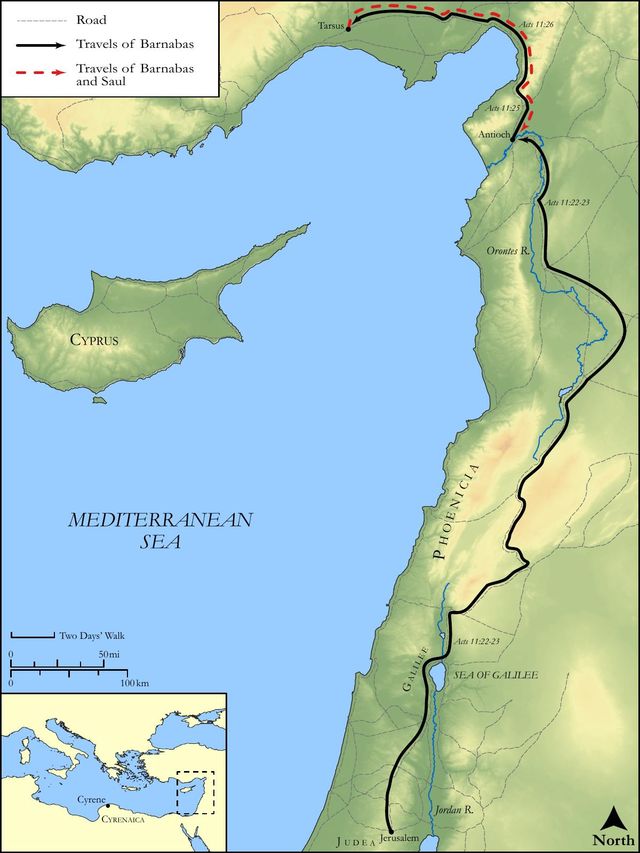
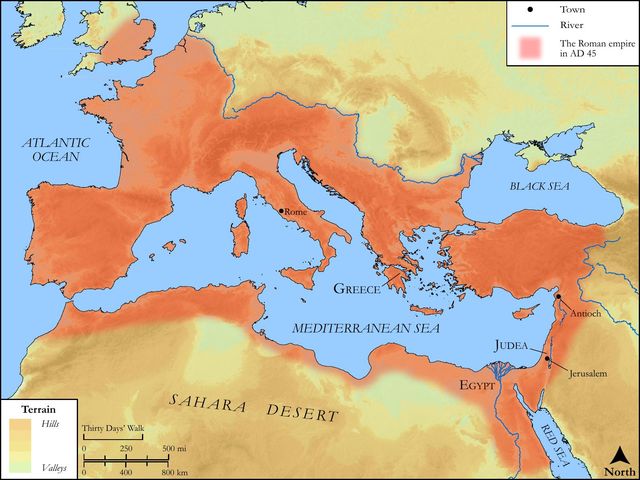
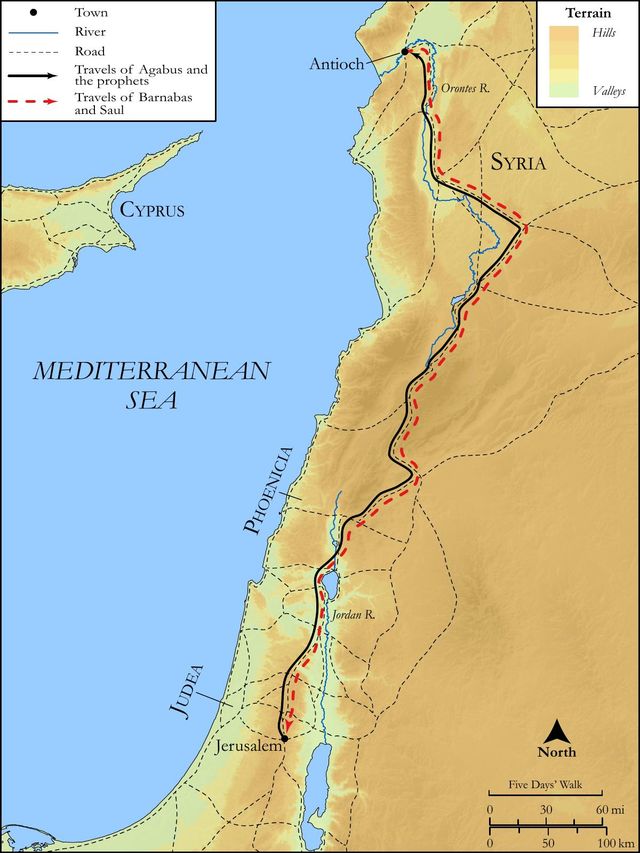
Study this verse
Public-domain commentary
Matthew Henry
From his Commentary on the Whole Bible. Henry comments on passages, not single verses — this entry covers Acts 11:27–30. His three-level outline is real structure in the source text, so it is rendered as structure.
When our Lord Jesus ascended on high he gave gifts unto men, not only apostles and evangelists, but prophets, who were enabled by the Spirit to foresee and foretel things to come, which not only served for a confirmation of the truth of Christianity (for all that these prophets foretold came to pass, which proved that they were sent of God, Deu 18:22; Jer 28:9), but was also of great use to the church, and served very much for its guidance. Now here we have,
I.A visit which some of these prophets made to Antioch (Act 11:27):
In these days, during that year that Barnabas and Saul lived at Antioch, there came prophets from Jerusalem to Antioch: we are not told how many, nor is it certain whether these were any of those prophets that we afterwards find in the church at Antioch, Act 13:1.
1.They came from Jerusalem, probably because they were not now so much regarded there as they had been; they saw their work in a manner done there, and therefore thought it time to be gone. Jerusalem had been infamous for killing the prophets and abusing them, and therefore is now justly deprived of these prophets.
2.They came to Antioch, because they heard of the flourishing state of that church, and there they hoped they might be of some service. Thus should every one as he hath received the gift minister the same. Barnabas came to exhort them, and they, having received the exhortation well, now have prophets sent them to show them things to come, as Christ had promised, Joh 16:13. Those that are faithful in their little shall be entrusted with more. The best understanding of scripture-predictions is to be got in the way of obedience to scripture-instructions.
II.A particular prediction of a famine approaching, delivered by one of these prophets, his name Agabus; we read of him again prophesying Paul's imprisonment, Act 21:10, Act 21:11. Here he stood up, probably in one of their public assemblies, and prophesied, Act 11:28. Observe,
1.Whence he had his prophecy. What he said was not of himself, nor a fancy of his own, nor an astronomical prediction, nor a conjecture upon the present workings of second causes, but he signified it by the Spirit, the Spirit of prophecy, that there should be a famine; as Joseph, by the Spirit enabling him, understood Pharaoh's dreams, foretold the famine in Egypt, and Elijah the famine in Israel in Ahab's time. Thus God revealed his secrets to his servants the prophets.
2.What the prophecy was: There should be great dearth throughout all the world, by unseasonable weather, that corn should be scarce and dear, so that many of the poor should perish for want of bread. This should be not in one particular country, but through all the world, that is, all the Roman empire, which they in their pride, like Alexander before them, called the world. Christ had foretold in general that there should be famines (Mat 24:7; Mar 13:8; Luk 21:11); but Agabus foretels one very remarkable famine now at hand.
3.The accomplishment of it: It came to pass in the days of Claudius Caesar; it began in the second year of his reign, and continued to the fourth, if not longer. Several of the Roman historians make mention of it, as does also Josephus. God sent them the bread of life, and they rejected it, loathed the plenty of that manna; and therefore God justly broke the staff of bread, and punished them with famine; and herein he was righteous. They were barren, and did not bring forth to God, and therefore God made the earth barren to them.
III.The good use they made of this prediction.
When they were told of a famine at hand, they did not do as the Egyptians, hoard up corn for themselves; but, as became Christians, laid by for charity to relieve others, which is the best preparative for our own sufferings and want. It is promised to those that consider the poor that God will preserve them, and keep them alive, and they shall be blessed upon the earth, Psa 41:1, Psa 41:2. And those who show mercy, and give to the poor, shall not be ashamed in the evil time, but in the days of famine they shall be satisfied, Psa 37:19, Psa 37:21. The best provision we can lay up against a dear time is to lay up an interest in these promises, by doing good, and communicating, Luk 12:33. Many give it as a reason why they should be sparing, but the scripture gives it as a reason why we should be liberal, to seven, and also to eight, because we know not what evil shall be upon the earth, Ecc 11:2. Observe,
1.What they determined - that every man, according to his ability, should send relief to the brethren that dwelt in Judea, Act 11:29.
(1.)The persons that were recommended to them as objects for charity were the brethren that dwelt in Judea. Though we must, as we have opportunity, do good to all men, yet we must have a special regard to the household of faith, Gal 6:10. No poor must be neglected, but God's poor most particularly regarded. The care which every particular church ought to take of their own poor we were taught by the early instance of that in the church at Jerusalem, where the ministration was so constant that none lacked, Act 4:34. But the communion of saints in that instance is here extended further, and provision is made by the church at Antioch for the relief of the poor in Judea, whom they call their brethren. It seems it was the custom of the Jews of the dispersion to send money to those Jews who dwelt in Judea, for the relief of the poor that were among them, and to make collections for that purpose (Tully speaks of such a thing in his time, Orat. pro Flacco), which supposes there were many poor in Judea, more than in other countries, so that the rich among them were not able to bear the charge of keeping them from starving; either because their land had become barren, though it had been a fruitful land, for the iniquity of those that dwelt therein, or because they had no traffic with other nations. Now we may suppose that the greatest part of those who turned Christians in that country were the poor (Mat 11:5, The poor are evangelized), and also that when the poor turned Christians they were put out of the poor's book, and cut off from their shares in the public charity; and it were easy to foresee that if there came a famine it would go very hard with them; and, if any of them should perish for want, it would be a great reproach to the Christian profession; and therefore this early care was taken, upon notice of this famine coming, to send them a stock beforehand, lest, if it should be deferred till the famine came, it should be too late.
(2.)The agreement there was among the disciples about it, that every man should contribute, according to his ability, to this good work. The Jews abroad, in other countries, grew rich by trade, and many of the rich Jews became Christians, whose abundance ought to be a supply to the want of their poor brethren that were at a great distance; for the case of such ought to be considered, and not theirs only that live among us. Charitable people are traders with what God has given them, and the merchants find their account in sending effects to countries that lie very remote; and so should we in giving alms to those afar off that need them, which therefore we should be forward to do when we are called to it. Every man determined to send something, more or less, according to his ability, what he could spare from the support of himself and his family, and according as God had prospered him. What may be said to be according to our ability we must judge for ourselves, but must be careful that we judge righteous judgment.
2.What they did - they did as they determined (Act 11:30). Which also they did. They not only talked of it, but they did it. Many a good motion of that kind is made and commended, but is not prosecuted, and so comes to nothing. But this was pursued, the collection was made, and was so considerable that they thought it worth while to send Barnabas and Saul to Jerusalem, to carry it to the elders there, though they would want their labours in the mean time at Antioch. They sent it,
(1.)To the elders, the presbyters, the ministers or pastors, of the churches in Judea, to be by them distributed according to the necessity of the receivers, as it had been contributed according to the ability of the givers.
(2.)It was sent by Barnabas and Saul, who perhaps wanted an occasion to go to Jerusalem, and therefore were willing to take this. Josephus tells us that at this time king Irates sent his charity to the chief men of Jerusalem, for the poor of that country; and Helena, queen of the Adiabeni, being now at Jerusalem, and hearing of many that died of famine there, and in the country about, sent for provisions from Cyprus and Alexandria, and distributed them among the people; so says Dr. Lightfoot, who also computes, by the date of Paul's rapture, "fourteen years before he wrote the second Epistle to the Corinthians" (Co2 12:1, Co2 12:2), that it was in this journey of his to Jerusalem, with these alms and offerings, that he had his trance in the temple (which he speaks of, Act 22:17), and in that trance was rapt up into the third heaven; and then it was that Christ told him he would send him thence unto the Gentiles, which accordingly he did as soon as ever he came back to Antioch. It is no disparagement, in an extraordinary case, for ministers of the gospel to be messengers of the church's charity, though to undertake the constant care of that matter would ordinarily be too great a diversion from more needful work to those who have given themselves to prayer and the ministry of the word.
Historical interpretation
Three Centuries of Reception
3 surviving comments on this verse. Each one is dated, so this reads as a timeline rather than a list.
Select a marker to jump to its quote. Markers stagger vertically where authors wrote within a few decades of each other.
"And there stood up one of them named Agabus, and signified by the spirit that there would be great dearth throughout the world, which also came to pass in the days of Claudius Caesar." "By the Spirit," it says: for, that they may not imagine that this was the reason why the famine came, namely, because Christianity was come in, because the demons were departed, the Holy Ghost foretells it: this, however, was nothing wonderful, for in fact Christ predicted it. Not this was the reason, else this must have been the case from the beginning: but it was because of the evils done to the Apostles - and God had borne long with them; but, when they pressed upon them, a great famine ensues, betokening to the Jews the coming woes.
But it is predicted, that they might be prepared beforehand for almsgiving. "Unto the brethren which dwelt in Judaea;" for they were enduring great hardships, but before this, they were not suffering from famine.
And one of them named Agabus, rising up, signified by the Spirit that there would be a great famine. Agabus can be interpreted as a messenger of tribulation, who, according to his name, both predicts the general famine here and later the bonds to the apostle Paul.
Continue studying Acts 11:28 across the web’s major study libraries — every link below opens this exact verse, chapter, or book on the destination site.
Read & Compare
 BibleGatewayThis verse in more than 200 translations and 70 languages.
 Bible.comThe YouVersion reader — hundreds of translations, reading plans, and highlights.
 ESV.orgCrossway's official English Standard Version reader.
 NET BibleThe NET translation with 60,000+ translators' notes on every rendering decision.
 STEP BibleTyndale House's free study tool — original text, vocabulary, and scholarly resources.
 BibliaLogos Bible Software's free web reader.
 USCCBThe New American Bible (Revised Edition) with the U.S. bishops' study notes.
Commentaries
 BibleHub CommentariesDozens of classic commentaries on this verse, gathered on one page.
 StudyLightMore than 100 commentary sets — the largest collection on the web.
 BibleRefPlain-English commentary on what this verse means, verse by verse.
 Enduring WordDavid Guzik's free commentary on this chapter, widely used by Bible teachers.
 Bible Study ToolsVerse commentary alongside Greek and Hebrew study aids.
Original Language & Research
- BibleHub InterlinearThe verse word by word — original language, transliteration, and English.
- BibleHub LexiconEvery word's original-language definition and Strong's entry.
 Blue Letter BibleDeep-study tools — Strong's numbers, concordance, and word studies.
 CNTR CollationThe earliest Greek manuscripts of this verse, collated letter by letter.
Sermons, Hymns & Audio


TrulyRandomVerse is not affiliated with these sites and doesn’t control their content. They’re linked because they’re genuinely useful.
Summary
Acts 11:28 presents the prophetic ministry of Agabus within the burgeoning Christian community in Antioch, where he, empowered by the Holy Spirit, foretold a severe and widespread famine. This prophecy, which explicitly came to pass during the reign of Emperor Claudius, serves as a powerful testament to God's active involvement in human history, His sovereign control over natural events, and His divine communication to His people, preparing them for impending challenges and prompting a demonstration of practical Christian love and unity.
Context
ShowHideLiterary Context
Acts 11:28 is situated at a pivotal point in the book of Acts, following the establishment of a vibrant and diverse Christian community in Antioch, a significant Gentile center. Barnabas and Saul (Paul) had been ministering there for a full year, teaching a large number of disciples, and it was in Antioch that believers were first called "Christians" (Acts 11:26). The arrival of prophets from Jerusalem, including Agabus, indicates the ongoing spiritual vitality and interconnectedness of the early church. This specific prophecy immediately precedes the Antiochian believers' practical response of sending relief to the saints in Judea (Acts 11:29-30), demonstrating the immediate impact and purpose of divine revelation. It sets the stage for the church's outward-looking mission and its internal solidarity.
Historical & Cultural Context
The Roman Empire, at the time of this prophecy, was a vast and complex entity. Emperor Claudius reigned from 41 to 54 AD, a period marked by several documented famines across different regions of the empire. While "all the world" (Acts 11:28) in biblical idiom often referred to the Roman Empire, historical records confirm widespread food shortages, particularly affecting areas like Judea, which were prone to agricultural instability. The practice of prophecy was well-established in both Jewish and early Christian traditions, where prophets served as God's spokespersons, delivering messages of warning, comfort, or guidance. The mention of "Claudius Caesar" provides a crucial historical anchor, validating the accuracy and fulfillment of Agabus's Spirit-inspired prediction within verifiable historical events.
Key Themes
ShowHideThis verse powerfully contributes to several overarching themes in Acts and the broader biblical narrative. Firstly, it highlights the authenticity and authority of divine revelation, demonstrating that God continues to speak through His chosen servants, confirming His active presence in the world. Secondly, it underscores God's sovereignty and providence over all creation and human affairs, including natural phenomena like famine. The fulfillment of the prophecy affirms that God is not a distant deity but one who orchestrates events according to His purposes. Thirdly, it emphasizes the practicality and communal impact of prophecy, as the warning prompted a tangible response of compassion and unity among believers, illustrating the early church's commitment to mutual aid and transcending geographical and ethnic divides, a theme echoed in passages like Galatians 6:10. Finally, it subtly reinforces the growing maturity and organizational capacity of the early church, as they collectively mobilized resources to assist their brothers and sisters in need.
Exposition and Analysis
ShowHideKey Word Analysis
ShowHideMeaning "to indicate." This word emphasizes that Agabus's communication was not a personal opinion or a mere guess, but a divinely given sign or indication of a future event. It points to the Holy Spirit as the source, making the prophecy an authoritative revelation rather than a human prediction.
Meaning "a scarcity of food; famine, hunger." The use of this specific term highlights the severe nature of the impending crisis – a widespread and acute lack of provisions, directly impacting sustenance and survival. The addition of "great" (G3173, mégas) further intensifies the scale of the predicted famine.
Meaning "the inhabited earth," but specifically in this Roman context, referring to "the Roman empire." This term signifies the extensive geographical scope of the predicted famine, indicating that it would not be a localized event but would affect a significant portion of the known civilized world under Roman rule, underscoring the magnitude of the divine warning.
Verse Breakdown
ShowHide"And there stood up one of them named Agabus,"
This clause introduces the prophet Agabus, who is part of a group of prophets who had come down from Jerusalem. His action of "standing up" suggests a formal or public declaration, drawing attention to the importance of the message he was about to deliver to the assembled believers in Antioch.
"and signified by the Spirit that there should be great dearth throughout all the world:"
This is the core of the prophecy. Agabus's message is explicitly attributed to the Holy Spirit ("by the Spirit"), establishing its divine origin and authority. He "signified" (indicated) that a "great dearth" (severe famine) was imminent, affecting "all the world" (the Roman Empire). This highlights the supernatural nature of the communication and the significant impact of the foretold event.
"which came to pass in the days of Claudius Caesar."
This crucial concluding phrase confirms the historical fulfillment and accuracy of Agabus's prophecy. By anchoring the event to the reign of "Claudius Caesar" (41-54 AD), Luke provides undeniable evidence of God's foreknowledge and sovereign control over historical events, validating the prophetic word and reinforcing the trustworthiness of divine revelation.
Literary Devices
ShowHideLuke employs several Literary Devices to enhance the impact and credibility of this passage. The primary device is Prophecy, where Agabus, as a divine mouthpiece, delivers a future-telling message from the Holy Spirit. This serves to establish God's active involvement in human affairs and His ability to reveal His plans. The subsequent confirmation that the prophecy "came to pass" acts as a powerful form of Verification or Fulfillment, lending historical authenticity and divine authority to the narrative. The specific mention of "Claudius Caesar" functions as a Historical Anchor, grounding the spiritual event in verifiable temporal reality, which was crucial for Luke's Gentile audience and for establishing the factual basis of early Christian history. This also subtly employs Foreshadowing, as the prophecy directly sets up the subsequent verses detailing the church's compassionate response to the impending crisis.
Theological and Thematic Connections
ShowHideActs 11:28 profoundly illustrates the ongoing work of the Holy Spirit in the early church, not merely for spiritual empowerment but for practical guidance and preparation. It underscores God's meticulous providence, revealing His sovereign hand over both natural phenomena and the course of human history. The prophecy of Agabus was not an isolated incident but a divine warning designed to elicit a response of faith and action from the community. This passage affirms that God's revelation is purposeful, intended to equip His people to navigate challenges, demonstrate His character, and foster unity within the body of Christ. It highlights the principle that divine foreknowledge often precedes and enables human compassion and strategic action.
Reflection and Application
ShowHideActs 11:28 serves as a timeless reminder of God's active presence and benevolent oversight in the world, even amidst potential hardship. For believers today, this passage encourages a posture of spiritual attentiveness and responsiveness. Just as Agabus received a specific word from the Spirit, we are called to cultivate discernment, seeking God's wisdom and guidance through His Word, prayer, and the counsel of godly leaders. The immediate and generous response of the Antiochian church to the prophecy is a powerful example of practical Christian love and solidarity. It challenges us to move beyond mere intellectual assent to God's truth and to translate our faith into tangible acts of compassion and support for those in need, both within and outside the church. In a world prone to various crises—economic, social, or natural—this verse compels us to trust in God's ultimate sovereignty while actively participating in His redemptive work through acts of generosity and service, preparing for and responding to challenges with faith-filled action.
Questions for Reflection
ShowHideFAQ
ShowHideWho was Agabus and what was his significance?
ShowHideAgabus was a prophet in the early Christian church, first introduced in Acts 11:28. He is significant because he delivered a specific, Spirit-inspired prophecy of a widespread famine that would affect the Roman Empire, which subsequently came to pass. His ministry demonstrated the ongoing role of prophetic gifting in the early church for guidance and preparation. He later appears in Acts 21:10-11 prophesying Paul's imprisonment in Jerusalem, further solidifying his role as a recognized and credible prophet.
What was the "great dearth throughout all the world" and when did it occur?
ShowHideThe "great dearth" refers to a severe and widespread famine, as prophesied by Agabus. The phrase "throughout all the world" (Greek oikouménē) in this context refers to the Roman Empire, indicating the extensive reach of the food shortage. Luke explicitly states that this famine "came to pass in the days of Claudius Caesar," who reigned as Roman Emperor from 41 to 54 AD. Historical records corroborate that multiple famines occurred during Claudius's reign, particularly impacting regions like Judea and even Rome itself, confirming the accuracy of Agabus's prophecy.
Christ-Centered Fulfillment
ShowHideAgabus's prophecy of a great famine, and its subsequent fulfillment, points to Christ in several profound ways. Firstly, Jesus himself is the ultimate Prophet, the one through whom God speaks His final and most complete word (Hebrews 1:1-2). Agabus's Spirit-inspired foresight foreshadows Christ's own teachings about future events and His sovereign control over all creation, including natural disasters (Matthew 24:7). Secondly, the response of the Antiochian believers to the famine—sending relief to their brethren in Judea—is a beautiful illustration of the Body of Christ functioning as Jesus intended. Christ taught His disciples to love one another sacrificially (John 13:34-35), and their practical generosity in the face of scarcity embodies the very compassion and provision that Jesus, the Bread of Life (John 6:35), offers to a world spiritually hungry and in need. Ultimately, while earthly famines bring physical suffering, Christ provides eternal sustenance, satisfying the deepest hunger of the human soul and promising a future where there will be no more hunger or thirst (Revelation 7:16).