


Acts 11:26
Bible text: King James Version (1769 Blayney text) · Public domain
Bible text: King James Version with Strong's numbers · Public domain
Bible text: Berean Standard Bible · Public domain
Bible text: American Standard Version (1901) · Public domain
Bible text: World English Bible, Messianic edition · Public domain
Bible text: Geneva Bible (1599) · Public domain
Bible text: Young's Literal Translation · Public domain
- καὶkaiandG2532CONJConjunction
- εὑρὼνheurōnhaving foundG2147V-2AAP-NSMVerb 2nd Aorist Active Participle Nominative Singular Masculine
- αὐτὸνautonhimG846P-ASMPersonal pronoun Accusative Singular Masculine
- ἤγαγενēgagenhe broughtG71V-2AAI-3SVerb 2nd Aorist Active Indicative 3rd Singular
- αὐτὸνautonhimG846P-ASMPersonal pronoun Accusative Singular Masculine
- εἰςeistoG1519PREPPreposition
- ἈντιόχειανAntiocheianAntiochG490N-ASF-LNoun Accusative Singular Feminine Location
- ἐγένετοegenetoIt came to pass [that]G1096V-2ADI-3SVerb 2nd Aorist Middle Deponent Indicative 3rd Singular
- δὲdenowG1161CONJConjunction
- αὐτοῖςautoistheyG846P-DPMPersonal pronoun Dative Plural Masculine
- καὶkaialsoG2532CONJConjunction
- ἐνιαυτὸνeniautona yearG1763N-ASMNoun Accusative Singular Masculine
- ὅλονholonwholeG3650A-ASMAdjective Accusative Singular Masculine
- συναχθῆναιsunachthēnaigathering togetherG4863V-APNVerb Aorist Passive Infinitive
- ἐνeninG1722PREPPreposition
- τῇtēatheG3588T-DSFDefinite article Dative Singular Feminine
- ἐκκλησίᾳekklēsiachurchG1577N-DSFNoun Dative Singular Feminine
- καὶkaiandG2532CONJConjunction
- διδάξαιdidaxaiteachingG1321V-AANVerb Aorist Active Infinitive
- ὄχλονochlona crowdG3793N-ASMNoun Accusative Singular Masculine
- ἱκανόνhikanonlargeG2425A-ASMAdjective Accusative Singular Masculine
- χρηματίσαιchrēmatisaiWere callingG5537V-AANVerb Aorist Active Infinitive
- τεtethenG5037CONJConjunction
- πρώτωςprōtōsfirstADVAdverb
- ἐνeninG1722PREPPreposition
- ἈντιοχείᾳAntiocheiaAntiochG490N-DSF-LNoun Dative Singular Feminine Location
- τοὺςtoustheG3588T-APMDefinite article Accusative Plural Masculine
- μαθητὰςmathētasdisciplesG3101N-APMNoun Accusative Plural Masculine
- ΧριστιανούςChristianousChristiansG5546N-APM-TNoun Accusative Plural Masculine
English is a literal word-by-word gloss of the Greek, not the KJV's wording. Why?
This is the original text the KJV's translators worked from — each Greek word with its own literal English meaning in this verse, prepared by scholars at Tyndale House, Cambridge. The KJV translates whole sentences, not word by word, so its wording differs: one Greek word can become several English words, and the KJV may choose “charity” where the gloss reads “love”. Both are faithful — they answer different questions. For the KJV's own rendering, switch to the KJV text.
Details
See on the biblical-era maps
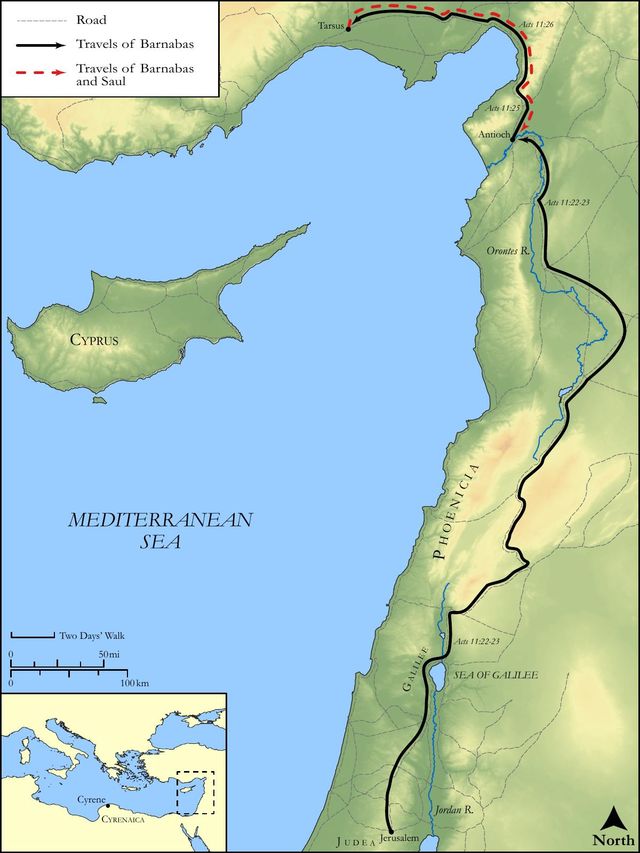
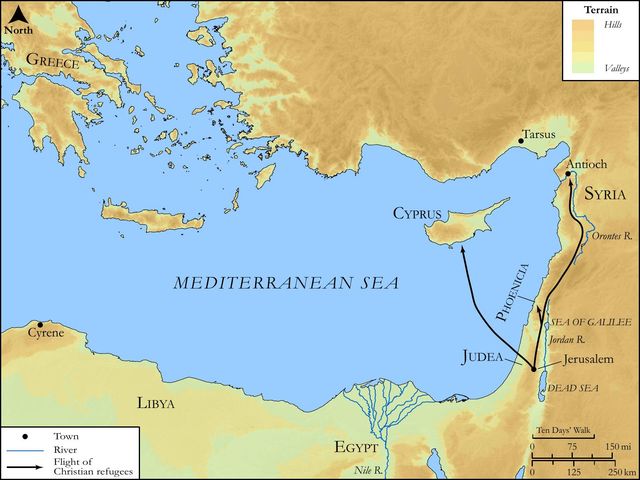
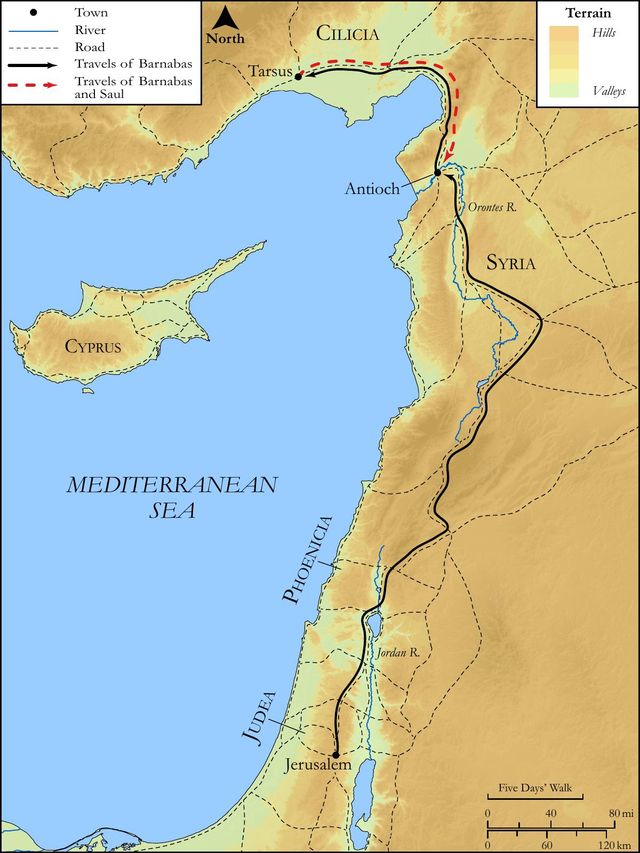
Study this verse
Public-domain commentary
Matthew Henry
From his Commentary on the Whole Bible. Henry comments on passages, not single verses — this entry covers Acts 11:19–26. His four-level outline is real structure in the source text, so it is rendered as structure.
We have here an account of the planting and watering of a church at Antioch, the chief city of Syria, reckoned afterwards the third most considerable city of the empire, only Rome and Alexandria being preferred before it, next to whose patriarch that of Antioch took place. It stood where Hamath or Riblah did, which we read of in the Old Testament. It is suggested that Luke, the penman of this history, as well as Theophilus, to whom he dedicates it, was of Antioch, which may be the reason why he takes more particular notice of the success of the gospel at Antioch, as also because there it was that Paul began to be famous, towards the story of whom he is hastening. Now concerning the church at Antioch observe,
I.The first preachers of the gospel there were such as were dispersed from Jerusalem by persecution, that persecution which arose five or six years ago (as some compute), at the time of Stephen's death (Act 11:19): They travelled as far as Phenice and other places preaching the word. God suffered them to be persecuted, that thereby they might be dispersed in the world, sown as seed to God, in order to their bringing forth much fruit. Thus what was intended for the hurt of the church was made to work for its good; as Jacob's curse of the tribe of Levi (I will divide them in Jacob, and scatter them in Israel) was turned into a blessing. The enemies designed to scatter and lose them, Christ designed to scatter and use them. Thus the wrath of man is made to praise God. Observe,
1.Those that fled from persecution did not flee from their work; though for the time they declined suffering, yet they did not decline service; nay, they threw themselves into a larger field of opportunity than before. Those that persecuted the preachers of the gospel hoped thereby to prevent their carrying it to the Gentile world; but it proved that they did but hasten it the sooner. Howbeit, they meant not so, neither did their heart think so. Those that were persecuted in one city fled to another; but they carried their religion along with them, not only that they might take the comfort of it themselves, but that they might communicate it to others, thus showing that when they got out of the way it was not because they were afraid of suffering, but because they were willing to reserve themselves for further service.
2.They pressed forward in their work, finding that the good pleasure of the Lord prospered in their hands. When they had preached successfully in Judea, Samaria, and Galilee, they got out of the borders of the land of Canaan, and travelled into Phoenicia, into the island of Cyprus, and into Syria. Though the further they travelled the more they exposed themselves, yet they travelled on; plus ultra-further still, was their motto; grudging no pains, and dreading no perils, in carrying on so good a work, and serving so good a Master.
3.They preached the word to none but to the Jews only who were dispersed in all those parts, and had synagogues of their own, in which they met with them by themselves, and preached to them. They did not yet understand that the Gentiles were to be fellow-heirs, and of the same body; but left the Gentiles either to turn Jews, and so come into the church, or else remain as they were.
4.They particularly applied themselves to the Hellenist Jews, here called the Grecians, that were at Antioch. Many of the preachers were natives of Judea and Jerusalem; but some of them were by birth of Cyprus and Cyrene, as Barnabas himself (Act 4:36), and Simon (Mar 15:21), but had their education in Jerusalem; and these, being themselves Grecian Jews, had a particular concern for those of their own denomination and distinction, and applied themselves closely to them at Antioch. Dr. Lightfoot says that they were there called Hellenists, or Grecians, because they were Jews of the corporation or enfranchisement of the city; for Antioch was a Syrogrecian city. To them they preached the Lord Jesus. This was the constant subject of their preaching; what else should the ministers of Christ preach, but Christ - Christ, and him crucified - Christ, and him glorified?
5.They had wonderful success in their preaching, Act 11:21.
(1.)Their preaching was accompanied with a divine power: The hand of the Lord was with them, which some understand of the power they were endued with to work miracles for the confirming of their doctrine; in these the Lord was working with them, for he confirmed the word with signs following (Mar 16:20); in these God bore them witness, Heb 2:4. But I rather under-stand it of the power of divine grace working on the hearts of the hearers, and opening them, as Lydia's heart was opened, because many saw the miracles who were not converted; but when by the Spirit the understanding was enlightened, and the will bowed to the gospel of Christ, that was a day of power, in which volunteers were enlisted under the banner of the Lord Jesus, Psa 110:3. The hand of the Lord was with them, to bring that home to the hearts and consciences of men which they could but speak to the outward ear. Then the word of the Lord gains its end, when the hand of the Lord goes along with it, to write it in their heart. Then people are brought to believe the report of the gospel, when with it the arm of the Lord is revealed (Isa 53:1), when God teaches with a strong hand, Isa 8:11. These were not apostles, but ordinary ministers, yet they had the hand of the Lord with them, and did wonders.
(2.)Abundance of good was done: A great number believed, and turned unto the Lord - many more than could have been expected, considering the outward disadvantages they laboured under: some of all sorts of people were wrought upon, and brought into obedience to Christ. Observe, What the change was.
[1.]They believed; they were convinced of the truth of the gospel, and subscribed to the record God had given in it concerning his Son.
[2.]The effect and evidence of this was that they turned unto the Lord. They could not be said to turn from the service of idols, for they were Jews, worshippers of the true God only; but they turned from a confidence in the righteousness of the law, to rely only upon the righteousness of Christ, the righteousness which is by faith; they turned from a loose, careless, carnal way of living, to live a holy, heavenly, spiritual, and divine life; they turned from worshipping God in show and ceremony, to worship him in spirit and in truth. They turned to the Lord Jesus, and he became all in all with them. This was the work of conversion wrought upon them, and it must be wrought upon every one of us. It was the fruit of their faith. All that sincerely believe will turn to the Lord; for, whatever we profess or pretend, we do not really believe the gospel if we do not cordially embrace Christ offered to us in the gospel.
II.The good work thus begun at Antioch was carried on to great perfection; and the church, thus founded, grew to be a flourishing one, by the ministry of Barnabas and Saul, who built upon the foundation which the other preachers had laid, and entered into their labours, Joh 4:37, Joh 4:38.
1.The church at Jerusalem sent Barnabas thither, to nurse this new-born church, and to strengthen the hands both of preachers and people, and put a reputation upon the cause of Christ there.
(1.)They heard the good news, that the gospel was received at Antioch, Act 11:22. The apostles there were inquisitive how the work went on in the countries about; and, it is likely, kept up a correspondence with all parts where preachers were, so that tidings of these things, of the great numbers that were converted at Antioch, soon came to the ears of the church that was in Jerusalem. Those that are in the most eminent stations in the church ought to concern themselves for those in a lower sphere.
(2.)They despatched Barnabas to them with all speed; they desired him to go, and assist and encourage these hopeful beginnings. They sent him forth as an envoy from them, and a representative of their whole body, to congratulate them upon the success of the gospel among them, as matter of rejoicing both to preachers and hearers, and with both they rejoiced. He must go as far as Antioch. It was a great way, but, far as it was, he was willing to undertake the journey for a public service. It is probable that Barnabas had a particular genius for work of this kind, was active and conversable, loved to be in motion, and delighted in doing good abroad as much as others in doing good at home, was as much of Zebulun's spirit, who rejoiced in his going out, as others are of Issachar's, who rejoiced in his tent; and, his talent lying this way, he was fittest to be employed in this work. God gives various gifts for various services.
(3.)Barnabas was wonderfully pleased to find that the gospel got ground, and that some of his countrymen, men of Cyprus (of which country he was, Act 4:36) were instrumental in it (Act 11:23): When he came, and had seen the grace of God, the tokens of God's good-will to the people of Antioch and the evidences of his good work among them, he was glad. He took time to make his observations, and not only in their public worship, but in their common conversations and in their families, he saw the grace of God among them. Where the grace of God is it will be seen, as the tree is known by its fruits; and, where it is seen, it ought to be owned. What we see which is good in any we must call God's grace in them, and give that grace the glory of it; and we ought ourselves to take the comfort of it, and make it the matter of our rejoicing. We must be glad to see the grace of God in others, and the more when we see it where we did not expect it.
(4.)He did what he could to fix them, to confirm those in the faith who were converted to the faith. He exhorted them - parekalei. It is the same word with that by which the name of Barnabas is interpreted (Act 4:36), huios paraklēseōs - a son of exhortation; his talent lay that way, and he traded with it; let him that exhorteth attend to exhortation, Rom 12:8. Or, being a son of consolation (for so we render the word), he comforted or encouraged them with purpose of heart to cleave to the Lord. The more he rejoiced in the beginning of the good work among them, the more earnest he was with them to proceed according to these good beginnings. Those we have comfort in we should exhort. Barnabas was glad for what he saw of the grace of God among them, and therefore was the more earnest with them to persevere.
[1.]To cleave to the Lord. Note, Those that have turned to the Lord are concerned to cleave unto the Lord, not to fall off from following him, not to flag and tire in following him. To cleave to the Lord Jesus is to live a life of dependence upon him and devotedness to him: not only to hold him fast, but to hold fast by him, to be strong in the Lord and in the power of his might.
[2.]To cleave to him with purpose of heart, with an intelligent, firm, and deliberate resolution, founded upon good grounds, and fixed upon that foundation, Psa 108:1. It is to bind our souls with a bond to be the Lord's, and to say as Ruth, Entreat me not to leave him, or to return from following after him.
(5.)Herein he gave a proof of his good character (Act 11:24): He was a good man, and full of the Holy Ghost, and of faith, and approved himself so upon this occasion.
[1.]He showed himself to be a man of a very sweet, affable, courteous disposition, that had himself the art of obliging, and could teach others. He was not only a righteous man, but a good man, a good-tempered man. Ministers that are so recommend themselves and their doctrine very much to the good opinion of those that are without. He was a good man, that is, a charitable man; so he had approved himself, when he sold an estate, and gave the money to the poor, Act 4:37.
[2.]By this it appeared that he was richly endued with the gifts and graces of the Spirit. The goodness of his natural disposition would not have qualified him for this service if he had not been full of the Holy Ghost, and so full of power by the Spirit of the Lord.
[3.]He was full of faith, full of the Christian faith himself, and therefore desirous to propagate it among others; full of the grace of faith, and full of the fruits of that faith that works by love. He was sound in the faith, and therefore pressed them to be so.
(6.)He was instrumental to do good, by bringing in those that were without, as well as by building up those that were within: Much people were added to the Lord, and thereby added to the church; many were turned to the Lord before, yet more are to be turned; it is done as thou hast commanded, and yet there is room.
2.Barnabas went to fetch Saul, to join with him in the work of the gospel at Antioch. The last news we heard of him was that, when his life was sought at Jerusalem, he was sent away to Tarsus, the city where he was born, and, it should seem, he continued there ever since, doing good, no doubt. But now Barnabas takes a journey to Tarsus on purpose to see what had become of him, to tell him what a door of opportunity was opened at Antioch, and to desire him to come and spend some time with him there, Act 11:25, Act 11:26. And here also it appears that Barnabas was a good sort of a man in two things - (1.) That he would take so much pains to bring an active useful man out of obscurity. It was he that introduced Saul to the disciples at Jerusalem, when they were shy of him; and it was he that brought him out of the corner into which he was driven, into a more public station. It is a very good work to fetch a candle from under a bushel, and to set it in a candlestick. (2.) That he would bring in Saul at Antioch, who, being a chief speaker (Act 14:12), and probably a more popular preacher, would be likely to eclipse him there, by outshining him; but Barnabas is very willing to be eclipsed when it is for the public service. If God by his grace inclines us to do what good we can, according to the ability we have, we ought to rejoice if others that have also larger capacities have larger opportunities, and do more good than we can do. Barnabas brought Saul to Antioch, though it might be the lessening of himself, to teach us to seek the things of Christ more than our own things.
3.We are here further told,
(1.)What service was now done to the church at Antioch. Paul and Barnabas continued there a whole year, presiding in their religious assemblies, and preaching the gospel, Act 11:26. Observe,
[1.]The church frequently assembled. The religious assemblies of Christians are appointed by Christ for his honour, and the comfort and benefit of his disciples. God's people of old frequently came together, at the door of the tabernacle of the congregation; places of meeting are now multiplied, but they must come together, though it be with difficulty and peril.
[2.]Ministers were the masters of those assemblies, and held those courts in Christ's name to which all that hold by, fRom. and under him, owe suit and service.
[3.]Teaching the people is one part of the work of ministers, when they preside in religious assemblies. They are not only to be the people's mouth to God in prayer and praise, but God's mouth to the people in opening the scriptures, and teaching out of them the good knowledge of the Lord.
[4.]It is a great encouragement to ministers when they have opportunity of teaching much people, of casting the net of the gospel where there is a large shoal of fish, in hopes that the more may be enclosed.
[5.]Preaching is not only for the conviction and conversion of those that are without, but for the instruction and edification of those that are within. A constituted church must have its teachers.
(2.)What honour was now put upon the church at Antioch: There the disciples were first called Christians; it is probable they called themselves so, incorporated themselves by that title, whether by some solemn act of the church or ministers, or whether this name insensibly obtained there by its being frequently used in their praying and preaching, we are not told; but it should seem that two such great men as Paul and Barnabas continuing there so long, being exceedingly followed, and meeting with no opposition, Christian assemblies made a greater figure there than any where, and became more considerable, which was the reason of their being called Christians first there, which, if there were to be a mother-church to rule over all other churches, would give Antioch a better title to the honour than Rome can pretend to. Hitherto those who gave up their names to Christ were called disciples, learners, scholars, trained up under him, in order to their being employed by him; but henceforward they were called Christians.
[1.]Thus the reproachful names which their enemies had hitherto branded them with would, perhaps, be superseded and disused. They called them Nazarenes (Act 24:5), the men of that way, that by-way, which had no name; and thus they prejudiced people against them. To remove the prejudice, they gave themselves a name which their enemies could not but say was proper.
[2.]Thus those who before their conversion had been distinguished by the names of Jews and Gentiles might after their conversion be called by one and the same name, which would help them to forget their former dividing names, and prevent their bringing their former marks of distinction, and with them the seeds of contention, into the church. Let not one say, "I was a Jew;" nor the other, "I was a Gentile;" when both the one and the other must now say, "I am a Christian." [3.] Thus they studied to do honour to their Master, and showed that they were not ashamed to own their relation to him, but gloried in it; as the scholars of Plato called themselves Platonists, and so the scholars of other great men. They took their denomination not from the name of his person, Jesus, but of his office, Christ - anointed, so putting their creed into their names, that Jesus is the Christ; and they were willing all the world should know that this is the truth they will live and die by. Their enemies will turn this name to their reproach, and impute it to them as their crime, but they will glory in it: If this be to be vile, I will be yet more vile. [4.] Thus they now owned their dependence upon Christ, and their receivings from him; not only that they believed in him who is the anointed, but that through him they themselves had the anointing, Jo1 2:20, Jo1 2:27. And God is said to have anointed us in Christ, Co2 1:21. [5.] Thus they laid upon themselves, and all that should ever profess that name, a strong and lasting obligation to submit to the laws of Christ, to follow the example of Christ, and to devote themselves entirely to the honour of Christ - to be to him for a name and a praise. Are we Christians? Then we ought to think, and speak, and act, in every thing as becomes Christians, and to do nothing to the reproach of that worthy name by which we are called; that that may not be said to us which Alexander said to a soldier of his own name that was noted for a coward, Aut nomen, aut mores muta - Either change thy name or mend thy manners. And as we must look upon ourselves as Christians, and carry ourselves accordingly, so we must look upon others as Christians, and carry ourselves towards them accordingly. A Christian, though not in every thing of our mind, should be loved and respected for his sake whose name he bears, because he belongs to Christ. [6.] Thus the scripture was fulfilled, for so it was written (Isa 62:2) concerning the gospel-church, Thou shalt be called by a new name, which the mouth of the Lord shall name. And it is said to the corrupt and degenerate church of the Jews, The Lord God shall slay thee, and call his servants by another name, Isa 65:15.
Historical interpretation
Three Centuries of Reception
7 surviving comments on this verse. Each one is dated, so this reads as a timeline rather than a list.
Select a marker to jump to its quote. Markers stagger vertically where authors wrote within a few decades of each other.
And the tribe of Christians, so named from him [Jesus], are not extinct at this day.
Let us therefore prove ourselves worthy of that name which we have received. For whosoever is called by any other name besides this, he is not of God; for he has not received the prophecy which speaks thus concerning us: "The people shall be called by a new name, which the Lord shall name them, and shall be a holy people." This was first fulfilled in Syria; for "the disciples were called Christians at Antioch," when Paul and Peter were laying the foundations of the Church.
Since, then, my friend, you have assailed me with empty words, boasting of your gods of wood and stone, hammered and cast, carved and graven, which neither see nor hear, for they are idols, and the works of men's hands; and since, besides, you call me a Christian, as if this were a damning name to bear, I, for my part, avow that I am a Christian,
Our good Master, Jesus Christ, bestowed on us a partnership in his revered name, so that we get our name from no other person connected with us, and if one happens to be rich and well-born or of lowly origin and poor, or if one has some distinction from his business or position, all such conditions are of no avail because the one authoritative name for those believing in him is that of Christian. Now, since this grace was ordained for us from above, it is necessary, first of all, for us to understand the greatness of the gift so that we can worthily thank the God who has given it to us. Then, it is necessary to show through our life that we ourselves are what the power of this great name requires us to be. The greatness of the gift of which we are deemed worthy through the partnership with the Master becomes clear to us if we recognize the true significance of the name of Christ, so that, when in our prayers we call upon the Lord of all by this name, we may comprehend the concept that we are taking into our soul.… Paul, most of all, knew what Christ is, and he indicated, by what he did, the kind of person named for him, imitating him so brilliantly that he revealed his own Master in himself, his own soul being transformed through his accurate imitation of his prototype, so that Paul no longer seemed to be living and speaking, but Christ himself seemed to be living in him. As this astute perceiver of particular goods says, “Do you seek a proof of the Christ who speaks in me?” and, “It is now no longer I that live but Christ lives in me." This man knew the significance of the name of Christ for us, saying that Christ is the “power of God and the wisdom of God.” And he called him “peace,” and “light inaccessible” in whom God dwells, and “sanctification and redemption,” and “great high priest,” and “passover,” and “a propitiation” of souls, “the brightness of glory and image of substance,” and “maker of the world,” and “spiritual food,” and “spiritual drink and spiritual rock,” “water,” “foundation” of faith, and “cornerstone,” and “image of the invisible God,” and “great God,” and “head of the body of the church,” and “the firstborn of every creature,” “firstfruits of those who have fallen asleep,” “firstborn from the dead,” “firstborn among many brothers,” and “mediator between God and humanity,” and “only begotten Son,” and “crowned with glory and honor,” and “lord of glory” and “beginning” of being, speaking thus of him who is the beginning, “king of justice and king of peace,” and “ineffable king of all, having the power of the kingdom,” and many other such things that are not easily enumerated. When all of these phrases are put next to each other, each one of the terms makes its own contribution to a revelation of what is signified by being named after Christ, and each provides for us a certain emphasis. To the extent that we take these concepts into our souls, they are all indications of the unspeakable greatness of the gift for us. However, since the rank of kingship underlies all worth and power and rule, by this title the royal power of Christ is authoritatively and primarily indicated (for the anointing of kingship, as we learn in the historical books, comes first), and all the force of the other titles depends on that of royalty. For this reason, the person who knows the separate elements included under it also knows the power encompassing these elements. But it is the kingship itself that declares what the title of Christ means.
Therefore, since, thanks to our good Master, we are sharers of the greatest and the most divine and the first of names, those honored by the name of Christ being called Christians, it is necessary that there be seen in us also all of the connotations of this name, so that the title be not a misnomer in our case but that our life be a testimony of it. Being something does not result from being called something. The underlying nature, whatever it happens to be, is discovered through the meaning attached to the name.
"And when he had found him, he brought him to Antioch." Verily this is the reason why it was there they were appointed to be called Christians, because Paul there spent so long time! "And it came to pass, that a whole year they assembled themselves with the Church, and taught much people. And the disciples were first called Christians at Antioch." No small matter of praise to that city! This is enough to make it a match for all, that for so long a time it had the benefit of that mouth, it first, and before all others: wherefore also it was there in the first place that men were accounted worthy of that name.
Do you observe the benefit resulting to that city from Paul, to what a height that name, like a standard, exalted it? Where three thousand, where five thousand, believed, where so great a multitude, nothing of the sort took place, but they were called "they of the way:" here they were called Christians.
Paul also preaches, and is no longer compelled to flee. And it is well ordered, that not they speak of the famine, but the prophets. The men of Antioch also did not take it amiss that they sent not the Apostles, but were content with their teachers: so fervent were they all for the word.
Continue studying Acts 11:26 across the web’s major study libraries — every link below opens this exact verse, chapter, or book on the destination site.
Read & Compare
 BibleGatewayThis verse in more than 200 translations and 70 languages.
 Bible.comThe YouVersion reader — hundreds of translations, reading plans, and highlights.
 ESV.orgCrossway's official English Standard Version reader.
 NET BibleThe NET translation with 60,000+ translators' notes on every rendering decision.
 STEP BibleTyndale House's free study tool — original text, vocabulary, and scholarly resources.
 BibliaLogos Bible Software's free web reader.
 USCCBThe New American Bible (Revised Edition) with the U.S. bishops' study notes.
Commentaries
 BibleHub CommentariesDozens of classic commentaries on this verse, gathered on one page.
 StudyLightMore than 100 commentary sets — the largest collection on the web.
 BibleRefPlain-English commentary on what this verse means, verse by verse.
 Enduring WordDavid Guzik's free commentary on this chapter, widely used by Bible teachers.
 Bible Study ToolsVerse commentary alongside Greek and Hebrew study aids.
Original Language & Research
- BibleHub InterlinearThe verse word by word — original language, transliteration, and English.
- BibleHub LexiconEvery word's original-language definition and Strong's entry.
 Blue Letter BibleDeep-study tools — Strong's numbers, concordance, and word studies.
 CNTR CollationThe earliest Greek manuscripts of this verse, collated letter by letter.
Sermons, Hymns & Audio


TrulyRandomVerse is not affiliated with these sites and doesn’t control their content. They’re linked because they’re genuinely useful.
Summary
Acts 11:26 chronicles a pivotal moment in the early church's expansion, detailing the year-long ministry of Barnabas and Saul (Paul) in Antioch, a vibrant Hellenistic city. Their dedicated teaching ministry led to significant growth among the diverse congregation, culminating in the disciples being identified for the first time as "Christians," a designation that would become the enduring hallmark of followers of Jesus Christ. This verse marks the formal recognition of a distinct, Christ-centered identity for believers, solidifying Antioch's role as a vital hub for the nascent global church.
Context
ShowHideLiterary Context
This verse is situated within a broader narrative in Acts that highlights the gospel's spread beyond its Jewish origins. Following the persecution that arose after Stephen's martyrdom, believers were scattered, leading some to preach the Word to Gentiles in Antioch, resulting in a great number believing and turning to the Lord (Acts 11:19-21). The Jerusalem church, upon hearing of these developments, sent Barnabas to Antioch. Barnabas, a man "full of the Holy Ghost and of faith," rejoiced at the grace of God he witnessed and exhorted the new believers to remain faithful (Acts 11:22-24). Recognizing the immense potential and the need for robust teaching in this rapidly growing, diverse community, Barnabas then sought out Saul in Tarsus (Acts 11:25). Acts 11:26 then describes the fruitful collaboration of these two key figures, setting the stage for Antioch to become the launching point for Paul's missionary journeys.
Historical & Cultural Context
Antioch in Syria was one of the largest and most influential cities in the Roman Empire, a bustling metropolis known for its diverse population, including significant Jewish and Greek communities. Its strategic location made it a crossroads of cultures and ideas, an ideal environment for the gospel to take root and spread. Unlike Jerusalem, which remained largely Jewish in its Christian composition, Antioch became a vibrant center for Gentile Christianity. The term "Christian" itself, first coined here, likely emerged from the multicultural environment of Antioch. It was probably a nickname given by outsiders—perhaps Roman officials or local pagans—to distinguish this new group from Jews, who were granted certain religious exemptions, and from other philosophical or religious sects. The suffix "-ianus" was Latin, commonly used to denote followers or adherents of a particular person or party (e.g., "Caesariani" for followers of Caesar). Thus, "Christianoi" would have meant "those of Christ" or "Christ's party."
Key Themes
ShowHideActs 11:26 contributes significantly to several overarching themes in the book of Acts. Firstly, it underscores the universal expansion of the gospel, demonstrating how God's saving grace transcends ethnic and cultural boundaries, reaching Gentiles in a major urban center. Secondly, it highlights the critical importance of teaching and discipleship in nurturing new believers. The year-long, dedicated instruction by Barnabas and Saul was foundational for the Antiochian church's maturity and stability, echoing the Great Commission's call to "teach them to observe all things" (Matthew 28:19-20). Thirdly, the verse emphasizes the power of collaborative ministry, as the combined gifts and efforts of Barnabas and Saul proved immensely effective. Finally, and most notably, it introduces the distinct identity of "Christian," marking a significant step in the self-understanding and public perception of Jesus's followers. This new name solidified their allegiance to Christ as distinct from Judaism or paganism, paving the way for a unique Christian identity that would spread globally, as seen in the subsequent missionary endeavors launched from Antioch (Acts 13:1-3).
Exposition and Analysis
ShowHideKey Word Analysis
ShowHideThis word means "to lead together, i.e., collect or convene." In this context, it signifies the regular, purposeful gathering of believers. It emphasizes the communal aspect of the early church, where disciples came together consistently for fellowship, instruction, and worship. This was not a casual meeting but a deliberate assembly, highlighting the importance of corporate gathering for the growth and cohesion of the church.
Derived from a verb meaning "to learn," didáskō means "to teach" in a broad application. It points to the systematic and authoritative instruction provided by Barnabas and Saul. This was not merely sharing stories but imparting theological truths, ethical principles, and the teachings of Jesus. The emphasis on "much people" and a "whole year" highlights the extensive and comprehensive nature of their teaching ministry, foundational for building a robust faith community.
The verb chrēmatízō means "to utter an oracle, to divinely intimate," or, in a secular sense, "to bear as a title." Here, it signifies that the disciples received or were given the name "Christians." While it could imply a divine origin for the name, it more commonly suggests a public designation, perhaps given by outsiders. Christianós (Christian) is derived from Christos (Christ) with the Latin suffix "-ianus," meaning "belonging to the party of" or "followers of." Thus, "called Christians" means they were identified as "Christ-followers" or "those belonging to Christ," marking a distinct identity for believers.
Verse Breakdown
ShowHide"And when he had found him, he brought him unto Antioch."
This clause describes Barnabas's initiative in seeking out Saul in Tarsus and bringing him back to Antioch. It underscores Barnabas's discernment, recognizing Saul's unique gifts and the pressing need for gifted teachers in the burgeoning Antiochian church. This act of partnership was crucial for the future ministry.
"And it came to pass, that a whole year they assembled themselves with the church, and taught much people."
This section details the dedicated and sustained ministry of Barnabas and Saul. For an entire year, they consistently gathered with the believers (the "church," ekklēsía, meaning a "calling out" or "assembly") and engaged in extensive teaching. The phrase "much people" indicates the significant number of individuals who were discipled, highlighting the effectiveness and impact of their combined efforts in nurturing the rapidly growing community.
"And the disciples were called Christians first in Antioch."
This is the climactic statement of the verse, marking a momentous event. It records the initial public designation of followers of Jesus as "Christians." This name, likely given by outsiders, served to distinguish them from both Jews and pagans, solidifying their unique identity and allegiance to Christ. The fact that it happened "first in Antioch" underscores the city's pioneering role as a multicultural center for the expanding Christian movement.
Literary Devices
ShowHideActs 11:26 employs several significant literary devices. The most prominent is Naming, specifically the coining of the term "Christian." This act of naming is not merely descriptive but Definitive, marking a crucial shift in identity for the followers of Jesus. Prior to this, they were known as "disciples," "those of the Way," or "Nazarenes." The new name "Christian" provided a distinct, universally recognizable label, signifying their unique allegiance to Christ. The narrative also uses Emphasis through the repetition of "Antioch," highlighting its geographical and theological significance as the birthplace of this new identity. Furthermore, the phrase "a whole year" serves as Hyperbole or Emphasis on Duration, underscoring the sustained and intensive nature of the teaching ministry, which contributed to the community's maturity and the eventual recognition of their distinct identity. The verse functions as a Transitional Statement, bridging the early, Jerusalem-centric phase of the church with its burgeoning Gentile mission, soon to be launched from Antioch.
Theological and Thematic Connections
ShowHideActs 11:26 offers profound theological insights into the nature of the church and Christian identity. The emergence of the name "Christian" signifies the maturation of a distinct faith community, no longer merely a sect of Judaism, but a new people united by their allegiance to Jesus Christ. This identity is rooted in Christ's person and work, emphasizing that to be a "Christian" is to belong to Christ, to be His follower, and to bear His name. The verse also highlights the divine orchestration of events, bringing together Barnabas and Saul to establish a robust teaching ministry, underscoring God's commitment to equipping His church for growth and mission. The communal gathering ("assembled themselves with the church") and the systematic teaching ("taught much people") reveal the essential components of a healthy, growing church—fellowship grounded in sound doctrine.
Reflection and Application
ShowHideActs 11:26 serves as a powerful reminder of our identity in Christ and the vital role of community and teaching in our spiritual formation. To be called a "Christian" is not merely a religious label but a declaration of allegiance to Jesus as Lord and Savior. It implies a lifestyle that reflects His character, teachings, and mission in the world. Just as the Antiochian believers were nurtured through a year of dedicated teaching, we too are called to be lifelong learners, continually immersing ourselves in God's Word and seeking sound biblical instruction. This commitment to discipleship strengthens our faith, equips us for service, and enables us to live out our Christian identity authentically. Furthermore, the collaborative spirit between Barnabas and Saul underscores the importance of partnership in ministry, reminding us that God often uses diverse gifts working together to build His kingdom. Finally, the pioneering spirit of Antioch, a hub for Gentile missions, challenges us to embrace the global scope of the gospel, actively participating in or supporting efforts to share Christ with all peoples, transcending cultural and ethnic barriers.
Questions for Reflection
ShowHideFAQ
ShowHideWhy was the name "Christian" first used in Antioch, and what was its original connotation?
ShowHideThe name "Christian" was first used in Antioch because it was a highly diverse, cosmopolitan city with a significant Gentile population. As the gospel spread beyond its Jewish origins, the growing community of believers in Antioch, composed of both Jews and Gentiles, needed a distinct identifier. The term "Christianoi" (Christians) was likely coined by outsiders, possibly Roman officials or the general populace, to distinguish these followers of Christ from the Jewish community and other religious groups. The Latin suffix "-ianus" meant "belonging to the party of" or "followers of," so "Christian" literally meant "Christ's people" or "those belonging to Christ." While it may have initially been used as a derogatory or mocking nickname, it was soon embraced by believers as a badge of honor, signifying their unwavering allegiance to Jesus as the Messiah and Lord. This new name underscored their unique identity, separate from both Judaism and paganism, and became the universal designation for followers of Christ. The events in Antioch, including the teaching ministry of Barnabas and Saul, solidified this distinct identity, making it a crucial center for the expansion of the early church into the Gentile world, as seen in Acts 13:1-3.
Christ-Centered Fulfillment
ShowHideActs 11:26, though a historical account of the early church, finds its deepest fulfillment in the person and work of Jesus Christ. The very name "Christian" points directly to Him, signifying that our identity is not based on ethnicity, social status, or human achievement, but solely on our relationship with the Anointed One, the Messiah. Jesus himself established the church through His redemptive work on the cross and His resurrection, gathering a people for Himself from every tribe and nation (Revelation 5:9). The teaching ministry of Barnabas and Saul, which nurtured the Antiochian believers, reflects Christ's own Great Commission to "make disciples of all nations, teaching them to observe all things whatsoever I have commanded you" (Matthew 28:19-20). He is the ultimate Teacher, and His words are the foundation of all sound doctrine (John 14:26). Furthermore, the communal gathering of the church in Antioch foreshadows the ultimate unity of believers in Christ, who is the head of His body, the church (Ephesians 1:22-23). To be called a "Christian" is to be identified with Christ's suffering, death, and resurrection, sharing in His new life and participating in His ongoing mission to reconcile the world to God (2 Corinthians 5:17-20). Thus, Acts 11:26 is not just a historical footnote but a powerful testament to the transformative power of Christ, who creates a new people, united in His name, and empowered by His Spirit to spread His gospel to the ends of the earth.