


Acts 11:25
Bible text: King James Version (1769 Blayney text) · Public domain
Bible text: Berean Standard Bible · Public domain
Bible text: American Standard Version (1901) · Public domain
Bible text: World English Bible, Messianic edition · Public domain
Bible text: Geneva Bible (1599) · Public domain
Bible text: Young's Literal Translation · Public domain
- ἐξῆλθενexēlthenHe went forthG1831V-2AAI-3SVerb 2nd Aorist Active Indicative 3rd Singular
- δὲdethenG1161CONJConjunction
- εἰςeistoG1519PREPPreposition
- ΤαρσὸνTarsonTarsusG5019N-ASF-LNoun Accusative Singular Feminine Location
- ὁho<the>G3588T-NSMDefinite article Nominative Singular Masculine
- ΒαρνάβαςBarnabasBarnabasG921N-NSM-PNoun Nominative Singular Masculine Individual
- ἀναζητῆσαιanazētēsaito seekG327V-AANVerb Aorist Active Infinitive
- ΣαῦλονSaulonSaulG4569N-ASM-PNoun Accusative Singular Masculine Individual
English is a literal word-by-word gloss of the Greek, not the KJV's wording. Why?
This is the original text the KJV's translators worked from — each Greek word with its own literal English meaning in this verse, prepared by scholars at Tyndale House, Cambridge. The KJV translates whole sentences, not word by word, so its wording differs: one Greek word can become several English words, and the KJV may choose “charity” where the gloss reads “love”. Both are faithful — they answer different questions. For the KJV's own rendering, switch to the KJV text.
Details
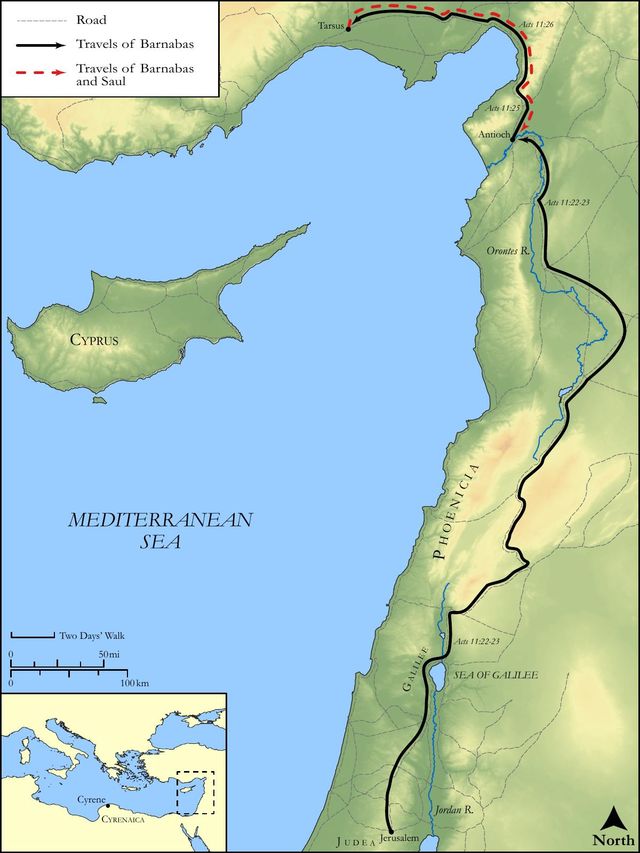
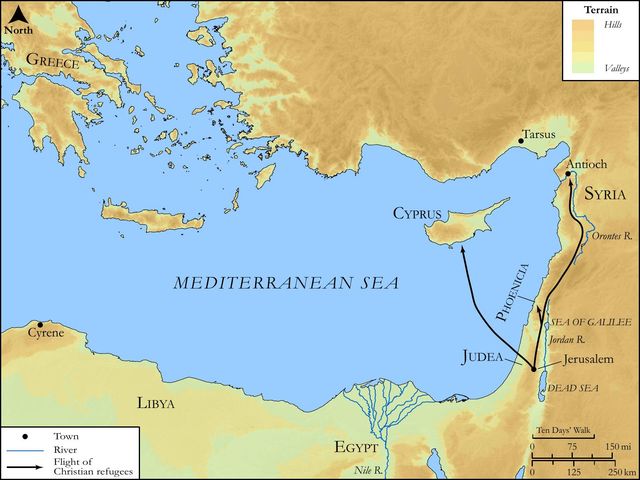
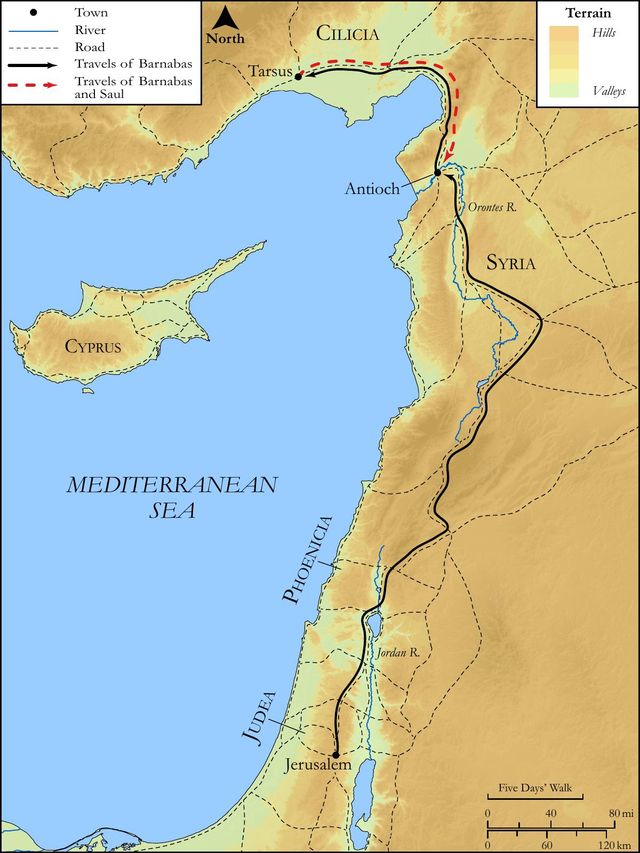
See on the biblical-era maps
Study this verse
Public-domain commentary
Matthew Henry
From his Commentary on the Whole Bible. Henry comments on passages, not single verses — this entry covers Acts 11:19–26. His four-level outline is real structure in the source text, so it is rendered as structure.
We have here an account of the planting and watering of a church at Antioch, the chief city of Syria, reckoned afterwards the third most considerable city of the empire, only Rome and Alexandria being preferred before it, next to whose patriarch that of Antioch took place. It stood where Hamath or Riblah did, which we read of in the Old Testament. It is suggested that Luke, the penman of this history, as well as Theophilus, to whom he dedicates it, was of Antioch, which may be the reason why he takes more particular notice of the success of the gospel at Antioch, as also because there it was that Paul began to be famous, towards the story of whom he is hastening. Now concerning the church at Antioch observe,
I.The first preachers of the gospel there were such as were dispersed from Jerusalem by persecution, that persecution which arose five or six years ago (as some compute), at the time of Stephen's death (Act 11:19): They travelled as far as Phenice and other places preaching the word. God suffered them to be persecuted, that thereby they might be dispersed in the world, sown as seed to God, in order to their bringing forth much fruit. Thus what was intended for the hurt of the church was made to work for its good; as Jacob's curse of the tribe of Levi (I will divide them in Jacob, and scatter them in Israel) was turned into a blessing. The enemies designed to scatter and lose them, Christ designed to scatter and use them. Thus the wrath of man is made to praise God. Observe,
1.Those that fled from persecution did not flee from their work; though for the time they declined suffering, yet they did not decline service; nay, they threw themselves into a larger field of opportunity than before. Those that persecuted the preachers of the gospel hoped thereby to prevent their carrying it to the Gentile world; but it proved that they did but hasten it the sooner. Howbeit, they meant not so, neither did their heart think so. Those that were persecuted in one city fled to another; but they carried their religion along with them, not only that they might take the comfort of it themselves, but that they might communicate it to others, thus showing that when they got out of the way it was not because they were afraid of suffering, but because they were willing to reserve themselves for further service.
2.They pressed forward in their work, finding that the good pleasure of the Lord prospered in their hands. When they had preached successfully in Judea, Samaria, and Galilee, they got out of the borders of the land of Canaan, and travelled into Phoenicia, into the island of Cyprus, and into Syria. Though the further they travelled the more they exposed themselves, yet they travelled on; plus ultra-further still, was their motto; grudging no pains, and dreading no perils, in carrying on so good a work, and serving so good a Master.
3.They preached the word to none but to the Jews only who were dispersed in all those parts, and had synagogues of their own, in which they met with them by themselves, and preached to them. They did not yet understand that the Gentiles were to be fellow-heirs, and of the same body; but left the Gentiles either to turn Jews, and so come into the church, or else remain as they were.
4.They particularly applied themselves to the Hellenist Jews, here called the Grecians, that were at Antioch. Many of the preachers were natives of Judea and Jerusalem; but some of them were by birth of Cyprus and Cyrene, as Barnabas himself (Act 4:36), and Simon (Mar 15:21), but had their education in Jerusalem; and these, being themselves Grecian Jews, had a particular concern for those of their own denomination and distinction, and applied themselves closely to them at Antioch. Dr. Lightfoot says that they were there called Hellenists, or Grecians, because they were Jews of the corporation or enfranchisement of the city; for Antioch was a Syrogrecian city. To them they preached the Lord Jesus. This was the constant subject of their preaching; what else should the ministers of Christ preach, but Christ - Christ, and him crucified - Christ, and him glorified?
5.They had wonderful success in their preaching, Act 11:21.
(1.)Their preaching was accompanied with a divine power: The hand of the Lord was with them, which some understand of the power they were endued with to work miracles for the confirming of their doctrine; in these the Lord was working with them, for he confirmed the word with signs following (Mar 16:20); in these God bore them witness, Heb 2:4. But I rather under-stand it of the power of divine grace working on the hearts of the hearers, and opening them, as Lydia's heart was opened, because many saw the miracles who were not converted; but when by the Spirit the understanding was enlightened, and the will bowed to the gospel of Christ, that was a day of power, in which volunteers were enlisted under the banner of the Lord Jesus, Psa 110:3. The hand of the Lord was with them, to bring that home to the hearts and consciences of men which they could but speak to the outward ear. Then the word of the Lord gains its end, when the hand of the Lord goes along with it, to write it in their heart. Then people are brought to believe the report of the gospel, when with it the arm of the Lord is revealed (Isa 53:1), when God teaches with a strong hand, Isa 8:11. These were not apostles, but ordinary ministers, yet they had the hand of the Lord with them, and did wonders.
(2.)Abundance of good was done: A great number believed, and turned unto the Lord - many more than could have been expected, considering the outward disadvantages they laboured under: some of all sorts of people were wrought upon, and brought into obedience to Christ. Observe, What the change was.
[1.]They believed; they were convinced of the truth of the gospel, and subscribed to the record God had given in it concerning his Son.
[2.]The effect and evidence of this was that they turned unto the Lord. They could not be said to turn from the service of idols, for they were Jews, worshippers of the true God only; but they turned from a confidence in the righteousness of the law, to rely only upon the righteousness of Christ, the righteousness which is by faith; they turned from a loose, careless, carnal way of living, to live a holy, heavenly, spiritual, and divine life; they turned from worshipping God in show and ceremony, to worship him in spirit and in truth. They turned to the Lord Jesus, and he became all in all with them. This was the work of conversion wrought upon them, and it must be wrought upon every one of us. It was the fruit of their faith. All that sincerely believe will turn to the Lord; for, whatever we profess or pretend, we do not really believe the gospel if we do not cordially embrace Christ offered to us in the gospel.
II.The good work thus begun at Antioch was carried on to great perfection; and the church, thus founded, grew to be a flourishing one, by the ministry of Barnabas and Saul, who built upon the foundation which the other preachers had laid, and entered into their labours, Joh 4:37, Joh 4:38.
1.The church at Jerusalem sent Barnabas thither, to nurse this new-born church, and to strengthen the hands both of preachers and people, and put a reputation upon the cause of Christ there.
(1.)They heard the good news, that the gospel was received at Antioch, Act 11:22. The apostles there were inquisitive how the work went on in the countries about; and, it is likely, kept up a correspondence with all parts where preachers were, so that tidings of these things, of the great numbers that were converted at Antioch, soon came to the ears of the church that was in Jerusalem. Those that are in the most eminent stations in the church ought to concern themselves for those in a lower sphere.
(2.)They despatched Barnabas to them with all speed; they desired him to go, and assist and encourage these hopeful beginnings. They sent him forth as an envoy from them, and a representative of their whole body, to congratulate them upon the success of the gospel among them, as matter of rejoicing both to preachers and hearers, and with both they rejoiced. He must go as far as Antioch. It was a great way, but, far as it was, he was willing to undertake the journey for a public service. It is probable that Barnabas had a particular genius for work of this kind, was active and conversable, loved to be in motion, and delighted in doing good abroad as much as others in doing good at home, was as much of Zebulun's spirit, who rejoiced in his going out, as others are of Issachar's, who rejoiced in his tent; and, his talent lying this way, he was fittest to be employed in this work. God gives various gifts for various services.
(3.)Barnabas was wonderfully pleased to find that the gospel got ground, and that some of his countrymen, men of Cyprus (of which country he was, Act 4:36) were instrumental in it (Act 11:23): When he came, and had seen the grace of God, the tokens of God's good-will to the people of Antioch and the evidences of his good work among them, he was glad. He took time to make his observations, and not only in their public worship, but in their common conversations and in their families, he saw the grace of God among them. Where the grace of God is it will be seen, as the tree is known by its fruits; and, where it is seen, it ought to be owned. What we see which is good in any we must call God's grace in them, and give that grace the glory of it; and we ought ourselves to take the comfort of it, and make it the matter of our rejoicing. We must be glad to see the grace of God in others, and the more when we see it where we did not expect it.
(4.)He did what he could to fix them, to confirm those in the faith who were converted to the faith. He exhorted them - parekalei. It is the same word with that by which the name of Barnabas is interpreted (Act 4:36), huios paraklēseōs - a son of exhortation; his talent lay that way, and he traded with it; let him that exhorteth attend to exhortation, Rom 12:8. Or, being a son of consolation (for so we render the word), he comforted or encouraged them with purpose of heart to cleave to the Lord. The more he rejoiced in the beginning of the good work among them, the more earnest he was with them to proceed according to these good beginnings. Those we have comfort in we should exhort. Barnabas was glad for what he saw of the grace of God among them, and therefore was the more earnest with them to persevere.
[1.]To cleave to the Lord. Note, Those that have turned to the Lord are concerned to cleave unto the Lord, not to fall off from following him, not to flag and tire in following him. To cleave to the Lord Jesus is to live a life of dependence upon him and devotedness to him: not only to hold him fast, but to hold fast by him, to be strong in the Lord and in the power of his might.
[2.]To cleave to him with purpose of heart, with an intelligent, firm, and deliberate resolution, founded upon good grounds, and fixed upon that foundation, Psa 108:1. It is to bind our souls with a bond to be the Lord's, and to say as Ruth, Entreat me not to leave him, or to return from following after him.
(5.)Herein he gave a proof of his good character (Act 11:24): He was a good man, and full of the Holy Ghost, and of faith, and approved himself so upon this occasion.
[1.]He showed himself to be a man of a very sweet, affable, courteous disposition, that had himself the art of obliging, and could teach others. He was not only a righteous man, but a good man, a good-tempered man. Ministers that are so recommend themselves and their doctrine very much to the good opinion of those that are without. He was a good man, that is, a charitable man; so he had approved himself, when he sold an estate, and gave the money to the poor, Act 4:37.
[2.]By this it appeared that he was richly endued with the gifts and graces of the Spirit. The goodness of his natural disposition would not have qualified him for this service if he had not been full of the Holy Ghost, and so full of power by the Spirit of the Lord.
[3.]He was full of faith, full of the Christian faith himself, and therefore desirous to propagate it among others; full of the grace of faith, and full of the fruits of that faith that works by love. He was sound in the faith, and therefore pressed them to be so.
(6.)He was instrumental to do good, by bringing in those that were without, as well as by building up those that were within: Much people were added to the Lord, and thereby added to the church; many were turned to the Lord before, yet more are to be turned; it is done as thou hast commanded, and yet there is room.
2.Barnabas went to fetch Saul, to join with him in the work of the gospel at Antioch. The last news we heard of him was that, when his life was sought at Jerusalem, he was sent away to Tarsus, the city where he was born, and, it should seem, he continued there ever since, doing good, no doubt. But now Barnabas takes a journey to Tarsus on purpose to see what had become of him, to tell him what a door of opportunity was opened at Antioch, and to desire him to come and spend some time with him there, Act 11:25, Act 11:26. And here also it appears that Barnabas was a good sort of a man in two things - (1.) That he would take so much pains to bring an active useful man out of obscurity. It was he that introduced Saul to the disciples at Jerusalem, when they were shy of him; and it was he that brought him out of the corner into which he was driven, into a more public station. It is a very good work to fetch a candle from under a bushel, and to set it in a candlestick. (2.) That he would bring in Saul at Antioch, who, being a chief speaker (Act 14:12), and probably a more popular preacher, would be likely to eclipse him there, by outshining him; but Barnabas is very willing to be eclipsed when it is for the public service. If God by his grace inclines us to do what good we can, according to the ability we have, we ought to rejoice if others that have also larger capacities have larger opportunities, and do more good than we can do. Barnabas brought Saul to Antioch, though it might be the lessening of himself, to teach us to seek the things of Christ more than our own things.
3.We are here further told,
(1.)What service was now done to the church at Antioch. Paul and Barnabas continued there a whole year, presiding in their religious assemblies, and preaching the gospel, Act 11:26. Observe,
[1.]The church frequently assembled. The religious assemblies of Christians are appointed by Christ for his honour, and the comfort and benefit of his disciples. God's people of old frequently came together, at the door of the tabernacle of the congregation; places of meeting are now multiplied, but they must come together, though it be with difficulty and peril.
[2.]Ministers were the masters of those assemblies, and held those courts in Christ's name to which all that hold by, fRom. and under him, owe suit and service.
[3.]Teaching the people is one part of the work of ministers, when they preside in religious assemblies. They are not only to be the people's mouth to God in prayer and praise, but God's mouth to the people in opening the scriptures, and teaching out of them the good knowledge of the Lord.
[4.]It is a great encouragement to ministers when they have opportunity of teaching much people, of casting the net of the gospel where there is a large shoal of fish, in hopes that the more may be enclosed.
[5.]Preaching is not only for the conviction and conversion of those that are without, but for the instruction and edification of those that are within. A constituted church must have its teachers.
(2.)What honour was now put upon the church at Antioch: There the disciples were first called Christians; it is probable they called themselves so, incorporated themselves by that title, whether by some solemn act of the church or ministers, or whether this name insensibly obtained there by its being frequently used in their praying and preaching, we are not told; but it should seem that two such great men as Paul and Barnabas continuing there so long, being exceedingly followed, and meeting with no opposition, Christian assemblies made a greater figure there than any where, and became more considerable, which was the reason of their being called Christians first there, which, if there were to be a mother-church to rule over all other churches, would give Antioch a better title to the honour than Rome can pretend to. Hitherto those who gave up their names to Christ were called disciples, learners, scholars, trained up under him, in order to their being employed by him; but henceforward they were called Christians.
[1.]Thus the reproachful names which their enemies had hitherto branded them with would, perhaps, be superseded and disused. They called them Nazarenes (Act 24:5), the men of that way, that by-way, which had no name; and thus they prejudiced people against them. To remove the prejudice, they gave themselves a name which their enemies could not but say was proper.
[2.]Thus those who before their conversion had been distinguished by the names of Jews and Gentiles might after their conversion be called by one and the same name, which would help them to forget their former dividing names, and prevent their bringing their former marks of distinction, and with them the seeds of contention, into the church. Let not one say, "I was a Jew;" nor the other, "I was a Gentile;" when both the one and the other must now say, "I am a Christian." [3.] Thus they studied to do honour to their Master, and showed that they were not ashamed to own their relation to him, but gloried in it; as the scholars of Plato called themselves Platonists, and so the scholars of other great men. They took their denomination not from the name of his person, Jesus, but of his office, Christ - anointed, so putting their creed into their names, that Jesus is the Christ; and they were willing all the world should know that this is the truth they will live and die by. Their enemies will turn this name to their reproach, and impute it to them as their crime, but they will glory in it: If this be to be vile, I will be yet more vile. [4.] Thus they now owned their dependence upon Christ, and their receivings from him; not only that they believed in him who is the anointed, but that through him they themselves had the anointing, Jo1 2:20, Jo1 2:27. And God is said to have anointed us in Christ, Co2 1:21. [5.] Thus they laid upon themselves, and all that should ever profess that name, a strong and lasting obligation to submit to the laws of Christ, to follow the example of Christ, and to devote themselves entirely to the honour of Christ - to be to him for a name and a praise. Are we Christians? Then we ought to think, and speak, and act, in every thing as becomes Christians, and to do nothing to the reproach of that worthy name by which we are called; that that may not be said to us which Alexander said to a soldier of his own name that was noted for a coward, Aut nomen, aut mores muta - Either change thy name or mend thy manners. And as we must look upon ourselves as Christians, and carry ourselves accordingly, so we must look upon others as Christians, and carry ourselves towards them accordingly. A Christian, though not in every thing of our mind, should be loved and respected for his sake whose name he bears, because he belongs to Christ. [6.] Thus the scripture was fulfilled, for so it was written (Isa 62:2) concerning the gospel-church, Thou shalt be called by a new name, which the mouth of the Lord shall name. And it is said to the corrupt and degenerate church of the Jews, The Lord God shall slay thee, and call his servants by another name, Isa 65:15.
Historical interpretation
Five Centuries of Reception
4 surviving comments on this verse. Each one is dated, so this reads as a timeline rather than a list.
Select a marker to jump to its quote. Markers stagger vertically where authors wrote within a few decades of each other.
Now it is good to read through the history what Jeremiah suffered among the people, in reference to whom he said, “I said: No more shall I speak or name the name of the Lord,” and again elsewhere, “I have unceasingly been an object of derision.” But whatever he also suffered at the hand of the reigning king of Israel has been written in his prophecy. But that those from among the people came frequently to stone even Moses has also been written, and the stones of that place were not his homeland, but those following him were, that is, the people, by whom he too was dishonored. And Isaiah is reported to have been cut up by the people. Now, if someone does not accept this report because it is found in the apocryphal Isaiah, let him believe in what is written in the letter to the Hebrews: “They were stoned, cut up, put to the test.” The “cut up” is referred to Isaiah, just as the verse “they were murdered by the sword” applies to Zechariah, who was murdered “between the temple and the altar,” as the Savior taught bearing witness, I believe, to a writing not contained in the shared and publicly accepted books but to one that is probably apocryphal. But they were dishonored by the Jews and went about “in sheepskins, in goatskins, impoverished, suffering tribulation” and the following. For “all who desire to live uprightly in Christ Jesus will suffer persecution.” Now it is probably because he learned that a prophet cannot have honor “in his homeland,” that Paul, having proclaimed the word in many other places, did not preach in Tarsus.
"Then departed Barnabas to Tarsus," etc. But why did he take him off from Tarsus and bring him here? Not without good reason; for here were both good hopes, and a greater city, and a great body of people. See how grace works all, not Paul: by small means the affair was taking its commencement. When it is become difficult the Apostles take it up. Why did they not before this send Barnabas? Because they had enough to do with Jerusalem.
"Then departed Barnabas to Tarsus, for to seek Saul." He came to the athletic wrestler, the general fit to lead armies, the champion of single combat, the lion - I am at a loss for words, say what I will - the hunting-dog, killer of lions, bull of strength, lamp of brightness, mouth sufficing for a world.
But he set out for Tarsus to search for Saul. For it was said earlier that Saul would be secretly sent from Jerusalem to Tarsus.
Continue studying Acts 11:25 across the web’s major study libraries — every link below opens this exact verse, chapter, or book on the destination site.
Read & Compare
 BibleGatewayThis verse in more than 200 translations and 70 languages.
 Bible.comThe YouVersion reader — hundreds of translations, reading plans, and highlights.
 ESV.orgCrossway's official English Standard Version reader.
 NET BibleThe NET translation with 60,000+ translators' notes on every rendering decision.
 STEP BibleTyndale House's free study tool — original text, vocabulary, and scholarly resources.
 BibliaLogos Bible Software's free web reader.
 USCCBThe New American Bible (Revised Edition) with the U.S. bishops' study notes.
Commentaries
 BibleHub CommentariesDozens of classic commentaries on this verse, gathered on one page.
 StudyLightMore than 100 commentary sets — the largest collection on the web.
 BibleRefPlain-English commentary on what this verse means, verse by verse.
 Enduring WordDavid Guzik's free commentary on this chapter, widely used by Bible teachers.
 Bible Study ToolsVerse commentary alongside Greek and Hebrew study aids.
Original Language & Research
- BibleHub InterlinearThe verse word by word — original language, transliteration, and English.
- BibleHub LexiconEvery word's original-language definition and Strong's entry.
 Blue Letter BibleDeep-study tools — Strong's numbers, concordance, and word studies.
 CNTR CollationThe earliest Greek manuscripts of this verse, collated letter by letter.
Sermons, Hymns & Audio


TrulyRandomVerse is not affiliated with these sites and doesn’t control their content. They’re linked because they’re genuinely useful.
Summary
Acts 11:25 marks a pivotal moment in the early church's expansion, depicting Barnabas's intentional journey from Antioch to Tarsus to locate Saul. This strategic decision by Barnabas, driven by the burgeoning Christian community in Antioch and the need for robust leadership and teaching, initiated the formation of a divinely orchestrated partnership that would profoundly shape the future of the Gentile mission and the spread of the Gospel.
Context
ShowHideLiterary Context
This verse immediately follows a period of remarkable growth for the Christian community in Antioch. Acts 11:19-24 describes how believers, scattered by persecution in Jerusalem, began proclaiming the Gospel to Gentiles in Antioch, leading to a "great number" believing. The Jerusalem church, upon hearing this news, sent Barnabas to investigate and encourage. Barnabas, witnessing God's grace, rejoiced and exhorted the new converts to remain faithful. Recognizing the immense spiritual hunger and the overwhelming need for sustained, deep teaching in this large, diverse city, Barnabas understood the task was too great for him alone. His subsequent action in Acts 11:25 flows directly from this recognition, highlighting his discernment and commitment to the long-term spiritual health of the Antioch church.
Historical & Cultural Context
Antioch, a major city in Syria, was a vibrant cosmopolitan center, strategically important and a melting pot of cultures, making it an ideal hub for the burgeoning Gentile mission. Tarsus, Saul's hometown in Cilicia, was a significant intellectual and commercial city known for its university and Hellenistic culture. Saul had retreated to Tarsus after his initial, tumultuous attempts at ministry in Jerusalem, where his life was threatened (Acts 9:29-30). This period in Tarsus, which likely lasted several years, was a time of quiet preparation, theological reflection, and spiritual growth for Saul, equipping him for the monumental work he was about to undertake. Barnabas's journey from Antioch to Tarsus underscores the geographical scope of early Christian activity and the necessity of travel for fostering connections and expanding ministry.
Key Themes
ShowHideThis verse contributes significantly to several key themes within Acts. It exemplifies Divine Providence and Collaboration, showing how God orchestrates events and brings individuals together for His purposes, particularly in the formation of the crucial Barnabas-Saul partnership. It highlights Barnabas's Discernment and Selflessness, as he recognized Saul's unique gifts and potential for ministry, especially to Gentiles, and was willing to seek him out and elevate another, rather than clinging to his own prominence. The theme of Saul's Preparation is also evident, as his time in Tarsus, following his conversion and initial ministry, served as a period of equipping for the monumental work ahead. Finally, it underscores the Growth of the Early Church and the subsequent need for more teachers and leaders to nurture and guide new believers, laying a foundation for future stability and outreach, as seen in Acts 11:26.
Exposition and Analysis
ShowHideKey Word Analysis
ShowHideThis verb signifies a purposeful exit or journey, emphasizing Barnabas's deliberate action in leaving Antioch to undertake this specific mission. It's not a casual stroll but a directed movement, highlighting the urgency and intentionality behind his decision.
This primary preposition indicates direction, purpose, and the point reached. Here, it highlights Tarsus as the specific destination and the objective of Barnabas's journey, underlining the focused nature of his quest.
This term denotes a thorough, earnest, and diligent search. It implies that Barnabas was not merely hoping to stumble upon Saul but actively and intentionally went to find him, underscoring the importance he placed on securing Saul's assistance for the Antioch ministry.
Verse Breakdown
ShowHide"Then departed Barnabas"
This phrase signals a new phase of action, with Barnabas taking initiative. His departure from Antioch, where he had been ministering effectively and joyfully, highlights his selflessness and commitment to the broader needs of the burgeoning church, demonstrating a willingness to go beyond his immediate responsibilities for the greater good of the Gospel.
"to Tarsus"
Tarsus was Saul's hometown, a significant intellectual and commercial city in Cilicia. This detail informs us of Saul's whereabouts during a period of relative obscurity following his initial conversion and brief ministry in Damascus and Jerusalem. It suggests a time of quiet preparation, study, and spiritual growth, equipping him for the monumental work he was about to undertake.
"for to seek Saul"
This concluding clause explicitly states the purpose of Barnabas's journey. It underscores his remarkable spiritual discernment in recognizing Saul's unique gifts and potential for ministry, particularly to Gentiles. Barnabas's conviction that Saul was the right person to assist in the demanding ministry at Antioch led him to undertake a significant journey to locate and recruit him.
Literary Devices
ShowHideActs 11:25 employs several literary devices. Characterization is prominent, further developing Barnabas as a discerning, selfless, and encouraging leader, living up to his "Son of Encouragement" moniker by actively seeking out and empowering another for ministry. There is a strong element of Foreshadowing, as this seemingly simple act of seeking Saul sets the stage for the monumental missionary journeys of Paul, which will dominate the latter half of the book of Acts. The narrative also subtly suggests Divine Orchestration, implying that God is providentially bringing these two key figures together for His larger redemptive purposes, even through Barnabas's human initiative. The deliberate and purposeful language of "departed... for to seek" emphasizes the Intentionality of Barnabas's actions, highlighting his strategic thinking in expanding the reach of the Gospel.
Theological and Thematic Connections
ShowHideThis verse beautifully illustrates the principle of spiritual discernment and the importance of collaborative ministry within the body of Christ. Barnabas, a man "full of the Holy Spirit and of faith" (Acts 11:24), recognized not only the immense need in Antioch but also the specific gifts of Saul that would best meet that need. His willingness to humble himself and seek out another, rather than attempting to shoulder the burden alone, speaks volumes about his focus on God's kingdom rather than personal prominence. This partnership, forged out of necessity and divine guidance, became a paradigm for effective Gospel proclamation, demonstrating that God often uses the complementary gifts of diverse individuals to accomplish His purposes.
Reflection and Application
ShowHideActs 11:25 offers profound lessons for believers today, emphasizing the importance of discernment, collaboration, and proactive service in God's kingdom. Like Barnabas, we are called to be attentive to the needs of our communities and churches, recognizing where gaps exist and where specific gifts might be best utilized. This often requires looking beyond ourselves and actively seeking out others who possess the skills, wisdom, or spiritual gifting necessary for a particular task. It challenges us to embrace a spirit of partnership, understanding that ministry is rarely a solo endeavor but thrives when individuals with complementary strengths work together for a common purpose. Furthermore, Barnabas's willingness to undertake a significant journey for the sake of the Gospel reminds us that advancing God's work may require personal sacrifice, inconvenience, and a proactive pursuit of divine opportunities. Just as Saul's time in Tarsus prepared him for a greater calling, we should trust that God uses all seasons of our lives—even periods of quiet or obscurity—to equip us for future service.
Questions for Reflection
ShowHideFAQ
ShowHideWhy did Barnabas go to Tarsus specifically to find Saul?
ShowHideBarnabas likely knew that Tarsus was Saul's hometown and where he had retreated after earlier tensions and threats to his life in Jerusalem (Acts 9:29-30). Barnabas, having previously vouched for Saul to the apostles in Jerusalem (Acts 9:27), was uniquely positioned to understand Saul's gifts and potential. He discerned that Saul, with his rigorous theological training and unique calling to the Gentiles, was precisely the leader needed to help manage the rapid growth and teach the diverse new believers in Antioch. His journey was a deliberate, Spirit-led recruitment effort.
What was Saul doing in Tarsus during this time?
ShowHideAfter his dramatic conversion on the road to Damascus and initial, tumultuous attempts at ministry in Damascus and Jerusalem, Saul had been sent away to Tarsus for his safety (Acts 9:29-30). This period, which likely lasted several years, was a time of quiet preparation, theological reflection, and spiritual growth. It allowed Saul to deepen his understanding of the Gospel, process his radical conversion, and perhaps refine his approach to ministry, equipping him for the monumental work he would soon undertake alongside Barnabas. It was a crucial season of divine equipping before his public ministry exploded.
Christ-Centered Fulfillment
ShowHideActs 11:25, though seemingly a simple narrative detail, profoundly points to the Christ-centered mission of the church. Barnabas's diligent search for Saul mirrors the active, seeking love of Christ, who came "to seek and to save that which was lost" (Luke 19:10). Just as Barnabas discerned Saul's unique gifting for a specific purpose, Christ, as the head of the church, gifts and calls individuals into His service, equipping them for the building up of His body (Ephesians 4:11-12). The subsequent partnership between Barnabas and Saul, a collaboration essential for the spread of the Gospel to the Gentiles, foreshadows the unity and diversity of the church, where believers, empowered by the Holy Spirit, work together to fulfill the Great Commission given by Christ (Matthew 28:19-20). Ultimately, this verse highlights how Christ orchestrates human relationships and journeys to advance His redemptive plan, ensuring that His kingdom continues to expand until "the earth will be filled with the knowledge of the glory of the LORD, as the waters cover the sea" (Habakkuk 2:14).