


John 14:26
Bible text: King James Version (1769 Blayney text) · Public domain
Bible text: King James Version with Strong's numbers · Public domain
Bible text: Berean Standard Bible · Public domain
Bible text: American Standard Version (1901) · Public domain
Bible text: World English Bible, Messianic edition · Public domain
Bible text: Geneva Bible (1599) · Public domain
Bible text: Young's Literal Translation · Public domain
- ὁhoTheG3588T-NSMDefinite article Nominative Singular Masculine
- δὲdehoweverG1161CONJConjunction
- παράκλητοςparaklētosHelperG3875N-NSMNoun Nominative Singular Masculine
- τὸtotheG3588T-NSNDefinite article Nominative Singular Neuter
- πνεῦμαpneumaSpiritG4151N-NSNNoun Nominative Singular Neuter
- τὸto<the>G3588T-NSNDefinite article Nominative Singular Neuter
- ἅγιονhagionHolyG40A-NSNAdjective Nominative Singular Neuter
- ὃhowhomG3739R-ASNRelative pronoun Accusative Singular Neuter
- πέμψειpempseiwill sendG3992V-FAI-3SVerb Future Active Indicative 3rd Singular
- ὁhotheG3588T-NSMDefinite article Nominative Singular Masculine
- πατὴρpatērFatherG3962N-NSM-TNoun Nominative Singular Masculine Title
- ἐνeninG1722PREPPreposition
- τῷtōtheG3588T-DSNDefinite article Dative Singular Neuter
- ὀνόματίonomatinameG3686N-DSNNoun Dative Singular Neuter
- μουmouof MeG3165P-1GSPersonal pronoun Genitive 1st Singular
- ἐκεῖνοςekeinosHeG1565D-NSMDemonstrative pronoun Nominative Singular Masculine
- ὑμᾶςhumasyouG4771P-2APPersonal pronoun Accusative 2nd Plural
- διδάξειdidaxeiwill teachG1321V-FAI-3SVerb Future Active Indicative 3rd Singular
- πάνταpantaall thingsG3956A-APNAdjective Accusative Plural Neuter
- καὶkaiandG2532CONJConjunction
- ὑπομνήσειhupomnēseiHe will bring to remembranceG5279V-FAI-3SVerb Future Active Indicative 3rd Singular
- ὑμᾶςhumasof youG4771P-2APPersonal pronoun Accusative 2nd Plural
- πάνταpantaall thingsG3956A-APNAdjective Accusative Plural Neuter
- ἃhathatG3739R-APNRelative pronoun Accusative Plural Neuter
- εἶπονeiponhave saidG2036V-2AAI-1SVerb 2nd Aorist Active Indicative 1st Singular
- ὑμῖνhuminto youG4771P-2DPPersonal pronoun Dative 2nd Plural
English is a literal word-by-word gloss of the Greek, not the KJV's wording. Why?
This is the original text the KJV's translators worked from — each Greek word with its own literal English meaning in this verse, prepared by scholars at Tyndale House, Cambridge. The KJV translates whole sentences, not word by word, so its wording differs: one Greek word can become several English words, and the KJV may choose “charity” where the gloss reads “love”. Both are faithful — they answer different questions. For the KJV's own rendering, switch to the KJV text.
Details
See on the biblical-era maps
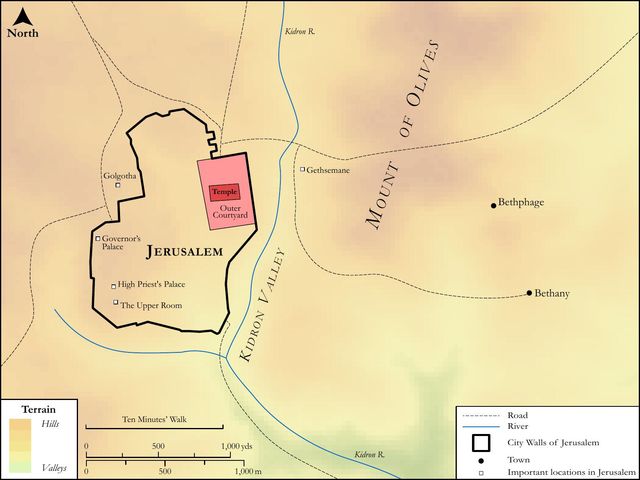
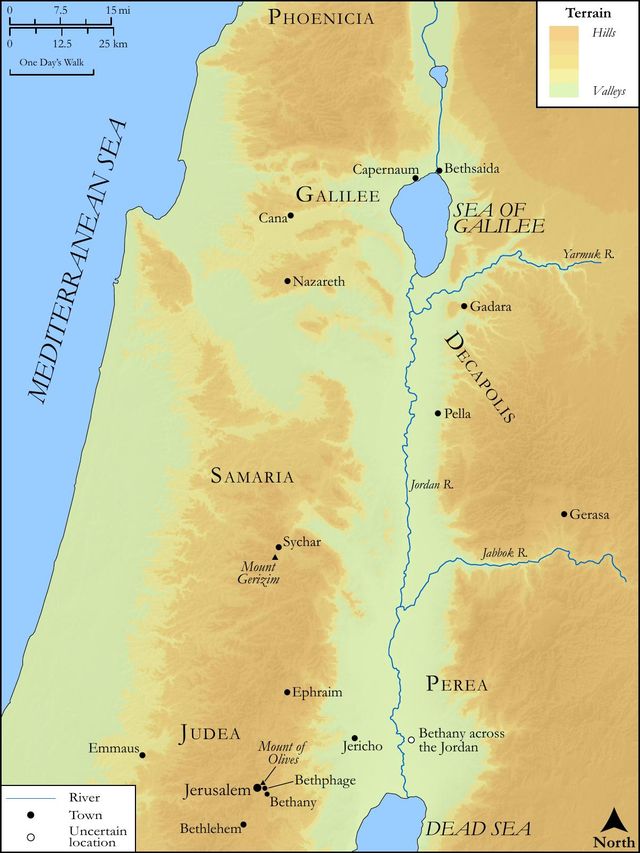
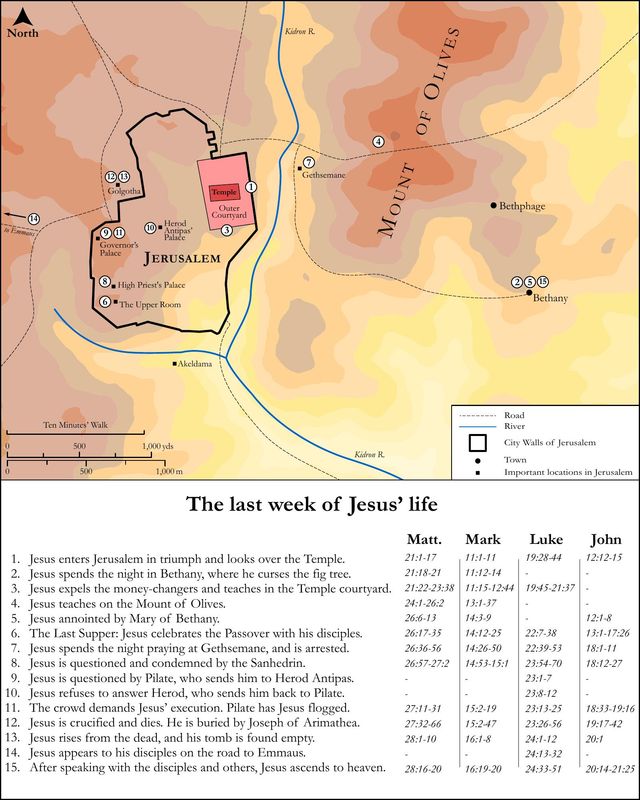
Study this verse
Public-domain commentary
Matthew Henry
From his Commentary on the Whole Bible. Henry comments on passages, not single verses — this entry covers John 14:25–27. His three-level outline is real structure in the source text, so it is rendered as structure.
Two things Christ here comforts his disciples with: -
I.That they should be under the tuition of his Spirit, Joh 14:25, Joh 14:26, where we may observe,
1.The reflection Christ would have them make upon the instructions he had given them: These things have I spoken unto you (referring to all the good lessons he had taught them, since they entered themselves into his school), being yet present with you. This intimates,
(1.)That what he had said he did not retract nor unsay, but ratify it, or stand to it. What he had spoken he had spoken, and would abide by it.
(2.)That he had improved the opportunity of his bodily presence with them to the utmost: "As long as I have been yet present with them, you know I have lost no time." Note, When our teachers are about to be removed from us we should call to mind what they have spoken, being yet present with us.
2.The encouragement given them to expect another teacher, and that Christ would find out a way of speaking to them after his departure from them, Joh 14:26. He had told them before that the Father would give them this other comforter (Joh 14:16), and here he returns to speak of it again; for as the promise of the Messiah had been, so the promise of the Spirit now was, the consolation of Israel. Two things he here tells them further concerning the sending of the Holy Ghost: -
(1.)On whose account he should be sent: "The Father will send him in my name; that is, for my sake, at my special instance and request:" or, "as my agent and representative." He came in his Father's name, as his ambassador: the Spirit comes in his name, as resident in his absence, to carry on his undertaking, and to ripen things for his second coming. Hence he is called the Spirit of Christ, for he pleads his cause, and does his work.
(2.)On what errand he should be sent; two things he shall do: - [1.] He shall teach you all things, as a Spirit of wisdom and revelation Christ was a teacher to his disciples; if he leave them now that they have made so little proficiency, what will become of them? Why, the Spirit shall teach them, shall be their standing tutor. He shall teach them all things necessary for them either to learn themselves, or to teach others. For those that would teach the things of God must first themselves be taught of God; this is the Spirit's work. See Isa 59:21. [2.] He shall bring all things to your remembrance whatsoever I have said unto you. Many a good lesson Christ had taught them, which they had forgotten, and which would be to seek when they had occasion for it. Many things they did not retain the remembrance of, because they did not rightly understand the meaning of them. The Spirit shall not teach them a new gospel, but bring to their minds that which they had been taught, by leading them into the understanding of it. The apostles were all of them to preach, and some of them to write, the things that Jesus did and taught, to transmit them to distant nations and future ages; now, if they had been left to themselves herein, some needful things might have been forgotten, others misrepresented, through the treachery of their memories; therefore the Spirit is promised to enable them truly to relate and record what Christ said unto them. And to all the saints the Spirit of grace is given to be a remembrancer, and to him by faith and prayer we should commit the keeping of what we hear and know.
II.That they should be under the influence of his peace (Joh 14:27):
Peace I leave with you. When Christ was about to leave the world he made his will. His soul he committed to his Father; his body he bequeathed to Joseph, to be decently interred; his clothes fell to the soldiers; his mother he left to the care of John: but what should he leave to his poor disciples, that had left all for him? Silver and gold he had none; but he left them that which was infinitely better, his peace. "I leave you, but I leave my peace with you. I not only give you a title to it, but put you in possession of it." He did not part in anger, but in love; for this was his farewell, Peace I leave with you, as a dying father leaves portions to his children; and this is a worthy portion. Observe,
1.The legacy that is here bequeathed Peace, my peace. Peace is put for all good, and Christ has left us all needful good, all that is really and truly good, as all the purchased promised good. Peace is put for reconciliation and love; the peace bequeathed is peace with God, peace with one another; peace in our own bosoms seems to be especially meant; a tranquillity of mind arising from a sense of our justification before God. It is the counterpart of our pardons, and the composure of our minds. This Christ calls his peace, for he is himself our peace, Eph 2:14. It is the peace he purchased for us and preached to us, and on which the angels congratulated men at his birth, Luk 2:14.
2.To whom this legacy is bequeathed: "To you, my disciples and followers, that will be exposed to trouble, and have need of peace; to you that are the sons of peace, and are qualified to receive it." This legacy was left to them as the representatives of the church, to them and their successors, to them and all true Christians in all ages.
3.In what manner it is left: Not as the world giveth, give I unto you. That is, (1.) "I do not compliment you with Peace be unto you; no, it is not a mere formality, but a real blessing." (2.) "The peace I give is of such a nature that the smiles of the world cannot give it, nor the frowns of the world take it away." Or, (3.) "The gifts I give to you are not such as this world gives to its children and votaries, to whom it is kind." The world's gifts concern only the body and time; Christ's gifts enrich the soul for eternity: the world gives lying vanities, and that which will cheat us; Christ gives substantial blessings, which will never fail us: the world gives and takes; Christ gives a good part that shall never be taken away. (4.) The peace which Christ gives is infinitely more valuable than that which the world gives. The world's peace begins in ignorance, consists with sin, and ends in endless troubles; Christ's peace begins in grace, consists with no allowed sin, and ends at length in everlasting peace. As is the difference between a killing lethargy and a reviving refreshing sleep, such is the difference between Christ's peace and the world's.
4.What use they should make of it: Let not your heart be troubled, for any evils past or present, neither let it be afraid of any evil to come. Note, Those that are interested in the covenant of grace, and entitled to the peace which Christ gives, ought not to yield to overwhelming griefs and fears. This comes in here as the conclusion of the whole matter; he had said (Joh 14:1), Let not your heart be troubled, and here he repeats it as that for which he had now given sufficient reason.
Historical interpretation
Nine Centuries of Reception
14 surviving comments on this verse. Each one is dated, so this reads as a timeline rather than a list.
Select a marker to jump to its quote. Markers stagger vertically where authors wrote within a few decades of each other.
But above, withal, He made a declaration concerning this His work. What, then, is the Paraclete's administrative office but this: the direction of discipline, the revelation of the Scriptures, the reformation of the intellect, the advancement toward the "better things? " Nothing is without stages of growth: all things await their season.
Grant, then, that all have erred; that the apostle was mistaken in giving his testimony; that the Holy Ghost had no such respect to any one (church) as to lead it into truth, although sent with this view by Christ, and for this asked of the Father that He might be the teacher of truth; grant, also, that He, the Steward of God, the Vicar of Christ, neglected His office, permitting the churches for a time to understand differently, (and) to believe differently, what He Himself was preaching by the apostles,-is it likely that so many churches, and they so great, should have gone astray into one and the same faith? No casualty distributed among many men issues in one and the same result.
Accordingly, setting out of the question the confirmer of all such things, the Paraclete, the guide of universal truth, inquire whether there be not a worthier reason adduced among its for the observing of the ninth hour; so that this reason (of ours) must be attributed even to Peter if he observed a Station at the time in question.
The Spirit is simple in being. His powers are many. They are entirely present everywhere and in everything. He is distributed but does not change. He is shared yet remains whole. Consider the analogy of the sunbeam: each person on whom its kindly light falls rejoices as if the sun existed for him alone, yet it illumines land and sea and is master of the atmosphere. In the same way, the Spirit is given to each one who receives him as if he were the possession of that person alone, yet he sends forth sufficient grace to fill the entire universe. Everything that partakes of his grace is filled with joy according to its capacity—the capacity of its nature, not of his power.The Spirit does not take up his abode in someone’s life through a physical approach. How could a corporeal being approach the bodiless One? Instead, the Spirit comes to us when we withdraw ourselves from evil passions that have crept into the soul through its friendship with the flesh, alienating us from a close relationship with God. Only when a person has been cleansed from the shame of his evil and has returned to his natural beauty, and [only when] the original form of the royal image has been restored in him, is it possible for him to approach the Paraclete. Then, like the sun, he will show you in himself the image of the invisible, and with purified eyes you will see in this blessed image the unspeakable beauty of its prototype. Through him hearts are lifted up, the infirm are held by the hand, and those who progress are brought to perfection. He shines on those who are cleansed from every spot and makes them spiritual people through fellowship with himself. When a sunbeam falls on a transparent substance, the substance itself becomes brilliant and radiates light from itself. So too Spirit-bearing souls, illumined by him, finally become spiritual themselves, and their grace is sent forth to others. From this comes knowledge of the future, understanding of mysteries, apprehension of hidden things, distribution of wonderful gifts, heavenly citizenship, a place in the choir of angels, endless joy in the presence of God, becoming like God, and the highest of all desires, becoming God.
For he who came in the name of the Son surely also came in the name of the Father, for the name of the Father and of the Son is one. Thus it comes about that the name of the Father and of the Son and of the Holy Spirit is one.
(Didym. de Spir. Sancto, l. ii. inter opera Hieron.) The Saviour affirms that the Holy Spirit is sent by the Father, in His, the Saviour's, name; which name is the Son. Here an agreement of nature and propriety, so to speak, of persons is shewn. The Son can come in the Father's name only, consistently with the proper relationship of the Son to the Father, and the Father to the Son. No one else comes in the name of the Father, but in the name of God, of the Lord, of the Almighty, and the like. As servants who come in the name of their Lord, do so as being the servants of that Lord, so the Son who comes in the name of the Father, bears that name as being the acknowledged only-begotten Son of the Father. That the Holy Spirit then is sent in the Son's name, by the Father, shows that He is in unity with the Son: whence He is said too to be the Spirit of the Son, and to make those sons by adoption, who are willing to receive Him. The Holy Spirit then, Who cometh in the name of the Son from the Father, shall teach them, who are established in the faith of Christ, all things; all things which are spiritual, both the understanding of truth, and the sacrament of wisdom. But He will teach not like those who have acquired an art or knowledge by study and industry, but as being the very art, doctrine, knowledge itself. As being this Himself, the Spirit of truth will impart the knowledge of divine things to the mind.
(Hom. lxxv. 3) To enable them to sustain His bodily departure more cheerfully, He promises that that departure shall be the source of great benefit; for that while He was then in the body, they could never know much, because the Spirit would not have come: But the Comforter, which is the Holy Ghost, Whom the Father will send in My name, He shall teach you all things, and bring all things to your remembrance, whatsoever I have said unto you.
(Hom. lxxv. 3) He often calls Him the Comforter, in allusion to the affliction in which they then were.
He insists that we must believe that the Holy Spirit also shares in the same oneness [that the Son does], when he foretells that the fullness of his doctrine will be perfected in them by the same Paraclete.… He meant to forewarn the blessed apostles both of his own ascent into heaven after the passion he was to suffer and of the descent of the Holy Spirit on them from heaven. But the Holy Spirit was not only in heaven, nor was he only on the earth. And neither would the Son ascend to heaven in such a way that he left the earth behind, nor did the Father alone possess the throne of heaven where the Son was returning and from where the Holy Spirit is said to come.
Neither must the Holy Spirit be regarded as separated from the Father whose Spirit he is, nor should the Son be believed to be separated from him whose face he is, as well as his right hand, power and wisdom.… For the divinity of the ever adorable Trinity is one and the same everywhere and forever. But so that a clear faith and separate belief in the Father, Son and Holy Spirit might be given to those who believe, it is accordingly written that the Father sends both the Son and the Holy Spirit, since neither he who sends nor he who is sent can be believed to be God if there is a place where he is and a place where he is not. Let us believe in the Son speaking to us, since he is the Truth: “I am not alone,” he says, “because the Father is with me.” And again, speaking of the Holy Spirit, he says, “But if I by the Spirit of God cast out devils.” … Accordingly, since nowhere is the divinity of the Trinity not present, it is part of the divine plan for the redemption of humankind that it is spoken of as both sending and being sent. For otherwise the human mind could not grasp that the Father is the Father, and the Son is the Son and the Holy Spirit is the Holy Spirit, unless it should learn their separateness by the naming of one as sent and one as sending.
(Tract. lxxvii. 2) So then the Son speaks, the Holy Spirit teaches: when the Son speaks we take in the words, when the Holy Spirit teaches, we understand those words. The whole Trinity indeed both speaks and teaches, but unless each person worked separately as well, the whole would be too much for human infirmity to take in.
(Tract. xxvii. 2) Suggest, i. e. bring to your remembrance. Every wholesome hint to remember that we receive is of the grace of the Spirit.
"But the Comforter," He adds, "which is the Holy Ghost, whom the Father will send in my name, He shall teach you all things, and bring all things to your remembrance, whatsoever I have said unto you." Is it, then, that the Son speaks, and the Holy Spirit teaches, so that we merely get hold of the words that are uttered by the Son, and then understand them by the teaching of the Spirit? as if the Son could speak without the Holy Spirit, or the Holy Spirit teach without the Son: or is it not rather that the Son also teacheth and the Spirit speaketh, and, when it is God that speaketh and teacheth anything, that the Trinity itself is speaking and teaching? And just because it is a Trinity, its persons required to be introduced individually, so that we might hear it in its distinct personality, and understand its inseparable nature. Listen to the Father speaking in the passage where thou readest, "The Lord said unto me, Thou art my Son:" listen to Him also teaching, in that where thou readest, "Every man that hath heard, and hath learned of the Father, cometh unto me." The Son, on the other hand, thou hast just heard speaking; for He saith of Himself, "Whatsoever I have said unto you:" and if thou wouldst also know Him as a Teacher, bethink thyself of the Master, when He saith, "One is your Master, even Christ." Furthermore, of the Holy Spirit, whom thou hast just been told of as a Teacher in the words, "He shall teach you all things," listen to Him also speaking, where thou readest in the Acts of the Apostles, that the Holy Spirit said to the blessed Peter, "Go with them, for I have sent them." The whole Trinity, therefore, both speaketh and teacheth: but were it not also brought before us in its individual personality, it would certainly altogether surpass the power of human weakness to comprehend it. For as it is altogether inseparable in itself, it could never be known as the Trinity, were it always spoken of inseparably; for when we speak of the Father, and the Son, and the Holy Spirit, we certainly do not pronounce them simultaneously, and yet in themselves they cannot be else than simultaneous. But when He added, "He will bring to your remembrance," we ought also to understand that we are commanded not to forget that these pre-eminently salutary admonitions are part of that grace which the Holy Spirit brings to our remembrance.
But the Paraclete, the Holy Spirit, whom the Father will send in my name, he will teach you all things and bring to your remembrance all things whatsoever I have said to you. Most of you know, my brothers, that in Greek speech "paraclete" is called in Latin "advocate" or "consoler." He is called advocate because he intercedes with the justice of the Father for the error of sinners. He who is of one substance with the Father and the Son is said to entreat for sinners, because those whom he has filled, he makes into those who entreat. Hence Paul also says: For the Spirit himself makes intercession for us with groanings that cannot be uttered. But he who entreats is less than he who is entreated; how then is the Spirit said to entreat, who is not less? But the Spirit himself entreats because he inflames those whom he has filled to entreat. Moreover, the same Spirit is called Consoler because for those who grieve over the commission of sin, while he prepares the hope of pardon, he lifts the mind from the affliction of sorrow. Of him it is rightly promised: He himself will teach you all things. Because unless the same Spirit is present in the heart of the hearer, the word of the teacher is useless. Therefore let no one attribute to the human teacher what he understands from the mouth of the teacher, because unless there is one within who teaches, the tongue of the teacher labors outwardly in vain. Behold, you all equally hear the one voice of the speaker, yet you do not equally perceive the meaning of the voice heard. Since therefore the voice is not different, why is the understanding of the voice different in your hearts, unless because through that which the voice of the speaker commonly admonishes, there is an interior master who specially teaches certain ones about the understanding of the voice? Concerning this anointing of the Spirit, it is again said through John: As his anointing teaches you concerning all things. Therefore one is not instructed by voice when the mind is not anointed by the Spirit. But why do we speak these things about human teaching, when even the Creator himself does not speak for the instruction of man, if he does not speak to that same man through the anointing of the Spirit? Certainly Cain, before he perpetrated fratricide in deed, heard: You have sinned; be still. But because, his sins demanding it, he was admonished by voice, not by the anointing of the Spirit, he was able to hear the words of God but scorned to keep them. But we must inquire why it is said of the same Spirit: He will bring all things to your remembrance, since to suggest is usually characteristic of an inferior. But because we sometimes say "to suggest" means "to supply," the invisible Spirit is said to suggest, not because he brings knowledge to us from below, but from what is hidden.
(Hom. xxx. in Evang.) Paraclete is Advocate, or Comforter. The Advocate then intercedes with the Father for sinners, when by His inward power He moves the sinner to pray for himself. The Comforter relieves the sorrow of penitents, and cheers them with the hope of pardon.
(Hom. xxx.) Unless the Spirit be present to the mind of the hearer, the word of the teacher is vain. Let none then attribute to the human teacher, the understanding which follows in consequence of his teaching: for unless there be a teacher within, the tongue of the teacher outside will labour in vain. Nay even the Maker Himself does not speak for the instruction of man, unless the Spirit by His unction speaks at the same time.
(Hom. xxx.) But why is it said of the Spirit, He shall suggest all things to you: to suggest being the office of an inferior? The word is used here, as it is used sometimes, in the sense of supplying secretly. The invisible Spirit suggests, not because He takes a lower place in teaching, but because. He teaches secretly.
The Holy Spirit then was both to teach and to bring to remembrance: to teach what Christ had forborne to tell His disciples, because they were not able to bear it; to bring to remembrance what Christ had told them, but which on account of its difficulty, or their slowness of understanding, they were unable to remember.
Continue studying John 14:26 across the web’s major study libraries — every link below opens this exact verse, chapter, or book on the destination site.
Read & Compare
 BibleGatewayThis verse in more than 200 translations and 70 languages.
 Bible.comThe YouVersion reader — hundreds of translations, reading plans, and highlights.
 ESV.orgCrossway's official English Standard Version reader.
 NET BibleThe NET translation with 60,000+ translators' notes on every rendering decision.
 STEP BibleTyndale House's free study tool — original text, vocabulary, and scholarly resources.
 BibliaLogos Bible Software's free web reader.
 USCCBThe New American Bible (Revised Edition) with the U.S. bishops' study notes.
Commentaries
 BibleHub CommentariesDozens of classic commentaries on this verse, gathered on one page.
 StudyLightMore than 100 commentary sets — the largest collection on the web.
 BibleRefPlain-English commentary on what this verse means, verse by verse.
 Enduring WordDavid Guzik's free commentary on this chapter, widely used by Bible teachers.
 Bible Study ToolsVerse commentary alongside Greek and Hebrew study aids.
Original Language & Research
- BibleHub InterlinearThe verse word by word — original language, transliteration, and English.
- BibleHub LexiconEvery word's original-language definition and Strong's entry.
 Blue Letter BibleDeep-study tools — Strong's numbers, concordance, and word studies.
 CNTR CollationThe earliest Greek manuscripts of this verse, collated letter by letter.
Sermons, Hymns & Audio


TrulyRandomVerse is not affiliated with these sites and doesn’t control their content. They’re linked because they’re genuinely useful.
Summary
John 14:26 presents a pivotal promise from Jesus to His disciples concerning the Holy Spirit, whom He identifies as the "Comforter" or "Advocate." This verse assures believers that after Jesus' physical departure, the Father will send the Holy Spirit in Jesus' name to serve as their divine teacher, guiding them into all truth and enabling them to recall and fully comprehend all that Jesus had taught them during His earthly ministry. It underscores the Spirit's indispensable role in preserving, interpreting, and applying Christ's words for all generations.
Context
ShowHideLiterary Context
This verse is situated within Jesus' Farewell Discourse in the Upper Room, spanning John 13 through John 17. Jesus is preparing His disciples for His imminent crucifixion, resurrection, and ascension, which will mark His physical departure from them. The disciples are troubled and confused by His words about leaving. In John 14:16-18, Jesus first introduces the concept of another "Comforter" or "Helper" (Paraclete) who will be with them forever, assuring them they will not be left as orphans. John 14:26 elaborates on this promise, specifically identifying this Helper as the Holy Spirit and detailing His two primary functions: teaching and reminding. This promise directly follows Jesus' statement about manifesting Himself to those who love Him and keep His commandments (John 14:21), reinforcing the idea that His presence will continue through the Spirit. The discourse continues with further promises of peace and the Spirit's role in conviction and guidance (John 14:27-31).
Historical & Cultural Context
The disciples, being Jewish, would have been familiar with the concept of God's Spirit interacting with humanity, as seen in the Old Testament (e.g., inspiring prophets, empowering leaders). However, the promise of the Spirit's indwelling and ongoing teaching role for all believers, particularly after the Messiah's departure, was a new and profound revelation. They were accustomed to rabbinic teaching, where disciples memorized and recalled their master's words. Jesus' promise of the Holy Spirit as a divine teacher and reminder would have resonated with this cultural practice but elevated it to a supernatural level, ensuring perfect recall and understanding of His divine instruction. The idea of a "Comforter" or "Advocate" also had legal and social connotations among the Greeks and Romans, referring to someone who stands alongside another to provide aid, counsel, or defense. This concept would have underscored the comprehensive support the Spirit would provide in a world hostile to the nascent Christian movement.
Key Themes
ShowHideThis verse contributes significantly to several major themes within John's Gospel and biblical theology. Firstly, it highlights the Trinitarian nature of God, showing the Father sending the Spirit in the Son's name, demonstrating the unified purpose and work of the Godhead. Secondly, it emphasizes the continuing divine presence with believers, ensuring they are not abandoned after Jesus' ascension. The Spirit's indwelling presence fulfills Jesus' promise to be with them always (Matthew 28:20). Thirdly, the verse establishes the Holy Spirit's role as the divine teacher and interpreter of truth. This is crucial for the faithful transmission of Jesus' teachings and the ongoing understanding of God's revelation. The Spirit's work ensures that the truth of Christ is not lost or distorted but is accurately remembered and applied, leading believers into deeper spiritual understanding and maturity, as further elaborated in John 16:13-15).
Exposition and Analysis
ShowHideKey Word Analysis
ShowHideThis word (G1321) is a prolonged (causative) form of a primary verb meaning "to learn," thus signifying "to teach" in a broad application. In this context, it emphasizes the Holy Spirit's role as the primary instructor for believers. The Spirit's teaching is not merely imparting information but enabling comprehension, spiritual discernment, and the application of divine truth to life. This teaching is comprehensive ("all things") and ongoing, guiding disciples into a deeper understanding of Christ's words and God's will.
This term (G3686) refers to a "name" literally or figuratively, encompassing authority, character, and reputation. When the Father sends the Holy Spirit "in my name," it signifies that the Spirit comes with the full authority of Jesus, representing His person, extending His mission, and acting according to His will and character. The Spirit's work is intrinsically linked to Christ, upholding His teachings and glorifying Him, rather than acting independently.
This word (G3956), encompassing all forms of declension, means "all, any, every, the whole." Its repetition in the verse ("teach you all things," "bring all things to your remembrance") underscores the comprehensive nature of the Holy Spirit's work. The Spirit's teaching and reminding are not selective but cover the entirety of Christ's revelation, ensuring that no essential truth is overlooked or forgotten. This provides a complete and holistic understanding of God's plan and Jesus' message.
Verse Breakdown
ShowHide"But the Comforter, which is the Holy Ghost"
This clause introduces the divine agent promised by Jesus. "Comforter" (Greek: Paráklētos) is a rich term meaning "one called alongside," encompassing roles such as advocate, helper, counselor, and consoler. The identification as "the Holy Ghost" (Holy Spirit) emphasizes His divine nature and distinct personality within the Trinity. He is not merely an influence but a divine Person.
"whom the Father will send in my name"
This clarifies the source and authority of the Spirit's mission. The Father initiates the sending, demonstrating His love and provision for believers. The phrase "in my name" signifies that the Spirit's mission is authorized by Jesus, represents His character, and continues His work on earth. It highlights the unity of purpose among the Father, Son, and Holy Spirit.
"he shall teach you all things"
This outlines the Spirit's primary function as an instructor. The Spirit will supernaturally enable believers to grasp spiritual truths, understand God's will, and gain wisdom that transcends human intellect. This teaching is comprehensive, covering "all things" necessary for faith and life, including the deeper implications of Jesus' words.
"and bring all things to your remembrance, whatsoever I have said unto you"
This describes the Spirit's crucial role in preserving the integrity of Jesus' teachings. For the disciples, this meant supernatural recall and accurate understanding of Jesus' extensive verbal instruction, which was vital for their future ministry and the faithful transmission of the Gospel. For all believers, it means the Spirit illuminates Scripture, making Jesus' words living and active in their hearts and minds, ensuring their continued relevance and power.
Literary Devices
ShowHideJohn 14:26 employs several significant literary devices to convey its profound theological message. Personification is central, as the Holy Spirit is presented not as an abstract force but as a distinct divine person who "teaches" and "brings to remembrance," actions typically attributed to sentient beings. This reinforces the Spirit's personality and active role in the lives of believers. The term "Comforter" itself, a translation of Paráklētos, functions as Symbolism, representing the multifaceted support, advocacy, and consolation that the Spirit provides. It is a symbolic title encapsulating His comprehensive ministry. Furthermore, the Repetition of "all things" ("teach you all things," "bring all things to your remembrance") serves as an emphatic device, underscoring the comprehensive and exhaustive nature of the Holy Spirit's work in guiding believers into a complete understanding of Christ's revelation. This repetition ensures the reader grasps the breadth and depth of the Spirit's instructional and mnemonic ministry.
Theological and Thematic Connections
ShowHideJohn 14:26 is foundational for understanding the ongoing work of the Holy Spirit within the Christian life and the church. It reveals the Spirit as the divine agent who actualizes Christ's presence and teaching in the lives of believers, ensuring that the truth revealed in Jesus is never lost but continually illuminated and applied. This verse establishes the Spirit's indispensable role in spiritual formation, biblical understanding, and the perpetuation of the Gospel message. It underscores the Trinitarian unity in salvation history, with the Father sending the Spirit in the Son's name to empower and guide believers, thus fulfilling God's redemptive plan. The Spirit's work ensures that the church remains grounded in the apostolic teaching, continually reminded of Christ's words and empowered to live them out.
Reflection and Application
ShowHideJohn 14:26 offers profound comfort and practical guidance for every believer. In a world saturated with information and competing ideologies, the promise of the Holy Spirit as our divine teacher and reminder is an anchor. It means we are never left to navigate the complexities of faith and life solely by our own intellect or human wisdom. The Spirit illuminates the Scriptures, making God's ancient words alive and relevant for our contemporary challenges. When we read the Bible, the Spirit helps us recall and understand Jesus' teachings, transforming mere information into life-giving truth. In moments of confusion, doubt, or temptation, the Spirit, our Comforter, brings to mind the specific words of Christ that apply to our situation, offering clarity, conviction, and consolation. This divine assistance empowers us to live out our faith authentically, to discern God's will, and to grow in Christlikeness, ensuring that our spiritual journey is guided by divine wisdom rather than fleeting human understanding.
Questions for Reflection
ShowHideFAQ
ShowHideWhat is the significance of the Holy Spirit being sent "in my name"?
ShowHideThe phrase "in my name" signifies that the Holy Spirit is sent with the full authority, character, and purpose of Jesus Christ. It means the Spirit acts as Jesus' representative, continuing His work on earth after His ascension. The Spirit's ministry is not independent but is always aligned with and glorifies Christ, bringing to remembrance and teaching what Jesus Himself taught. This emphasizes the unity of purpose within the Trinity, where the Father sends the Spirit to extend the Son's redemptive mission. It assures believers that the Spirit's guidance is truly Christ's guidance, ensuring doctrinal purity and faithful adherence to Jesus' teachings.
How does the Holy Spirit "teach you all things" and "bring all things to your remembrance" today?
ShowHideThe Holy Spirit teaches believers "all things" primarily through the illumination of Scripture. While the Spirit does not impart new, extra-biblical revelation for doctrine, He enables believers to understand, interpret, and apply the written Word of God. He opens our minds to spiritual truths that are otherwise incomprehensible to the natural person (1 Corinthians 2:14). When it comes to "bringing all things to your remembrance," the Spirit helps us recall specific biblical passages, Jesus' teachings, or God's promises that are relevant to our current circumstances. This is not about perfect rote memorization of every word Jesus spoke, but about the Spirit's ability to make the truth of God's Word living and active in our hearts and minds, providing comfort, conviction, or guidance precisely when needed. This divine recall is essential for living a life consistent with Christ's teachings and for sharing the Gospel effectively.
Christ-Centered Fulfillment
ShowHideJohn 14:26 finds its profound Christ-centered fulfillment in the ongoing, post-ascension ministry of Jesus through the person of the Holy Spirit. While Jesus physically departed from His disciples, He did not abandon them. Instead, He promised the Spirit as His divine surrogate, ensuring His continued presence and teaching authority among His followers. The sending of the Holy Spirit on the Day of Pentecost (Acts 2:1-4) was the historical fulfillment of this promise, inaugurating the age of the Spirit and the church. Through the Spirit, Christ continues to teach His church, not by new revelation, but by illuminating the written Word, ensuring that His teachings are accurately understood and applied across generations. The Spirit's role as the "Comforter" or "Advocate" means that Christ, through His Spirit, continues to intercede for believers (Romans 8:26-27) and empower them for witness (Acts 1:8). Thus, the Holy Spirit is the tangible expression of Christ's abiding presence, making Him effectively "Immanuel" (God with us) in the lives of believers, guiding them into all truth and conforming them to the image of the Son (Romans 8:29).