


John 14:25
Bible text: King James Version (1769 Blayney text) · Public domain
Bible text: Berean Standard Bible · Public domain
Bible text: American Standard Version (1901) · Public domain
Bible text: World English Bible, Messianic edition · Public domain
Bible text: Geneva Bible (1599) · Public domain
Bible text: Young's Literal Translation · Public domain
- ΤαῦταTautaThese thingsG3778D-APNDemonstrative pronoun Accusative Plural Neuter
- λελάληκαlelalēkaI have saidG2980V-RAI-1SVerb Perfect Active Indicative 1st Singular
- ὑμῖνhuminto youG4771P-2DPPersonal pronoun Dative 2nd Plural
- παρ᾽par᾽withG3844PREPPreposition
- ὑμῖνhuminyouG4771P-2DPPersonal pronoun Dative 2nd Plural
- μένων·menōnabidingG3306V-PAP-NSMVerb Present Active Participle Nominative Singular Masculine
English is a literal word-by-word gloss of the Greek, not the KJV's wording. Why?
This is the original text the KJV's translators worked from — each Greek word with its own literal English meaning in this verse, prepared by scholars at Tyndale House, Cambridge. The KJV translates whole sentences, not word by word, so its wording differs: one Greek word can become several English words, and the KJV may choose “charity” where the gloss reads “love”. Both are faithful — they answer different questions. For the KJV's own rendering, switch to the KJV text.
Details
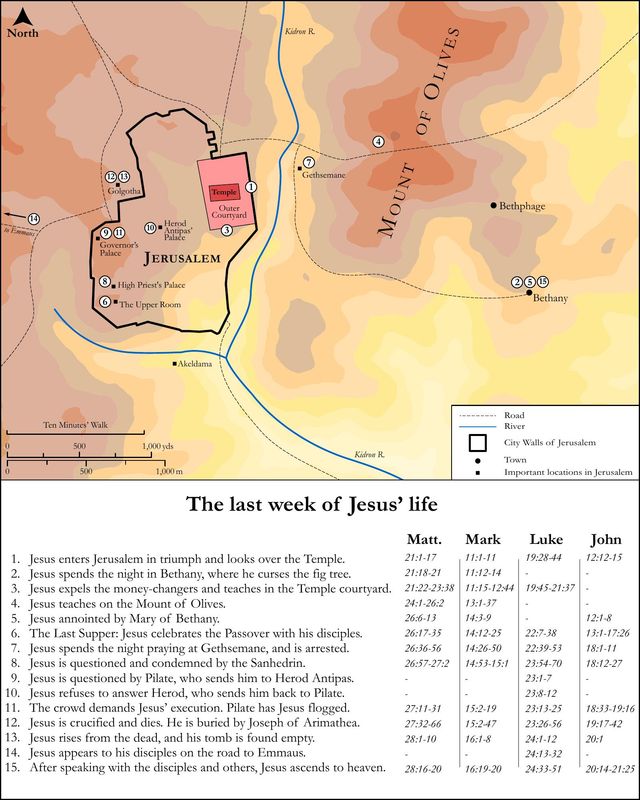
See on the biblical-era maps


Study this verse
Public-domain commentary
Matthew Henry
From his Commentary on the Whole Bible. Henry comments on passages, not single verses — this entry covers John 14:25–27. His three-level outline is real structure in the source text, so it is rendered as structure.
Two things Christ here comforts his disciples with: -
I.That they should be under the tuition of his Spirit, Joh 14:25, Joh 14:26, where we may observe,
1.The reflection Christ would have them make upon the instructions he had given them: These things have I spoken unto you (referring to all the good lessons he had taught them, since they entered themselves into his school), being yet present with you. This intimates,
(1.)That what he had said he did not retract nor unsay, but ratify it, or stand to it. What he had spoken he had spoken, and would abide by it.
(2.)That he had improved the opportunity of his bodily presence with them to the utmost: "As long as I have been yet present with them, you know I have lost no time." Note, When our teachers are about to be removed from us we should call to mind what they have spoken, being yet present with us.
2.The encouragement given them to expect another teacher, and that Christ would find out a way of speaking to them after his departure from them, Joh 14:26. He had told them before that the Father would give them this other comforter (Joh 14:16), and here he returns to speak of it again; for as the promise of the Messiah had been, so the promise of the Spirit now was, the consolation of Israel. Two things he here tells them further concerning the sending of the Holy Ghost: -
(1.)On whose account he should be sent: "The Father will send him in my name; that is, for my sake, at my special instance and request:" or, "as my agent and representative." He came in his Father's name, as his ambassador: the Spirit comes in his name, as resident in his absence, to carry on his undertaking, and to ripen things for his second coming. Hence he is called the Spirit of Christ, for he pleads his cause, and does his work.
(2.)On what errand he should be sent; two things he shall do: - [1.] He shall teach you all things, as a Spirit of wisdom and revelation Christ was a teacher to his disciples; if he leave them now that they have made so little proficiency, what will become of them? Why, the Spirit shall teach them, shall be their standing tutor. He shall teach them all things necessary for them either to learn themselves, or to teach others. For those that would teach the things of God must first themselves be taught of God; this is the Spirit's work. See Isa 59:21. [2.] He shall bring all things to your remembrance whatsoever I have said unto you. Many a good lesson Christ had taught them, which they had forgotten, and which would be to seek when they had occasion for it. Many things they did not retain the remembrance of, because they did not rightly understand the meaning of them. The Spirit shall not teach them a new gospel, but bring to their minds that which they had been taught, by leading them into the understanding of it. The apostles were all of them to preach, and some of them to write, the things that Jesus did and taught, to transmit them to distant nations and future ages; now, if they had been left to themselves herein, some needful things might have been forgotten, others misrepresented, through the treachery of their memories; therefore the Spirit is promised to enable them truly to relate and record what Christ said unto them. And to all the saints the Spirit of grace is given to be a remembrancer, and to him by faith and prayer we should commit the keeping of what we hear and know.
II.That they should be under the influence of his peace (Joh 14:27):
Peace I leave with you. When Christ was about to leave the world he made his will. His soul he committed to his Father; his body he bequeathed to Joseph, to be decently interred; his clothes fell to the soldiers; his mother he left to the care of John: but what should he leave to his poor disciples, that had left all for him? Silver and gold he had none; but he left them that which was infinitely better, his peace. "I leave you, but I leave my peace with you. I not only give you a title to it, but put you in possession of it." He did not part in anger, but in love; for this was his farewell, Peace I leave with you, as a dying father leaves portions to his children; and this is a worthy portion. Observe,
1.The legacy that is here bequeathed Peace, my peace. Peace is put for all good, and Christ has left us all needful good, all that is really and truly good, as all the purchased promised good. Peace is put for reconciliation and love; the peace bequeathed is peace with God, peace with one another; peace in our own bosoms seems to be especially meant; a tranquillity of mind arising from a sense of our justification before God. It is the counterpart of our pardons, and the composure of our minds. This Christ calls his peace, for he is himself our peace, Eph 2:14. It is the peace he purchased for us and preached to us, and on which the angels congratulated men at his birth, Luk 2:14.
2.To whom this legacy is bequeathed: "To you, my disciples and followers, that will be exposed to trouble, and have need of peace; to you that are the sons of peace, and are qualified to receive it." This legacy was left to them as the representatives of the church, to them and their successors, to them and all true Christians in all ages.
3.In what manner it is left: Not as the world giveth, give I unto you. That is, (1.) "I do not compliment you with Peace be unto you; no, it is not a mere formality, but a real blessing." (2.) "The peace I give is of such a nature that the smiles of the world cannot give it, nor the frowns of the world take it away." Or, (3.) "The gifts I give to you are not such as this world gives to its children and votaries, to whom it is kind." The world's gifts concern only the body and time; Christ's gifts enrich the soul for eternity: the world gives lying vanities, and that which will cheat us; Christ gives substantial blessings, which will never fail us: the world gives and takes; Christ gives a good part that shall never be taken away. (4.) The peace which Christ gives is infinitely more valuable than that which the world gives. The world's peace begins in ignorance, consists with sin, and ends in endless troubles; Christ's peace begins in grace, consists with no allowed sin, and ends at length in everlasting peace. As is the difference between a killing lethargy and a reviving refreshing sleep, such is the difference between Christ's peace and the world's.
4.What use they should make of it: Let not your heart be troubled, for any evils past or present, neither let it be afraid of any evil to come. Note, Those that are interested in the covenant of grace, and entitled to the peace which Christ gives, ought not to yield to overwhelming griefs and fears. This comes in here as the conclusion of the whole matter; he had said (Joh 14:1), Let not your heart be troubled, and here he repeats it as that for which he had now given sufficient reason.
Historical interpretation
Two Centuries of Reception
6 surviving comments on this verse. Each one is dated, so this reads as a timeline rather than a list.
Select a marker to jump to its quote. Markers stagger vertically where authors wrote within a few decades of each other.
(Hom. lxxv. 3) These things have I spoken unto you, being yet present with you. Some of these things were obscure, and not understood by the disciples.
(Tract. lxxvii. 1) The abode He promised them hereafter is altogether a different one from this present abode He now speaks of. The one is spiritual and inward, the other outward, and perceptible to the bodily sight and hearing.
In the preceding lesson of the holy Gospel, which is followed by the one that has just been read, the Lord Jesus had said that He and the Father would come to those who loved Them, and make Their abode with them. But He had also already said above of the Holy Spirit, "But ye shall know Him; for He shall dwell with you, and shall be in you": by which we understood that the divine Trinity dwelleth together in the saints as in His own temple. But now He saith, "These things have I spoken unto you while still dwelling with you." That dwelling, therefore, which He promised in the future, is of one kind; and this, which He declares to be present, is of another. The one is spiritual, and is realized inwardly by the mind; the other is corporal, and is exhibited outwardly to the eye and the ear. The one brings eternal blessedness to those who have been delivered, the other pays its visits in time to those who await deliverance. As regards the one, the Lord never withdraws from those who love Him; as regards the other, He comes and goes. "These things," He says, "have I spoken unto you, while still dwelling with you;" that is, in His bodily presence, wherein He was visibly conversing with them.
Contrariwise, His speech has in it the human element, and is not quite foreign to the standards we apply to ourselves, to the extent that the mind into which it entered was fitted to receive the words before us. Perhaps some one will plausibly say that Christ is not amongst us according to the power of His Godhead, although He fills the Universe and is not wholly separated from anything, but rather encompasses with unspeakable might earth and heaven, and does not leave the depths of the abyss: for where is not God"? When, then, He says, These things have I spoken unto you, while yet abiding with you, we must think that He there speaks as a man; and since He was about to vanish from our sight, I mean according to the flesh, He says this when the preparation for His departure into heaven was complete; and He says that the most perfect and complete revelation to us of the mystery is through the Comforter, that is the Holy Ghost, sent from the Father in His Name, I mean that of the Son. For as His Spirit is Christ in us, therefore He says, He shall teach you all things that I said. For since He is the Spirit of Christ, and His mind, as it is written, which is nought else but what He is, in regard to identity of nature, even though He be both conceived of and is existent, He knows all that is in Him. And Paul will be our witness, saying, For who knoweth the things of a man, save the spirit of the man which is in him? even so the things of God none knoweth save the Spirit of God. Wherefore as knowing what is in the counsel of the Only-begotten, He reporteth all things to us, not having the knowledge thereof from learning, that is; that He may not seem to fill the rank of a minister and to transmit the words of another but as His Spirit, as we said just now, and knowing untaught all that belongeth to Him of Whom and in Whom He is, He revealeth to the Saints the Divine mysteries; just as man's mind too, knowing all things that are therein, ministereth externally by uttered word the desires of the soul whose mind it is, being mentally discerned in the thoughts, and named as something else than itself, not other by nature, but as a part complemental of the whole, existing in it and believed to go forth from it. Such a relation as this is inapplicable to the ineffable Divine Nature. For small is all the power of illustrations, even if it go on to subtleties. The perfect knowledge then is begotten in the Saints by the Spirit. And indeed the inspired Paul exhorts some: I also, having heard of the faith in the Lord Jesus which is among you, and the love which ye show toward all the Saints, cease not to give thanks for you, making mention of you in my prayers; that the God of our Lord Jesus Christ, the Father of glory, may give unto you a spirit of wisdom and revelation in the knowledge of Him; having the eyes of your heart enlightened, that ye may know what is the hope of His calling, what the riches of the glory of His inheritance in the Saints, and what the exceeding greatness of His power to us-ward who believe, according to the working which He hath wrought in Christ, when He raised Him from the dead, and made Him to sit at His right hand in the heavenly places, far above all rule, and authority, and power, and dominion, and every name that is named, not only in this world, but also in that which is to come. For in the revelation of these things by the Spirit working in us in an unspeakable way, we see the deep meaning of the Incarnation and the power of the hidden mystery. And that His Spirit, indwelling in the Saints, accomplishes the presence and the power of Christ Himself and teaches all things that He has spoken unto us, Paul will once more make none the less clear to us by the words: For this cause I bow my knees unto the Father, from Whom every family both in heaven and on earth is named, that He would grant you, according to the riches of His glory, that ye may be strengthened with power through His Spirit in the inward man; that Christ may dwell in your hearts through faith to the end; that ye, being rooted and grounded in love, may be strong to apprehend with all the Saints what is the breadth, and length, and depth, and height, and to know the love of Christ, which passeth knowledge, that ye may be filled unto all the fulness of God.
Furthermore, we must show that when He said that all would be revealed by the Spirit to the Saints, He does not give them over to another master----do not think that: but He keeps them by His side, through the Spirit, no longer seen by the eye of the flesh, but rather gazed upon as became a God by the intellectual vision of the heart.
He withdrew his bodily presence for a time, for he is to abide at the right hand of the Father until the times that have been divinely decreed for the multiplication of the children of the church are accomplished. And then in the same body in which he ascended he will come again to judge the living and the dead. And so what was visible in Christ is now veiled in mystery. And, so that faith might be more perfect and more steadfast, vision was succeeded by revealed truth whose authority the hearts of the faithful, illumined by light from above, would now begin to follow.
"These things I have spoken to you while abiding with you." When would He not abide with them, who, about to ascend to heaven, promises, saying: "Behold, I am with you all days even to the consummation of the world"? But the incarnate Word both abides and departs: He departs in body, He abides in divinity. He declares therefore that He then abided with them, because He who was always present by invisible power was already departing from corporeal sight.
Continue studying John 14:25 across the web’s major study libraries — every link below opens this exact verse, chapter, or book on the destination site.
Read & Compare
 BibleGatewayThis verse in more than 200 translations and 70 languages.
 Bible.comThe YouVersion reader — hundreds of translations, reading plans, and highlights.
 ESV.orgCrossway's official English Standard Version reader.
 NET BibleThe NET translation with 60,000+ translators' notes on every rendering decision.
 STEP BibleTyndale House's free study tool — original text, vocabulary, and scholarly resources.
 BibliaLogos Bible Software's free web reader.
 USCCBThe New American Bible (Revised Edition) with the U.S. bishops' study notes.
Commentaries
 BibleHub CommentariesDozens of classic commentaries on this verse, gathered on one page.
 StudyLightMore than 100 commentary sets — the largest collection on the web.
 BibleRefPlain-English commentary on what this verse means, verse by verse.
 Enduring WordDavid Guzik's free commentary on this chapter, widely used by Bible teachers.
 Bible Study ToolsVerse commentary alongside Greek and Hebrew study aids.
Original Language & Research
- BibleHub InterlinearThe verse word by word — original language, transliteration, and English.
- BibleHub LexiconEvery word's original-language definition and Strong's entry.
 Blue Letter BibleDeep-study tools — Strong's numbers, concordance, and word studies.
 CNTR CollationThe earliest Greek manuscripts of this verse, collated letter by letter.
Sermons, Hymns & Audio


TrulyRandomVerse is not affiliated with these sites and doesn’t control their content. They’re linked because they’re genuinely useful.
Summary
Jesus concludes a significant portion of His intimate farewell discourse with His disciples, underscoring the direct and personal nature of the profound truths He has imparted to them while still physically present. This verse serves as a pivotal summary, emphasizing the foundational importance of His immediate teachings as a preparation for His impending departure and the subsequent ministry of the Holy Spirit.
Context
ShowHideLiterary Context
John 14:25 is positioned at the close of a crucial section within Jesus' Farewell Discourse, which spans John 13-17. Specifically, it follows a series of comforting and revelatory statements made during the Last Supper, where Jesus has addressed His impending departure, the promise of "many mansions" in His Father's house (John 14:2), His identity as "the way, the truth, and the life" (John 14:6), and the profound promise of the Holy Spirit, the "Comforter" or "Advocate" (John 14:16-17). The phrase "These things" in verse 25 explicitly refers back to all the teachings, assurances, and commands given in John 14:1-24, setting the stage for the Spirit's future role in bringing these very words to remembrance and deeper understanding (John 14:26).
Historical & Cultural Context
This discourse takes place in the intimate setting of the Upper Room, likely on the eve of Passover, a time of profound religious and cultural significance for the Jewish people. The disciples, having spent three years in constant companionship with Jesus, were accustomed to His direct, personal instruction. The concept of a master's "farewell discourse" was not uncommon in Israel, as in the last words of Jacob, Moses, Joshua and David, often serving as a final testament or ethical will, imparting crucial wisdom and instructions to disciples before a leader's departure. Jesus' discourse, however, transcends typical human farewells, as it is imbued with divine authority and prophetic insight into His death, resurrection, and the coming of the Spirit. The disciples, though struggling to grasp the full implications of His departure, were receiving foundational truths that would sustain them through the imminent crisis of His crucifixion and empower them for their future mission.
Key Themes
ShowHideJohn 14:25 contributes significantly to several key themes within John's Gospel and the broader Farewell Discourse. Firstly, it highlights the Authority and Sufficiency of Jesus' Teaching. His words are not mere suggestions but foundational truths, directly delivered and divinely authoritative, forming the bedrock of the disciples' faith and future ministry. Secondly, the verse underscores the theme of Preparation for Absence and Future Presence. Jesus' statement "being yet present with you" subtly but powerfully foreshadows His impending physical departure, while simultaneously preparing the disciples for a new form of His presence through the Holy Spirit, who will "abide with you forever" (John 14:16). Finally, it emphasizes the Interconnectedness of Jesus' Words and the Holy Spirit's Work. Jesus' teachings are not isolated, but are the very content that the Spirit will later illuminate, remind, and empower the disciples to understand and proclaim, as promised in John 14:26 and John 16:13-14.
Exposition and Analysis
ShowHideKey Word Analysis
ShowHideThis demonstrative pronoun, meaning "these things," refers comprehensively to the entire body of teaching, comfort, and revelation Jesus has just delivered in the preceding verses of John 14. It encompasses His promises regarding the Father's house, His identity as the unique path to God, the power of prayer in His name, and crucially, the imminent coming of the Holy Spirit. The use of "these" emphasizes the specific, immediate, and vital nature of the discourse just concluded.
Derived from a verb meaning "to talk" or "to utter words," this term highlights the direct, personal, and verbal communication from Jesus to His disciples. The perfect tense in Greek ("I have spoken") indicates a completed action with enduring results. It signifies that these truths are not merely suggestions but established, authoritative declarations that carry lasting weight and validity, forming a permanent record for His followers.
This verb means "to stay," "abide," "continue," or "remain." In this context, it emphasizes Jesus' physical, tangible presence with His disciples at the very moment of speaking. It contrasts with His impending physical departure, underscoring the immediacy and intimacy of the instruction. The implication is that these profound truths were delivered face-to-face, allowing for direct interaction and personal impartation, before a new phase of His relationship with them would begin through the Spirit.
Verse Breakdown
ShowHide"These things have I spoken unto you"
This clause serves as a summary statement, pointing back to the preceding teachings in John 14:1-24. Jesus is affirming that the profound truths about His Father's house, His identity as the Way, the promise of the Spirit, and the power of prayer have been clearly and directly communicated to His disciples. The perfect tense of "spoken" (λελάληκα) emphasizes that these words are not fleeting but are established, completed declarations with lasting significance, forming a foundational bedrock for their faith.
"being yet present with you."
This phrase highlights the crucial context of the discourse: Jesus' physical presence with them. It underscores the intimacy and directness of the instruction, given while He was still tangible and accessible. This statement also subtly foreshadows His imminent physical departure through crucifixion and ascension. The implication is that while His physical presence is temporary, the words He has spoken are eternal and will be recalled and illuminated by the Holy Spirit after He is gone, ensuring their continued relevance and power.
Literary Devices
ShowHideIn John 14:25, Jesus employs Summary and Foreshadowing. The opening phrase, "These things have I spoken unto you," acts as a concise Summary of the extensive and profound teachings He has just delivered in the preceding verses of John 14. This rhetorical device allows Jesus to draw a clear conclusion to a segment of His discourse, emphasizing the totality and importance of what has just been said. Simultaneously, the phrase "being yet present with you" functions as poignant Foreshadowing. While stating a current reality, it subtly but powerfully hints at His imminent physical departure. This prepares the disciples, and the reader, for the transition from Jesus' physical presence to His spiritual presence through the Holy Spirit, a central theme of the Farewell Discourse. The directness of the statement also carries an element of Emphasis, highlighting the unique privilege the disciples had in receiving these truths directly from the Master before His physical absence.
Theological and Thematic Connections
ShowHideJohn 14:25 profoundly connects the authority of Jesus' direct teaching with the future work of the Holy Spirit, establishing a continuity between Christ's earthly ministry and the ongoing life of the Church. It underscores the divine origin and enduring nature of Jesus' words, which are not merely human wisdom but foundational truths from God Himself. The verse implies that while Jesus' physical presence was temporary, His words are eternal and form the basis for all future understanding and spiritual growth. The Holy Spirit, as promised in the very next verse, will not bring new revelation that contradicts Jesus' teaching, but will rather illuminate, remind, and empower the disciples to fully grasp and apply what Jesus has already spoken. This highlights the Spirit's role as the divine interpreter and enabler of Christ's truth, ensuring that the church continues to build on the unshakeable foundation laid by Jesus Himself.
Reflection and Application
ShowHideJohn 14:25 invites contemporary believers to reflect deeply on the immense privilege and profound responsibility of having access to the very words of Jesus Christ recorded in Scripture. Just as the disciples received foundational truths directly from the Master, we too are beneficiaries of His direct instruction, preserved for us through the inspired Word of God. This verse challenges us to cherish these divine utterances, recognizing their timeless authority and transformative power. It reminds us that our spiritual journey is not about seeking new, esoteric revelations, but about diligently studying, meditating upon, and applying the truths Jesus has already spoken. Furthermore, it encourages us to rely on the Holy Spirit, who was promised to illuminate these words, bringing them to remembrance and guiding us into deeper understanding and obedience, just as He did for the first disciples. Our walk with Christ is a continuous process of engaging with His spoken word, empowered by His abiding Spirit.
Questions for Reflection
ShowHideFAQ
ShowHideWhat is the significance of Jesus saying "These things have I spoken unto you, being yet present with you" at this point in the Farewell Discourse?
ShowHideThe significance of John 14:25 lies in its dual function as both a summary and a transition. Firstly, it acts as a summary, explicitly referring back to all the profound truths, comforts, and commands Jesus has just imparted to His disciples in John 14:1-24. This emphasizes the direct, personal, and authoritative nature of His teaching. He is affirming that these are not indirect messages or future revelations, but established words delivered face-to-face. Secondly, the phrase "being yet present with you" serves as a crucial transition and subtle foreshadowing. It acknowledges His current physical presence, which is about to end, and prepares the disciples for His imminent departure. This sets the stage for the promise of the Holy Spirit in the very next verse (John 14:26), who will continue Jesus' work by bringing these very words to their remembrance and guiding them into all truth after He is physically gone. Thus, the verse highlights the foundational importance of His direct teachings while also pointing to the new era of the Spirit's ministry.
Christ-Centered Fulfillment
ShowHideJohn 14:25 finds its Christ-centered fulfillment not merely in the historical fact of Jesus' physical presence, but in the ongoing reality of His spiritual presence and the enduring power of His Word through the Holy Spirit. While Jesus' earthly ministry involved direct, face-to-face instruction, His ascension did not sever His connection with His disciples; rather, it inaugurated a new, more pervasive form of presence. The "things" He spoke while "yet present" are now preserved in the inspired Scriptures, forming the very foundation of Christian faith and practice. The fulfillment comes as the promised Holy Spirit, the Comforter, takes these very words of Christ and illuminates them, bringing them to remembrance and guiding believers into all truth (John 16:13). Thus, Christ's teaching, though delivered in a specific historical moment, remains eternally relevant and powerfully active through the Spirit, who enables us to understand, obey, and live out the truths spoken by our ascended Lord. This continuity ensures that Jesus, the Word made flesh, continues to speak to His Church, fulfilling His promise to be with us always, even unto the end of the world.