


John 16:13
Bible text: King James Version (1769 Blayney text) · Public domain
Bible text: King James Version with Strong's numbers · Public domain
Bible text: Berean Standard Bible · Public domain
Bible text: American Standard Version (1901) · Public domain
Bible text: World English Bible, Messianic edition · Public domain
Bible text: Geneva Bible (1599) · Public domain
Bible text: Young's Literal Translation · Public domain
- ὅτανhotanWhenG3752CONJConjunction
- δὲdehoweverG1161CONJConjunction
- ἔλθῃelthēmay comeG2064V-2AAS-3SVerb 2nd Aorist Active Subjunctive 3rd Singular
- ἐκεῖνοςekeinosHeG1565D-NSMDemonstrative pronoun Nominative Singular Masculine
- τὸtotheG3588T-NSNDefinite article Nominative Singular Neuter
- πνεῦμαpneumaSpiritG4151N-NSNNoun Nominative Singular Neuter
- τῆςtēs<the>G3588T-GSFDefinite article Genitive Singular Feminine
- ἀληθείαςalētheiasof truthG225N-GSFNoun Genitive Singular Feminine
- ὁδηγήσειhodēgēseiHe will guideG3594V-FAI-3SVerb Future Active Indicative 3rd Singular
- ὑμᾶςhumasyouG4771P-2APPersonal pronoun Accusative 2nd Plural
- ἐνenintoG1722PREPPreposition
- τῇtēatheG3588T-DSFDefinite article Dative Singular Feminine
- ἀληθείᾳalētheiatruthG225N-DSFNoun Dative Singular Feminine
- πάσῃpasēallG3956A-DSFAdjective Dative Singular Feminine
- οὐounotG3756PRT-NNegative Particle Negative
- γὰρgarforG1063CONJConjunction
- λαλήσειlalēseiHe will speakG2980V-FAI-3SVerb Future Active Indicative 3rd Singular
- ἀφ᾽aph᾽fromG575PREPPreposition
- ἑαυτοῦhe'autouHimselfG1438F-3GSMReflexive pronoun Genitive 3rd Singular Masculine
- ἀλλ᾽all᾽butG235CONJConjunction
- ὅσαhosaas much asG3745K-APNCorrelative pronoun Accusative Plural Neuter
- ἂνanmaybeG302PRTParticle or Disjunctive
- ἀκούσειakouseiHe will hearG191V-FAI-3SVerb Future Active Indicative 3rd Singular
- λαλήσειlalēseiHe will speakG2980V-FAI-3SVerb Future Active Indicative 3rd Singular
- καὶkaiandG2532CONJConjunction
- τὰtathe [things]G3588T-APNDefinite article Accusative Plural Neuter
- ἐρχόμεναerchomenacomingG2064V-PNP-APNVerb Present Middle Or Passive Deponent Participle Accusative Plural Neuter
- ἀναγγελεῖanangeleiHe will declareG312V-FAI-3SVerb Future Active Indicative 3rd Singular
- ὑμῖνhuminto youG4771P-2DPPersonal pronoun Dative 2nd Plural
English is a literal word-by-word gloss of the Greek, not the KJV's wording. Why?
This is the original text the KJV's translators worked from — each Greek word with its own literal English meaning in this verse, prepared by scholars at Tyndale House, Cambridge. The KJV translates whole sentences, not word by word, so its wording differs: one Greek word can become several English words, and the KJV may choose “charity” where the gloss reads “love”. Both are faithful — they answer different questions. For the KJV's own rendering, switch to the KJV text.
Details
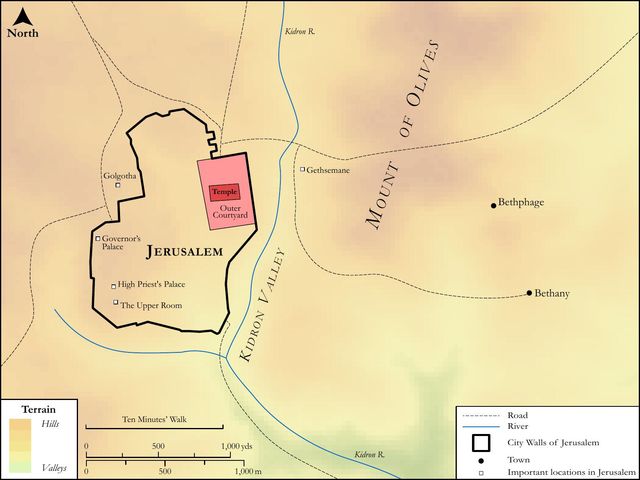
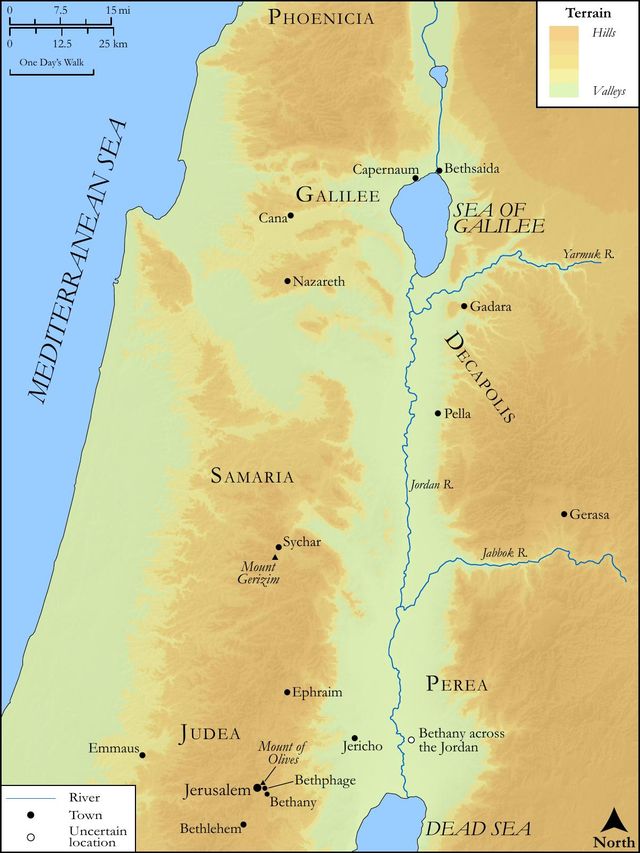
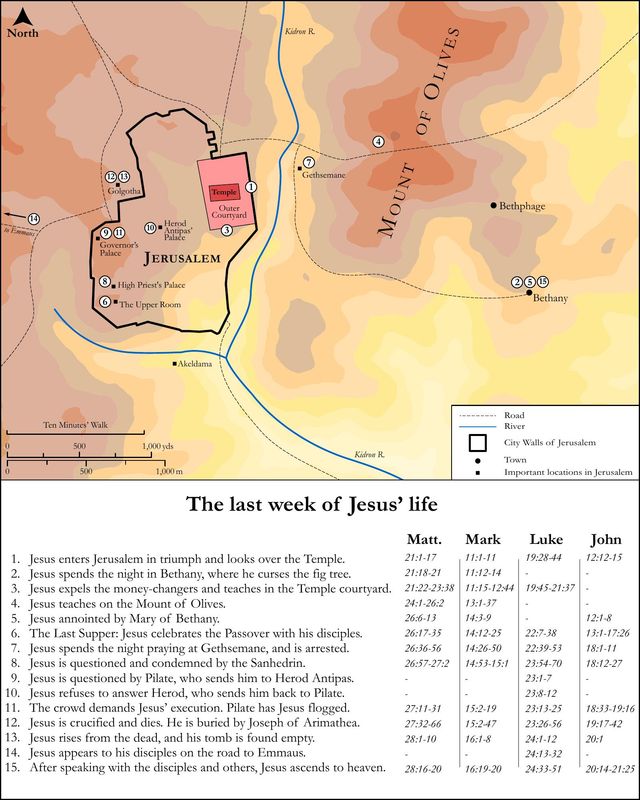
See on the biblical-era maps
Study this verse
Public-domain commentary
Matthew Henry
From his Commentary on the Whole Bible. Henry comments on passages, not single verses — this entry covers John 16:7–15. His four-level outline is real structure in the source text, so it is rendered as structure.
As it was usual with the Old Testament prophets to comfort the church in its calamities with the promise of the Messiah (Isa 9:6; Mic 5:6; Zac 3:8); so, the Messiah being come, the promise of the Spirit was the great cordial, and is still.
Three things we have here concerning the Comforter's coming: -
I.That Christ's departure was absolutely necessary to the Comforter's coming, Joh 16:7.
The disciples were so loth to believe this that Christ saw cause to assert it with a more than ordinary solemnity: I tell you the truth. We may be confident of the truth of everything that Christ told us; he has no design to impose upon us. Now, to make them easy, he here tells them,
1.In general, It was expedient for them that he should go away. This was strange doctrine, but if it was true it was comfortable enough, and showed them how absurd their sorrow was. It is expedient, not only for me, but for you also, that I go away; though they did not see it, and are loth to believe it, so it is. Note,
(1.)Those things often seem grievous to us that are really expedient for us; and particularly our going away when we have finished our course.
(2.)Our Lord Jesus is always for that which is most expedient for us, whether we think so or no. He deals not with us according to the folly of our own choice, but graciously over-rules it, and gives us the physic we are loth to take, because he knows it is good for us.
2.It was therefore expedient because it was in order to the sending of the Spirit. Now observe,
(1.)That Christ's going was in order to the Comforter's coming.
[1.]This is expressed negatively: If I go not away, the Comforter will not come. And why not? First, So it was settled in the divine counsels concerning this affair, and the measure must not be altered; shall the earth be forsaken for them? He that gives freely may recall one gift before he bestows another, while we would fondly hold all. Secondly, It is congruous enough that the ambassador extraordinary should be recalled, before the envoy come, that is constantly to reside. Thirdly, The sending of the Spirit was to be the fruit of Christ's purchase, and that purchase was to be made by his death, which was his going away. Fourthly, It was to be an answer to his intercession within the veil. See Joh 14:16. Thus must this gift be both paid for, and prayed for, by our Lord Jesus, that we might learn to put the greater value upon it. Fifthly, The great argument the Spirit was to use in convincing the world must be Christ's ascension into heaven, and his welcome here. See Joh 16:10, and Joh 7:39. Lastly, The disciples must be weaned from his bodily presence, which they were too apt to dote upon, before they were duly prepared to receive the spiritual aids and comforts of a new dispensation.
[2.]It is expressed positively: If I depart I will send him to you; as though he had said, "Trust me to provide effectually that you shall be no loser by my departure." The glorified Redeemer is not unmindful of his church on earth, nor will ever leave it without its necessary supports. Though he departs, he sends the Comforter, nay, he departs on purpose to send him. Thus still, though one generation of ministers and Christians depart, another is raised up in their room, for Christ will maintain his own cause.
(2.)That the presence of Christ's Spirit in his church is so much better, and more desirable, than his bodily presence, that it was really expedient for us that he should go away, to send the Comforter. His corporal presence could be put in one place at one time, but his Spirit is every where, in all places, at all times, wherever two or three are gathered in his name. Christ's bodily presence draws men's eyes, his Spirit draws their hearts; that was the letter which kills, his Spirit gives life.
II.That the coming of the Spirit was absolutely necessary to the carrying on of Christ's interests on earth (Joh 16:8):
And when he is come, elthōn ekeinos. He that is sent is willing of himself to come, and at his first coming he will do this, he will reprove, or, as the margin reads it, he will convince the world, by your ministry, concerning sin, righteousness, and judgment.
1.See here what the office of the Spirit is, and on what errand he is sent.
(1.)To reprove. The Spirit, by the word and conscience, is a reprover; ministers are reprovers by office, and by them the Spirit reproves.
(2.)To convince. It is a law-term, and speaks the office of the judge in summing up the evidence, and setting a matter that has been long canvassed in a clear and true light. He shall convince, that is, "He shall put to silence the adversaries of Christ and his cause, by discovering and demonstrating the falsehood and fallacy of that which they have maintained, and the truth and certainty of that which they have opposed." Note, Convincing work is the Spirit's work; he can do it effectually, and none but he; man may open the cause, but it is the Spirit only that can open the heart. The Spirit is called the Comforter (Joh 16:7), and here it is said, He shall convince. One would think this were cold comfort, but it is the method the Spirit takes, first to convince, and then to comfort; first to lay open the wound, and then to apply healing medicines. Or, taking conviction more generally, for a demonstration of what is right, it intimates that the Spirit's comforts are solid, and grounded upon truth.
2.See who they are whom he is to reprove and convince: The world, both Jew and Gentile.
(1.)He shall give the world the most powerful means of conviction, for the apostles shall go into all the world, backed by the Spirit, to preach the gospel, fully proved.
(2.)He shall sufficiently provide for the taking off and silencing of the objections and prejudices of the world against the gospel. Many an infidel was convinced of all and judged of all, Co1 14:24.
(3.)He shall effectually and savingly convince many in the world, some in every age, in every place, in order to their conversion to the faith of Christ. Now this was an encouragement to the disciples, in reference to the difficulties they were likely to meet with,
[1.]That they should see good done, Satan's kingdom fall like lightning, which would be their joy, as it was his. Even this malignant world the Spirit shall work upon; and the conviction of sinners is the comfort of faithful ministers.
[2.]That this would be the fruit of their services and sufferings, these should contribute very much to this good work.
3.See what the Spirit shall convince the world of.
(1.)Of sin (Joh 16:9), because they believe not on me.
[1.]The Spirit is sent to convince sinners of sin, not barely to tell them of it; in conviction there is more than this; it is to prove it upon them, and force them to own it, as they (Joh 8:9) that were convicted of their own consciences. Make them to know their abominations. The Spirit convinces of the fact of sin, that we have done so and so; of the fault of sin, that we have done ill in doing so; of the folly of sin, that we have acted against right reason, and our true interest; of the filth of sin, that by it we are become odious to God; of the fountain of sin, the corrupt nature; and lastly, of the fruit of sin, that the end thereof is death. The Spirit demonstrates the depravity and degeneracy of the whole world, that all the world is guilty before God.
[2.]The Spirit, in conviction, fastens especially upon the sin of unbelief, their not believing in Christ, First, As the great reigning sin. There was, and is, a world of people, that believe not in Jesus Christ, and they are not sensible that it is their sin. Natural conscience tells them that murder and theft are sin; but it is a supernatural work of the spirit to convince them that it is a sin to suspend their belief of the gospel, and to reject the salvation offered by it. Natural religion, after it has given us its best discoveries and directions, lays and leaves us under this further obligation, that whatever divine revelation shall be made to us at any time, with sufficient evidence to prove it divine, we accept it, and submit to it. This law those transgress who, when God speaketh to us by his Son, refuse him that speaketh; and therefore it is sin. Secondly, As the great ruining sin. Every sin is so in its own nature; no sin is so to them that believe in Christ; so that it is unbelief that damns sinners. It is because of this that they cannot enter into rest, that they cannot escape the wrath of God; it is a sin against the remedy. Thirdly, As that which is at the bottom of all sin; so Calvin takes it. The Spirit shall convince the world that the true reason why sin reigns among them is because they are not by faith united to Christ. Ne putimus vel guttam unam rectitudinis sine Christo nobis inesse - Let us not suppose that, apart from Christ, we have a drop of rectitude. - Calvin.
(2.)Of righteousness, because I go to my Father, and you see me no more, Joh 16:10. We may understand this,
[1.]Of Christ's personal righteousness. He shall convince the world that Jesus of Nazareth was Christ the righteous (Jo1 2:1), as the centurion owned (Luk 23:47), Certainly this was a righteous man. His enemies put him under the worst of characters, and multitudes were not or would not be convinced but that he was a bad man, which strengthened their prejudices against his doctrine; but he is justified by the spirit (Ti1 3:16), he is proved to be a righteous man, and not, a deceiver; and then the point is in effect gained; for he is either the great Redeemer or a great cheat; but a cheat we are sure he is not. Now by what medium or argument will the Spirit convince men of the sincerity of the Lord Jesus? Why, First, Their seeing him no more will contribute something towards the removal of their prejudices; they shall see him no more in the likeness of sinful flesh, in the form of a servant, which made them slight him. Moses was more respected after his removal than before. But, Secondly, His going to the Father would be a full conviction of it. The coming of the Spirit, according to the promise, was a proof of Christ's exaltation to God's right hand (Act 2:33), and this was a demonstration of his righteousness; for the holy God would never set a deceiver at his right hand.
[2.]Of Christ's righteousness communicated to us for our justification and salvation; that everlasting righteousness which Messiah was to bring in, Dan 9:24. Now, First, The Spirit shall convince men of this righteousness. Having by convictions of sin shown them their need of a righteousness, lest this should drive them to despair he will show them where it is to be had, and how they may, upon their believing, be acquitted from guilt, and accepted as righteous in God's sight. It was hard to convince those of this righteousness that went about to establish their own (Rom 10:3), but the Spirit will do it. Secondly, Christ's ascension is the great argument proper to convince men of this righteousness: I go to the Father, and, as an evidence of my welcome with him, you shall see me no more. If Christ had left any part of his undertaking unfinished, he had been sent back again; but now that we are sure he is at the right hand of God, we are sure of being justified through him.
(3.)Of judgment, because the prince of this world is judged, Joh 16:11. Observe here,
[1.]The devil, the prince of this world, was judged, was discovered to be a great deceiver and destroyer, and as such judgment was entered against him, and execution in part done. He was cast out of the Gentile world when his oracles were silenced and his altars deserted, cast out of the bodies of many in Christ's name, which miraculous power continued long in the church; he was cast out of the souls of people by the grace of God working with the gospel of Christ; he fell as lightning from heaven.
[2.]This is a good argument wherewith the Spirit convinces the world of judgment, that is, First, Of inherent holiness and sanctification, Mat 12:18. By the judgment of the prince of this world, it appears that Christ is stronger than Satan, and can disarm and dispossess him, and set up his throne upon the ruin of his. Secondly, Of a new and better dispensation of things. He shall show that Christ's errand into the world was to set things to right in it, and to introduce times of reformation and regeneration; and he proves it by this, that the prince of this world, the great master of misrule, is judged and expelled. All will be well when his power is broken who made the mischief. Thirdly, Of the power and dominion of the Lord Jesus. He shall convince the world that all judgment is committed to him, and that he is the Lord of all, which is evident by this, that he has judged the prince of this world, has broken the serpent's head, destroyed him that had the power of death, and spoiled principalities; if Satan be thus subdued by Christ, we may be sure no other power can stand before him. Fourthly, Of the final day of judgment: all the obstinate enemies of Christ's gospel and kingdom shall certainly be reckoned with at last, for the devil, their ringleader, is judged.
III.That the coming of the Spirit would be of unspeakable advantage to the disciples themselves.
The Spirit has work to do, not only on the enemies of Christ, to convince and humble them, but upon his servants and agents, to instruct and comfort them; and therefore it was expedient for them that he should go away.
1.He intimates to them the tender sense he had of their present weakness (Joh 16:12): I have yet many things to say unto you (not which should have been said, but which he could and would have said), but you cannot bear them now. See what a teacher Christ is.
(1.)None like him for copiousness; when he has said much, he has still many things more to say; treasures of wisdom and knowledge are hid in him, if we be not straitened in ourselves.
(2.)None like him for compassion; he would have told them more of the things pertaining to the kingdom of God, particularly of the rejection of the Jews and the calling of the Gentiles, but they could not bear it, it would have confounded and stumbled them, rather than have given them any satisfaction. When, after his resurrection, they spoke to him of restoring the kingdom to Israel, he referred them to the coming of the Holy Ghost, by which they should receive power to bear those discoveries which were so contrary to the notions they had received that they could not bear them now.
2.He assures them of sufficient assistances, by the pouring out of the Spirit. They were now conscious to themselves of great dulness, and many mistakes; and what shall they do now their master is leaving them? "But when he, the Spirit of Truth, is come, you will be easy, and all will be well." Well indeed; for he shall undertake to guide the apostles, and glorify Christ.
(1.)To guide the apostles. He will take care,
[1.]That they do not miss their way: He will guide you; as the camp of Israel was guided through the wilderness by the pillar of cloud and fire. The Spirit guided their tongues in speaking, and their pens in writing, to secure them from mistakes. The Spirit is given us to be our guide (Rom 8:14), not only to show us the way, but to go along with us, by his continued aids and influences.
[2.]That they do not come short of their end: He will guide them into all truth, as the skilful pilot guides the ship into the port it is bound for. To be led into a truth is more than barely to know it; it is to be intimately and experimentally acquainted with it; to be piously and strongly affected with it; not only to have the notion of it in our heads, but the relish and savour and power of it in our hearts; it denotes a gradual discovery of truth shining more and more: "He shall lead you by those truths that are plain and easy to those that are more difficult." But how into all truth? The meaning is,
First, Into the whole truth relating to their embassy; whatever was needful or useful for them to know, in order to the due discharge of their office, they should be fully instructed in it; what truths they were to teach others the Spirit would teach them, would give them the understanding of, and enable them both to explain and to defend.
Secondly, Into nothing but the truth. All that he shall guide you into shall be truth (Jo1 2:27); the anointing is truth. In the following words he proves both these: - 1. "The Spirit shall teach nothing but the truth, for he shall not speak of himself any doctrine distinct from mine, but whatsoever he shall hear, and knows to be the mind of the Father, that, and that only, shall he speak." This intimates, (1.) That the testimony of the Spirit, in the word and by the apostles, is what we may rely upon. The Spirit knows and searches all things, even the deep things of God, and the apostles received that Spirit (Co1 2:10, Co1 2:11), so that we may venture our souls upon the Spirit's word. (2.) That the testimony of the Spirit always concurs with the word of Christ, for he does not speak of himself, has no separate interest or intention of his own, but, as in essence so in records, he is one with the Father and the Son, Jo1 5:7. Men's word and spirit often disagree, but the eternal Word and the eternal Spirit never do. 2. "He shall teach you all truth, and keep back nothing that is profitable for you, for he will show you things to come." The Spirit was in the apostles a Spirit of prophecy; it was foretold that he should be so (Joe 2:28), and he was so. The Spirit showed them things to come, as Act 11:28; Act 20:23; Act 21:11. The Spirit spoke of the apostasy of the latter times, Ti1 4:1. John, when he was in the Spirit had things to come shown him in vision. Now this was a great satisfaction to their own minds, and of use to them in their conduct, and was also a great confirmation of their mission. Jansenius has a pious note upon this: We should not grudge that the Spirit does not show us things to come in this world, as he did to the apostles; let it suffice that the Spirit in the word hath shown us things to come in the other world, which are our chief concern.
(2.)The Spirit undertook to glorify Christ, Joh 16:14, Joh 16:15.
[1.]Even the sending of the Spirit was the glorifying of Christ. God the Father glorified him in heaven, and the Spirit glorified him on earth. It was the honour of the Redeemer that the Spirit was both sent in his name and sent on his errand, to carry on and perfect his undertaking. All the gifts and graces of the Spirit, all the preaching and all the writing of the apostles, under the influence of the Spirit, the tongues, and miracles, were to glorify Christ.
[2.]The Spirit glorified Christ by leading his followers into the truth as it is in Jesus, Eph 4:21. He assures them, First, that the Spirit should communicate the things of Christ to them: He shall receive of mine, and shall show it unto you. As in essence he proceeded from the Son, so in influence and operation he derived from him. He shall take ek tou emou - of that which is mine. All that the Spirit shows us, that is, applies to us, for our instruction and comfort, all that he gives us for our strength and quickening, and all that he secures and seals to us, did all belong to Christ, and was had and received from him. All was his, for he bought it, and paid dearly for it, and therefore he had reason to call it his own; his, for he first received it; it was given him as the head of the church, to be communicated by him to all his members. The Spirit came not to erect a new kingdom, but to advance and establish the same kingdom that Christ had erected, to maintain the same interest and pursue the same design; those therefore that pretend to the Spirit, and vilify Christ, give themselves the lie, for he came to glorify Christ. Secondly, That herein the things of God should be communicated to us. Lest any should think that the receiving of this would not make them much the richer, he adds, All things that the Father hath are mine. As God, all that self-existent light and self-sufficient happiness which the Father has, he has; as Mediator, all things are delivered to him of the Father (Mat 11:27); all that grace and truth which God designed to show us he lodged in the hands of the Lord Jesus, Col 1:19. Spiritual blessings in heavenly things are given by the Father to the Son for us, and the Son entrusts the Spirit to convey them to us. Some apply it to that which goes just before: He shall show you things to come, and so it is explained by Rev 1:1. God gave it to Christ, and he signified it to John, who wrote what the Spirit said, Rev 1:1.
Historical interpretation
Six Centuries of Reception
44 surviving comments on this verse. Each one is dated, so this reads as a timeline rather than a list.
Select a marker to jump to its quote. Markers stagger vertically where authors wrote within a few decades of each other.
But the Holy Spirit does not speak His own things, but those of Christ, and that not from himself, but from the Lord; even as the Lord also announced to us the things that He received from the Father. For, says He, "the word which ye hear is not Mine, but the Father's, who sent Me." And says He of the Holy Spirit, "He shall not speak of Himself, but whatsoever things He shall hear from Me." And He says of Himself to the Father, "I have," says He, "glorified Thee upon the earth ; I have finished the work which, Thou gavest Me; I have manifested Thy name to men." And of the Holy Ghost, "He shall glorify Me, for He receives of Mine."
Accordingly, setting out of the question the confirmer of all such things, the Paraclete, the guide of universal truth, inquire whether there be not a worthier reason adduced among its for the observing of the ninth hour; so that this reason (of ours) must be attributed even to Peter if he observed a Station at the time in question.
It is only at the last that He instructs them to "go and teach all nations, and baptize them," when they were so soon to receive "the Holy Ghost, the Comforter, who should guide them into all the truth." And this, too, makes towards the the same conclusion.
Meanwhile He has received from the Father the promised gift, and has shed it forth, even the Holy Spirit-the Third Name in the Godhead, and the Third Degree of the Divine Majesty; the Declarer of the One Monarchy of God, but at the same time the Interpreter of the Economy, to every one who hears and receives the words of the new prophecy; and "the Leader into all truth," such as is in the Father, and the Son, and the Holy Ghost, according to the mystery of the doctrine of Christ.
The Lord sent the Paraclete because, since human weakness could not receive everything at once, it might gradually be directed and regulated and brought to perfection of discipline by the Lord’s vicar, the Holy Spirit.… And so, he declared the work of the Spirit. This, then, is the Paraclete’s guiding office: the direction of discipline, the revelation of the Scriptures, the reforming of the intellect and the progress in us toward “better things.”
He will be, after Christ, the only one to be called and revered as Master; for He speaks not from Himself, but what is commanded by Christ. He is the only prelate, because He alone succeeds Christ.
The Son of God says concerning the Holy Spirit that “he will not speak from himself,” that is, not without the participation of the Father and myself. For the Spirit is not divided and separated but speaks what he hears.… This means he shall not speak without me. For he speaks the truth, he breathes wisdom. He does not speak without the Father, for he is the Spirit of God. He does not hear from himself, for all things are of God.… Therefore what the Spirit says is the Son’s, what the Son has given is the Father’s. So neither the Son nor the Spirit speaks anything of himself. For the Trinity speaks nothing external to itself.
He means that his hearers had not yet attained to all those things that for his name’s sake they were able to bear. And so, revealing more minor things, he puts off the greater for a future time. These were things they could not understand because the Spirit had not yet been given, as the Evangelist says, “For the Spirit had not been given because Jesus had not yet been glorified,” intimating the glory of Jesus was in his tasting death for all. And after the resurrection, when he appeared to his disciples, he breathed on them and said, “Receive the Holy Spirit” and again “You will receive the power of the Holy Spirit when he comes on you.” Where the Spirit entered into their believing hearts, they were filled with wisdom and knowledge and other effects of the Spirit that would lead them into all truth. But, as yet, they were slaves to the types, and shadows and images of the Law, and they could not bear the truth of which the Law was the shadow. But when the Holy Spirit came, he would lead them by his teaching and discipline into all truth, transferring them from the dead letter to the quickening Spirit in whom alone all scriptural truth resides.
By the Spirit of truth too the knowledge of future events has been granted to holy people. Prophets filled with this Spirit foretold and saw things to come, as if they were present: “And he will show you things to come.”
“He will not speak on his own,” that is, not without me or without the Father’s and my will. This is because he is not of himself but is from the Father and me. The fact that he exists and that he speaks he has from the Father and me. “I speak the truth,” that is, I inspire as well as speak by him, since he is the Spirit of truth. To say and to speak in the Trinity must not be understood according to our usage but according to the usage of incorporeal natures, and especially the Trinity, which implants its will in the hearts of all of those believers who are worthy to hear it.… For the Father then to speak and the Son to hear, or vice versa, is a mode of expressing the identity of their nature and their agreement. Again, the Holy Spirit, who is the Spirit of truth and the Spirit of wisdom, cannot hear from the Son what he does not know, seeing he is the very thing that is produced from the Son, that is, truth proceeding from truth, Comforter from Comforter, God from God. And finally, in case anyone should separate him from the will and company of the Father and the Son, it is written, “Whatever he shall hear, that shall he speak.”
(Hom. lxxviii. 2) In this way then He raised their spirits; for there is nothing for which mankind so long, as the knowledge of the future. He relieves them from all anxiety on this account, by showing that dangers would not fall upon them unawares. Then to show that He could have told them all the truth into which the Holy Spirit would lead them, He adds, He shall glorify Me.
(Hom. lxxviii. 2) And because He had said, Ye have one Master, even Christ, (Mat. 23:8) that they might not be prevented by this from admitting the Holy Ghost as well, He adds, For He shall receive of Mine, and shall show it unto you.
When He says, "He will teach you all truth," or "will guide you into all truth," I do not think the fulfillment is possible in any one's mind in this present life (for who is there, while living in this corruptible and soul-oppressing body, that can know all truth, when even the apostle says, "We know in part"?), but because it is effected by the Holy Spirit, of whom we have now received the earnest, that we shall attain also to the actual fullness of knowledge: whereof it is said by the same apostle, "But then face to face;" and, "Now I know in part, but then shall I know even as also I am known;" not as a thing which he knows fully in this life, but which, as a thing that would still be future on to the attainment of that perfection, the Lord promised us through the love of the Spirit, when He said, "He will teach you all truth," or "will guide you unto all truth."
Take heed, those of you specially who are still children and have need of a milk diet, of turning a curious ear to men, who have found occasion for self-deception and the deceiving of others in the words of the Lord, "I have yet many things to say unto you, but ye cannot bear them now," in order to the discovery of that which is unknown, while you still have minds that are incompetent to discriminate between the true and the false; and most especially on account of the obscene lewdnesses which Satan has instilled, by God's permission, into unstable and carnal souls, for this end, that His judgments may everywhere be objects of terror, and that pure discipline may best manifest its sweetness in contrast with the impurities of wickedness.
In this portion of the holy Gospel, where the Lord says to His disciples, "I have yet many things to say unto you, but ye cannot bear them now," there meets us first this subject of needful inquiry, how it was that He said a little before, "All things that I have heard of my Father I have made known unto you," and yet says here, "I have yet many things to say unto you, but ye cannot bear them now." But how it was that He spake of what He had not yet done as if it were done, just as the prophet testifies that God has made those things which are still to come, when He says, "Who hath made those things which are still to come," we have already explained as well as we could when dealing with those words themselves. Now, however, you are perhaps wishing to know what those things were which the apostles were then unable to bear. But which of us would venture to assert his own present capacity for what they wanted the ability to receive? And on this account you are neither to expect me to tell you things which perhaps I could not comprehend myself were they told me by another; nor would you be able to bear them, even were I talented enough to let you hear of things that are above your comprehension.
As these things are so, beloved, I warn you in the love of Christ to beware of impure seducers and sects of obscene filthiness, whereof the apostle says, "But it is a shame even to speak of those things which are done of them in secret:" lest, when they begin to teach their horrible impurities, which no human ear whatever can bear, they declare them to be the very things whereof the Lord said, "I have yet many things to say unto you, but ye cannot bear them now;" and assert that it is the Holy Spirit's agency that makes such impure and detestable things possible to be borne. The evil things which no human modesty whatever can endure are of one kind, and of quite another are the good things which man's little understanding is unable to bear: the former are wrought in unchaste bodies, the latter are beyond the reach of all bodies; the one is perpetrated in the filthiness of the flesh, the other is scarcely perceivable by the pure mind.
But what difference there is between proceeding and being born, would be too lengthy to make the subject of inquiry and dissertation, and would make our definition liable to the charge of rashness, even after we had discussed it; for such a thing is of the utmost difficulty, both for the mind to comprehend in any adequate way, and even were it so that the mind has attained to any such comprehension, for the tongue to explain, however able the one that presides as a teacher, or he that is present as a hearer. Accordingly, "He shall not speak of Himself;" because He is not of Himself. "But whatsoever He shall hear, that shall He speak:" He shall hear of Him from whom He proceedeth. To Him hearing is knowing; but knowing is being, as has been discussed above. Because, then, He is not of Himself, but of Him from whom He proceedeth, and of whom He has essence, of Him He has knowledge; from Him, therefore, He has hearing, which is nothing else than knowledge.
Beware, with fear and prayer, of rushing into that mystery of Solomon's, where "the woman that is foolish and brazen-faced, and become destitute of bread," invites the passers-by with the words, "Come and make a pleasant feast on hidden bread, and the sweetness of stolen waters." For the woman thus spoken of is the vanity of the impious, who, utterly senseless as they are, fancy that they know something, just as was said of that woman, that she had "become destitute of bread;" who, though destitute of a single loaf, promises loaves; in other words, though ignorant of the truth, she promises the knowledge of the truth. But it is bread of a hidden character she promises, and which she declares is partaken of with pleasure, as well as the sweetness of stolen waters; in order that what is publicly forbidden to be uttered or believed in the Church, may be listened to and acted upon with willingness and relish.
(Tr. xlix) This is like what He said of Himself above, i. e. I can of Mine own Self do nothing; as I hear I judge. But that may be understood of Him as man; how must we understand this of the Holy Ghost, Who never became a creature by assuming a creature? As meaning that He is not from Himself. The Son is born of the Father, and the Holy Ghost proceeds from the Father. In what the difference consists between proceeding and being born, it would require a long time to discuss, and would be rash to define. But to hear is with Him to know, to know to be. As then He is not from Himself, but from Him from Whom He proceeds, from Whom His being is, from the same is His knowledge. From the same therefore His hearing. The Holy Ghost then always hears, because He always knows; and He hath heard, hears, and will hear from Him from Whom He is.
(ii. de Trin. c. iii) But it does not follow from hence that the Holy Spirit is inferior: for it is only signified that He proceeds from the Father.
(Tr. xcix) Nor let the use of the future tense perplex you: that hearing is eternal, because the knowledge is eternal. To that which is eternal, without beginning, and without end, a verb of any tense may be applied. For though an unchangeable nature does not admit of was, and shall be, but only is, yet it is allowable to say of It, was, and is, and shall be; was, because It never began; shall be, because It never shall end; is, because It always is.
The Holy Spirit, whom the Lord promised to send to His disciples, to teach them all the truth which, at the time He was speaking to them, they were unable to bear: of the which Holy Spirit, as the apostle says, we have now received "the earnest," an expression whereby we are to understand that His fullness is reserved for us till another life: that Holy Spirit, therefore, teacheth believers also in the present life, as far as they can severally apprehend what is spiritual; and enkindles a growing desire in their breasts, according as each one makes progress in that love, which will lead him both to love what he knows already, and to long after what still remains to be known: so that those very things which he has some notion of at present, he may know that he is still ignorant of, as they are yet to be known in that life which eye hath not seen, nor ear heard, nor the heart of man hath perceived.
And be not disturbed by the fact that the verb is put in the future tense. For it is not said, whatsoever He hath heard, or, whatsoever He heareth; but, "whatsoever He shall hear, that shall He speak." For such hearing is everlasting, because the knowing is everlasting. But in the case of what is eternal, without beginning and without end, in whatever tense the verb is put, whether in the past, or present, or future, there is no falsehood thereby implied. For although to that immutable and ineffable nature, there is no proper application of Was and Will be, but only Is: for that nature alone is in truth, because incapable of change; and to it therefore was it exclusively suited to say, "I Am That I Am," and "Thou shall say unto the children of Israel, He Who Is hath sent me unto you." Yet on account of the changeableness of the times amid which our mortal and changeable life is spent, there is nothing false in our saying, both it was, and will be, and is. It was in past, it is in present, it will be in future ages. It was, because it never was wanting; it will be, because it will never be wanting; it is, because it always is. For it has not, like one who no longer survives, died with the past; nor, like one who abideth not, is it gliding away with the present; nor, as one who had no previous existence, will it rise up with the future.
But were the inner Master wishing at present to say those things in such a way of knowing, that is, to unfold and make them patent to our mind, our human weakness would be unable to bear them. Whereof you remember, beloved, that I have already spoken, when we were occupied with the words of the holy Gospel, where the Lord says, "I have yet many things to say unto you, but ye cannot bear them now." Not that in these words of the Lord we should be suspecting an over-fastidious concealment of no one knows what secrets, which might be uttered by the Teacher, but could not be borne by the learner, but those very things which in connection with religious doctrine we read and write, hear and speak of, as within the knowledge of such and such persons, were Christ willing to utter to us in the self-same way as He speaks of them to the holy angels, in His own Person as the only-begotten Word of the Father, and co-eternal with Him, where are the human beings that could bear them, even were they already spiritual, as the apostles still were not when the Lord so spoke to them, and as they afterwards became when the Holy Spirit descended?
But some one will say, Have spiritual men nothing in the matter of doctrine, which they are to say nothing about to the carnal, but to speak out upon to the spiritual? If I shall answer, They have not, I shall be immediately met with the words of the Apostle Paul in his Epistle to the Corinthians: "I could not speak unto you as unto spiritual, but as unto carnal. As unto babes in Christ I have given you milk to drink, and not meat to eat: for hitherto ye were not able; neither yet now are ye able; for ye are yet carnal;" and with these, "We speak wisdom among them that are perfect;" and with these also, "Comparing spiritual things with spiritual: but the natural man perceiveth not the things of the Spirit of God; for they are foolishness unto him."
If, then, the Holy Spirit proceedeth both from the Father and from the Son, why said the Son, "He proceedeth from the Father"? Why, do you think, but just because it is to Him He is wont to attribute even that which is His own, of whom He Himself also is? Hence we have Him saying, "My doctrine is not mine, but His that sent me." If, therefore, in such a passage we are to understand that as His doctrine, which nevertheless He declared not to be His own, but the Father's, how much more in that other passage are we to understand the Holy Spirit as proceeding from Himself, where His words, "He proceedeth from the Father," were uttered so as not to imply, He proceedeth not from me? But from Him, of whom the Son has it that He is God (for He is God of God), He certainly has it that from Him also the Holy Spirit proceedeth: and in this way the Holy Spirit has it of the Father Himself, that He should also proceed from the Son, even as He proceedeth from the Father.
In the very mind, therefore, that is to say, in the inner man, there is a kind of growth, not only in order to the transition from milk to solid food, but also to the taking of food itself in still larger and larger measure. But such growth is not in the way of a space-covering mass of matter, but in that of an illuminated understanding; because that food is itself the light of the understanding. In order, then, to your growth and apprehension of God, and in order that your apprehension may keep full pace with your ever-advancing growth, you ought to be addressing your prayer, and turning your hope, not to the teacher whose voice only reaches your ears, that is, who plants and waters only by outside labor, but to Him who giveth the increase.
When our Lord gave the promise of the coming of His Holy Spirit, He said, "He shall teach you all truth," or, as we read in some copies, "He shall guide you into all truth. For He shall not speak of Himself; but whatsoever He shall hear, that shall He speak." On these Gospel words we have already discoursed as the Lord enabled us; and now give your attention to those that follow. "And He will show you," He said, "things to come." Over this, which is perfectly plain, there is no need to linger; for it contains no question that demands from us any regular exposition.
And for no other reason, I suppose, is He called in a peculiar way the Spirit; since though asked concerning each person in His turn, we cannot but admit that the Father and the Son are each of them a Spirit; for God is a Spirit, that is, God is not carnal, but spiritual. By the name, therefore, which they each also hold in common, it was requisite that He should be distinctly called, who is not the one nor the other of them, but in whom what is common to both becomes apparent. Why, then, should we not believe that the Holy Spirit proceedeth also from the Son, seeing that He is likewise the Spirit of the Son? For did He not so proceed, He could not, when showing Himself to His disciples after the resurrection, have breathed upon them, and said, "Receive ye the Holy Spirit." For what else was signified by such a breathing upon them, but that from Him also the Holy Spirit proceedeth?
"As the Father hath life in Himself," and He Himself is not something different from the life that is in Him; "so hath He given to the Son to have life in Himself," that is, hath begotten the Son, that He also should Himself be the life. Accordingly we ought to accept what is said of the Holy Spirit, "For he shall not speak of Himself; but whatsoever He shall hear, that shall He speak," in such a way as to understand thereby that He is not of Himself. Because it is the Father only who is not of another. For the Son is born of the Father, and the Holy Spirit proceedeth from the Father; but the Father is neither born of, nor proceedeth from, another. And yet surely there should not on that account occur to human thought any idea of disparity in the supreme Trinity; for both the Son is equal to Him of whom He is born, and the Holy Spirit to Him from whom He proceedeth.
The Holy Spirit, therefore, is always hearing, because He always knows: and He both knew, and knows, and will know; and in the same way He both heard, and hears, and will hear; for, as we have already said, to Him hearing is one with knowing, and knowing with Him is one with being. From Him, therefore, He heard, and hears, and will hear, of whom He is; and of Him He is, from whom He proceeds.
Some one may here inquire whether the Holy Spirit proceedeth also from the Son. For the Son is Son of the Father alone, and the Father is Father of the Son alone; but the Holy Spirit is not the Spirit of one of them, but of both. You have the Lord Himself saying, "For it is not ye that speak, but the Spirit of your Father that speaketh in you;" and you have the apostle, "God hath sent forth the spirit of His Son into your hearts." Are there, then, two, the one of the Father, the other of the Son? Certainly not. For there is "one body," he said, when referring to the Church; and presently added, "and one Spirit." And since, then, just as there is one Father, and one Lord, namely, the Son, so also there is one Spirit; He is doubtless of both.
Hear, therefore, how the apostle foresaw such things, and gave salutary admonition about avoiding them, when he said, "Shun profane novelties of words; for they increase unto much ungodliness, and their speech insinuates itself as doth a cancer." He did not say novelties of words merely; but added, "profane." For there are also novelties of words in perfect harmony with religious doctrine, as is told us in Scripture of the very name of Christians, when it began to be used. For it was in Antioch that the disciples were first called Christians after the Lord's ascension, as we read in the Acts of the Apostles.
When it is said of the Holy Spirit, "For He shall not speak of Himself; but whatsoever He shall hear, that shall He speak," so much the more is a simple nature, which is simple in the truest sense, to be either understood or believed, which in its extent and sublimity far surpasses the nature of our minds. For there is mutability in our mind, which comes by learning to the perception of what it was previously ignorant of, and loses by unlearning what it formerly knew; and is deceived by what has a similarity to truth, so as to approve of the false in place of the true, and is hindered by its own obscurity as by a kind of darkness from arriving at the truth. And so that substance is not in the truest sense simple, to which being is not identical with knowing; for it can exist without the possession of knowledge. But it cannot be so with that divine substance, for it is what it has. And on this account it has not knowledge in any such way as that the knowledge whereby it knows should be to it one thing, and the essence whereby it exists another; but both are one.
What is this that the Lord said of the Holy Spirit, when promising that He would come and teach His disciples all truth, or, guide them into all truth: "For He shall not speak of Himself; but whatsoever He shall hear, that shall He speak"? For this is similar to what He said of Himself, "I can of mine own self do nothing: as I hear, I judge." But when expounding that, we said that it might be taken as referring to His human nature; so that He seemed as the Son to announce beforehand that His own obedience, whereby He became obedient even unto the death of the cross, would have its place also in the judgment, when He shall judge the quick and the dead; for He shall do so for the very reason that He is the Son of man. But when it is said of the Holy Spirit, "For He shall not speak of Himself; but whatsoever He shall hear, that shall He speak," shall we dare to harbor the notion that it was so said in reference to any human nature of His, or the assumption of any creature-form? For it was the Son alone in the Trinity who assumed the form of a servant, a form which in His case was fitted into the unity of His person.
In opposition also to the impiety of Arian heretics, they coined the new term, Patris Homousios; but there was nothing new signified by such a name; for what is called Homousios is just this: "I and my Father are one," to wit, of one and the same substance. For if every novelty were profane, as little should we have it said by the Lord, "A new commandment I give unto you;" nor would the Testament be called New, nor the new song be sung throughout the whole earth. But there is profanity in the novelties of words, when it is said by "the foolish and audacious woman, Come and enjoy the tasting of hidden bread, and the sweetness of stolen waters."
You ought to be informed in the first place, and, those of you who can, to understand, and the others, who cannot as yet understand, to believe, that in that substantial essence, which is God, the senses are not, as if through some material structure of a body, distributed in their appropriate places; as, in the mortal flesh of all animals there is in one place sight, in another hearing, in another taste, in another smelling, and over the whole the sense of touch. Far be it from us to believe so in the case of that incorporeal and immutable nature. In it, therefore, hearing and seeing are one and the same thing. But these are not in God's case in different parts of the body. For when He is said to know, all are included: both seeing, and hearing, and smelling, and tasting, and touching; without any alteration of His substance, and without the existence of any material element which is greater in one place and smaller in another: and when there are any such thoughts of God in those even who are old in years, they are the thoughts only of a childish mind.
All these utterly senseless heretics, who wish to be styled Christians, attempt to color the audacities of their devices, which are perfectly abhorrent to every human feeling, with the chance presented to them of that gospel sentence uttered by the Lord, "I have yet many things to say unto you, but ye cannot bear them now:" as if these were the very things which the apostles could not then bear, and as if the Holy Spirit had taught them what the unclean spirit, with all the length he can carry his audacity, blushes to teach and to preach in broad daylight.
Wherefore, beloved, you need not expect to hear from us what the Lord then refrained from telling His disciples, because they were still unable to bear them: but rather seek to grow in the love that is shed abroad in your hearts by the Holy Spirit who is given unto you; that, fervent in spirit, and loving spiritual things, you may be able, not by any sign apparent to your bodily eyes, or any sound striking on your bodily ears, but by the inward eyesight and hearing, to become acquainted with that spiritual light and that spiritual word which carnal men are unable to bear. For that cannot be loved which is altogether unknown. But when what is known, in however small a measure, is also loved, by the self-same love one is led on to a better and fuller knowledge. If, then, you grow in the love which the Holy Spirit spreads abroad in your hearts, "He will teach you all truth."
For the fact that the Holy Spirit appeared in bodily form, as a dove, was a sight begun and ended at the time: just as also, when He descended upon the disciples, there were seen upon them cloven tongues as of fire, which also sat upon every one of them. Any one, therefore, who says that the dove was connected with the Holy Spirit in the unity of His person, as that it and Godhead (for the Holy Spirit is God) should go to constitute the one person of the Holy Spirit, is compelled also to affirm the same thing of that fire; and so may understand that he ought to assert neither. For those things in regard to the substance of God, which needed at any time to be represented in some outward way, and so exhibited themselves to men's bodily senses, and then passed away, were formed for the moment by divine power from the subservient creation, and not from the dominant nature itself; which, ever abiding the same, excites into action whatever it pleases; and, itself unchangeable, changes all things else at its pleasure.
In connection with this, we come also to some understanding of the further point, that is, so far as it can be understood by such beings as ourselves, why the Holy Spirit is not said to be born, but to proceed: since, if He also were called by the name of Son, He could not avoid being called the Son of both, which is utterly absurd. For no one is a son of two, unless of a father and mother. But it would be utterly abhorrent to entertain the suspicion of any such intervention between God the Father and God the Son. For not even a son of human parents proceedeth at the same time from father and from mother: but at the time that he proceedeth from the father into the mother, it is not then that he proceedeth from the mother; and when he cometh forth from the mother into the light of day, it is not then that he proceedeth from the father. But the Holy Spirit proceedeth not from the Father into the Son, and then proceedeth from the Son to the work of the creature's sanctification; but He proceedeth at the same time from both: although this the Father hath given unto the Son, that He should proceed from Him also, even as He proceedeth from Himself.
"Be ye therefore renewed in the spirit of your mind," and "understand what is the will of God, which is good, and acceptable, and perfect;" that, "rooted and grounded in love, ye may be able to comprehend, with all saints, what is the length, and breadth, and height, and depth, even to know the love of Christ which passeth knowledge, that ye may be filled with all the fullness of God." For in such a way will the Holy Spirit teach you all truth, when He shall shed abroad that love ever more and more largely in your hearts.
And yet no one keeps silence about Him, who is there that apprehends Him as He is to be understood, although He is never out of the mouths and the hearing of men? Who is there, whose keenness of mind can even get near Him? Who is there that would have known Him as the Trinity, had not He Himself desired so to become known? And what man is there that now holds his tongue about that Trinity; and yet what man is there that has any such idea of it as the angels? The very things, therefore, that are incessantly being uttered off-hand and openly about the eternity, the truth, the holiness of God, are understood well by some, and badly by others: nay rather, are understood by some, and not understood at all by others. For he that understands in a bad way, does not understand at all. And in the case even of those by whom they are understood in a right sense, by some they are perceived with less, by others with greater mental vividness, and by none on earth are apprehended as they are by the angels.
It is such whom the apostle foresaw through the Holy Spirit, when he said: "For the time will come when they will not endure sound doctrine; but after their own lusts shall they heap to themselves teachers, having itching ears; and they shall turn away their ears from the truth, and shall be turned unto fables." For that mentioning of secrecy and theft, whereof it is said, "Partake with pleasure of hidden bread and the sweetness of stolen waters," creates an itching in those who listen with ears that are lusting after spiritual fornication, just as by a kind of itching also of desire in the flesh the soundness of chastity is corrupted.
At that time the apostles were not yet fitted even to die for Christ, when He said to them, "Ye cannot follow me now," and when the very foremost of them, Peter, who had presumptuously declared that he was already able, met with a different experience from what he anticipated: and yet afterwards a countless number both of men and women, boys and girls, youths and maidens, old and young, were crowned with martyrdom; and the sheep were found able for that which, when the Lord spake these words, the shepherds were still unable to bear.
When then "He," that is the Comforter, the Spirit of Truth, is come, He shall guide you into all the truth. See how free from extravagance the expression is: note the soberness of the phrase. For having told them that the Comforter would come unto them, He called Him the Spirit of Truth, that is, His own Spirit. For He is the Truth. For that His disciples might know that He does not promise them the visitation of a foreign and strange power, but rather that He will vouchsafe unto them His Presence in another form, He calls the Comforter the Spirit of Truth, that is, His own Spirit. For the Holy Spirit is not in truth alien from the Substance of the Only-begotten, but proceeds naturally from it, having no separate existence from Him so far as identity of nature is concerned, even though He may be in some sort conceived of as having a separate existence. The Spirit of Truth then, He says, will lead you to complete knowledge of the truth. For as having perfect knowledge of the truth, of which He is also the Spirit, He will make no partial revelation of it to those who worship Him, but will rather engraft in their hearts the mystery concerning it in its entirety. For even if now we know in part, as Paul says, still, though our knowledge be limited, the fair vision of the truth has gleamed upon us entire and undefiled. As then no man knoweth the things of a man, according to the Scripture, save the spirit of the man which is in him, in the same way, I think, to use the words of Paul, none knoweth the things of God save the Spirit of God which is in Him.
When then He cometh, He says, He shall not speak from Himself (He does not say, He will make you wise, and will reveal to you the mystery of the truth); He will tell you nothing that is not in accord with My teaching, nor will He expound to you any strange doctrine, for He will not introduce laws peculiar to Himself; but since He is My Spirit, and as it were My Mind, He will surely speak to you of the things concerning Me. And this the Saviour saith, not that we should suppose that the Holy Spirit has merely ministerial functions, as some ignorantly maintain, but rather from a wish to satisfy the disciples that His Spirit, not being separate from Him so far as identity of Substance is concerned, will surely speak the things concerning Him, and will work and purpose the same.
And for this reason He added the words, and He will show you things to come; and it is almost as though He said these very words, "This will be a sign unto you that the Spirit is in very truth of My Substance and as it were My Mind----His telling you things to come, as I have done. For I foretold, even though you have not been able to take everything to heart. He would not then foretell things to come, as I have done, if He did not indeed exist in Me and proceed through Me, and if He were not Consubstantial with Me."
It is true that a countless number of the faithful have foreknown and proclaimed coming events as a result of the gift of the Spirit. There are some who, filled with the grace of the Spirit, cure the sick raise, raise the dead, command demons and shine forth with many virtues. They lead an angelic life on earth. Nevertheless they do not know by a revelation of the Spirit the things that are to come about there. We can also take these words of the Lord to mean that when the Spirit comes, he may announce to us “the things that are to come” when he brings back to our memory the joys of the heavenly fatherland, when he makes known to us the feasts of the commonwealth on high through the gift of his breathing on [us]. He announces to us “the things that are to come” when he draws us away from the delights of present things and kindles within us the desire for the kingdom that has been promised us in heaven.
Continue studying John 16:13 across the web’s major study libraries — every link below opens this exact verse, chapter, or book on the destination site.
Read & Compare
 BibleGatewayThis verse in more than 200 translations and 70 languages.
 Bible.comThe YouVersion reader — hundreds of translations, reading plans, and highlights.
 ESV.orgCrossway's official English Standard Version reader.
 NET BibleThe NET translation with 60,000+ translators' notes on every rendering decision.
 STEP BibleTyndale House's free study tool — original text, vocabulary, and scholarly resources.
 BibliaLogos Bible Software's free web reader.
 USCCBThe New American Bible (Revised Edition) with the U.S. bishops' study notes.
Commentaries
 BibleHub CommentariesDozens of classic commentaries on this verse, gathered on one page.
 StudyLightMore than 100 commentary sets — the largest collection on the web.
 BibleRefPlain-English commentary on what this verse means, verse by verse.
 Enduring WordDavid Guzik's free commentary on this chapter, widely used by Bible teachers.
 Bible Study ToolsVerse commentary alongside Greek and Hebrew study aids.
Original Language & Research
- BibleHub InterlinearThe verse word by word — original language, transliteration, and English.
- BibleHub LexiconEvery word's original-language definition and Strong's entry.
 Blue Letter BibleDeep-study tools — Strong's numbers, concordance, and word studies.
 CNTR CollationThe earliest Greek manuscripts of this verse, collated letter by letter.
Sermons, Hymns & Audio


TrulyRandomVerse is not affiliated with these sites and doesn’t control their content. They’re linked because they’re genuinely useful.
Summary
John 16:13 presents a profound promise from Jesus concerning the future ministry of the Holy Spirit, whom He identifies as the "Spirit of truth." This verse assures believers that the Spirit will provide comprehensive guidance into all divine truth, not speaking independently but faithfully relaying the Father's and Son's words. Furthermore, the Spirit will reveal future events, equipping disciples with foresight and understanding of God's unfolding plan, thereby preparing them for the challenges and triumphs ahead.
Context
ShowHideLiterary Context
John 16:13 is situated within Jesus' Farewell Discourse (John 13-17), delivered to His disciples in the upper room on the eve of His crucifixion. This extended teaching serves to prepare them for His imminent departure, the persecution they will face, and the subsequent coming of the Holy Spirit. Chapters 14 and 15 introduce the Spirit as the "Comforter" or "Helper" (John 14:16), who will teach them all things and bring to their remembrance all that Jesus had said (John 14:26). Chapter 16 continues this theme, elaborating on the Spirit's specific roles: convicting the world of sin, righteousness, and judgment (John 16:8-11), and specifically, guiding the disciples into all truth and declaring future things, as detailed in this verse. The discourse culminates in Jesus' high priestly prayer in John 17, underscoring the deep theological unity and purpose behind the Father, Son, and Spirit's work.
Historical & Cultural Context
The disciples, steeped in Jewish tradition, would have understood "truth" in terms of God's revealed Torah and prophetic word. However, Jesus was introducing a new paradigm: truth embodied in Himself (John 14:6) and now to be illuminated by the Spirit. The concept of a divine Spirit guiding prophets and revealing God's will was familiar from the Old Testament, but the promise of the Spirit's indwelling and continuous guidance for all believers was revolutionary. The disciples were about to face the traumatic event of Jesus' crucifixion and the subsequent challenges of establishing the early church in a hostile Roman and Jewish world. Their understanding of "things to come" would have been shaped by apocalyptic expectations, but Jesus' promise pointed to a more immediate and personal revelation necessary for their mission, rather than merely eschatological predictions. The cultural context also includes the expectation of a "teacher of righteousness" or a prophetic figure, which the Spirit would fulfill in a unique, divine way.
Key Themes
ShowHideThis verse contributes significantly to several major themes within John's Gospel and the broader biblical narrative. Firstly, it highlights the Person and Work of the Holy Spirit, emphasizing His divine nature as the "Spirit of truth" and His active role in the lives of believers post-Ascension. Secondly, it underscores the theme of Divine Revelation and Guidance, as the Spirit is promised to lead disciples into a complete understanding of God's truth, which is intrinsically linked to Jesus' own teaching. This guidance is not merely intellectual but involves spiritual discernment and moral direction. Thirdly, the verse reinforces the Unity and Subordination within the Trinity, as the Spirit's ministry is presented as fully aligned with and derived from the Father and the Son, never acting independently. The Spirit's task is to glorify Christ and reveal His words (John 16:14), demonstrating the perfect harmony of the Godhead. Finally, it touches on Eschatology and Prophecy, indicating the Spirit's role in disclosing future events, thereby preparing the church for its ongoing mission and the unfolding of God's redemptive plan throughout history.
Exposition and Analysis
ShowHideKey Word Analysis
ShowHideThis term, derived from a word meaning "a current of air, breath," refers to the divine Spirit, the Holy Spirit. In this context, it signifies the third person of the Trinity, who is the embodiment and source of divine life, truth, and power. The Spirit is not merely an influence but a distinct divine person.
Meaning "truth" or "verity," this word denotes reality, sincerity, and conformity to fact. When applied to the Spirit, "Spirit of truth" emphasizes His nature as the very essence of divine reality, in contrast to falsehood or deception. He is the one who reveals God's authentic nature and purposes.
This verb means "to show the way" or "to lead." It implies active direction, like a guide leading someone on a journey, ensuring they stay on the correct path and reach their destination. Here, it signifies the Spirit's ongoing, active role in directing believers into a full and accurate understanding of God's revealed will and character.
Verse Breakdown
ShowHide"Howbeit when he, the Spirit of truth, is come"
This clause introduces the arrival and identity of the divine agent. "Howbeit" (G1161, dé) indicates a transition or continuation from previous thoughts about the Spirit. The phrase "Spirit of truth" (G4151, pneûma G225, alḗtheia) unequivocally identifies the Holy Spirit as the one who embodies and reveals divine truth. His "coming" (G2064, érchomai) refers to His advent at Pentecost, initiating His full ministry in the church.
"he will guide you into all truth"
This is the core promise of the Spirit's function. The verb "guide" (G3594, hodēgéō) implies active, continuous direction, not just imparting information. The preposition "into" (G1519, eis) suggests a deep immersion and full apprehension of "all truth" (G3956, pâs G225, alḗtheia), meaning the complete body of divine revelation concerning God, Christ, salvation, and the Christian life. This guidance is comprehensive and infallible.
"for he shall not speak of himself; but whatsoever he shall hear, that shall he speak"
This crucial explanatory clause (introduced by "for," G1063, gár) clarifies the Spirit's mode of operation and His relationship within the Trinity. The Spirit does not originate His own message ("not speak of himself," G3756, ou G2980, laléō G575, apó G1438, heautoû). Instead, His speech is entirely derivative and harmonious with the Father and the Son ("whatsoever he shall hear," G3745, hósos G302, án G191, akoúō). This highlights the perfect unity and mutual glorification within the Godhead, ensuring the Spirit's message is always God's truth.
"and he will shew you things to come"
This final clause describes another vital aspect of the Spirit's ministry: prophetic revelation. The Spirit will "show" or "announce in detail" (G2532, kaí G312, anangéllō) future events ("things to come," G2064, érchomai). This includes both immediate future events relevant to the disciples' ministry and broader eschatological truths concerning God's unfolding plan for history and the church.
Literary Devices
ShowHideJohn 16:13 employs several significant literary devices that enhance its theological depth. The primary device is Personification, as the Holy Spirit is consistently referred to with personal pronouns ("he," "himself") and attributed with personal actions like "guiding," "speaking," "hearing," and "showing." This reinforces the Spirit's identity as a distinct divine person, not merely an impersonal force. There is also a strong element of Contrast evident in the phrase "he shall not speak of himself; but whatsoever he shall hear, that shall he speak." This contrasts the Spirit's self-effacing, derivative speech with any potential for independent, self-glorifying communication, thereby emphasizing His perfect alignment with the Father and the Son. Furthermore, the phrase "Spirit of truth" is a form of Apposition, where the Spirit is directly identified with the very essence of truth, highlighting His nature and function. The promise to "guide you into all truth" can be seen as a form of Metaphor, portraying spiritual understanding as a journey with the Spirit as the indispensable guide, leading believers through complex spiritual terrain.
Theological and Thematic Connections
ShowHideJohn 16:13 is a cornerstone passage for understanding the ongoing work of the Holy Spirit in the lives of believers and the church. It underscores the Spirit's essential role in revealing and applying divine truth, ensuring that the church remains grounded in God's authoritative word and understands His unfolding purposes. The Spirit's ministry of guiding into "all truth" implies a progressive, dynamic understanding of God's revelation, moving beyond initial conversion to deeper spiritual discernment and maturity. His refusal to speak of Himself highlights the Trinitarian unity, where the Spirit's primary function is to glorify the Father and the Son, always pointing to Christ as the ultimate revelation of God. This passage assures believers that they are not left without divine guidance in a complex world, but are equipped with an infallible Teacher and Guide who illuminates Scripture, convicts of sin, and reveals God's future plans.
Reflection and Application
ShowHideJohn 16:13 offers profound comfort and practical direction for every believer. In a world saturated with competing narratives, misinformation, and spiritual confusion, the promise of the "Spirit of truth" guiding us into "all truth" provides an anchor for our souls. This means we are not left to our own limited understanding or susceptible to every passing doctrine. Instead, we have an indwelling divine Guide who illuminates Scripture, convicts our hearts, and directs our paths. This guidance is comprehensive, covering not only theological understanding but also moral discernment and practical wisdom for daily life. When we face difficult decisions, seek clarity on God's will, or wrestle with complex biblical passages, we can confidently pray for and expect the Spirit's illumination. Furthermore, the Spirit's role in showing "things to come" reminds us that God is sovereign over history and that He prepares His people for what lies ahead, instilling hope and purpose even amidst uncertainty. Our responsibility is to cultivate a sensitivity to the Spirit's leading, to immerse ourselves in God's Word, and to live in obedience to the truths He reveals.
Questions for Reflection
ShowHideFAQ
ShowHideDoes "all truth" mean the Spirit will reveal every secret or future event to me personally?
ShowHideWhile the Spirit does guide believers into "all truth," this primarily refers to the comprehensive understanding of God's revealed truth necessary for salvation, sanctification, and ministry, as found in Scripture and illuminated by the Spirit. It does not necessarily mean He will reveal every personal secret or every detail of future events to every individual. The "things to come" often refer to prophetic insights relevant to the church's mission and God's unfolding plan, as revealed through inspired apostles and prophets in the New Testament, or general principles for navigating the future. The Spirit's guidance is always consistent with God's written Word and His established will, empowering believers to live according to divine truth and discern His purposes for their lives and the world.
Christ-Centered Fulfillment
ShowHideJohn 16:13, though speaking of the Holy Spirit, is profoundly Christ-centered, revealing the Spirit's ministry as a continuation and culmination of Jesus' own work. The "Spirit of truth" is the Spirit of Christ, sent by the Father at Jesus' request (John 14:16) and in His name (John 14:26). The truth into which the Spirit guides believers is ultimately the truth embodied in Jesus Himself, who declared, "I am the way, the truth, and the life" (John 14:6). The Spirit's guidance ensures that believers continue to understand and live out the implications of Christ's person and work, making Him known to the world. Furthermore, the Spirit's refusal to "speak of himself" but to speak "whatsoever he shall hear" highlights His role in glorifying Christ (John 16:14), bearing witness to Him (John 15:26), and reminding disciples of all that Jesus taught (John 14:26). Thus, the Spirit's entire ministry is to draw attention to Jesus, to apply His saving work, and to empower believers to live as His witnesses, fulfilling the Great Commission until His glorious return (Acts 1:8). The "things to come" that the Spirit reveals ultimately point to the consummation of Christ's kingdom and His final triumph over all things.