


John 16:14
- ἐκεῖνοςekeinosHeG1565D-NSMDemonstrative pronoun Nominative Singular Masculine
- ἐμὲemeMe myselfG1473P-1ASPersonal pronoun Accusative 1st Singular
- δοξάσειdoxaseiwill glorifyG1392V-FAI-3SVerb Future Active Indicative 3rd Singular
- ὅτιhotiforG3754CONJConjunction
- ἐκekfromG1537PREPPreposition
- τοῦtouthat which [is]G3588T-GSNDefinite article Genitive Singular Neuter
- ἐμοῦemouMineG1473S-1SGSNPossessive pronoun Genitive 1st Person Singular Neuter
- λήμψεταιlēmpsetaiHe will takeG2983V-FDI-3SVerb Future Middle Deponent Indicative 3rd Singular
- καὶkaiandG2532CONJConjunction
- ἀναγγελεῖanangeleiwill discloseG312V-FAI-3SVerb Future Active Indicative 3rd Singular
- ὑμῖνhuminto youG4771P-2DPPersonal pronoun Dative 2nd Plural
English is a literal word-by-word gloss of the Greek, not the KJV's wording. Why?
This is the original text the KJV's translators worked from — each Greek word with its own literal English meaning in this verse, prepared by scholars at Tyndale House, Cambridge. The KJV translates whole sentences, not word by word, so its wording differs: one Greek word can become several English words, and the KJV may choose “charity” where the gloss reads “love”. Both are faithful — they answer different questions. For the KJV's own rendering, switch to the KJV text.
Details
See on the biblical-era map
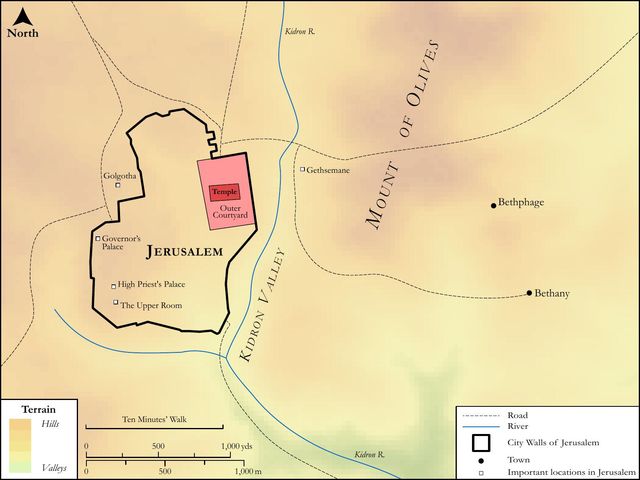
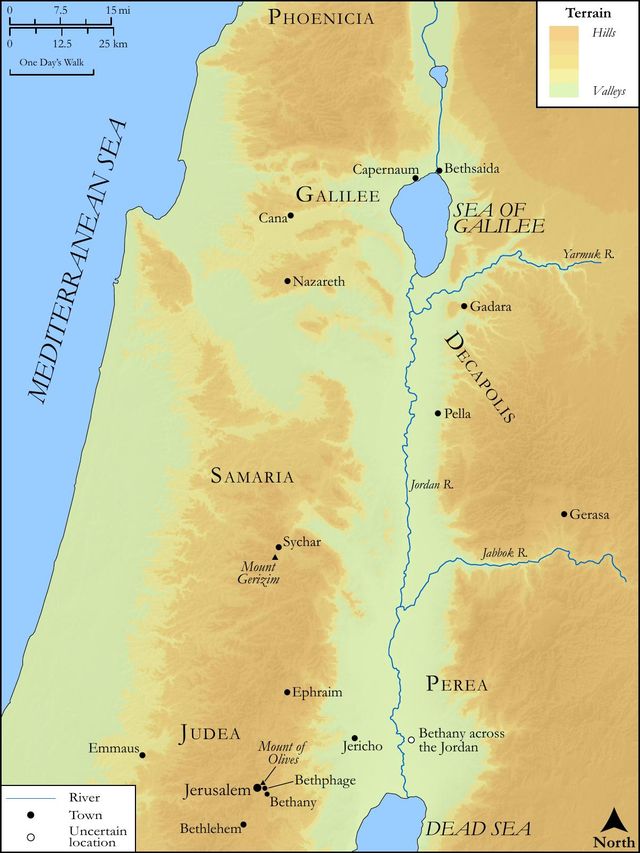
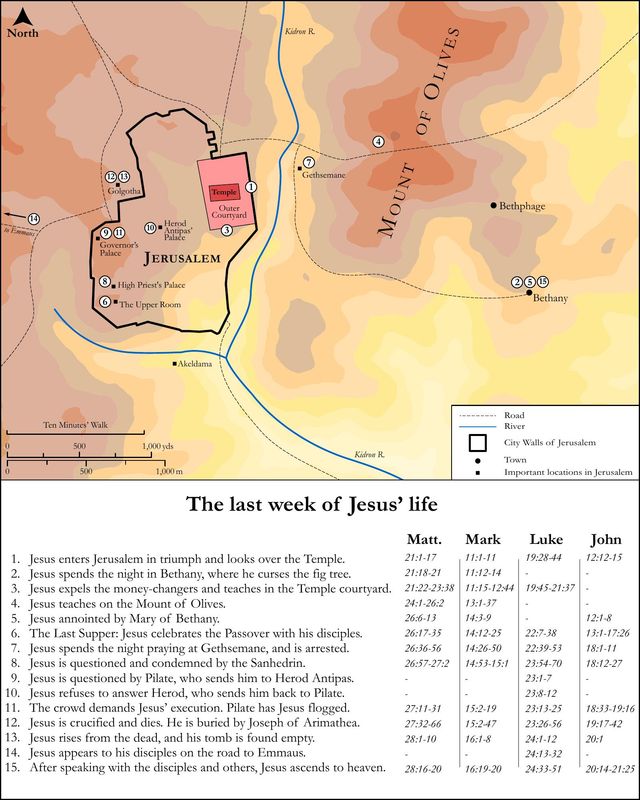
Study this verse
Public-domain commentary
Matthew Henry
From his Commentary on the Whole Bible. Henry comments on passages, not single verses — this entry covers John 16:7–15. His four-level outline is real structure in the source text, so it is rendered as structure.
As it was usual with the Old Testament prophets to comfort the church in its calamities with the promise of the Messiah (Isa 9:6; Mic 5:6; Zac 3:8); so, the Messiah being come, the promise of the Spirit was the great cordial, and is still.
Three things we have here concerning the Comforter's coming: -
I.That Christ's departure was absolutely necessary to the Comforter's coming, Joh 16:7.
The disciples were so loth to believe this that Christ saw cause to assert it with a more than ordinary solemnity: I tell you the truth. We may be confident of the truth of everything that Christ told us; he has no design to impose upon us. Now, to make them easy, he here tells them,
1.In general, It was expedient for them that he should go away. This was strange doctrine, but if it was true it was comfortable enough, and showed them how absurd their sorrow was. It is expedient, not only for me, but for you also, that I go away; though they did not see it, and are loth to believe it, so it is. Note,
(1.)Those things often seem grievous to us that are really expedient for us; and particularly our going away when we have finished our course.
(2.)Our Lord Jesus is always for that which is most expedient for us, whether we think so or no. He deals not with us according to the folly of our own choice, but graciously over-rules it, and gives us the physic we are loth to take, because he knows it is good for us.
2.It was therefore expedient because it was in order to the sending of the Spirit. Now observe,
(1.)That Christ's going was in order to the Comforter's coming.
[1.]This is expressed negatively: If I go not away, the Comforter will not come. And why not? First, So it was settled in the divine counsels concerning this affair, and the measure must not be altered; shall the earth be forsaken for them? He that gives freely may recall one gift before he bestows another, while we would fondly hold all. Secondly, It is congruous enough that the ambassador extraordinary should be recalled, before the envoy come, that is constantly to reside. Thirdly, The sending of the Spirit was to be the fruit of Christ's purchase, and that purchase was to be made by his death, which was his going away. Fourthly, It was to be an answer to his intercession within the veil. See Joh 14:16. Thus must this gift be both paid for, and prayed for, by our Lord Jesus, that we might learn to put the greater value upon it. Fifthly, The great argument the Spirit was to use in convincing the world must be Christ's ascension into heaven, and his welcome here. See Joh 16:10, and Joh 7:39. Lastly, The disciples must be weaned from his bodily presence, which they were too apt to dote upon, before they were duly prepared to receive the spiritual aids and comforts of a new dispensation.
[2.]It is expressed positively: If I depart I will send him to you; as though he had said, "Trust me to provide effectually that you shall be no loser by my departure." The glorified Redeemer is not unmindful of his church on earth, nor will ever leave it without its necessary supports. Though he departs, he sends the Comforter, nay, he departs on purpose to send him. Thus still, though one generation of ministers and Christians depart, another is raised up in their room, for Christ will maintain his own cause.
(2.)That the presence of Christ's Spirit in his church is so much better, and more desirable, than his bodily presence, that it was really expedient for us that he should go away, to send the Comforter. His corporal presence could be put in one place at one time, but his Spirit is every where, in all places, at all times, wherever two or three are gathered in his name. Christ's bodily presence draws men's eyes, his Spirit draws their hearts; that was the letter which kills, his Spirit gives life.
II.That the coming of the Spirit was absolutely necessary to the carrying on of Christ's interests on earth (Joh 16:8):
And when he is come, elthōn ekeinos. He that is sent is willing of himself to come, and at his first coming he will do this, he will reprove, or, as the margin reads it, he will convince the world, by your ministry, concerning sin, righteousness, and judgment.
1.See here what the office of the Spirit is, and on what errand he is sent.
(1.)To reprove. The Spirit, by the word and conscience, is a reprover; ministers are reprovers by office, and by them the Spirit reproves.
(2.)To convince. It is a law-term, and speaks the office of the judge in summing up the evidence, and setting a matter that has been long canvassed in a clear and true light. He shall convince, that is, "He shall put to silence the adversaries of Christ and his cause, by discovering and demonstrating the falsehood and fallacy of that which they have maintained, and the truth and certainty of that which they have opposed." Note, Convincing work is the Spirit's work; he can do it effectually, and none but he; man may open the cause, but it is the Spirit only that can open the heart. The Spirit is called the Comforter (Joh 16:7), and here it is said, He shall convince. One would think this were cold comfort, but it is the method the Spirit takes, first to convince, and then to comfort; first to lay open the wound, and then to apply healing medicines. Or, taking conviction more generally, for a demonstration of what is right, it intimates that the Spirit's comforts are solid, and grounded upon truth.
2.See who they are whom he is to reprove and convince: The world, both Jew and Gentile.
(1.)He shall give the world the most powerful means of conviction, for the apostles shall go into all the world, backed by the Spirit, to preach the gospel, fully proved.
(2.)He shall sufficiently provide for the taking off and silencing of the objections and prejudices of the world against the gospel. Many an infidel was convinced of all and judged of all, Co1 14:24.
(3.)He shall effectually and savingly convince many in the world, some in every age, in every place, in order to their conversion to the faith of Christ. Now this was an encouragement to the disciples, in reference to the difficulties they were likely to meet with,
[1.]That they should see good done, Satan's kingdom fall like lightning, which would be their joy, as it was his. Even this malignant world the Spirit shall work upon; and the conviction of sinners is the comfort of faithful ministers.
[2.]That this would be the fruit of their services and sufferings, these should contribute very much to this good work.
3.See what the Spirit shall convince the world of.
(1.)Of sin (Joh 16:9), because they believe not on me.
[1.]The Spirit is sent to convince sinners of sin, not barely to tell them of it; in conviction there is more than this; it is to prove it upon them, and force them to own it, as they (Joh 8:9) that were convicted of their own consciences. Make them to know their abominations. The Spirit convinces of the fact of sin, that we have done so and so; of the fault of sin, that we have done ill in doing so; of the folly of sin, that we have acted against right reason, and our true interest; of the filth of sin, that by it we are become odious to God; of the fountain of sin, the corrupt nature; and lastly, of the fruit of sin, that the end thereof is death. The Spirit demonstrates the depravity and degeneracy of the whole world, that all the world is guilty before God.
[2.]The Spirit, in conviction, fastens especially upon the sin of unbelief, their not believing in Christ, First, As the great reigning sin. There was, and is, a world of people, that believe not in Jesus Christ, and they are not sensible that it is their sin. Natural conscience tells them that murder and theft are sin; but it is a supernatural work of the spirit to convince them that it is a sin to suspend their belief of the gospel, and to reject the salvation offered by it. Natural religion, after it has given us its best discoveries and directions, lays and leaves us under this further obligation, that whatever divine revelation shall be made to us at any time, with sufficient evidence to prove it divine, we accept it, and submit to it. This law those transgress who, when God speaketh to us by his Son, refuse him that speaketh; and therefore it is sin. Secondly, As the great ruining sin. Every sin is so in its own nature; no sin is so to them that believe in Christ; so that it is unbelief that damns sinners. It is because of this that they cannot enter into rest, that they cannot escape the wrath of God; it is a sin against the remedy. Thirdly, As that which is at the bottom of all sin; so Calvin takes it. The Spirit shall convince the world that the true reason why sin reigns among them is because they are not by faith united to Christ. Ne putimus vel guttam unam rectitudinis sine Christo nobis inesse - Let us not suppose that, apart from Christ, we have a drop of rectitude. - Calvin.
(2.)Of righteousness, because I go to my Father, and you see me no more, Joh 16:10. We may understand this,
[1.]Of Christ's personal righteousness. He shall convince the world that Jesus of Nazareth was Christ the righteous (Jo1 2:1), as the centurion owned (Luk 23:47), Certainly this was a righteous man. His enemies put him under the worst of characters, and multitudes were not or would not be convinced but that he was a bad man, which strengthened their prejudices against his doctrine; but he is justified by the spirit (Ti1 3:16), he is proved to be a righteous man, and not, a deceiver; and then the point is in effect gained; for he is either the great Redeemer or a great cheat; but a cheat we are sure he is not. Now by what medium or argument will the Spirit convince men of the sincerity of the Lord Jesus? Why, First, Their seeing him no more will contribute something towards the removal of their prejudices; they shall see him no more in the likeness of sinful flesh, in the form of a servant, which made them slight him. Moses was more respected after his removal than before. But, Secondly, His going to the Father would be a full conviction of it. The coming of the Spirit, according to the promise, was a proof of Christ's exaltation to God's right hand (Act 2:33), and this was a demonstration of his righteousness; for the holy God would never set a deceiver at his right hand.
[2.]Of Christ's righteousness communicated to us for our justification and salvation; that everlasting righteousness which Messiah was to bring in, Dan 9:24. Now, First, The Spirit shall convince men of this righteousness. Having by convictions of sin shown them their need of a righteousness, lest this should drive them to despair he will show them where it is to be had, and how they may, upon their believing, be acquitted from guilt, and accepted as righteous in God's sight. It was hard to convince those of this righteousness that went about to establish their own (Rom 10:3), but the Spirit will do it. Secondly, Christ's ascension is the great argument proper to convince men of this righteousness: I go to the Father, and, as an evidence of my welcome with him, you shall see me no more. If Christ had left any part of his undertaking unfinished, he had been sent back again; but now that we are sure he is at the right hand of God, we are sure of being justified through him.
(3.)Of judgment, because the prince of this world is judged, Joh 16:11. Observe here,
[1.]The devil, the prince of this world, was judged, was discovered to be a great deceiver and destroyer, and as such judgment was entered against him, and execution in part done. He was cast out of the Gentile world when his oracles were silenced and his altars deserted, cast out of the bodies of many in Christ's name, which miraculous power continued long in the church; he was cast out of the souls of people by the grace of God working with the gospel of Christ; he fell as lightning from heaven.
[2.]This is a good argument wherewith the Spirit convinces the world of judgment, that is, First, Of inherent holiness and sanctification, Mat 12:18. By the judgment of the prince of this world, it appears that Christ is stronger than Satan, and can disarm and dispossess him, and set up his throne upon the ruin of his. Secondly, Of a new and better dispensation of things. He shall show that Christ's errand into the world was to set things to right in it, and to introduce times of reformation and regeneration; and he proves it by this, that the prince of this world, the great master of misrule, is judged and expelled. All will be well when his power is broken who made the mischief. Thirdly, Of the power and dominion of the Lord Jesus. He shall convince the world that all judgment is committed to him, and that he is the Lord of all, which is evident by this, that he has judged the prince of this world, has broken the serpent's head, destroyed him that had the power of death, and spoiled principalities; if Satan be thus subdued by Christ, we may be sure no other power can stand before him. Fourthly, Of the final day of judgment: all the obstinate enemies of Christ's gospel and kingdom shall certainly be reckoned with at last, for the devil, their ringleader, is judged.
III.That the coming of the Spirit would be of unspeakable advantage to the disciples themselves.
The Spirit has work to do, not only on the enemies of Christ, to convince and humble them, but upon his servants and agents, to instruct and comfort them; and therefore it was expedient for them that he should go away.
1.He intimates to them the tender sense he had of their present weakness (Joh 16:12): I have yet many things to say unto you (not which should have been said, but which he could and would have said), but you cannot bear them now. See what a teacher Christ is.
(1.)None like him for copiousness; when he has said much, he has still many things more to say; treasures of wisdom and knowledge are hid in him, if we be not straitened in ourselves.
(2.)None like him for compassion; he would have told them more of the things pertaining to the kingdom of God, particularly of the rejection of the Jews and the calling of the Gentiles, but they could not bear it, it would have confounded and stumbled them, rather than have given them any satisfaction. When, after his resurrection, they spoke to him of restoring the kingdom to Israel, he referred them to the coming of the Holy Ghost, by which they should receive power to bear those discoveries which were so contrary to the notions they had received that they could not bear them now.
2.He assures them of sufficient assistances, by the pouring out of the Spirit. They were now conscious to themselves of great dulness, and many mistakes; and what shall they do now their master is leaving them? "But when he, the Spirit of Truth, is come, you will be easy, and all will be well." Well indeed; for he shall undertake to guide the apostles, and glorify Christ.
(1.)To guide the apostles. He will take care,
[1.]That they do not miss their way: He will guide you; as the camp of Israel was guided through the wilderness by the pillar of cloud and fire. The Spirit guided their tongues in speaking, and their pens in writing, to secure them from mistakes. The Spirit is given us to be our guide (Rom 8:14), not only to show us the way, but to go along with us, by his continued aids and influences.
[2.]That they do not come short of their end: He will guide them into all truth, as the skilful pilot guides the ship into the port it is bound for. To be led into a truth is more than barely to know it; it is to be intimately and experimentally acquainted with it; to be piously and strongly affected with it; not only to have the notion of it in our heads, but the relish and savour and power of it in our hearts; it denotes a gradual discovery of truth shining more and more: "He shall lead you by those truths that are plain and easy to those that are more difficult." But how into all truth? The meaning is,
First, Into the whole truth relating to their embassy; whatever was needful or useful for them to know, in order to the due discharge of their office, they should be fully instructed in it; what truths they were to teach others the Spirit would teach them, would give them the understanding of, and enable them both to explain and to defend.
Secondly, Into nothing but the truth. All that he shall guide you into shall be truth (Jo1 2:27); the anointing is truth. In the following words he proves both these: - 1. "The Spirit shall teach nothing but the truth, for he shall not speak of himself any doctrine distinct from mine, but whatsoever he shall hear, and knows to be the mind of the Father, that, and that only, shall he speak." This intimates, (1.) That the testimony of the Spirit, in the word and by the apostles, is what we may rely upon. The Spirit knows and searches all things, even the deep things of God, and the apostles received that Spirit (Co1 2:10, Co1 2:11), so that we may venture our souls upon the Spirit's word. (2.) That the testimony of the Spirit always concurs with the word of Christ, for he does not speak of himself, has no separate interest or intention of his own, but, as in essence so in records, he is one with the Father and the Son, Jo1 5:7. Men's word and spirit often disagree, but the eternal Word and the eternal Spirit never do. 2. "He shall teach you all truth, and keep back nothing that is profitable for you, for he will show you things to come." The Spirit was in the apostles a Spirit of prophecy; it was foretold that he should be so (Joe 2:28), and he was so. The Spirit showed them things to come, as Act 11:28; Act 20:23; Act 21:11. The Spirit spoke of the apostasy of the latter times, Ti1 4:1. John, when he was in the Spirit had things to come shown him in vision. Now this was a great satisfaction to their own minds, and of use to them in their conduct, and was also a great confirmation of their mission. Jansenius has a pious note upon this: We should not grudge that the Spirit does not show us things to come in this world, as he did to the apostles; let it suffice that the Spirit in the word hath shown us things to come in the other world, which are our chief concern.
(2.)The Spirit undertook to glorify Christ, Joh 16:14, Joh 16:15.
[1.]Even the sending of the Spirit was the glorifying of Christ. God the Father glorified him in heaven, and the Spirit glorified him on earth. It was the honour of the Redeemer that the Spirit was both sent in his name and sent on his errand, to carry on and perfect his undertaking. All the gifts and graces of the Spirit, all the preaching and all the writing of the apostles, under the influence of the Spirit, the tongues, and miracles, were to glorify Christ.
[2.]The Spirit glorified Christ by leading his followers into the truth as it is in Jesus, Eph 4:21. He assures them, First, that the Spirit should communicate the things of Christ to them: He shall receive of mine, and shall show it unto you. As in essence he proceeded from the Son, so in influence and operation he derived from him. He shall take ek tou emou - of that which is mine. All that the Spirit shows us, that is, applies to us, for our instruction and comfort, all that he gives us for our strength and quickening, and all that he secures and seals to us, did all belong to Christ, and was had and received from him. All was his, for he bought it, and paid dearly for it, and therefore he had reason to call it his own; his, for he first received it; it was given him as the head of the church, to be communicated by him to all his members. The Spirit came not to erect a new kingdom, but to advance and establish the same kingdom that Christ had erected, to maintain the same interest and pursue the same design; those therefore that pretend to the Spirit, and vilify Christ, give themselves the lie, for he came to glorify Christ. Secondly, That herein the things of God should be communicated to us. Lest any should think that the receiving of this would not make them much the richer, he adds, All things that the Father hath are mine. As God, all that self-existent light and self-sufficient happiness which the Father has, he has; as Mediator, all things are delivered to him of the Father (Mat 11:27); all that grace and truth which God designed to show us he lodged in the hands of the Lord Jesus, Col 1:19. Spiritual blessings in heavenly things are given by the Father to the Son for us, and the Son entrusts the Spirit to convey them to us. Some apply it to that which goes just before: He shall show you things to come, and so it is explained by Rev 1:1. God gave it to Christ, and he signified it to John, who wrote what the Spirit said, Rev 1:1.
Historical interpretation
Three Centuries of Reception
15 surviving comments on this verse. Each one is dated, so this reads as a timeline rather than a list.
Select a marker to jump to its quote. Markers stagger vertically where authors wrote within a few decades of each other.
And of the Holy Spirit, "He shall glorify Me, for He receives of Mine."
He is called "another Comforter," indeed; but in what way He is another we have already shown, "He shall receive of mine," says Christ, just as Christ Himself received of the Father's.
“All things that the Father has,” he says, “are mine”—and why not also the names? When therefore you read of God Almighty, and the Most High, and the God of hosts, and the King of Israel and “I am,” beware lest by these the Son also is shown to be of his own right God Almighty, as being the Word of God Almighty, and as having received power over all.
But the Paraclete, having many things to teach fully which the Lord deferred till He came, (according to the pre-definition,) will begin by bearing emphatic witness to Christ, (as being) such as we believe (Him to be), together with the whole order of God the Creator, and will glorify Him, and will "bring to remembrance" concerning Him.
He says, “He will take of mine,” as I myself have taken of the Father’s. So the close series of the Father in the Son and the Son in the Paraclete makes three who cohere, the one attached to the other.
The work and teaching of the Spirit will redound to my glory, for the Spirit also proceeds from me. For when he says “from me,” it is clear that he is also from the Father, for “what belongs to me belongs to the Father.” Then he hears again in the same manner the phrase “he will take from what is mine.” It is not as if some knowledge comes on the Spirit—and that at the present time. It would be a horrible thing, indeed, almost an evil conjecture, to state that the Spirit received his instruction when he was about to bring it to humankind. Indeed, it would be a horrible suggestion if someone should say that the Spirit was taught at all. Then he would no longer be believed to dwell in people and bring all wisdom to them, if he did not have some innate wisdom in him but rather needed to be taught. Thus, when he said, “he will take from what is mine and announce it to you,” he meant simply to say that the Spirit would proceed from him. The statements speak of lesser things since they are adapted to what is well known to people, but the real glory of the Spirit is greater since it pertains to divinity. Moreover, it is said that God listens to a person’s words. However, it is clear that nothing is added at that time to the knowledge of God but that even before we spoke our words, he knew our prayers and had created everything according to his knowledge from the very beginning of his creation, knowing full well the changes in emotions that would take place in his creatures. Nonetheless, it is still said, “Hear, O Lord” and “The Lord heard.” And yet it is not necessary for God to wait for anything in time, as if there would be some change in God because of the prayers of human beings, or as if God would gain some knowledge from what is being said. Rather, these words are being spoken in a human fashion, so to speak, while among the godly they are understood in a divine fashion. In your suppositions the unchanging and unchangeable nature of the glory of God is not purified because he hears people speaking. So then simply because the Spirit hears and receives something does not mean that he will receive any additional knowledge or a change to the unchanging nature of the Spirit.
To "receive" [or "take"] must be taken here in a sense agreeable to the divine nature. As the Son in giving is not deprived of what he gives or imparts to others with any loss of his own, so too the Holy Spirit does not receive what before he did not have. For if he received what before he did not have—the gift being transferred to another—the giver would be thereby a loser. We must understand then that the Holy Spirit receives from the Son that which belonged to his nature and that there are not two substances implied, one giving and the other receiving, but one substance only. In the same way, the Son too is said to receive from the Father that wherein he himself subsists. For neither is the Son anything but what is given him by the Father, nor is the Holy Spirit any substance but that which is given him by the Son.
(Didym. de Spir. Sanct. ut sup.) To receive must be taken here in a sense agreeable to the Divine Nature. As the Son in giving is not deprived of what He gives, nor imparts to others with any loss of His own, so too the Holy Ghost does not receive what before He had not; for if He received what before He had not, the gift being transferred to another, the giver would be thereby a loser. We must understand then that the Holy Ghost receives from the Son that which belonged to His nature, and that there are not two substances implied, one giving, and the other receiving, but one substance only. In like manner the Son too is said to receive from the Father that wherein He Himself Subsists. For neither is the Son any thing but what is given Him by the Father, nor the Holy Ghost any substance but that which is given Him by the Son.
(Hom. lxxviii. 2) In this way then He raised their spirits; for there is nothing for which mankind so long, as the knowledge of the future. He relieves them from all anxiety on this account, by showing that dangers would not fall upon them unawares. Then to show that He could have told them all the truth into which the Holy Spirit would lead them, He adds, He shall glorify Me.
(Hom. lxxviii. 2) And because He had said, Ye have one Master, even Christ, (Mat. 23:8) that they might not be prevented by this from admitting the Holy Ghost as well, He adds, For He shall receive of Mine, and shall show it unto you.
(Tr. c) By pouring love into the hearts of believers, and making them spiritual, and so able to see that the Son Whom they had known before only according to the flesh, and thought a man like themselves, was equal to the Father. Or certainly because that love filling them with boldness, and casting out fear, they proclaimed Christ to men, and so spread His fame throughout the whole world. For what they were going to do in the power of the Holy Ghost, this the Holy Ghost says He does Himself.
But that is not a true glory which He has among heretics, with whom, nevertheless, He appears to have a generally accepted fame accompanied with praise. Such is no true glory, because in both respects they are mistaken, for they both think that to be good which is not good, and they suppose Christ to be what Christ is not. For to say that the only-begotten Son is not equal to Him that begat, is not good: to say that the only-begotten Son of God is man only, and not God, is not good: to say that the flesh of the Truth is not true flesh, is not good. Of the three doctrines which I have stated, the first is held by the Arians, the second by the Photinians, and the third by the Manicheans. But inasmuch as there is nothing in any of them that is good, and Christ has nothing to do with them, in both respects they are in the wrong; and they attach no true glory to Christ, although there may appear to be amongst them a generally accepted fame regarding Christ of a laudatory character.
But the words that He proceeds to add, "He shall make me clearly known; for He shall receive of mine, and shall show it unto you," are not to be carelessly passed over. For by the words, "He shall make me clearly known," we may understand, that by shedding abroad God's love in the hearts of believers, and making them spiritual, He showed them how it was that the Son was equal to the Father, whom previously they had only known according to the flesh, and as men themselves had thought of Him only as man. Or at least that, filled themselves through that very love with boldness, and divested of all fear, they might proclaim Christ unto men; and so His fame be spread abroad through the whole world. So that He said, "He shall make me clearly known," as if meaning, He shall free you from fear, and endow you with a love that will so inflame your zeal in preaching me, that you will send forth the odor, and commend the honor of, my glory throughout the world. For what they were to do in the Holy Spirit, He said that the Spirit Himself would also do, as is implied in the words, "For it is not ye that speak, but the Spirit of your Father that speaketh in you." The Greek word, indeed, which is doxasei, has been rendered by the Latin interpreters in their respective translations, clarificabit ("shall make clearly known") by one, and glorificabit ("shall glorify") by another: for the idea expressed in Greek by the one term doxa, from which is derived the verb doxasei, may be interpreted both by claritas (brightness) and gloria (glory). For by glory every one becomes bright, and glorious by brightness; and hence what is signified by both words, is one and the same thing.
And, as the most famous writers of the Latin tongue in olden time have defined it, glory is the generally diffused and accepted fame of any one accompanied with praise. But when this happened in the world in regard to Christ, we are not to suppose that it was the bestowing of any great thing on Christ, but on the world. For to praise what is good is not of benefit to that which receives, but to those who give the commendation.
His true glory, therefore, in the Catholic Church is celebrated in these words by the prophet: "Be thou exalted, O God, above the heavens; and Thy glory above all the earth." Accordingly, that after His exaltation the Holy Spirit was to come, and to glorify Him, the sacred psalm, and the Only-begotten Himself, promised as an event of the future, which we see accomplished.
As the Holy Spirit was about to reveal to those who should be found worthy the mystery that is in Christ, and to demonstrate completely Who He is by nature, and how great is His power and might, and that He reigneth over all with the Father, Christ is impelled to say, He shall glorify Me. For He sets our mind above the conceits of the Jews, and does not suffer us to entertain so limited and dwarfed a conception as to think that He is a mere Man, slightly surpassing the prophets in the stature they attained, or even falling short of their renown----for we find that the leaders of the Jews had this idea concerning Him, because they not knowing the mystery of piety, frequently uttered blasphemies against Christ, and, encountering His sayings with their mad folly, said on one occasion: Who art Thou? Abraham is dead, and the prophets are dead; and Thou sayest, If a man keep My word, He shall never see death. Whom makest Thou Thyself? And on another occasion they cast in His teeth the meanness of His birth according to the flesh, and His great insignificance in this respect: Is not this the son of Joseph, whose father and mother we know? How then doth He say, I am come down out of heaven? Note herein the miserable reasoning of the Jews. As then the multitude were so disposed and thought that the Lord was not truly God because in this human frame He was liable to death, and because they did not scruple to entertain the basest conception of His Nature, the Spirit, when He came down from heaven, illustrated completely His glory to the Saints; not that we should say, that He merely convinced them by wise words, but that He by actual proof also satisfied the minds of all that He was truly God, and the fruit of the Substance of God the Father. What then is this proof? And how did He increase the honour and admiration in which Christ was held? By exercising His activity universally in a marvellous and Divine manner, and by implanting in the Saints complete and perfect knowledge, He furthered His glory. For to the Sovereign Nature of the Universe alone must we ascribe omniscience and the sight of all things naked and laid open to the view, and the ability to accomplish all His purposes.
The Comforter then, that is, His own Spirit, being omnipotent and omniscient, glorifies the Son. And how does He glorify Him? Surely what His Spirit knows and is able to effect, Christ knows and is able to effect. And if, as He says, the Spirit receives of Him, the Spirit Himself being omnipotent, surely He Himself has a power which is universal. And we must in no wise suppose that the Comforter, that is, the Spirit, is lacking in innate and inherent power in such a way that, if He did not receive assistance from without, His own power would not be self-sufficient to fully accomplish the Divine designs. Any one who merely imagined any such idea to be true about the Spirit would with good reason undergo the charge of the worst blasphemy of all. But it is because He is Consubstantial with the Son, and divinely proceeds through Him, exercising universally His entire activity and power, that Christ says, "He shall receive of Me." For we believe that the Spirit has a self-supporting existence and is in truth that which He is, and with the qualities predicated of Him; though, being inherent in the Substance of God, He proceeds and issues from it and has innate in Himself all that that nature implies. For the Divine Substance is not His by participation or by relation, still less is It His as though He had a separate existence from It, since He is an attribute of It. For just as the fragrance of sweet-smelling flowers, proceeding in some sort from the essential and natural exercise of the functions or qualities of the flowers that emit it, conveys the perception thereof to the outer world by meeting those organs of smell in the body, and yet seems in some way, so far as its logical conception goes, to be separate from its natural cause, while (as having no independent existence) it is not separate in nature from the source from which it proceeds and in which it exists, even so you may conceive of the relation of God and the Holy Spirit, taking this by way of illustration. In this way then the statement that His Spirit receives something from the Only-begotten is wholly unimpeachable and cannot be cavilled at. For proceeding naturally as His attribute through Him, and having all that He has in its entirety, He is said to receive that which He has. And if this meaning is conveyed in language that is obscure, far from being offended at it, we should with more justice lay the blame on the poverty of our own language, which is not able to give expression to Divine truths in a suitable way. And what language is adequate to explain the ineffable Nature and Glory of God? He says then that the Comforter "will receive of Mine, and will show it unto you;" that is, He will say nothing that is not in harmony with My purpose; but, since He is My Spirit, His language will be in every way identical with Mine, and He will show you of My Will.
Continue studying John 16:14 across the web’s major study libraries — every link below opens this exact verse, chapter, or book on the destination site.
Read & Compare
 BibleGatewayThis verse in more than 200 translations and 70 languages.
 Bible.comThe YouVersion reader — hundreds of translations, reading plans, and highlights.
 ESV.orgCrossway's official English Standard Version reader.
 NET BibleThe NET translation with 60,000+ translators' notes on every rendering decision.
 STEP BibleTyndale House's free study tool — original text, vocabulary, and scholarly resources.
 BibliaLogos Bible Software's free web reader.
 USCCBThe New American Bible (Revised Edition) with the U.S. bishops' study notes.
Commentaries
 BibleHub CommentariesDozens of classic commentaries on this verse, gathered on one page.
 StudyLightMore than 100 commentary sets — the largest collection on the web.
 BibleRefPlain-English commentary on what this verse means, verse by verse.
 Enduring WordDavid Guzik's free commentary on this chapter, widely used by Bible teachers.
 Bible Study ToolsVerse commentary alongside Greek and Hebrew study aids.
Original Language & Research
- BibleHub InterlinearThe verse word by word — original language, transliteration, and English.
- BibleHub LexiconEvery word's original-language definition and Strong's entry.
 Blue Letter BibleDeep-study tools — Strong's numbers, concordance, and word studies.
 CNTR CollationThe earliest Greek manuscripts of this verse, collated letter by letter.
Sermons, Hymns & Audio


TrulyRandomVerse is not affiliated with these sites and doesn’t control their content. They’re linked because they’re genuinely useful.
Summary
In Jesus reveals a profound truth about the mission of the Holy Spirit: His primary purpose is to glorify the Son. The Spirit achieves this by receiving the very essence and truth of Christ—His person, His words, His work, and His glory—and then declaring or unveiling these realities to the disciples. This verse underscores the complete unity of purpose within the Godhead, emphasizing that the Holy Spirit does not draw attention to Himself but serves as the divine agent who illuminates and exalts Jesus Christ, making His presence and truth known to believers.
Context
ShowHideLiterary Context
John 16:14 is situated within Jesus' extensive Farewell Discourse, spanning John chapters 13 through 17. This discourse, delivered in the intimate setting of the Upper Room just hours before His crucifixion, is a pivotal moment where Jesus prepares His disciples for His imminent physical departure and the subsequent advent of the Holy Spirit. Earlier in this discourse, Jesus introduces the Spirit as the "Advocate" or "Helper" (Greek: Paraclete) who will come after He leaves (John 14:16). He assures them the Spirit will teach them all things (John 14:26) and bear witness to Him (John 15:26). Immediately preceding John 16:14, Jesus explains that the Spirit will convict the world concerning sin, righteousness, and judgment (John 16:8-11), and will guide the disciples into all truth, speaking not on His own authority but declaring what He hears and proclaiming what is yet to come (John 16:13). Thus, John 16:14 serves as the culmination of these explanations, succinctly stating the ultimate purpose and focus of the Spirit's entire ministry: the glorification of Jesus Christ.
Historical & Cultural Context
The disciples, deeply rooted in a monotheistic Jewish tradition, were struggling to comprehend Jesus' claims of divinity and His impending departure. Their understanding of God was primarily shaped by the Old Testament, where the Spirit of God (Ruach Elohim) was understood as the active presence and power of God, inspiring prophets and empowering leaders. However, the concept of a distinct "person" of God, the Holy Spirit, indwelling believers and continuing the work of a departed Messiah, was entirely new and revolutionary. Jesus' words in John 16:14 were designed to reassure them that His departure would not mean abandonment, but a new, more intimate form of His presence through the Spirit. Culturally, the idea of a "witness" or "advocate" (Paraclete) was familiar in legal contexts, but Jesus redefines this role in a spiritual, theological sense, emphasizing the Spirit's role in testifying to Him. The disciples' grief and confusion over Jesus' impending death also provided the backdrop for these comforting and instructive words, preparing them for a future where their understanding and witness would be Spirit-empowered.
Key Themes
ShowHideJohn 16:14 powerfully contributes to several overarching themes within John's Gospel and the broader biblical narrative. Firstly, it highlights the unity and distinct roles within the Trinity. While the Father, Son, and Holy Spirit are co-equal and co-eternal, this verse clarifies the Spirit's functional role in exalting the Son, demonstrating the harmonious cooperation within the Godhead. Secondly, it reinforces Christ's centrality and supremacy. The entire divine plan, including the Spirit's work, revolves around Jesus. The Spirit does not compete for glory but directs all attention to Christ's person and finished work, echoing themes found in John 1:1-18 and John 3:16. Thirdly, it speaks to the theme of divine revelation. The Spirit is presented as the agent who mediates divine truth from Christ to believers, illuminating their understanding of who Jesus is and what He has accomplished. This is consistent with Jesus' earlier promise that the Spirit would "guide you into all truth" (John 16:13). Finally, it underscores the continuity of Jesus' ministry through the Spirit. Even after Jesus' ascension, His work of teaching, revealing, and convicting continues on earth through the Holy Spirit, ensuring that His presence remains real and His message accessible to all generations of believers.
Exposition and Analysis
ShowHideKey Word Analysis
ShowHideFrom doxa (glory), this verb means "to render (or esteem) glorious," "to magnify," or "to cause to be held in high esteem." In this context, it signifies the Holy Spirit's work of revealing Jesus' inherent divine splendor, majesty, and true worth. The Spirit does not add glory to Jesus, but rather unveils and makes manifest the glory that is already His as the Son of God, enabling believers and the world to recognize and honor Him. This involves demonstrating Jesus' power, authority, wisdom, and love.
This verb means "to take," "to get hold of," or "to obtain." Here, it indicates that the Holy Spirit does not originate His own message or agenda. Instead, He "takes" or "receives" the very essence, teachings, character, and divine nature that belong to Jesus ("of mine"). This highlights the Spirit's complete alignment with and dependence upon the Son, ensuring that His revelation is always consistent with Christ's person and will. The Spirit's ministry is derivative, drawing from the inexhaustible wellspring of Christ's truth.
Meaning "to announce (in detail)," "to declare," "to report," or "to tell." This word describes the active role of the Holy Spirit in communicating and making known the things He has received from Christ. It implies a detailed, clear, and comprehensive proclamation. The Spirit doesn't merely hint at truth but expounds upon it, illuminating the minds and hearts of believers so they can grasp the depth and breadth of Christ's revelation. This "showing" is a continuous process, unfolding the truth about Jesus to His followers throughout history.
Verse Breakdown
ShowHide"He shall glorify me:"
This opening clause unequivocally states the primary mission and ultimate goal of the Holy Spirit's work. The "He" refers to the Holy Spirit, whom Jesus has been discussing as the promised Helper. The Spirit's entire ministry is oriented towards exalting, magnifying, and revealing the inherent glory of Jesus Christ. This means that any genuine work of the Spirit will ultimately direct attention and praise to the Son, demonstrating His divine nature, His perfect life, His atoning death, and His victorious resurrection.
"for he shall receive of mine,"
This explanatory clause reveals the mechanism by which the Spirit glorifies Jesus. The Spirit does not operate independently or invent new truths. Instead, He "receives" (takes, draws from) what belongs to Jesus. "Mine" (Greek: emou) refers to everything that pertains to Christ: His words, His teachings, His divine nature, His authority, His redemptive work, His character, and His very being. This emphasizes the Spirit's complete dependence on and unity with the Son, ensuring that the Spirit's revelation is always consistent with and derived from Christ Himself.
"and shall shew [it] unto you."
This final clause specifies the recipients and the practical outcome of the Spirit's work. Having received from Christ, the Spirit then "shows" (declares, announces, reveals) these truths to the disciples (and by extension, to all believers). This "showing" is an act of illumination, enabling spiritual understanding and insight into the person and work of Jesus. It implies that the Spirit makes Christ's presence real, His teachings comprehensible, and His glory evident to the hearts and minds of His followers, empowering them to live in light of His truth and to bear witness to Him.
Literary Devices
ShowHideThe verse employs several significant literary devices. Personification is evident in the portrayal of the Holy Spirit as an active, conscious agent who "glorifies," "receives," and "shows." This gives the Spirit a distinct identity and role within the divine economy, making His actions tangible and understandable to the disciples. There is also a strong element of Emphasis through repetition of the core idea of the Spirit's Christ-centered mission throughout the Farewell Discourse, culminating in this concise statement. The causal conjunction "for" (Greek: hoti) introduces a Reason/Explanation, clarifying how the Spirit will glorify Jesus, by receiving from Him. Finally, the verse functions as a Promise and Foreshadowing, assuring the disciples of the Spirit's future ministry and its profound impact on their understanding of and relationship with Christ after His physical departure.
Theological and Thematic Connections
ShowHideJohn 16:14 is a cornerstone for understanding the functional relationship within the Holy Trinity. It beautifully illustrates the unity of purpose between the Father, Son, and Holy Spirit, where each Person of the Godhead works in perfect concert to achieve the divine will. The Spirit's role is not to draw attention to Himself, but to direct all glory and honor to Jesus Christ, revealing His divine nature and redemptive work. This highlights the profound truth that all of God's revelation and redemptive activity is ultimately Christ-centered. The Spirit acts as the divine illuminator, taking the truth of Christ and making it accessible and real to human hearts, ensuring that the saving knowledge of Jesus is continually proclaimed and understood. This verse serves as a crucial theological safeguard, reminding us that any genuine spiritual experience or teaching will always elevate and magnify Jesus.
Reflection and Application
ShowHideJohn 16:14 offers profound implications for our spiritual lives and for the church today. It serves as a vital discernment principle: any genuine work of the Holy Spirit will ultimately point to and exalt Jesus Christ. If a teaching, ministry, or spiritual experience draws primary attention to itself, to human leaders, to manifestations, or even solely to the Spirit's power without glorifying Christ, it warrants careful scrutiny. Our worship, preaching, and personal devotion should always be Christ-centered, recognizing that the Spirit's role is to illuminate Jesus' person, His finished work on the cross, and His ongoing reign. This verse also encourages us to depend on the Holy Spirit for a deeper understanding of Christ. It is through His divine illumination that we truly grasp the depths of God's love revealed in Jesus, the power of His resurrection, and the wisdom of His teachings. As we yield to the Spirit, He continues to take what is Christ's and reveal it to us, transforming us into His likeness and empowering us to bear witness to Him in the world.
Questions for Reflection
ShowHideFAQ
ShowHideDoes the Holy Spirit have His own distinct ministry, or is He solely focused on Jesus?
ShowHideWhile the Holy Spirit is a distinct person of the Trinity with unique divine attributes and functions, John 16:14 clarifies that His primary mission is to glorify Jesus Christ. This does not mean He lacks His own distinct ministry, but rather that His ministry is always in perfect harmony with and directed towards exalting the Son. The Spirit convicts the world of sin, righteousness, and judgment (John 16:8), guides believers into all truth (John 16:13), empowers for witness (Acts 1:8), and distributes spiritual gifts (1 Corinthians 12:4-11). However, all these aspects of His work ultimately serve to reveal, magnify, and apply the person and work of Jesus Christ. He never draws attention to Himself but always points to the Son.
What does it mean for the Holy Spirit to "receive of mine" (Jesus')?
ShowHideThe phrase "he shall receive of mine" (Greek: lambánō ek tou emou) signifies that the Holy Spirit does not speak or act independently of Jesus. Instead, He draws from the very essence, truth, and authority that belong to Christ. This includes Jesus' words, His teachings, His divine nature, His redemptive work, His character, and His will. It means that the Spirit's revelation is always consistent with, derived from, and an unfolding of what Jesus has already revealed or accomplished. The Spirit is not a source of new, independent doctrines that contradict or go beyond Christ's revelation. Rather, He illuminates and applies the truth of Christ, making it comprehensible and real to believers, as seen in passages like John 14:26 where Jesus says the Spirit will "bring to your remembrance all that I have said to you."
Christ-Centered Fulfillment
ShowHideJohn 16:14 finds its profound Christ-centered fulfillment in the ongoing work of the Holy Spirit, who makes the person and finished work of Jesus Christ a living reality for believers. The Spirit's glorification of Jesus is not merely a theological concept but a dynamic, active process that began at Pentecost (Acts 2:1-4) and continues to this day. It is the Spirit who convicts the world of sin because they do not believe in Jesus (John 16:9). He testifies to Christ's righteousness, evidenced by His ascension to the Father (John 16:10), and reveals the judgment of the ruler of this world, who has been defeated by Christ's victory on the cross (John 16:11). For believers, the Spirit takes the truth of Christ's atoning sacrifice and resurrection, applying it to their hearts, leading to repentance and faith. He indwells them, making Christ's presence real within them (Romans 8:9-11), and transforms them into the image of Christ (2 Corinthians 3:18). Every genuine spiritual gift, every act of worship, every proclamation of the gospel empowered by the Spirit ultimately serves to magnify Jesus as Lord and Savior, demonstrating that Christ is indeed "all in all" (Colossians 3:11). Thus, the Spirit's mission is the fulfillment of Christ's redemptive purpose, ensuring that His glory is revealed throughout all creation.