


John 16:10
Bible text: King James Version (1769 Blayney text) · Public domain
Bible text: Berean Standard Bible · Public domain
Bible text: American Standard Version (1901) · Public domain
Bible text: World English Bible, Messianic edition · Public domain
Bible text: Geneva Bible (1599) · Public domain
Bible text: Young's Literal Translation · Public domain
- περὶpericoncerningG4012PREPPreposition
- δικαιοσύνηςdikaiosunēsrighteousnessG1343N-GSFNoun Genitive Singular Feminine
- δέdehoweverG1161CONJConjunction
- ὅτιhotibecauseG3754CONJConjunction
- πρὸςprostoG4314PREPPreposition
- τὸνtontheG3588T-ASMDefinite article Accusative Singular Masculine
- πατέραpateraFatherG3962N-ASM-TNoun Accusative Singular Masculine Title
- μουmouof mineG3165P-1GSPersonal pronoun Genitive 1st Singular
- ὑπάγωhupagōI go awayG5217V-PAI-1SVerb Present Active Indicative 1st Singular
- καὶkaiandG2532CONJConjunction
- οὐκέτιouketino longerG2089PRT-N + G2089=ADV
- θεωρεῖτέtheōreiteyou beholdG2334V-PAI-2PVerb Present Active Indicative 2nd Plural
- με·meMeG3165P-1ASPersonal pronoun Accusative 1st Singular
English is a literal word-by-word gloss of the Greek, not the KJV's wording. Why?
This is the original text the KJV's translators worked from — each Greek word with its own literal English meaning in this verse, prepared by scholars at Tyndale House, Cambridge. The KJV translates whole sentences, not word by word, so its wording differs: one Greek word can become several English words, and the KJV may choose “charity” where the gloss reads “love”. Both are faithful — they answer different questions. For the KJV's own rendering, switch to the KJV text.
Details
See on the biblical-era maps
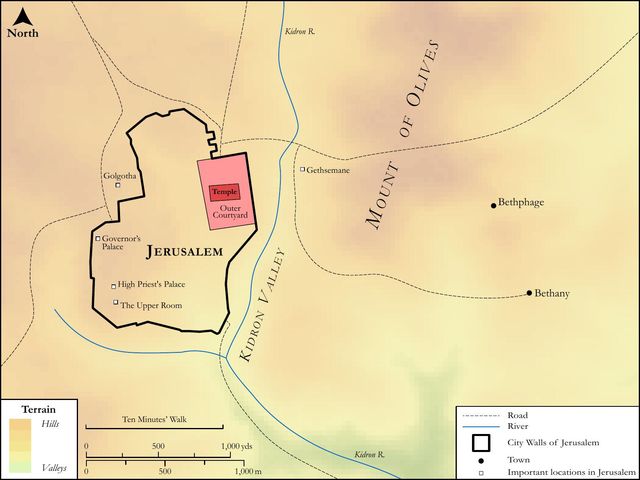
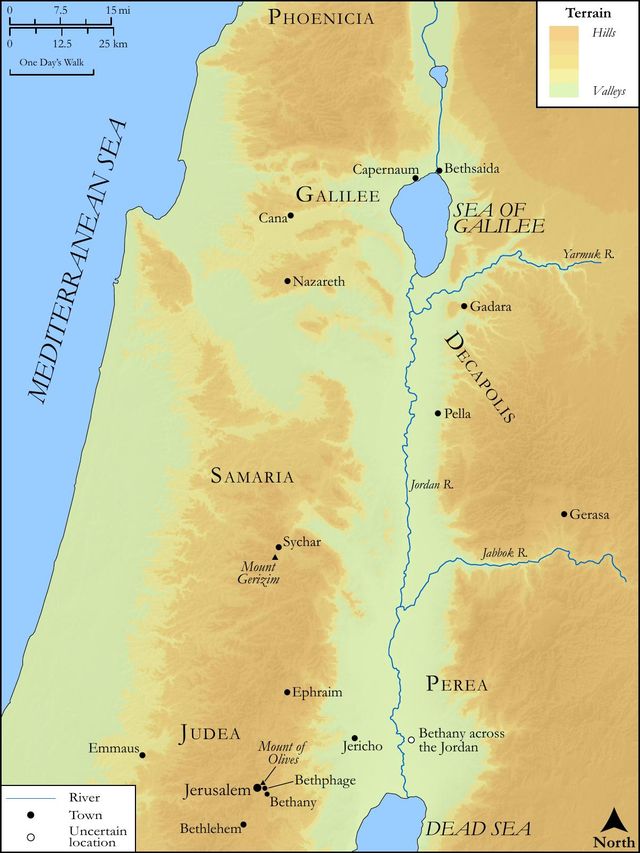
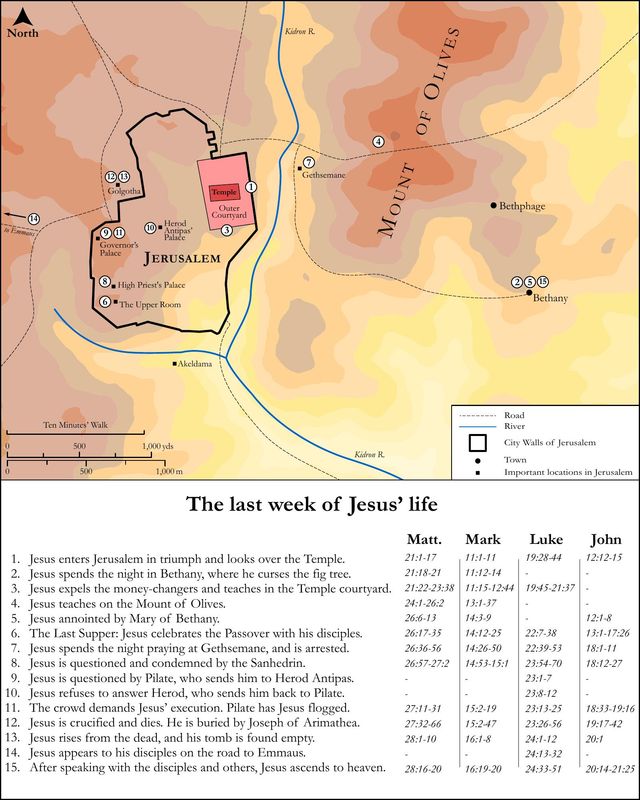
Study this verse
Public-domain commentary
Matthew Henry
From his Commentary on the Whole Bible. Henry comments on passages, not single verses — this entry covers John 16:7–15. His four-level outline is real structure in the source text, so it is rendered as structure.
As it was usual with the Old Testament prophets to comfort the church in its calamities with the promise of the Messiah (Isa 9:6; Mic 5:6; Zac 3:8); so, the Messiah being come, the promise of the Spirit was the great cordial, and is still.
Three things we have here concerning the Comforter's coming: -
I.That Christ's departure was absolutely necessary to the Comforter's coming, Joh 16:7.
The disciples were so loth to believe this that Christ saw cause to assert it with a more than ordinary solemnity: I tell you the truth. We may be confident of the truth of everything that Christ told us; he has no design to impose upon us. Now, to make them easy, he here tells them,
1.In general, It was expedient for them that he should go away. This was strange doctrine, but if it was true it was comfortable enough, and showed them how absurd their sorrow was. It is expedient, not only for me, but for you also, that I go away; though they did not see it, and are loth to believe it, so it is. Note,
(1.)Those things often seem grievous to us that are really expedient for us; and particularly our going away when we have finished our course.
(2.)Our Lord Jesus is always for that which is most expedient for us, whether we think so or no. He deals not with us according to the folly of our own choice, but graciously over-rules it, and gives us the physic we are loth to take, because he knows it is good for us.
2.It was therefore expedient because it was in order to the sending of the Spirit. Now observe,
(1.)That Christ's going was in order to the Comforter's coming.
[1.]This is expressed negatively: If I go not away, the Comforter will not come. And why not? First, So it was settled in the divine counsels concerning this affair, and the measure must not be altered; shall the earth be forsaken for them? He that gives freely may recall one gift before he bestows another, while we would fondly hold all. Secondly, It is congruous enough that the ambassador extraordinary should be recalled, before the envoy come, that is constantly to reside. Thirdly, The sending of the Spirit was to be the fruit of Christ's purchase, and that purchase was to be made by his death, which was his going away. Fourthly, It was to be an answer to his intercession within the veil. See Joh 14:16. Thus must this gift be both paid for, and prayed for, by our Lord Jesus, that we might learn to put the greater value upon it. Fifthly, The great argument the Spirit was to use in convincing the world must be Christ's ascension into heaven, and his welcome here. See Joh 16:10, and Joh 7:39. Lastly, The disciples must be weaned from his bodily presence, which they were too apt to dote upon, before they were duly prepared to receive the spiritual aids and comforts of a new dispensation.
[2.]It is expressed positively: If I depart I will send him to you; as though he had said, "Trust me to provide effectually that you shall be no loser by my departure." The glorified Redeemer is not unmindful of his church on earth, nor will ever leave it without its necessary supports. Though he departs, he sends the Comforter, nay, he departs on purpose to send him. Thus still, though one generation of ministers and Christians depart, another is raised up in their room, for Christ will maintain his own cause.
(2.)That the presence of Christ's Spirit in his church is so much better, and more desirable, than his bodily presence, that it was really expedient for us that he should go away, to send the Comforter. His corporal presence could be put in one place at one time, but his Spirit is every where, in all places, at all times, wherever two or three are gathered in his name. Christ's bodily presence draws men's eyes, his Spirit draws their hearts; that was the letter which kills, his Spirit gives life.
II.That the coming of the Spirit was absolutely necessary to the carrying on of Christ's interests on earth (Joh 16:8):
And when he is come, elthōn ekeinos. He that is sent is willing of himself to come, and at his first coming he will do this, he will reprove, or, as the margin reads it, he will convince the world, by your ministry, concerning sin, righteousness, and judgment.
1.See here what the office of the Spirit is, and on what errand he is sent.
(1.)To reprove. The Spirit, by the word and conscience, is a reprover; ministers are reprovers by office, and by them the Spirit reproves.
(2.)To convince. It is a law-term, and speaks the office of the judge in summing up the evidence, and setting a matter that has been long canvassed in a clear and true light. He shall convince, that is, "He shall put to silence the adversaries of Christ and his cause, by discovering and demonstrating the falsehood and fallacy of that which they have maintained, and the truth and certainty of that which they have opposed." Note, Convincing work is the Spirit's work; he can do it effectually, and none but he; man may open the cause, but it is the Spirit only that can open the heart. The Spirit is called the Comforter (Joh 16:7), and here it is said, He shall convince. One would think this were cold comfort, but it is the method the Spirit takes, first to convince, and then to comfort; first to lay open the wound, and then to apply healing medicines. Or, taking conviction more generally, for a demonstration of what is right, it intimates that the Spirit's comforts are solid, and grounded upon truth.
2.See who they are whom he is to reprove and convince: The world, both Jew and Gentile.
(1.)He shall give the world the most powerful means of conviction, for the apostles shall go into all the world, backed by the Spirit, to preach the gospel, fully proved.
(2.)He shall sufficiently provide for the taking off and silencing of the objections and prejudices of the world against the gospel. Many an infidel was convinced of all and judged of all, Co1 14:24.
(3.)He shall effectually and savingly convince many in the world, some in every age, in every place, in order to their conversion to the faith of Christ. Now this was an encouragement to the disciples, in reference to the difficulties they were likely to meet with,
[1.]That they should see good done, Satan's kingdom fall like lightning, which would be their joy, as it was his. Even this malignant world the Spirit shall work upon; and the conviction of sinners is the comfort of faithful ministers.
[2.]That this would be the fruit of their services and sufferings, these should contribute very much to this good work.
3.See what the Spirit shall convince the world of.
(1.)Of sin (Joh 16:9), because they believe not on me.
[1.]The Spirit is sent to convince sinners of sin, not barely to tell them of it; in conviction there is more than this; it is to prove it upon them, and force them to own it, as they (Joh 8:9) that were convicted of their own consciences. Make them to know their abominations. The Spirit convinces of the fact of sin, that we have done so and so; of the fault of sin, that we have done ill in doing so; of the folly of sin, that we have acted against right reason, and our true interest; of the filth of sin, that by it we are become odious to God; of the fountain of sin, the corrupt nature; and lastly, of the fruit of sin, that the end thereof is death. The Spirit demonstrates the depravity and degeneracy of the whole world, that all the world is guilty before God.
[2.]The Spirit, in conviction, fastens especially upon the sin of unbelief, their not believing in Christ, First, As the great reigning sin. There was, and is, a world of people, that believe not in Jesus Christ, and they are not sensible that it is their sin. Natural conscience tells them that murder and theft are sin; but it is a supernatural work of the spirit to convince them that it is a sin to suspend their belief of the gospel, and to reject the salvation offered by it. Natural religion, after it has given us its best discoveries and directions, lays and leaves us under this further obligation, that whatever divine revelation shall be made to us at any time, with sufficient evidence to prove it divine, we accept it, and submit to it. This law those transgress who, when God speaketh to us by his Son, refuse him that speaketh; and therefore it is sin. Secondly, As the great ruining sin. Every sin is so in its own nature; no sin is so to them that believe in Christ; so that it is unbelief that damns sinners. It is because of this that they cannot enter into rest, that they cannot escape the wrath of God; it is a sin against the remedy. Thirdly, As that which is at the bottom of all sin; so Calvin takes it. The Spirit shall convince the world that the true reason why sin reigns among them is because they are not by faith united to Christ. Ne putimus vel guttam unam rectitudinis sine Christo nobis inesse - Let us not suppose that, apart from Christ, we have a drop of rectitude. - Calvin.
(2.)Of righteousness, because I go to my Father, and you see me no more, Joh 16:10. We may understand this,
[1.]Of Christ's personal righteousness. He shall convince the world that Jesus of Nazareth was Christ the righteous (Jo1 2:1), as the centurion owned (Luk 23:47), Certainly this was a righteous man. His enemies put him under the worst of characters, and multitudes were not or would not be convinced but that he was a bad man, which strengthened their prejudices against his doctrine; but he is justified by the spirit (Ti1 3:16), he is proved to be a righteous man, and not, a deceiver; and then the point is in effect gained; for he is either the great Redeemer or a great cheat; but a cheat we are sure he is not. Now by what medium or argument will the Spirit convince men of the sincerity of the Lord Jesus? Why, First, Their seeing him no more will contribute something towards the removal of their prejudices; they shall see him no more in the likeness of sinful flesh, in the form of a servant, which made them slight him. Moses was more respected after his removal than before. But, Secondly, His going to the Father would be a full conviction of it. The coming of the Spirit, according to the promise, was a proof of Christ's exaltation to God's right hand (Act 2:33), and this was a demonstration of his righteousness; for the holy God would never set a deceiver at his right hand.
[2.]Of Christ's righteousness communicated to us for our justification and salvation; that everlasting righteousness which Messiah was to bring in, Dan 9:24. Now, First, The Spirit shall convince men of this righteousness. Having by convictions of sin shown them their need of a righteousness, lest this should drive them to despair he will show them where it is to be had, and how they may, upon their believing, be acquitted from guilt, and accepted as righteous in God's sight. It was hard to convince those of this righteousness that went about to establish their own (Rom 10:3), but the Spirit will do it. Secondly, Christ's ascension is the great argument proper to convince men of this righteousness: I go to the Father, and, as an evidence of my welcome with him, you shall see me no more. If Christ had left any part of his undertaking unfinished, he had been sent back again; but now that we are sure he is at the right hand of God, we are sure of being justified through him.
(3.)Of judgment, because the prince of this world is judged, Joh 16:11. Observe here,
[1.]The devil, the prince of this world, was judged, was discovered to be a great deceiver and destroyer, and as such judgment was entered against him, and execution in part done. He was cast out of the Gentile world when his oracles were silenced and his altars deserted, cast out of the bodies of many in Christ's name, which miraculous power continued long in the church; he was cast out of the souls of people by the grace of God working with the gospel of Christ; he fell as lightning from heaven.
[2.]This is a good argument wherewith the Spirit convinces the world of judgment, that is, First, Of inherent holiness and sanctification, Mat 12:18. By the judgment of the prince of this world, it appears that Christ is stronger than Satan, and can disarm and dispossess him, and set up his throne upon the ruin of his. Secondly, Of a new and better dispensation of things. He shall show that Christ's errand into the world was to set things to right in it, and to introduce times of reformation and regeneration; and he proves it by this, that the prince of this world, the great master of misrule, is judged and expelled. All will be well when his power is broken who made the mischief. Thirdly, Of the power and dominion of the Lord Jesus. He shall convince the world that all judgment is committed to him, and that he is the Lord of all, which is evident by this, that he has judged the prince of this world, has broken the serpent's head, destroyed him that had the power of death, and spoiled principalities; if Satan be thus subdued by Christ, we may be sure no other power can stand before him. Fourthly, Of the final day of judgment: all the obstinate enemies of Christ's gospel and kingdom shall certainly be reckoned with at last, for the devil, their ringleader, is judged.
III.That the coming of the Spirit would be of unspeakable advantage to the disciples themselves.
The Spirit has work to do, not only on the enemies of Christ, to convince and humble them, but upon his servants and agents, to instruct and comfort them; and therefore it was expedient for them that he should go away.
1.He intimates to them the tender sense he had of their present weakness (Joh 16:12): I have yet many things to say unto you (not which should have been said, but which he could and would have said), but you cannot bear them now. See what a teacher Christ is.
(1.)None like him for copiousness; when he has said much, he has still many things more to say; treasures of wisdom and knowledge are hid in him, if we be not straitened in ourselves.
(2.)None like him for compassion; he would have told them more of the things pertaining to the kingdom of God, particularly of the rejection of the Jews and the calling of the Gentiles, but they could not bear it, it would have confounded and stumbled them, rather than have given them any satisfaction. When, after his resurrection, they spoke to him of restoring the kingdom to Israel, he referred them to the coming of the Holy Ghost, by which they should receive power to bear those discoveries which were so contrary to the notions they had received that they could not bear them now.
2.He assures them of sufficient assistances, by the pouring out of the Spirit. They were now conscious to themselves of great dulness, and many mistakes; and what shall they do now their master is leaving them? "But when he, the Spirit of Truth, is come, you will be easy, and all will be well." Well indeed; for he shall undertake to guide the apostles, and glorify Christ.
(1.)To guide the apostles. He will take care,
[1.]That they do not miss their way: He will guide you; as the camp of Israel was guided through the wilderness by the pillar of cloud and fire. The Spirit guided their tongues in speaking, and their pens in writing, to secure them from mistakes. The Spirit is given us to be our guide (Rom 8:14), not only to show us the way, but to go along with us, by his continued aids and influences.
[2.]That they do not come short of their end: He will guide them into all truth, as the skilful pilot guides the ship into the port it is bound for. To be led into a truth is more than barely to know it; it is to be intimately and experimentally acquainted with it; to be piously and strongly affected with it; not only to have the notion of it in our heads, but the relish and savour and power of it in our hearts; it denotes a gradual discovery of truth shining more and more: "He shall lead you by those truths that are plain and easy to those that are more difficult." But how into all truth? The meaning is,
First, Into the whole truth relating to their embassy; whatever was needful or useful for them to know, in order to the due discharge of their office, they should be fully instructed in it; what truths they were to teach others the Spirit would teach them, would give them the understanding of, and enable them both to explain and to defend.
Secondly, Into nothing but the truth. All that he shall guide you into shall be truth (Jo1 2:27); the anointing is truth. In the following words he proves both these: - 1. "The Spirit shall teach nothing but the truth, for he shall not speak of himself any doctrine distinct from mine, but whatsoever he shall hear, and knows to be the mind of the Father, that, and that only, shall he speak." This intimates, (1.) That the testimony of the Spirit, in the word and by the apostles, is what we may rely upon. The Spirit knows and searches all things, even the deep things of God, and the apostles received that Spirit (Co1 2:10, Co1 2:11), so that we may venture our souls upon the Spirit's word. (2.) That the testimony of the Spirit always concurs with the word of Christ, for he does not speak of himself, has no separate interest or intention of his own, but, as in essence so in records, he is one with the Father and the Son, Jo1 5:7. Men's word and spirit often disagree, but the eternal Word and the eternal Spirit never do. 2. "He shall teach you all truth, and keep back nothing that is profitable for you, for he will show you things to come." The Spirit was in the apostles a Spirit of prophecy; it was foretold that he should be so (Joe 2:28), and he was so. The Spirit showed them things to come, as Act 11:28; Act 20:23; Act 21:11. The Spirit spoke of the apostasy of the latter times, Ti1 4:1. John, when he was in the Spirit had things to come shown him in vision. Now this was a great satisfaction to their own minds, and of use to them in their conduct, and was also a great confirmation of their mission. Jansenius has a pious note upon this: We should not grudge that the Spirit does not show us things to come in this world, as he did to the apostles; let it suffice that the Spirit in the word hath shown us things to come in the other world, which are our chief concern.
(2.)The Spirit undertook to glorify Christ, Joh 16:14, Joh 16:15.
[1.]Even the sending of the Spirit was the glorifying of Christ. God the Father glorified him in heaven, and the Spirit glorified him on earth. It was the honour of the Redeemer that the Spirit was both sent in his name and sent on his errand, to carry on and perfect his undertaking. All the gifts and graces of the Spirit, all the preaching and all the writing of the apostles, under the influence of the Spirit, the tongues, and miracles, were to glorify Christ.
[2.]The Spirit glorified Christ by leading his followers into the truth as it is in Jesus, Eph 4:21. He assures them, First, that the Spirit should communicate the things of Christ to them: He shall receive of mine, and shall show it unto you. As in essence he proceeded from the Son, so in influence and operation he derived from him. He shall take ek tou emou - of that which is mine. All that the Spirit shows us, that is, applies to us, for our instruction and comfort, all that he gives us for our strength and quickening, and all that he secures and seals to us, did all belong to Christ, and was had and received from him. All was his, for he bought it, and paid dearly for it, and therefore he had reason to call it his own; his, for he first received it; it was given him as the head of the church, to be communicated by him to all his members. The Spirit came not to erect a new kingdom, but to advance and establish the same kingdom that Christ had erected, to maintain the same interest and pursue the same design; those therefore that pretend to the Spirit, and vilify Christ, give themselves the lie, for he came to glorify Christ. Secondly, That herein the things of God should be communicated to us. Lest any should think that the receiving of this would not make them much the richer, he adds, All things that the Father hath are mine. As God, all that self-existent light and self-sufficient happiness which the Father has, he has; as Mediator, all things are delivered to him of the Father (Mat 11:27); all that grace and truth which God designed to show us he lodged in the hands of the Lord Jesus, Col 1:19. Spiritual blessings in heavenly things are given by the Father to the Son for us, and the Son entrusts the Spirit to convey them to us. Some apply it to that which goes just before: He shall show you things to come, and so it is explained by Rev 1:1. God gave it to Christ, and he signified it to John, who wrote what the Spirit said, Rev 1:1.
Historical interpretation
Three Centuries of Reception
8 surviving comments on this verse. Each one is dated, so this reads as a timeline rather than a list.
Select a marker to jump to its quote. Markers stagger vertically where authors wrote within a few decades of each other.
(Hom. lxxviii. 2) i. e. My going to the Father will be a proof that I have led an irreproachable life, so that they will not be able to say, This man is a sinner; this man is not from God. (c. 9:24, 16) Again, inasmuch as I conquered the devil, (which no one who was a sinner could do,) they cannot say that I have a devil, and am a deceiver. But as he hath been condemned by Me, they shall be assured that they shall trample upon him afterwards; and My resurrection will show that he was not able to detain Me.
"Of righteousness, because I go to the Father, and ye see Me no more." That is, "I have exhibited a blameless life, and this is the proof, that, 'I go to the Father.'" For since they continually urged this against Him, that He was not from God, and therefore called Him a sinner and transgressor, He saith, that the Spirit shall take from them this excuse also. "For if My being deemed not to be from God, showeth Me to be a transgressor, when the Spirit shall have shown that I am gone thither, not merely for a season, but to abide there, (for the, 'Ye see Me no more,' is the expression of one declaring this,) what will they say then?" Observe how by these two things, their evil suspicion is removed; since neither doth working miracles belong to a sinner, (for a sinner cannot work them,) nor doth the being with God continually belong to a sinner. "So that ye can no longer say, that 'this man is a sinner,' that 'this man is not from God.'"
And therefore we ought not to think of ourselves as having no part in that justice that the Lord himself is referring to, when he speaks "about justice, because I am going to the Father." After all, we too have risen again with Christ, and with our head we are Christ, for the time being in faith and hope. But our hope will be fulfilled in the final resurrection of the dead. But when our hope is fulfilled or completed, that is when our justification will be completed too. It is the Lord who is going to complete it, and he showed us what we should hope for in his own flesh (that is, in our head), in which he rose again and ascended to the Father. Because this is what Scripture says: "He was handed over for our transgressions and rose again for our justification." So the world is challenged about sin, in those who do not believe in Christ, and about justice, in those who rise again among the members of Christ.
"But of righteousness," He adds, "because I go to the Father, and ye shall see me no more." And here we have to consider in the first place, if any one is rightly reproved of sin, how he may also be rightly reproved of righteousness. For if a sinner ought to be reproved just because he is a sinner, will any one imagine that a righteous man is also to be reproved because he is righteous? Surely not. For if at any time a righteous man also is reproved, he is rightly reproved on this account, that, according to Scripture, "There is not a just man upon earth, that doeth good, and sinneth not." And accordingly, when a righteous man is reproved, he is reproved of sin, and not of righteousness. Since in that divine utterance also, where we read, "Be not made righteous over-much," there is notice taken, not of the righteousness of the wise man, but of the pride of the presumptuous. The man, therefore, that becomes "righteous over-much," by that very excess becomes unrighteous. For he makes himself righteous over-much who says that he has no sin, or who imagines that he is made righteous, not by the grace of God, but by the sufficiency of his own will: nor is he righteous through living righteously, but is rather self-inflated with the imagination of being what he is not. By what means, then, is the world to be reproved of righteousness, if not by the righteousness of believers? Accordingly, it is convinced of sin, because it believeth not on Christ; and it is convinced of the righteousness of those who do believe. For the very comparison with believers is itself a reproving of unbelievers. And this the exposition itself sufficiently indicates. For in wishing to open up what He has said, He adds, "Of righteousness, because I go to the Father, and ye shall see me no more." He does not say, And they shall see me no more; that is, those of whom He had said, "because they have believed not on me." Of them He spake, when expounding what He denominated sin, in the words, "because they have believed not on me;" but when expounding what He called righteousness, whereof the world is convicted, He turned to those to whom He was speaking, and said, "because I go to the Father, and ye shall see me no more." Wherefore it is of its own sins, but of others' righteousness, that the world is convicted, just as darkness is reproved by the light: "For all things," says the apostle, "that are reproved, are made manifest by the light." For the magnitude of the evil chargeable on those who do not believe, may be made apparent not only by itself, but also by the goodness of those who do believe. And since the cry of unbelievers usually is, How can we believe what we do not see? so the righteousness of believers just required this very definition, "Because I go to the Father, and ye shall see me no more." For blessed are they who see not, and yet do believe. For of those also who saw Christ, the faith in Him that met with commendation was not that they believed what they saw, namely, the Son of man; but that they believed what they did not see, namely, the Son of God. But after His servant-form was itself also withdrawn from their view, then in every respect was the word truly fulfilled, "The just liveth by faith." For "faith," according to the definition in the Epistle to the Hebrews, "is the confidence of those that hope, the conviction of things that are not seen."
(Tr. xciv) Or whereas they had asked Him above, whither He was going, and He had replied that He was going whither they would not come; now He promises that He will go in such a way that no one will ask Him whither He goeth: and none of you asketh Me, Whither goest Thou? Going up to heaven, they questioned Him not in words, but followed with their eyes. But our Lord saw what effect His words would produce upon their minds. Not having yet that inward consolation which the Holy Ghost was to impart, they were afraid to lose the outward presence of Christ, and so, when they could no longer doubt from His own words that they were going to lose Him, their human affections were saddened, for the loss of their visible object. Wherefore it follows; But because I have said these things unto you, sorrow hath filled your heart. But He knew that it would be for their good, forasmuch as that inward sight wherewith the Holy Ghost would console them, was the better one: Nevertheless I tell you the truth; It is expedient for you that I go away.
(i. de Trin. c. 9.) This He says not on account of any inequality between the Word of God and the Holy Ghost, but because the presence of the Son of man amongst them would impede the coming of the latter. For the Holy Ghost did not humble Himself as did the Son, by taking upon Him the form of a servant. It was necessary therefore that the form of the servant should he removed from their eyes; for so long as they looked upon that, they thought that Christ was no more than what they saw Him to be. So it follows: But if I depart, I will send Him unto you.
(Tr. xciv) But could He not send Him while here, Him, Who, we know, came and abode on Him at His baptism, yea Him from Whom we know He never could be separated? What meaneth then, If I go not away, the Comforter will not come unto you, but, ye cannot receive the Spirit, so long as ye know Christ according to the flesh? Christ departing in the body, not the Holy Ghost only, but the Father, and the Son also came spiritually.
(de Verb. Dom. serm. lx) The Holy Ghost the Comforter brought this, that the form of a servant which our Lord had received in the womb of the Virgin, being removed from the fleshly eye, He was manifested to the purified mental vision in the very form of God in which He remained equal to the Father, even while He deigned to appear in the flesh.
(Tr. xcv. 1) But how is it that Christ did not reprove the world? Is it because Christ spoke among the Jews only, whereas the Holy Spirit, poured into His disciples throughout the whole world, reproved not one nation only, but the world? But who would dare to say that the Holy Ghost reproved the world by Christ's disciples, and that Christ did not, when the Apostle exclaims, Do ye seek a proof of Christ speaking in Me? (2 Cor. 13:3. Vulg.) Those then whom the Holy Ghost reproves, Christ reproves also. He shall reprove the world, means, He shall pour love into your hearts, insomuch, that fear being cast out, ye shall be free to reprove. He then explains what He has said: Of sin, because they believed not in Me. He mentions this as the sin above all others, because while it remains, the others are retained, when it departs, the others are remitted.
(de Verb. Dom. s. lxi) But it makes a great difference whether one believes in Christ, or only that He is Christ. For that He was Christ, even the devils believed: but e believes in Christ, who both hopes in Christ and loves Christ.
(Tr. xcv. 2) The world is reproved of sin, because it believes not in Christ, and reproved of righteousness, the righteousness of those that believe. The very contrast of the believing, is the censure of the unbelieving. Of righteousness, because I go to the Father: as it is the common objection of unbelievers, How can we believe what we do not see? so the righteousness of believers lies in this, Because I go to the Father, and ye see Me no more. For blessed are they which see not, and believe. The faith even of those who saw Christ is praised, not because they believed what they saw, i. e. the Son of man, but because they believed what they saw not, i. e. the Son of God. And when the form of the servant was withdrawn from their sight altogether, then only was fulfilled in completeness the text, The just liveth by faith. (Heb. 10:38) It will be your righteousness then, of which the world will be reproved, that ye shall believe in Me, not seeing Me. And when ye shall see Me, ye shall see Me as I shall be, not as I am now with you, i. e. ye shall not see Me mortal, but everlasting. For in saying, Ye see Me no more (jam non videbitis me Vulg.), He means that they should see Him no more for ever.
(de Verb. Dom. s. lxi) Or thus: They believed not, He went to the Father. Theirs therefore was the sin, His the righteousness. But that He came from the Father to us, was mercy; that He went to the Father, was righteousness; according to the saying of the Apostle, Wherefore God also hath highly exalted Him. (Philip. 2:9) But if He went to the Father alone, what profit is it to us? Is He not alone rather in the sense of being one with all His members, as the head is with the body? So then the world is reproved of sin, in those who believe not in Christ; and of righteousness, in those who rise again in the members of Christ. It follows, Of judgment, because the prince of this world is judged: i. e. the devil, the prince of the wicked, who in heart dwell only in this world which they love. (s. lx). He is judged in that he is cast out; and the world is reproved of this judgment; for it is vain for one who does not believe in Christ to complain of the devil, whom judged, i. e. cast out, and permitted to attack us from without, only for our trial, not men only but women, boys and girls, have by martyrdom overcome.
(Tr. xcv) Or, is judged, i. e. is destined irrevocably for the punishment of eternal fire. And of this judgment is the world reproved, in that it is judged with its prince, the proud and ungodly one whom it imitates. Let men therefore believe in Christ, lest they be reproved of the sin of unbelief, by which all sins are retained; pass over to the number of the believing, lest they be reproved of the righteousness of those whom justified they do not imitate; beware of the judgment to come, lest with the prince of this world whom they imitate, they too be judged.
(de Qu. N. et V. Test. qu. 89) In this way too the Holy Ghost reproved the world of sin, i. e. by the mighty works He did in the name of the Saviour, Who was condemned by the world. The Saviour, His righteousness retained, feared not to return to Him Who sent Him, and in that He returned, proved that He had come from Him: Of righteousness, because I go to the Father.
(de Qu. V. et N. Test. qu. 89) The devils seeing souls go from hell to heaven, knew that the prince of this world was judged, and being brought to trial in the Saviour's cause, had lost all right to what he held. This was seen on our Saviour's ascension, but was declared plainly and openly in the descent of the Holy Ghost on the disciples.
But how are we to understand, "Ye shall see me no more"? For He saith not, I go to the Father, and ye shall not see me, so as to be understood as referring to the interval of time when He would not be seen, whether short or long, but at all events terminable; but in saying, "Ye shall see me no more," as if a truth announced beforehand that they would never see Christ in all time coming. Is this the righteousness we speak of, never to see Christ, and yet to believe on Him; seeing that the faith whereby the just liveth is commended on the very ground of believing that the Christ whom it seeth not meanwhile, it shall see some day? Once more, in reference to this righteousness, are we to say that the Apostle Paul was not righteous when confessing that He had seen Christ after His ascension into heaven, which was undoubtedly the time of which He had already said, "Ye shall see me no more"? Was Stephen, that hero of surpassing renown, not righteous in the spirit of this righteousness, who, when they were stoning him, exclaimed, "Behold, I see the heavens opened, and the Son of man standing on the right hand of God"? What, then, is meant by "I go to the Father, and ye shall see me no more," but just this, As I am while with you now? For at that time He was still mortal in the likeness of sinful flesh. He could suffer hunger and thirst, be wearied, and sleep; and this Christ, that is, Christ in such a condition, they were no more to see after He had passed from this world to the Father; and such, also, is the righteousness of faith, whereof the apostle says, "Though we have known Christ after the flesh, yet now henceforth know we Him no more." This, then, He says, will be your righteousness whereof the world shall be reproved, "because I go to the Father, and ye shall see me no more:" seeing that ye shall believe in me as in one whom ye shall not see; and when ye shall see me as I shall be then, ye shall not see me as I am while with you meanwhile; ye shall not see me in my humility, but in my exaltation; nor in my mortality, but in my eternity; nor at the bar, but on the throne of judgment: and by this faith of yours, in other words, your righteousness, the Holy Spirit will reprove an unbelieving world.
But further, He says: He will reprove the world in respect of righteousness, because I go to the Father and ye behold Me no more. For He will duly hold converse with those who believe in Christ after His ascension into heaven, as duly justified thereby. For they received as the true God Him Whom, though they had in nowise seen Him, they yet believed to sit on His Father's throne. For by calling to mind what Thomas said and did, one might readily perceive that Christ calls those who thus believe blessed. For when he was in doubt about the restoration of the Son to life, he said: Except I shall put my hand into His side, and see the prints of the nails, I will not believe. And when, after Christ had permitted him to do as he desired, he believed, what words did he hear? Because thou hast seen Me, thou hast believed: blessed are they that have not seen and yet have believed. Justly then have those been justified who without seeing have believed; but the world has missed the attainment of an equal blessedness, not seeking to obtain the righteousness that is of faith, but deliberately preferring to abide in its own wickedness.
The righteousness of Christ’s disciples consisted in this, that they believed that the Lord, whom they discerned was a true human being, was also the true Son of God, and that they worshiped always with a definite love the one whom they knew had been taken away bodily from them. The righteousness of the believers, that is, of those who have not seen the Lord in his human body, consists in this, that with their hearts they believe and love him whom they have never seen with their bodily vision as true God and man. Unbelievers are convicted of this righteousness, [which arises from] faith because, when they hear the word of life in the same way [as believers], they are unwilling to believe [in a way that leads] to righteousness.
Continue studying John 16:10 across the web’s major study libraries — every link below opens this exact verse, chapter, or book on the destination site.
Read & Compare
 BibleGatewayThis verse in more than 200 translations and 70 languages.
 Bible.comThe YouVersion reader — hundreds of translations, reading plans, and highlights.
 ESV.orgCrossway's official English Standard Version reader.
 NET BibleThe NET translation with 60,000+ translators' notes on every rendering decision.
 STEP BibleTyndale House's free study tool — original text, vocabulary, and scholarly resources.
 BibliaLogos Bible Software's free web reader.
 USCCBThe New American Bible (Revised Edition) with the U.S. bishops' study notes.
Commentaries
 BibleHub CommentariesDozens of classic commentaries on this verse, gathered on one page.
 StudyLightMore than 100 commentary sets — the largest collection on the web.
 BibleRefPlain-English commentary on what this verse means, verse by verse.
 Enduring WordDavid Guzik's free commentary on this chapter, widely used by Bible teachers.
 Bible Study ToolsVerse commentary alongside Greek and Hebrew study aids.
Original Language & Research
- BibleHub InterlinearThe verse word by word — original language, transliteration, and English.
- BibleHub LexiconEvery word's original-language definition and Strong's entry.
 Blue Letter BibleDeep-study tools — Strong's numbers, concordance, and word studies.
 CNTR CollationThe earliest Greek manuscripts of this verse, collated letter by letter.
Sermons, Hymns & Audio


TrulyRandomVerse is not affiliated with these sites and doesn’t control their content. They’re linked because they’re genuinely useful.
Summary
John 16:10, part of Jesus' Upper Room discourse, explains the Holy Spirit's role in convicting the world of righteousness. This conviction stems from the undeniable proof of Jesus' perfect life and completed mission: His ascension to the Father, signifying divine acceptance and vindication, and His subsequent physical absence from the disciples' sight, which necessitates a deeper, Spirit-led understanding of His saving work.
Context
ShowHideLiterary Context
This verse is embedded within Jesus' profound farewell discourse to His disciples (John 13-17), specifically within the section (John 16:7-15) where He explains the necessity and ministry of the coming Holy Spirit. After promising the Spirit's advent as the "Helper" or "Advocate" (Paraclete), Jesus outlines the Spirit's three-fold conviction of the world: concerning sin, righteousness, and judgment (John 16:8). Verse 10 directly elaborates on the second point, "of righteousness," providing the reason for this conviction: Jesus' return to the Father and His subsequent invisibility to human eyes. This sequence reveals a logical progression, moving from humanity's failure (sin) to God's standard (righteousness in Christ) and finally to the inevitable consequence of rejecting that standard (judgment).
Historical & Cultural Context
Jesus' discourse takes place in Jerusalem, likely in the Upper Room, just hours before His arrest and crucifixion. The disciples, steeped in Jewish messianic expectations, anticipated a triumphant earthly king who would overthrow Roman rule and restore Israel's glory. Jesus' repeated predictions of His suffering and departure were deeply unsettling and confusing to them. Their understanding of "righteousness" would have been primarily rooted in the Mosaic Law and covenant obedience, often emphasizing external adherence. Jesus' teaching here redefines righteousness, linking it intrinsically to His person and His unique relationship with the Father, a concept that challenged their existing paradigms. His ascension, a concept only hinted at, would later become the ultimate validation in the eyes of the early church.
Key Themes
ShowHideJohn 16:10 contributes significantly to several major themes within John's Gospel and the broader biblical narrative. Firstly, it underscores Jesus' Perfect Righteousness and Vindication. His return to the Father is the ultimate divine affirmation that He lived a sinless life and perfectly fulfilled God's will, completing His mission of redemption. This is not a defeat but an exaltation, demonstrating His unique status as the Son of God. Secondly, it highlights The Holy Spirit's Convicting Ministry. The Spirit's role is not merely to comfort but to confront the world with its spiritual blindness, specifically its failure to recognize and embrace the true righteousness embodied in Christ. This conviction prepares hearts for repentance and faith, pointing them to the only source of true righteousness, Jesus Christ, as seen in passages like John 3:20. Finally, the phrase "ye see me no more" introduces the theme of Faith Beyond Sight. The disciples, who had walked with and physically seen Jesus, would now have to live by faith in an unseen Lord, guided by the Spirit's testimony. This foreshadows the entire Christian era, where believers encounter Christ not through physical sight but through spiritual revelation and faith, as Jesus himself states in John 20:29.
Exposition and Analysis
ShowHideKey Word Analysis
ShowHideThis term refers to equity of character or act, and specifically in a Christian context, justification. Here, it denotes Jesus' perfect conformity to God's will, His sinless life, and His successful fulfillment of His redemptive mission. His ascension to the Father is the ultimate proof of His complete righteousness, demonstrating that He fully satisfied all divine requirements and was therefore accepted and exalted by God. The Spirit convicts the world of this standard of righteousness, which humanity inherently lacks.
Meaning "to lead (oneself) under," or "withdraw or retire (as if sinking out of sight)." In this context, it signifies Jesus' departure from the earthly realm and His return to the Father. This "going" is not a retreat of defeat but a purposeful movement towards exaltation and the completion of His work, culminating in His ascension. It is the definitive action that validates His righteousness.
Meaning "to be a spectator of, i.e. discern, (literally, figuratively (experience) or intensively (acknowledge))." Here, it refers to the disciples' physical perception of Jesus. The cessation of their physical sight of Him marks a transition from a tangible presence to a spiritual understanding and reliance on the Holy Spirit's testimony about the unseen, glorified Christ. The Spirit's conviction of righteousness becomes crucial precisely because Jesus is no longer physically visible.
Verse Breakdown
ShowHide"Of righteousness,"
This phrase identifies the second area concerning which the Holy Spirit will convict the world, following "sin" (John 16:9) and preceding "judgment" (John 16:11). It refers to the divine standard of perfect uprightness and right standing with God, which is fully embodied in Jesus Christ. The Spirit's work is to expose the world's failure to meet this standard and its inherent lack of true righteousness apart from Christ.
"because I go to my Father,"
This clause provides the foundational reason for the Spirit's conviction concerning righteousness. Jesus' ascension to the Father is the ultimate proof of His perfect righteousness. His return to the Father signifies that His earthly mission was completed flawlessly, His sacrifice was accepted, and His life was entirely pleasing to God. It is the divine vindication of His person and work, demonstrating His absolute rightness and His unique status as the Son.
"and ye see me no more;"
This final clause highlights the practical implication of Jesus' departure for the disciples and, by extension, for the world. His physical absence necessitates a new mode of understanding and relating to Him. The Spirit's conviction of righteousness becomes vital because Jesus, the embodiment of righteousness, is no longer physically present to be seen. Faith must now be placed in the unseen, glorified Christ, and the Spirit's testimony serves as the internal witness to His continued reality and saving power.
Literary Devices
ShowHideJohn 16:10 employs several literary devices to convey its profound theological truth. Cause and Effect is central, as Jesus explicitly states that the conviction "of righteousness" is because He goes to the Father. His ascension is the cause, and the Spirit's conviction of His righteousness is the direct effect, validating His perfect life and accepted sacrifice. Symbolism is also present in "going to my Father," which symbolizes not just a physical departure but Jesus' ultimate vindication, exaltation, and return to divine glory. It represents the successful completion of His redemptive work and His acceptance back into the Godhead. Furthermore, there is an underlying Antithesis between "seeing" and "seeing no more." The disciples' previous physical sight of Jesus is contrasted with their future reliance on spiritual understanding and the Spirit's testimony about the unseen Christ. This highlights the transition from an era of physical presence to one of faith in the glorified, unseen Lord.
Theological and Thematic Connections
ShowHideJohn 16:10 is a pivotal verse that anchors the concept of righteousness firmly in the person and work of Jesus Christ. His going to the Father is the ultimate divine declaration of His perfect righteousness and the complete success of His atoning work. This means that true righteousness is not something humanity can achieve through its own efforts or adherence to law, but it is found solely in Christ. The Holy Spirit's role is to illuminate this truth, convicting the world of its inherent unrighteousness and pointing it to the perfect righteousness available through faith in Jesus. This conviction is essential for salvation, as it exposes humanity's need for a Savior who has already met God's righteous demands.
Reflection and Application
ShowHideJohn 16:10 offers profound comfort and a challenging call to introspection. For the believer, it affirms the absolute completeness and divine acceptance of Christ's work. Our righteousness is not our own, but it is found in Him, secured by His perfect life, atoning death, and triumphant ascension. This truth should lead to deep gratitude and confidence in our standing before God. For the world, the Holy Spirit continues His convicting work, demonstrating that true righteousness is not a human achievement but a divine gift, perfectly embodied in Jesus, who has returned to the Father. This conviction exposes the futility of self-righteousness and the desperate need for Christ. We are called to humbly acknowledge our spiritual bankruptcy and embrace the righteousness that comes through faith in Him. Living by faith in the unseen Christ means trusting His finished work, relying on the Spirit's guidance, and allowing His perfect righteousness to transform our lives from the inside out, shaping our character and conduct to reflect His own.
Questions for Reflection
ShowHideFAQ
ShowHideWhy is Jesus' going to the Father proof of His righteousness?
ShowHideJesus' ascension to the Father is the ultimate divine vindication of His life and ministry. In Jewish thought, to "go to the Father" implies returning to God's presence, which signifies divine approval, acceptance, and exaltation. If Jesus had been a sinner or had failed in His mission, He would not have been welcomed back into the glory of the Father. His return demonstrates that He perfectly fulfilled all of God's righteous requirements, lived a sinless life, and successfully completed His redemptive work on the cross. Therefore, His ascension is the irrefutable evidence of His absolute righteousness, establishing Him as the standard by which all humanity will be judged and the source of true righteousness for all who believe. This is a foundational truth for understanding the gospel message.
What does "ye see me no more" imply for believers?
ShowHideThe phrase "ye see me no more" signifies Jesus' physical departure from the earthly realm, marking the end of His bodily presence among His disciples. For believers, this implies a crucial transition from a faith based on physical sight and proximity to one based on spiritual understanding and the testimony of the Holy Spirit. While His physical presence is gone, His spiritual presence through the Spirit is even more pervasive and intimate. It means that our relationship with Christ is now sustained by faith, nurtured by the Spirit, and grounded in the unseen realities of His heavenly reign. This shift prepares believers to live by faith, trusting in the glorified Christ who is now at the Father's right hand, interceding for them, as described in Hebrews 4:14-16.
How does the Holy Spirit convict the world of righteousness today?
ShowHideThe Holy Spirit convicts the world of righteousness today by continually pointing to Jesus Christ as the perfect standard of God's righteousness. He reveals humanity's inherent inability to achieve righteousness through its own efforts, exposing the hollowness of self-righteousness and legalism. The Spirit illuminates the truth that true righteousness is found only in Christ's finished work—His perfect life, atoning death, and triumphant resurrection and ascension. By convicting the world, the Spirit creates a sense of spiritual need, drawing people to acknowledge their sin and embrace the imputed righteousness that comes through faith in Jesus. This conviction is a gracious act, designed to lead individuals to repentance and salvation, as the Spirit continues to bear witness to Christ's saving power throughout the world, echoing the call to believe in the Lord Jesus Christ and be saved.
Christ-Centered Fulfillment
ShowHideJohn 16:10 finds its profound Christ-centered fulfillment in the reality of Jesus' ascension and His subsequent exaltation at the right hand of the Father. This "going to my Father" is not merely a departure but the triumphant coronation of the Son, signifying the completion of His redemptive work and His establishment as the righteous King and High Priest. His ascension is the ultimate proof of His perfect righteousness, validating His sinless life and accepted sacrifice, thereby fulfilling the Old Testament prophecies of a righteous Messiah who would perfectly fulfill God's will and reign eternally. As the resurrected and ascended Lord, Jesus now serves as our Advocate with the Father (1 John 2:1), and His righteousness is imputed to all who believe, fulfilling the promise of a righteousness not of human effort but of divine grace (Romans 3:21-22). The Holy Spirit, sent by the ascended Christ (John 16:7), now convicts the world of this very righteousness, drawing humanity to the only one who perfectly embodies and provides it, thereby fulfilling God's plan for salvation through the glorified Son.