


Revelation 19:10
Bible text: King James Version (1769 Blayney text) · Public domain
Bible text: King James Version with Strong's numbers · Public domain
Bible text: Berean Standard Bible · Public domain
Bible text: American Standard Version (1901) · Public domain
Bible text: World English Bible, Messianic edition · Public domain
Bible text: Geneva Bible (1599) · Public domain
Bible text: Young's Literal Translation · Public domain
- καὶkaiAndG2532CONJConjunction
- ἔπεσαepesaI fellG4098V-2AAI-1SVerb 2nd Aorist Active Indicative 1st Singular
- ἔμπροσθενemprosthenbeforeG1715PREPPreposition
- τῶνtōntheG3588T-GPMDefinite article Genitive Plural Masculine
- ποδῶνpodōnfeetG4228N-GPMNoun Genitive Plural Masculine
- αὐτοῦautouof himG846P-GSMPersonal pronoun Genitive Singular Masculine
- προσκυνῆσαιproskunēsaito worshipG4352V-AANVerb Aorist Active Infinitive
- αὐτῷautōhimG846P-DSMPersonal pronoun Dative Singular Masculine
- καὶkaiAndG2532CONJConjunction
- λέγειlegeihe saysG3004V-PAI-3SVerb Present Active Indicative 3rd Singular
- μοι·moito meG3165P-1DSPersonal pronoun Dative 1st Singular
- ὅραhorado see [that] youG3708V-PAM-2SVerb Present Active Imperative 2nd Singular
- μήmē[do] notG3361PRT-NNegative Particle Negative
- σύνδουλόςsundoulosA fellow servantG4889N-NSMNoun Nominative Singular Masculine
- σούsouwith youG4771P-2GSPersonal pronoun Genitive 2nd Singular
- εἰμιeimiI amG1510V-PAI-1SVerb Present Active Indicative 1st Singular
- καὶkaiandG2532CONJConjunction
- τῶνtōntheG3588T-GPMDefinite article Genitive Plural Masculine
- ἀδελφῶνadelphōnbrothersG80N-GPMNoun Genitive Plural Masculine
- σουsouof youG4771P-2GSPersonal pronoun Genitive 2nd Singular
- τῶνtōnwhoG3588T-GPMDefinite article Genitive Plural Masculine
- ἐχόντωνechontōnareG2192V-PAP-GPMVerb Present Active Participle Genitive Plural Masculine
- ἐχόντωνechontōnholdingG2192V-PAP-GPMVerb Present Active Participle Genitive Plural Masculine
- τὴνtēntheG3588T-ASFDefinite article Accusative Singular Feminine
- μαρτυρίανmarturiantestimonyG3141N-ASFNoun Accusative Singular Feminine
- τοῦtou<the>G3588T-GSMDefinite article Genitive Singular Masculine
- Ἰησοῦ·Iēsouof JesusG2424N-GSM-PNoun Genitive Singular Masculine Individual
- τῷtō<the>G3588T-DSMDefinite article Dative Singular Masculine
- θεῷtheōGodG2316N-DSM-TNoun Dative Singular Masculine Title
- προσκύνησονproskunēsondo worshipG4352V-AAM-2SVerb Aorist Active Imperative 2nd Singular
- ἡhēTheG3588T-NSFDefinite article Nominative Singular Feminine
- γὰρgarforG1063CONJConjunction
- μαρτυρίαmarturiatestimonyG3141N-NSFNoun Nominative Singular Feminine
- τοῦtou<the>G3588T-GSMDefinite article Genitive Singular Masculine
- ἸησοῦIēsouof JesusG2424N-GSM-PNoun Genitive Singular Masculine Individual
- ἐστινestinisG1510V-PAI-3SVerb Present Active Indicative 3rd Singular
- τὸtotheG3588T-NSNDefinite article Nominative Singular Neuter
- πνεῦμαpneumaspiritG4151N-NSNNoun Nominative Singular Neuter
- τῆςtēs<the>G3588T-GSFDefinite article Genitive Singular Feminine
- προφητείαςprophēteiasof prophecyG4394N-GSFNoun Genitive Singular Feminine
English is a literal word-by-word gloss of the Greek, not the KJV's wording. Why?
This is the original text the KJV's translators worked from — each Greek word with its own literal English meaning in this verse, prepared by scholars at Tyndale House, Cambridge. The KJV translates whole sentences, not word by word, so its wording differs: one Greek word can become several English words, and the KJV may choose “charity” where the gloss reads “love”. Both are faithful — they answer different questions. For the KJV's own rendering, switch to the KJV text.
Details
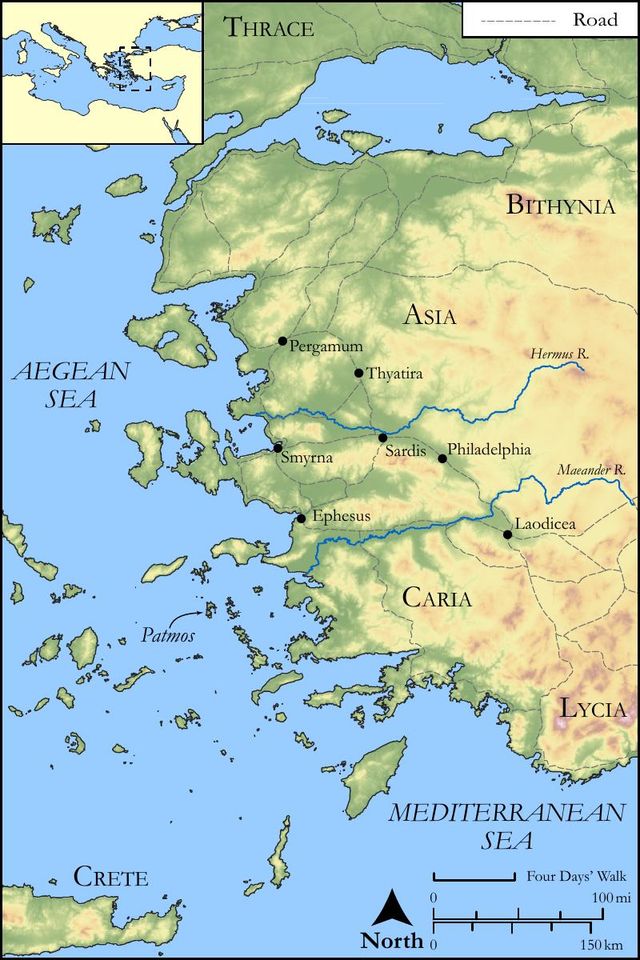
See on the biblical-era maps

Study this verse
Public-domain commentary
Matthew Henry
From his Commentary on the Whole Bible. Henry comments on passages, not single verses — this entry covers Revelation 19:5–10. His three-level outline is real structure in the source text, so it is rendered as structure.
The triumphant song being ended, and epithalamium, or marriage-song, begins, Rev 19:6. Here observe,
I.The concert of heavenly music.
The chorus was large and loud, as the voice of many waters and of mighty thunderings. God is fearful in praises. There is no discord in heaven; the morning stars sing together; no jarring string, nor key untuned, but pure and perfect melody.
II.The occasion of this song; and that is the reign and dominion of that omnipotent God who has redeemed his church by his own blood, and is now in a more public manner betrothing her to himself: The marriage of the Lamb has come, Rev 19:7. Some think this refers to the conversion of the Jews, which they suppose will succeed the fall of Babylon; others, to the general resurrection: the former seems more probable. Now,
1.You have here a description of the bride, how she appeared; not in the gay and gaudy dress of the mother of harlots, but in fine linen, clean and white, which is the righteousness of saints; in the robes of Christ's righteousness, both imputed for justification and imparted for sanctification - the stola, the white robe of absolution, adoption, and enfranchisement, and the white robe of purity and universal holiness. She had washed her robes and made them white in the blood of the Lamb; and these her nuptial ornaments she did not purchase by any price of her own, but received them as the gift and grant of her blessed Lord.
2.The marriage-feast, which, though not particularly described (as Mat 22:4), yet is declared to be such as would make all those happy who were called to it, so called as to accept the invitation, a feast made up of the promises of the gospel, the true sayings of God, Rev 19:9. These promises, opened, applied, sealed, and earnested by the Spirit of God, in holy eucharistical ordinances, are the marriage-feast; and the whole collective body of all those who partake of this feast is the bride, the Lamb's wife; they eat into one body, and drink into one Spirit, and are not mere spectators or guests, but coalesce into the espoused party, the mystical body of Christ.
3.The transport of joy which the apostle felt in himself at this vision. He fell down at the feet of the angel, to worship him, supposing him to be more than a creature, or having his thoughts at the present overpowered by the vehemency of his affections. Here observe,
(1.)What honour he offered to the angel: He fell at his feet, to worship him; this prostration was a part of external worship, it was a posture of proper adoration.
(2.)How the angel refused it, and this was with some resentment: "See thou do it not; have a care what thou doest, thou art doing a wrong thing." (3.) He gave a very good reason for his refusal: "I am thy fellow-servant, and of thy brethren which have the testimony of Jesus - I am a creature, thine equal in office, though not in nature; I, as an angel and messenger of God, have the testimony of Jesus, a charge to be a witness for him and to testify concerning him, and thou, as an apostle, having the Spirit of prophecy, hast the same testimony to give in; and therefore we are in this brethren and fellow-servants." (4.) He directs him to the true and only object of religious worship; namely, God: "Worship God, and him alone." This fully condemns both the practice of the papists in worshipping the elements of bread and wine, and saints, and angels, and the practice of those Socinians and Arians who do not believe that Christ is truly and by nature God, and yet pay him religious worship; and this shows what wretched fig-leaves all their evasions and excuses are which they offer in their own vindication: they stand hereby convicted of idolatry by a messenger from heaven.
Historical interpretation
Eight Centuries of Reception
9 surviving comments on this verse. Each one is dated, so this reads as a timeline rather than a list.
Select a marker to jump to its quote. Markers stagger vertically where authors wrote within a few decades of each other.
Yet these also have spoken beforehand of the punishments that are to light upon the profane and unbelieving, in order that none be left without a witness, or be able to say, "We have not heard, neither have we known." But do you also, if you please, give reverential attention to the prophetic Scriptures, and they will make your way plainer for escaping the eternal punishments, and obtaining the eternal prizes of God. For He who gave the mouth for speech, and formed the ear to hear, and made the eye to see, will examine all things, and will judge righteous judgment, rendering merited awards to each.
The lowest person must worship the same God as is worshiped by the highest angel. In fact it is by refusing to worship him that human nature has been brought low. The source of wisdom and of truth is the same for angel and humankind, namely, the one unchangeable Wisdom and Truth. The very Virtue and changeless Wisdom of God who is consubstantial and coeternal with the Father, for our salvation deigned, in the temporal dispensation, to take upon himself our nature in order to teach us that humanity must worship what every rational intellectual creature must also worship. Let us believe that the highest angels and most excellent ministers of God want us to join them in the worship of the one God, in contemplation of whom they find their happiness. Even we are not made happy by seeing an angel but by seeing the Truth, by which we love the angels too and rejoice with them. We do not grudge that they should have readier access to the Truth and enjoy him without obstacle. Rather, we love them because we are bidden by our common Lord to hope for the same condition hereafter. So we honor them with love but not with divine worship. We do not build temples for them. They do not wish to be honored by us in that way, because they know that when we are good people we are ourselves the temples of the most high God.
Indeed, the whole point of prophecy and of the sanctifying work of the Spirit lies in the testimony of Jesus Christ, whom the entire law and all prophecy serve [as though slaves]. For this reason, when he manifested himself on the mountain between Moses and Elijah, his face and his clothing were resplendent with his brightness, and he declared that the law and the prophets had truly testified of him. And so, whatever they had foretold, he himself testifies that it serves Christ and the church, for he said of Moses, “For he wrote of me.” And when he had risen from the dead, he said, “Everything written about me in the law of Moses and the prophets and the psalms must be fulfilled.”
When the royal commands of God were heard, he fell down to worship him who was speaking with him. However, to respect the nature of his own office and to show that God is above all things, he prohibited this, saying, “Do not do this, because I am a fellow servant with you and your brothers who hold the testimony of Jesus.” The testimony of Jesus is the true profession of the catholic confession. “For the testimony of Jesus is the Spirit of prophecy.” The Spirit of prophecy is truth and judgment and justice, which in their fullness are contained in the catholic faith.
“Do not worship me as one who is foretelling the future,” the holy angel says. For the confession of Christ, that is, the testimony is the gift of the prophetic Spirit. And you should note also this. The prophecy [is given] for this reason, so that the testimony of Christ may be made strong and the faith be given witness by the saints. Therefore, do not pay homage to me, as fellow servant, but to him who possesses power over all things. From this passage we also learn of the humble disposition of the holy angels, for they do not claim for themselves divine glory as do the evil demons but ascribe this glory to the Lord. May it be that we “outdo one another” with a humble mind, thus fulfilling the saying of the Lord: “Learn from me, for I am gentle and lowly in heart, and you will find rest for your souls.” And may we receive rest in the coming age, where “sorrow and pain and groaning have fled,” and where the dwelling is of all who rejoice and gaze upon the light of the face of Christ our God, to whom every song of praise, honor and worship be given, together with the Father and the life-giving Spirit forever and ever. Amen.
Who hold the testimony of Jesus. After the Lord Jesus elevated the assumed man above the heavens, the angel feared being worshipped by a man, evidently worshipping the man-God above himself, which we read was done by men before the Lord's Incarnation and was not forbidden by angels.
See that you do not do that. I am your fellow servant, and of your brethren. He had said earlier: I am the first and the last (Rev. 1). Therefore, he shows that the angel was sent in the figure of the Lord and the Church. For at the end, he also says: I, Jesus, have sent my angel to testify to you these things in the churches (Rev. 22).
The testimony of Jesus is the spirit of prophecy. For whatever the spirit of prophecy said is the testimony of Jesus, who has the testimony from the Law and the Prophets. Therefore, he says, do not worship me as God, since I have come to bear witness to His virtues. Thus far concerning the fall of Babylon, henceforth concerning the future glory of Jerusalem.
The accursed and God-hating Greeks, hearing how it is a doctrine among us that holy angels by the good pleasure of God protect nations and churches and each one individually. Of the nations it is written by the most wise Daniel and "I came because of your words. And the prince of the kingdom of the Persians stood against me," (Dan.10:12-13) and again "now I return to make war with the prince of the Persians; and I was going out, and the prince of the Greeks was coming," (Dan.10:20) and again "there is none to resist me on this matter except Michael your prince;" (Dan.10:21) and again "at that time shall arise Michael the great prince who stands over the sons of your people." (Dan. 12:1) But concerning the churches of the present unveiling it says this in those who have reached it, to which a companion writer, Gregory among the saints, says concerning the holy angels: "for I believe that different angels protect different churches, as John teaches me through the Revelation"; and concerning each one, in the prophet's saying "an angel of the Lord will be set around those who fear him and he will deliver them." (Ps. 33:8) Moreover also the apostle writing about the holy angels: "Are they not all ministering spirits sent out to serve for the sake of those who are to inherit salvation?" (Heb.1:14)
Since then the Greeks hear these things being taught by us, they say to us, "Why do you, who hold the same opinions as we do, reproach the teaching among us that regards the leaders of nations as gods? For those whom you call angels we call gods," as if only our names were in dispute and not also the matters themselves. Not that you indeed call the order of angels gods, so that there would be no difference even in names between us. To these men, accursed and worshipping with the works of your hands, and having set up as gods yesterday and the day before those whom you became acquainted with in all shameful things, who, having taken away most of the divine doctrines from us and bringing them into your destructive teachings, mingled them with your doctrines, but because you followed a guide who was a man and not God, you were not able to preserve the gentleness of all our teachings, and having followed him but a little, you shipwrecked perhaps about the first starting-point.
Therefore, nothing is common between us and you, just as neither is light common with darkness, nor Christ with Beliar (see 2 Cor. 6:14-15), as it is written.
For you, while setting up ethnic rulers as gods, or rather impure demons, introduce yourselves to them by assigning and wishing to offer reverence and worship as to gods; and indeed you treat some among you as divine and make no account of the One who appointed guardianship of men to God, but govern the nations by your own will as you yourselves may desire. Therefore you assigned to Ares the most savage and bloodthirsty peoples, the Scythians and the Germans, those who came to be governed by Ares as a scanty and murderous mortal would be; but to Athena you assigned the Greeks as wise, having received their intelligence from her; and you distributed other peoples to other gods, each of the gods arranging the nations according to his own dispositions. As for us, what shall we say concerning recognition from present things? For when one wished to worship the divine angel of the evangelist, and not to worship him as a god, for who more than John knew who is by nature and in truth God, and who the angels are, that they are ministers and servants and creatures of God?—nevertheless he appears to refuse even that worship as due to an angel, since worship in any case is present, and saying, See that you do not do that; I am your fellow servant and of your brethren who have the testimony of Jesus. The "See" is not merely a word preventing the act but is a claiming declaration. And he also calls himself a fellow servant of all who profess themselves servants of Christ and bear witness that God has been made flesh. What then is to be done, most divine angel, since you forbade yourself to be worshiped? Worship God; for the testimony of Jesus is the spirit of prophecy, as if he said: Is that why you seek to worship me, because I have foretold to you the things that are to come? All those who testify to the lordship and divinity of Christ are filled with a prophetic gift, and I am not alone. Why then, he says, do you worship the same gift as is granted to my fellow servants? Likewise the Greeks are similarly glorified concerning their national founders, and Christians speak so concerning the holy angels.
Continue studying Revelation 19:10 across the web’s major study libraries — every link below opens this exact verse, chapter, or book on the destination site.
Read & Compare
 BibleGatewayThis verse in more than 200 translations and 70 languages.
 Bible.comThe YouVersion reader — hundreds of translations, reading plans, and highlights.
 ESV.orgCrossway's official English Standard Version reader.
 NET BibleThe NET translation with 60,000+ translators' notes on every rendering decision.
 STEP BibleTyndale House's free study tool — original text, vocabulary, and scholarly resources.
 BibliaLogos Bible Software's free web reader.
 USCCBThe New American Bible (Revised Edition) with the U.S. bishops' study notes.
Commentaries
 BibleHub CommentariesDozens of classic commentaries on this verse, gathered on one page.
 StudyLightMore than 100 commentary sets — the largest collection on the web.
 BibleRefPlain-English commentary on what this verse means, verse by verse.
 Enduring WordDavid Guzik's free commentary on this chapter, widely used by Bible teachers.
 Bible Study ToolsVerse commentary alongside Greek and Hebrew study aids.
Original Language & Research
- BibleHub InterlinearThe verse word by word — original language, transliteration, and English.
- BibleHub LexiconEvery word's original-language definition and Strong's entry.
 Blue Letter BibleDeep-study tools — Strong's numbers, concordance, and word studies.
 CNTR CollationThe earliest Greek manuscripts of this verse, collated letter by letter.
Sermons, Hymns & Audio


TrulyRandomVerse is not affiliated with these sites and doesn’t control their content. They’re linked because they’re genuinely useful.
Summary
Revelation 19:10 records a pivotal moment where the Apostle John, overwhelmed by the grand visions of God's triumph and the Marriage Supper of the Lamb, prostrates himself before the angel delivering these revelations. The angel immediately rebukes John, clarifying that worship is reserved for God alone, identifying himself as a "fellowservant" alongside John and all believers who bear the testimony of Jesus. The verse culminates in the profound declaration that "the testimony of Jesus is the spirit of prophecy," establishing Christ as the central theme and animating force behind all divine revelation.
Context
ShowHideLiterary Context
This verse is strategically placed immediately after the climactic announcement of the "Marriage Supper of the Lamb" in Revelation 19:9. The preceding chapters detail the fall of Babylon (chapter 18) and the triumphant praise of the heavenly host (chapter 19:1-8) for God's righteous judgments and the impending union of Christ with His church. John's reaction of prostration is a natural, albeit misdirected, response to the overwhelming glory and significance of these divine pronouncements. The angel's correction serves as a crucial theological interjection, ensuring that the focus remains solely on God amidst the unfolding collision of kingdoms. It sets the stage for the subsequent visions of Christ's return and millennial reign by firmly establishing the proper object of worship.
Historical & Cultural Context
Among the Greeks and Romans, prostration (proskynesis) was a common gesture of profound respect, submission, or adoration, offered to emperors, deities, or powerful individuals. John, a Jew steeped in Old Testament monotheism, would have understood that ultimate worship was due only to Yahweh. However, in the context of apocalyptic visions, where heavenly beings often appear with immense power and glory, the line between reverence and worship could become blurred for a human recipient. The angel's swift correction underscores the absolute distinction between Creator and creature, a foundational tenet of Jewish and early Christian faith, contrasting sharply with the polytheistic and emperor-worshipping tendencies prevalent in the Roman Empire of John's time. This reinforces the unique and exclusive claim of God to all worship.
Key Themes
ShowHideRevelation 19:10 powerfully contributes to several overarching themes within the book of Revelation and the broader biblical narrative. Firstly, it emphatically reiterates the theme of exclusive worship of God, a principle foundational to the Mosaic Law (e.g., Deuteronomy 6:13) and affirmed by Jesus Himself when tempted by Satan (Matthew 4:10). Secondly, it highlights the humility and servanthood of heavenly messengers, portraying even exalted angels as fellow servants with humanity, all united under God's ultimate authority. This echoes the understanding of angels as "ministering spirits" found in Hebrews 1:14. Finally, and most profoundly, the verse establishes the Christ-centered nature of all prophecy and divine revelation. The declaration that "the testimony of Jesus is the spirit of prophecy" reveals that the ultimate purpose and driving force of God's prophetic word, from Old Testament foreshadowings to New Testament fulfillment and apocalyptic visions, is to bear witness to the person, work, and future reign of Jesus Christ. This theme is consistent with the book's opening statement in Revelation 1:1-2, which identifies the book as "the Revelation of Jesus Christ" and John's purpose as bearing "record of the word of God, and of the testimony of Jesus Christ."
Exposition and Analysis
ShowHideKey Word Analysis
ShowHideThis term (G4352) signifies a profound act of reverence, adoration, or homage, often involving prostration or bowing down. It describes the physical posture and inner disposition of submission and adoration. The angel's immediate and firm correction, "See thou do it not," followed by the command "worship God," underscores that this ultimate act of devotion is reserved solely for the supreme Divinity (G2316, theós'), distinguishing between respectful reverence for a messenger and exclusive adoration for the Creator.
Derived from sýn (with) and doúlos (slave/servant), this compound word (G4889) means a co-slave or co-servant. The angel's self-identification as John's "fellowservant" (G4889) and a "fellowservant...of thy brethren that have the testimony of Jesus" (G2424) is a profound statement of humility and shared purpose. It emphasizes that even exalted heavenly beings are not objects of worship but are, like human believers, bondservants of the same divine Master, united in their mission to bear witness to Jesus.
This noun (G3141) refers to evidence given, a record, or a witness. When paired with "of Jesus" (G2424, Iēsoûs'), the phrase "the testimony of Jesus" (G3141) is crucial. It can be interpreted as either Jesus' own witness (what He testifies) or a witness about Jesus (what is testified concerning Him). In this context, especially given its connection to prophecy, it primarily signifies the witness to Jesus Christ—the message, truth, and revelation concerning His person, work, and ultimate triumph, which is the very essence and driving force of all true prophecy.
Verse Breakdown
ShowHide"And I fell at his feet to worship him."
John's reaction is one of overwhelming awe and reverence in the presence of the glorious angel who has just delivered momentous revelations about God's victory and the Marriage Supper of the Lamb. This act of prostration (proskynéō) is an understandable human response to such divine majesty, yet it is quickly identified as misdirected.
"And he said unto me, See [thou do it] not:"
The angel's immediate and firm rebuke is critical. The Greek phrase mḗ horáō (G3361, G3708) translates to "do not look" or "beware lest you do it," functioning as a strong prohibition. This swift intervention prevents John from committing idolatry and underscores the absolute exclusivity of divine worship.
"I am thy fellowservant, and of thy brethren that have the testimony of Jesus:"
The angel humbly identifies himself not as an object of worship but as a co-servant. He stands on equal footing in service to God with John and all other believers who possess the "testimony of Jesus." This highlights the unity of all God's servants, heavenly and earthly, in their shared mission and allegiance to Christ.
"worship God:"
This is the unequivocal command, the core theological message of the verse. Following the negative prohibition, the angel provides the positive directive, redirecting John's (and the reader's) worship to its sole rightful object: God (G2316, theós'). This simple yet profound command serves as a foundational principle for all true faith.
"for the testimony of Jesus is the spirit of prophecy."
This concluding clause explains why worship must be directed to God alone and why the angel is merely a fellow servant. The "testimony of Jesus" (the witness concerning Christ) is identified as the "spirit of prophecy"—the very essence, animating principle, or divine inspiration behind all true prophetic revelation. All genuine prophecy, whether in the Old Testament, the New Testament, or ongoing divine communication, ultimately points to, reveals, and glorifies Jesus Christ. He is the ultimate subject and fulfillment of God's prophetic word.
Literary Devices
ShowHideRevelation 19:10 employs several potent literary devices. The scene itself is rich in Dramatic Irony, where John, a prophet receiving divine revelation, attempts to worship the messenger rather than the source of the message, a mistake the audience is immediately enlightened about. The angel's response is characterized by Direct Address and Command, using imperative verbs like "See thou do it not" and "worship God," which convey authority and urgency, leaving no room for misinterpretation. There is also clear Contrast between the angel's glorious appearance and his humble self-identification as a "fellowservant," which serves to elevate God alone as worthy of worship. The Repetition of the phrase "testimony of Jesus" (twice in the verse) emphasizes its critical importance, drawing attention to Christ as the central theme. Finally, the concluding statement, "the testimony of Jesus is the spirit of prophecy," functions as a profound Theological Aphorism or Summary Statement, encapsulating a core truth about the nature of divine revelation and its ultimate Christ-centered purpose.
Theological and Thematic Connections
ShowHideRevelation 19:10 stands as a theological cornerstone, asserting the absolute exclusivity of worship for God alone. This principle, deeply embedded in the monotheistic foundations of biblical faith, serves as a bulwark against idolatry in all its forms, whether the worship of created beings, human leaders, or material possessions. The angel's humble self-identification as a "fellowservant" underscores the unity of all God's people—both heavenly and earthly—in their shared mission to serve the one true God and bear witness to Christ. Most significantly, the declaration that "the testimony of Jesus is the spirit of prophecy" reveals the profound Christocentric nature of all divine revelation. It means that every authentic prophetic utterance, every inspired word from God, ultimately finds its meaning, purpose, and fulfillment in Jesus Christ. He is not merely a subject of prophecy, but the very essence and animating power behind it, making Him the lens through which all Scripture must be understood.
Reflection and Application
ShowHideRevelation 19:10 offers profound and practical lessons for contemporary believers. First, it serves as a perpetual reminder of the singular object of our worship: God alone. In a world saturated with distractions and competing allegiances, this verse calls us to examine our hearts and ensure that our ultimate devotion, adoration, and allegiance are directed solely to the Creator. We must guard against elevating anything or anyone—be it a charismatic leader, a spiritual experience, a particular doctrine, or even our own ministries—to a place that rivals God's unique claim on our hearts. Second, the angel's humility as a "fellowservant" challenges us to embrace a similar posture in our service to God. No matter our gifts, roles, or spiritual experiences, we are all simply servants alongside our brothers and sisters, united in our common Master. This fosters humility, guards against pride, and promotes unity within the body of Christ. Finally, the declaration that "the testimony of Jesus is the spirit of prophecy" is a powerful call to embrace a Christ-centered faith. It compels us to interpret all Scripture, understand all divine revelation, and live all of life through the lens of Jesus Christ. Our preaching, teaching, and personal study should consistently point to Him, recognizing that He is the fulfillment of God's redemptive plan and the ultimate revelation of God's character and purposes.
Questions for Reflection
ShowHideFAQ
ShowHideWhy did John attempt to worship the angel, and why was he rebuked?
ShowHideJohn was overwhelmed by the glorious visions and the momentous truths being revealed by the angel, particularly the announcement of the Marriage Supper of the Lamb. His act of falling at the angel's feet was likely an expression of profound awe and reverence, a natural human response to such divine majesty. However, the angel immediately rebuked him because worship (Greek: proskynéō) is reserved exclusively for God. The angel, though glorious, is a created being, a "fellowservant" (Greek: sýndoulos) alongside John and all believers. This correction reinforces a fundamental biblical principle: only the Creator is worthy of ultimate adoration and worship, as demonstrated by Jesus' own words in Matthew 4:10.
What does the angel mean by calling himself a "fellowservant"?
ShowHideBy calling himself a "fellowservant" (Greek: sýndoulos), the angel humbly identifies with John and all believers who "have the testimony of Jesus." This signifies that despite his heavenly status and glorious appearance, he is not an object of worship but is, like humans, a servant of the same divine Master. It emphasizes the unity of purpose among all God's creatures, heavenly and earthly, who are collectively engaged in serving God and bearing witness to Jesus Christ. This highlights the angel's humility and redirects all glory and worship to God alone.
What is the significance of the phrase "the testimony of Jesus"?
ShowHideThe phrase "the testimony of Jesus" (Greek: martyría Iēsoû) is central to understanding this verse and the entire book of Revelation. It refers to the witness about Jesus Christ—the revelation of His person, His saving work, His ultimate triumph, and His future reign. It is the core message concerning Him that is proclaimed and revealed. This testimony is not merely historical fact but a living, dynamic truth that empowers believers and animates all genuine prophecy. It is the truth about who Jesus is and what He has done, is doing, and will do, which forms the foundation of Christian faith and hope.
What does it mean that "the testimony of Jesus is the spirit of prophecy"?
ShowHideThis profound statement means that the ultimate purpose, essence, and animating principle (the "spirit") of all true prophecy is to bear witness to Jesus Christ. Whether it's the foreshadowings in the Old Testament, the direct revelations in the New Testament, or the apocalyptic visions in Revelation, all genuine divine revelation ultimately points to, explains, and glorifies Jesus. He is the central theme, the fulfillment, and the very reason for prophecy. It implies that any prophecy or spiritual utterance that does not ultimately lead to or magnify Jesus is not from the true "spirit of prophecy." This concept aligns with John 5:39, where Jesus tells the Jews that the Scriptures "testify of me."
Christ-Centered Fulfillment
ShowHideRevelation 19:10 powerfully encapsulates the Christ-centered nature of all divine revelation and worship. The angel's firm redirection of John's worship from himself to God underscores that Jesus Christ, as the Second Person of the Trinity, is the ultimate and exclusive object of all true adoration. The declaration, "the testimony of Jesus is the spirit of prophecy," reveals that Christ is not merely a figure within prophecy, but its very essence and animating force. From the earliest promises of a coming redeemer in Genesis 3:15 to the detailed messianic prophecies of Isaiah (e.g., Isaiah 53), and culminating in the New Testament's full unveiling of His person and work, all Scripture points to Jesus. He is the Word made flesh (John 1:1-14), the one to whom Moses and the Prophets testified (John 5:46), and the fulfillment of all God's promises (2 Corinthians 1:20). The entire narrative of salvation history finds its culmination and meaning in His life, death, resurrection, and glorious return. Thus, the "testimony of Jesus" is not just a message about Him, but the very Spirit of God revealing Him, ensuring that all true prophecy ultimately exalts the Lamb of God who takes away the sin of the world (John 1:29).