


Revelation 4:10
- πεσοῦνταιpesountaiwill fallG4098V-FNI-3PVerb Future Middle Or Passive Deponent Indicative 3rd Plural
- οἱhoitheG3588T-NPMDefinite article Nominative Plural Masculine
- εἴκοσιeikositwentyG1501A-NUIAdjective
- καὶkaiandG2532CONJConjunction
- τέσσαρεςtessaresfourG5064A-NPMAdjective Nominative Plural Masculine
- πρεσβύτεροιpresbuteroieldersG4245N-NPMNoun Nominative Plural Masculine
- ἐνώπιονenōpionbeforeG1799PREPPreposition
- τοῦtouthe [One]G3588T-GSMDefinite article Genitive Singular Masculine
- καθημένουkathēmenousittingG2521V-PNP-GSMVerb Present Middle Or Passive Deponent Participle Genitive Singular Masculine
- ἐπὶepiuponG1909PREPPreposition
- τοῦtoutheG3588T-GSMDefinite article Genitive Singular Masculine
- θρόνουthronouthroneG2362N-GSMNoun Genitive Singular Masculine
- καὶkaiandG2532CONJConjunction
- προσκυνήσουσινproskunēsousinthey will worshipG4352V-FAI-3PVerb Future Active Indicative 3rd Plural
- τῷtōthe [One]G3588T-DSMDefinite article Dative Singular Masculine
- ζῶντιzōntilivingG2198V-PAP-DSMVerb Present Active Participle Dative Singular Masculine
- εἰςeistoG1519PREPPreposition
- τοὺςtoustheG3588T-APMDefinite article Accusative Plural Masculine
- αἰῶναςaiōnasagesG165N-APMNoun Accusative Plural Masculine
- τῶνtōnof theG3588T-GPMDefinite article Genitive Plural Masculine
- αἰώνωνaiōnōnagesG165N-GPMNoun Genitive Plural Masculine
- καὶkaiandG2532CONJConjunction
- βαλοῦσινbalousinthey will castG906V-FAI-3PVerb Future Active Indicative 3rd Plural
- τοὺςtoustheG3588T-APMDefinite article Accusative Plural Masculine
- στεφάνουςstephanouscrownsG4735N-APMNoun Accusative Plural Masculine
- αὐτῶνautōnof themG846P-GPMPersonal pronoun Genitive Plural Masculine
- ἐνώπιονenōpionbeforeG1799PREPPreposition
- τοῦtoutheG3588T-GSMDefinite article Genitive Singular Masculine
- θρόνουthronouthroneG2362N-GSMNoun Genitive Singular Masculine
- λέγοντες·legontessayingG3004V-PAP-NPMVerb Present Active Participle Nominative Plural Masculine
English is a literal word-by-word gloss of the Greek, not the KJV's wording. Why?
This is the original text the KJV's translators worked from — each Greek word with its own literal English meaning in this verse, prepared by scholars at Tyndale House, Cambridge. The KJV translates whole sentences, not word by word, so its wording differs: one Greek word can become several English words, and the KJV may choose “charity” where the gloss reads “love”. Both are faithful — they answer different questions. For the KJV's own rendering, switch to the KJV text.
Details
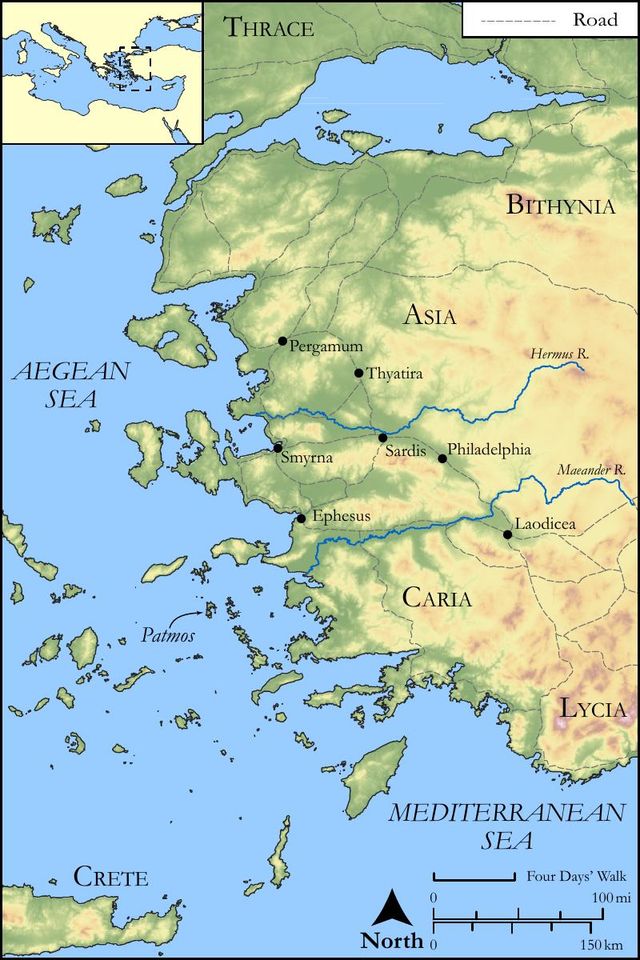
See on the biblical-era map

Study this verse
Public-domain commentary
Matthew Henry
From his Commentary on the Whole Bible. Henry comments on passages, not single verses — this entry covers Revelation 4:8–11. His three-level outline is real structure in the source text, so it is rendered as structure.
We have considered the sights that the apostle saw in heaven: now let us observe the songs that he heard, for there is in heaven not only that to be seen which will highly please a sanctified eye, but there is that to be heard which will greatly delight a sanctified ear. This is true concerning the church of Christ here, which is a heaven upon earth, and it will be eminently so in the church made perfect in the heaven of heavens.
I.He heard the song of the four living creatures, of the ministers of the church, which refers to the prophet Isaiah's vision, Isa 6:1-13. And here,
1.They adore one God, and one only, the Lord God Almighty, unchangeable and everlasting.
2.They adore three holies in this one God, the Holy Father, the Holy Son, and the Holy Spirit; and these are one infinitely holy and eternal Being, who sits upon the throne, and lives for ever and ever. In this glory the prophet saw Christ, and spoke of him.
II.He heard the adorations of the four-and-twenty elders, that is, of the Christian people represented by them; the ministers led, and the people followed, in the praises of God, Rev 4:10, Rev 4:11. Here observe,
1.The object of their worship, the same with that which the ministers adored: Him that sat on the throne, the eternal everliving God. The true church of God has one and the same object of worship. Two different objects of worship, either co-ordinate or sub-ordinate, would confound the worship and divide the worshippers. It is unlawful to join in divine worship with those who either mistake or multiply the object. There is but one God, and he alone, as God, is worshipped by the church on earth and in heaven.
2.The acts of adoration.
(1.)They fell down before him that sat on the throne; they discovered the most profound humility, reverence, and godly fear.
(2.)They cast their crowns before the throne; they gave God the glory of the holiness wherewith he had crowned their souls on earth and the honour and happiness with which he crowns them in heaven. They owe all their graces and all their glories to him, and acknowledge that his crown is infinitely more glorious than theirs, and that it is their glory to be glorifying God.
3.The words of adoration: they said, Thou art worthy, O Lord, to receive glory, and honour, and power, Rev 4:11. Observe,
(1.)They do not say, We give thee glory, and honour, and power; for what can any creature pretend to give unto God? But they say, thou art worthy to receive glory.
(2.)In this they tacitly acknowledge that God is exalted far above all blessing and praise. He was worthy to receive glory, but they were not worthy to praise, nor able to do it according to his infinite excellences.
4.We have the ground and reason of their adoration, which is threefold: - (1.) He is the Creator of all things, the first cause; and none but the Creator of all things should be adored; no made thing can be the object of religious worship. (2.) He is the preserver of all things, and his preservation is a continual creation; they are created still by the sustaining power of God. All beings but God are dependent upon the will and power of God, and no dependent being must be set up as an object of religious worship. It is the part of the best dependent beings to be worshippers, not to be worshipped. (3.) He is the final cause of all things: For thy pleasure they are and were created. It was his will and pleasure to create all things; he was not put upon it by the will of another; there is no such thing as a subordinate creator, that acts under and by the will and power of another; and, if there were, he ought not to be worshipped. As God made all things at his pleasure, so he made them for his pleasure, to deal with them as he pleases and to glorify himself by them one way or other. Though he delights not in the death of sinners, but rather that they should turn and live, yet he hath made all things for himself, Pro 16:4. Now if these be true and sufficient grounds for religious worship, as they are proper to God alone, Christ must needs be God, one with the Father and Spirit, and be worshipped as such; for we find the same causality ascribed to him. Col 1:16, Col 1:17, All things were created by him and for him, and he is before all things, and by him all things consist.
Historical interpretation
Seven Centuries of Reception
7 surviving comments on this verse. Each one is dated, so this reads as a timeline rather than a list.
Select a marker to jump to its quote. Markers stagger vertically where authors wrote within a few decades of each other.
"The first living creature was like to a lion, and the second was like to a calf, and the third had a face like to a man, and the fourth was like to a flying eagle; and they had six wings, and round about and within they were full of eyes; and they had no rest, saying, Holy, holy, holy, Lord Omnipotent. And the four and twenty elders, failing down before the throne, adored God." The four and twenty elders arethe twenty-four books of the prophets and of the law, which give testimonies of the judgment. Moreover, also, they are the twenty-four fathers-twelve apostles and twelve patriarchs.And in that the living creatures are different in appearance, this is the reason: the living creature like to a lion designates Mark, in whom is heard the voice of the lion roaring in the desert. And in the figure of a man, Matthew strives to declareto us the genealogy of Mary, from whom Christ took flesh. Therefore, in enumerating from Abraham to David, and thence to Joseph, he spoke of Him as if of a man: therefore his announcement sets forth the image of a man. Luke, in narrating the priesthood of Zacharias as he offers a sacrifice for the people, and the angel that appears to him with respect of the priesthood, and the victim in the same description bore the likeness of a calf. John the evangelist, like to an eagle hastening on uplifted wings to greater heights, argues about the Word of God. Mark, therefore, as an evangelist thus beginning, "The beginning of the Gospel of Jesus Christ, as it is written in Isaiah the prophet; " The voice of one crying in the wilderness," -has the effigy of a lion. And Matthew, "The hook of the generation of Jesus Christ, the son of David, the son of Abraham: " this is the form of a man. But Luke said, "There was a priest, by name Zachariah, of the course of Abia, and his wife was of the daughters of Aaron: " this is the likeness of a calf. But John, when he begins, "In the beginning was the Word, and the Word was with God, and the Word was God," sets forth the likeness of a flying eagle. Moreover, not only do the evangelists express their four similitudes in their respective openings of the Gospels, but also the Word itself of God the Father Omnipotent, which is His Son our Lord Jesus Christ, bears the same likeness in the time of His advent. When He preaches to us, He is, as it were, a lion and a lion's whelp. And when for man's salvation He was made man to overcome death, and to set all men free, and that He offered Himself a victim to the Father on our behalf, He was called a calf. And that He overcame death and ascended into the heavens, extending His wings and protecting His people, He was named a flying eagle. Therefore these announcements, although they are four, yet are one, because it proceeded from one mouth. Even as the river in paradise, although it is one, was divided into four heads. Moreover, that for the announcement of the New Testament those bring creatures had eyes within and without, shows the spiritual providence which both looks into the secrets of the heart, and beholds the things which are coming after that are within and without.
And when these things were doing, he says that all the elders fell down and adored the Lord; while the living creatures-that is, of course, the actions recorded in the Gospels and the teaching of the Lord-gave Him glory and honour.31 In that they had fulfilled the word that had been previously foretold by them, they worthily and with reason exult, feeling that they have ministered the mysteries and the word of the Lord. Finally, also, because He had come who should remove death, and who alone was worthy to take the crown of immortality, all for the glory of His most excellent doing had crowns.
"And they cast their crowns under His feet." That is, on account of the eminent glory of Christ's victory, they cast all their victories under His feet. This is what in the Gospel the Holy Spirit consummated by showing, For when about finally to suffer, our Lord had come to Jerusalem, and the people had gone forth to meet Him, some strewed the road with palm branches cut down, others threw down their garments, doubtless these were setting forth two peoples-the one of the patriarchs, the other of the prophets; that is to say, of the great men who had any kind of palms of their victories against sin, and cast them under the feet of Christ, the victor of all. And the palm and the crown signify the same things, and these are not given save to the victor.
When the animals resound with praise, that is, when the Evangelists preach and celebrate the dispensation of Christ, … the twenty-four elders, that is, the whole church, that is, the leaders and people immediately fall on their faces and adore him who lives forever and ever.… By casting their crowns before the throne, they are ascribing to God whatever they possess of virtue and dignity. For whatever good we seek and acquire by right is attributed to him from whom he who conquers receives assistance. A figure of this action occurred in the Gospel when the people, going before the Lord, cast their garments and palm branches on the road before him, saying, “Blessed is he who comes in the name of the Lord, the King of Israel.”
The twenty-four elders fell down before Him who sits on the throne and worshipped. When the creatures resound in praise, that is, when the evangelists proclaim the dispensation of Christ, the whole Church, which consists of leaders and peoples (for this is what the doubled number twelve signifies), immediately falls on its face and worships Him who lives forever and ever.
And they cast their crowns before the throne. Namely, assigning whatever virtue, whatever dignity they had. For He created all things out of nothing.
And when those living creatures gave glory, and honour, and benediction to him that sitteth on the throne, who liveth for ever and ever; the four and twenty ancients fell down, and adored him that liveth for ever and ever. Here the living creatures no longer indicate a genus, but a species, namely the evangelists; but by the twenty-four ancients is represented the universal Church in its superior and inferior members. So the living creatures give glory and honor to him that sits on the throne, when the holy evangelists teach us that he ought to be praised for all good things, as in Every best gift, etc. [James 1:17] As the evangelists are thus speaking, the twenty-four ancients, that is all the saints, fall down, because they feel humble. They adore God at the same time as they fall, because they honor God by the very fact of attributing nothing to themselves. This fall and adoration should be understood as spiritual, according to this: God is a spirit; and they that adore him, must adore him in spirit and in truth. [John 4:24] And cast their crowns before the throne, saying, etc. He is repeating the very same thing: for the ancients laying their crowns before the throne mean the elect, with a pious confession of the mind, laying down before their consciences, which God presides over, the swelling of pride for the virtues they have received, and attributing everything to him who presides over them; which is also why they say:
Along with the holy living creatures, the elders give glory to God; the act of casting their crowns before God signifies that the crown is a symbol of victory and kingship. Casting them before the throne of God, the true and genuine kingdom and the victory over all given to God who reigns over all.
Continue studying Revelation 4:10 across the web’s major study libraries — every link below opens this exact verse, chapter, or book on the destination site.
Read & Compare
 BibleGatewayThis verse in more than 200 translations and 70 languages.
 Bible.comThe YouVersion reader — hundreds of translations, reading plans, and highlights.
 ESV.orgCrossway's official English Standard Version reader.
 NET BibleThe NET translation with 60,000+ translators' notes on every rendering decision.
 STEP BibleTyndale House's free study tool — original text, vocabulary, and scholarly resources.
 BibliaLogos Bible Software's free web reader.
 USCCBThe New American Bible (Revised Edition) with the U.S. bishops' study notes.
Commentaries
 BibleHub CommentariesDozens of classic commentaries on this verse, gathered on one page.
 StudyLightMore than 100 commentary sets — the largest collection on the web.
 BibleRefPlain-English commentary on what this verse means, verse by verse.
 Enduring WordDavid Guzik's free commentary on this chapter, widely used by Bible teachers.
 Bible Study ToolsVerse commentary alongside Greek and Hebrew study aids.
Original Language & Research
- BibleHub InterlinearThe verse word by word — original language, transliteration, and English.
- BibleHub LexiconEvery word's original-language definition and Strong's entry.
 Blue Letter BibleDeep-study tools — Strong's numbers, concordance, and word studies.
 CNTR CollationThe earliest Greek manuscripts of this verse, collated letter by letter.
Sermons, Hymns & Audio


TrulyRandomVerse is not affiliated with these sites and doesn’t control their content. They’re linked because they’re genuinely useful.
Summary
Revelation 4:10 vividly portrays a profound moment of celestial worship where the twenty-four elders, representing the redeemed people of God, prostrate themselves before the divine throne. Their act of falling down and casting their crowns signifies ultimate humility, complete surrender of all perceived glory, and unreserved adoration for the eternal and sovereign God who lives forever and ever, setting a powerful example of true reverence in the heavenly court.
Context
ShowHideLiterary Context
Revelation 4:10 is the climactic response of the twenty-four elders to the preceding worship of the four living creatures. The entire fourth chapter of Revelation serves as an awe-inspiring introduction to God's heavenly throne room, establishing the divine sovereignty and the centrality of worship. Following John's initial vision of the throne and the One seated upon it in Revelation 4:2-3, and the description of the twenty-four elders themselves in Revelation 4:4, the narrative builds to the incessant, tri-holy praise of the four living creatures in Revelation 4:8. It is this continuous declaration of God's holiness and eternal existence that prompts the elders' immediate and dramatic act of worship in Revelation 4:10. Their actions here directly precede and set the stage for their own declaration of God's worthiness in Revelation 4:11, forming a seamless and escalating sequence of adoration.
Historical & Cultural Context
The imagery of elders and crowns in Revelation 4:10 draws upon both Old Testament and Greco-Roman cultural understandings. In ancient Near Eastern cultures, prostration (falling down) before a king or deity was a universal sign of profound respect, submission, and worship. The "elders" (Greek: presbyteroi) held positions of authority, wisdom, and leadership in both Jewish and early Christian communities, signifying a mature and respected status. The "crowns" (Greek: stephanos) were not necessarily royal diadems but more akin to wreaths or victor's crowns, awarded for achievement, victory, or honor (as seen in athletic games or civic recognition). For the elders to cast these symbols of their own achievement or authority before the throne was an act of ultimate humility, acknowledging that any honor or reward they possessed ultimately originated from and belonged to God alone. This act would have been a powerful visual statement to John's original audience, who understood the significance of such gestures in demonstrating fealty and reverence.
Key Themes
ShowHideRevelation 4:10 powerfully contributes to several overarching themes within the book of Revelation and biblical theology. Firstly, it underscores the Sovereignty and Majesty of God, presenting Him as the ultimate object of worship, seated on the throne of the universe, living "for ever and ever." This eternal existence and unchallengeable authority are foundational to understanding God's control over history and prophecy. Secondly, the verse highlights the theme of Profound Adoration and Worship, demonstrating the appropriate posture of redeemed humanity before divine glory—one of complete submission, humility, and unreserved praise. The elders' act of casting their crowns symbolizes the Renunciation of Self-Glory, emphasizing that all honor, achievement, and authority belong to God alone, and any reward received by humanity is ultimately a gift to be returned to the Giver. This scene sets the tone for the entire book, establishing that all events, judgments, and victories ultimately serve to bring glory to the One on the throne, a theme echoed throughout Revelation, such as in the triumphant songs of Revelation 5:12-13.
Exposition and Analysis
ShowHideKey Word Analysis
ShowHideG4352 - This verb, derived from a root meaning "to kiss towards," signifies an act of profound homage, often involving prostration or bowing down before a superior. It conveys not merely respect, but a total surrender of self, acknowledging the absolute authority and worthiness of the one being worshipped. In this context, it emphasizes the elders' complete submission and adoration before God.
G2198 - A primary verb meaning "to live," either literally or figuratively. When applied to God, as here, "him that liveth" (ho zōn) is a direct declaration of His eternal, self-existent, and unending life. This attribute is a core aspect of His divine nature, distinguishing Him as the source of all life and the One who transcends time and mortality.
G4735 - This term refers to a chaplet or wreath, often used as a badge of royalty, a prize in public games, or a symbol of honor. Unlike a royal diadem (diadēma), the stéphanos typically signifies a victor's laurel or a mark of achieved honor. The act of casting these crowns before the throne is highly symbolic, representing the elders' voluntary surrender of all their earned honors, achievements, or authority back to the One from whom all blessings flow.
Verse Breakdown
ShowHide"The four and twenty elders fall down before him that sat on the throne,"
This clause introduces the subjects of the action—the twenty-four elders, often seen as representatives of the church or redeemed humanity. Their action, "fall down," signifies immediate and complete prostration, a universal posture of humility and submission before a supreme authority. This physical act demonstrates their recognition of God's absolute sovereignty and majesty.
"and worship him that liveth for ever and ever,"
This part identifies the object of their worship and the reason for it. They worship "him that liveth for ever and ever," a powerful descriptor of God's eternal, self-existent, and unchanging nature. This phrase emphasizes God's timelessness and His ultimate control over all existence, providing the foundational reason for such profound adoration.
"and cast their crowns before the throne, saying,"
The final clause describes a highly symbolic act: the elders remove their crowns—symbols of their authority, victory, or reward—and place them before the throne. This is an act of ultimate humility and renunciation of self-glory, acknowledging that any honor or achievement they possess is derived from God and rightfully belongs back to Him. The verse concludes by indicating that this physical act of worship is accompanied by a verbal declaration, which is then elaborated in the subsequent verse Revelation 4:11.
Literary Devices
ShowHideRevelation 4:10 is rich in Symbolism and Imagery. The "four and twenty elders" are symbolic figures, often interpreted as representing the totality of God's redeemed people (12 tribes of Israel + 12 apostles, or a complete number of the church). Their "falling down" is a powerful visual Imagery of prostration, conveying absolute humility and submission. The act of "casting their crowns" is highly symbolic, representing the surrender of all human achievement, honor, and authority back to God. These "crowns" themselves are symbols of victory or reward, making their relinquishment all the more significant. The phrase "him that liveth for ever and ever" employs Hyperbole to emphasize God's eternal nature and timeless existence, a common way to describe divine attributes in biblical literature. The entire scene is a vivid Anthropomorphism, depicting heavenly beings in human-like actions (falling, casting) to make the profound spiritual reality of worship comprehensible to human understanding.
Theological and Thematic Connections
ShowHideRevelation 4:10 provides a foundational theological statement about the nature of true worship and the object of our adoration. It unequivocally establishes God's absolute sovereignty, eternality, and worthiness as the basis for all praise. The elders' actions demonstrate that genuine worship involves not only outward expressions but also an inward posture of profound humility, a relinquishing of all self-glory, and a complete surrender of all perceived achievements or authority back to the Creator. This scene underscores the biblical truth that all honor and glory belong to God alone, and any reward or status we may attain is ultimately a gift to be laid at His feet. It serves as a heavenly model for earthly worship, calling believers to a similar posture of adoration and self-effacement before the King of Kings.
Reflection and Application
ShowHideRevelation 4:10 offers a profound blueprint for our personal and corporate worship. It challenges us to consider the depth of our own reverence for God. Are we truly falling down in humility before Him, or do we approach Him casually? Do we genuinely "cast our crowns" before His throne, surrendering our achievements, talents, and even our very identities to Him, acknowledging that all good things come from His hand? This heavenly vision reminds us that our earthly lives should be lived with an awareness of God's supreme sovereignty and an eager desire to give Him all glory. It calls us to cultivate a heart that recognizes God's eternal nature and His unchanging reign, inspiring us to live lives of humble submission and unreserved adoration, anticipating the day when we too will join in such profound worship. It encourages us to lay down our pride, our self-sufficiency, and our need for human recognition, replacing them with a singular focus on God's worthiness.
Questions for Reflection
ShowHideFAQ
ShowHideWho are the "four and twenty elders" mentioned in this verse?
ShowHideThe identity of the "four and twenty elders" (G4245, presbýteros) is a subject of ongoing theological discussion, but common interpretations suggest they represent the totality of God's redeemed people from all ages. This number is often seen as symbolic, combining the twelve tribes of Israel (representing the Old Testament people of God) and the twelve apostles (representing the New Testament church), signifying a complete and unified body of believers. They are depicted as seated on thrones and crowned, suggesting a royal and priestly status granted to them by God, yet their ultimate act is one of worship and submission to the One on the throne. They are part of the heavenly court, participating in the divine worship and administration.
What is the significance of the elders "casting their crowns before the throne"?
ShowHideThe act of "casting their crowns" (G4735, stéphanos) is profoundly symbolic. These crowns likely represent the rewards, honors, or victories that God has bestowed upon them. By laying them down before the throne, the elders are demonstrating ultimate humility, acknowledging that any glory, authority, or achievement they possess is not their own but comes entirely from God. It is an act of renouncing self-glory and attributing all praise and dominion back to the One who is truly worthy. This gesture underscores the truth that all blessings flow from God, and all honor ultimately belongs to Him. It is a powerful visual metaphor for surrendering all human accomplishment and recognizing God as the sole source of all good.
How does this verse emphasize God's eternality?
ShowHideThe phrase "worship him that liveth (G2198, záō) for ever (G165, aiṓn) and ever (G165, aiṓn)" is a powerful declaration of God's absolute eternality and unending existence. The Greek phrase "eis tous aiōnas tōn aiōnōn" literally means "unto the ages of the ages," conveying an infinite, timeless duration. This emphasizes that God is not bound by time; He is the self-existent One who always was, always is, and always will be. His life is inherent and unending, making Him the ultimate source of life and the unchanging foundation of all reality. This attribute distinguishes Him from all created beings and forms the basis for His unchallengeable sovereignty and worthiness of eternal worship.
Christ-Centered Fulfillment
ShowHideWhile Revelation 4:10 directly describes the worship of God the Father on the throne, it implicitly points to Christ as the ultimate object and enabler of such worship. The One "who liveth for ever and ever" is a title that applies equally to the Son, who is Himself eternal and co-equal with the Father. Indeed, in the very next chapter, the focus of worship shifts to the Lamb who was slain Revelation 5:6-14, demonstrating that the worship of the Father is inseparable from the worship of the Son. Christ, as the Lamb of God, is the one through whom humanity gains access to the throne room Hebrews 10:19-22. The crowns cast before the throne, symbolizing victory and righteousness, are ultimately won through Christ's triumph over sin and death, and it is His righteousness that is imputed to believers, enabling them to stand before God. Thus, the elders' act of worship, surrendering all glory, foreshadows the ultimate reality that all things are "through him and for him" Colossians 1:16. The heavenly scene in Revelation 4 and Revelation 5 reveals a unified worship of the Triune God, with Christ as the central figure through whom all creation offers its adoration and by whom all glory is ultimately received.