


Revelation 19:4
Bible text: King James Version (1769 Blayney text) · Public domain
Bible text: King James Version with Strong's numbers · Public domain
Bible text: Berean Standard Bible · Public domain
Bible text: American Standard Version (1901) · Public domain
Bible text: World English Bible, Messianic edition · Public domain
Bible text: Geneva Bible (1599) · Public domain
Bible text: Young's Literal Translation · Public domain
- καὶkaiAndG2532CONJConjunction
- ἔπεσανepesanfell downG4098V-2AAI-3PVerb 2nd Aorist Active Indicative 3rd Plural
- οἱhoitheG3588T-NPMDefinite article Nominative Plural Masculine
- πρεσβύτεροιpresbuteroieldersG4245N-NPMNoun Nominative Plural Masculine
- οἱhoi<the>G3588T-NPMDefinite article Nominative Plural Masculine
- εἴκοσιeikositwentyG1501A-NUIAdjective
- καὶkaiandG2532CONJConjunction
- τέσσαρεςtessaresfourG5064A-NPMAdjective Nominative Plural Masculine
- καὶkaiandG2532CONJConjunction
- τὰtatheG3588T-NPNDefinite article Nominative Plural Neuter
- τέσσαραtessarafourG5064A-NPNAdjective Nominative Plural Neuter
- ζῷαzōaliving creaturesG2226N-NPNNoun Nominative Plural Neuter
- καὶkaiandG2532CONJConjunction
- προσεκύνησανprosekunēsanthey worshipedG4352V-AAI-3PVerb Aorist Active Indicative 3rd Plural
- τῷtō<the>G3588T-DSMDefinite article Dative Singular Masculine
- θεῷtheōGodG2316N-DSM-TNoun Dative Singular Masculine Title
- τῷtōwhoG3588T-DSMDefinite article Dative Singular Masculine
- καθημένῳkathēmenōis sittingG2521V-PNP-DSMVerb Present Middle Or Passive Deponent Participle Dative Singular Masculine
- ἐπὶepionG1909PREPPreposition
- τῷtōtheG3588T-DSMDefinite article Dative Singular Masculine
- θρόνῳthronōthroneG2362N-DSMNoun Dative Singular Masculine
- λέγοντες·legontessayingG3004V-PAP-NPMVerb Present Active Participle Nominative Plural Masculine
- ἀμὴνamēnAmenG281INJ-HEBInterjection
- ἁλληλουϊάhallēlouiaHallelujah!G239PRTParticle or Disjunctive
English is a literal word-by-word gloss of the Greek, not the KJV's wording. Why?
This is the original text the KJV's translators worked from — each Greek word with its own literal English meaning in this verse, prepared by scholars at Tyndale House, Cambridge. The KJV translates whole sentences, not word by word, so its wording differs: one Greek word can become several English words, and the KJV may choose “charity” where the gloss reads “love”. Both are faithful — they answer different questions. For the KJV's own rendering, switch to the KJV text.
Details
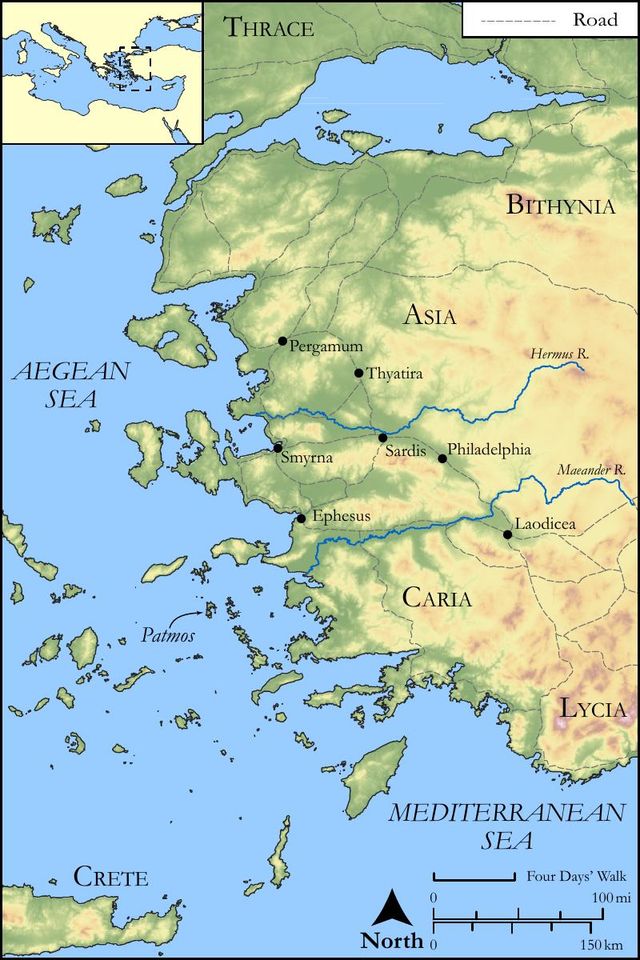
See on the biblical-era maps

Study this verse
Public-domain commentary
Matthew Henry
From his Commentary on the Whole Bible. Henry comments on passages, not single verses — this entry covers Revelation 19:1–4.
The fall of Babylon being fixed, finished, and declared to be irrecoverable in the foregoing chapter, this begins with a holy triumph over her, in pursuance of the order given forth: Rejoice over her, thou heaven, and you holy apostles and prophets, Rev 18:20. They now gladly answer the call; and here you have, 1. The form of their thanksgiving, in that heavenly and most comprehensive word, Alleluia, praise you the Lord: with this they begin, with this they go on, and with this they end (Rev 19:4); their prayers are now turned into praises, their hosannas end in halleluias. 2. The matter of their thanksgiving: they praise him for the truth of his word, and the righteousness of his providential conduct, especially in this great event - the ruin of Babylon, which had been a mother, nurse, and nest of idolatry, lewdness, and cruelty (Rev 19:2), for which signal example of divine justice they ascribe salvation, and glory, and honour, and power, unto our God. 3. The effect of these their praises: when the angels and saints cried Alleluia, her fire burned more fiercely and her smoke ascended for ever and ever, Rev 19:3. The surest way to have our deliverances continued and completed is to give God the glory of what he has done for us. Praising God for what we have is praying in the most effectual manner for what is yet further to be done for us; the praises of the saints blow up the fire of God's wrath against the common enemy. 4. The blessed harmony between the angels and the saints in this triumphant song, Rev 19:4. The churches and their ministers take the melodious sound from the angels, and repeat it; falling down, and worshipping God, they cry, Amen, Alleluia.
Historical interpretation
Eight Centuries of Reception
6 surviving comments on this verse. Each one is dated, so this reads as a timeline rather than a list.
Select a marker to jump to its quote. Markers stagger vertically where authors wrote within a few decades of each other.
But in Leviticus He says: "Go not ye after idols, nor make to yourselves molten gods: I am the Lord your God." And in other passages: "The children of Israel are my household servants; these are they whom I led forth from the land of Egypt: I am the Lord your God.
When [the voice] commands that this [praise] be done and then it is reported that [such praise] was given, it indicates that [God] has accepted the praise of his elect as pleasing, indeed, giving his approval to the praise that had been given and indicating that it is to be perpetual. The “great” in the church are those of whom the apostle said, “We speak wisdom among the perfect,” and of whom the Lord said, “Whoever teaches men so shall be called great in the kingdom of heaven.” The “small” are those of whom it is said, “As babes in Christ, I have given you milk to drink, not solid food.”
The throne of God is the seraphim and the cherubim. Whether these be great or small in their accomplishments, all are urged to praise God according to their abilities. However, I think that also those who are small in age and children who are not yet grown shall be great when they sing to God who has done such great things.
And the twenty-four elders and the four living creatures fell down and worshiped God. The Church venerates God not only with the office of the lips but with the utmost sweetness of devotion.
Saying: Amen, Alleluia. Although these words can be interpreted (for they translate to faith or truth and the praise of the Lord, as I have said), out of reverence for the sanctity of the original language, the first authority of that tongue is preserved. For the Church continually sings Alleluia on the Lord's days and throughout the entire Easter season because of the hope of the resurrection, which is to be in the praise of the Lord.
But to have the elders and the living creatures say Amen denotes assent to the doxology brought by the holy angels; for the Amen signifies the voice transferred into Greek from the Hebrews, "so be it."
Continue studying Revelation 19:4 across the web’s major study libraries — every link below opens this exact verse, chapter, or book on the destination site.
Read & Compare
 BibleGatewayThis verse in more than 200 translations and 70 languages.
 Bible.comThe YouVersion reader — hundreds of translations, reading plans, and highlights.
 ESV.orgCrossway's official English Standard Version reader.
 NET BibleThe NET translation with 60,000+ translators' notes on every rendering decision.
 STEP BibleTyndale House's free study tool — original text, vocabulary, and scholarly resources.
 BibliaLogos Bible Software's free web reader.
 USCCBThe New American Bible (Revised Edition) with the U.S. bishops' study notes.
Commentaries
 BibleHub CommentariesDozens of classic commentaries on this verse, gathered on one page.
 StudyLightMore than 100 commentary sets — the largest collection on the web.
 BibleRefPlain-English commentary on what this verse means, verse by verse.
 Enduring WordDavid Guzik's free commentary on this chapter, widely used by Bible teachers.
 Bible Study ToolsVerse commentary alongside Greek and Hebrew study aids.
Original Language & Research
- BibleHub InterlinearThe verse word by word — original language, transliteration, and English.
- BibleHub LexiconEvery word's original-language definition and Strong's entry.
 Blue Letter BibleDeep-study tools — Strong's numbers, concordance, and word studies.
 CNTR CollationThe earliest Greek manuscripts of this verse, collated letter by letter.
Sermons, Hymns & Audio


TrulyRandomVerse is not affiliated with these sites and doesn’t control their content. They’re linked because they’re genuinely useful.
Summary
Revelation 19:4 presents a pivotal moment of profound, unified worship in the heavenly realm, where the twenty-four elders and the four living creatures prostrate themselves before God enthroned. Their resounding affirmation, "Amen; Alleluia," serves as a powerful, collective endorsement of God's righteous judgments and His supreme sovereignty, marking a climactic point in the unfolding drama of divine justice and ultimate victory.
Context
ShowHideLiterary Context
This verse is situated within the grand "Hallelujah Chorus" of Revelation 19, which marks a decisive turning point in John's apocalyptic vision. Immediately preceding this verse, a great multitude in heaven has already erupted in praise, celebrating God's righteous judgment upon "the great whore" (Babylon), whose destruction is depicted as a just recompense for her corruption and persecution of the saints (Revelation 19:1-3). The worship of the elders and living creatures in verse 4 thus acts as a formal, authoritative affirmation of this divine verdict, serving as an emphatic "Amen" to the preceding heavenly pronouncements and setting the stage for the subsequent joyous anticipation of the marriage supper of the Lamb. Their worship underscores the universal agreement in heaven regarding God's just and holy character.
Historical & Cultural Context
The book of Revelation was written during a period of intense persecution for early Christians under the Roman Empire, likely during the reign of Emperor Domitian. John's vision served as a message of hope and endurance to beleaguered churches, assuring them that despite earthly suffering and the apparent triumph of evil, God remained sovereign and would ultimately execute justice. The imagery of heavenly worship, thrones, and prostration would have resonated with the reverence paid to kings and idols by the nations, but here it directs all ultimate homage to the one true God. The use of Hebrew exclamations like "Amen" and "Alleluia" connects this heavenly worship to the ancient traditions of Israelite praise and liturgy, emphasizing continuity in divine revelation and worship across covenants.
Key Themes
ShowHideRevelation 19:4 powerfully contributes to several overarching themes within the book of Revelation and biblical theology. Firstly, it highlights the theme of Divine Sovereignty and Justice, showcasing God's absolute control over history and His unwavering commitment to righteous judgment, particularly evident in the destruction of Babylon, which is met with universal acclaim in heaven. Secondly, it reinforces the theme of Unceasing Heavenly Worship, portraying heaven as a realm where adoration of God is the primary and perpetual activity, as seen consistently with the elders and living creatures throughout the book (e.g., Revelation 4:9-11). Thirdly, the verse underscores Unity in Adoration, as diverse representatives of creation and redeemed humanity (the elders and living creatures) join in a singular, humble act of worship, demonstrating that all legitimate praise culminates at God's throne. This profound unity in worship anticipates the ultimate establishment of God's kingdom, where all creation will acknowledge His rightful reign, a theme echoed in passages like Philippians 2:10-11.
Exposition and Analysis
ShowHideKey Word Analysis
ShowHideThis verb, derived from a root meaning "to kiss towards" or "to fawn like a dog licking its master's hand," signifies an act of profound reverence, adoration, and submission. It involves prostrating oneself, bowing down, or showing homage. In the context of Revelation 19:4, it denotes the elders and living creatures offering ultimate, humble adoration to God, acknowledging His supreme authority and worthiness, particularly in light of His recent acts of judgment.
A transliterated Hebrew word meaning "so be it," "truly," or "it is firm/certain." When spoken in a liturgical or responsive context, as here, it functions as a strong affirmation or endorsement. It expresses complete agreement with and assent to the divine pronouncements and actions. In this heavenly scene, the "Amen" signifies the elders' and living creatures' full approval and validation of God's righteous judgment and His character, declaring it to be true and unchangeable.
A transliterated Hebrew phrase, Hallelujah (הַלְלוּיָהּ), meaning "Praise ye Yah!" or "Praise the Lord!" It is a direct command and an exclamation of joyous praise directed specifically to Yahweh, the covenant name of God. Its repetition throughout Revelation 19 signifies an overwhelming, triumphant, and collective outpouring of adoration and exultation, celebrating God's victory and His just reign.
Verse Breakdown
ShowHide"And the four and twenty elders"
These figures, consistently present around God's throne throughout Revelation (e.g., Revelation 4:4), are widely understood to symbolize the complete, redeemed people of God—likely representing the twelve tribes of Israel and the twelve apostles, thus encompassing both Old and New Covenant believers. Their prominent position and consistent participation in heavenly worship underscore the idea that the entire company of the redeemed is actively engaged in glorifying God.
"and the four beasts"
Also known as "living creatures" (from the Greek zōon), these are majestic, cherubim-like beings full of eyes, representing the holiness, power, and perhaps the entirety of creation (as seen in Revelation 4:6-8). Their presence in this act of worship signifies that all creation, in its purest and most powerful form, acknowledges and participates in the adoration of its Creator.
"fell down and worshipped God that sat on the throne"
This phrase describes a profound act of reverent submission and adoration. "Fell down" (píptō) indicates prostration, a posture of ultimate humility and complete surrender. "Worshipped" (proskynéō) denotes the offering of homage and adoration. The object of their worship is explicitly "God that sat on the throne," emphasizing His supreme authority, divine majesty, and unwavering reign. This act is a direct response to God's just judgments and His inherent worthiness.
"saying, Amen; Alleluia."
This dual exclamation encapsulates the essence of their worship. "Amen" serves as a solemn affirmation, a declarative "so be it" or "it is true," confirming their absolute agreement with God's actions and character, particularly His recent judgments. "Alleluia" is a joyous, exultant cry of praise, a command to "Praise the Lord!" The combination signifies both profound theological assent and exuberant, unreserved adoration, marking the climax of heavenly approval for God's righteous reign.
Literary Devices
ShowHideRevelation 19:4 employs several potent literary devices to convey its theological message. Symbolism is paramount, with the "four and twenty elders" representing the redeemed church and the "four beasts" symbolizing creation or perhaps the highest order of angelic beings. Their collective action underscores the universality of God's dominion and the scope of His worship. The act of "fell down" is a powerful visual Metaphor for absolute submission and profound reverence, transcending mere physical posture to convey spiritual humility. The exclamations "Amen" and "Alleluia" function as Interjections that are deeply rooted in liturgical tradition, serving as a climactic Repetition of the "Alleluia" chorus introduced earlier in the chapter. This repetition builds a sense of overwhelming, unified praise and reinforces the certainty of God's justice and victory. The entire scene is part of John's Apostolic Vision, a divinely inspired literary framework that uses vivid, often fantastical imagery to communicate profound spiritual truths about the end times, God's character, and the ultimate triumph of His kingdom.
Theological and Thematic Connections
ShowHideRevelation 19:4 provides a profound glimpse into the nature of heavenly worship, revealing that true adoration is not merely emotional but deeply theological, rooted in an understanding of God's character and His righteous acts. The unified response of "Amen; Alleluia" to God's judgment on Babylon underscores that divine justice is not a cause for lament in heaven, but for exultant praise and affirmation. This scene teaches that God's sovereignty extends over all things, including the execution of justice, and that His ultimate triumph elicites universal, unreserved worship from both redeemed humanity and creation itself. It connects the present suffering of believers to a future reality where God's perfect plan will be fully vindicated, inspiring endurance and a longing for His ultimate reign.
Reflection and Application
ShowHideRevelation 19:4 invites believers to align their hearts and minds with the heavenly perspective, recognizing that God's justice, though sometimes mysterious or delayed from an earthly vantage point, is ultimately perfect and worthy of the highest praise. This verse challenges us to cultivate a worship that is not merely performative but profoundly responsive to God's character and His sovereign acts in the world. When we face injustice, suffering, or the apparent triumph of evil, this passage reminds us that God is actively seated "on the throne," executing His righteous judgments according to His perfect timing. Our "Amen" should be a confident affirmation of His truth and justice, and our "Alleluia" an unceasing declaration of His worthiness, even in the midst of trials. This heavenly vision calls us to participate in the eternal chorus, anticipating the day when every wrong will be righted and God's glory will be fully revealed.
Questions for Reflection
ShowHideFAQ
ShowHideWho are the "four and twenty elders" and the "four beasts" mentioned in this verse?
ShowHideThe "four and twenty elders" are symbolic figures consistently depicted around God's throne in Revelation. While their exact identity is debated, they are widely interpreted as representing the complete, redeemed people of God, encompassing both Old Testament saints (symbolized by the 12 tribes of Israel) and New Testament believers (symbolized by the 12 apostles). They are often seen wearing white robes and crowns, signifying victory and royal priesthood (Revelation 4:4). The "four beasts," also called "living creatures" (Greek: zōon), are majestic, cherubim-like beings full of eyes and wings (Revelation 4:6-8). They are often understood to represent the highest order of angelic beings, the holiness and power of creation, or even the four cardinal aspects of creation. Both groups perpetually worship God, symbolizing that all of redeemed humanity and all of creation ultimately bow before the Creator.
Why do they say "Amen; Alleluia" in this specific context?
ShowHideThe dual exclamation "Amen; Alleluia" is a powerful response to God's preceding acts of judgment, particularly the destruction of Babylon (Revelation 19:1-3). "Amen" is a Hebrew word meaning "so be it" or "truly," serving as a solemn affirmation of agreement and assent. It signifies that the elders and living creatures fully endorse God's righteous judgment and character, declaring it to be true and just. "Alleluia" (from Hebrew Hallelujah) means "Praise the Lord!" and is an exclamation of joyous praise and triumph. Together, these words express both profound theological agreement with God's justice and exuberant, unreserved adoration for His victory and sovereignty. It's a declaration that God's actions are not only right but also worthy of the highest praise.
Christ-Centered Fulfillment
ShowHideWhile Revelation 19:4 explicitly describes the worship of "God that sat on the throne," this scene finds its ultimate Christ-centered fulfillment in the person and work of Jesus Christ, who is God incarnate and shares in the divine throne and worship. The very justice celebrated here, particularly the triumph over evil and the establishment of God's kingdom, is accomplished through the Lamb, Jesus Christ, who conquered sin and death through His sacrificial work (Revelation 5:9-10). The "Amen" of the heavenly hosts is a resounding affirmation of God's plan, which culminates in Christ's final victory and reign. Similarly, the "Alleluia" of praise ultimately redounds to Christ, who is "the Alpha and the Omega" (Revelation 22:13) and worthy of all adoration alongside the Father (Revelation 5:13). This heavenly worship anticipates the day when "every knee should bow, of things in heaven, and things in earth, and things under the earth; and that every tongue should confess that Jesus Christ is Lord, to the glory of God the Father" (Philippians 2:10-11). Thus, the worship of God on the throne in Revelation 19:4 is a foretaste of the eternal worship directed to the Father and the Son, through whom all things exist and by whom all things will be brought to their glorious completion.