


Jeremiah 28:6
Bible text: King James Version (1769 Blayney text) · Public domain
Bible text: King James Version with Strong's numbers · Public domain
Bible text: Berean Standard Bible · Public domain
Bible text: American Standard Version (1901) · Public domain
Bible text: World English Bible, Messianic edition · Public domain
Bible text: Geneva Bible (1599) · Public domain
Bible text: Young's Literal Translation · Public domain
- וַיֹּאמֶרvai·Yo·merand he saidH559Conj-w ¦ V-Qal-ConsecImperf-3msVerb Qal Consecutive Imperfect 3rd Singular Masculineוַandיֹּאמֶרhe said
- יִרְמְיָהyir·me·YahJeremiahH3414N-proper-mNoun Proper Masculine
- הַנָּבִיאha·na·Vi'the prophetH5030Art ¦ N-msNoun Singular Masculine Absoluteהַtheנָּבִיאprophet
- אָמֵן'a·MenamenH543PrtParticle Interjection
- כֵּןkenthusH3651AdvAdverb
- יַעֲשֶׂהya·'a·Sehmay he doH6213V-Qal-Imperf-3msVerb Qal Imperfect 3rd Singular Masculine
- יְהוָהYah·wehYahwehH3068N-properNoun Proper Title
- יָקֵםya·Kemmay he carry outH6965V-Hiphil-Imperf-3msVerb Hiphil Imperfect 3rd Singular Masculine
- יְהוָהYah·wehYahwehH3068N-properNoun Proper Title
- אֶת'et<obj.>H853DirObjMParticle Object Indicator
- דְּבָרֶיךָde·va·Rei·khayour wordsH1697N-mpc ¦ 2msNoun Plural Masculine Constructדְּבָרֶיwordsךָyour
- אֲשֶׁר'a·SherwhichH834RelParticle Relative
- נִבֵּאתָni·Be·tayou have prophesiedH5012V-Niphal-Perf-2msVerb Niphal Perfect 2nd Singular Masculine
- לְהָשִׁיבle·ha·Shivby bringing backH7725Prep-l ¦ V-Hiphil-InfVerb Hiphil Infinitive Constructלְbyהָשִׁיבbringing back
- כְּלֵיke·Lei[the] articles ofH3627N-mpcNoun Plural Masculine Construct
- בֵיתveit[the] house ofH1004N-mscNoun Singular Masculine Construct
- יְהוָהYah·wehYahwehH3068N-properNoun Proper Title
- וְכָלve·kholand allH3605Conj-w ¦ N-mscNoun Singular Masculine Constructוְandכָלall
- הַגּוֹלָהha·go·Lahthe exile[s]H1473Art ¦ N-fsNoun Singular Feminine Absoluteהַtheגּוֹלָהexile[s]
- מִבָּבֶלmi·ba·Velfrom BabylonH894Prep-m ¦ N-properNoun Proper LocationמִfromבָּבֶלBabylon
- אֶל'eltoH413PrepPreposition
- הַמָּקוֹםha·ma·Komthe placeH4725Art ¦ N-msNoun Singular Masculine Absoluteהַtheמָּקוֹםplace
- הַזֶּהha·Zeh<the> thisH2088Art ¦ PrtParticle Demonstrativeהַ<the>זֶּהthis
English is a literal word-by-word gloss of the Hebrew, not the KJV's wording. Why?
This is the original text the KJV's translators worked from — each Hebrew word with its own literal English meaning in this verse, prepared by scholars at Tyndale House, Cambridge. The KJV translates whole sentences, not word by word, so its wording differs: one Hebrew word can become several English words, and the KJV may choose “the LORD” where the gloss reads “Yahweh”. Both are faithful — they answer different questions. For the KJV's own rendering, switch to the KJV text.
Details
See on the biblical-era map
Study this verse
Public-domain commentary
Matthew Henry
From his Commentary on the Whole Bible. Henry comments on passages, not single verses — this entry covers Jeremiah 28:1–9. His two-level outline is real structure in the source text, so it is rendered as structure.
This struggle between a true prophet and a false one is said here to have happened in the beginning of the reign of Zedekiah, and yet in the fourth year, for the first four years of his reign might well be called the beginning, or former part, of it, because during those years he reigned under the dominion of the king of Babylon and as a tributary to him; whereas the rest of his reign, which might well be called the latter part of it, in distinction from that former part, he reigned in rebellion against the king of Babylon. In this fourth year of his reign he went in person to Babylon (as we find, Jer 51:59), and it is probable that this gave the people some hope that his negotiation in person would put a good end to the war, in which hope the false prophets encouraged them, this Hananiah particularly, who was of Gibeon, a priests' city, and therefore probably himself a priest, as well as Jeremiah. Now here we have,
I.The prediction which Hananiah delivered publicly, solemnly, in the house of the Lord, and in the name of the Lord, in an august assembly, in the presence of the priests and of all the people, who probably were expecting to have some message from heaven. In delivering this prophecy, he faced Jeremiah, he spoke it to him (Jer 28:1), designing to confront and contradict him, as much as to say, "Jeremiah, thou liest." Now this prediction is that the king of Babylon's power, at least his power over Judah and Jerusalem, should be speedily broken, that within two full years the vessels of the temple should be brought back, and Jeremiah, and all the captives that were carried away with him, should return; whereas Jeremiah had foretold that the yoke of the king of Babylon should be bound on yet faster, and that the vessels and captives should not return for 70 years, Jer 28:2-4. Now, upon the reading of this sham prophecy, and comparing it with the messages that God sent by the true prophets, we may observe what a vast difference there is between them. Here is nothing of the spirit and life, the majesty of style and sublimity of expression, that appear in the discourses of God's prophets, nothing of that divine flame and flatus. But that which is especially wanting here is an air of piety; he speaks with a great deal of confidence of the return of their prosperity, but here is not a word of good counsel given them to repent, and reform, and return to God, to pray, and seek his face, that they may be prepared for the favours God had in reserve for them. He promises them temporal mercies, in God's name, but makes no mention of those spiritual mercies which God always promised should go along with them, as Jer 24:7, I will give them a heart to know me. By all this it appears that, whatever he pretended, he had only the spirit of the world, not the Spirit of God (Co1 2:12), that he aimed to please, not to profit.
II.Jeremiah's reply to this pretended prophecy.
1.He heartily wishes it might prove true. Such an affection has he for his country, and so truly desirous is he of the welfare of it, that he would be content to lie under the imputation of a false prophet, so that their ruin might be prevented. He said, Amen; the Lord do so; the Lord perform thy words, Jer 28:5, Jer 28:6. This was not the first time that Jeremiah had prayed for his people, though he had prophesied against them, and deprecated the judgments which yet he certainly knew would come; as Christ prayed, Father, if it be possible, let this cup pass from me, when yet he knew it must not pass from him. Though, as a faithful prophet, he foresaw and foretold the destruction of Jerusalem, yet, as a faithful Israelite, he prayed earnestly for the preservation of it, in obedience to that command, Pray for the peace of Jerusalem. Though the will of God's purpose is the rule of prophecy and patience, the will of his precept is the rule of prayer and practice. God himself, though he has determined, does not desire, the death of sinners, but would have all men to be saved. Jeremiah often interceded for his people, Jer 18:20. The false prophets thought to ingratiate themselves with the people by promising them peace; now the prophet shows that he bore them as great a good-will as their prophets did, whom they were so fond of; and, though he had no warrant from God to promise them peace, yet he earnestly desired it and prayed for it. How strangely were those besotted who caressed those who did them the greatest wrong imaginable by flattering them and persecuted him who did them the greatest service imaginable by interceding for them! See Jer 27:18.
2.He appeals to the event, to prove it false, Jer 28:7-9. The false prophets reflected upon Jeremiah, as Ahab upon Micaiah, because he never prophesied good concerning them, but evil. Now he pleads that this had been the purport of the prophecies that other prophets had delivered, so that it ought not to be looked upon as a strange thing, or as rendering his mission doubtful; for prophets of old prophesied against many countries and great kingdoms, so bold were they in delivering the messages which God sent by them, and so far from fearing men, or seeking to please them, as Hananiah did. They made no difficulty, any more than Jeremiah did, of threatening war, famine, and pestilence, and what they said was regarded as coming from God; why then should Jeremiah be run down as a pestilent fellow, and a sower of sedition, when he preached no otherwise than God's prophets had always done before him? Other prophets had foretold destruction did not come, which yet did not disprove their divine mission, as in the case of Jonah; for God is gracious, and ready to turn away his wrath from those that turn away from their sins. But the prophet that prophesied of peace and prosperity, especially as Hananiah did, absolutely and unconditionally, without adding that necessary proviso, that they do not by wilful sin put a bar in their own door and stop the current of God's favours, will be proved a true prophet only by the accomplishment of his prediction; if it come to pass, then it shall be known that the Lord has sent him, but, if not, he will appear to be a cheat and an impostor.
Historical interpretation
Historical reception
3 surviving comments on this verse. Each one is dated, so this reads as a timeline rather than a list.
(Verse 5 onwards) And Jeremiah the prophet said to the prophet Hananiah: Listen, Hananiah: The Lord did not send you, and yet you have made this people trust in a lie. Therefore, thus says the Lord: Behold, I will send (or cast) you away from the face of the earth, you will die this year. And what follows: Because you have spoken against the Lord. And Hananiah the prophet died in that year, in the seventh month, which is not mentioned in the Septuagint. For as much as they have set him forth above: He died in the seventh month. And this Ananias is not spoken of in the Septuagint as a prophet, though the Holy Scripture of the Hebrews calls him a prophet, even though Jeremiah accuses him, saying: Hear, Ananias, the Lord has not sent you, yet thou have prophesied. For how could he call him a prophet, whom he denied to be sent by the Lord? But the truth and order of the history is preserved, as we have said, not according to what it was, but according to what it was thought to be at that time. You deceived, he says, the people with a lie, so that they would not submit to the judgments of God. Therefore, you know that you will die this year. When we die, we are released from the prisons of the body, according to that testimony, which heretics interpret wrongly: Bring my soul out of prison (Ps. 141:8): so how is death now imposed as a punishment on false prophets? But in this place it should be noted that Jeremiah, after suffering injury from a false prophet, and before receiving a direct message from the Lord, remains silent; later, however, sent by the Lord, he boldly accuses the liar and announces his impending death. And that he who usually translates the seventh month is said to rest under this number, perhaps they falsely claim that he died in the seventh month so that he may be freed from the evils of the body, according to what they quote from the writing. Death is rest for a man. But we know that the bodies of believers are temples of God, if indeed the Holy Spirit dwells in them (Sirach 22:11).
(Vers. 5, 6.) And Jeremiah the prophet said to the prophet Ananias, in the eyes of the priests and in the eyes of all the people who stood in the house of the Lord. And Jeremiah the prophet said: Amen, let the Lord do so. May the Lord fulfill your words that you prophesied; so that the vessels may be brought back to the house of the Lord, and all the exile of Babylon to this place. He wishes to become what the false prophet lies about, for this is what Amen signifies: a word that the Lord often uses in the Gospel: Amen, amen I say to you (John 5:19). And he desires, for the prosperity of things, to speak more kindly than strictly. Hence another prophet bears witness, saying: O that I were not a man having the spirit, and spoke rather falsehood (Micah 2:11). On the contrary, Jonah is distressed why he lied, and is reproved by the Lord, that it is more profitable for prophets to speak falsehood than the multitude of such ruin (Jonah 3). And lest he seem to approve the prophecy of a false prophet, he asserts the truth under the example of others lying without injury.
Jeremiah wishes “May the Lord do” what the false prophet said falsely, for this is what “Amen” signifies, a word that the Lord often employed in the Gospel: “Amen, amen, I say to you.” He also has greater desire that prosperity is realized than that the truth is told. Another prophet testifies in this connection, saying, “O that I not be a man who has the Spirit and prefers to speak falsely!” Unlike Jeremiah, however, Jonah is saddened that he should tell a falsehood, in response to which the Lord proves that a false prophecy is better than the destruction of so great a multitude of people. Lest it seem that he was approving the prediction of the false prophet, he then speaks the truth by using an example from others, without utilizing harmful deception: “Yet, hear this word that I speak in your hearing and in that of all the people. The prophets who preceded me and you from the beginning also prophesied many things for the earth and for great kingdoms concerning war and disease and famine. The prophet who foretold peace, when it comes to pass, will be known as the prophet whom the Lord sent in truth.”
Continue studying Jeremiah 28:6 across the web’s major study libraries — every link below opens this exact verse, chapter, or book on the destination site.
Read & Compare
 BibleGatewayThis verse in more than 200 translations and 70 languages.
 Bible.comThe YouVersion reader — hundreds of translations, reading plans, and highlights.
 ESV.orgCrossway's official English Standard Version reader.
 NET BibleThe NET translation with 60,000+ translators' notes on every rendering decision.
 STEP BibleTyndale House's free study tool — original text, vocabulary, and scholarly resources.
 BibliaLogos Bible Software's free web reader.
 USCCBThe New American Bible (Revised Edition) with the U.S. bishops' study notes.
Commentaries
 BibleHub CommentariesDozens of classic commentaries on this verse, gathered on one page.
 StudyLightMore than 100 commentary sets — the largest collection on the web.
 BibleRefPlain-English commentary on what this verse means, verse by verse.
 Enduring WordDavid Guzik's free commentary on this chapter, widely used by Bible teachers.
 Bible Study ToolsVerse commentary alongside Greek and Hebrew study aids.
Original Language & Research
- BibleHub InterlinearThe verse word by word — original language, transliteration, and English.
- BibleHub LexiconEvery word's original-language definition and Strong's entry.
 Blue Letter BibleDeep-study tools — Strong's numbers, concordance, and word studies.
 SefariaThe Hebrew text with Rashi and centuries of Jewish commentary.
Sermons, Hymns & Audio


TrulyRandomVerse is not affiliated with these sites and doesn’t control their content. They’re linked because they’re genuinely useful.
Summary
Jeremiah 28:6 captures a deeply poignant and human moment where the prophet Jeremiah, despite possessing God's true, albeit difficult, word of prolonged judgment, expresses a profound, compassionate longing for the immediate and hopeful message of the false prophet Hananiah to be true. His "Amen" is not an endorsement of Hananiah's lie, but a heartfelt and prayerful wish that the swift restoration of Judah, the return of the sacred temple vessels, and the liberation of all exiles from Babylonian captivity would indeed be God's will and come to pass, revealing the prophet's profound empathy for his suffering people.
Context
ShowHideLiterary Context
This verse is strategically placed at the beginning of a dramatic confrontation between Jeremiah and Hananiah in the temple courts of Jerusalem, detailed in Jeremiah 28. Hananiah, a self-proclaimed prophet, had just publicly declared that within two years, God would break Babylon's yoke, restore the plundered temple vessels, and bring back all the captives. This directly contradicted Jeremiah's consistent message of seventy years of exile, as prophesied in Jeremiah 25:11 and later reaffirmed in Jeremiah 29:10. Jeremiah's initial "Amen" in verse 6, seemingly an affirmation, is immediately qualified by his subsequent warning in Jeremiah 28:7-9, where he articulates the biblical test for true prophets of peace: their words must come to pass. This sets the stage for Hananiah's defiant act of breaking Jeremiah's symbolic wooden yoke and Jeremiah's later divine pronouncement of Hananiah's death as a false prophet.
Historical & Cultural Context
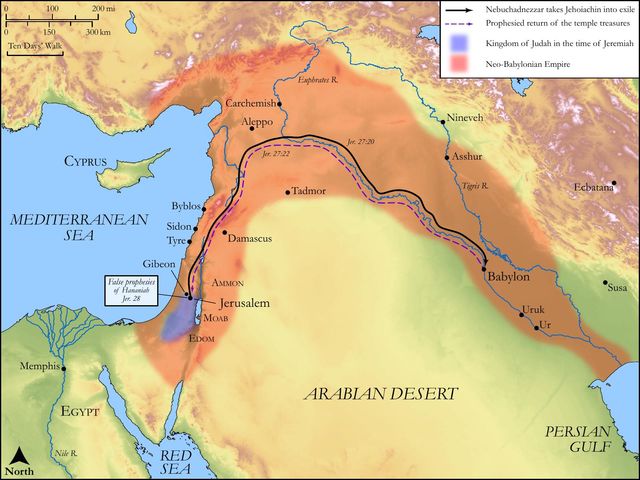
The events of Jeremiah 28 are set around 594 BC, a mere few years after the first significant Babylonian deportation of Judah's elite, including King Jehoiachin and many skilled craftsmen, in 597 BC. During this initial invasion, Nebuchadnezzar had also systematically plundered the Jerusalem temple, carrying away many of its sacred vessels to Babylon (2 Kings 24:13-16). Judah was a humiliated tributary, and its populace, both those remaining in Jerusalem and those in exile, harbored an intense longing for freedom, the return of their kin, and the restoration of their precious temple artifacts. In such a climate of despair and national humiliation, any message promising a swift end to the oppression, like Hananiah's, would have been immensely popular and comforting, starkly contrasting with Jeremiah's unpopular and difficult message of submission to Babylon as God's judgment.
Key Themes
ShowHideThis verse powerfully contributes to several overarching themes within the book of Jeremiah and broader biblical theology. Firstly, it vividly illustrates the Tension Between True and False Prophecy, showcasing the perennial struggle between a popular, comforting lie and a difficult, unpopular truth from God. Jeremiah's deeply human response underscores the immense burden of delivering God's authentic, often challenging, word, even when it goes against his own heart's desire. Secondly, it profoundly reveals the Human Desire for Restoration and Deliverance, even within the heart of God's prophet of judgment. Jeremiah's "Amen" is a raw, empathetic expression of his deep compassion for his suffering people and his yearning for God's mercy, the restoration of His house, and the return of His people, despite knowing that the immediate future held continued judgment. Finally, the passage emphasizes God's Sovereignty Over History and Prophecy. While human desire for a quick fix is natural, the ultimate fulfillment of prophecy rests solely on God's will and timing, not on human hopes, popular opinion, or false assurances. The true return of the captives and vessels would indeed happen, but on God's terms and timeline, not Hananiah's short-sighted prediction, as Jeremiah 29:10-14 later affirms with a promise of a future and a hope.
Exposition and Analysis
ShowHideKey Word Analysis
ShowHideFrom the root meaning "to be firm, trustworthy." This word signifies "so be it," "truly," or "let it be established." In this context, Jeremiah's "Amen" is not an affirmation of Hananiah's prophecy as true, but rather a deeply felt prayer or wish that such a desirable outcome—the swift restoration of his people and the temple vessels—would indeed be God's will and come to pass. It conveys a profound yearning for the good news to be valid, even as he intellectually knows it is not God's present word.
This is the Tetragrammaton (YHWH), the personal, covenantal name of God, often vocalized as "Yahweh" or "Jehovah." It denotes the self-existent, eternal God who is faithful to His promises and sovereign over all creation and history. Jeremiah's invocation of "the LORD" underscores that the fulfillment of any prophecy, whether true or false, ultimately depends on the will and power of the one true God, not on human pronouncements. It is a plea to the ultimate divine authority, acknowledging that only He can "do so" or "perform" such a thing.
A primitive root meaning "to speak (or sing) by inspiration," typically in prediction or simple discourse. The related noun, "prophet" (Hebrew, nâbîyʼ'), refers to an inspired man or woman. Here, Jeremiah acknowledges Hananiah's act of "prophesying," but the subsequent verses (Jeremiah 28:7-9) clarify that this act was not divinely inspired. The word itself describes the action of speaking on behalf of a divine source, but its truthfulness is always subject to verification by God's established word and subsequent fulfillment.
Verse Breakdown
ShowHide"Even the prophet Jeremiah said, Amen:"
This opening clause highlights the surprising and deeply human response of Jeremiah, the very prophet commissioned to deliver God's difficult message of judgment and prolonged exile. His "Amen" is a poignant expression of his personal desire for the good news of immediate restoration to be true, even though he knows it contradicts the word God has given him. It reveals his profound compassion for his suffering people and his yearning for their deliverance from the harsh realities of Babylonian oppression.
"the LORD do so: the LORD perform thy words which thou hast prophesied,"
This is Jeremiah's prayerful wish, a fervent plea to God. By invoking the personal name of God ("the LORD") twice, Jeremiah emphasizes that only God possesses the power and authority to bring about such an outcome. He wishes that God would indeed "perform" or "establish" Hananiah's words, not because he believes them to be God's current truth, but because they represent the most desirable and merciful outcome for Judah, reflecting his deep empathy for their plight.
"to bring again the vessels of the LORD'S house, and all that is carried away captive, from Babylon into this place."
This final clause specifies the content of Hananiah's popular prophecy and the object of Jeremiah's heartfelt wish. The "vessels of the LORD'S house" (H3627 kᵉlîy and H1004 bayith) were sacred temple implements, symbols of God's presence, His covenant with Israel, and the nation's spiritual heritage, which had been plundered by Babylon. "All that is carried away captive" (H1473 gôwlâh) refers to the exiled population, including the king, nobles, and skilled workers. The desire for their return "from Babylon into this place" (H4725 mâqôwm) encapsulates the national yearning for comprehensive restoration, both material and human, to their homeland and their former glory.
Literary Devices
ShowHideJeremiah 28:6 employs several significant literary devices that enrich its meaning and impact. Most notably, there is profound Irony in Jeremiah's "Amen." While "Amen" typically signifies affirmation, agreement, and truth ("so be it"), here it is uttered in response to a prophecy that Jeremiah knows, by divine revelation, is false. Jeremiah's "Amen" is not an endorsement of Hananiah's message as divine truth, but rather a deeply human and empathetic expression of a wish that such a comforting message were true. This creates a powerful Dramatic Contrast between Jeremiah's personal longing and his prophetic duty to deliver God's actual, difficult word. The verse also relies on Symbolism, particularly with "the vessels of the LORD'S house" and "all that is carried away captive." These are not merely physical objects or people, but represent the desecration of God's sanctuary, the brokenness of the covenant community, and the humiliation of the nation. Therefore, their promised return becomes a potent symbol of national restoration, divine favor, and the renewal of God's presence among His people.
Theological and Thematic Connections
ShowHideJeremiah 28:6 offers a profound theological insight into the nature of true prophecy and the heart of a genuine prophet. It demonstrates that while God's word is immutable and often challenging, His true messengers are not devoid of human emotion or compassion. Jeremiah's "Amen" reveals a prophet who deeply loves his people and yearns for their well-being, even when his divine commission requires him to deliver messages of judgment and prolonged suffering. This tension underscores the ethical and emotional burden of prophetic ministry, where personal desire must yield to divine revelation. The passage also highlights the critical importance of discernment, reminding us that popular or comforting messages are not necessarily true, and that God's timing and methods often differ from human expectations. True prophecy, unlike Hananiah's, is ultimately confirmed by its fulfillment, aligning with God's established character and prior revelation.
Reflection and Application
ShowHideJeremiah's "Amen" in this verse serves as a powerful reminder that even when God's truth is difficult to bear, our human hearts naturally long for comfort, peace, and swift resolution to suffering. This passage invites us to examine our own desires: do we seek God's truth, even when it's challenging and unpopular, or do we gravitate towards messages that simply affirm our hopes, preferences, and desire for immediate gratification? It calls us to cultivate a spirit of robust discernment, to test every word, every teaching, and every promise against the consistent revelation of God's character and His established Word, rather than being swayed by popular opinion, emotional appeal, or the allure of an easy way out. Furthermore, it encourages us to embrace the often-uncomfortable reality of God's perfect timing, trusting that His plans, though they may involve periods of waiting, hardship, or even judgment, are ultimately for our good and His glory. Like Jeremiah, we are called to hold deep compassion for those who suffer, while steadfastly upholding and proclaiming the truth of God, even when it is unpopular or personally painful to deliver.
Questions for Reflection
ShowHideFAQ
ShowHideWhy did Jeremiah say "Amen" if Hananiah was a false prophet?
ShowHideJeremiah's "Amen" in Jeremiah 28:6 is not an endorsement of Hananiah's prophecy as true or divinely inspired. Instead, it is interpreted as a deeply human and compassionate expression of a wish or heartfelt prayer. Jeremiah genuinely desired the good news Hananiah proclaimed—the swift return of the exiles and temple vessels—to be God's will. It reflects his profound love for his people and his yearning for their deliverance from suffering, even though he knew, by divine revelation, that God's true plan involved a longer period of exile as judgment (Jeremiah 25:11). His "Amen" is more akin to "Would that the LORD would do so!" or "So be it, if only it were true!"—a yearning for a different, more merciful reality than the one God had revealed to him.
What was the significance of the temple vessels being carried away captive?
ShowHideThe temple vessels were sacred implements used in the worship of God in the Jerusalem temple, central to Israel's covenant relationship and identity. Their removal by Nebuchadnezzar to Babylon (2 Kings 24:13) was a profound symbol of Judah's humiliation, the desecration of God's sanctuary, and the apparent triumph of pagan powers over the God of Israel. It was a tangible sign of God's judgment on His people for their unfaithfulness and idolatry. Their return, as prophesied by Hananiah and wished for by Jeremiah, would symbolize the restoration of God's honor, the renewal of the covenant, and the re-establishment of Judah's national and spiritual identity. This longing for their return is later fulfilled, though much later and on God's terms, as seen in Ezra 1:7-11.
How can we discern true prophecy or teaching today?
ShowHideThe Bible provides clear criteria for discerning true prophecy and teaching, principles that remain vital for believers today. Firstly, true prophecy must always align with God's established Word, the Scriptures (Deuteronomy 13:1-5 and Isaiah 8:20). Any message that contradicts biblical truth is false, regardless of its popularity or the perceived sincerity of its messenger. Secondly, true prophecy regarding the future must come to pass exactly as predicted, without error (Deuteronomy 18:21-22). Thirdly, the life and character of the prophet or teacher should bear good fruit, demonstrating godliness, humility, and integrity, not self-aggrandizement, greed, or moral compromise (Matthew 7:15-20). Finally, true prophecy often calls people to repentance, obedience to God, and deeper holiness, rather than simply offering comforting words without a call to spiritual transformation. Believers are exhorted to "test the spirits to see whether they are from God" (1 John 4:1) and to "examine everything carefully; hold fast to that which is good" (1 Thessalonians 5:21).
Christ-Centered Fulfillment
ShowHideJeremiah 28:6, with its poignant expression of longing for restoration and the return from captivity, finds its ultimate and profound fulfillment in Jesus Christ. The "Amen" uttered by Jeremiah, a wish for God to perform a desired restoration, points forward to Christ, who is the very "Amen" of God's promises. As 2 Corinthians 1:20 declares, "For all the promises of God find their Yes in him. That is why it is through him that we utter our Amen to God for his glory." Jesus is the definitive "Yes" to all of God's redemptive purposes, embodying the faithfulness and truth of God that Jeremiah yearned for. The physical return of the temple vessels and exiles from Babylon foreshadows the greater spiritual liberation and restoration accomplished by Christ. He is the true Temple (John 2:19-21), whose sacrifice not only purifies but also rebuilds the spiritual house of God, the Church, making believers living stones in a spiritual dwelling (Ephesians 2:19-22). Furthermore, Christ brings true freedom from the captivity of sin and death, a far deeper and more pervasive bondage than physical exile (Romans 6:22). He gathers His people, not merely from a geographical Babylon, but from every nation, tribe, and tongue, into His eternal kingdom, a new heavens and new earth where righteousness dwells (Revelation 7:9-10 and Revelation 21:1-4). Thus, the deep yearning for restoration expressed in Jeremiah's "Amen" is ultimately and perfectly satisfied in the person and work of Jesus Christ, who truly performs all of God's words of salvation and brings His people home to Himself.