


Romans 6:22
- νυνὶnuniNowG3570ADVAdverb
- δὲdehoweverG1161CONJConjunction
- ἐλευθερωθέντεςeleutherōthenteshaving been set freeG1659V-APP-NPMVerb Aorist Passive Participle Nominative Plural Masculine
- ἀπὸapofromG575PREPPreposition
- τῆςtēs<the>G3588T-GSFDefinite article Genitive Singular Feminine
- ἁμαρτίαςhamartiassinG266N-GSFNoun Genitive Singular Feminine
- δουλωθέντεςdoulōthenteshaving become slavesG1402V-APP-NPMVerb Aorist Passive Participle Nominative Plural Masculine
- δὲdenowG1161CONJConjunction
- τῷtō<the>G3588T-DSMDefinite article Dative Singular Masculine
- θεῷtheōto GodG2316N-DSM-TNoun Dative Singular Masculine Title
- ἔχετεecheteyou haveG2192V-PAI-2PVerb Present Active Indicative 2nd Plural
- τὸνtontheG3588T-ASMDefinite article Accusative Singular Masculine
- καρπὸνkarponfruitG2590N-ASMNoun Accusative Singular Masculine
- ὑμῶνhumōnof youG4771P-2GPPersonal pronoun Genitive 2nd Plural
- εἰςeisuntoG1519PREPPreposition
- ἁγιασμόνhagiasmonsanctificationG38N-ASMNoun Accusative Singular Masculine
- τὸto<the>G3588T-ASNDefinite article Accusative Singular Neuter
- δὲdenowG1161CONJConjunction
- τέλοςtelosthe endG5056N-ASNNoun Accusative Singular Neuter
- ζωὴνzōēn[is] lifeG2222N-ASFNoun Accusative Singular Feminine
- αἰώνιονaiōnioneternalG166A-ASFAdjective Accusative Singular Feminine
English is a literal word-by-word gloss of the Greek, not the KJV's wording. Why?
This is the original text the KJV's translators worked from — each Greek word with its own literal English meaning in this verse, prepared by scholars at Tyndale House, Cambridge. The KJV translates whole sentences, not word by word, so its wording differs: one Greek word can become several English words, and the KJV may choose “charity” where the gloss reads “love”. Both are faithful — they answer different questions. For the KJV's own rendering, switch to the KJV text.
Details
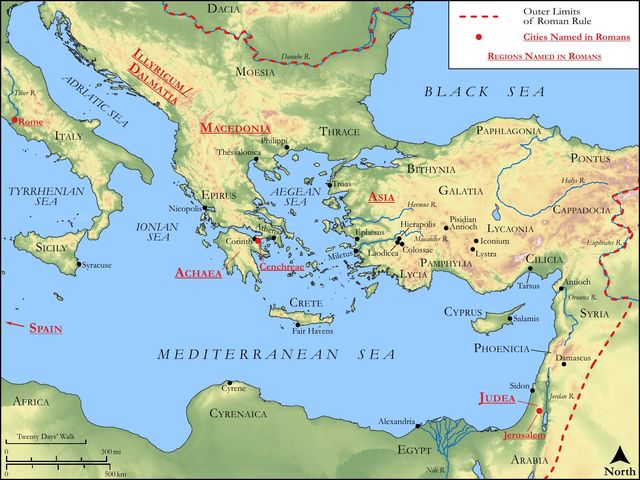
See on the biblical-era map

Study this verse
Public-domain commentary
Matthew Henry
From his Commentary on the Whole Bible. Henry comments on passages, not single verses — this entry covers Romans 6:1–23. His four-level outline is real structure in the source text, so it is rendered as structure.
The apostle's transition, which joins this discourse with the former, is observable: "What shall we say then? Rom 6:1. What use shall we make of this sweet and comfortable doctrine? Shall we do evil that good may come, as some say we do? Rom 3:8. Shall we continue in sin that grace may abound? Shall we hence take encouragement to sin with so much the more boldness, because the more sin we commit the more will the grace of God be magnified in our pardon? Is this a use to be made of it?" No, it is an abuse, and the apostle startles at the thought of it (Rom 6:2): "God forbid; far be it from us to think such a thought." He entertains the objection as Christ did the devil's blackest temptation (Mat 4:10): Get thee hence, Satan. Those opinions that give any countenance to sin, or open a door to practical immoralities, how specious and plausible soever they be rendered, by the pretension of advancing free grace, are to be rejected with the greatest abhorrence; for the truth as it is in Jesus is a truth according to godliness, Tit 1:1. The apostle is very full in pressing the necessity of holiness in this chapter, which may be reduced to two heads: - His exhortations to holiness, which show the nature of it; and his motives or arguments to enforce those exhortations, which show the necessity of it.
I.For the first, we may hence observe the nature of sanctification, what it is, and wherein it consists.
In general it has two things in it, mortification and vivification - dying to sin and living to righteousness, elsewhere expressed by putting off the old man and putting on the new, ceasing to do evil and learning to do well.
1.Mortification, putting off the old man; several ways this is expressed.
(1.)We must live no longer in sin (Rom 6:2), we must not be as we have been nor do as we have done. The time past of our life must suffice, Pe1 4:3. Though there are none that live without sin, yet, blessed be God, there are those that do not live in sin, do not live in it as their element, do not make a trade of it: this is to be sanctified.
(2.)The body of sin must be destroyed, Rom 6:6. The corruption that dwelleth in us is the body of sin, consisting of many parts and members, as a body. This is the root to which the axe must be laid. We must not only cease from the acts of sin (this may be done through the influence of outward restraints, or other inducements), but we must get the vicious habits and inclinations weakened and destroyed; not only cast away the idols of iniquity out of the heart. - That henceforth we should not serve sin. The actual transgression is certainly in a great measure prevented by the crucifying and killing of the original corruption. Destroy the body of sin, and then, though there should be Canaanites remaining in the land, yet the Israelites will not be slaves to them. It is the body of sin that sways the sceptre, wields the iron rod; destroy this, and the yoke is broken. The destruction of Eglon the tyrant is the deliverance of oppressed Israel from the Moabites.
(3.)We must be dead indeed unto sin, Rom 6:11. As the death of the oppressor is a release, so much more is the death of the oppressed, Job 3:17, Job 3:18. Death brings a writ of ease to the weary. Thus must we be dead to sin, obey it, observe it, regard it, fulfil its will no more than he that is dead doth his quandam task-masters - be as indifference to the pleasures and delights of sin as a man that is dying is to his former diversions. He that is dead is separated from his former company, converse, business, enjoyments, employments, is not what he was, does not what he did, has not what he had. Death makes a mighty change; such a change doth sanctification make in the soul, it cuts off all correspondence with sin.
(4.)Sin must not reign in our mortal bodies that we should obey it, Rom 6:12. Though sin may remain as an outlaw, though it may oppress as a tyrant, yet let it not reign as a king. Let it not make laws, nor preside in councils, nor command the militia; let it not be uppermost in the soul, so that we should obey it. Though we may be sometimes overtaken and overcome by it, yet let us never be obedient to it in the lusts thereof; let not sinful lusts be a law to you, to which you would yield a consenting obedience. In the lusts thereof - en tais epithumiais autou. It refers to the body, not to sin. Sin lies very much in the gratifying of the body, and humouring that. And there is a reason implied in the phrase your mortal body; because it is a mortal body, and hastening apace to the dust, therefore let not sin reign in it. It was sin that made our bodies mortal, and therefore do not yield obedience to such an enemy.
(5.)We must not yield our members as instruments of unrighteousness, Rom 6:13. The members of the body are made use of by the corrupt nature as tools, by which the wills of the flesh are fulfilled; but we must not consent to that abuse. The members of the body are fearfully and wonderfully made; it is a pity they should be the devil's tools of unrighteousness unto sin, instruments of the sinful actions, according to the sinful dispositions. Unrighteousness is unto sin; the sinful acts confirm and strengthen the sinful habits; one sin begets another; it is like the letting forth of water, therefore leave it before it be meddled with. The members of the body may perhaps, through the prevalency of temptation, be forced to be instruments of sin; but do not yield them to be so, do not consent to it. This is one branch of sanctification, the mortification of sin.
2.Vivification, or living to righteousness; and what is that?
(1.)It is to walk in newness of life, Rom 6:4. Newness of life supposes newness of heart, for out of the heart are the issues of life, and there is not way to make the stream sweet but by making the spring so. Walking, in scripture, is put for the course and tenour of the conversation, which must be new. Walk by new rules, towards new ends, from new principles. Make a new choice of the way. Choose new paths to walk in, new leaders to walk after, new companions to walk with. Old things should pass away, and all things become new. The man is what he was not, does what he did not.
(2.)It is to be alive unto God through Jesus Christ our Lord, Rom 6:11. To converse with God, to have a regard to him, a delight in him, a concern for him, the soul upon all occasions carried out towards him as towards an agreeable object, in which it takes a complacency: this is to be alive to God. The love of God reigning in the heart is the life of the soul towards God. Anima est ubi amat, non ubi animat - The soul is where it loves, rather than where it lives. It is to have the affections and desires alive towards God. Or, living (our live in the flesh) unto God, to his honour and glory as our end, by his word and will as our rule - in all our ways to acknowledge him, and to have our eyes ever towards him; this is to live unto God. - Through Jesus Christ our Lord. Christ is our spiritual life; there is no living to God but through him. He is the Mediator; there can be no comfortable receivings from God, nor acceptable regards to God, but in and through Jesus Christ; no intercourse between sinful souls and a holy God, but by the mediation of the Lord Jesus. Through Christ as the author and maintainer of this life; through Christ as the head from whom we receive vital influence; through Christ as the root by which we derive sap and nourishment, and so live. In living to God, Christ is all in all.
(3.)It is to yield ourselves to God, as those that are alive from the dead, Rom 6:13. The very life and being of holiness lie in the dedication of ourselves to the Lord, giving our own selves to the Lord, Co2 8:5. "Yield yourselves to him, not only as the conquered yields to the conqueror, because he can stand it out no longer; but as the wife yields herself to her husband, to whom her desire is, as the scholar yields himself to the teacher, the apprentice to his master, to be taught and ruled by him. Not yield your estates to him, but yield yourselves; nothing less than your whole selves;" parastēsate eautous - accommodate vos ipsos Deo - accommodate yourselves to God; so Tremellius, from the Syriac. "Not only submit to him, but comply with him; not only present yourselves to him once for all, but be always ready to serve him. Yield yourselves to him as wax to the seal, to take any impression, to be, and have, and do, what he pleases." When Paul said, Lord, what wilt thou have me to do? (Act 9:6) he was then yielded to God. As those that are alive from the dead. To yield a dead carcase to a living God is not to please him, but to mock him: "Yield yourselves as those that are alive and good for something, a living sacrifice," Rom 12:1. The surest evidence of our spiritual life is the dedication of ourselves to God. It becomes those that are alive from the dead (it may be understood of a death in law), that are justified and delivered from death, to give themselves to him that hath so redeemed them.
(4.)It is to yield our members as instruments of righteousness to God. The members of our bodies, when withdrawn from the service of sin, are not to lie idle, but to be made use of in the service of God. When the strong man armed is dispossessed, let him whose right it is divide the spoils. Though the powers and faculties of the soul be the immediate subjects of holiness and righteousness, yet the members of the body are to be instruments; the body must be always ready to serve the soul in the service of God. Thus (Rom 6:19), "Yield your members servants to righteousness unto holiness. Let them be under the conduct and at the command of the righteous law of God, and that principle of inherent righteousness which the Spirit, as sanctifier, plants in the soul." Righteousness unto holiness, which intimates growth, and progress, and ground obtained. As every sinful act confirms the sinful habit, and makes the nature more and more prone to sin (hence the members of a natural man are here said to be servants to iniquity unto iniquity - one sin makes the heart more disposed for another), so every gracious act confirms the gracious habit: serving righteousness is unto holiness; one duty fits us for another; and the more we do the more we may do for God. Or serving righteousness, eis hagiasmon - as an evidence of sanctification.
II.The motives or arguments here used to show the necessity of sanctification.
There is such an antipathy in our hearts by nature to holiness that it is no easy matter to bring them to submit to it: it is the Spirit's work, who persuades by such inducements as these set home upon the soul.
1.He argues from our sacramental conformity to Jesus Christ. Our baptism, with the design and intention of it, carried in it a great reason why we should die to sin, and live to righteousness. Thus we must improve our baptism as a bridle of restraint to keep us in from sin, as a spur of constraint to quicken us to duty. Observe this reasoning.
(1.)In general, we are dead to sin, that is, in profession and in obligation. Our baptism signifies our cutting off from the kingdom of sin. We profess to have no more to do with sin. We are dead to sin by a participation of virtue and power for the killing of it, and by our union with Christ and interest in him, in and by whom it is killed. All this is in vain if we persist in sin; we contradict a profession, violate an obligation, return to that to which we were dead, like walking ghosts, than which nothing is more unbecoming and absurd. For (Rom 6:7) he that is dead is freed from sin; that is, he that is dead to it is freed from the rule and dominion of it, as the servant that is dead is freed from his master, Job 3:19. Now shall we be such fools as to return to that slavery from which we are discharged? When we are delivered out of Egypt, shall we talk of going back to it again?
(2.)In particular, being baptized into Jesus Christ, we were baptized into his death, Rom 6:3. We were baptized eis Christon - unto Christ, as Co1 10:2, eis Mōsēn - unto Moses. Baptism binds us to Christ, it binds us apprentice to Christ as our teacher, it is our allegiance to Christ as our sovereign. Baptism is externa ansa Christi - the external handle of Christ, by which Christ lays hold on men, and men offer themselves to Christ. Particularly, we were baptized into his death, into a participation of the privileges purchased by his death, and into an obligation both to comply with the design of his death, which was to redeem us from all iniquity, and to conform to the pattern of his death, that, as Christ died for sin, so we should die to sin. This was the profession and promise of our baptism, and we do not do well if we do not answer this profession, and make good this promise.
[1.]Our conformity to the death of Christ obliges us to die unto sin; thereby we know the fellowship of his sufferings, Phi 3:10. Thus we are here said to be planted together in the likeness of is death (Rom 6:5), tō homoiōmati, not only a conformity, but a conformation, as the engrafted stock is planted together into the likeness of the shoot, of the nature of which it doth participate. Planting is in order to life and fruitfulness: we are planted in the vineyard in a likeness to Christ, which likeness we should evidence in sanctification. Our creed concerning Jesus Christ is, among other things, that he was crucified, dead, and buried; now baptism is a sacramental conformity to him in each of these, as the apostle here takes notice. First, Our old man is crucified with him, Rom 6:6. The death of the cross was a slow death; the body, after it was nailed to the cross, gave many a throe and many a struggle: but it was a sure death, long in expiring, but expired at last; such is the mortification of sin in believers. It was a cursed death, Gal 3:13. Sin dies as a malefactor, devoted to destruction; it is an accursed thing. Though it be a slow death, yet this must needs hasten it that it is an old man that is crucified; not in the prime of its strength, but decaying: that which waxeth old is ready to vanish away, Heb 8:13. Crucified with him - sunestaurōthē, not in respect of time, but in respect of causality. The crucifying of Christ for us has an influence upon the crucifying of sin in us. Secondly, We are dead with Christ, Rom 6:8. Christ was obedient to death: when he died, we might be said to die with him, as our dying to sin is an act of conformity both to the design and to the example of Christ's dying for sin. Baptism signifies and seals our union with Christ, our engrafting into Christ; so that we are dead with him, and engaged to have no more to do with sin than he had. Thirdly, We are buried with him by baptism, Rom 6:4. Our conformity is complete. We are in profession quite cut off from all commerce and communion with sin, as those that are buried are quite cut off from all the world; not only not of the living, but no more among the living, have nothing more to do with them. Thus must we be, as Christ was, separate from sin and sinners. We are buried, namely, in profession and obligation: we profess to be so, and we are bound to be so: it was our covenant and engagement in baptism; we are sealed to be the Lord's, therefore to be cut off from sin. Why this burying in baptism should so much as allude to any custom of dipping under water in baptism, any more than our baptismal crucifixion and death should have any such references, I confess I cannot see. It is plain that it is not the sign, but the thing signified, in baptism, that the apostle here calls being buried with Christ, and the expression of burying alludes to Christ's burial. As Christ was buried, that he might rise again to a new and more heavenly life, so we are in baptism buried, that is, cut off from the life of sin, that we may rise again to a new life of faith and love.
[2.]Our conformity to the resurrection of Christ obliges us to rise again to newness of life. This is the power of his resurrection which Paul was so desirous to know, Phi 3:10. Christ was raised up from the dead by the glory of the Father, that is, by the power of the Father. The power of God is his glory; it is glorious power, Col 1:11. Now in baptism we are obliged to conform to that pattern, to be planted in the likeness of his resurrection (Rom 6:5), to live with him, Rom 6:8. See Col 2:12. Conversion is the first resurrection from the death of sin to the life of righteousness; and this resurrection is conformable to Christ's resurrection. This conformity of the saints to the resurrection of Christ seems to be intimated in the rising of so many of the bodies of the saints, which, though mentioned before by anticipation, is supposed to have been concomitant with Christ's resurrection, Mat 27:52. We have all risen with Christ. In two things we must conform to the resurrection of Christ: - First, He rose to die no more, Rom 6:9. We read of many others that were raised from the dead, but they rose to die again. But, when Christ rose, he rose to die no more; therefore he left his grave-clothes behind him, whereas Lazarus, who was to die again, brought them out with him, as one that should have occasion to use them again: but over Christ death has no more dominion; he was dead indeed, but he is alive, and so alive that he lives for evermore, Rev 1:18. Thus we must rise from the grave of sin never again to return to it, nor to have any more fellowship with the works of darkness, having quitted that grave, that land of darkness as darkness itself. Secondly, He rose to live unto God (Rom 6:10), to live a heavenly life, to receive that glory which was set before him. Others that were raised from the dead returned to the same life in every respect which they had before lived; but so did not Christ: he rose again to leave the world. Now I am no more in the world, Joh 13:1; Joh 17:11. He rose to live to God, that is, to intercede and rule, and all to the glory of the Father. Thus must we rise to live to God: this is what he calls newness of life (Rom 6:4), to live from other principles, by other rules, with other aims, than we have done. A life devoted to God is a new life; before, self was the chief and highest end, but now God. To live indeed is to live to God, with our eyes ever towards him, making him the centre of all our actions.
2.He argues from the precious promises and privileges of the new covenant, Rom 6:14. It might be objected that we cannot conquer and subdue sin, it is unavoidably too hard for us: "No," says he, "you wrestle with an enemy that may be dealt with and subdued, if you will but keep your ground and stand to your arms; it is an enemy that is already foiled and baffled; there is strength laid up in the covenant of grace for your assistance, if you will but use it. Sin shall not have dominion." God's promises to us are more powerful and effectual for the mortifying of sin than our promises to God. Sin may struggle in a believer, and may create him a great deal of trouble, but it shall not have dominion; it may vex him, but shall not rule over him. For we are not under the law, but under grace, not under the law of sin and death, but under the law of the spirit of life, which is in Christ Jesus: we are actuated by other principles than we have been: new lords, new laws. Or, not under the covenant of works, which requires brick, and gives no straw, which condemns upon the least failure, which runs thus, "Do this, and live; do it not, and die;" but under the covenant of grace, which accepts sincerity as our gospel perfection, which requires nothing but what it promises strength to perform, which is herein well ordered, that every transgression in the covenant does not put us out of covenant, and especially that it does not leave our salvation in our own keeping, but lays it up in the hands of the Mediator, who undertakes for us that sin shall not have dominion over us, who hath himself condemned it, and will destroy it; so that, if we pursue the victory, we shall come off more than conquerors. Christ rules by the golden sceptre of grace, and he will not let sin have dominion over those that are willing subjects to that rule. This is a very comfortable word to all true believers. If we were under the law, we were undone, for the law curses every one that continues not in every thing; but we are under grace, grace which accepts the willing mind, which is not extreme to mark what we do amiss, which leaves room for repentance, which promises pardon upon repentance; and what can be to an ingenuous mind a stronger motive than this to have nothing to do with sin? Shall we sin against so much goodness, abuse such love? Some perhaps might suck poison out of this flower, and disingenuously use this as an encouragement to sin. See how the apostle starts at such a thought (Rom 6:15): Shall we sin because we are not under the law, but under grace? God forbid. What can be more black and ill-natured than from a friend's extraordinary expressions of kindness and good-will to take occasion to affront and offend him? To spurn at such bowels, to spit in the face of such love, is that which, between man and man, all the world would cry out shame on.
3.He argues from the evidence that this will be of our state, making for us, or against us (Rom 6:16): To whom you yield yourselves servants to obey, his servants you are. All the children of men are either the servants of God, or the servants of sin; these are the two families. Now, if we would know to which of these families we belong, we must enquire to which of these masters we yield obedience. Our obeying the laws of sin will be an evidence against us that we belong to that family on which death is entailed. As, on the contrary, our obeying the laws of Christ will evidence our relation to Christ's family.
4.He argues from their former sinfulness, Rom 6:17-21, where we may observe,
(1.)What they had been and done formerly. We have need to be often reminded of our former state. Paul frequently remembers it concerning himself, and those to whom he writes. [1.] You were the servants of sin. Those that are now the servants of God would do well to remember the time when they were the servants of sin, to keep them humble, penitent, and watchful, and to quicken them in the service of God. It is a reproach to the service of sin that so many thousands have quitted the service, and shaken off the yoke; and never any that sincerely deserted it, and gave themselves to the service of God, have returned to the former drudgery. "God be thanked that you were so, that is, that though you were so, yet you have obeyed. You were so; God be thanked that we can speak of it as a thing past: you were so, but you are not now so. Nay, your having been so formerly tends much to the magnifying of divine mercy and grace in the happy change. God be thanked that the former sinfulness is such a foil and such a spur to your present holiness." [2.] You have yielded your members servants to uncleanness, and to iniquity unto iniquity, Rom 6:19. It is the misery of a sinful state that the body is made a drudge to sin, than which there could not be a baser or a harder slavery, like that of the prodigal that was sent into the fields to feed swine. You have yielded. Sinners are voluntary in the service of sin. The devil could not force them into the service, if they did not yield themselves to it. This will justify God in the ruin of sinners, that they sold themselves to work wickedness: it was their own act and deed. To iniquity unto iniquity. Every sinful act strengthens and confirms the sinful habit: to iniquity as the work unto iniquity as the wages. Sow the wind, and reap the whirlwind; growing worse and worse, more and more hardened. This he speaks after the manner of men, that is, he fetches a similitude from that which is common among men, even the change of services and subjections. [3.] You were free from righteousness (Rom 6:20); not free by any liberty given, but by a liberty taken, which is licentiousness: "You were altogether void of that which is good, - void of any good principles, motions, or inclinations, - void of all subjection to the law and will of God, of all conformity to his image; and this you were highly pleased with, as a freedom and a liberty; but a freedom from righteousness is the worst kind of slavery."
(2.)How the blessed change was made, and wherein it did consist.
[1.]You have obeyed from the heart that form of doctrine which was delivered to you, Rom 6:17. This describes conversion, what it is; it is our conformity to, and compliance with, the gospel which was delivered to us by Christ and his ministers. - Margin. Whereto you were delivered; eis hon paredothēte - into which you were delivered. And so observe, First, The rule of grace, that form of doctrine - tupon didachēs. The gospel is the great rule both of truth and holiness; it is the stamp, grace is the impression of that stamp; it is the form of healing words, Ti2 1:13. Secondly, The nature of grace, as it is our conformity to that rule. 1. It is to obey from the heart. The gospel is a doctrine not only to be believed, but to be obeyed, and that from the heart, which denotes the sincerity and reality of that obedience; not in profession only, but in power - from the heart, the innermost part, the commanding part of us. 2. It is to be delivered into it, as into a mould, as the wax is cast into the impression of the seal, answering it line for line, stroke for stroke, and wholly representing the shape and figure of it. To be a Christian indeed is to be transformed into the likeness and similitude of the gospel, our souls answering to it, complying with it, conformed to it - understanding, will, affections, aims, principles, actions, all according to that form of doctrine.
[2.]Being made free from sin, you became servants of righteousness (Rom 6:18), servants to God, Rom 6:22. Conversion is, First, A freedom from the service of sin; it is the shaking off of that yoke, resolving to have no more to do with it. Secondly, A resignation of ourselves to the service of God and righteousness, to God as our master, to righteousness as our work. When we are made free from sin, it is not that we may live as we list, and be our own masters; no: when we are delivered out of Egypt, we are, as Israel, led to the holy mountain, to receive the law, and are there brought into the bond of the covenant. Observe, We cannot be made the servants of God till we are freed from the power and dominion of sin; we cannot serve two masters so directly opposite one to another as God and sin are. We must, with the prodigal, quit the drudgery of the citizen of the country, before we can come to our Father's house.
(3.)What apprehensions they now had of their former work and way. He appeals to themselves (Rom 6:21), whether they had not found the service of sin,
[1.]An unfruitful service: "What fruit had you then? Did you ever get any thing by it? Sit down, and cast up the account, reckon your gains, what fruit had you then?" Besides the future losses, which are infinitely great, the very present gains of sin are not worth mentioning. What fruit? Nothing that deserves the name of fruit. The present pleasure and profit of sin do not deserve to be called fruit; they are but chaff, ploughing iniquity, sowing vanity, and reaping the same.
[2.]It is an unbecoming service; it is that of which we are now ashamed - ashamed of the folly, ashamed of the filth, of it. Shame came into the world with sin, and is still the certain product of it - either the shame of repentance, or, if not that, eternal shame and contempt. Who would wilfully do that which sooner or later he is sure to be ashamed of?
5.He argues from the end of all these things. it is the prerogative of rational creatures that they are endued with a power of prospect, are capable of looking forward, considering the latter end of things. To persuade us from sin to holiness here are blessing and cursing, good and evil, life and death, set before us; and we are put to our choice.
(1.)The end of sin is death (Rom 6:21): The end of those things is death. Though the way may seem pleasant and inviting, yet the end is dismal: at the last it bites; it will be bitterness in the latter end. The wages of sin is death, Rom 6:23. Death is as due to a sinner when he hath sinned as wages are to a servant when he hath done his work. This is true of every sin. There is no sin in its own nature venial. Death is the wages of the least sin. Sin is here represented either as the work for which the wages are given, or as the master by whom the wages are given; all that are sin's servants and do sin's work must expect to be thus paid.
(2.)If the fruit be unto holiness, if there be an active principle of true and growing grace, the end will be everlasting life - a very happy end! - Though the way be up-hill, though it be narrow, and thorny, and beset, yet everlasting life at the end of it is sure. So, Rom 6:23, The gift of God is eternal life. Heaven is life, consisting in the vision and fruition of God; and it is eternal life, no infirmities attending it, no death to put a period to it. This is the gift of God. The death is the wages of sin, it comes by desert; but the life is a gift, it comes by favour. Sinners merit hell, but saints do not merit heaven. There is no proportion between the glory of heaven and our obedience; we must thank God, and not ourselves, if ever we get to heaven. And this gift is through Jesus Christ our Lord. It is Christ that purchased it, prepared it, prepares us for it, preserves us to it; he is the Alpha and Omega, All in all in our salvation.
Historical interpretation
Two Centuries of Reception
7 surviving comments on this verse. Each one is dated, so this reads as a timeline rather than a list.
Select a marker to jump to its quote. Markers stagger vertically where authors wrote within a few decades of each other.
And the apostle, succinctly describing the end, writes in the Epistle to the Romans: "But now, being made free from sin, and become servants to God, ye have your fruit unto holiness, and the end everlasting life."
Throughout this chapter, while withdrawing our members from unrighteousness and sin and applying them to righteousness and holiness, and transferring the same from the wages of death to the gift of eternal life, Paul undoubtedly promises to the flesh the reward of salvation. Now it would not have been consistent for a rule of holiness and righteousness to be especially enjoined for the flesh if the reward of such a discipline were not also within its reach; nor could even baptism be ordered for the flesh if by its regeneration a course were not inaugurated tending to its restitution.
Paul repeats what he has already said [in verse 18] but with an important difference. There he said that we have become slaves to obedience, which leads to righteousness, but here he says that we have become slaves to God. By saying this, Paul shows that after someone has been set free from sin he ought to serve righteousness and perform all the virtues in the first instance and then ascend by the way of spiritual progress to the point where he becomes a slave of God, even though to be a slave of righteousness is also to be a slave of God. For Christ is righteousness, and to serve Christ is to serve God. Nevertheless, there is a scale of spiritual perfection, and there are different levels of virtue. For this reason Christ is said to reign, because he is righteousness, until such time as the fullness of all virtue is complete in everyone. Then, when the measure of perfection is reached, it is said that he will give up the kingdom to God the Father, so that God may be all in all.
If when we receive the forgiveness of sins we become imitators of good deeds, we shall acquire holiness and we shall obtain eternal life at the end, for we shall pass from death, which Paul said was the end, to life, which is without end.
Of the former, the fruit was shame, even after the being set free. Of these the fruit is holiness, and where holiness is, there is all confidence. But of those things the end is death, and of these everlasting life. Do you see how he points out some things as already given, and some as existing in hope, and from what are given he draws proof of the others also, that is from the holiness of the life. For to prevent your saying (i.e. as an objection) everything lies in hope, he points out that you have already reaped fruits, first the being freed from wickedness, and such evils as the very recollection of puts one to shame; second, the being made a servant unto righteousness; a third, the enjoying of holiness; a fourth, the obtaining of life, and life too not for a season, but everlasting. Yet with all these, he says, do but serve as ye served it. For though the master is far preferable, and the service also has many advantages, and the rewards too for which ye are serving, still I make no further demand. Next, since he had mentioned arms and a king, he keeps on with the metaphor.
Doubtless there is no blessing in something for which one feels shame when repenting of it. Everyone who comes to know goodness is ashamed of his former actions, but anyone who is ashamed of righteousness is not aware of its fruit. Therefore, those who sin get nothing out of it in the present, and in the future they will reap eternal death. But those who serve God have the gift of the Holy Spirit in the present and eternal life in the future. Or perhaps it should be read like this: what have you got out of doing things which make you feel ashamed whenever you think of them? The return you have already received is that, having been sanctified by baptism, you are alive.
[Daniel 5:19] "'He slew whomever he would and smote to death whomever he wished to; those whom he wished he set on high, and brought low whomever he would.'" Thus he sets forth the example of the king's great-grandfather, in order to teach him the justice of God and make it clear that his great-grandson too was to suffer similar treatment because of his pride. Now if Nebuchadnezzar slew whomever he would and smote to death whomever he wished to; if he set on high those whom he would and brought low whomever he wished to, there is certainly no Divine providence or Scriptural injunction behind these honors and slayings, these acts of promotion and humiliation. But rather, such things ensue from the will of the men themselves who do the slaying and promoting to honor, and all the rest. If this be the case, the question arises as to how we are to understand the Scripture: "The heart of a king reposes in the hand of God; He will incline it in whatever direction He wishes" (Proverbs 21:1). Perhaps we might say that every saint is a king, for sin does not reign in his mortal body, and his heart therefore is kept safe, for he is in God's hand (Romans 6:1-23). And whatever has once come into the hand of God the Father, according to the Gospel, no man is able to take it away (John 10:28). And whoever is taken away, it is understood that he never was in God's hand at all.
Continue studying Romans 6:22 across the web’s major study libraries — every link below opens this exact verse, chapter, or book on the destination site.
Read & Compare
 BibleGatewayThis verse in more than 200 translations and 70 languages.
 Bible.comThe YouVersion reader — hundreds of translations, reading plans, and highlights.
 ESV.orgCrossway's official English Standard Version reader.
 NET BibleThe NET translation with 60,000+ translators' notes on every rendering decision.
 STEP BibleTyndale House's free study tool — original text, vocabulary, and scholarly resources.
 BibliaLogos Bible Software's free web reader.
 USCCBThe New American Bible (Revised Edition) with the U.S. bishops' study notes.
Commentaries
 BibleHub CommentariesDozens of classic commentaries on this verse, gathered on one page.
 StudyLightMore than 100 commentary sets — the largest collection on the web.
 BibleRefPlain-English commentary on what this verse means, verse by verse.
 Enduring WordDavid Guzik's free commentary on this chapter, widely used by Bible teachers.
 Bible Study ToolsVerse commentary alongside Greek and Hebrew study aids.
Original Language & Research
- BibleHub InterlinearThe verse word by word — original language, transliteration, and English.
- BibleHub LexiconEvery word's original-language definition and Strong's entry.
 Blue Letter BibleDeep-study tools — Strong's numbers, concordance, and word studies.
 CNTR CollationThe earliest Greek manuscripts of this verse, collated letter by letter.
Sermons, Hymns & Audio


TrulyRandomVerse is not affiliated with these sites and doesn’t control their content. They’re linked because they’re genuinely useful.
Summary
Romans 6:22 encapsulates the transformative reality of the believer's new identity in Christ. Having been decisively liberated from the enslaving dominion of sin, believers are now willingly devoted to God, resulting in a life progressively characterized by holiness. This journey of sanctification culminates in the ultimate and glorious destiny of everlasting life, a stark contrast to the death that sin once promised.
Context
ShowHideLiterary Context
This verse serves as a powerful summary and conclusion to Paul's profound theological argument in Romans 6. Paul begins the chapter by addressing the misconception that grace encourages continued sin (Romans 6:1-2). He then meticulously explains the believer's union with Christ in His death and resurrection, emphasizing that believers have died to sin's power and are raised to walk in newness of life (Romans 6:3-11). The subsequent verses (Romans 6:12-14) issue an exhortation not to let sin reign in their mortal bodies, for they are no longer under law but under grace. The immediate preceding passage (Romans 6:15-21) draws a vivid contrast between two masters: sin, which leads to death, and righteousness, which leads to sanctification. Verse 22, therefore, articulates the positive outcome of choosing God as master, presenting the "fruit" and "end" of this new allegiance.
Historical & Cultural Context
The concept of "slavery" (δοῦλος, doulos) was pervasive in the Roman world, where a significant portion of the population were actual slaves. Paul's audience, both Jewish and Gentile, would have intimately understood the implications of being owned by a master—absolute submission, lack of personal rights, and living solely for the master's will. By using this metaphor, Paul powerfully conveys the radical shift in allegiance for believers. They were formerly "slaves of sin" (Romans 6:17), bound to its dictates and consequences. Now, through Christ, they are "made free" from that oppressive master, but this freedom is not autonomy; rather, it is a transfer of ownership to a new, benevolent Master—God. This voluntary, joyful servanthood to God stands in stark contrast to the involuntary and destructive servitude to sin, offering a profound redefinition of freedom within a familiar social construct.
Key Themes
ShowHideRomans 6:22 is rich with several interconnected themes central to Paul's theology. Foremost is the theme of Radical Transformation and New Identity, emphasizing a decisive break from the old life dominated by sin to a new life defined by Christ. This transformation leads directly to Sanctification, the ongoing process of being set apart for God and growing in practical holiness. The verse highlights the Shift in Allegiance, moving from serving sin, which yields death, to serving God, which yields life. This new servanthood is not burdensome but liberating, as the master is righteous and good. Finally, the verse clearly presents the Teleological End of the Christian Life, which is not merely moral improvement but the glorious and ultimate reality of "everlasting life," a concept further expounded upon in Romans 8. This ultimate hope provides both motivation and assurance for the believer's journey of holiness.
Exposition and Analysis
ShowHideKey Word Analysis
ShowHideFrom the root word meaning "free," this passive verb signifies a definitive act of liberation performed by an external agent. It means "to liberate, i.e. (figuratively) to exempt (from moral, ceremonial or mortal liability)." In this context, believers are not freeing themselves, but God has decisively delivered them from the legal and spiritual bondage of sin. This emphasizes the divine initiative in salvation.
Derived from the word for "slave" or "bondservant," this verb means "to enslave (literally or figuratively)." While "made free" from sin, believers have simultaneously "become servants" or "enslaved" to God. This is a paradox that reveals a profound truth: true freedom from sin's tyranny is found in willing, joyful submission to God's benevolent authority. It implies complete devotion and obedience to God as the new, righteous Master.
This term refers to "purification, i.e. (the state) purity; concretely (by Hebraism) a purifier." It denotes both the state of being set apart for God's purposes (sanctification as a status) and the progressive process of moral and spiritual purification in the believer's life (sanctification as a process). The "fruit unto holiness" indicates that a life devoted to God naturally produces character and conduct that reflect His purity and righteousness.
Verse Breakdown
ShowHide"But now being made free from sin"
This clause marks a decisive turning point in the believer's spiritual state. The "but now" (G1161 dé G3570 nyní) emphasizes the contrast with their former condition as slaves to sin. The passive voice of "being made free" (G1659 eleutheróō) underscores that this liberation is not self-achieved but is a gracious act of God, accomplished through Christ's work on the cross. It signifies a complete break from sin's dominion and its power to compel obedience.
"and become servants to God"
This phrase reveals the nature of the believer's new allegiance. Freedom from sin does not lead to lawlessness or autonomy, but to a transfer of masters. Having been delivered from the tyranny of sin, believers now willingly and joyfully submit themselves as bondservants (G1402 doulóō) to God (G2316 theós). This new servanthood is characterized by love, devotion, and obedience, reflecting a profound shift in identity and purpose.
"ye have your fruit unto holiness"
The immediate and ongoing result of this new servanthood is the production of "fruit" (G2590 karpós). This "fruit" is directed "unto" (G1519 eis) or towards "holiness" (G38 hagiasmós). This refers to the process of sanctification—the progressive transformation of character and conduct to reflect God's moral purity and to be set apart for His purposes. It is the tangible evidence of a life lived in submission to God, demonstrating a growing conformity to Christ.
"and the end everlasting life"
This final clause declares the ultimate culmination and blessed destiny of the believer's journey. "The end" (G5056 télos) signifies the ultimate goal, outcome, or purpose. This end is not the death that sin pays as wages, but "everlasting life" (G166 aiṓnios G2222 zōḗ). This is not merely unending existence but a quality of life characterized by God's own nature, a life of fellowship with Him that begins in the present and is fully realized in eternity. It is the gracious gift of God, the glorious telos of the believer's liberation and service.
Literary Devices
ShowHidePaul masterfully employs several literary devices in Romans 6:22. Central to the verse is Antithesis, creating a sharp contrast between the former state and the new reality. Believers are "made free from sin" (the old master) and simultaneously "become servants to God" (the new master). This highlights the radical shift in allegiance and identity. The concept of "fruit unto holiness" is a powerful Metaphor, drawing on the imagery of a tree producing fruit. Just as a healthy tree naturally yields good fruit, a life submitted to God will naturally produce the fruit of righteousness and holiness. Finally, the verse exhibits a clear Progression or Climax: liberation from sin leads to servanthood to God, which in turn produces holiness, ultimately culminating in everlasting life. This logical and theological sequence demonstrates the divine order of salvation and its glorious outcome.
Theological and Thematic Connections
ShowHideRomans 6:22 profoundly articulates the practical outworking of salvation, moving beyond justification (being declared righteous) to sanctification (being made righteous). It underscores that true freedom is not found in autonomy from God, but in willing submission to Him, which paradoxically liberates us from the destructive power of sin. This verse emphasizes the active role of the believer in pursuing holiness, not as a means to earn salvation, but as the natural and expected "fruit" of a transformed life. It also highlights the teleological nature of the Christian journey, with "everlasting life" as the ultimate, glorious end, a gift of God's grace that contrasts sharply with the wages of sin. This transformation from slavery to sin to servanthood to God, leading to holiness and eternal life, is the very essence of the new covenant reality.
Reflection and Application
ShowHideRomans 6:22 offers profound encouragement and a clear blueprint for the Christian life. It reminds us that our liberation from sin's dominion is a divine act, not a human achievement, empowering us to live differently. This verse calls us to embrace our new identity as willing servants of God, recognizing that our freedom is found in joyful submission to His benevolent will. The "fruit unto holiness" is a powerful reminder that our faith is not merely intellectual assent but a transformative journey that should manifest in tangible changes in our character, attitudes, and actions. This means actively cultivating virtues, resisting temptation, and pursuing righteousness in every area of life, allowing the Holy Spirit to work within us. Furthermore, the promise of "everlasting life" provides an eternal perspective, reminding us that our present struggles and pursuits of holiness are not in vain, but are part of a grand narrative leading to an glorious, unending fellowship with God. This hope fuels our perseverance and strengthens our resolve to live lives worthy of our calling.
Questions for Reflection
ShowHideFAQ
ShowHideDoes "made free from sin" mean believers can no longer sin?
ShowHideNo, "made free from sin" (G1659 eleutheróō) in this context refers to liberation from sin's dominion or slavery, meaning sin no longer has the ultimate power to compel a believer's obedience. It signifies a change in mastery, not an instantaneous eradication of the capacity or temptation to sin. Believers still possess a sinful nature and will struggle with sin throughout their earthly lives, as acknowledged elsewhere in Scripture (e.g., 1 John 1:8-10). However, they are no longer helpless victims but have the power through the Holy Spirit to resist sin and choose righteousness (Romans 8:13).
What does it mean to "become servants to God" if believers are "free"?
ShowHideThis is a beautiful paradox central to Christian freedom. Being "made free from sin" (G1659 eleutheróō) liberates believers from a destructive master. This freedom, however, is not autonomy or lawlessness, but a transfer of allegiance to a new, benevolent Master—God. To "become servants" (G1402 doulóō) to God means to willingly and joyfully submit to His righteous will and purposes. Unlike the oppressive bondage to sin, servanthood to God is characterized by love, purpose, and true flourishing. It's a chosen, loving devotion that leads to life, not death, and is the only path to genuine liberty (John 8:36).
Is "holiness" a state we achieve or a process we undergo?
ShowHide"Holiness" (G38 hagiasmós) in Romans 6:22 encompasses both a state and a process. The moment a person is justified by faith in Christ, they are declared holy and set apart for God (a positional holiness or sanctification). However, the "fruit unto holiness" clearly refers to the progressive work of sanctification, where the believer is continually being transformed into the likeness of Christ (2 Corinthians 3:18). It is an ongoing journey of moral and spiritual purification, where one's character and conduct increasingly reflect God's purity and righteousness. This process is empowered by the Holy Spirit working within the believer (Philippians 2:12-13).
Christ-Centered Fulfillment
ShowHideRomans 6:22 finds its ultimate fulfillment and power in the person and work of Jesus Christ. It is through His sacrificial death that we are "made free from sin," for He bore the penalty for our transgressions, breaking sin's legal claim and dominion over us (Romans 8:3-4). His resurrection then empowers us to "become servants to God," as we are united with Him in newness of life, no longer living for ourselves but for Him who died and rose again (2 Corinthians 5:15). The "fruit unto holiness" is not achieved by human effort but is the natural outflow of Christ's life within us, as the Holy Spirit, sent by Christ, empowers us to walk in obedience and produce the fruit of righteousness (Galatians 5:22-23). Finally, the "end everlasting life" is the very gift of God in Christ Jesus (Romans 6:23), for He is the source and embodiment of eternal life (John 14:6) and promises it to all who believe in Him (John 3:16). Thus, every aspect of this verse points to Christ as the liberator, the new Master, the enabler of holiness, and the giver of eternal life.