


1 Corinthians 6:18
- ΦεύγετεPheugetedo fleeG5343V-PAM-2PVerb Present Active Imperative 2nd Plural
- τὴνtēn<the>G3588T-ASFDefinite article Accusative Singular Feminine
- πορνείανporneiansexual immoralityG4202N-ASFNoun Accusative Singular Feminine
- πᾶνpanEveryG3956A-NSNAdjective Nominative Singular Neuter
- ἁμάρτημαhamartēmasinG265N-NSNNoun Nominative Singular Neuter
- ὃhowhateverG3739R-ASNRelative pronoun Accusative Singular Neuter
- ἐὰνeanifG1437CONDConjunction
- ποιήσῃpoiēsēshall doG4160V-AAS-3SVerb Aorist Active Subjunctive 3rd Singular
- ἄνθρωποςanthrōposa manG444N-NSMNoun Nominative Singular Masculine
- ἐκτὸςektosoutsideG1622PREPPreposition
- τοῦtoutheG3588T-GSNDefinite article Genitive Singular Neuter
- σώματόςsōmatosbodyG4983N-GSNNoun Genitive Singular Neuter
- ἐστιν·estinisG1510V-PAI-3SVerb Present Active Indicative 3rd Singular
- ὁhothe [one]G3588T-NSMDefinite article Nominative Singular Masculine
- δὲdehoweverG1161CONJConjunction
- πορνεύωνporneuōnsinning sexuallyG4203V-PAP-NSMVerb Present Active Participle Nominative Singular Masculine
- εἰςeisagainstG1519PREPPreposition
- τὸto<the>G3588T-ASNDefinite article Accusative Singular Neuter
- ἴδιονidion[their] ownG2398A-ASNAdjective Accusative Singular Neuter
- σῶμαsōmabodyG4983N-ASNNoun Accusative Singular Neuter
- ἁμαρτάνειhamartaneisinsG264V-PAI-3SVerb Present Active Indicative 3rd Singular
English is a literal word-by-word gloss of the Greek, not the KJV's wording. Why?
This is the original text the KJV's translators worked from — each Greek word with its own literal English meaning in this verse, prepared by scholars at Tyndale House, Cambridge. The KJV translates whole sentences, not word by word, so its wording differs: one Greek word can become several English words, and the KJV may choose “charity” where the gloss reads “love”. Both are faithful — they answer different questions. For the KJV's own rendering, switch to the KJV text.
Details
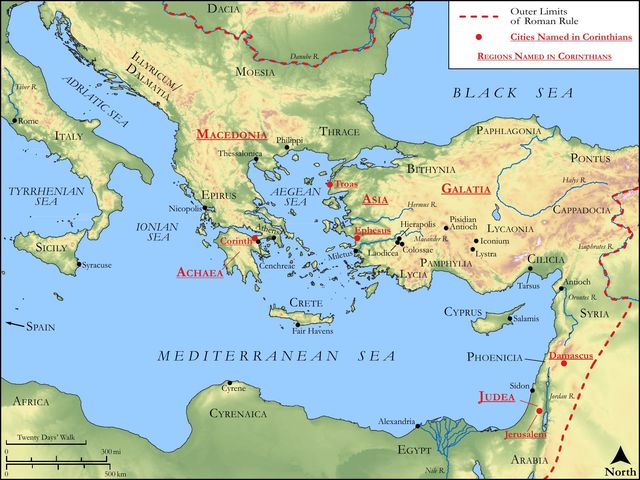
See on the biblical-era map

Study this verse
Public-domain commentary
Matthew Henry
From his Commentary on the Whole Bible. Henry comments on passages, not single verses — this entry covers 1 Corinthians 6:12–20.
The twelfth verse and former part of the thirteenth seem to relate to that early dispute among Christians about the distinction of meats, and yet to be prefatory to the caution that follows against fornication. The connection seems plain enough if we attend to the famous determination of the apostles, Acts 15, where the prohibition of certain foods was joined with that of fornication. Now some among the Corinthians seem to have imagined that they were as much at liberty in the point of fornication as of meats, especially because it was not a sin condemned by the laws of their country. They were ready to say, even in the case of fornication, All things are lawful for me. This pernicious conceit Paul here sets himself to oppose: he tells them that many things lawful in themselves were not expedient at certain times, and under particular circumstances; and Christians should not barely consider what is in itself lawful to be done, but what is fit for them to do, considering their profession, character, relations, and hopes: they should be very careful that by carrying this maxim too far they be not brought into bondage, either to a crafty deceiver or a carnal inclination. All things are lawful for me, says he, but I will not be brought under the power of any, Co1 6:12. Even in lawful things, he would not be subject to the impositions of a usurped authority: so far was he from apprehending that in the things of God it was lawful for any power on earth to impose its own sentiments. Note, There is a liberty wherewith Christ has made us free, in which we must stand fast. But surely he would never carry this liberty so far as to put himself into the power of any bodily appetite. Though all meats were supposed lawful, he would not become a glutton nor a drunkard. And much less would he abuse the maxim of lawful liberty to countenance the sin of fornication, which, though it might be allowed by the Corinthian laws, was a trespass upon the law of nature, and utterly unbecoming a Christian. He would not abuse this maxim about eating and drinking to encourage any intemperance, nor indulge a carnal appetite: "Though meats are for the belly and the belly for meats (Co1 6:13), though the belly was made to receive food, and food was originally ordained to fill the belly, yet if it be not convenient for me, and much more if it be inconvenient, and likely to enslave me, if I am in danger of being subjected to my belly and appetite, I will abstain. But God shall destroy both it and them, at least as to their mutual relation. There is a time coming when the human body will need no further recruits of food." Some of the ancients suppose that this is to be understood of abolishing the belly as well as the food; and that though the same body will be raised at the great day, yet not with all the same members, some being utterly unnecessary in a future state, as the belly for instance, when the man is never to hunger, nor thirst, nor eat, nor drink more. But, whether this be true or no, there is a time coming when the need and use of food shall be abolished. Note, The expectation we have of being without bodily appetites in a future life is a very good argument against being under their power in the present life. This seems to me the sense of the apostle's argument; and that this passage is plainly to be connected with his caution against fornication, though some make it a part of the former argument against litigious law-suits, especially before heathen magistrates and the enemies of true religion. These suppose that the apostle argues that though it may be lawful to claim our rights yet it is not always expedient, and it is utterly unfit for Christians to put themselves into the power of infidel judges, lawyers, and solicitors, on these accounts. But this connection seems not so natural. The transition to his arguments against fornication, as I have laid it, seems very natural: But the body is not for fornication, but for the Lord, and the Lord for the body, Co1 6:13. Meats and the belly are for one another; not so fornication and the body.
I.The body is not for fornication, but for the Lord.
This is the first argument he uses against this sin, for which the heathen inhabitants of Corinth were infamous, and the converts to Christianity retained too favourable an opinion of it. It is making things to cross their intention and use. The body is not for fornication; it was never formed for any such purpose, but for the Lord, for the service and honour of God. It is to be an instrument of righteousness to holiness (Rom 6:19), and therefore is never to be made an instrument of uncleanness. It is to be a member of Christ, and therefore must not be made the member of a harlot, Co1 6:15. And the Lord is for the body, that is, as some think, Christ is to be Lord of the body, to have property in it and dominion over it, having assumed a body and been made to partake of our nature, that he might be head of his church, and head over all things, Heb 2:5, Heb 2:18. Note, We must take care that we do not use what belongs to Christ as if it were our own, and much less to his dishonour.
II.Some understand this last passage, The Lord is for the body, thus:
He is for its resurrection and glorification, according to what follows, Co1 6:14, which is a second argument against this sin, the honour intended to be put on our bodies: God hath both raised up our Lord, and will raise us up by his power (Co1 6:14), by the power of him who shall change our vile body, and make it like to his glorious body by that power whereby he is able to subdue all things to himself, Phi 3:21. It is an honour done to the body that Jesus Christ was raised from the dead: and it will be an honour to our bodies that they will be raised. Let us not abuse those bodies by sin, and make them vile, which, if they be kept pure, shall, notwithstanding their present vileness, be made like to Christ's glorious body. Note, The hopes of a resurrection to glory should restrain Christians from dishonouring their bodies by fleshly lusts.
III.A third argument is the honour already put on them:
Know you not that your bodies are the members of Christ? Co1 6:15. If the soul be united to Christ by faith, the whole man is become a member of his mystical body. The body is in union with Christ as well as the soul. How honourable is this to the Christian! His very flesh is a part of the mystical body of Christ. Note, It is good to know in what honourable relations we stand, that we may endeavour to become them. But now, says the apostle, shall I take the members of Christ, and make them the members of a harlot? God forbid. Or, take away the members of Christ? Would not this be a gross abuse, and the most notorious injury? Would it not be dishonouring Christ, and dishonouring ourselves to the very last degree? What, make a Christ's members the members of a harlot, prostitute them to so vile a purpose! The thought is to be abhorred. God forbid. Know you not that he who is joined to a harlot is one body with hers? For two, says he, shall be one flesh. But he who is joined to the Lord is one spirit, Co1 6:16, Co1 6:17. Nothing can stand in greater opposition to the honourable relations and alliances of a Christian man than this sin. He is joined to the Lord in union with Christ, and made partaker by faith of his Spirit. One spirit lives and breathes and moves in the head and members. Christ and his faithful disciples are one, Joh 17:21, Joh 17:22. But he that is joined to a harlot is one body, for two shall be one flesh, by carnal conjunction, which was ordained of God only to be in a married state. Now shall one in so close a union with Christ as to be one spirit with him yet be so united to a harlot as to become one flesh with her? Were not this a vile attempt to make a union between Christ and harlots? And can a greater indignity he offered to him or ourselves? Can any thing be more inconsistent with our profession or relation? Note, The sin of fornication is a great injury in a Christian to his head and lord, and a great reproach and blot on his profession. It is no wonder therefore that the apostle should say, "Flee fornication (Co1 6:18), avoid it, keep out of the reach of temptations to it, of provoking objects. Direct the eyes and mind to other things and thoughts." Alia vitia pugnando, sola libido fugiendo vincitur - Other vices may be conquered in fight, this only by flight; so speak many of the fathers.
IV.A fourth argument is that it is a sin against our own bodies.
Every sin that a man does is without the body; he that committeth fornication sinneth against his own body (Co1 6:18); every sin, that is, every other sin, every external act of sin besides, is without the body. It is not so much an abuse of the body as of somewhat else, as of wine by the drunkard, food by the glutton, etc. Nor does it give the power of the body to another person. Nor does it so much tend to the reproach of the body and render it vile. This sin is in a peculiar manner styled uncleanness, pollution, because no sin has so much external turpitude in it, especially in a Christian. He sins against his own body; he defiles it, he degrades it, making it one with the body of that vile creature with whom he sins. He casts vile reproach on what he Redeemer has dignifies to the last degree by taking it into union with himself. Note, We should not make our present vile bodies more vile by sinning against them.
V.The fifth argument against this sin is that the bodies of Christians are the temples of the Holy Ghost which is in them, and which they have of God, Co1 6:19. He that is joined to Christ is one spirit. He is yielded up to him, is consecrated thereby, and set apart for his use, and is hereupon possessed, and occupied, and inhabited, by his Holy Spirit. This is the proper notion of a temple - a place where God dwells, and sacred to his use, by his own claim and his creature's surrender. Such temples real Christians are of the Holy Ghost. Must he not therefore be God? But the inference is plain that hence we are not our own. We are yielded up to God, and possessed by and for God; nay, and this is virtue of a purchase made of us: You are bought with a price. In short, our bodies were made for God, they were purchased for him. If we are Christians indeed they are yielded to him, and he inhabits and occupies them by his Spirit: so that our bodies are not our own, but his. And shall we desecrate his temple, defile it, prostitute it, and offer it up to the use and service of a harlot? Horrid sacrilege! This is robbing God in the worst sense. Note, The temple of the Holy Ghost must be kept holy. Our bodies must be kept as his whose they are, and fit for his use and residence.
VI.The apostle argues from the obligation we are under to glorify God both with our body and spirit, which are his, Co1 6:20.
He made both, he bought both, and therefore both belong to him and should be used and employed for him, and therefore should not be defiled, alienated from him, and prostituted by us. No, they must be kept as vessels fitted for our Master's use. We must look upon our whole selves as holy to the Lord, and must use our bodies as property which belongs to him and is sacred to his use and service. We are to honour him with our bodies and spirits, which are his; and therefore, surely, must abstain from fornication; and not only from the outward act, but from the adultery of the heart, as our Lord calls it, Mat 5:28. Body and spirit are to be kept clean, that God may be honoured by both. But God is dishonoured when either is defiled by so beastly a sin. Therefore flee fornication, nay, and every sin. Use your bodies for the glory and service of their Lord and Maker. Note, We are not proprietors of ourselves, nor have power over ourselves, and therefore should not use ourselves according to our own pleasure, but according to his will, and for his glory, whose we are, and whom we should serve, Act 27:23.
Historical interpretation
Three Centuries of Reception
9 surviving comments on this verse. Each one is dated, so this reads as a timeline rather than a list.
Select a marker to jump to its quote. Markers stagger vertically where authors wrote within a few decades of each other.
"Every sin which a human being may have committed is extraneous to the body; but whoever fornicateth, sinneth against his own body." And, for fear you should fly to that statement for a licence to fornication, on the ground that you will be sinning against a thing which is yours, not the Lord's, he takes you away from yourself, and awards you, according to his previous disposition, to Christ: "And ye are not your own; "immediately opposing (thereto), "for bought ye are with a price"-the blood, to wit, of the Lord: "glorify and extol the Lord in your body.
Or if he appoints himself a searcher and judge of the heart and reins, let him in all cases judge equally. And as he knows that it is written, "Behold, thou art made whole; sin no more, lest a worse thing happen unto thee," let him separate the fraudulent and adulterers from his side and from his company, since the case of an adulterer is by far both graver and worse than that of one who has taken a certificate, because the latter has sinned by necessity, the former by free will: the latter, thinking that it is sufficient for him that he has not sacrificed, has been deceived by an error; the former, a violator of the matrimonial tie of another, or entering a brothel, into the sink and filthy gulf of the common people, has befouled by detestable impurity a sanctified body and God's temple, as says the apostle: "Every sin that a man doeth is without the body, but he that committeth fornication sinneth against his own body." And yet to these persons themselves repentance is granted, and the hope of lamenting and atoning is left, according to the saying of the same apostle: "I fear lest, when I come to you, I shall bewail many of those who have sinned already, and have not repented of the uncleanness, and fornication, and lasciviousness which they have committed."
That the sin of fornication is grievous. In the first Epistle of Paul to the Corinthians: "Every sin whatsoever a man doeth is outside the body; but he who committeth fornication sinneth against his own body. Ye are not your own, for ye are bought with a great price. Glorify and bear the Lord in your body."
If someone hangs himself or kills himself with a dagger, he does not sin against his body but against his soul, on which he inflicts violence. But to fornicate is a sin of the body which touches both the body and the soul.
And therefore the Apostle says: Flee from fornication; so that by a swift flight, we may avoid the cruelty of the raging mistress and be able to escape from her foul service.
"Flee fornication."
He said not, "abstain from fornication," but "Flee:" that is, with all zeal make to yourselves deliverance from that evil. "Every sin that a man doeth is without the body; but he that committeth fornication sinneth against his own body." This is less than what went before; but since he had to speak of fornicators, he amplifies that guilt by topics drawn from all quarters, from greater things and smaller alike, making the charge heinous. And, in fact, that former topic was addressed to the more religious, but this to the weaker sort. For this also is characteristic of the wisdom of Paul, not only to allege the great things wherewith to abash men, but the lesser also, and the consideration of what is disgraceful and unseemly.
"What then," say you, "does not the murderer stain his hand? What, of the covetous person and the extortioner?" I suppose it is plain to every one. But since it was not possible to mention anything worse than the fornicator, he amplifies the crime in another way, by saying that in the fornicator the entire body becomes defiled. For it is as polluted as if it had fallen into a vessel of filth, and been immersed in defilement. And this too is our way. For from covetousness and extortion no one would make haste to go into a bath, but as if nothing had happened returns to his house. Whereas from intercourse with a harlot, as having become altogether unclean, he goes to a bath. To such a degree does the conscience retain from this sin a kind of sense of unusual shame. Both however are bad, both covetousness and fornication; and both cast into hell. But as Paul doeth every thing with good management, so by whatever topics he had he magnified the sin of fornication.
Fornication multiplies sins because two people are involved, and both perish together.
Note that Paul did not say that we should hate immorality, but that we should shun it as people who are aware of the perniciousness of evil.
Gregory said, ‘God asks three things of anyone who is baptized: to keep the true faith with all his soul and all his might; to control his tongue; to be chaste in his body.’
Continue studying 1 Corinthians 6:18 across the web’s major study libraries — every link below opens this exact verse, chapter, or book on the destination site.
Read & Compare
 BibleGatewayThis verse in more than 200 translations and 70 languages.
 Bible.comThe YouVersion reader — hundreds of translations, reading plans, and highlights.
 ESV.orgCrossway's official English Standard Version reader.
 NET BibleThe NET translation with 60,000+ translators' notes on every rendering decision.
 STEP BibleTyndale House's free study tool — original text, vocabulary, and scholarly resources.
 BibliaLogos Bible Software's free web reader.
 USCCBThe New American Bible (Revised Edition) with the U.S. bishops' study notes.
Commentaries
 BibleHub CommentariesDozens of classic commentaries on this verse, gathered on one page.
 StudyLightMore than 100 commentary sets — the largest collection on the web.
 BibleRefPlain-English commentary on what this verse means, verse by verse.
 Enduring WordDavid Guzik's free commentary on this chapter, widely used by Bible teachers.
 Bible Study ToolsVerse commentary alongside Greek and Hebrew study aids.
Original Language & Research
- BibleHub InterlinearThe verse word by word — original language, transliteration, and English.
- BibleHub LexiconEvery word's original-language definition and Strong's entry.
 Blue Letter BibleDeep-study tools — Strong's numbers, concordance, and word studies.
 CNTR CollationThe earliest Greek manuscripts of this verse, collated letter by letter.
Sermons, Hymns & Audio


TrulyRandomVerse is not affiliated with these sites and doesn’t control their content. They’re linked because they’re genuinely useful.
Summary
The Apostle Paul issues a forceful and direct command to the Corinthian believers, urging them to actively "flee fornication." This verse highlights the uniquely destructive nature of sexual immorality, asserting that while other sins may be committed externally, engaging in fornication constitutes a profound violation "against his own body." Paul's instruction underscores the sanctity of the human body and its intrinsic connection to one's spiritual identity, setting the stage for his subsequent teaching on the body as a temple of the Holy Spirit and a member of Christ.
Context
ShowHideLiterary Context
Paul's exhortation in 1 Corinthians 6:18 is strategically placed within a broader argument against various forms of unholy conduct prevalent in the Corinthian church. In the preceding verses of 1 Corinthians 6, Paul addresses issues such as believers suing each other in pagan courts (1 Corinthians 6:1-8) and associating with immoral individuals. He then lists a catalogue of sins, including "fornicators" and "adulterers," warning that those who practice such things "shall not inherit the kingdom of God" (1 Corinthians 6:9-10). The immediate context leading up to verse 18 involves Paul's discussion of the body's purpose: "The body is not for fornication, but for the Lord; and the Lord for the body" (1 Corinthians 6:13). This sets the theological foundation for his emphatic command to flee sexual sin, culminating in his powerful declaration that the believer's body is a "temple of the Holy Ghost" (1 Corinthians 6:19) and bought with a price (1 Corinthians 6:20).
Historical & Cultural Context
The ancient city of Corinth was notorious throughout the Greco-Roman world for its pervasive sexual immorality. As a bustling port city, it was a hub of trade, wealth, and diverse cultures, but also a center of pagan worship, including the temple of Aphrodite, where sacred prostitution was practiced. The Greek verb korinthiazomai (to Corinthianize) was even coined to mean "to practice fornication." This cultural backdrop meant that sexual permissiveness was not only common but often integrated into religious and social life. Many new converts in the Corinthian church would have come directly out of this pagan environment, bringing with them deeply ingrained habits and understandings of sexuality that were antithetical to Christian holiness. Paul's strong admonition to "flee fornication" was therefore not merely a general moral teaching but a direct, urgent, and counter-cultural call to radical purity, essential for distinguishing the Christian community from its surrounding pagan society.
Key Themes
ShowHideThis verse powerfully contributes to several overarching themes in 1 Corinthians and Pauline theology. Firstly, it emphasizes the theme of Radical Purity and Separation, urging believers to not merely resist but to actively and decisively "flee" sexual sin, highlighting its severe spiritual consequences and the need for a distinct Christian lifestyle in a corrupt world. Secondly, it introduces the theme of The Unique Nature of Sexual Sin, asserting that it uniquely violates "his own body," unlike other sins. This distinction underscores that sexual sin corrupts the very vessel intended for God's glory and union with Christ, impacting the individual's physical and spiritual being in a profound way. Finally, it reinforces the theme of The Sanctity and Ownership of the Body, laying the groundwork for Paul's subsequent teaching that the believer's body is "for the Lord" (1 Corinthians 6:13), a "member of Christ" (1 Corinthians 6:15), and ultimately a "temple of the Holy Ghost" (1 Corinthians 6:19), purchased by God (1 Corinthians 6:20).
Exposition and Analysis
ShowHideKey Word Analysis
ShowHideThis primary verb means "to run away" (literally or figuratively), "to shun," or "to vanish." Paul's use of this imperative is not merely a suggestion to avoid temptation but a command for immediate, decisive, and active escape from situations, thoughts, or opportunities that could lead to sexual sin. It implies a recognition of the danger and a swift, intentional removal from its presence, rather than attempting to stand and fight the temptation head-on in a vulnerable position.
Derived from porneúō (to act the harlot), porneía is a broad term encompassing all forms of unlawful sexual activity. This includes prostitution, adultery, premarital sex, incest, homosexuality, and any sexual expression outside the bounds of a monogamous, heterosexual marriage as defined by biblical teaching. Figuratively, it can also refer to idolatry, highlighting the spiritual infidelity inherent in unholy practices. Paul uses this comprehensive term to cover the vast array of sexual sins prevalent in Corinth and to emphasize the complete prohibition against them for believers.
From sōzō (to save), sōma refers to the body as a sound whole, used in a very wide application, literally or figuratively. In this context, it refers to the physical human body, but with profound theological implications. Paul is not merely speaking of a physical shell, but the integrated person, emphasizing that sexual sin uniquely involves and defiles the physical person in a way that other sins (e.g., lying, coveting) do not directly or primarily. This paves the way for his argument about the body's sacredness as a temple of the Holy Spirit and a member of Christ.
Verse Breakdown
ShowHide"Flee fornication."
This is a direct, urgent, and absolute command in the present active imperative, indicating a continuous and decisive action. Paul does not say "resist" or "avoid," but "flee," implying that sexual temptation is so potent and dangerous that the only safe course of action is to run away from it, removing oneself from its sphere of influence entirely. This emphasizes proactive spiritual discipline.
"Every sin that a man doeth is without the body;"
This clause presents a stark contrast. Paul asserts that other sins, such as lying, stealing, or coveting, are committed "outside" or "without" the body in the sense that their primary impact or locus of action is not the physical body itself, even though they may originate from within and affect the whole person. While all sin has consequences for the entire being, their essence does not involve the physical body in the same direct, violating manner as sexual sin.
"but he that committeth fornication sinneth against his own body."
The conjunction "but" (G1161, dé) introduces a strong antithesis. Paul argues that fornication is uniquely self-violating. Unlike other sins, sexual immorality directly involves and defiles the physical body, which, for the believer, is a sacred vessel, a member of Christ, and a temple of the Holy Spirit. This sin corrupts the very instrument intended for holiness and union with God, thus constituting a direct offense against one's own self and, by extension, against God who created and indwells that body.
Literary Devices
ShowHidePaul employs several potent Literary Devices in this verse to underscore his message. The most prominent is Contrast, where he sharply differentiates fornication from "every sin that a man doeth." This rhetorical strategy highlights the unique and severe nature of sexual immorality. While all sin is serious, Paul uses this contrast to emphasize that porneia has a distinct, self-violating quality that sets it apart. Furthermore, the imperative "Flee" serves as a powerful instance of Hyperbole and Emphasis. While it's a literal command, its starkness and urgency are designed to shock and impress upon the readers the extreme danger and defiling nature of this particular sin, demanding an immediate and absolute response, rather than a casual resistance. The repetition of "body" (G4983, sōma) throughout this passage (including verses 13, 14, 15, 16, 19, 20) also serves as a form of Repetition or Anaphora (though not strictly at the beginning of clauses), drawing constant attention to the physical self as the locus of this unique sin and the subject of God's redemptive work.
Theological and Thematic Connections
ShowHidePaul's teaching in 1 Corinthians 6:18 is deeply rooted in biblical theology, particularly concerning the sanctity of the human body and the call to holiness. God created humanity, body and soul, in His image, and both aspects are intended for His glory. Sexual union, as designed by God, is meant to be a sacred expression of covenant within marriage, reflecting the unity and intimacy of Christ and the Church. Therefore, any sexual activity outside of this divine design is a distortion of God's good creation and a violation of His holy standards. Paul's assertion that fornication sins "against his own body" underscores the profound theological truth that our bodies are not our own to do with as we please, but belong to God, who will ultimately resurrect and glorify them. This understanding elevates sexual purity from a mere moral rule to a fundamental aspect of worship and stewardship of the self, in anticipation of future glorification.
Reflection and Application
ShowHidePaul's command to "flee fornication" remains profoundly relevant for believers today, serving as a vital call to proactive spiritual vigilance in a world saturated with sexual temptation. It challenges us to move beyond passive resistance and to actively remove ourselves from situations, media, relationships, or thought patterns that could lead to sexual sin. This involves setting clear boundaries, cultivating accountability, and intentionally filling our minds with what is pure and honorable. The unique emphasis on sinning "against his own body" compels us to view our physical selves not merely as instruments for pleasure or utility, but as sacred vessels, intrinsically linked to our spiritual identity and destiny in Christ. Living out this truth means honoring God with our bodies in every aspect of life, recognizing that sexual purity is not just about avoiding sin, but about embracing our identity as temples of the Holy Spirit and members of Christ, thereby glorifying God in our bodies and spirits, which are His.
Questions for Reflection
ShowHideFAQ
ShowHideWhat does Paul mean by 'Every sin that a man doeth is without the body' if all sin originates from within?
ShowHidePaul's statement here is not meant to be a universal theological declaration that other sins have no physical consequences or do not originate from the heart (as Jesus taught in Matthew 15:18-19). Rather, he is highlighting a unique characteristic of sexual sin. Most sins, like lying, coveting, or anger, are primarily acts of the mind, will, or speech, even if they have external manifestations or consequences. Their primary locus is not the physical body itself as the instrument of the sin. However, fornication and other sexual sins inherently involve the physical body in the act itself, defiling it in a direct and profound way. In the context of 1 Corinthians 6, Paul is arguing that the body, which is destined for resurrection and is a temple of the Holy Spirit (1 Corinthians 6:19), is uniquely violated and desecrated by sexual immorality. It's a sin that directly abuses the body's intended purpose and sacredness, making it distinct from other sins that might be committed "outside" this direct physical violation.
Christ-Centered Fulfillment
ShowHideThe imperative to "flee fornication" finds its ultimate motivation and empowerment in Christ. For the believer, purity is not merely a moral code but a response to the profound reality of our union with Christ. Paul reminds the Corinthians that their "bodies are the members of Christ" (1 Corinthians 6:15) and that "he that is joined unto the Lord is one spirit" (1 Corinthians 6:17). To commit fornication, then, is to take the very members of Christ and make them members of a harlot, an unthinkable desecration of the sacred union forged by His sacrifice. Furthermore, our bodies have been "bought with a price" (1 Corinthians 6:20)—the precious blood of Jesus Christ (1 Peter 1:18-19). This redemption means we are no longer our own; our bodies belong to Him. Therefore, the call to purity is a call to honor Christ with our bodies, recognizing them as dwelling places for the Holy Spirit (1 Corinthians 6:19) who empowers us to live in holiness. Our future hope, the resurrection and glorification of our bodies (Romans 8:11), further underscores the sanctity of our physical selves, motivating us to live in a manner worthy of the one who has redeemed us and promises our full transformation.