


1 Corinthians 6:17
- ὁhoThe [one]G3588T-NSMDefinite article Nominative Singular Masculine
- δὲdehoweverG1161CONJConjunction
- κολλώμενοςkollōmenosbeing joinedG2853V-PPP-NSMVerb Present Passive Participle Nominative Singular Masculine
- τῷtōto theG3588T-DSMDefinite article Dative Singular Masculine
- κυρίῳkuriōLordG2962N-DSM-TNoun Dative Singular Masculine Title
- ἓνhenoneG1520A-NSNAdjective Nominative Singular Neuter
- πνεῦμάpneumaspiritG4151N-NSNNoun Nominative Singular Neuter
- ἐστινestinisG1510V-PAI-3SVerb Present Active Indicative 3rd Singular
English is a literal word-by-word gloss of the Greek, not the KJV's wording. Why?
This is the original text the KJV's translators worked from — each Greek word with its own literal English meaning in this verse, prepared by scholars at Tyndale House, Cambridge. The KJV translates whole sentences, not word by word, so its wording differs: one Greek word can become several English words, and the KJV may choose “charity” where the gloss reads “love”. Both are faithful — they answer different questions. For the KJV's own rendering, switch to the KJV text.
Details
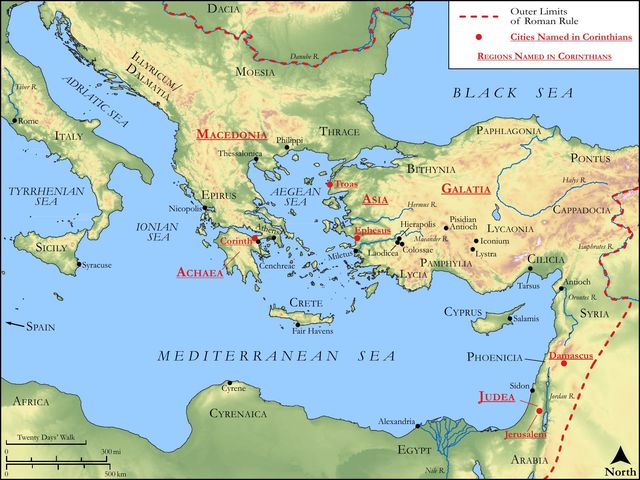
See on the biblical-era map

Study this verse
Public-domain commentary
Matthew Henry
From his Commentary on the Whole Bible. Henry comments on passages, not single verses — this entry covers 1 Corinthians 6:12–20.
The twelfth verse and former part of the thirteenth seem to relate to that early dispute among Christians about the distinction of meats, and yet to be prefatory to the caution that follows against fornication. The connection seems plain enough if we attend to the famous determination of the apostles, Acts 15, where the prohibition of certain foods was joined with that of fornication. Now some among the Corinthians seem to have imagined that they were as much at liberty in the point of fornication as of meats, especially because it was not a sin condemned by the laws of their country. They were ready to say, even in the case of fornication, All things are lawful for me. This pernicious conceit Paul here sets himself to oppose: he tells them that many things lawful in themselves were not expedient at certain times, and under particular circumstances; and Christians should not barely consider what is in itself lawful to be done, but what is fit for them to do, considering their profession, character, relations, and hopes: they should be very careful that by carrying this maxim too far they be not brought into bondage, either to a crafty deceiver or a carnal inclination. All things are lawful for me, says he, but I will not be brought under the power of any, Co1 6:12. Even in lawful things, he would not be subject to the impositions of a usurped authority: so far was he from apprehending that in the things of God it was lawful for any power on earth to impose its own sentiments. Note, There is a liberty wherewith Christ has made us free, in which we must stand fast. But surely he would never carry this liberty so far as to put himself into the power of any bodily appetite. Though all meats were supposed lawful, he would not become a glutton nor a drunkard. And much less would he abuse the maxim of lawful liberty to countenance the sin of fornication, which, though it might be allowed by the Corinthian laws, was a trespass upon the law of nature, and utterly unbecoming a Christian. He would not abuse this maxim about eating and drinking to encourage any intemperance, nor indulge a carnal appetite: "Though meats are for the belly and the belly for meats (Co1 6:13), though the belly was made to receive food, and food was originally ordained to fill the belly, yet if it be not convenient for me, and much more if it be inconvenient, and likely to enslave me, if I am in danger of being subjected to my belly and appetite, I will abstain. But God shall destroy both it and them, at least as to their mutual relation. There is a time coming when the human body will need no further recruits of food." Some of the ancients suppose that this is to be understood of abolishing the belly as well as the food; and that though the same body will be raised at the great day, yet not with all the same members, some being utterly unnecessary in a future state, as the belly for instance, when the man is never to hunger, nor thirst, nor eat, nor drink more. But, whether this be true or no, there is a time coming when the need and use of food shall be abolished. Note, The expectation we have of being without bodily appetites in a future life is a very good argument against being under their power in the present life. This seems to me the sense of the apostle's argument; and that this passage is plainly to be connected with his caution against fornication, though some make it a part of the former argument against litigious law-suits, especially before heathen magistrates and the enemies of true religion. These suppose that the apostle argues that though it may be lawful to claim our rights yet it is not always expedient, and it is utterly unfit for Christians to put themselves into the power of infidel judges, lawyers, and solicitors, on these accounts. But this connection seems not so natural. The transition to his arguments against fornication, as I have laid it, seems very natural: But the body is not for fornication, but for the Lord, and the Lord for the body, Co1 6:13. Meats and the belly are for one another; not so fornication and the body.
I.The body is not for fornication, but for the Lord.
This is the first argument he uses against this sin, for which the heathen inhabitants of Corinth were infamous, and the converts to Christianity retained too favourable an opinion of it. It is making things to cross their intention and use. The body is not for fornication; it was never formed for any such purpose, but for the Lord, for the service and honour of God. It is to be an instrument of righteousness to holiness (Rom 6:19), and therefore is never to be made an instrument of uncleanness. It is to be a member of Christ, and therefore must not be made the member of a harlot, Co1 6:15. And the Lord is for the body, that is, as some think, Christ is to be Lord of the body, to have property in it and dominion over it, having assumed a body and been made to partake of our nature, that he might be head of his church, and head over all things, Heb 2:5, Heb 2:18. Note, We must take care that we do not use what belongs to Christ as if it were our own, and much less to his dishonour.
II.Some understand this last passage, The Lord is for the body, thus:
He is for its resurrection and glorification, according to what follows, Co1 6:14, which is a second argument against this sin, the honour intended to be put on our bodies: God hath both raised up our Lord, and will raise us up by his power (Co1 6:14), by the power of him who shall change our vile body, and make it like to his glorious body by that power whereby he is able to subdue all things to himself, Phi 3:21. It is an honour done to the body that Jesus Christ was raised from the dead: and it will be an honour to our bodies that they will be raised. Let us not abuse those bodies by sin, and make them vile, which, if they be kept pure, shall, notwithstanding their present vileness, be made like to Christ's glorious body. Note, The hopes of a resurrection to glory should restrain Christians from dishonouring their bodies by fleshly lusts.
III.A third argument is the honour already put on them:
Know you not that your bodies are the members of Christ? Co1 6:15. If the soul be united to Christ by faith, the whole man is become a member of his mystical body. The body is in union with Christ as well as the soul. How honourable is this to the Christian! His very flesh is a part of the mystical body of Christ. Note, It is good to know in what honourable relations we stand, that we may endeavour to become them. But now, says the apostle, shall I take the members of Christ, and make them the members of a harlot? God forbid. Or, take away the members of Christ? Would not this be a gross abuse, and the most notorious injury? Would it not be dishonouring Christ, and dishonouring ourselves to the very last degree? What, make a Christ's members the members of a harlot, prostitute them to so vile a purpose! The thought is to be abhorred. God forbid. Know you not that he who is joined to a harlot is one body with hers? For two, says he, shall be one flesh. But he who is joined to the Lord is one spirit, Co1 6:16, Co1 6:17. Nothing can stand in greater opposition to the honourable relations and alliances of a Christian man than this sin. He is joined to the Lord in union with Christ, and made partaker by faith of his Spirit. One spirit lives and breathes and moves in the head and members. Christ and his faithful disciples are one, Joh 17:21, Joh 17:22. But he that is joined to a harlot is one body, for two shall be one flesh, by carnal conjunction, which was ordained of God only to be in a married state. Now shall one in so close a union with Christ as to be one spirit with him yet be so united to a harlot as to become one flesh with her? Were not this a vile attempt to make a union between Christ and harlots? And can a greater indignity he offered to him or ourselves? Can any thing be more inconsistent with our profession or relation? Note, The sin of fornication is a great injury in a Christian to his head and lord, and a great reproach and blot on his profession. It is no wonder therefore that the apostle should say, "Flee fornication (Co1 6:18), avoid it, keep out of the reach of temptations to it, of provoking objects. Direct the eyes and mind to other things and thoughts." Alia vitia pugnando, sola libido fugiendo vincitur - Other vices may be conquered in fight, this only by flight; so speak many of the fathers.
IV.A fourth argument is that it is a sin against our own bodies.
Every sin that a man does is without the body; he that committeth fornication sinneth against his own body (Co1 6:18); every sin, that is, every other sin, every external act of sin besides, is without the body. It is not so much an abuse of the body as of somewhat else, as of wine by the drunkard, food by the glutton, etc. Nor does it give the power of the body to another person. Nor does it so much tend to the reproach of the body and render it vile. This sin is in a peculiar manner styled uncleanness, pollution, because no sin has so much external turpitude in it, especially in a Christian. He sins against his own body; he defiles it, he degrades it, making it one with the body of that vile creature with whom he sins. He casts vile reproach on what he Redeemer has dignifies to the last degree by taking it into union with himself. Note, We should not make our present vile bodies more vile by sinning against them.
V.The fifth argument against this sin is that the bodies of Christians are the temples of the Holy Ghost which is in them, and which they have of God, Co1 6:19. He that is joined to Christ is one spirit. He is yielded up to him, is consecrated thereby, and set apart for his use, and is hereupon possessed, and occupied, and inhabited, by his Holy Spirit. This is the proper notion of a temple - a place where God dwells, and sacred to his use, by his own claim and his creature's surrender. Such temples real Christians are of the Holy Ghost. Must he not therefore be God? But the inference is plain that hence we are not our own. We are yielded up to God, and possessed by and for God; nay, and this is virtue of a purchase made of us: You are bought with a price. In short, our bodies were made for God, they were purchased for him. If we are Christians indeed they are yielded to him, and he inhabits and occupies them by his Spirit: so that our bodies are not our own, but his. And shall we desecrate his temple, defile it, prostitute it, and offer it up to the use and service of a harlot? Horrid sacrilege! This is robbing God in the worst sense. Note, The temple of the Holy Ghost must be kept holy. Our bodies must be kept as his whose they are, and fit for his use and residence.
VI.The apostle argues from the obligation we are under to glorify God both with our body and spirit, which are his, Co1 6:20.
He made both, he bought both, and therefore both belong to him and should be used and employed for him, and therefore should not be defiled, alienated from him, and prostituted by us. No, they must be kept as vessels fitted for our Master's use. We must look upon our whole selves as holy to the Lord, and must use our bodies as property which belongs to him and is sacred to his use and service. We are to honour him with our bodies and spirits, which are his; and therefore, surely, must abstain from fornication; and not only from the outward act, but from the adultery of the heart, as our Lord calls it, Mat 5:28. Body and spirit are to be kept clean, that God may be honoured by both. But God is dishonoured when either is defiled by so beastly a sin. Therefore flee fornication, nay, and every sin. Use your bodies for the glory and service of their Lord and Maker. Note, We are not proprietors of ourselves, nor have power over ourselves, and therefore should not use ourselves according to our own pleasure, but according to his will, and for his glory, whose we are, and whom we should serve, Act 27:23.
Historical interpretation
Two Centuries of Reception
4 surviving comments on this verse. Each one is dated, so this reads as a timeline rather than a list.
Select a marker to jump to its quote. Markers stagger vertically where authors wrote within a few decades of each other.
The soul of Jesus clung to God from the beginning of the creation in a union inseparable and indissoluble, as the soul of the wisdom and word of God, and of the truth and the true light. Receiving him wholly and itself entering into his light and splendor, it was made one spirit with him in a preeminent degree. This is what the apostle promises to those who imitate Jesus.
The Spirit of God is shared between God and human beings when we are united to the Lord.
We Are Not Irremediably In Error
“It is not true, as some maintain who are led astray by error, that the human being is irremediably dead and can no longer do anything good. A small child is incapable of anything; it cannot run to its mother on its own legs; it tumbles on the ground, cries out, sobs, calls out to her. And she is gentle with it, she is touched to see her baby seeking her so impatiently with so many sobs. It cannot reach her but cries out to her tirelessly, and she goes to it overcome with love, she kisses it, presses it to her heart and feeds it, with unspeakable tenderness. God loves us and he behaves like her towards the soul that seeks him and cries out to him. In the eagerness of that infinite love that is his… He takes hold of our spirit, unites Himself to it, and we become ‘one spirit with Him’, as the apostle says (I Corinthians 6.17). The soul is linked with the Lord, and the Lord, full of compassion and love, unites Himself to it and it dwells in his grace. Then the soul and the Lord are one spiritually, they form one life, one heart.” - "Homily 46"
"But he that is joined unto the Lord is one spirit."
For the conjunction suffers the two no longer to be two, but makes them both one.
Now mark again, how he proceeds by means of the bare terms, conducting his accusation in the names of the harlot and of Christ.
Wherefore he saith, "He that is joined to a harlot is one body; but he that is joined to the Lord is one Spirit." For such an one becomes thenceforth Spirit, although a body envelope him. For when nothing corporeal nor gross nor earthly is around him, the body doth but merely envelope him; since the whole government of him is in the soul and the Spirit. In this way God is glorified. Wherefore both in the Prayer we are commanded to say, "Hallowed be Thy Name:" and Christ saith also, "Let your light shine before men, that they may see your good works, and glorify your Father which is in heaven."
Continue studying 1 Corinthians 6:17 across the web’s major study libraries — every link below opens this exact verse, chapter, or book on the destination site.
Read & Compare
 BibleGatewayThis verse in more than 200 translations and 70 languages.
 Bible.comThe YouVersion reader — hundreds of translations, reading plans, and highlights.
 ESV.orgCrossway's official English Standard Version reader.
 NET BibleThe NET translation with 60,000+ translators' notes on every rendering decision.
 STEP BibleTyndale House's free study tool — original text, vocabulary, and scholarly resources.
 BibliaLogos Bible Software's free web reader.
 USCCBThe New American Bible (Revised Edition) with the U.S. bishops' study notes.
Commentaries
 BibleHub CommentariesDozens of classic commentaries on this verse, gathered on one page.
 StudyLightMore than 100 commentary sets — the largest collection on the web.
 BibleRefPlain-English commentary on what this verse means, verse by verse.
 Enduring WordDavid Guzik's free commentary on this chapter, widely used by Bible teachers.
 Bible Study ToolsVerse commentary alongside Greek and Hebrew study aids.
Original Language & Research
- BibleHub InterlinearThe verse word by word — original language, transliteration, and English.
- BibleHub LexiconEvery word's original-language definition and Strong's entry.
 Blue Letter BibleDeep-study tools — Strong's numbers, concordance, and word studies.
 CNTR CollationThe earliest Greek manuscripts of this verse, collated letter by letter.
Sermons, Hymns & Audio


TrulyRandomVerse is not affiliated with these sites and doesn’t control their content. They’re linked because they’re genuinely useful.
Summary
First Corinthians 6:17 profoundly declares the intimate and transformative spiritual union between a believer and the Lord Jesus Christ. In stark contrast to unholy physical or spiritual entanglements, Paul asserts that those who are joined to the Lord become "one spirit," signifying a deep, mystical, and inseparable bond that redefines the believer's identity, purpose, and call to holiness, rooted in the indwelling presence of the Holy Spirit.
Context
ShowHideLiterary Context
This verse is a crucial theological anchor within Paul's broader argument in 1 Corinthians 6. Paul addresses several pressing issues within the Corinthian church, including internal lawsuits among believers (verses 1-11) and, more prominently, the pervasive problem of sexual immorality (πορνεία, porneia, fornication) within the congregation (verses 12-20). He has just emphatically warned against a believer's body—which is a member of Christ—being joined to a harlot, stating that such an act makes the two "one body" (verse 16), drawing on the Genesis creation narrative. Verse 17 then provides the profound counter-point and the ultimate theological rationale for fleeing such unholy unions, by highlighting the true, holy, and far superior spiritual union that Christians share with the Lord. It sets the stage for Paul's concluding exhortation in 1 Corinthians 6:18-20, emphasizing the sanctity of the body as a temple of the Holy Spirit.
Historical & Cultural Context
The city of Corinth was a bustling, cosmopolitan port city renowned for its commercial activity, but also notorious for its moral laxity and widespread idolatry. It housed numerous temples, including a prominent temple dedicated to Aphrodite, where sacred prostitution was practiced. This pervasive culture of sexual immorality, coupled with various philosophical viewpoints (such as Gnosticism, which might have taught that actions of the body had no bearing on the spirit), presented significant challenges to the nascent Christian community. Believers were constantly exposed to and tempted by these cultural norms. Paul's strong admonitions were thus not merely abstract theological statements but urgent, practical directives designed to safeguard the purity and distinctiveness of the Christian community in a morally corrupt environment. The concept of "union" was familiar in both religious and philosophical contexts, but Paul redefines it within the framework of the believer's relationship with the divine Lord.
Key Themes
ShowHideFirst Corinthians 6:17 contributes significantly to several major theological and narrative themes found throughout Paul's letter and the broader biblical narrative. The most prominent theme is the Profound Spiritual Union that believers experience with the Lord Jesus Christ. This union is not merely intellectual assent or emotional connection but a mystical, transformative bond that permeates the very essence of the believer's being. This spiritual intimacy forms the bedrock for the theme of Holiness and Purity, as Paul argues that such an exalted union with Christ demands a life that reflects His purity and nature, providing a powerful motivation to flee fornication and other sins. Furthermore, the phrase "one spirit" implicitly points to the theme of The Indwelling Holy Spirit. The Holy Spirit is the divine agent who facilitates and actualizes this spiritual union between the believer and Christ, signifying that the human spirit of the believer is brought into complete alignment and communion with the Spirit of God. This theme is further developed in Paul's teaching that believers' bodies are temples of the Holy Spirit, underscoring the sacredness of the believer's entire person.
Exposition and Analysis
ShowHideKey Word Analysis
ShowHideData, this word means "to glue, i.e. (passively or reflexively) to stick (figuratively)." It conveys a sense of inseparable attachment, much like two things being permanently bonded together. Paul intentionally uses this same strong term in 1 Corinthians 6:16 to describe the physical union between a man and a harlot, creating a powerful linguistic and theological contrast. While the physical act creates "one body," the spiritual relationship with the Lord creates "one spirit," highlighting the profound nature and permanence of both types of union.
According to Strong's G2962, this term signifies "supreme in authority, i.e. (as noun) controller; by implication, Master (as a respectful title)." When applied to Jesus, kýrios denotes His divine sovereignty, His authoritative position as the head of the church, and the object of worship. Being "joined unto the Lord" therefore implies a relationship of submission, allegiance, and intimate fellowship with the one who holds ultimate authority and mastery over the believer's life.
As per Strong's G4151, pneûma can refer to a "current of air, breath," or figuratively, "a spirit, i.e. (human) the rational soul, (by implication) vital principle, mental disposition, etc., or (superhuman) an angel, demon, or (divine) God, Christ's spirit, the Holy Spirit." In the context of 1 Corinthians 6:17, "one spirit" refers to the profound unity between the believer's human spirit and the Holy Spirit, who is the Spirit of God and Christ. It does not imply a loss of individual identity but a complete alignment, communion, and shared life with the divine Spirit, facilitated by the indwelling of the Holy Spirit.
Verse Breakdown
ShowHide"But he that is joined unto the Lord"
The opening conjunction "But" (G1161, dé) introduces a sharp contrast to the preceding discussion of physical union with a harlot. This phrase identifies the subject as "he that is joined" (G2853, kolláō), emphasizing an active and intentional, yet divinely enabled, attachment or cleaving to "the Lord" (G2962, kýrios). This joining is not merely intellectual assent or a superficial connection, but a profound, adhesive bond that reorients the believer's entire being towards Christ as their sovereign Master. It speaks to the believer's conversion and ongoing relationship, where Christ has become the central focus and authority in their life.
"is one spirit"
This declarative statement (G2076, estí, "is") reveals the nature and outcome of being joined to the Lord. The believer and the Lord are not merely close or aligned, but they become "one spirit" (G1520, heîs G4151, pneûma). This signifies a profound, mystical, and existential unity. It implies that the Holy Spirit, who is the Spirit of Christ, indwells the believer, merging the believer's human spirit with the divine Spirit in purpose, will, and essence. This spiritual oneness is the antithesis of the "one body" formed in unholy sexual union; it represents a sacred, life-giving, and sanctifying communion that defines the believer's new identity in Christ.
Literary Devices
ShowHidePaul employs several powerful literary devices in 1 Corinthians 6:17 to underscore his theological point. The most prominent is Antithesis or Juxtaposition. By using the identical Greek verb kolláō ("joined" or "cleave") in both 1 Corinthians 6:16 (describing union with a harlot resulting in "one body") and 1 Corinthians 6:17 (describing union with the Lord resulting in "one spirit"), Paul creates a stark and unforgettable contrast. This rhetorical strategy highlights the absolute incompatibility of the two types of union and elevates the sacredness of the believer's bond with Christ. Furthermore, the phrase "one spirit" functions as a profound Metaphor or Symbolism. It is not a literal merging of identities into one undifferentiated being, but a symbolic representation of an intimate, shared spiritual reality, a complete alignment of will, purpose, and essence, empowered by the Holy Spirit. This metaphorical language conveys a depth of communion that transcends mere intellectual or emotional connection, pointing to a transformative, existential reality.
Theological and Thematic Connections
ShowHideThe declaration that "he that is joined unto the Lord is one spirit" is a cornerstone of Pauline theology, elucidating the profound nature of the believer's relationship with God. This spiritual union is not merely a legal standing but an ontological reality, signifying a new creation in Christ where the believer participates in the divine nature (2 Peter 1:4). It underscores the Trinitarian work of salvation: the Father's plan, the Son's atoning work, and the Spirit's indwelling presence that actualizes this union. This oneness implies a shared life, shared purpose, and shared destiny with Christ, providing the ultimate motivation for sanctification and holy living. It means that the believer's identity is no longer defined by their past sins or worldly affiliations but by their intimate, inseparable bond with the resurrected Lord, making them members of His body and temples of the Holy Spirit.
Reflection and Application
ShowHideFirst Corinthians 6:17 offers a foundational truth that should profoundly shape every believer's self-perception, choices, and daily walk. To be "one spirit" with the Lord means that our deepest identity is now inextricably linked to Christ. This union calls us to live in a manner consistent with our new reality, recognizing that our bodies are not our own, but have been bought with a price. This understanding provides powerful motivation for holy living, as any action, especially those involving our bodies, directly impacts our sacred union with Christ. It empowers us to resist temptation and flee from sin, knowing that our very essence is intertwined with the Holy One. Furthermore, this verse assures us of spiritual empowerment; we are not left to our own strength, but the Spirit of God within us enables us to walk in righteousness, bear spiritual fruit, and live out the implications of being abiding in Him. Our relationship with God is not distant or merely transactional, but a deep, personal, and spiritual union that permeates every part of our being, demanding a life of holiness and devotion.
Questions for Reflection
ShowHideFAQ
ShowHideDoes "one spirit" mean we lose our individual identity or personality?
ShowHideNo, the phrase "one spirit" (Greek: hen pneuma) does not imply a loss of individual identity or personality. Instead, it signifies a profound, intimate, and transformative spiritual union. It means that the believer's human spirit is brought into complete alignment and communion with the Holy Spirit, who is the Spirit of God and Christ. This union is one of purpose, will, and essence, where the believer's life is now directed and empowered by the divine Spirit, but their distinct personhood remains. Think of it less as absorption and more as a perfect harmony, much like the unity within the Trinity where distinct persons (Father, Son, Holy Spirit) are nevertheless one God. This spiritual bond enables the believer to think, desire, and act in accordance with God's will, fostering a Christ-like character while still retaining their unique individuality.
How does this verse relate to sexual purity and Paul's broader argument in 1 Corinthians 6?
ShowHideThis verse is the theological linchpin of Paul's argument for sexual purity in 1 Corinthians 6. Paul has just stated in 1 Corinthians 6:16 that a man who joins himself to a prostitute becomes "one body" with her. He then immediately contrasts this unholy physical union with the sacred spiritual union of the believer with the Lord, where they become "one spirit." The implication is clear: if a believer is so intimately united with Christ, their body, which is a member of Christ, cannot be joined to something unholy (like a harlot) without desecrating that sacred union and dishonoring Christ. The profound spiritual reality of being "one spirit" with the Lord serves as the ultimate motivation for believers to flee sexual immorality and to glorify God with their bodies (1 Corinthians 6:19-20).
Christ-Centered Fulfillment
ShowHideThe profound truth of 1 Corinthians 6:17 finds its ultimate fulfillment and possibility in the person and work of Jesus Christ. It is through His atoning sacrifice on the cross that humanity, alienated from God by sin, can be reconciled and "joined unto the Lord." Christ's incarnation, where God became flesh, bridged the infinite gap between the divine and the human, making such an intimate union conceivable. His death paid the price for our sin, and His resurrection inaugurated a new spiritual reality, empowering believers with new life. The "Lord" to whom we are joined is none other than the resurrected and ascended Christ, who, having received all authority, pours out His Spirit upon believers. This "one spirit" reality is actualized by the indwelling Holy Spirit, whom Christ promised to send as the Helper, enabling believers to live in continuous communion with Him (John 14:16-17). Thus, our union with Christ is not merely a theological concept but a living, dynamic reality made possible by His finished work, guaranteeing that our lives are now "hidden with Christ in God" (Colossians 3:3) and that we walk in the newness of life according to the Spirit (Romans 8:1-4). This spiritual oneness is a foretaste of the complete and glorious union believers will experience with Christ in eternity.