


John 15:4
Bible text: King James Version (1769 Blayney text) · Public domain
Bible text: King James Version with Strong's numbers · Public domain
Bible text: Berean Standard Bible · Public domain
Bible text: American Standard Version (1901) · Public domain
Bible text: World English Bible, Messianic edition · Public domain
Bible text: Geneva Bible (1599) · Public domain
Bible text: Young's Literal Translation · Public domain
- μείνατεmeinatedo abideG3306V-AAM-2PVerb Aorist Active Imperative 2nd Plural
- ἐνeninG1722PREPPreposition
- ἐμοὶemoiMe myselfG1473P-1DSPersonal pronoun Dative 1st Singular
- κἀγὼkagōand I myselfG2532P-1NS + G2532=CONJ
- ἐνeninG1722PREPPreposition
- ὑμῖνhuminyouG4771P-2DPPersonal pronoun Dative 2nd Plural
- καθὼςkathōsEven asG2531CONJConjunction
- τὸtotheG3588T-NSNDefinite article Nominative Singular Neuter
- κλῆμαklēmabranchG2814N-NSNNoun Nominative Singular Neuter
- οὐounotG3756PRT-NNegative Particle Negative
- δύναταιdunataiis ableG1410V-PNI-3SVerb Present Middle Or Passive Deponent Indicative 3rd Singular
- καρπὸνkarponfruitG2590N-ASMNoun Accusative Singular Masculine
- φέρεινphereinto bearG5342V-PANVerb Present Active Infinitive
- ἀφ᾽aph᾽ofG575PREPPreposition
- ἑαυτοῦhe'autouitselfG1438F-3GSNReflexive pronoun Genitive 3rd Singular Neuter
- ἐὰνeanonlyG1437CONDConjunction
- μὴmēunlessG3361PRT-NNegative Particle Negative
- μένῃmenēit shall abideG3306V-PAS-3SVerb Present Active Subjunctive 3rd Singular
- ἐνeninG1722PREPPreposition
- τῇtēatheG3588T-DSFDefinite article Dative Singular Feminine
- ἀμπέλῳampelōvineG288N-DSFNoun Dative Singular Feminine
- οὕτωςhoutōssoG3779ADVAdverb
- οὐδὲoudeneither [are able]G3761CONJ-NConjunction Negative
- ὑμεῖςhumeisyouG4771P-2NPPersonal pronoun Nominative 2nd Plural
- ἐὰνeanonlyG1437CONDConjunction
- μὴmēunlessG3361PRT-NNegative Particle Negative
- ἐνeninG1722PREPPreposition
- ἐμοὶemoiMe myselfG1473P-1DSPersonal pronoun Dative 1st Singular
- μένητεmenēteyou shall abideG3306V-PAS-2PVerb Present Active Subjunctive 2nd Plural
English is a literal word-by-word gloss of the Greek, not the KJV's wording. Why?
This is the original text the KJV's translators worked from — each Greek word with its own literal English meaning in this verse, prepared by scholars at Tyndale House, Cambridge. The KJV translates whole sentences, not word by word, so its wording differs: one Greek word can become several English words, and the KJV may choose “charity” where the gloss reads “love”. Both are faithful — they answer different questions. For the KJV's own rendering, switch to the KJV text.
Details
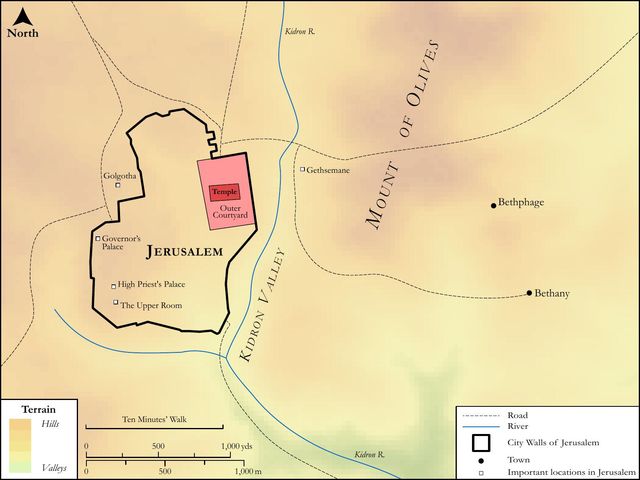
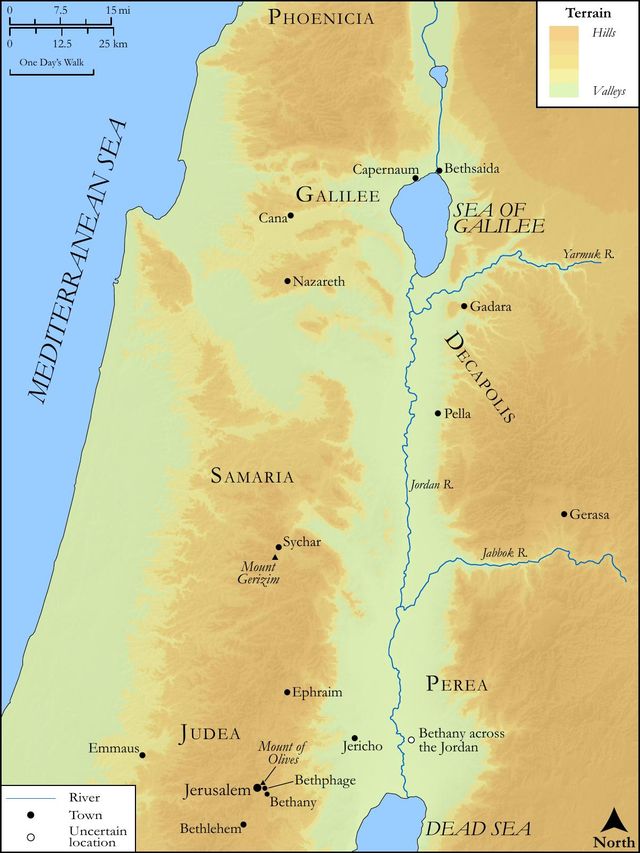
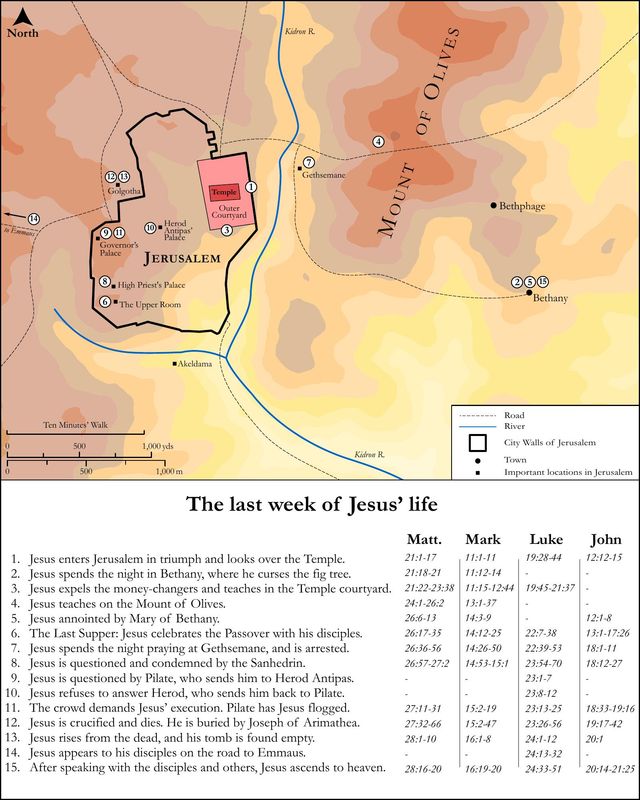
See on the biblical-era maps
Study this verse
Public-domain commentary
Matthew Henry
From his Commentary on the Whole Bible. Henry comments on passages, not single verses — this entry covers John 15:1–8. His four-level outline is real structure in the source text, so it is rendered as structure.
Here Christ discourses concerning the fruit, the fruits of the Spirit, which his disciples were to bring forth, under the similitude of a vine. Observe here,
I.The doctrine of this similitude; what notion we ought to have of it.
1.That Jesus Christ is the vine, the true vine. It is an instance of the humility of Christ that he is pleased to speak of himself under low and humble comparisons. He that is the Sun of righteousness, and the bright and morning Star, compares himself to a vine. The church, which is Christ mystical, is a vine (Psa 80:8), so is Christ, who is the church seminal. Christ and his church are thus set forth.
(1.)He is the vine, planted in the vineyard, and not a spontaneous product; planted in the earth, for his is the Word made flesh. The vine has an unsightly unpromising outside; and Christ had no form nor comeliness, Isa 53:2. The vine is a spreading plant, and Christ will be known as salvation to the ends of the earth. The fruit of the vine honours God and cheers man (Jdg 9:13), so does the fruit of Christ's mediation; it is better than gold, Pro 8:19.
(2.)He is the true vine, as truth is opposed to pretence and counterfeit; he is really a fruitful plant, a plant of renown. He is not like that wild vine which deceived those who gathered of it (Kg2 4:39), but a true vine. Unfruitful trees are said to lie (Hab 3:17. marg.), but Christ is a vine that will not deceive. Whatever excellency there is in any creature, serviceable to man, it is but a shadow of that grace which is in Christ for his people's good. He is that true vine typified by Judah's vine, which enriched him with the blood of the grape (Gen 49:11), by Joseph's vine, the branches of which ran over the wall (Gen 49:22), by Israel's vine, under which he dwelt safely, Kg1 4:25.
2.That believers are branches of this vine, which supposes that Christ is the root of the vine. The root is unseen, and our life is hid with Christ; the root bears the tree (Rom 11:18), diffuses sap to it, and is all in all to its flourishing and fruitfulness; and in Christ are all supports and supplies. The branches of the vine are many, some on one side of the house or wall, others on the other side; yet, meeting in the root, are all but one vine; thus all good Christians, though in place and opinion distant from each other, yet meet in Christ, the centre of their unity. Believers, like the branches of the vine, are weak, and insufficient to stand of themselves, but as they are borne up. See Eze 15:2.
3.That the Father is the husbandman, geōrgos - the land-worker. Though the earth is the Lord's, it yields him no fruit unless he work it. God has not only a propriety in, but a care of, the vine and all the branches. He hath planted, and watered, and gives the increase; for we are God's husbandry, Co1 3:9. See Isa 5:1, Isa 5:2; Isa 27:2, Isa 27:3. He had an eye upon Christ, the root, and upheld him, and made him to flourish out of a dry ground. He has an eye upon all the branches, and prunes them, and watches over them, that nothing hurt them. Never was any husbandman so wise, so watchful, about his vineyard, as God is about his church, which therefore must needs prosper.
II.The duty taught us by this similitude, which is to bring forth fruit, and, in order to this, to abide in Christ.
1.We must be fruitful. From a vine we look for grapes (Isa 5:2), and from a Christian we look for Christianity; this is the fruit, a Christian temper and disposition, a Christian life and conversation, Christian devotions and Christian designs. We must honour God, and do good, and exemplify the purity and power of the religion we profess; and this is bearing fruit. The disciples here must be fruitful, as Christians, in all the fruits of righteousness, and as apostles, in diffusing the savour of the knowledge of Christ. To persuade them to this, he urges,
(1.)The doom of the unfruitful (Joh 15:2): They are taken away.
[1.]It is here intimated that there are many who pass for branches in Christ who yet do not bear fruit. Were they really united to Christ by faith, they would bear fruit; but being only tied to him by the thread of an outward profession, though they seem to be branches, they will soon be seen to be dry ones. Unfruitful professors are unfaithful professors; professors, and no more. It might be read, Every branch that beareth not fruit in me, and it comes much to one; for those that do not bear fruit in Christ, and in his Spirit and grace, are as if they bore no fruit at all, Hos 10:1.
[2.]It is here threatened that they shall be taken away, in justice to them and in kindness to the rest of the branches. From him that has not real union with Christ, and fruit produced thereby, shall be taken away even that which he seemed to have, Luk 8:18. Some think this refers primarily to Judas.
(2.)The promise made to the fruitful: He purgeth them, that they may bring forth more fruit. Note,
[1.]Further fruitfulness is the blessed reward of forward fruitfulness. The first blessing was, Be fruitful; and it is still a great blessing.
[2.]Even fruitful branches, in order to their further fruitfulness, have need of purging or pruning; kathairei - he taketh away that which is superfluous and luxuriant, which hinders its growth and fruitfulness. The best have that in them which is peccant, aliquid amputandum - something which should be taken away; some notions, passions, or humours, that want to be purged away, which Christ has promised to do by his word, and Spirit, and providence; and these shall be taken off by degrees in the proper season.
[3.]The purging of fruitful branches, in order to their greater fruitfulness, is the care and work of the great husbandman, for his own glory.
(3.)The benefits which believers have by the doctrine of Christ, the power of which they should labour to exemplify in a fruitful conversation: Now you are clean, Joh 15:3.
[1.]Their society was clean, now that Judas was expelled by that word of Christ, What thou doest, do quickly; and till they were got clear of him they were not all clean. The word of Christ is a distinguishing word, and separates between the precious and the vile; it will purify the church of the first-born in the great dividing day.
[2.]They were each of them clean, that is, sanctified, by the truth of Christ (Joh 17:17); that faith by which they received the word of Christ purified their hearts, Act 15:9. The Spirit of grace by the word refined them from the dross of the world and the flesh, and purged out of them the leaven of the scribes and Pharisees, from which, when they saw their inveterate rage and enmity against their Master, they were now pretty well cleansed. Apply it to all believers. The word of Christ is spoken to them; there is a cleansing virtue in that word, as it works grace, and works out corruption. It cleanses as fire cleanses the gold from its dross, and as physic cleanses the body from its disease. We then evidence that we are cleansed by the word when we bring forth fruit unto holiness. Perhaps here is an allusion to the law concerning vineyards in Canaan; the fruit of them was as unclean, and uncircumcised, the first three years after it was planted, and the fourth year it was to be holiness of praise unto the Lord; and then it was clean, Lev 19:23, Lev 19:24. The disciples had now been three years under Christ's instruction; and now you are clean.
(4.)The glory that will redound to God by our fruitfulness, with the comfort and honour that will come to ourselves by it, Joh 15:8. If we bear much fruit,
[1.]Herein our Father will be glorified. The fruitfulness of the apostles, as such, in the diligent discharge of their office, would be to the glory of God in the conversion of souls, and the offering of them up to him, Rom 15:9, Rom 15:16. The fruitfulness of all Christians, in a lower or narrower sphere, is to the glory of God. By the eminent good works of Christians many are brought to glorify our Father who is in heaven.
[2.]So shall we be Christ's disciples indeed, approving ourselves so, and making it to appear that we are really what we call ourselves. So shall we both evidence our discipleship and adorn it, and be to our Master for a name and a praise, and a glory, that is, disciples indeed, Jer 13:11. So shall we be owned by our Master in the great day, and have the reward of disciples, a share in the joy of our Lord. And the more fruit we bring forth, the more we abound in that which is good, the more he is glorified.
2.In order to our fruitfulness, we must abide in Christ, must keep up our union with him by faith, and do all we do in religion in the virtue of that union. Here is,
(1.)The duty enjoined (Joh 15:4): Abide in me, and I in you. Note, It is the great concern of all Christ's disciples constantly to keep up a dependence upon Christ and communion with him, habitually to adhere to him, and actually to derive supplies from him. Those that are come to Christ must abide in him: "Abide in me, by faith; and I in you, by my Spirit; abide in me, and then fear not but I will abide in you;" for the communion between Christ and believers never fails on his side. We must abide in Christ's word by a regard to it, and it in us as a light to our feet. We must abide in Christ's merit as our righteousness and plea, and it in us as our support and comfort. The knot of the branch abides in the vine, and the sap of the vine abides in the branch, and so there is a constant communication between them.
(2.)The necessity of our abiding in Christ, in order to our fruitfulness (Joh 15:4, Joh 15:5): "You cannot bring forth fruit, except you abide in me; but, if you do, you bring forth much fruit; for, in short, without me, or separate from me, you can do nothing." So necessary is it to our comfort and happiness that we be fruitful, that the best argument to engage us to abide in Christ is, that otherwise we cannot be fruitful.
[1.]Abiding in Christ is necessary in order to our doing much good. He that is constant in the exercise of faith in Christ and love to him, that lives upon his promises and is led by his Spirit, bringeth forth much fruit, he is very serviceable to God's glory, and his own account in the great day. Note, Union with Christ is a noble principle, productive of all good. A life of faith in the Son of God is incomparably the most excellent life a man can live in this world; it is regular and even, pure and heavenly; it is useful and comfortable, and all that answers the end of life.
[2.]It is necessary to our doing any good. It is not only a means of cultivating ad increasing what good there is already in us, but it is the root and spring of all good: "Without me you can do nothing: not only no great thing, heal the sick, or raise the dead, but nothing." Note, We have as necessary and constant a dependence upon the grace of the Mediator for all the actions of the spiritual and divine life as we have upon the providence of the Creator for all the actions of the natural life; for, as to both, it is in the divine power that we live, move, and have our being. Abstracted from the merit of Christ, we can do nothing towards our justification; and from the Spirit of Christ nothing towards our sanctification. Without Christ we can do nothing aright, nothing that will be fruit pleasing to God or profitable to ourselves, Co2 3:5. We depend upon Christ, not only as the vine upon the wall, for support; but, as the branch on the root, for sap.
(3.)The fatal consequences of forsaking Christ (Joh 15:6): If any man abide not in me, he is cast forth as a branch. This is a description of the fearful state of hypocrites that are not in Christ, and of apostates that abide not in Christ.
[1.]They are cast forth as dry and withered branches, which are plucked off because they cumber the tree. It is just that those should have no benefit by Christ who think they have no need of him; and that those who reject him should be rejected by him. Those that abide not in Christ shall be abandoned by him; they are left to themselves, to fall into scandalous sin, and then are justly cast out of the communion of the faithful.
[2.]They are withered, as a branch broken off from the tree. Those that abide not in Christ, though they may flourish awhile in a plausible, at least a passable profession, yet in a little time wither and come to nothing. Their parts and gifts wither; their zeal and devotion wither; their credit and reputation wither; their hopes and comforts wither, Job 8:11-13. Note, Those that bear no fruit, after while will bear no leaves. How soon is that fig-tree withered away which Christ has cursed!
[3.]Men gather them. Satan's agents and emissaries pick them up, and make an easy prey of them. Those that fall off from Christ presently fall in with sinners; and the sheep that wander from Christ's fold, the devil stands ready to seize them for himself. When the Spirit of the Lord had departed from Saul, an evil spirit possessed him.
[4.]They cast them into the fire, that is, they are cast into the fire; and those who seduce them and draw them to sin do in effect cast them there; for they make them children of hell. Fire is the fittest place for withered branches, for they are good for nothing else, Eze 15:2-4.
[5.]They are burned; this follows of course, but it is here added very emphatically, and makes the threatening very terrible. They will not be consumed in a moment, like thorns under a pot (Ecc 7:6), but kaietai, they are burning for ever in a fire, which not only cannot be quenched, but will never spend itself. This comes of quitting Christ, this is the end of barren trees. Apostates are twice dead (Jde 1:12), and when it is said, They are cast into the fire and are burned, it speaks as if they were twice damned. Some apply men's gathering them to the ministry of the angels in the great day, when they shall gather out of Christ's kingdom all things that offend, and shall bundle the tares for the fire.
(4.)The blessed privilege which those have that abide in Christ (Joh 15:7): If my words abide in you, you shall ask what you will of my Father in my name, and it shall be done. See here,
[1.]How our union with Christ is maintained - by the word: If you abide in me; he had said before, and I in you; here he explains himself, and my words abide in you; for it is in the word that Christ is set before us, and offered to us, Rom 10:6-8. It is in the word that we receive and embrace him; and so where the word of Christ dwells richly there Christ dwells. If the word be our constant guide and monitor, if it be in us as at home, then we abide in Christ, and he in us.
[2.]How our communion with Christ is maintained - by prayer: You shall ask what you will, and it shall be done to you. And what can we desire more than to have what we will for the asking? Note, Those that abide in Christ as their heart's delight shall have, through Christ, their heart's desire. If we have Christ, we shall want nothing that is good for us. Two things are implied in this promise: - First, That if we abide in Christ, and his word in us, we shall not ask any thing but what is proper to be done for us. The promises abiding in us lie ready to be turned into prayers; and the prayers so regulated cannot but speed. Secondly, That if we abide in Christ and his word we shall have such an interest in God's favour and Christ's mediation that we shall have an answer of peace to all our prayers.
Historical interpretation
Historical reception
10 surviving comments on this verse. Each one is dated, so this reads as a timeline rather than a list.
Select a marker to jump to its quote. Markers stagger vertically where authors wrote within a few decades of each other.
Therefore, the vine has clearly indicated itself as an example to be drawn upon for the establishment of our way of life, which is first said to bud when warmed by the temperature of spring: then to produce fruit from the very joints of its branches, from which the budding grape is formed, and gradually growing, it retains the bitterness of its immature offspring, and can only become sweet when fully ripe and cooked. Meanwhile, the vine is covered with flourishing tendrils, which provide considerable support against the cold and protect it from the heat of the sun. But what is more pleasing to me, or more delightful than a spectacle, than to see wreaths hanging like beautiful rural necklaces, to pluck grapes shining with a golden or purple color? You think the hyacinths and other gems sparkle, the Indian gems flash, and the grace of the white ones gleam. Do not overlook the warning in these, O man, lest your final days find your fruits premature, or the time of a full life make your unfinished works disgraceful. For bitter fruit tends to be more unpleasant; and it cannot be sweet unless it has reached the maturity of perfection. To this perfect man, neither the cold of dreaded death nor the sun of iniquity usually does harm because he is overshadowed by spiritual grace and extinguishes the fires of all worldly desires and bodily lusts. Let all who behold you praise you, and let the ranks of the Church marvel at you like a garland of palm branches. Let each one behold the beautiful necklaces of the faithful souls; let them delight in the maturity of prudence, the splendor of faith, the beauty of confession, the loveliness of justice, and the abundance of mercy, so that it may be said to you: Your wife is like a fruitful vine on the sides of your house (Ps. 127:3); because you imitate the abundance of a fruitful vine and the bountiful gift of generosity.
"He that abideth in Me, and I in him." Seest thou that the Son contributeth not less than the Father towards the care of the disciples? The Father purgeth, but He keepeth them in Himself. The abiding in the root is that which maketh the branches to be fruit-bearing. For that which is not purged, if it remain on the root, bears fruit, though perhaps not so much as it ought; but that which remains not, bears none at all. But still the "purging" also hath been shown to belong to the Son, and the "abiding in the root," to the Father, who also begat the Root. Seest thou how all is common, both the "purging," and the enjoying the virtue which is from the root?
"He is cast forth," He saith. No longer enjoying the benefit of the husbandman's hand. "And is withered." That is, if he had aught of the root, he loses it; if any grace, he is stripped of this, and is bereft of the help and life which proceed from it. And what the end? "He is cast into the fire." Not such he who abideth with Him. Then He showeth what it is to "abide," and saith, "If My words abide in you." Seest thou that with reason I said above, that He seeketh the proof by works? For when He had said, "Whatsoever ye shall ask I will do it," He added, "If ye love Me, ye will keep My commandments." And here, "If ye abide in Me, and My words abide in you."
"As the branch cannot bear fruit of itself except it abide in the vine, so neither can he who abideth not in Me." For that they might not be separated from Him by timidity, He fasteneth and glueth to Himself their souls slackened through fear, and holdeth out to them good hopes for the future. For the root remains, but to be taken away, or to be left, belongs to the branches. Then having urged them on in both ways, by things pleasant and things painful, He requireth first what is to be done on our side.
(Hom. lxxvi non occ.) Having said that they were clean through the word which He had spoken unto them, He now teaches them that they must do their part.
(Hom. lxxvi. 1) The Son then contributes no less than the Father to the help of the disciples. The Father changeth, but the Son keepeth them in Him, which is that which makes the branches fruitful. And again, the cleansing is attributed to the Son also, and the abiding in the root to the Father who begat the root. (c. 2.). It is a great loss to be able to do nothing, but He goes on to say more than this: If a man abide not in Me, he is cast forth as a branch, i. e. shall not benefit by the care of the husbandman, and withereth, i. e. shall lose all that it desires from the root, all that supports its life, and shall die.
(Hom. lxxvi. 2) Then He shows what it is to abide in Him. If ye abide in Me, and My words abide in you, ye shall ask what ye will, and it shall be done unto you. It is to be shown by their works.
Jesus called Himself the vine, and His disciples the branches, and His Father the husbandman; whereon we have already discoursed as we were able. But in the present passage, while still speaking of Himself as the vine, and of His branches, or, in other words, of the disciples, He said, "Abide in me, and I in you." They are not in Him in the same kind of way that He is in them. And yet both ways tend to their advantage, and not to His. For the relation of the branches to the vine is such that they contribute nothing to the vine, but from it derive their own means of life; while that of the vine to the branches is such that it supplies their vital nourishment, and receives nothing from them. And so their having Christ abiding in them, and abiding themselves in Christ, are in both respects advantageous, not to Christ, but to the disciples. For when the branch is cut off, another may spring up from the living root; but that which is cut off cannot live apart from the root.
(Tract. lxxxi. 1) Abide in Me, and I in you: not they in Him, as He in them; for both are for the profit not of Him, but them. The branches do not confer any advantage upon the vine, but receive their support from it: the vine supplies nourishment to the branches, takes none from them: so that the abiding in Christ, and the having Christ abiding in them, are both for the profit of the disciples, not of Christ; according to what follows, As the branch cannot bear fruit of itself, except it abide in the vine, no more can ye, except ye abide in Me. Great display of grace! He strengtheneth the hearts of the humble, stoppeth the mouth of the proud. They who hold that God is not necessary for the doing of good works, the subverters, not the assertors, of free will, contradict this truth. For he who thinks that he bears fruit of himself, is not in the vine; he who is not in the vine, is not in Christ; he who is not in Christ, is not a Christian.
And then He proceeds to say: "As the branch cannot bear fruit of itself, except it abide in the vine; no more can ye, except ye abide in me." A great encomium on grace, my brethren, one that will instruct the souls of the humble, and stop the mouths of the proud. Let those now answer it, if they dare, who, ignorant of God's righteousness, and going about to establish their own, have not submitted themselves unto the righteousness of God. Let the self-complacent answer it, who think they have no need of God for the performance of good works. Fight they not against such a truth, those men of corrupt mind, reprobate concerning the faith, whose reply is only full of impious talk, when they say: It is of God that we have our existence as men, but it is of ourselves that we are righteous? What is it you say, you who deceive yourselves, and, instead of establishing freewill, cast it headlong down from the heights of its self-elevation through the empty regions of presumption into the depths of an ocean grave? Why, your assertion that man of himself worketh righteousness, that is the height of your self-elation. But the Truth contradicts you, and declares, "The branch cannot bear fruit of itself, except it abide in the vine." Away with you now over your giddy precipices, and, without a spot whereon to take your stand, vapor away at your windy talk. These are the empty regions of your presumption. But look well at what is tracking your steps, and, if you have any sense remaining, let your hair stand on end. For whoever imagines that he is bearing fruit of himself is not in the vine, and he that is not in the vine is not in Christ, and he that is not in Christ is not a Christian. Such are the ocean depths into which you have plunged.
We shall know then, by an accurate investigation of the words before us, that the being received of Christ through faith pure and true is the first work of that zeal which is requisite and dear to God. For this is the |385 meaning of being numbered among the branches, which cling to the true Vine, I mean Christ. But the fruit of our second meditation is by no means less in importance than our first, but it has, indeed, an even more pregnant meaning: the loving to be united to God, and to lay fast hold on Him, through a love exhibited in works, which has the fulfilment of the holy and Divine command. For this causes us inseparably to inhere in, and to be closely united to, Him, as the Psalmist expresses it: My soul has been joined unto Thee. The being received then as it were into the rank of branches will not be sufficient for complete joy of heart, or for the sanctification which, as it were, exhibits Christ sanctifying us. But I maintain that the following Him purely through love perfect and unfailing is also necessary. For by this means, the power of union or intimate conjunction with the Father may be best maintained and preserved. When therefore Christ said to His disciples, Already ye are clean because of the word which I have spoken unto you; lest any one of those who have once been purified should be considered incapable of falling away, even though he should bestow no care to remain in a state of grace, He adds this useful injunction----that it is necessary to abide in Him. And what will this be? Nothing else, as I think, but quite obviously that which Paul well expresses: Wherefore let him that thinketh he standeth take heed lest he fall. For a thousand backslidings befall those who think that they are firmly fixed, and who do not take great precautions not to lose the place which they have obtained; and I think that we require the utmost modesty and sobriety, even though a man think himself firmly fixed by the progress he has already made towards establishing himself in righteousness. He then has shown the nature and extent of the punishment of him who has, as it were, been cut off from intimate union with God, through slipping back from negligence into what is wrong, in the statement, As the branch cannot bear fruit of itself, except it abide in the vine, so neither can ye, except ye abide in Me. For unless the branch had supplied to it from its mother the vine the life-producing sap, how would it bear grapes, or what fruit will it bring forth, and from what source? You will perceive that the language of Christ has an application by analogy to ourselves. For no fruit of virtue will spring up anew in us, who have once fallen away from intimate union with Christ. To those, however, who are joined to Him Who is able to strengthen them, and Who nourishes in righteousness, the capacity of bearing fruit will readily be added by the provision and grace of the Spirit, as by life-producing water. And knowing this, the Only-begotten said in the Gospels: If any man thirst, let him come unto Me and drink. And to this, the Evangelist, inspired by the Spirit, has testified, when in his excellent explanation he says: But this spake He of the Spirit, Which they that believe on Him were to receive. And the blessed David, speaking as though to God the Father, thus addressed Him: With Thee is the fountain of life, and Thou shalt give them to drink of the river of blessedness. For by the fountain of Divine and spiritual life and of the fulness of blessedness, who else could be meant but the Son, Who fattens and waters our souls in the position of branches clinging to Him by faith and love, with the quickening and joy-giving grace of the Spirit.
Just as the root of the vine administers and distributes to the branches the benefit of its own natural and inherent qualities, so too the only-begotten Word of God imparts to the saints, as it were, a likeness to his own nature and the nature of God the Father by giving them the Spirit, insomuch as they have been united with him through faith and perfect holiness. Christ nourishes them in piety and works in them the knowledge of all virtue and good works.
Continue studying John 15:4 across the web’s major study libraries — every link below opens this exact verse, chapter, or book on the destination site.
Read & Compare
 BibleGatewayThis verse in more than 200 translations and 70 languages.
 Bible.comThe YouVersion reader — hundreds of translations, reading plans, and highlights.
 ESV.orgCrossway's official English Standard Version reader.
 NET BibleThe NET translation with 60,000+ translators' notes on every rendering decision.
 STEP BibleTyndale House's free study tool — original text, vocabulary, and scholarly resources.
 BibliaLogos Bible Software's free web reader.
 USCCBThe New American Bible (Revised Edition) with the U.S. bishops' study notes.
Commentaries
 BibleHub CommentariesDozens of classic commentaries on this verse, gathered on one page.
 StudyLightMore than 100 commentary sets — the largest collection on the web.
 BibleRefPlain-English commentary on what this verse means, verse by verse.
 Enduring WordDavid Guzik's free commentary on this chapter, widely used by Bible teachers.
 Bible Study ToolsVerse commentary alongside Greek and Hebrew study aids.
Original Language & Research
- BibleHub InterlinearThe verse word by word — original language, transliteration, and English.
- BibleHub LexiconEvery word's original-language definition and Strong's entry.
 Blue Letter BibleDeep-study tools — Strong's numbers, concordance, and word studies.
 CNTR CollationThe earliest Greek manuscripts of this verse, collated letter by letter.
Sermons, Hymns & Audio


TrulyRandomVerse is not affiliated with these sites and doesn’t control their content. They’re linked because they’re genuinely useful.
Summary
John 15:4 is a foundational verse within Jesus' Farewell Discourse, articulating the indispensable nature of a continuous, intimate union between Christ and His followers. Through the vivid analogy of a vine and its branches, Jesus declares that spiritual vitality, productivity, and fruitfulness are utterly dependent on believers remaining in Him, just as He remains in them, underscoring a mutual and life-giving relationship.
Context
ShowHideLiterary Context
This verse is embedded within Jesus' profound Farewell Discourse, delivered to His disciples on the eve of His crucifixion. It immediately follows the opening declaration of the vine analogy in John 15:1-3, where Jesus identifies Himself as the "true vine" and God the Father as the "vinedresser." The preceding verses establish the Father's active role in pruning branches for greater fruitfulness and cleansing disciples through the word. John 15:4 then pivots to the disciples' responsibility to maintain their connection to the Vine, emphasizing that their very capacity to bear fruit hinges on this abiding relationship. The entire chapter elaborates on the nature and implications of this union, leading into commands to love one another and warnings about the world's hatred.
Historical & Cultural Context
Viticulture was a prominent agricultural practice in ancient Israel, making the imagery of the vine and branches immediately understandable to Jesus' audience. Vines were cultivated carefully, with branches pruned to maximize fruit production. Beyond agriculture, the vine was a potent symbol in the Old Testament, frequently representing Israel (e.g., Psalm 80:8-16, Isaiah 5:1-7). By declaring Himself the "true vine," Jesus redefines this national symbol, asserting that true spiritual life and connection to God are now found exclusively in Him, not merely in ethnic or national identity. This teaching likely occurred after the Last Supper, as Jesus and His disciples were likely moving towards the Garden of Gethsemane, perhaps passing vineyards on the slopes around Jerusalem.
Key Themes
ShowHideThe central theme is Mutual Abiding, expressed by the repeated command "Abide in me, and I in you." This signifies a deep, continuous, and reciprocal fellowship with Christ, where believers remain in Him and He in them. This relationship is the wellspring of Absolute Dependence; just as a branch cannot produce fruit apart from its connection to the vine, believers are utterly reliant on Christ for spiritual vitality and productivity, a truth echoed in passages like Philippians 4:13. The ultimate purpose of this abiding is Spiritual Fruitfulness, which encompasses righteous living, transformed character (often referred to as the Fruit of the Spirit in Galatians 5:22-23), good works, and the expansion of God's kingdom. Finally, the verse profoundly speaks to the Union with Christ, a mystical yet real spiritual oneness through which believers receive life, nourishment, and the power to live a godly life, a concept central to Pauline theology as well (e.g., Romans 6:5).
Exposition and Analysis
ShowHideKey Word Analysis
ShowHideThis primary verb (G3306) signifies "to stay (in a given place, state, relation or expectancy)." Its repeated use in John 15 emphasizes a continuous, settled, and intentional dwelling or remaining in Christ. It implies more than a temporary visit or a fleeting connection; it denotes a permanent, intimate, and active relationship, the source from which all spiritual life flows.
Derived from a word meaning "to break off," this noun (G2814) refers to a limb or shoot of a vine. In the analogy, it represents the individual believer. The nature of a branch is that it is entirely dependent on the vine for its life, sap, and ability to produce fruit. Without this connection, it is lifeless and useless for its intended purpose.
This noun (G288) denotes a vine, specifically as a plant that coils about a support. In this context, it is Jesus Christ Himself, the source of life, nourishment, and stability for the branches. As the "true vine," He is the singular and authentic source of spiritual life, in contrast to any other system or identity.
Verse Breakdown
ShowHide"Abide in me, and I in you."
This opening command sets the imperative for the believer's relationship with Christ. "Abide" (ménō) implies a continuous, intentional, and intimate dwelling. The reciprocal "and I in you" highlights the mutual nature of this spiritual union; as believers actively remain in Christ, He likewise indwells them, providing His life and power. This is not a passive state but an active, dynamic fellowship.
"As the branch cannot bear fruit of itself, except it abide in the vine;"
This clause introduces the powerful analogy, illustrating the absolute dependence of the branch on the vine. The branch possesses no inherent capacity for fruitfulness; its very existence and ability to produce fruit are entirely contingent upon its unbroken connection to the vine, which supplies all necessary nutrients and life. The phrase "of itself" (G575 G1438) stresses the utter inability of the branch to generate life or fruit independently.
"no more can ye, except ye abide in me."
This concluding parallel applies the analogy directly to the disciples (and by extension, all believers). Just as the branch's fruitfulness is conditional upon its abiding, so too is the believer's spiritual fruitfulness. Without a continuous, vital union with Christ, spiritual productivity is impossible. This emphasizes that fruit is not the result of human effort or self-sufficiency, but the natural outflow of Christ's life flowing through the believer.
Literary Devices
ShowHideJohn 15:4 masterfully employs several literary devices to convey its profound theological truth. The primary device is Analogy, specifically the extended metaphor of the vine and branches that runs throughout the chapter. Jesus uses this familiar agricultural image to explain the abstract spiritual relationship between Himself and His followers. Within this analogy, Metaphor is evident: Jesus is the "vine," believers are the "branches," and spiritual outcomes are "fruit." This allows for a vivid and relatable understanding of complex spiritual realities. Furthermore, Repetition of the word "abide" (Greek: ménō) serves to underscore its critical importance, driving home the central command and the absolute necessity of this continuous union for spiritual life and fruitfulness. The structure of the verse itself, moving from command to analogy and then back to application, creates a powerful and memorable teaching.
Theological and Thematic Connections
ShowHideJohn 15:4 is a cornerstone for understanding the believer's life in Christ, deeply intertwining with core Christian doctrines. It speaks profoundly to Christology, presenting Jesus as the exclusive source of spiritual life and fruitfulness, the "true vine" through whom all divine nourishment flows. It illuminates Soteriology by implying that salvation initiates this union, but Sanctification is the ongoing process of maintaining and deepening it for the purpose of bearing fruit that glorifies God. The verse also implicitly connects to Pneumatology, as the Holy Spirit is the means by which Christ indwells believers and empowers them to abide and bear fruit (John 14:16-17). The concept of "fruit" here is multifaceted, encompassing character transformation, righteous deeds, and evangelistic witness, all flowing from a life lived in vital union with the Savior.
Reflection and Application
ShowHideJohn 15:4 issues a profound call to intentional, daily commitment to maintaining a vibrant and intimate relationship with Jesus Christ. It reminds us that spiritual fruitfulness is not a matter of striving in our own strength, but of submitting to and drawing life from the True Vine. This abiding is a dynamic process, nurtured through consistent prayer, diligent engagement with God's Word, and active obedience to His commands. Just as a branch withers and dies apart from the vine, our spiritual lives will become barren and ineffective if we neglect our connection to Christ. The promise is not merely survival, but abundant fruitfulness—a life characterized by love, joy, peace, patience, kindness, goodness, faithfulness, gentleness, and self-control, all flowing naturally from His indwelling presence. This verse challenges us to examine the depth of our communion with Christ and to prioritize the spiritual practices that foster this vital union, recognizing that our capacity to impact the world for God's glory is directly proportional to our rootedness in Him.
Questions for Reflection
ShowHideFAQ
ShowHideWhat does "abide" truly mean in this context?
ShowHideIn John 15:4, "abide" (Greek: ménō) means to remain, dwell, or continue in a settled, permanent, and intimate relationship. It's not a fleeting visit or a temporary association but a deep, ongoing, and personal fellowship with Jesus Christ. It implies a conscious and continuous dependence on Him as the source of life, nourishment, and power. This abiding is reciprocal: as believers remain in Christ, He remains in them, providing His life and presence. It encompasses active trust, obedience, and communion, as seen throughout Jesus' teachings in John.
What is the "fruit" Jesus refers to, and how is it produced?
ShowHideThe "fruit" Jesus speaks of in John 15 is multifaceted, representing the spiritual outcomes of a life lived in union with Him. It includes transformed character, often identified with the Fruit of the Spirit in Galatians 5:22-23 (love, joy, peace, patience, kindness, goodness, faithfulness, gentleness, self-control). It also encompasses righteous actions, good works, and an effective witness that draws others to Christ, leading to more disciples (as implied in John 15:8). This fruit is not produced by human effort or striving, but is the natural, supernatural outflow of Christ's life flowing through the believer who is abiding in Him. It is a divine work, manifesting through human yieldedness.
How does one "abide" in Christ practically today?
ShowHideAbiding in Christ is a holistic spiritual discipline that involves several key practices. It begins with faith and surrender, acknowledging Jesus as Lord and the source of all life. Practically, it involves consistent prayer, maintaining an ongoing conversation with God, expressing dependence and gratitude. It requires meditation on and obedience to God's Word, allowing the Scriptures to cleanse, guide, and nourish the soul (as mentioned in John 15:3). Obedience to Jesus' commands, particularly the command to love one another (John 15:12), is a vital expression of abiding. Finally, fellowship with other believers and participation in the life of the church also foster this connection, as believers mutually encourage and build one another up in Christ.
Christ-Centered Fulfillment
ShowHideJohn 15:4 finds its ultimate fulfillment and deepest meaning in the person and work of Jesus Christ. He is not merely a teacher of principles; He is the "true vine" (as stated in John 15:1), the very embodiment of the life and connection that He commands His followers to maintain. Through His atoning death and glorious resurrection, Christ made it possible for humanity, once cut off by sin, to be grafted into Him, establishing the New Covenant relationship where believers are spiritually united with Him. The promise "and I in you" is fulfilled by the indwelling Holy Spirit, whom Jesus promised would come after His departure (John 14:16-17). It is through the Spirit that Christ's life, power, and character are imparted to the believer, enabling them to truly "abide" and bear fruit. Thus, the call to abide is an invitation to participate in the resurrected life of Christ, where He is the life-giving source, and our fruitfulness is a direct testament to His finished work and ongoing presence within us (Galatians 2:20; Colossians 3:1-4).