


2 Kings 4:39
- וַיֵּצֵאvai·ye·Tze'and he went outH3318Conj-w ¦ V-Qal-ConsecImperf-3msVerb Qal Consecutive Imperfect 3rd Singular Masculineוַandיֵּצֵאhe went out
- אֶחָד'e·Chadone [man]H259N-fsNoun Singular Feminine Absolute
- אֶל'eltoH413PrepPreposition
- הַשָּׂדֶהha·sa·Dehthe fieldH7704Art ¦ N-msNoun Singular Masculine Absoluteהַtheשָּׂדֶהfield
- לְלַקֵּטle·la·Ketto gatherH3950Prep-l ¦ V-Piel-InfVerb Piel Infinitive Constructלְtoלַקֵּטgather
- אֹרֹת'o·RotherbsH219N-fpNoun Plural Feminine Absolute
- וַיִּמְצָאvai·yim·Tza'and he foundH4672Conj-w ¦ V-Qal-ConsecImperf-3msVerb Qal Consecutive Imperfect 3rd Singular Masculineוַandיִּמְצָאhe found
- גֶּפֶןGe·fena vine ofH1612N-cscNoun Singular common gender Construct
- שָׂדֶהsa·Deh[the] fieldH7704N-msNoun Singular Masculine Absolute
- וַיְלַקֵּטvay·la·Ketand he gatheredH3950Conj-w ¦ V-Piel-ConsecImperf-3msVerb Piel Consecutive Imperfect 3rd Singular Masculineוַandיְלַקֵּטhe gathered
- מִמֶּנּוּmi·Me·nufrom itH4480Prep ¦ 3msPrepositionמִמֶּfromנּוּit
- פַּקֻּעֹתpa·ku·'Otgourds ofH6498N-fpcNoun Plural Feminine Construct
- שָׂדֶהsa·Deh[the] fieldH7704N-msNoun Singular Masculine Absolute
- מְלֹאme·Lo'[the] fullness ofH4393N-mscNoun Singular Masculine Construct
- בִגְדוֹvig·Dohis garmentH899N-msc ¦ 3msNoun Singular Masculine Constructבִגְדgarmentוֹhis
- וַיָּבֹאvai·ya·Vo'and he cameH935Conj-w ¦ V-Qal-ConsecImperf-3msVerb Qal Consecutive Imperfect 3rd Singular Masculineוַandיָּבֹאhe came
- וַיְפַלַּחvay·fa·Lachand he sliced [them]H6398Conj-w ¦ V-Piel-ConsecImperf-3msVerb Piel Consecutive Imperfect 3rd Singular Masculineוַandיְפַלַּחhe sliced [them]
- אֶל'elintoH413PrepPreposition
- סִירsir[the] pot ofH5518N-fscNoun Singular Feminine Construct
- הַנָּזִידha·na·Zidthe cooked foodH5138Art ¦ N-msNoun Singular Masculine Absoluteהַtheנָּזִידcooked food
- כִּיkiforH3588PrtParticle Conditional
- לֹאlo'notH3808NegParticle Negative
- יָדָעוּya·Da·'upeople knewH3045V-Qal-Perf-3cpVerb Qal Perfect 3rd Plural common gender
English is a literal word-by-word gloss of the Hebrew, not the KJV's wording. Why?
This is the original text the KJV's translators worked from — each Hebrew word with its own literal English meaning in this verse, prepared by scholars at Tyndale House, Cambridge. The KJV translates whole sentences, not word by word, so its wording differs: one Hebrew word can become several English words, and the KJV may choose “the LORD” where the gloss reads “Yahweh”. Both are faithful — they answer different questions. For the KJV's own rendering, switch to the KJV text.
Details
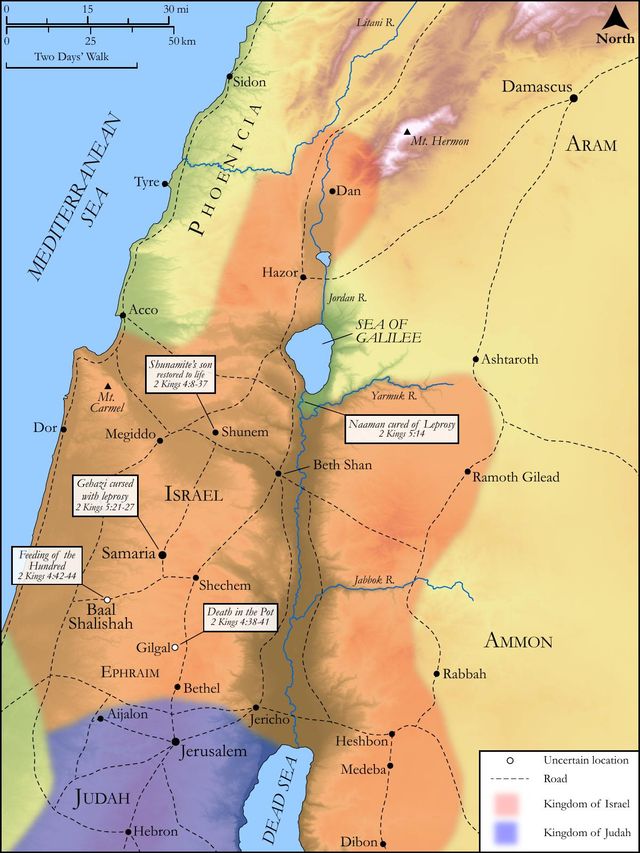
See on the biblical-era map
Study this verse
Public-domain commentary
Matthew Henry
From his Commentary on the Whole Bible. Henry comments on passages, not single verses — this entry covers 2 Kings 4:38–44. His two-level outline is real structure in the source text, so it is rendered as structure.
We have here Elisha in his place, in his element, among the sons of the prophets, teaching them, and, as a father, providing for them; and happy it was for them that they had one over them who naturally cared for their state, under whom they were well fed and well taught. There was a dearth in the land, for the wickedness of those that dwelt therein, the same that we read of, Kg2 8:1. It continued seven years, just as long again as that in Elijah's time. A famine of bread there was, but not of hearing the word of God, for Elisha had the sons of the prophets sitting before him, to hear his wisdom, who were taught, that they might teach others. Two instances we have here of the care he took about their meat. Christ twice fed those to whom he preached. Elisha was in the more care about it now because of the dearth, that the sons of the prophets might not be ashamed in this evil time, but, even in the days of famine, might be satisfied, Psa 37:19.
I.He made hurtful food to become safe and wholesome.
1.On the lecture-day, the sons of the prophets being all to attend, he ordered his servant to provide food for their bodies, while he was breaking to them the bread of life for their souls. Whether there was any flesh-meat for them does not appear; he orders only that pottage should be seethed for them of herbs, Kg2 4:38. The sons of the prophets should be examples of temperance and mortification, not desirous of dainties, but content with plain food. If they have neither savoury meats nor sweet meats, nay, if a mess of pottage be all the dinner, let them remember that this great prophet entertained himself and his guests no better.
2.One of the servitors, who was sent to gather herbs (which, it should seem, must serve instead of flesh for the pottage), by mistake brought in that which was noxious, or at least very nauseous, and shred it into the pottage: wild gourds they are called, Kg2 4:39. Some think it was coloquintida, a herb strongly cathartic, and, if not qualified, dangerous. The sons of the prophets, it seems, were better skilled in divinity than in natural philosophy, and read their Bibles more than their herbals. If any of the fruits of the earth be hurtful, we must look upon it as an effect of the curse (thorns and thistles shall it bring forth unto thee), for the original blessing made all good.
3.The guests complained to Elisha of the unwholesomeness of their food. Nature has given man the sense of tasting, not only that wholesome food may be pleasant, but that that which is unwholesome may be discovered before it comes to the stomach; the mouth tries meat by tasting it, Job 12:11. This pottage was soon found by the taste of it to be dangerous, so that they cried out, There is death in the pot, Kg2 4:40. The table often becomes a snare, and that which should be for our welfare proves a trap, which is a good reason why we should not feed ourselves without fear; when we are receiving the supports and comforts of life we must keep up an expectation of death and a fear of sin.
4.Elisha immediately cured the bad taste and prevented the bad consequences of this unwholesome pottage; as before he had healed the bitter waters with salt, so now the bitter broth with meal, Kg2 4:41. It is probable that there was meal in it before, but that was put in by a common hand, only to thicken the pottage; this was the same thing, but cast in by Elisha's hand, and with intent to heal the pottage, by which it appears that the change was not owing to the meal (that was the sign only, not the means), but to the divine power. Now all was well, not only no death, but no harm in the pot. We must acknowledge God's goodness in making our food wholesome and nourishing. I am the Lord that healeth thee.
II.He made a little food to go a great way.
1.Elisha had a present brought him of twenty barley-loaves and some ears of corn (Kg2 4:42), a present which, in those ages, would not be despicable at any time, but now in a special manner valuable, when there was a dearth in the land. It is said to be of the first-fruits, which was God's due out of their increase; and when the priests and Levites were all at Jerusalem, out of their reach, the religious people among them, with good reason, looked upon the prophets as God's receivers, and brought their first-fruits to them, which helped to maintain their schools.
2.Having freely received, he freely gave, ordering it all to be set before the sons of the prophets, reserving none for himself, none for the hereafter. "Let the morrow take thought for the things of itself, give it all to the people that they may eat." It well becomes the men of God to be generous and open-handed, and the fathers of the prophets to be liberal to the sons of the prophets.
3.Though the loaves were little, it is likely no more than what one man would ordinarily eat at a meal, yet with twenty of them he satisfied 100 men, Kg2 4:43, Kg2 4:44. his servant thought that to set so little meat before so many men was but to tantalize them, and shame his master for making so great an invitation to such short commons; but he in God's name, pronounced it a full meal for them, and so it proved; they did eat, and left thereof, not because their stomachs failed them, but because the bread increased in the eating. God has promised his church (Psa 132:15) that he will abundantly bless her provision, and satisfy her poor with bread; for whom he feeds he fills, and what he blesses comes to much, as what he blows upon comes to little, Hag 1:9. Christ's feeding his hearers was a miracle far beyond this; but both teach us that those who wait upon God in the way of duty may hope to be both protected and supplied by a particular care of divine Providence.
Historical interpretation
Fourteen Centuries of Reception
2 surviving comments on this verse. Each one is dated, so this reads as a timeline rather than a list.
Select a marker to jump to its quote. Markers stagger vertically where authors wrote within a few decades of each other.
This was the starving steward of the prophets who was forced by the lack of food to go through the fields in order to gather some herbs. And since he could not find the herbs he knew, he gathered those that he did not know and were not edible. And since it is written that he gathered wild colocynths, some say that he gathered colocynths, others those [herbs] that are called the source of bitterness: with their inside parts, physicians make an effective and purifying medicine. Others say that perhaps their name comes from the term used by farmers: squirting cucumbers, which have a very bitter taste and resemble a vine. In fact, the Scripture calls a vine that plant that the steward found and from which he gathered colocynths.
Wild gourds of the field: Colocynthidas. They are extremely bitter, and therefore are called the gall of the earth; and are poisonous if taken in a great quantity.
Continue studying 2 Kings 4:39 across the web’s major study libraries — every link below opens this exact verse, chapter, or book on the destination site.
Read & Compare
 BibleGatewayThis verse in more than 200 translations and 70 languages.
 Bible.comThe YouVersion reader — hundreds of translations, reading plans, and highlights.
 ESV.orgCrossway's official English Standard Version reader.
 NET BibleThe NET translation with 60,000+ translators' notes on every rendering decision.
 STEP BibleTyndale House's free study tool — original text, vocabulary, and scholarly resources.
 BibliaLogos Bible Software's free web reader.
 USCCBThe New American Bible (Revised Edition) with the U.S. bishops' study notes.
Commentaries
 BibleHub CommentariesDozens of classic commentaries on this verse, gathered on one page.
 StudyLightMore than 100 commentary sets — the largest collection on the web.
 BibleRefPlain-English commentary on what this verse means, verse by verse.
 Enduring WordDavid Guzik's free commentary on this chapter, widely used by Bible teachers.
 Bible Study ToolsVerse commentary alongside Greek and Hebrew study aids.
Original Language & Research
- BibleHub InterlinearThe verse word by word — original language, transliteration, and English.
- BibleHub LexiconEvery word's original-language definition and Strong's entry.
 Blue Letter BibleDeep-study tools — Strong's numbers, concordance, and word studies.
 SefariaThe Hebrew text with Rashi and centuries of Jewish commentary.
Sermons, Hymns & Audio


TrulyRandomVerse is not affiliated with these sites and doesn’t control their content. They’re linked because they’re genuinely useful.
Summary
During a severe famine in Gilgal, a member of the prophetic community inadvertently gathered highly toxic wild gourds, mistaking them for edible herbs. These poisonous plants were then shredded into the communal pot of pottage, unknowingly threatening the lives of the "sons of the prophets." This perilous situation sets the stage for a dramatic display of divine intervention through the prophet Elisha, highlighting the dangers of ignorance and the miraculous nature of God's provision and protection for His people.
Context
ShowHideLiterary Context
This verse is situated within a series of miracles performed by the prophet Elisha, demonstrating God's power and care for His people during a period of spiritual and national decline. The immediate narrative in 2 Kings 4:38 establishes the setting in Gilgal, where Elisha is ministering to the "sons of the prophets"—a community of disciples. A severe famine grips the land, prompting the preparation of a communal meal. Verse 2 Kings 4:39 details the accidental introduction of poison, leading directly to the cry of "death in the pot" in 2 Kings 4:40 and Elisha's miraculous purification of the stew in 2 Kings 4:41. This incident, along with the feeding of a hundred men with twenty loaves in 2 Kings 4:42-44, underscores Elisha's role as God's chosen instrument of provision and life, echoing themes found throughout 2 Kings chapter 4.
Historical & Cultural Context
The setting of Gilgal holds historical significance as an early Israelite encampment and a place of covenant renewal (e.g., Joshua 5:9). By Elisha's time, it was a recognized center for prophetic activity, housing a "school" or community of prophets. Famine was a recurring and devastating reality in ancient Israel, often seen as a consequence of national sin or a test from God. In such times, people would resort to foraging for wild plants to supplement their meager diets, increasing the risk of consuming toxic varieties. The "pottage" (or stew) was a common, simple meal, typically consisting of grains, lentils, or vegetables, making the accidental poisoning a threat to the entire community's sustenance and survival. The communal nature of the meal highlights the shared vulnerability and interdependence within the prophetic group.
Key Themes
ShowHideThe verse introduces several key themes that resonate throughout the broader narrative. The most prominent is the danger of ignorance or lack of discernment, encapsulated in the phrase "for they knew them not." This highlights the peril of consuming unknown or potentially harmful substances, especially in desperate times, and serves as a spiritual metaphor for the need for wisdom and discernment in all areas of life. Another central theme is divine provision amidst scarcity and danger. Even in a time of severe famine and accidental poisoning, God's ability to provide and protect His people is powerfully demonstrated through Elisha's intervention, foreshadowing miraculous preservation of life. Finally, the narrative emphasizes community and shared vulnerability. The sons of the prophets shared their meager resources, and their collective exposure to the poisonous pottage underscores the importance of spiritual leadership and divine intervention for the well-being of the entire group, reinforcing the idea that the community's fate is intertwined.
Exposition and Analysis
ShowHideKey Word Analysis
ShowHideThis term refers to a specific type of wild plant, widely identified by scholars as Citrullus colocynthis, commonly known as colocynth or "bitter apple." This plant produces small, melon-like fruits that are extremely bitter and highly purgative, causing severe gastrointestinal distress, and are toxic if consumed in significant quantities. The context of them being "wild" (Hebrew, sâdeh, H7704) emphasizes that it was not a cultivated, known food source but something gathered from the untamed field, underscoring the desperation and lack of discernment.
The verb "shred" implies breaking, cutting, or piercing into pieces. In this context, it indicates that the gatherer prepared the gourds by chopping them up before adding them to the pot. This action made the poisonous nature of the gourds even less discernible once mixed into the stew, highlighting the insidious way the danger was incorporated and ensuring the full release of their toxic properties.
The phrase "for they knew them not" (Hebrew, lo yade'u) is crucial, underscoring the central problem: a profound lack of knowledge, recognition, or discernment. It was not malice but ignorance that led to the peril. This emphasizes the importance of wisdom and understanding, especially when dealing with matters of life and death, both physically and spiritually, as their lack of recognition of the plant's true nature nearly led to fatal consequences.
Verse Breakdown
ShowHide"And one went out into the field to gather herbs"
This clause sets the scene, depicting a proactive, albeit misguided, attempt to contribute to the communal meal during a time of scarcity. The "field" signifies a natural, uncultivated environment, where the distinction between edible and poisonous plants might be less clear to the untrained eye.
"and found a wild vine, and gathered thereof wild gourds his lap full"
The discovery of the "wild vine" and the subsequent gathering of a significant quantity ("his lap full") of "wild gourds" highlights the abundance of the toxic plant and the gatherer's unwitting enthusiasm. The term "wild gourds" immediately signals the dangerous nature of the find, which was tragically misunderstood.
"and came and shred [them] into the pot of pottage"
This action seals the fate of the meal. The gourds are not merely added but "shred," meaning they are prepared and integrated into the stew, making them indistinguishable from the other ingredients and ensuring their toxic properties would be fully released into the communal food.
"for they knew [them] not"
This concluding explanatory clause is the linchpin of the verse. It reveals the tragic irony and the root cause of the imminent disaster: a profound lack of knowledge or discernment regarding the nature of the gathered plants. This ignorance transforms an act of helpfulness into a source of potential death for the entire community.
Literary Devices
ShowHideThe narrative of 2 Kings 4:39 employs several effective literary devices. Foreshadowing is prominent, as the gathering of the "wild gourds" implicitly warns of the impending crisis, setting up the dramatic cry of "death in the pot" in the subsequent verse. There is a strong element of irony in the situation: an act of well-intentioned contribution by a member of the prophetic community nearly results in their collective demise. This highlights the unexpected sources of danger. The narrative also utilizes contrast, juxtaposing the severe natural scarcity (famine) with the supernatural provision and purification that Elisha will soon enact. Furthermore, the "pot" itself can be seen as a symbol of the community, and the "poison" within it as a representation of insidious dangers, whether physical, spiritual, or doctrinal, that can infiltrate and threaten a group from within, often unknowingly.
Theological and Thematic Connections
ShowHideThis incident profoundly illustrates God's meticulous care for His people, even in their moments of ignorance and vulnerability. It underscores the divine principle that while humans may err, God's sovereign power can intervene to avert disaster and bring about preservation. The prophet Elisha acts as God's instrument, demonstrating that divine power is not limited by natural circumstances or human mistakes. Theologically, the narrative speaks to the pervasive nature of sin and its consequences, which can "poison" life, and God's ultimate ability to purify and redeem. It also highlights the importance of discernment, not just in identifying physical dangers, but in recognizing spiritual "poisons" that can subtly infiltrate and harm the community of faith.
Reflection and Application
ShowHideThe narrative of the poisoned pottage serves as a potent spiritual allegory for the dangers of undiscerning choices and the subtle ways harmful influences can enter our lives or communities. Just as the sons of the prophets unknowingly brought a deadly substance into their midst, we too can inadvertently introduce "poison" through unexamined beliefs, unwise associations, or a lack of spiritual discernment. This story calls us to cultivate a spirit of vigilance and wisdom, to be mindful of what we "gather" and "shred" into our personal and communal "pots." However, it also offers immense hope, reminding us that even when we find ourselves in seemingly irredeemable situations—when "death is in the pot"—God, through His chosen instruments, can intervene miraculously. He possesses the power to purify, redeem, and transform what is harmful into something life-giving, demonstrating His boundless grace and restorative power in our lives.
Questions for Reflection
ShowHideFAQ
ShowHideWhat are "wild gourds" and why were they dangerous?
ShowHideThe "wild gourds" mentioned in 2 Kings 4:39 are widely identified by scholars as Citrullus colocynthis, commonly known as colocynth or "bitter apple." This plant produces fruits that resemble small melons but are extremely bitter and highly toxic, especially when consumed in significant quantities. They cause severe gastrointestinal distress, including violent purging, and can be fatal. The danger lay in their resemblance to edible gourds or cucumbers, leading to their unwitting inclusion in the communal meal.
Why didn't the sons of the prophets know the gourds were poisonous?
ShowHideThe text states, "for they knew them not." This highlights a lack of specific botanical knowledge or discernment on the part of the gatherer and the community. In times of severe famine, desperation often led people to forage for any available food, even unfamiliar wild plants, increasing the risk of misidentification. The gatherer likely mistook the colocynth for a harmless, edible variety, or perhaps its appearance was deceptive, leading to a tragic oversight that nearly cost them their lives.
What is the significance of the event taking place in Gilgal?
ShowHideGilgal holds deep historical and spiritual significance in Israel. It was the first encampment of the Israelites after crossing the Jordan River into the Promised Land (Joshua 4:19). It was also a place where the covenant was renewed and where Samuel judged Israel (1 Samuel 7:16). By Elisha's time, Gilgal had become a center for prophetic activity, housing a community or "school" of prophets. The choice of Gilgal for this miracle underscores that God's powerful presence and provision were active in a place deeply rooted in Israel's sacred history, affirming His continued care for His people in familiar, consecrated spaces.
Christ-Centered Fulfillment
ShowHideThe narrative of the poisoned pottage in 2 Kings 4:39 finds profound Christ-centered fulfillment in the person and work of Jesus. Elisha's miraculous purification of the stew, turning death into life, powerfully foreshadows Christ's ultimate redemptive work. Just as Elisha removed the physical poison, Jesus, the Lamb of God who takes away the sin of the world, came to purify humanity from the spiritual poison of sin and death. His atoning sacrifice on the cross (as described in Hebrews 9:14) cleanses our consciences from dead works to serve the living God. Where human ignorance and desperation led to a deadly meal, Christ offers Himself as the true bread from heaven, providing eternal life and sustenance that purifies rather than poisons (as seen in John 6:53-56). He is the ultimate source of discernment, perfectly knowing what is good and what is harmful, and His Word is a lamp to our feet and a light to our path (Psalm 119:105). Through His resurrection, Christ has conquered death itself, transforming the bitter cup of judgment into the sweet wine of salvation, ensuring that for those in Him, even the most dire circumstances can be redeemed for good (Romans 8:28).