


Jeremiah 2:21
Bible text: King James Version (1769 Blayney text) · Public domain
Bible text: Berean Standard Bible · Public domain
Bible text: American Standard Version (1901) · Public domain
Bible text: World English Bible, Messianic edition · Public domain
Bible text: Geneva Bible (1599) · Public domain
Bible text: Young's Literal Translation · Public domain
- וְאָנֹכִיve·'a·no·Khiand IH595Conj-w ¦ Pro-1csPronoun Personal 1st Singular common genderוְandאָנֹכִיI
- נְטַעְתִּיךְne·ta'·TikhI had planted youH5193V-Qal-Perf-1cs ¦ 2fsVerb Qal Perfect 1st Singular common genderנְטַעְתִּיI had plantedךְyou
- שֹׂרֵקso·Reka choice vineH8321N-mscNoun Singular Masculine Construct
- כֻּלֹּהku·Lohall of itH3605N-msc ¦ 3msNoun Singular Masculine Constructכֻּלֹּall ofהit
- זֶרַעZe·ra'[was] seed ofH2233N-mscNoun Singular Masculine Construct
- אֱמֶת'e·MetreliabilityH571N-fsNoun Singular Feminine Absolute
- וְאֵיךְve·'eiKhand how?H349Conj-w ¦ InterrogParticle Interrogativeוְandאֵיךְhow?
- נֶהְפַּכְתְּneh·Pakhthave you changed yourselfH2015V-Niphal-Perf-2fsVerb Niphal Perfect 2nd Singular Feminine
- לִיLito <the> mePrep-l ¦ 1csSuffix Personal 1st Singular common genderלִto <the>יme
- סוּרֵיsu·Rei[the] degenerate [ones] ofH5494Adj-mpcAdjective Plural Masculine Construct
- הַגֶּפֶןha·Ge·fenthe vineH1612Art ¦ N-csNoun Singular common gender Absoluteהַtheגֶּפֶןvine
- נָכְרִיָּהna·khe·ri·YahalienH5237Adj-fsAdjective Singular Feminine Absolute
English is a literal word-by-word gloss of the Hebrew, not the KJV's wording. Why?
This is the original text the KJV's translators worked from — each Hebrew word with its own literal English meaning in this verse, prepared by scholars at Tyndale House, Cambridge. The KJV translates whole sentences, not word by word, so its wording differs: one Hebrew word can become several English words, and the KJV may choose “the LORD” where the gloss reads “Yahweh”. Both are faithful — they answer different questions. For the KJV's own rendering, switch to the KJV text.
Details
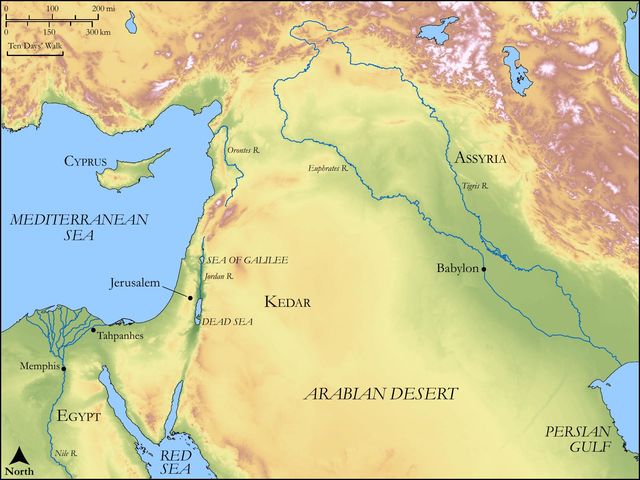
See on the biblical-era map
Study this verse
Public-domain commentary
Matthew Henry
From his Commentary on the Whole Bible. Henry comments on passages, not single verses — this entry covers Jeremiah 2:20–28. His three-level outline is real structure in the source text, so it is rendered as structure.
In these verses the prophet goes on with his charge against this backsliding people. Observe here,
I.The sin itself that he charges them with - idolatry, that great provocation which they were so notoriously guilty of.
1.They frequented the places of idol-worship (Jer 2:20): "Upon every high hill and under every green tree, in the high places and the groves, such as the heathen had a foolish fondness and veneration for, thou wanderest, first to one and then to another, like one unsettled, and still uneasy and unsatisfied; but in all playing the harlot," worshipping false gods, which is spiritual whoredom, and was commonly accompanied with corporal whoredom too. Note, Those that leave God wander endlessly, and a vagrant lust is insatiable.
2.They made images for themselves, and gave divine honour to them (Jer 2:26, Jer 2:27); not only the common people, but even the kings and princes, who should have restrained the people from doing ill, and the priests and prophets, who should have taught them to do well, were themselves so wretchedly sottish and stupid, and under the power of such a strong delusion, as to say to a stock, "Thou art my father (that is, Thou art my god, the author of my being, to whom I owe duty and on whom I have a dependence)," and to a stone, to an idol made of stone, "Thou hast begotten me, or brought me forth; therefore protect me, provide for me, and bring me up." What greater affront could men put upon God, who is our Father that has made us? It was a downright disowning of their obligations to him. What greater affront could men put upon themselves and their own reason than to acknowledge that which is in itself absurd and impossible, and, by making stocks and stones their parents, to make themselves no better than stocks and stones? When these were first made the objects of worship they were supposed to be animated by some celestial power or spirit; but by degrees the thought of this was lost, and so vain did idolaters become in their imagination, even the princes and priests themselves, that the very idol, though made of wood and stone, was supposed to be their father, and adored accordingly.
3.They multiplied these dunghill deities endlessly (Jer 2:28): According to the number of thy cities are thy gods, O Judah! When they had forsaken that God who is one, and all-sufficient for all,
(1.)They were not satisfied with any gods they had, but still desired more, that idolatry being in this respect of the same nature with covetousness, which is spiritual idolatry (for the more men have the more they would have), which is a plain evidence that what men make an idol of they find to be insufficient and unsatisfying, and that it cannot make the comers thereunto perfect.
(2.)They could not agree in the same god. Having left the centre of unity, they fell into endless discord; one city fancied one deity and another another, and each was anxious to have one of its own to be near them and to take special care of them. Thus did they in vain seek that in many gods which is to be found in one God only.
II.The proof of this.
No witnesses need be called; it is proved by the notorious evidence of the facts.
1.They went about to deny it, and were ready to plead, Not guilty. They pretended that they would acquit themselves from this guilt, they washed themselves with nitre, and took much soap, offered many things in excuse and extenuation of it, Jer 2:22. They pretended that they did not worship these as gods, but as demons, and mediators between the immortal God and mortal men, or that it was not divine honour that they gave them, but civil respect; thus they sought to evade the convictions of God's word and to screen themselves from the dread of his wrath. Nay, some of them had the impudence to deny the thing itself; they said, I am not polluted, I have not gone after Baalim, Jer 2:23. Because it was done secretly, and industriously concealed (Eze 8:12), they thought it could never be proved upon them, and they had impudence enough to deny it. In this, as in other things, their way was like that of the adulterous woman, that says, I have done no wickedness, Pro 30:20.
2.Notwithstanding all their evasions, they are convicted of it and found guilty: "How canst thou deny the fact, and say, I have not gone after Baalim? How canst thou deny the fault, and say, I am not polluted?" The prophet speaks with wonder at their impudence: "How canst thou put on a face to say so, when it is certain?" (1.) "God's omniscience is a witness against thee: Thy iniquity is marked before me, saith the Lord God; it is laid up and hidden, to be produced against thee in the day of judgment, sealed up among his treasures," Deu 32:34; Job 21:19; Hos 13:12. "It is imprinted deeply and stained before me;" so some read it. "Though thou endeavour to wash it out, as murderers to get the stain of the blood of the person slain out of their clothes, yet it will never be got out." God's eye is upon it, and we are sure that his judgment is according to truth. (2.) "Thy own conscience is a witness against thee. See thy way in the valley" (they had worshipped idols, not only on the high hills, but in the valleys, Isa 57:5, Isa 57:6), in the valley over-against Beth-peor (so some), where they worshipped Baal-peor (Deu 34:6, Num 25:3), as if the prophet looked as far back as the iniquity of Peor; but, if it mean any particular valley, surely it is the valley of the son of Hinnom, for that was the place where they sacrificed their children to Moloch and which therefore witnessed against them more than any other: "look into that valley, and thou canst not but know what thou hast done."
III.The aggravations of this sin with which they are charged, which made it exceedingly sinful.
1.God had done great things for them, and yet they revolted from him and rebelled against him (Jer 2:20): Of old time I have broken thy yoke and burst thy bonds; this refers to the bringing of them out of the land of Egypt and the house of bondage, which they would not remember (Jer 2:6), but God did; for, when he told them that they should have no other gods before him, he prefixed this as a reason: I am the Lord thy God that brought thee out of the land of Egypt! These bonds of theirs which God had loosed should have bound them for ever to him; but they had ungratefully broken the bonds of duty to that God who had broken the bonds of their slavery.
2.They had promised fair, but had not made good their promise: "Thou saidst, I will not transgress; then, when the mercy of thy deliverance was fresh, thou wast so sensible of it that thou wast willing to lay thyself under the most sacred ties to continue faithful to thy God and never to forsake him." Then they said, Nay, but we will serve the Lord, Jos 24:21. How often have we said that we would not transgress, we would not offend any more, and yet we have started aside, like a deceitful bow, and repeated and multiplied our transgressions!
3.They had wretchedly degenerated from what they were when God first formed them into a people (Jer 2:21). I had planted thee a noble vine. The constitution of their government both in church and state was excellent, their laws were righteous, and all the ordinances instructive and very significant; and a generation of good men there was among them when they first settled in Canaan. Israel served the Lord, and kept close to him all the days of Joshua, and the elders that out-lived Joshua, Jos 24:31. They were then wholly a right seed, likely to replenish the vineyard they were planted in with choice vines. But it proved otherwise; they very next generation knew not the Lord, nor the works which he had done (Jdg 2:10), and so they were worse and worse till they became the degenerate plants of a strange vine. They were now the reverse of what they were at first. Their constitution was quite broken, and there was nothing in them of that good which one might have expected from a people so happily formed, nothing of the purity and piety of their ancestors. Their vine is as the vine of Sodom, Deu 32:32. This may fitly be applied to the nature of man; it was planted by its great author a noble vine, a right seed (God made man upright); but it is so universally corrupt that it has become the degenerate plant of a strange vine, that bears gall and wormwood, and it is so to God, it is highly distasteful and offensive to him.
4.They were violent and eager in the pursuit of their idolatries, doted on their idols, and were fond of new ones, and they would not be restrained form them either by the word of God or by his providence, so strong was the impetus with which they were carried out after this sin. They are here compared to a swift dromedary traversing her ways, a female of that species of creatures hunting about for a male (Jer 2:23), and, to the same purport, a wild ass used to the wilderness (Jer 2:24), not tamed by labour, and therefore very wanton, snuffing up the wind at her pleasure when she comes near the he-ass, and on such an occasion who can turn her away? Who can hinder her from that which she lusts after? Those that seek her then will not weary themselves for her, for they know it is to no purpose; but will have a little patience till she is big with young, till that month comes which is the last of the months that she fulfils (Job 39:2), when she is heavy and unwieldy, and then they shall find her, and she cannot out-run them. Note,
(1.)Eager lust is a brutish thing, and those that will not be turned away from the gratifying and indulging of it by reason, and conscience, and honour, are to be reckoned as brute-beasts and no better, such as were born, and still are, like the wild ass's colt; let them not be looked upon as rational creatures.
(2.)Idolatry is strangely intoxicating, and those that are addicted to it will with great difficulty be cured of it. That lust is as headstrong as any.
(3.)There are some so violently set upon the prosecution of their lusts that it is to no purpose to attempt to give check to them: those that do so weary themselves in vain. Ephraim is joined to idols; let him alone.
(4.)The time will come when the most fierce will be tamed and the most wanton will be manageable; when distress and anguish come upon them, then their ears will be open to discipline, that is the month in which you may find them, Psa 141:5, Psa 141:6.
5.They were obstinate in their sin, and, as they could not be restrained, so they would not be reformed, Jer 2:25. Here is,
(1.)Fair warning given them of the ruin that this wicked course of life would certainly bring them to at last, with a caution therefore not to persist in it, but to break off from it. He would certainly bring them into a miserable captivity, when their feet should be unshod, and they should be forced to travel barefoot, and when they would be denied fair water by their oppressors, so that their throat should be dried with thirst; this will be in the end hereof. Those that affect strange gods, and strange ways of worship, will justly be made prisoners to a strange king in a strange land. "Take up in time therefore; thy running after thy idols will run the shoes off thy feet, and thy panting after them will bring thy throat to thirst; withhold therefore thy foot from these violent pursuits, and thy throat from these violent desires." One would think that it should effectually check us in the career of sin to consider what it will bring us to at last.
(2.)Their rejecting this fair warning. They said to those that would have persuaded them to repent and reform, "There is no hope; no, never expect to work upon us, or prevail with us to cast away our idols, for we have loved strangers, and after them we will go; we are resolved we will, and therefore trouble not yourselves nor us any more with your admonitions; it is to no purpose. There is no hope that we should ever break the corrupt habit and disposition we have got, and therefore we may as well yield to it as go about to get the mastery of it." Note, Their case is very miserable who have brought themselves to such a pass that their corruptions triumph over their convictions; they know they should reform, but own they cannot, and therefore resolve they will not. But, as we must not despair of the mercy of God, but believe that sufficient for the pardon of our sins, though ever so heinous, if we repent and sue for that mercy, so neither must we despair of the grace of God, but believe that able to subdue our corruptions, though ever so strong, if we pray for and improve that grace. A man must never say There is no hope, as long as he is on this side hell.
6.They had shamed themselves by their sin, in putting confidence in that which would certainly deceive them in the day of their distress, and putting him away that would have helped them, Jer 2:26-28. As the thief is ashamed when, notwithstanding all his arts and tricks to conceal his theft, he is found, and brought to punishment, so are the house of Israel ashamed, not with a penitent shame for the sin they had been guilty of, but with a penal shame for the disappointment they met with in that sin. They will be ashamed when they find,
(1.)That they are forced to cry to the God whom they had put contempt upon. In their prosperity they had turned the back to God and not the face; they had slighted him, acted as if they had forgotten him, or did what they could to forget him, would not look towards him, but looked another way; they went from him as fast and as far as they could; but in the time of their trouble they will find no satisfaction but in applying to him; then they will say, Arise, and save us. Their fathers had many a time taken this shame to themselves (Jdg 3:9, Jdg 4:3, Jdg 10:10), yet they would not be persuaded to cleave to God, that they might come to him in their trouble with the more confidence.
(2.)That they have no relief from the gods they have made their court to. They will be ashamed when they perceive that the gods they have made cannot serve them, and that the God who made them will not serve them. To bring them to this shame, if so be they might hereby be brought to repentance, they are here sent to the gods whom they served, Jdg 10:14. They cried to God, Arise, and save us. God says of the idols, "Let them arise, and save thee, for thou hast no reason to expect that I should Let them arise, if they can, from the places where they are fixed; let them try whether they can save thee: but thou wilt be ashamed when thou findest that they can do thee no good, for, though thou hadst a god for every city, yet thy cities are burnt without inhabitant," Jer 2:15. Thus it is the folly of sinners to please themselves with that which will certainly be their grief, and pride themselves in that which will certainly be their shame.
Historical interpretation
Three Centuries of Reception
14 surviving comments on this verse. Each one is dated, so this reads as a timeline rather than a list.
Select a marker to jump to its quote. Markers stagger vertically where authors wrote within a few decades of each other.
Thus does Paul also boast that the observance of the law and the whole glory of the Jewish system was to him like garbage, so that he might be found in Christ, having not his own justification that was of the law, but the justification from God. In this sense, therefore, Paul did not keep his own vineyard—that is to say, he did not keep the Jews’ tradition after he had received the faith of Christ. Perhaps the reason why he did not keep it was that, though it had been planted by God as a true vine, it had turned into the bitterness of a strange vine. “For their vine comes from the vine of Sodom, and from the fields of Gomorrah … their clusters are bitter; their wine is the poison of serpents, and the cruel venom of asps.”
Let us attempt to discuss also a third exposition at the moral level. If there is anyone who, while evils are increasing and vices are overflowing, can turn from the things that are in flux and passing away and fallen and can hear the word of God and the heavenly precepts, this person is building an ark of salvation within his own heart and is dedicating a library, so to speak, of the divine word within himself. He is erecting faith, love and hope as its length, breadth and height. He stretches out faith in the Trinity to the length of life and immortality. He establishes the breadth of love with the compassion of gentleness and kindness. He raises the height of hope to heavenly and exalted places. For while he walks on the earth, he has his “citizenship in heaven.” But he brings the sum of his acts back to one. For he knows that “all indeed run, but one receives the palm of victory,” of course, being that one who was not changeable with a variety of thoughts and instability of mind. But he does not construct this library from planks that are unhewn and rough but from planks that have been squared and arranged in a uniform line, that is, not from the volumes of secular authors but from the prophetic and apostolic volumes. For these authors, who have been hewn by diverse temptations, all vices having been curtailed and excised, contain life that has been squared and set free in every part. For the authors of secular books can indeed be called “lofty trees” and “shady trees”—for Israel is accused of having fornicated “under every lofty and shady tree”—because they speak indeed in a lofty manner and use flowery eloquence; they have not, however, acted as they have spoken. They cannot, therefore, be called “squared planks” because life and speech will by no means be equal in them.
The God who “brings forth the sun on the evil and the good” is a desert to no one. To no one is he who “rains on the just and unjust” ever a land made dry. How is he a desert, when he brings forth the day and causes the night to rest? How is he a desert, when he causes the land to bear fruit? How is he a desert, when he provides for each person in his soul so that it is endowed with reason, so that it can grasp knowledge and exercise its intelligence, and in the body so that it has healthy sense faculties? And so with respect to the way of what is universal, God is not a desert.
God did not make “death, and he does not delight in the destruction of living things; for he created all things that they might exist, and the creatures of the world are wholesome, and there is no destructive poison in them, and the dominion of hades is not on earth.” Passing over, then, a little passage, I will ask, From where, then, did death come? “By the envy of the devil, death came into the world.” If, then, there is something excellent in our regard, God has made it, but we have created evil and sins for ourselves. For the same reason, the beginning of the passage just read from the prophet speaks in a rhetorical sense to those who have bitterness in the soul contrary to the sweetness that God fashioned for it: “How have you turned to bitterness, you strange vine?” as if he was saying, God did not make lameness, but he has made all things swift of foot, yet what cause arose that has made the lame lame? And God has made all limbs absolutely sound, but what cause arose that makes things suffer? In the same way, the soul, not only of the first man but of all people, arose according to the image—for the statement “Let us make man according to our image and according to our likeness,” applies to all people.
So also God is introduced by the prophet as saying to the person who had become evil by his own choice, “Yet I had planted you a fruitful vine. How have you turned back into a wild vine?” Anywhere it is said that evils happen to the wicked from God, it must be understood as an accidental coincidence of name. This name is given to the chastisements that God in his goodness is said to send not for the hurt of those who are chastised but for their benefit and profit, in the same way that a physician might be thought to apply bad things in his painful and bitter remedies to save the sick.
Sin is a terrible thing, and the most grievous disease of the soul is iniquity, which corrupts the fiber of the soul and makes it liable to eternal fire. It is an evil freely chosen, the product of the will. The prophet clearly declares that we sin of our own free will: “I had planted you, a choice vine of fully tested stock; how could you turn into bitterness, a spurious vine?” The planting was good, but the fruit coming from the will is evil. So the planter is blameless, but the vine will burn with fire since it was planted for good and bore evil fruit of its own will.
Learn this also, that before the soul comes into the world, it has committed no sin. But though we came into the world sinless, we now of our own choice commit sin.… Remember also how God again accuses them and says, “I have planted you a choice vine, wholly of pure seed; how then have you turned degenerate and become a wild vine?”
Yet if the husband’s power allures you, pray tell me who it was that spoke in the prophet, saying, “O Lord, make it known to me that I may know. Then I saw their thoughts. I was led as a harmless lamb to the slaughter and knew it not. They took counsel together against me, saying, Come, let us throw wood into his bread.” For if the Son here spoke of the mystery of his coming incarnation—because it was blasphemous to suppose that the words are spoken concerning the Father—then surely it is the Son who speaks in an earlier passage: “I have planted you as a fruitful vine—how did you become bitter, and a wild vine?”
Hence God gave the gift of prayer. But he does this, even though he does not need for us to ask, but that we might not grow indifferent from being saved without effort. For this reason, he said to Jeremiah, “Do not pray for this people, for I will not hear you,” not wishing to stop his praying (for he earnestly longs for our salvation) but to terrify them. Seeing this, the prophet did not stop praying. So that you may see that God did not wish to turn Jeremiah from it, but to shame them that he said this, hear what it says. “Don’t you see what they are doing?” Also when he says to the city, “Although you wash yourself with soda and use an abundance of soap, the stain of your guilt is still before me,” it is not that he may cast them into despair that he so speaks, but that he may rouse them to repentance.
(Verse 21.) But I planted you as a choice vine, all true seed; how have you turned into a corrupt, foreign vine to me? Septuagint: But I planted you as a fruitful vine, all true; how have you turned into a bitter foreign grapevine? For the fruitful vine, or the chosen one, is called Sorec in Hebrew: which is mentioned in the song of Isaiah (Isaiah 5). And it is of the best kind of grapevine: with which branch Israel says that the Lord has planted himself; and he marvels at how the true seed and the chosen vine have turned into bitterness: and therefore has become a foreign vine; and no one is secure, if even the planting of the Lord and the true seed and the vine of Sorec are so changed by their own fault, that they depart from the Lord through bitterness and become a foreign grapevine. And in this we must consider the clemency of the Savior, that he who said in the Gospel, 'I am the true vine' (John 15:1), also gave to his disciples and to the people who believe in him, that they may be chosen or true vine, if they desire to remain in what has been planted.
For it is by similitude, and not by any personal propriety, that he is thus called a vine. For when he says, "I am the true vine," it is to distinguish himself, doubtless, from that vine to which the words are addressed: "How are you turned into sourness, as a strange vine?" For how could that be a true vine that was expected to bring forth grapes and brought forth thorns?
All those who refuse Christ for another become strangers. And how are they made strangers? Because even that vine, though planted by him, when it had become sour, what did it hear? "Wherefore you have been turned into sourness, O alien vine?"
Now, those who were called children and were enrolled in the ranks of children made themselves foreign by proving ungrateful for favors done, limping in respect of the faith and abandoning the path of godliness. Thus God said through the prophet Jeremiah, “How did you turn into bitterness to me, a foreign vine, whereas I planted every vine to be genuine and fruitful?”
God through Jeremiah reproaches the evil of the human will in such a way that he teaches that it is foreign to him. He says, “Yet I planted you as a choice vine.… How then did you turn degenerate and become a wild vine?” He says that the vine is foreign to him not because of some defect in the divine creation but by the avoidance of his own will, which is justly blamed because it brought forth bitterness, something God did not produce in it. It had the bitterness not from God’s predestination or from God’s work but from the evil of its own will. Because of that bitterness, God rebukes it a second time through the prophet mentioned above: “Know and see that it is evil and bitter for you to forsake the Lord your God: the fear of me is not in you.” Since, therefore, it is evil and bitter for a person to have left the Lord and not to have in him a fear of God, who is contrary to the truth in such a way that he thinks it comes from a good and kind God.
Continue studying Jeremiah 2:21 across the web’s major study libraries — every link below opens this exact verse, chapter, or book on the destination site.
Read & Compare
 BibleGatewayThis verse in more than 200 translations and 70 languages.
 Bible.comThe YouVersion reader — hundreds of translations, reading plans, and highlights.
 ESV.orgCrossway's official English Standard Version reader.
 NET BibleThe NET translation with 60,000+ translators' notes on every rendering decision.
 STEP BibleTyndale House's free study tool — original text, vocabulary, and scholarly resources.
 BibliaLogos Bible Software's free web reader.
 USCCBThe New American Bible (Revised Edition) with the U.S. bishops' study notes.
Commentaries
 BibleHub CommentariesDozens of classic commentaries on this verse, gathered on one page.
 StudyLightMore than 100 commentary sets — the largest collection on the web.
 BibleRefPlain-English commentary on what this verse means, verse by verse.
 Enduring WordDavid Guzik's free commentary on this chapter, widely used by Bible teachers.
 Bible Study ToolsVerse commentary alongside Greek and Hebrew study aids.
Original Language & Research
- BibleHub InterlinearThe verse word by word — original language, transliteration, and English.
- BibleHub LexiconEvery word's original-language definition and Strong's entry.
 Blue Letter BibleDeep-study tools — Strong's numbers, concordance, and word studies.
 SefariaThe Hebrew text with Rashi and centuries of Jewish commentary.
Sermons, Hymns & Audio


TrulyRandomVerse is not affiliated with these sites and doesn’t control their content. They’re linked because they’re genuinely useful.
Summary
Jeremiah 2:21 encapsulates God's profound lament over Israel's spiritual apostasy, expressed through the powerful metaphor of a vine. Having meticulously planted them as a "noble vine," a perfectly cultivated and true seed, God expresses His astonishment and sorrow at their inexplicable transformation into a "degenerate plant of a strange vine." This verse highlights the stark contrast between God's gracious, perfect provision and Israel's tragic, self-inflicted corruption, revealing the heartbreak of divine betrayal and the profound grief of a divine planter whose prized vineyard has gone wild.
Context
ShowHideLiterary Context
Jeremiah 2 initiates a powerful series of divine indictments against Judah, establishing the pervasive theme of Israel's covenant unfaithfulness. The preceding verses (Jeremiah 2:1-20) vividly recount God's steadfast love and faithfulness to His people from their youth, likening Israel to a cherished bride. Yet, despite this divine devotion, Israel has inexplicably abandoned Yahweh, exchanging their glorious relationship for worthless idols, a spiritual adultery described in stark terms. Verse 21, with its poignant vine imagery, serves as a climactic expression of this initial lament, intensifying the emotional weight of God's accusation. It powerfully underscores the depth of Israel's spiritual degeneration and sets the stage for the subsequent pronouncements of judgment and calls to repentance that reverberate throughout the entire book of Jeremiah. This verse also anticipates the broader prophetic tradition where Israel's unfaithfulness is often depicted through agricultural metaphors, particularly that of a vineyard.
Historical & Cultural Context
Jeremiah prophesied during a tumultuous period in Judah's history, spanning the late 7th and early 6th centuries BCE. Following the brief but significant religious reforms under King Josiah, Judah rapidly reverted to widespread idolatry and syncretism after his death. The people enthusiastically embraced the worship of Baal and other foreign deities, adopting abhorrent Canaanite religious practices, including child sacrifice and cultic prostitution, directly violating the Mosaic covenant. The imagery of the vine was deeply embedded in the cultural consciousness of ancient Israel, as viticulture was a cornerstone of their agricultural economy. A "noble vine" (Hebrew: sôrêq) referred to a highly prized, superior quality grape variety, known for yielding the finest wine. This term powerfully conveyed the ideal state of Israel as God's specially chosen and cultivated people, set apart for His glory. Conversely, a "strange vine" (Hebrew: gephen nokrîy) would imply a wild, uncultivated, or foreign variety, producing sour, bitter, or even poisonous fruit, directly reflecting Israel's spiritual corruption and their adoption of foreign, pagan religious practices that yielded the bitter fruit of sin and judgment.
Key Themes
ShowHideThis verse profoundly contributes to several foundational themes within Jeremiah and the broader prophetic corpus. Firstly, it highlights the theme of Divine Election and Investment, portraying God as the meticulous and loving planter who chose Israel, brought them out of Egypt, and cultivated them with the utmost care, expecting spiritual fruitfulness and righteousness. This divine act of planting is echoed in Psalm 80:8 and Isaiah 5:1-7. Secondly, the verse powerfully illustrates the theme of Profound Spiritual Degeneration and Apostasy, depicting Israel's inexplicable rebellion and their tragic abandonment of their covenant relationship with Yahweh. Their turning to worthless idols, as lamented in Jeremiah 2:5, is here visualized as a complete perversion of their original nature. Finally, the rhetorical question, "how then art thou turned?", underscores God's Heartbroken Lament and Perplexity. It reveals a God who is not distant or indifferent, but one deeply grieved and bewildered by His people's betrayal, a divine sorrow that permeates Jeremiah's prophecies.
Exposition and Analysis
ShowHideKey Word Analysis
ShowHideThis primitive root means "to strike in, i.e. fix; specifically, to plant (literally or figuratively); fastened, plant(-er)." In Jeremiah 2:21, it emphasizes God's deliberate, sovereign, and foundational act of establishing Israel. It speaks to the intentionality and precision with which God brought Israel out of bondage in Egypt and settled them in the promised land, providing everything necessary for their flourishing as His chosen people, a testament to His meticulous care and divine purpose.
This term refers to a "vine stock (properly, one yielding purple grapes, the richest variety); choice(-st, noble) wine." The sôrêq was a highly prized, superior quality vine known for producing the finest, dark-red grapes, indicative of excellence and purity. Its use here underscores the perfection, purity, and high potential of God's original planting of Israel, highlighting the ideal state in which they were established—a people set apart for God's glory, capable of bearing abundant good fruit and reflecting His righteousness.
This primitive root means "to turn about or over; by implication, to change, overturn, return, pervert." This powerful verb captures the drastic, unexpected, and utterly perverse transformation of Israel. It implies a complete reversal from their original, noble state and divine purpose. The shift from a "noble vine" to a "degenerate plant of a strange vine" is not a gradual decline but a radical, willful perversion, indicating a conscious and egregious deviation from their divine identity and covenant obligations.
Verse Breakdown
ShowHide"Yet I had planted thee a noble vine, wholly a right seed:"
This opening clause emphatically establishes God's perfect and intentional foundation for Israel. The pronoun "I" is stressed in the Hebrew, highlighting God's personal, sovereign involvement and unwavering commitment to His people. "Planted" (nâṭaʻ) signifies His divine act of choosing, establishing, and nurturing them. The phrase "noble vine" (sôrêq) emphasizes their inherent excellence and high potential, while "wholly a right seed" (Hebrew: zera' 'emeth, from H2233 and H571) reinforces their pure, true, and authentic origin, signifying that God provided them with every spiritual advantage and a flawless beginning, setting them apart as a covenant people destined for fruitfulness, righteousness, and faithfulness.
"how then art thou turned into the degenerate plant of a strange vine unto me?"
This is God's heartbroken rhetorical question, expressing profound astonishment, bewilderment, and deep sorrow. The interrogative "how then" conveys utter perplexity at such a radical and inexplicable transformation from purity to corruption. "Turned" (hâphak) signifies a complete perversion or reversal of their original nature and purpose. "Degenerate plant" (Hebrew: çûwr, from H5494) denotes something corrupted, turned aside from its true nature, or gone bad, producing sour or worthless fruit. "Strange vine" (Hebrew: gephen nokrîy, from H1612 and H5237) refers to a foreign, wild, or inferior vine, producing bad fruit. The concluding phrase "unto me" underscores the personal offense and profound betrayal against God Himself, who had invested so much in them. It highlights their spiritual adultery and adoption of foreign idolatry, which produced bitter fruit instead of righteousness and covenant obedience.
Literary Devices
ShowHideJeremiah 2:21 is rich in literary artistry, primarily employing Metaphor and Rhetorical Question to convey its powerful message. The central Metaphor is that of Israel as a vine, an image deeply rooted in Old Testament prophetic tradition, which illustrates God's careful cultivation and His expectation of spiritual fruitfulness from His people. The stark contrast between the "noble vine" and the "degenerate plant of a strange vine" is a powerful Juxtaposition that vividly highlights Israel's radical spiritual decline and apostasy. This contrast creates a dramatic tension, emphasizing the profound chasm between God's perfect provision and Israel's corrupt reality. The Rhetorical Question, "how then art thou turned into the degenerate plant of a strange vine unto me?", serves not to elicit an answer but to convey God's deep sorrow, bewilderment, and sense of betrayal. This question effectively Personifies God's grief, portraying Him as a heartbroken gardener lamenting the inexplicable ruin of His prized vineyard. The use of such devices amplifies the emotional impact of the divine lament, underscoring the inexplicable nature of Israel's unfaithfulness despite God's perfect and gracious provision.
Theological and Thematic Connections
ShowHideJeremiah 2:21 profoundly illustrates the covenant relationship between God and Israel, emphasizing both divine grace and human responsibility. God's initial act of planting Israel as a "noble vine" speaks to His sovereign election, meticulous care, and generous provision, bestowing upon them every spiritual blessing necessary for flourishing. However, Israel's subsequent transformation into a "degenerate plant of a strange vine" underscores the tragic reality of human rebellion and the devastating consequences of spiritual apostasy. This verse serves as a powerful theological statement on the nature of faithfulness and betrayal, revealing God's deep emotional investment in His people and His heartbroken response to their unfaithfulness. It resonates with other prophetic passages that use similar vine imagery to depict Israel's relationship with God, consistently highlighting their failure to produce righteous fruit and their propensity to turn away from the true source of life.
Reflection and Application
ShowHideJeremiah 2:21 serves as a timeless mirror for individual believers and the church today, inviting profound introspection. Just as God meticulously cultivated Israel, He also invests profoundly in each of us, planting us in His kingdom, granting us every spiritual blessing in Christ, and endowing us with the potential to bear abundant good fruit for His glory. The piercing question for us, then, is whether we are diligently maintaining our identity as a "noble vine," deeply rooted in Christ and His unchanging truth, or if we are allowing the pervasive influences of the world, subtle false teachings, or personal compromises to subtly transform us into a "degenerate plant of a strange vine." This verse calls us to vigilant self-examination, urging us to guard our hearts and minds against anything that would corrupt our spiritual purity, diminish our fruitfulness, or turn us away from our first love. It powerfully reminds us that true spiritual vitality and lasting fruitfulness come solely from abiding in the True Vine, Jesus Christ, and faithfully reflecting His character in a world that desperately needs to see His light and experience His transforming power.
Questions for Reflection
ShowHideFAQ
ShowHideWhy does God use the vine imagery so often for Israel?
ShowHideThe vine imagery is a rich and recurring metaphor throughout the Old Testament because it was deeply familiar and culturally significant to an agrarian society like ancient Israel. It effectively conveys several profound theological truths: God's role as the careful, meticulous cultivator and provider for His people; Israel's potential for abundant fruitfulness, representing righteousness, obedience, and spiritual vitality; and their inherent responsibility to bear good fruit in response to His covenant. It also highlights the intimate, dependent relationship between God and His people, as a vine is utterly reliant on its planter for life, sustenance, and fruitfulness. Passages like Psalm 80:8-16 and Isaiah 5:1-7 vividly portray this relationship, often lamenting Israel's tragic failure to live up to its divine calling.
What does "degenerate plant of a strange vine" specifically mean?
ShowHideThis phrase powerfully describes Israel's profound spiritual decline and apostasy. A "degenerate plant" (Hebrew: çûwr) implies a corruption or turning away from its original, pure nature; it's a plant that has gone bad, producing sour, bitter, or worthless fruit instead of good, desired fruit. A "strange vine" (Hebrew: gephen nokrîy) refers to a foreign, wild, or alien vine, one that is not native or cultivated by the owner. Together, these terms signify that Israel, once pure, divinely chosen, and meticulously cultivated, had become utterly corrupted by adopting foreign gods and pagan practices. They were no longer producing the fruit of righteousness and obedience to Yahweh but the bitter fruit of idolatry, unfaithfulness, and oppression, completely alien to their true identity as God's chosen people and a profound betrayal of their covenant relationship.
Does God give up on His people when they turn away?
ShowHideWhile Jeremiah 2:21 expresses God's profound grief, disappointment, and even bewilderment over Israel's turning away, it does not imply that God gives up on His people entirely or permanently. The very act of lamenting suggests a deep love and a desire for reconciliation and restoration, even in the midst of judgment. Throughout the book of Jeremiah, despite severe pronouncements of judgment and exile, there are also unwavering promises of future restoration, a new covenant, and a renewed relationship with a faithful remnant (e.g., Jeremiah 31:31-34). God's faithfulness and covenant promises are ultimately greater than human unfaithfulness. While He holds His people accountable for their sin and allows consequences, His ultimate plan for redemption and the establishment of His kingdom prevails, demonstrating His enduring love, steadfast commitment, and sovereign grace even in the face of profound rebellion.
Christ-Centered Fulfillment
ShowHideJeremiah 2:21, with its poignant lament over Israel as a degenerate vine, finds its ultimate Christ-centered fulfillment in Jesus, who triumphantly declares Himself to be the "true vine" in John 15:1. Israel, the Old Testament vine, tragically failed to bear the fruit of righteousness and instead became corrupt, producing bitter fruit of idolatry and unfaithfulness. Jesus, however, embodies the perfect, "noble vine" that Israel was always meant to be. He is the perfectly obedient Son who fulfills all of God's expectations and perfectly reflects the Father's character. Believers, through saving faith, are spiritually grafted into Him, becoming living branches on this true vine (as powerfully illustrated in John 15:5). This spiritual grafting, foreshadowed in passages like Romans 11:17-24, means that our spiritual vitality, purity, and ability to bear fruit (specifically, the fruit of the Spirit, as beautifully described in Galatians 5:22-23) come not from our own inherent goodness, lineage, or efforts, but solely from our intimate, abiding union with Christ. He is the inexhaustible source of life, purity, and fruitfulness, offering redemption from the degenerate nature of humanity and transforming us into branches that bear abundant fruit for God's glory.