


Jeremiah 2:5
- כֹּהkohthusH3541AdvAdverb
- אָמַר'a·Marhe saysH559V-Qal-Perf-3msVerb Qal Perfect 3rd Singular Masculine
- יְהוָהYah·wehYahwehH3068N-properNoun Proper Title
- מַהmahwhat?H4100InterrogPronoun Interrogative
- מָּצְאוּma·tze·'Udid they findH4672V-Qal-Perf-3cpVerb Qal Perfect 3rd Plural common gender
- אֲבוֹתֵיכֶם'a·vo·tei·Khemyour ancestorsH1N-fpc ¦ 2mpNoun Plural Feminine Constructאֲבוֹתֵיancestorsכֶםyour
- בִּיbiin <the> mePrep-b ¦ 1csSuffix Personal 1st Singular common genderבִּin <the>יme
- עָוֶל'A·velinjusticeH5766N-msNoun Singular Masculine Absolute
- כִּיkithatH3588PrtParticle Conditional
- רָחֲקוּra·cha·Kuthey became distantH7368V-Qal-Perf-3cpVerb Qal Perfect 3rd Plural common gender
- מֵעָלָיme·'a·Laifrom with <the> meH5921Prep-m ¦ Prep ¦ 1csPreposition Definiteמֵfromעָלָwith <the>יme
- וַיֵּלְכוּvai·ye·le·Khuand they walkedH1980Conj-w ¦ V-Qal-ConsecImperf-3mpVerb Qal Consecutive Imperfect 3rd Plural Masculineוַandיֵּלְכוּthey walked
- אַחֲרֵי'a·cha·ReiafterH310Adj-mpcAdjective Numerical Plural Masculine Construct
- הַהֶבֶלha·He·vel<the> vanityH1892Art ¦ N-msNoun Singular Masculine Absoluteהַ<the>הֶבֶלvanity
- וַיֶּהְבָּלוּvai·yeh·Ba·luand they became vainH1891Conj-w ¦ V-Qal-ConsecImperf-3mpVerb Qal Consecutive Imperfect 3rd Plural Masculineוַandיֶּהְבָּלוּthey became vain
English is a literal word-by-word gloss of the Hebrew, not the KJV's wording. Why?
This is the original text the KJV's translators worked from — each Hebrew word with its own literal English meaning in this verse, prepared by scholars at Tyndale House, Cambridge. The KJV translates whole sentences, not word by word, so its wording differs: one Hebrew word can become several English words, and the KJV may choose “the LORD” where the gloss reads “Yahweh”. Both are faithful — they answer different questions. For the KJV's own rendering, switch to the KJV text.
Details
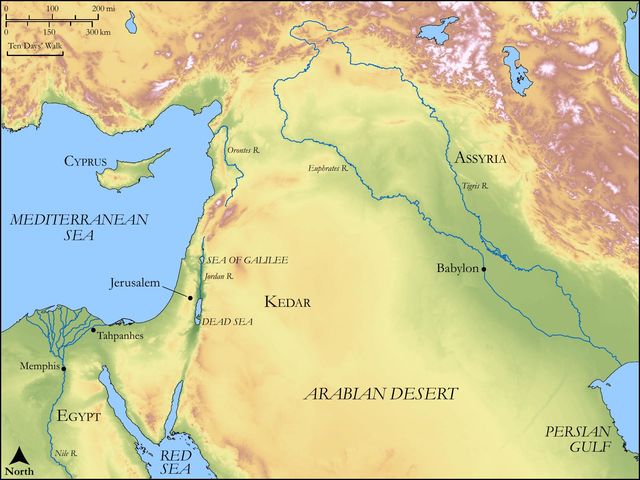
See on the biblical-era map
Study this verse
Public-domain commentary
Matthew Henry
From his Commentary on the Whole Bible. Henry comments on passages, not single verses — this entry covers Jeremiah 2:1–8. His four-level outline is real structure in the source text, so it is rendered as structure.
Here is, I. A command given to Jeremiah to go and carry a message from God to the inhabitants of Jerusalem. He was charged in general (Jer 1:17) to go and speak to them; here he is particularly charged to go and speak this to them. Note, It is good for ministers by faith and prayer to take out a fresh commission when they address themselves solemnly to any part of their work. Let a minister carefully compare what he has to deliver with the word of God, and see that it agrees with it, that he may be able to say, not only, The Lord sent me, but, He sent me to speak this. He must go from Anathoth, where he lived in a pleasant retirement, spending his time (it is likely) among a few friends and in the study of the law, and must make his appearance at Jerusalem, that noisy tumultuous city, and cry in their ears, as a man in earnest and that would be heard: "Cry aloud, that all may hear, and none may plead ignorance. Go close to them, and cry in the ears of those that have stopped their ears."
II.The message he was commanded to deliver.
He must upbraid them with their horrid ingratitude in forsaking a God who had been of old so kind to them, that this might either make them ashamed and bring them to repentance, or might justify God in turning his hand against them.
1.God here puts them in mind of the favours he had of old bestowed upon them, when they were first formed into a people (Jer 2:2): "I remember for thy sake, and I would have thee to remember it, and improve the remembrance of it for thy good; I cannot forget the kindness of thy youth and the love of thy espousals."
(1.)This may be understood of the kindness they had for God; it was not such indeed as they had any reason to boast of, or to plead with God for favour to be shown them (for many of them were very unkind and provoking, and, when they did return and enquire early after God, they did but flatter him), yet God is pleased to mention it, and plead it with them; for, though it was but little love that they showed him, he took it kindly. When they believed the Lord and his servant Moses, when they sang God's praise at the Red Sea, when at the foot of Mount Sinai they promised, All that the Lord shall say unto us we will do and will be obedient, then was the kindness of their youth and the love of their espousals. When they seemed so forward for God he said, Surely they are my people, and will be faithful to me, children that will not lie. Note, Those that begin well and promise fair, but do not perform and persevere, will justly be upbraided with their hopeful and promising beginnings. God remembers the kindness of our youth and the love of our espousals, the zeal we then seemed to have for him and the affection wherewith we made our covenants with him, the buds and blossoms that never came to perfection; and it is good for us to remember them, that we may remember whence we have fallen, and return to our first love, Rev 2:4, Rev 2:5; Gal 4:15. In two things appeared the kindness of their youth: - [1.] That they followed the direction of the pillar of cloud and fire in the wilderness; and though sometimes they spoke of returning into Egypt, or pushing forward into Canaan, yet they did neither, but for forty years together went after God in the wilderness, and trusted him to provide for them, though it was a land that was not sown. This God took kindly, and took notice of it to their praise long after, that, though much was amiss among them, yet they never forsook the guidance they were under. Thus, though Christ often chid his disciples, yet he commended them, at parting, for continuing with him, Luk 22:28. It must be the strong affection of the youth, and the espousals, that will carry us on to follow God in a wilderness, with an implicit faith and an entire resignation; and it is a pity that those who have so followed him should ever leave him. [2.] That they entertained divine institutions, set up the tabernacle among them, and attended the service of it. Israel was then holiness to the Lord; they joined themselves to him in covenant as a peculiar people. Thus they began in the spirit, and God puts them in mind of it, that they might be ashamed of ending in the flesh.
(2.)Or it may be understood of God's kindness to them; of that he afterwards speaks largely. When Israel was a child, then I loved him, Hos 11:1. He then espoused that people to himself with all the affection with which a young man marries a virgin (Isa 62:5), for the time was a time of love, Eze 16:8.
[1.]God appropriated them to himself. Though they were a sinful people, yet, by virtue of the covenant made with them and the church set up among them, they were holiness to the Lord, dedicated to his honour and taken under his special tuition; they were the first fruits of his increase, the first constituted church he had in the world; they were the first-fruits, but the full harvest was to be gathered from among the Gentiles. The first-fruits of the increase were God's part of it, were offered to him, and he was honoured with them; so were the people of the Jews; what little tribute, rent, and homage, God had from the world, he had it chiefly from them; and it was their honour to be thus set apart for God. This honour have all the saints; they are the first-fruits of his creatures, Jam 1:18.
[2.]Having espoused them, he espoused their cause, and became an enemy to their enemies, Exo 23:22. Being the first-fruits of his increase, all that devoured him (so it should be read) did offend; they trespassed, they contracted guilt, and evil befel them, as those were reckoned offenders that devoured the first-fruits, or any thing else that was holy to the Lord, that embezzled them, or converted them to their own use, Lev 5:15. Whoever offered any injury to the people of God did so at their peril; their God was ready to avenge their quarrel, and said to the proudest of kings, Touch not my anointed, Psa 105:14, Psa 105:15; Exo 17:14. He had in a special manner a controversy with those that attempted to debauch them and draw them off from being holiness to the Lord; witness his quarrel with the Midianites about the matter of Peor, Num 25:17, Num 25:18.
[3.]He brought them out of Egypt with a high hand and great terror (Deu 4:34), and yet with a kind hand and great tenderness led them through a vast howling wilderness (Jer 2:6), a land of deserts and pits, or of graves, terram sepulchralem - a sepulchral land, where there was ground, not to feed them, but to bury them, where there was no good to be expected, for it was a land of drought, but all manner of evil to be feared, for it was the shadow of death. In that darksome valley they walked forty years; but God was with them; his rod, in Moses's hand, and his staff, comforted them, and even there God prepared a table for them (Psa 23:4, Psa 23:5), gave them bread out of the clouds and drink out of the rocks. It was a land abandoned by all mankind, as yielding neither road nor rest. It was no thoroughfare, for no man passed through it - no settlement, for no man dwelt there. For God will teach his people to tread untrodden paths, to dwell alone, and to be singular. The difficulties of the journey are thus insisted on, to magnify the power and goodness of God in bringing them, through all, safely to their journey's end at last. All God's spiritual Israel must own their obligations to him for a safe conduct through the wilderness of this world, no less dangerous to the soul than that was to the body.
[4.]At length he settled them in Canaan (Jer 2:7): I brought you into a plentiful country, which would be the more acceptable after they had been for so many years in a land of drought. They did eat the fruit thereof and the goodness thereof, and were allowed so to do. I brought you into a land of Carmel (so the word is); Carmel was a place of extraordinary fruitfulness, and Canaan was as one great fruitful field, Deu 8:7.
[5.]God gave them the means of knowledge and grace, and communion with him; this is implied, Jer 2:8. They had priests that handled the law, read it, and expounded it to them; that was part of their business, Deu 33:8. They had pastors, to guide them and take care of their affairs, magistrates and judges; they had prophets to consult God for them and to make known his mind to them.
2.He upbraids them with their horrid ingratitude, and the ill returns they had made him for these favours; let them all come and answer to this charge (Jer 2:4); it is exhibited in the name of God against all the families of the house of Israel, for they can none of them plead, Not guilty.
(1.)He challenges them to produce any instance of his being unjust and unkind to them. Though he had conferred favours upon them in some things, yet, if in other things he had dealt hardly with them, they would not have been altogether without excuse. He therefore puts it fairly to them to show cause for their deserting him (Jer 2:5): "What iniquity have your fathers found in me, or you either? Have you, upon trial, found God a hard master? Have his commands put any hardship upon you or obliged you to any thing unfit, unfair, or unbecoming you? Have his promises put any cheats upon you, or raised your expectations of things which you were afterwards disappointed of? You that have renounced your covenant with God, can you say that it was a hard bargain and that which you could not live upon? You that have forsaken the ordinances of God, can you say that it was because they were a wearisome service, or work that there was nothing to be got by? No; the disappointments you have met with were owing to yourselves, not to God. The yoke of his commandments if easy, and in the keeping of them there is great reward." Note, Those that forsake God cannot say that he has ever given them any provocation to do so: for this we may safely appeal to the consciences of sinners; the slothful servant that offered such a plea as this had it overruled out of his own mouth, Luk 19:22. Though he afflicts us, we cannot say that there is iniquity in him; he does us no wrong. The ways of the Lord are undoubtedly equal; all the iniquity is in our ways.
(2.)He charges them with being very unjust and unkind to him notwithstanding.
[1.]They had quitted his service: "They have gone from me, nay, they have gone far from me." They studied how to estrange themselves from God and their duty, and got as far as they could out of the reach of his commandments and their own convictions. Those that have deserted religion commonly set themselves at a greater distance from it, and in a greater opposition to it, than those that never knew it.
[2.]They had quitted it for the service of idols, which was so much the greater reproach to God and his service; they went from him, not to better themselves, but to cheat themselves: They have walked after vanity, that is, idolatry; for an idol is a vain thing; it is nothing in the world, Co1 8:4; Deu 32:21; Jer 14:22. Idolatrous worships are vanities, Act 14:15. Idolaters are vain, for those that make idols are like unto them (Psa 115:8), as much stocks and stones as the images they worship, and good for as little.
[3.]They had with idolatry introduced all manner of wickedness. When they entered into the good land which God gave them they defiled it (Jer 2:7), by defiling themselves and disfitting themselves for the service of God. It was God's land; they were but tenants to him, sojourners in it, Lev 25:23. It was his heritage, for it was a holy land, Immanuel's land; but they made it an abomination, even to God himself, who was wroth, and greatly abhorred Israel.
[4.]Having forsaken God, though they soon found that they had changed for the worse, yet they had no thoughts of returning to him again, nor took any steps towards it. Neither the people nor the priests made any enquiry after him, took any thought about their duty to him, nor expressed any desire to recover his favour. First, The people said not, Where is the Lord? Jer 2:6. Though they were trained up in an observance of him as their God, and had been often told that he brought them out of the land of Egypt, to be a people peculiar to himself, yet they never asked after him nor desired the knowledge of his ways. Secondly, The priests said not, Where is the Lord? Jer 2:8. Those whose office it was to attend immediately upon him were in no concern to acquaint themselves with him, or approve themselves to him. Those who should have instructed the people in the knowledge of God took no care to get the knowledge of him themselves. The scribes, who handled the law, did not know God nor his will, could not expound the scriptures at all, or not aright. The pastors, who should have kept the flock from transgressing, were themselves ringleaders in transgression: They have transgressed against me. The pretenders to prophecy prophesied by Baal, in his name, to his honour, being backed and supported by the wicked kings to confront the Lord's prophets. Baal's prophets joined with Baal's priests, and walked after the things which do not profit, that is, after the idols which can be no way helpful to their worshippers. See how the best characters are usurped, and the best offices liable to corruption; and wonder not at the sin and ruin of a people when the blind are leaders of the blind.
Historical interpretation
Historical reception
3 surviving comments on this verse. Each one is dated, so this reads as a timeline rather than a list.
Select a marker to jump to its quote. Markers stagger vertically where authors wrote within a few decades of each other.
“What transgression have your fathers found in me?” … showing their thankless disposition, and that when in the enjoyment of all things, they requited it by the contraries; but here God expresses it with yet greater force.
Again, elsewhere he says, “What fault have your fathers found in me?” That which is said is great and marvelous, because what he says means, “What wrong have I done?” God tells human beings, “What sin have I committed?”—something that not even slaves tolerate that their master utter.
(Verses 4, 5.) Hear the word of the Lord, house of Jacob, and all the families of the house of Israel. Thus says the Lord: What did your fathers find in me of iniquity, that they went far from me, and went after vanity, and became vain? This meaning is also testified by another prophet: O my people, what have I done to you, and how have I been a burden to you? Answer me: for I brought you out of the land of Egypt, and delivered you from the house of slaves (Micah 6:3-4). However, both names, Jacob and Israel, are used: not according to the twelve tribes, but according to the entire people. For Jacob himself was later called Israel. But the sins of the fathers do not have an effect on their children, although the children, having the likeness of the fathers, may be punished for their own sins and the sins of their parents. We often read that God has mercy on the children because of the holy fathers. However, the fathers of the sinful people have forsaken God, and not for a short time, but for a long time. And they have followed vanity, that is, idols, which are of no benefit to their worshippers. And they have become like them, as it is written: Let them become like those who make and trust in them, and all who trust in them.
Continue studying Jeremiah 2:5 across the web’s major study libraries — every link below opens this exact verse, chapter, or book on the destination site.
Read & Compare
 BibleGatewayThis verse in more than 200 translations and 70 languages.
 Bible.comThe YouVersion reader — hundreds of translations, reading plans, and highlights.
 ESV.orgCrossway's official English Standard Version reader.
 NET BibleThe NET translation with 60,000+ translators' notes on every rendering decision.
 STEP BibleTyndale House's free study tool — original text, vocabulary, and scholarly resources.
 BibliaLogos Bible Software's free web reader.
 USCCBThe New American Bible (Revised Edition) with the U.S. bishops' study notes.
Commentaries
 BibleHub CommentariesDozens of classic commentaries on this verse, gathered on one page.
 StudyLightMore than 100 commentary sets — the largest collection on the web.
 BibleRefPlain-English commentary on what this verse means, verse by verse.
 Enduring WordDavid Guzik's free commentary on this chapter, widely used by Bible teachers.
 Bible Study ToolsVerse commentary alongside Greek and Hebrew study aids.
Original Language & Research
- BibleHub InterlinearThe verse word by word — original language, transliteration, and English.
- BibleHub LexiconEvery word's original-language definition and Strong's entry.
 Blue Letter BibleDeep-study tools — Strong's numbers, concordance, and word studies.
 SefariaThe Hebrew text with Rashi and centuries of Jewish commentary.
Sermons, Hymns & Audio


TrulyRandomVerse is not affiliated with these sites and doesn’t control their content. They’re linked because they’re genuinely useful.
Summary
Jeremiah 2:5 introduces a profound divine indictment against Israel, presented as a rhetorical question from the LORD. He challenges His people to identify any fault or injustice on His part that could possibly justify their inexplicable departure from Him. This verse serves as the opening charge in God's "covenant lawsuit" against Judah, highlighting their unprovoked spiritual infidelity and their foolish pursuit of worthless idols, which ultimately led to their own spiritual emptiness and futility.
Context
ShowHideLiterary Context
Jeremiah 2:5 stands as the opening salvo in a powerful divine lament and accusation against Judah, often characterized as a "rib" or covenant lawsuit. Through His prophet Jeremiah, the LORD directly confronts the nation, contrasting His unwavering faithfulness and benevolent care with their unprovoked and irrational rebellion. This verse sets the stage for the detailed charges that follow throughout the chapter, where God recounts His historical goodness, such as leading them through the wilderness in Jeremiah 2:6-8, and exposes the absurdity of their idolatry, exemplified by their forsaking the "fountain of living waters" for broken cisterns in Jeremiah 2:13. The entire chapter emphasizes the broken covenant relationship and God's righteous indignation over their spiritual adultery.
Historical & Cultural Context
Jeremiah's prophetic ministry commenced in the 13th year of King Josiah's reign (c. 627/626 BC). This era was marked by Josiah's significant religious reforms, which aimed to eradicate idolatry and restore exclusive Yahwistic worship. However, despite these outward reforms, the hearts of the people often remained uncommitted, and idolatry was deeply entrenched from the prolonged reigns of previous kings like Manasseh and Amon. Judah existed within a volatile geopolitical landscape, witnessing the decline of the mighty Assyrian Empire and the ascendance of the Babylonian Empire, while Egypt continued to exert influence. The covenant relationship, established at Mount Sinai, was central to Israel's national identity, defining their unique status as Yahweh's chosen people. Their "walking after vanity" refers to the pervasive adoption of Canaanite fertility cults (such as Baal and Asherah worship) and astral worship, practices explicitly forbidden by the Mosaic Law and considered an abomination.
Key Themes
ShowHideThis verse powerfully contributes to several overarching themes found in Jeremiah and the broader Old Testament. Firstly, it underscores God's Blamelessness and Unwavering Faithfulness. The rhetorical question, "What iniquity have your fathers found in me?", serves as a profound declaration of God's perfect character and His consistent goodness towards Israel throughout their history. He challenges them to identify any flaw in His dealings that could possibly justify their defection, thereby highlighting His justice and righteous nature, a truth echoed in Deuteronomy 32:4. Secondly, it emphasizes Israel's Unprovoked Apostasy. Their turning away was not a reaction to divine injustice or failure, but a deliberate, irrational choice to abandon the very source of life and truth. This highlights the profound spiritual ingratitude and rebellion inherent in their actions, a theme powerfully articulated in other prophetic books, such as Isaiah 1:2-3. Lastly, the verse vividly portrays The Futility and Transformative Power of Idolatry. To "walk after vanity" means to pursue worthless things, specifically idols and false gods. The devastating consequence is that those who pursue emptiness themselves "become vain," reflecting the spiritual barrenness and futility that results from worshipping non-entities. This concept is foundational to understanding the warnings against idolatry throughout the Old Testament.
Exposition and Analysis
ShowHideKey Word Analysis
ShowHideThis word denotes moral evil, perverseness, or unrighteousness. In Jeremiah 2:5, God's rhetorical question, "What iniquity have your fathers found in me?", directly challenges Israel to produce any evidence of moral wrong, injustice, or failure on His part. It emphatically asserts God's absolute righteousness and blamelessness in His dealings with His covenant people, rendering their defection utterly inexcusable and without any legitimate basis.
This term signifies emptiness, breath, vapor, or futility. It describes something transitory, insubstantial, and ultimately unsatisfactory. In this context, "vanity" refers specifically to the idols and false gods that Israel pursued. These were not merely alternative deities but non-existent entities, unable to provide life, sustenance, or salvation. The pursuit of such emptiness is portrayed as the ultimate spiritual folly, a stark contrast to the living God.
This is the verbal form of hebel, meaning "to be vain in act, word, or expectation," or specifically "to lead astray" or "to become vain." The phrase "and are become vain" highlights the devastating consequence of Israel's idolatry: by pursuing emptiness, they themselves were transformed into something empty, spiritually barren, and devoid of true purpose or life. This underscores the profound truth that what one worships ultimately shapes one's character, destiny, and spiritual state.
Verse Breakdown
ShowHide"Thus saith the LORD"
This opening declaration serves as a divine imprimatur, establishing the absolute authority and divine origin of the message. It signifies that the subsequent words are not merely Jeremiah's human observations but a direct, authoritative pronouncement from Yahweh, the covenant God of Israel, imbuing the challenge with ultimate weight and truth.
"What iniquity have your fathers found in me"
This is the pivotal rhetorical question, forming the core of God's indictment. God challenges Israel to present any evidence of wrongdoing, injustice, or failure on His part that could possibly justify their turning away. The implied and undeniable answer is "none," thereby highlighting God's perfect faithfulness, blameless character, and unwavering benevolence throughout their entire history.
"that they are gone far from me"
This clause describes the act of spiritual departure and abandonment. It signifies a deliberate and profound breach of the covenant relationship, a willful alienation from the God who had chosen, delivered, and sustained them. It implies a conscious, active decision to sever ties with their divine benefactor, moving away from His presence and precepts.
"and have walked after vanity"
This specifies the direction and object of their departure. Instead of remaining in faithful fellowship with the living God, they chose to pursue "vanity"—a term referring to worthless idols, false gods, and the empty, often immoral, practices associated with their worship. This highlights the profound irrationality and spiritual folly of their choice, exchanging the source of life for non-entities.
"and are become vain?"
This final clause reveals the tragic, self-inflicted consequence of their actions. By pursuing emptiness (idols), Israel themselves became empty, spiritually barren, and devoid of true meaning or purpose. It illustrates the profound spiritual principle that one ultimately becomes like what one worships, emphasizing the futility and self-destructive nature of idolatry.
Literary Devices
ShowHideJeremiah 2:5 employs several potent literary devices to convey its message with striking impact. The most prominent is the Rhetorical Question, "What iniquity have your fathers found in me?" This question is not posed to elicit an answer, but to underscore the undeniable truth of God's blamelessness and Israel's utterly inexcusable apostasy. It forces the audience to confront the irrationality and profound ingratitude of their actions. There is also a powerful use of Wordplay or Pun between the Hebrew words hebel (vanity, emptiness) and hâbal (to become vain, empty). This linguistic connection profoundly emphasizes the direct, transformative consequence of idolatry: those who pursue emptiness ultimately become empty themselves. Furthermore, the phrase "walked after vanity" employs Metaphor, depicting their spiritual deviation as a physical journey away from God towards worthless pursuits. The concept of "vanity" itself functions as Symbolism, representing the insubstantial, powerless, and ultimately destructive nature of idols and false worship.
Theological and Thematic Connections
ShowHideJeremiah 2:5 lays bare the fundamental nature of sin as an unprovoked rebellion against a perfectly righteous and benevolent God. It highlights the profound theological truth that humanity's turning away from God is never justified by any fault in Him, but always stems from a willful choice to pursue what is ultimately worthless. This verse underscores the sacredness of the covenant relationship, portraying God as a wronged party who, despite His unwavering faithfulness, is abandoned for empty substitutes. The consequence of this spiritual infidelity is not merely punishment, but a transformative emptiness that reflects the nature of the "vanities" pursued. This serves as a timeless warning against idolatry in all its forms, reminding us that true life, enduring purpose, and ultimate fulfillment are found exclusively in the living God.
Reflection and Application
ShowHideJeremiah 2:5 serves as a powerful mirror for contemporary believers, prompting us to deeply examine our own loyalties and pursuits. Just as ancient Israel was drawn away by the "vanities" of their age—idols and false gods—we too can be subtly lured by modern "vanities": materialism, self-reliance, fleeting pleasures, social approval, or even intellectual pride. The Lord's rhetorical question, "What iniquity have your fathers found in me?", challenges us to consider if we have allowed anything to distance us from Him, not because of His failing, but because of our own misplaced affections. This verse reminds us that God remains perfectly faithful and just; any perceived distance or lack in our spiritual lives is a result of our own turning away, not His. It compels us to reflect on the transformative power of what we worship and pursue. If we chase after empty things, we risk becoming spiritually empty and unfulfilled ourselves. True satisfaction, enduring purpose, and abundant life are found only in an unwavering relationship with the living God, the true "fountain of living waters" as depicted in Jeremiah 17:13. This calls us to actively and intentionally set our hearts and minds on Him and His eternal truths, rather than the fleeting and ultimately unsatisfying allurements of the world.
Questions for Reflection
ShowHideFAQ
ShowHideWhat does "vanity" mean in this specific context?
ShowHideIn Jeremiah 2:5, "vanity" (Hebrew: hebel) primarily refers to idols and false gods. It carries the sense of emptiness, breath, vapor, or futility. Unlike the living God, these idols are non-entities; they are powerless, insubstantial, and offer nothing of true value or sustenance. By "walking after vanity," Israel was pursuing something that was ultimately worthless and incapable of providing life, salvation, or genuine fulfillment, leading them to spiritual barrenness and a profound lack of purpose.
Why does God refer to "your fathers" instead of directly addressing the current generation?
ShowHideGod refers to "your fathers" to highlight a historical pattern of rebellion and spiritual infidelity that has characterized the nation of Israel throughout its history. This connects the current generation's apostasy to a long-standing national sin, emphasizing that their actions are not an isolated incident but a continuation of a deeply ingrained tendency to stray from the covenant. It also underscores the sacred covenant relationship established with their ancestors, which the current generation is now flagrantly violating, making their unprovoked turning away even more egregious and without excuse, as seen in the broader narrative of Israel's history.
How does this verse relate to the concept of God's "lawsuit" against Israel?
ShowHideJeremiah 2:5 serves as the foundational charge in God's "rib" (Hebrew for "controversy" or "lawsuit") against Israel. In this divine legal proceeding, God acts as the plaintiff, and Israel is the accused. The rhetorical question, "What iniquity have your fathers found in me?", is God's opening challenge to the defense. He demands that Israel present any justification for their breach of covenant—any fault, injustice, or failing on His part. Since no such "iniquity" can be found in God, their rebellion is exposed as utterly baseless, inexcusable, and a profound act of spiritual ingratitude, thus strengthening God's righteous case against them, a theme common in prophetic literature like Hosea 4.
Christ-Centered Fulfillment
ShowHideJeremiah 2:5, with its poignant question about God's blamelessness and Israel's inexplicable turning to "vanity," finds its ultimate and profound fulfillment in the person and work of Jesus Christ. Israel's failure to find "iniquity" in God yet still abandoning Him foreshadows humanity's ultimate rebellion against God's perfect revelation in His Son. Jesus, the Lamb of God, was utterly without "iniquity" (1 Peter 2:22), perfectly embodying God's righteousness and unwavering faithfulness. Yet, He was rejected by His own people (John 1:11) and crucified, a supreme act of human "walking after vanity" by preferring worldly power and self-righteousness over the divine truth. However, it is through this very rejection and His sacrificial death that the "iniquity" of humanity is atoned for (Isaiah 53:5-6). Jesus is the true "fountain of living waters" (John 4:10-14) who fills the hebel (emptiness) of human existence, offering genuine satisfaction and eternal life where idols offer only futility. By turning from the "vanities" of the world and embracing Christ, we are no longer "become vain" but are made new creations in Him (2 Corinthians 5:17), transformed into His image and filled with His Spirit, living lives of purpose and truth that truly honor God.