


Exodus 3:8
Bible text: King James Version (1769 Blayney text) · Public domain
Bible text: King James Version with Strong's numbers · Public domain
Bible text: Berean Standard Bible · Public domain
Bible text: American Standard Version (1901) · Public domain
Bible text: World English Bible, Messianic edition · Public domain
Bible text: Geneva Bible (1599) · Public domain
Bible text: Young's Literal Translation · Public domain
- וָאֵרֵדva·'e·Redand I have come downH3381Conj-w ¦ V-Qal-ConsecImperf-1csVerb Qal Consecutive Imperfect 1st Singular common genderוָandאֵרֵדI have come down
- לְהַצִּילוֹle·ha·tzi·Loto deliver itH5337Prep-l ¦ V-Hiphil-Inf ¦ 3msVerb Hiphil Infinitive Constructלְtoהַצִּילdeliverוֹit
- מִיַּדmi·Yadfrom [the] hand ofH3027Prep-m ¦ N-cscNoun Singular common gender Constructמִfromיַּד[the] hand of
- מִצְרַיִםmitz·Ra·yimEgyptH4714N-properNoun Proper Location
- וּלְהַעֲלֹתוֹu·le·ha·'a·lo·Toand to bring up itH5927Conj-w ¦ Prep-l ¦ V-Hiphil-Inf ¦ 3msVerb Hiphil Infinitive Constructוּandלְtoהַעֲלֹתbring upוֹit
- מִןminfromH4480PrepPreposition
- הָאָרֶץha·'A·retzthe landH776Art ¦ N-fsNoun Singular Feminine Absoluteהָtheאָרֶץland
- הַהִואha·hi·V'<the> thatH1931Art ¦ Pro-3fsPronoun Personal 3rd Singular Feminineהַ<the>הִואthat
- אֶל'elintoH413PrepPreposition
- אֶרֶץ'E·retza landH776N-fsNoun Singular Feminine Absolute
- טוֹבָהto·VahgoodH2896Adj-fsAdjective Singular Feminine Absolute
- וּרְחָבָהu·re·cha·Vahand spaciousH7342Conj-w ¦ Adj-fsAdjective Singular Feminine Absoluteוּandרְחָבָהspacious
- אֶל'elintoH413PrepPreposition
- אֶרֶץ'E·retza landH776N-fsNoun Singular Feminine Absolute
- זָבַתza·Vatflowing ofH2100V-Qal-Prtcpl-fsVerb Qal Participle Singular Feminine Construct
- חָלָבcha·LavmilkH2461N-msNoun Singular Masculine Absolute
- וּדְבָשׁu·de·Vashand honeyH1706Conj-w ¦ N-msNoun Singular Masculine Absoluteוּandדְבָשׁhoney
- אֶל'eltoH413PrepPreposition
- מְקוֹםme·Kom[the] place ofH4725N-mscNoun Singular Masculine Construct
- הַכְּנַעֲנִיha·ke·na·'a·Nithe Canaanite[s]H3669Art ¦ N-msNoun Gentilic Singular Masculine AbsoluteהַtheכְּנַעֲנִיCanaanite[s]
- וְהַחִתִּיve·Ha·chi·Tiand the Hittite[s]H2850Conj-w ¦ Art ¦ N-msNoun Gentilic Singular Masculine AbsoluteוְandהַtheחִתִּיHittite[s]
- וְהָאֱמֹרִיve·ha·'e·mo·Riand the Amorite[s]H567Conj-w ¦ Art ¦ N-msNoun Gentilic Singular Masculine AbsoluteוְandהָtheאֱמֹרִיAmorite[s]
- וְהַפְּרִזִּיve·hap·pe·ri·Ziand the Perizzite[s]H6522Conj-w ¦ Art ¦ N-msNoun Gentilic Singular Masculine AbsoluteוְandהַtheפְּרִזִּיPerizzite[s]
- וְהַחִוִּיve·ha·chi·Viand the Hivite[s]H2340Conj-w ¦ Art ¦ N-msNoun Gentilic Singular Masculine AbsoluteוְandהַtheחִוִּיHivite[s]
- וְהַיְבוּסִיve·hay·vu·Siand the Jebusite[s]H2983Conj-w ¦ Art ¦ N-msNoun Gentilic Singular Masculine AbsoluteוְandהַtheיְבוּסִיJebusite[s]
English is a literal word-by-word gloss of the Hebrew, not the KJV's wording. Why?
This is the original text the KJV's translators worked from — each Hebrew word with its own literal English meaning in this verse, prepared by scholars at Tyndale House, Cambridge. The KJV translates whole sentences, not word by word, so its wording differs: one Hebrew word can become several English words, and the KJV may choose “the LORD” where the gloss reads “Yahweh”. Both are faithful — they answer different questions. For the KJV's own rendering, switch to the KJV text.
Details
See on the biblical-era maps

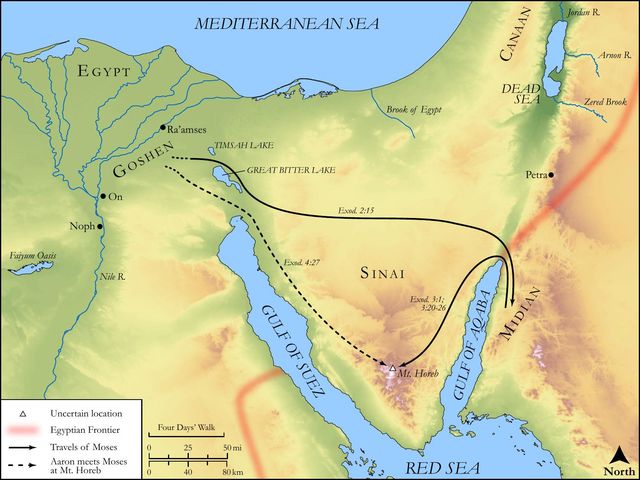
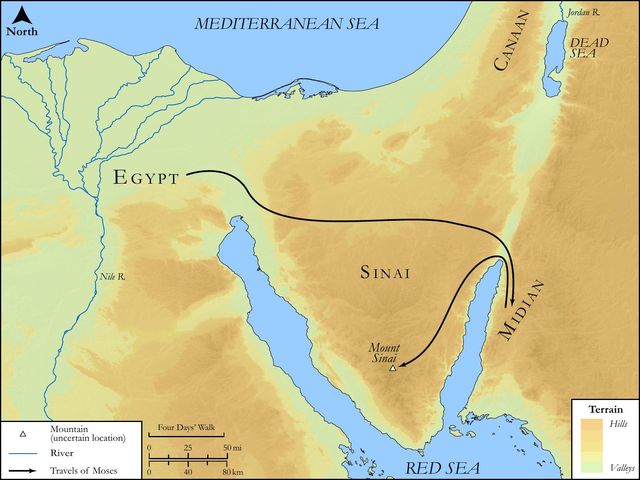
Study this verse
Public-domain commentary
Matthew Henry
From his Commentary on the Whole Bible. Henry comments on passages, not single verses — this entry covers Exodus 3:7–10. His two-level outline is real structure in the source text, so it is rendered as structure.
Now that Moses had put off his shoes (for, no doubt, he observed the orders given him, Exo 3:5), and covered his face, God enters upon the particular business that was now to be concerted, which was the bringing of Israel out of Egypt. Now, after forty years of Israel's bondage and Moses's banishment, when we may suppose both he and they began to despair, they of being delivered and he of delivering them, at length, the time has come, even the year of the redeemed. Note, God often comes for the salvation of his people when they have done looking for him. Shall he find faith? Luk 18:8.
Here is, I. The notice God takes of the afflictions of Israel (Exo 3:7, Exo 3:9): Seeing I have seen, not only, I have surely seen, but I have strictly observed and considered the matter. Three things God took cognizance of: - 1. Their sorrows, Exo 3:7. It is likely they were not permitted to make a remonstrance of their grievances to Pharaoh, nor to seek relief against their task-masters in any of his courts, nor scarcely durst complain to one another; but God observed their tears. Note, Even the secret sorrows of God's people are known to him. 2. Their cry: I have heard their cry (Exo 3:7), it has come unto me, Exo 3:9. Note, God is not deaf to the cries of his afflicted people. 3. The tyranny of their persecutors: I have seen the oppression, Exo 3:9. Note, As the poorest of the oppressed are not below God's cognizance, so the highest and greatest of their oppressors are not above his check, but he will surely visit for these things.
II.The promise God makes of their speedy deliverance and enlargement: I have come down to deliver them, Exo 3:8.
1.It denotes his resolution to deliver them, and that his heart was upon it, so that it should be done speedily and effectually, and by methods out of the common road of providence: when God does something very extraordinary he is said to come down to do it, as Isa 64:1.
2.This deliverance was typical of our redemption by Christ, in which the eternal Word did indeed come down from heaven to deliver us: it was his errand into the world. He promises also their happy settlement in the land of Canaan, that they should exchange bondage for liberty, poverty for plenty, labour for rest, and the precarious condition of tenants at will for the ease and honour of lords proprietors. Note, Whom God by his grace delivers out of a spiritual Egypt he will bring to a heavenly Canaan.
III.The commission he gives to Moses in order hereunto, Exo 3:10.
He is not only sent as a prophet to Israel, to assure them that they should speedily be delivered (even that would have been a great favour), but he is sent as an ambassador to Pharaoh, to treat with him, or rather as a herald at arms, to demand their discharge, and to denounce war in case of refusal; and he is sent as a prince to Israel, to conduct and command them. Thus is he taken from following the ewes great with young, to a pastoral office much more noble, as David, Psa 78:71. Note, God is the fountain of power, and the powers that be are ordained of him as he pleases. The same hand that now fetched a shepherd out of a desert, to be the planter of a Jewish church, afterwards fetched fishermen from their ships, to be the planters of the Christian church, That the excellency of the power might be of God.
Historical interpretation
Four Centuries of Reception
4 surviving comments on this verse. Each one is dated, so this reads as a timeline rather than a list.
Select a marker to jump to its quote. Markers stagger vertically where authors wrote within a few decades of each other.
And when forty years were expired, there appeared to him in the wilderness of mount Sina an angel of the Lord in a flame of fire in a bush. When Moses saw it, he wondered at the sight: and as he drew near to behold it, the voice of the Lord came unto him, Saying, I am the God of thy fathers, the God of Abrham, and the God of Isaac, and the God of Jacob. Then Moses trembled, and durst not behold. Then said the Lord to him, Put off thy shoes from thy feet: for the place where thou standest is holy ground. I have seen, I have seen the affliction of my people which is in Egypt, and I have heard their groaning, and am come down to deliver them. And now come, I will send thee into Egypt. [Exodus 3:7-8] This Moses whom they refused, saying, Who made thee a ruler and a judge? the same did God send to be a ruler and a deliverer by the hand of the angel which appeared to him in the bush. He brought them out, after that he had showed wonders and signs in the land of Egypt, and in the Red sea, and in the wilderness forty years.
… Jesus Christ was to introduce the second people (which is composed of us nations, lingering deserted in the world previously) into the land of promise, “flowing with milk and honey” (that is, into the possession of eternal life, than which nothing is sweeter). This had to come about not through Moses (that is, not through the law’s discipline) but through Joshua (that is, through the new law’s grace), after our circumcision with “a knife of rock” (that is, with Christ’s precepts, for Christ is in many ways and figures predicted as a rock). Therefore the man who was being prepared to act as an image of this sacrament was inaugurated under the figure of the Lord’s name, even so as to be named Jesus.
Indeed, unless that land which was styled the land that flowed with milk and honey signified something great, through which, as by a visible token, he was leading those who understood his wondrous works to invisible grace and the kingdom of heaven, they could not be blamed for scorning that land, whose temporal kingdom we also ought to esteem as nothing, that we may love that Jerusalem which is free, the mother of us all, which is in heaven, and truly to be desired.
I ask whether we should take the land flowing with milk and honey spiritually, since, according to the proper sense, this phrase does not describe the land that was being given to the people of Israel. Or is it a figure of speech that is used to praise the richness and sweetness of the land?
Continue studying Exodus 3:8 across the web’s major study libraries — every link below opens this exact verse, chapter, or book on the destination site.
Read & Compare
 BibleGatewayThis verse in more than 200 translations and 70 languages.
 Bible.comThe YouVersion reader — hundreds of translations, reading plans, and highlights.
 ESV.orgCrossway's official English Standard Version reader.
 NET BibleThe NET translation with 60,000+ translators' notes on every rendering decision.
 STEP BibleTyndale House's free study tool — original text, vocabulary, and scholarly resources.
 BibliaLogos Bible Software's free web reader.
 USCCBThe New American Bible (Revised Edition) with the U.S. bishops' study notes.
Commentaries
 BibleHub CommentariesDozens of classic commentaries on this verse, gathered on one page.
 StudyLightMore than 100 commentary sets — the largest collection on the web.
 BibleRefPlain-English commentary on what this verse means, verse by verse.
 Enduring WordDavid Guzik's free commentary on this chapter, widely used by Bible teachers.
 Bible Study ToolsVerse commentary alongside Greek and Hebrew study aids.
Original Language & Research
- BibleHub InterlinearThe verse word by word — original language, transliteration, and English.
- BibleHub LexiconEvery word's original-language definition and Strong's entry.
 Blue Letter BibleDeep-study tools — Strong's numbers, concordance, and word studies.
 SefariaThe Hebrew text with Rashi and centuries of Jewish commentary.
Sermons, Hymns & Audio


TrulyRandomVerse is not affiliated with these sites and doesn’t control their content. They’re linked because they’re genuinely useful.
Summary
Exodus 3:8 is a profound declaration from God to Moses, revealing His divine purpose to actively intervene in the suffering of the Israelites. It articulates God's compassionate resolve to deliver His people from Egyptian bondage and lead them to a specific, promised land characterized by extraordinary abundance and fertility, a land already inhabited by various Canaanite tribes. This verse encapsulates God's unwavering faithfulness to His covenant, His sovereign power to fulfill His promises, and His generous provision for His chosen people.
Context
ShowHideLiterary Context
This pivotal declaration is spoken by God from the burning bush, immediately following His profound revelation of awareness concerning His people's plight. In Exodus 3:7, God states, "I have surely seen the affliction of my people which are in Egypt, and have heard their cry by reason of their taskmasters; for I know their sorrows." Verse 8 then serves as the divine response, articulating God's direct, purposeful, and personal action to remedy their suffering. It transitions from God's empathetic observation to His active intervention, setting the stage for Moses' commission, the plagues, the Exodus, and the subsequent journey to the Promised Land. This verse is the first explicit statement of God's intention to bring Israel out of Egypt and into the promised inheritance, thus initiating the central narrative of the Pentateuch.
Historical & Cultural Context
The Israelites had endured centuries of slavery in Egypt, a period marked by harsh labor and oppression, culminating in the decree to kill their male infants (Exodus 1:8-22). This historical backdrop highlights the desperation of the Israelites and the magnitude of God's promised deliverance. The description of the destination as "a land flowing with milk and honey" was a powerful Hebrew idiom, signifying unparalleled fertility and prosperity, a stark contrast to the forced labor and scarcity experienced in Egypt. Furthermore, the explicit naming of the Canaanite tribes (Canaanites, Hittites, Amorites, Perizzites, Hivites, and Jebusites) underscores the geopolitical reality of the region. These were established inhabitants, indicating that Israel's entry would involve divine judgment upon these peoples and a divinely ordained conquest to claim the promised inheritance, fulfilling ancient prophecies made to Abraham regarding his descendants and their land (Genesis 15:13-16).
Key Themes
ShowHideExodus 3:8 is rich with foundational theological themes. It powerfully introduces the theme of Divine Initiative and Compassion, demonstrating God's proactive movement towards His suffering people, not merely reacting to their cries but acting from His inherent character of love and justice. It is a direct affirmation of God's Covenant Faithfulness, as the promise of land was central to the covenant established with Abraham, Isaac, and Jacob (Genesis 12:1-3 and Genesis 12:7). The verse also emphasizes God's Sovereignty Over Nations, as He declares His intention to dispossess existing inhabitants to make way for His chosen people. Finally, the imagery of "a land flowing with milk and honey" introduces the theme of Abundant Divine Provision, signifying not just material blessing but also the spiritual rest and flourishing that God intends for His people.
Exposition and Analysis
ShowHideKey Word Analysis
ShowHideThis primitive root means "to descend (literally, to go downwards...); causatively, to bring down." In this context, it is an anthropomorphic expression emphasizing God's personal, active, and decisive intervention. It signifies God's movement from His transcendent realm into the immanent human sphere, specifically to engage with and alleviate the suffering of His people. It is not a literal physical descent but a powerful theological statement of His presence and purposeful action.
This primitive root means "to snatch away, whether in a good or a bad sense; ... rescue, rid, save." Here, it denotes God's powerful act of rescue, indicating a forceful removal from oppression. It conveys the idea of liberation, salvation, and the active preservation of His people from the grasp of their oppressors, highlighting God's role as their ultimate rescuer.
This primitive root means "to flow freely (as water)... to overflow; flow." When used in the phrase "flowing with milk and honey," it vividly describes the abundant and continuous natural yield of the land. It suggests a land so rich and fertile that its produce, like milk and honey, seems to effortlessly gush forth, symbolizing unparalleled prosperity and a generous, self-sustaining environment.
Verse Breakdown
ShowHide"And I am come down to deliver them out of the hand of the Egyptians"
This opening clause immediately establishes God's direct and personal involvement in Israel's plight. The phrase "I am come down" is an anthropomorphism signifying God's active intervention, underscoring His compassionate awareness of their suffering and His resolve to act. "To deliver them out of the hand of the Egyptians" highlights the specific nature of the oppression—the Egyptians' power and control (represented by "hand")—and God's intention to break that bondage through a powerful act of salvation.
"and to bring them up out of that land unto a good land and a large"
Following deliverance, God declares His purpose to lead them to a new destination. "Bring them up" signifies a journey from a lower, oppressive state (Egypt) to a higher, more desirable one (the Promised Land). The land is described as "good" (fertile, pleasant, beneficial) and "large" (spacious enough for a growing nation, offering freedom and room for expansion), presenting a stark contrast to the confined and enslaved conditions in Egypt.
"unto a land flowing with milk and honey"
This iconic biblical idiom vividly describes the extraordinary fertility, abundance, and prosperity of the promised inheritance. "Milk" signifies the richness of livestock and dairy products, indicating a land suitable for grazing and animal husbandry. "Honey" (likely date honey or wild honey, not necessarily bee honey) represents the sweetness and fruitfulness of the land's produce, such as dates, figs, and grapes. Together, they paint a picture of a land that is naturally rich, self-sustaining, and capable of providing generously for its inhabitants, symbolizing God's lavish blessing.
"unto the place of the Canaanites, and the Hittites, and the Amorites, and the Perizzites, and the Hivites, and the Jebusites"
The explicit naming of these six distinct Canaanite tribes identifies the current inhabitants of the promised land. This detail underscores God's absolute sovereignty over all peoples and territories. It signals that the Israelites are not entering an uninhabited land but one already occupied, implying a divinely ordained displacement and conquest. This highlights God's authority to give and take away nations according to His righteous judgment and redemptive purposes, fulfilling His ancient promises.
Literary Devices
ShowHideExodus 3:8 employs several potent literary devices. Anthropomorphism is evident in the phrase "I am come down," which attributes human-like action (descending) to God. This device makes God's transcendent nature relatable and emphasizes His personal, active, engagement in human affairs, conveying His immanence and compassionate intervention. The most prominent device is the Idiom or Metaphor of "a land flowing with milk and honey." This vivid phrase serves as a powerful symbol of unparalleled abundance, fertility, and prosperity, painting a sensory picture of a land of ease and plenty, contrasting sharply with the harshness of slavery. Finally, the Enumeration of the six Canaanite tribes (Canaanites, Hittites, Amorites, Perizzites, Hivites, and Jebusites) serves to concretize the identity of the land's current inhabitants and underscores the specific nature of the divine promise and the impending conquest.
Theological and Thematic Connections
ShowHideExodus 3:8 is a foundational text that reveals core aspects of God's character and His redemptive plan. It powerfully demonstrates God's active and compassionate engagement with human suffering, His unwavering commitment to His covenant promises, and His supreme sovereignty over all creation and nations. The promise of a "land flowing with milk and honey" is not merely a material blessing but a symbol of the holistic flourishing and rest God desires for His people, a place where they can worship and live in freedom. This divine declaration sets the stage for the entire Exodus narrative, establishing God as the ultimate Deliverer and Provider.
Reflection and Application
ShowHideExodus 3:8 offers profound encouragement and timeless truths for believers today. Just as God intimately saw the affliction of Israel, heard their cries, and knew their sorrows, He is equally aware of our struggles, hears our prayers, and is actively engaged in our contemporary circumstances. This verse serves as a powerful testament to God's unwavering faithfulness; despite long periods of waiting, seemingly impossible situations, or overwhelming oppression, God remains committed to bringing His plans to fruition and fulfilling His promises. The vivid imagery of a "land flowing with milk and honey" metaphorically assures us of God's abundant provision and the ultimate blessing He has prepared for those who trust Him, whether in present circumstances or in the eternal future. It reminds us that God is a sovereign Deliverer who leads His people from every form of bondage—spiritual, emotional, or circumstantial—to a place of blessing, rest, and flourishing, according to His perfect will and timing. We are called to trust in His active intervention and patiently await His deliverance, knowing that His promises are sure.
Questions for Reflection
ShowHideFAQ
ShowHideWhat does "I am come down" imply about God?
ShowHideThe phrase "I am come down" (Hebrew: yâradti, from H3381) is an anthropomorphism, meaning it describes God using human-like actions to make His divine activity comprehensible to humanity. It does not imply that God is physically located in a specific place or that He literally descends from a higher physical location. Instead, it powerfully conveys His personal, active, and direct intervention in human affairs. It emphasizes His immanence—His presence and involvement—and His compassionate initiative to deliver His people from their plight. It signifies a divine movement towards humanity for the purpose of salvation and a demonstration of His sovereign will.
Why is the Promised Land described as "a land flowing with milk and honey"?
ShowHideThis iconic phrase is a rich idiom used throughout the Old Testament to convey the extraordinary fertility, abundance, and prosperity of the land God promised to Israel. "Milk" (Hebrew: châlâb, from H2461) signifies the richness of livestock and dairy products, indicating a land suitable for grazing and animal husbandry. "Honey" (Hebrew: dᵉbash, from H1706), often understood as date honey or wild honey rather than exclusively bee honey, represents the sweetness and fruitfulness of the land's produce, such as dates, figs, and grapes. Together, they paint a picture of a land that is naturally rich, self-sustaining, and capable of providing generously for its inhabitants, a stark contrast to the barrenness of the desert or the oppressive conditions in Egypt. It symbolizes God's lavish blessing, abundant provision, and the promise of a life of flourishing and rest for His people. This description is reiterated in passages like Deuteronomy 6:3.
Christ-Centered Fulfillment
ShowHideExodus 3:8 finds its ultimate and most profound fulfillment in the person and work of Jesus Christ. Just as God declared, "I am come down to deliver them," so too did God Himself "come down" in the incarnation of Jesus, the Word made flesh (John 1:14). Christ personally entered into the human condition, experiencing its sorrows and suffering, to deliver humanity not merely from physical bondage but from the far greater slavery to sin and death (Matthew 1:21). He is the ultimate Deliverer who leads His people out of the "land of Egypt"—the dominion of darkness and the curse of the Law—and brings them into a spiritual "good land and a large," the kingdom of God, characterized by grace, truth, and eternal life. This new spiritual inheritance far surpasses any earthly "land flowing with milk and honey," offering true rest for the soul (Hebrews 4:9-10). Through His atoning sacrifice on the cross, Christ conquered the spiritual "Canaanites" of sin, Satan, and death, establishing His new covenant people in a place of everlasting blessing and communion with God, foreshadowing the ultimate restoration of the new heavens and new earth, where God's people will dwell in perfect peace and abundance forever (Revelation 21:1-4).