


Genesis 15:21
Bible text: King James Version (1769 Blayney text) · Public domain
Bible text: King James Version with Strong's numbers · Public domain
Bible text: Berean Standard Bible · Public domain
Bible text: American Standard Version (1901) · Public domain
Bible text: World English Bible, Messianic edition · Public domain
Bible text: Geneva Bible (1599) · Public domain
Bible text: Young's Literal Translation · Public domain
- וְאֶתve·'Etand <obj.>H853Conj-w ¦ DirObjMParticle Object Indicatorוְandאֶת<obj.>
- הָאֱמֹרִיha·'e·mo·Rithe Amorite[s]H567Art ¦ N-msNoun Gentilic Singular Masculine AbsoluteהָtheאֱמֹרִיAmorite[s]
- וְאֶתve·'Etand <obj.>H853Conj-w ¦ DirObjMParticle Object Indicatorוְandאֶת<obj.>
- הַכְּנַעֲנִיha·ke·na·'a·Nithe Canaanite[s]H3669Art ¦ N-msNoun Gentilic Singular Masculine AbsoluteהַtheכְּנַעֲנִיCanaanite[s]
- וְאֶתve·'Etand <obj.>H853Conj-w ¦ DirObjMParticle Object Indicatorוְandאֶת<obj.>
- הַגִּרְגָּשִׁיha·gir·ga·Shithe Girgashite[s]H1622Art ¦ N-msNoun Gentilic Singular Masculine AbsoluteהַtheגִּרְגָּשִׁיGirgashite[s]
- וְאֶתve·'Etand <obj.>H853Conj-w ¦ DirObjMParticle Object Indicatorוְandאֶת<obj.>
- הַיְבוּסִיhay·vu·Sithe Jebusite[s]H2983Art ¦ N-msNoun Gentilic Singular Masculine AbsoluteהַtheיְבוּסִיJebusite[s]
English is a literal word-by-word gloss of the Hebrew, not the KJV's wording. Why?
This is the original text the KJV's translators worked from — each Hebrew word with its own literal English meaning in this verse, prepared by scholars at Tyndale House, Cambridge. The KJV translates whole sentences, not word by word, so its wording differs: one Hebrew word can become several English words, and the KJV may choose “the LORD” where the gloss reads “Yahweh”. Both are faithful — they answer different questions. For the KJV's own rendering, switch to the KJV text.
Details
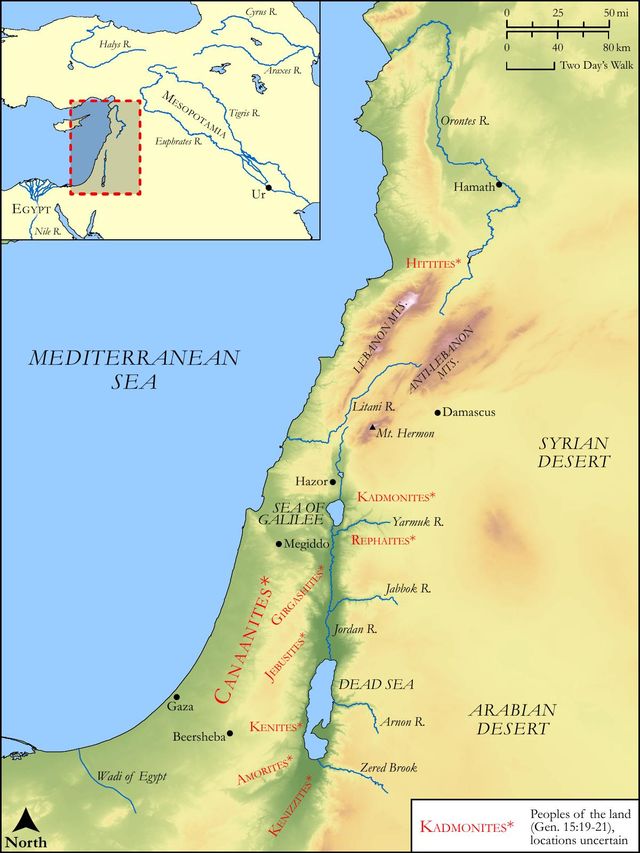
See on the biblical-era maps


Study this verse
Public-domain commentary
Matthew Henry
From his Commentary on the Whole Bible. Henry comments on passages, not single verses — this entry covers Genesis 15:17–21. His three-level outline is real structure in the source text, so it is rendered as structure.
Here is, I. The covenant ratified (Gen 15:17); the sign which Abram desired was given, at length, when the sun had gone down, so that it was dark; for that was a dark dispensation.
1.The smoking furnace signified the affliction of his seed in Egypt. They were there in the iron furnace (Deu 4:20), the furnace of affliction (Isa 48:10), labouring in the very fire. They were there in the smoke, their eyes darkened, that they could not see to the end of their troubles, and themselves at a loss to conceive what God would do with them. Clouds and darkness were round about them.
2.The burning lamp denotes comfort in this affliction; and this God showed to Abram, at the same time that he showed him the smoking furnace.
(1.)Light denotes deliverance out of the furnace; their salvation was as a lamp that burneth, Isa 62:1. When God came down to deliver them, he appeared in a bush that burned, and was not consumed, Exo 3:2.
(2.)The lamp denotes direction in the smoke. God's word was their lamp: this word to Abram was so, it was a light shining in a dark place. Perhaps this burning lamp prefigured the pillar of cloud and fire, which led them out of Egypt, in which God was.
(3.)The burning lamp denotes the destruction of their enemies who kept them so long in the furnace. See Zac 12:6. The same cloud that enlightened the Israelites troubled and burned the Egyptians.
3.The passing of these between the pieces was the confirming of the covenant God now made with him, that he might have strong consolation, being fully persuaded that what God promised he would certainly perform. It is probable that the furnace and lamp, which passed between the pieces, burnt and consumed them, and so completed the sacrifice, and testified God's acceptance of it, as of Gideon's (Jdg 6:21), Manoah's (Jdg 13:19, Jdg 13:20), and Solomon's, Ch2 7:1. So it intimates,
(1.)That God's covenants with man are made by sacrifice (Psa 50:5), by Christ, the great sacrifice: no agreement without atonement.
(2.)God's acceptance of our spiritual sacrifices is a token for good and an earnest of further favours. See Jdg 13:23. And by this we may know that he accepts our sacrifices if he kindle in our souls a holy fire of pious and devout affections in them.
II.The covenant repeated and explained:
In that same day, that day never to be forgotten, the Lord made a covenant with Abram, that is, gave a promise to Abram, saying, Unto thy seed have I given this land, Gen 15:18. Here is,
1.A rehearsal of the grant. He had said before, To thy seed will I give this land, Gen 12:7; Gen 13:15. But here he says, I have given it; that is,
(1.)I have given the promise of it, the charter is sealed and delivered, and cannot be disannulled. Note, God's promises are God's gifts, and are so to be accounted.
(2.)The possession is as sure, in due time, as if it were now actually delivered to them. What God has promised is as sure as if it were already done; hence, it is said, He that believes hath everlasting life (Joh 3:36), for he shall as surely go to heaven as if he were there already.
2.A recital of the particulars granted, such as is usual in the grants of lands. He specifies the boundaries of the land intended hereby to be granted, Gen 15:18. And then, for the greater certainty, as is usual in such cases, he mentions in whose tenure and occupation these lands now were. Ten several nations, or tribes, are here spoken of (Gen 15:19-21) that must be cast our, to make room for the seed of Abram. They were not possessed of all these countries when God brought them into Canaan. The bounds are fixed much narrower, Num 34:2, Num 34:3, etc. But,
(1.)In David's time, and Solomon's, their jurisdiction extended to the utmost of these limits, Ch2 9:26.
(2.)It was their own fault that they were not sooner and longer in possession of all these territories. They forfeited their right by their sins, and by their own sloth and cowardice kept themselves out of possession.
(3.)The land granted is here described in its utmost extent because it was to be a type of the heavenly inheritance, where there is room enough: in our father's house are many mansions. The present occupants are named, because their number, and strength, and long prescription, should be no hindrance to the accomplishment of this promise in its season, and to magnify God's love to Abram and his seed, in giving to that one nation the possessions of many nations, so precious were they in his sight, and so honourable, Isa 43:4.
Historical interpretation
Historical reception
1 surviving comment on this verse from the historical church.
What is clearly stated in the text can be expounded as follows. When the sun was already near setting, a flame emerged, and there appeared a smoking oven and fiery torches “that passed between the two parts of the divided animals,” burning and lighting up the place, to allow the patriarch to see what was happening and to reveal in a more divine manner the mysteries to be searched out. It should be noted that a fire did not appear only after the covenant had been made, but the gift of the law through Moses took place itself in the midst of a fire. Fire could be seen, and, without being able to see the one who was speaking, the giving of the commandments could be heard. What is suggested here is perhaps something like this. As the law contains rewards and punishments, it was given in the midst of fire to indicate that it brings burning to some and illumination to others. In fact, fire has a twofold power: it illuminates, and at the same time it burns. The gift of the law, then, burns those who abandon it and enlightens those who observe it. So too here, torches and smoke appeared; now smoke is the result and as it were the consequence of a fire that has been lit. Moreover, a flame had appeared first. We conclude, then, that one who is defining what is to be done and what is not to be done in a matter this difficult requires the light of God and also fear, symbolized by the furnace, so as to accomplish everything in accordance with right reason.
Continue studying Genesis 15:21 across the web’s major study libraries — every link below opens this exact verse, chapter, or book on the destination site.
Read & Compare
 BibleGatewayThis verse in more than 200 translations and 70 languages.
 Bible.comThe YouVersion reader — hundreds of translations, reading plans, and highlights.
 ESV.orgCrossway's official English Standard Version reader.
 NET BibleThe NET translation with 60,000+ translators' notes on every rendering decision.
 STEP BibleTyndale House's free study tool — original text, vocabulary, and scholarly resources.
 BibliaLogos Bible Software's free web reader.
 USCCBThe New American Bible (Revised Edition) with the U.S. bishops' study notes.
Commentaries
 BibleHub CommentariesDozens of classic commentaries on this verse, gathered on one page.
 StudyLightMore than 100 commentary sets — the largest collection on the web.
 BibleRefPlain-English commentary on what this verse means, verse by verse.
 Enduring WordDavid Guzik's free commentary on this chapter, widely used by Bible teachers.
 Bible Study ToolsVerse commentary alongside Greek and Hebrew study aids.
Original Language & Research
- BibleHub InterlinearThe verse word by word — original language, transliteration, and English.
- BibleHub LexiconEvery word's original-language definition and Strong's entry.
 Blue Letter BibleDeep-study tools — Strong's numbers, concordance, and word studies.
 SefariaThe Hebrew text with Rashi and centuries of Jewish commentary.
Sermons, Hymns & Audio


TrulyRandomVerse is not affiliated with these sites and doesn’t control their content. They’re linked because they’re genuinely useful.
Summary
The divine enumeration of ten nations whose territories God solemnly promised to Abraham and his descendants as an eternal inheritance. This verse specifically names the Amorites, Canaanites, Girgashites, and Jebusites, all prominent inhabitants of the land that would eventually become Israel. This meticulous listing underscores the precision, certainty, and comprehensive nature of God's covenant with Abraham, a foundational promise that would guide the destiny of a nation for centuries and foreshadow the ultimate fulfillment of God's redemptive plan.
Context
ShowHideLiterary Context
This verse is the culmination of a profound covenant ceremony described in Genesis chapter 15, where God formally establishes His promise to Abraham concerning the inheritance of the land and the proliferation of his offspring. The chapter begins with Abraham's expression of doubt regarding an heir, prompting God's re-affirmation of a natural son and a promise that his descendants would be as numerous as the stars (Genesis 15:1-5). Following Abraham's act of faith (Genesis 15:6), the narrative shifts decisively to the land promise, sealed by a solemn covenant ritual involving divided animals, a practice that Scripture records again in Jeremiah 34 to signify a binding agreement (Genesis 15:7-17). The preceding verses, Genesis 15:18-20, already established the geographical boundaries "from the river of Egypt unto the great river, the river Euphrates" and listed six other nations (Kenites, Kenizzites, Kadmonites, Hittites, Perizzites, Rephaim). Genesis 15:21 completes this comprehensive list of peoples whose land God was granting to Abraham's lineage, emphasizing the specificity and scope of the divine promise and setting the stage for future historical events.
Historical & Cultural Context
In Scripture, land was intrinsically linked to identity, security, and divine favor. Covenants, especially those involving land grants, were often formalized through elaborate rituals, as seen in the "cutting" of the covenant in Genesis 15. The nations listed in Genesis 15:19-21 represent the diverse inhabitants of Canaan, a land strategically located between major empires and known for its fertility. These groups, including the Amorites, Canaanites, Girgashites, and Jebusites, were distinct tribal or ethnic entities with their own territories, cultures, and often polytheistic religious practices. The divine declaration of their eventual dispossession, as hinted in Genesis 15:16, was not arbitrary but contingent on the "fullness of the iniquity" of these peoples, implying a period of divine forbearance before judgment. This context highlights God's sovereign right over all lands and peoples, His patience, and His ultimate justice in fulfilling His promises to His chosen people while also holding other nations accountable for their moral corruption.
Key Themes
ShowHideThe enumeration of these specific nations in Genesis 15:21 contributes significantly to several overarching themes in Genesis and the broader biblical narrative. Firstly, it underscores the theme of Divine Faithfulness and Covenant Certainty. God's promise to Abraham is not vague but meticulously detailed, demonstrating His unwavering commitment to His word. Secondly, it highlights God's Sovereignty Over Nations and Territories. God, as the ultimate Creator and Ruler, has the authority to grant and dispossess lands, determining the destinies of peoples according to His divine will. This theme is crucial for understanding the subsequent history of Israel's conquest of Canaan, as detailed in books like Joshua. Thirdly, it reinforces the Land Promise as a central component of the Abrahamic Covenant, a promise that would shape Israel's identity and history for millennia. Finally, the implied judgment on these nations, linked to their "iniquity" in Genesis 15:16, introduces the theme of Divine Justice and Retribution, where God's patience has limits, and His righteous judgment will eventually fall upon those who persist in wickedness.
Exposition and Analysis
ShowHideKey Word Analysis
ShowHidePatrial from an unused name, likely derived from a root meaning "prominence," suggesting "mountaineer." The Amorites were a prominent Semitic people, influential throughout Mesopotamia and Canaan. Their inclusion highlights their significant presence in the region and their eventual displacement by the Israelites, as seen in later biblical narratives like those in Numbers 21:21-35.
Patrial from "Canaan." While "Canaanites" can broadly refer to all inhabitants of Canaan, here they are listed alongside other specific tribes, indicating a distinct group within the larger population, perhaps those inhabiting the plains or coastal areas. By implication, the term also came to mean "merchant" or "trafficker," reflecting their commercial activities. Their presence underscores the general inhabitants of the promised land, whose idolatrous practices were pervasive.
Patrial from an unused name of uncertain derivation. This tribe is less frequently mentioned in the biblical narrative compared to others but is consistently included in these lists of nations destined for dispossession (e.g., Deuteronomy 7:1). Their consistent inclusion affirms the completeness and specificity of God's plan for the land.
Patrial from "Jebus," the ancient name for Jerusalem. These were the inhabitants of Jerusalem before King David conquered it centuries later. Their specific mention foreshadows the long historical trajectory of God's promise, culminating in the establishment of Israel's capital and central sanctuary in their former stronghold.
Verse Breakdown
ShowHide"And the Amorites"
This clause introduces the first of four specific tribal groups mentioned in this verse, a prominent Semitic people known for their strength and widespread presence in Canaan, whose territory would be part of the promised inheritance.
"and the Canaanites"
This refers to a distinct subgroup of the broader Canaanite population, emphasizing the diverse ethnic composition of the land and God's intention to dispossess all who stood in the way of His covenant promise.
"and the Girgashites"
The inclusion of this less prominent tribe underscores the comprehensive nature of God's promise, indicating that no inhabitant of the designated territory would be exempt from the divine decree of dispossession.
"and the Jebusites"
This final clause names the inhabitants of ancient Jerusalem, highlighting the strategic importance of their territory and foreshadowing the eventual Israelite conquest of this key city, centuries after Abraham.
Literary Devices
ShowHideThe primary literary device at play in Genesis 15:21 is Enumeration, which is the listing of items for emphasis or clarity. Here, it meticulously details the specific tribal groups inhabiting the land promised to Abraham, providing concrete evidence of the scope and specificity of God's covenant. This detailed listing also serves as a form of Foreshadowing, prophetically outlining the future conquest of Canaan by the Israelites as recounted in the book of Joshua. The repetition of similar lists throughout the Pentateuch (e.g., Exodus 3:8) further emphasizes the divine decree and the certainty of its fulfillment. Furthermore, the very act of naming these nations imbues them with a symbolic significance: they represent the obstacles that God's people would overcome, demonstrating God's power to clear the way for His promises.
Theological and Thematic Connections
ShowHideThe meticulous listing of these nations in Genesis 15:21 serves as a powerful testament to the unwavering nature of God's covenant with Abraham. It demonstrates that God's promises are not vague aspirations but specific, tangible commitments that will be fulfilled in His timing, even if it requires generations and the dramatic reshaping of geopolitical realities. This passage underscores God's absolute sovereignty over all nations and territories, asserting His right to establish and disestablish peoples according to His divine will and righteous judgment. The detailed nature of the promise instills confidence in God's faithfulness, reminding believers that His word is utterly reliable and His plans will ultimately prevail.
Reflection and Application
ShowHideFor believers today, Genesis 15:21 reinforces the enduring truth of God's faithfulness and the certainty of His promises. Just as God meticulously fulfilled His detailed promise to Abraham regarding the land and its inhabitants, so too can we trust in His promises concerning our lives, salvation, and the future. This passage encourages patience and steadfast faith, reminding us that God's grand plans unfold according to His perfect timeline, often over generations, and that His word is utterly reliable. It also speaks to God's ultimate justice and His sovereign right to establish and disestablish nations according to His divine will, offering profound comfort and assurance that He is always in control, even amidst the complexities and uncertainties of world events. We are called to trust in His comprehensive vision, knowing that every detail of His redemptive plan will come to fruition.
Questions for Reflection
ShowHideFAQ
ShowHideWhy are these specific nations listed?
ShowHideThe listing of these specific nations (Amorites, Canaanites, Girgashites, and Jebusites, along with the six others in Genesis 15:19-20) serves to precisely define the geographical and demographic scope of the land God promised to Abraham's descendants. It underscores the specificity and tangibility of God's covenant, detailing the existing inhabitants who would eventually be dispossessed to make way for Israel. This meticulous detail demonstrates God's foreknowledge and the comprehensive nature of His divine plan.
Does God's promise to dispossess these nations imply injustice?
ShowHideFrom a biblical perspective, God, as the Creator and Sovereign of all the earth, has the ultimate right to determine the boundaries and inhabitants of nations. Genesis 15:16 indicates that the "iniquity of the Amorites is not yet full," suggesting that the dispossession was not arbitrary but a delayed judgment for their moral corruption, idolatry, and egregious practices, which had reached a point requiring divine intervention. God's judgment, though severe, is always rooted in His perfect righteousness and justice, providing ample time for repentance before the full measure of sin is met with consequence.
How does this ancient promise relate to modern geopolitics?
ShowHideWhile Genesis 15:21 describes a specific historical and theological promise to Abraham concerning the land of Canaan, its primary application for contemporary believers is theological, highlighting God's covenant faithfulness and sovereignty. Interpreting this passage directly as a blueprint for modern geopolitical conflicts or land claims requires careful theological discernment and often leads to misapplication. The New Testament shifts the primary focus from a physical land to a spiritual inheritance in Christ for all believers, transcending ethnic and geographical boundaries, as seen in passages like Galatians 3:29.
Christ-Centered Fulfillment
ShowHideWhile Genesis 15:21 meticulously details a physical land promise to Abraham's descendants, its ultimate fulfillment points profoundly to Christ and the spiritual reality of God's kingdom. The promise of an inheritance, initially tied to a specific territory and the dispossession of nations, finds its spiritual and eternal reality in the new covenant established by Christ. He is the true "seed" of Abraham, through whom all the nations of the earth are blessed (Galatians 3:16). Through His sacrificial death and glorious resurrection, Christ establishes a new covenant, making all believers—both Jew and Gentile—heirs to an eternal inheritance that transcends geographical boundaries and earthly limitations. The "land" becomes a metaphor for the new creation, the spiritual blessings found in union with Christ, and the eschatological reality of God's dwelling with His people in a new heaven and a new earth (Revelation 21:1-4). In Christ, God's promises are fulfilled in a far grander, more inclusive, and eternally significant way, gathering a people from every tribe, tongue, and nation into His glorious, everlasting kingdom (Revelation 7:9-10).