


Numbers 32:12
- בִּלְתִּיbil·TiexceptH1115N-cscNoun Singular common gender Construct
- כָּלֵבka·LevCalebH3612N-proper-mNoun Proper Masculine
- בֶּןben[the] son ofH1121N-mscNoun Singular Masculine Construct
- יְפֻנֶּהye·fu·NehJephunnehH3312N-proper-mNoun Proper Masculine
- הַקְּנִזִּיha·ke·ni·Zithe KenizziteH7074Art ¦ N-msNoun Gentilic Singular Masculine AbsoluteהַtheקְּנִזִּיKenizzite
- וִיהוֹשֻׁעַvi·ho·Shu·a'and JoshuaH3091Conj-w ¦ N-proper-mNoun Proper MasculineוִandיהוֹשֻׁעַJoshua
- בִּןbin[the] son ofH1121N-mscNoun Singular Masculine Construct
- נוּןNunNunH5126N-proper-mNoun Proper Masculine
- כִּיkiforH3588PrtParticle Conditional
- מִלְאוּmil·'Uthey have filledH4390V-Piel-Perf-3cpVerb Piel Perfect 3rd Plural common gender
- אַחֲרֵי'a·cha·ReiafterH310Adj-mpcAdjective Numerical Plural Masculine Construct
- יְהוָהYah·wehYahwehH3068N-properNoun Proper Title
English is a literal word-by-word gloss of the Hebrew, not the KJV's wording. Why?
This is the original text the KJV's translators worked from — each Hebrew word with its own literal English meaning in this verse, prepared by scholars at Tyndale House, Cambridge. The KJV translates whole sentences, not word by word, so its wording differs: one Hebrew word can become several English words, and the KJV may choose “the LORD” where the gloss reads “Yahweh”. Both are faithful — they answer different questions. For the KJV's own rendering, switch to the KJV text.
Details
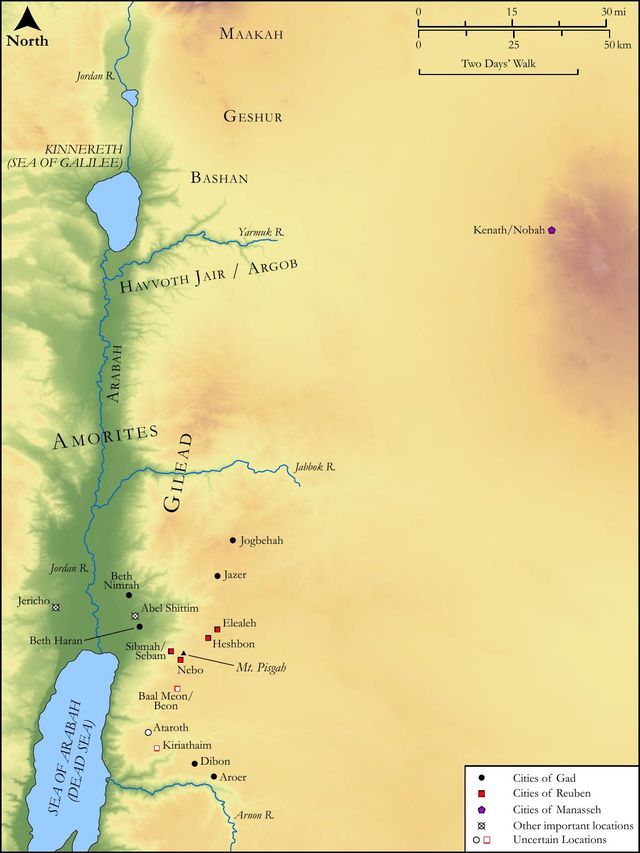
See on the biblical-era map
Study this verse
Continue studying Numbers 32:12 across the web’s major study libraries — every link below opens this exact verse, chapter, or book on the destination site.
Read & Compare
 BibleGatewayThis verse in more than 200 translations and 70 languages.
 Bible.comThe YouVersion reader — hundreds of translations, reading plans, and highlights.
 ESV.orgCrossway's official English Standard Version reader.
 NET BibleThe NET translation with 60,000+ translators' notes on every rendering decision.
 STEP BibleTyndale House's free study tool — original text, vocabulary, and scholarly resources.
 BibliaLogos Bible Software's free web reader.
 USCCBThe New American Bible (Revised Edition) with the U.S. bishops' study notes.
Commentaries
 BibleHub CommentariesDozens of classic commentaries on this verse, gathered on one page.
 StudyLightMore than 100 commentary sets — the largest collection on the web.
 BibleRefPlain-English commentary on what this verse means, verse by verse.
 Enduring WordDavid Guzik's free commentary on this chapter, widely used by Bible teachers.
 Bible Study ToolsVerse commentary alongside Greek and Hebrew study aids.
Original Language & Research
- BibleHub InterlinearThe verse word by word — original language, transliteration, and English.
- BibleHub LexiconEvery word's original-language definition and Strong's entry.
 Blue Letter BibleDeep-study tools — Strong's numbers, concordance, and word studies.
 SefariaThe Hebrew text with Rashi and centuries of Jewish commentary.
Sermons, Hymns & Audio


TrulyRandomVerse is not affiliated with these sites and doesn’t control their content. They’re linked because they’re genuinely useful.
Summary
Numbers 32:12 stands as a profound declaration within the wilderness narrative, identifying Caleb, son of Jephunneh the Kenezite, and Joshua, son of Nun, as the sole members of their generation (those twenty years and older) permitted to enter the Promised Land. This verse highlights their exceptional faithfulness and unwavering devotion, explicitly stating that they "wholly followed the LORD," a stark contrast to the widespread disobedience and unbelief that characterized the rest of the Israelites during their forty years of wandering. It powerfully underscores divine justice and the profound reward for complete obedience and trust in God's sovereign promises, setting these two men apart as exemplars of true devotion.
Context
ShowHideLiterary Context
This verse is strategically placed within a pivotal dialogue between Moses and the tribes of Reuben and Gad, who express a desire to settle in the fertile Transjordan region east of the Jordan River, rather than cross into Canaan. Moses initially reacts with strong disapproval, fearing their request will demoralize the rest of the Israelites and lead to a repetition of the catastrophic rebellion at Kadesh-Barnea. He pointedly reminds them of the divine decree that condemned the previous generation, those who had witnessed God's glory and signs in Egypt and the wilderness yet tested Him ten times, to die outside the Promised Land Numbers 14:20-35. Numbers 32:12 functions as a crucial parenthetical statement, identifying the two individuals explicitly exempted from this sweeping judgment. This exception reinforces Moses' stern warning to the Transjordanian tribes, cautioning them against repeating the sin of unbelief and discouragement that led to the demise of their predecessors, thereby setting the stage for Moses' conditional agreement, contingent upon their commitment to fight alongside their brethren for the conquest of Canaan.
Historical & Cultural Context
The setting is the culmination of the forty-year wilderness wandering, a period of divine judgment and purification for the generation that rebelled at Kadesh-Barnea. The Israelites, having been miraculously delivered from Egyptian bondage, were now poised on the threshold of entering the Promised Land, a land described as "flowing with milk and honey" and promised to their patriarchs Abraham, Isaac, and Jacob. The sending of twelve spies into Canaan was a critical turning point, intended to gather intelligence but evolving into a profound test of faith. Ten spies returned with a fearful report, emphasizing the formidable strength of the inhabitants and their fortified cities, which led the people to weep, complain bitterly, and even propose returning to Egypt. Caleb and Joshua, however, brought a positive and courageous report, urging the people to trust in God's unfailing ability to deliver the land into their hands Numbers 13:30. Culturally, the concept of "wholly following" a leader or deity implied absolute loyalty, undivided allegiance, and unwavering adherence to their will, a stark contrast to the wavering commitment often displayed by the Israelite community. Caleb's identification as "the Kenezite" is particularly significant, as it indicates his lineage was not originally Israelite but had been incorporated, perhaps through intermarriage or covenant, into the tribe of Judah, underscoring that faithfulness and divine favor transcend ethnic origin.
Key Themes
ShowHideNumbers 32:12 encapsulates several profound themes central to the book of Numbers and the broader Pentateuch. Foremost is the theme of Faithfulness and Obedience, powerfully exemplified by Caleb and Joshua, whose unwavering trust in God's promises stood in stark contrast to the widespread unbelief of their peers. Their "wholly following the LORD" serves as a model of complete devotion and undivided loyalty, a quality highly valued and explicitly commended by God. This verse also powerfully illustrates the Consequences of Disobedience and Unbelief, as the entire generation, save for these two men, was condemned to die in the wilderness, unable to enter the land God had sworn to give them Numbers 14:29-35. Conversely, it highlights the Reward of Faithfulness, as Caleb and Joshua alone among the adults of their generation received the promised inheritance, demonstrating God's justice and His commitment to His covenant with those who honor Him. The phrase "wholly followed the LORD" itself becomes a recurring and emphatic motif, emphasizing a radical, all-encompassing commitment to God's will and word, even in the face of daunting obstacles or popular dissent, a theme echoed throughout the journey to the Promised Land.
Exposition and Analysis
ShowHideKey Word Analysis
ShowHideA primitive root meaning "to fill or (intransitively) be full of, in a wide application (literally and figuratively)." In this context, combined with "followed," it denotes completeness, fullness, or an unreserved commitment. It signifies that Caleb and Joshua's adherence to the LORD was not partial or hesitant but full and complete, permeating every aspect of their being and action.
Properly "the hind part," generally used as an adverb or conjunction meaning "after (in various senses)." When combined with mâlêʾ (wholly), it forms the idiomatic phrase "wholly followed," meaning to pursue fully, to go after completely, or to adhere unreservedly. It implies a persistent, intentional pursuit and obedience to God's leading.
"(the) self-Existent or Eternal; Jehovah, Jewish national name of God." This is the covenant name of God, emphasizing His eternal, unchanging, and relational nature. The fact that Caleb and Joshua "wholly followed" Yahweh underscores their fidelity to the God of Israel's covenant, not merely a generic deity, but the one true God who had delivered them and made promises to their fathers.
Verse Breakdown
ShowHide"Save Caleb the son of Jephunneh the Kenezite,"
This clause immediately identifies the first of the two exceptional individuals. Caleb is distinguished not only by his father's name but also by his unique tribal affiliation, "the Kenezite." This detail indicates his origin from the Kenizzites, a non-Israelite group (likely Edomite or Horite) who had been incorporated into the tribe of Judah. This inclusion underscores that God's favor and the capacity to "wholly follow" Him are not restricted by birth or lineage but are open to all who demonstrate genuine faith and obedience, highlighting God's grace and the individual nature of faithfulness.
"and Joshua the son of Nun:"
Joshua, the second exception, is presented as Caleb's counterpart in unwavering faithfulness. As Moses' devoted aide and divinely appointed successor, Joshua's unwavering loyalty to God and Moses was well-established throughout the wilderness journey. His inclusion here, alongside Caleb, reinforces the profound idea that true leadership and the inheritance of God's promises are predicated on absolute trust and obedience, rather than mere position, human strength, or popular opinion. These two men represent the faithful remnant, a beacon of hope and a testament to God's selective preservation based on righteous conduct.
"for they have wholly followed the LORD."
This final clause provides the divine rationale for their exceptional status, serving as the core theological statement of the verse. It explains why Caleb and Joshua were spared the fate of their rebellious generation. Their "wholly following the LORD" encapsulates their courage at Kadesh-Barnea, their unwavering trust in God's power over the formidable inhabitants of Canaan, and their consistent devotion throughout the arduous wilderness journey. This phrase serves as the ultimate commendation, defining the quality of faith and obedience that God honors and rewards with the fulfillment of His promises, emphasizing a total, unreserved commitment to His will.
Literary Devices
ShowHideThe verse employs several significant literary devices that amplify its message. Contrast is paramount, sharply setting Caleb and Joshua apart from the vast majority of their generation, whose pervasive unbelief and rebellion led to their demise in the wilderness. This stark juxtaposition highlights the profound difference between partial and wholehearted devotion to God. The two men function as Exemplars, serving as enduring models of faith, courage, and obedience for future generations of Israel and for all believers. Their singular mention underscores their unique status and the divine approval of their actions. The phrase "wholly followed the LORD" acts as a Leitwort (a guiding word or phrase), recurring in other passages concerning Caleb (e.g., Numbers 14:24 and Deuteronomy 1:36), thereby emphasizing its profound significance and establishing it as a key characteristic of true faithfulness. Furthermore, the verse contains an element of Foreshadowing, as the faithfulness of Caleb and Joshua anticipates their eventual leadership roles in the conquest and settlement of the Promised Land, demonstrating that God equips and empowers those who fully commit to Him.
Theological and Thematic Connections
ShowHideNumbers 32:12 profoundly illustrates the biblical principle that God honors unwavering faith and complete obedience. It stands as a testament to divine justice, where the consequences of corporate rebellion are meted out, yet divine grace and specific promises are extended to those who demonstrate genuine trust and individual faithfulness. Caleb and Joshua's experience underscores that while corporate sin can bring corporate judgment, individual faithfulness is recognized, preserved, and ultimately rewarded by God. Their story serves as a powerful reminder that God's promises are conditional upon a responsive faith, and that a "wholehearted" pursuit of Him is the pathway to inheriting His blessings, both temporal and eternal. This concept of undivided loyalty to God resonates throughout Scripture, emphasizing the call to love the Lord with all one's heart, soul, and might, and to follow Him without reservation.
Reflection and Application
ShowHideThe narrative of Caleb and Joshua in Numbers 32:12 offers a potent challenge and profound encouragement for contemporary believers. It reminds us that true faith is not merely intellectual assent to theological truths but an active, unwavering commitment that "wholly follows the LORD" even when circumstances are daunting, popular opinion is against us, or the path ahead seems impossible. Like Caleb and Joshua, we are called to fix our eyes on God's promises and power, rather than on the size of the "giants" in our lives or the discouraging voices around us. Their example calls us to examine the depth of our own devotion: Is our loyalty to Christ partial or complete? Do we trust Him fully in every area of our lives, or do we hold back, allowing fear, doubt, or worldly comforts to dictate our steps? Embracing a "wholehearted" faith means surrendering our anxieties, trusting God's provision, and courageously stepping into the purposes He has for us, knowing that His faithfulness to His promises far outweighs any obstacle or opposition. It is a call to radical, all-encompassing discipleship.
Questions for Reflection
ShowHideFAQ
ShowHideWhat does "wholly followed the LORD" truly mean in practical terms for Caleb and Joshua?
ShowHideFor Caleb and Joshua, "wholly followed the LORD" meant an absolute and unwavering trust in God's promises and power, even when faced with overwhelming opposition and fear from their peers. Practically, this manifested most vividly in their courageous minority report after spying out the land Numbers 13:30 and Numbers 14:6-9, where they urged the Israelites to go up and take the land, believing God would deliver it into their hands despite the formidable inhabitants. It meant prioritizing God's command and promise over human fear, logic, and the overwhelming consensus of the majority, maintaining their conviction even when the entire congregation threatened to stone them. It also implied a consistent, obedient walk with God throughout the forty years in the wilderness, never wavering in their commitment or succumbing to the idolatry, complaining, and rebellion that plagued the rest of their generation. It was a complete, unreserved devotion of heart, mind, and will to God's revealed will, demonstrating that their faith was active and resilient.
Christ-Centered Fulfillment
ShowHideNumbers 32:12, in its commendation of Caleb and Joshua's "wholehearted" following of the LORD, powerfully foreshadows the perfect obedience and complete faithfulness of Jesus Christ. While Caleb and Joshua were exemplary figures, their obedience was still imperfect and limited by their humanity. Jesus, however, is the ultimate and perfect embodiment of one who "wholly followed the LORD" in every conceivable way. His entire life, from His miraculous incarnation to His sacrificial crucifixion, was characterized by absolute submission to the Father's will, even to the point of death on a cross Philippians 2:8. Where the Israelites failed to enter their promised rest due to unbelief and disobedience, Christ, through His perfect obedience and atoning sacrifice, secured an eternal rest and an imperishable inheritance for all who believe in Him Hebrews 4:9-10. He is the true and greater Joshua, who leads His people into the spiritual Promised Land, not by human strength or military might, but by the power of His atoning sacrifice and glorious resurrection Hebrews 2:10. Thus, the faithfulness of Caleb and Joshua serves as a type, pointing to the flawless and redemptive obedience of the Lamb of God, through whom all God's promises find their ultimate "Yes" and "Amen" 2 Corinthians 1:20, granting access to the truest and eternal inheritance.