


Joshua 14:9
Bible text: King James Version (1769 Blayney text) · Public domain
Bible text: King James Version with Strong's numbers · Public domain
Bible text: Berean Standard Bible · Public domain
Bible text: American Standard Version (1901) · Public domain
Bible text: World English Bible, Messianic edition · Public domain
Bible text: Geneva Bible (1599) · Public domain
Bible text: Young's Literal Translation · Public domain
- וַיִּשָּׁבַעvai·yi·sha·Va'and he swore an oathH7650Conj-w ¦ V-Niphal-ConsecImperf-3msVerb Niphal Consecutive Imperfect 3rd Singular Masculineוַandיִּשָּׁבַעhe swore an oath
- מֹשֶׁהmo·ShehMosesH4872N-proper-mNoun Proper Masculine
- בַּיּוֹםbai·Yomon the dayH3117Prep-b ¦ N-msNoun Singular Masculine Absoluteבַּon theיּוֹםday
- הַהוּאha·Hu'<the> thatH1931Art ¦ Pro-3msPronoun Personal 3rd Singular Masculineהַ<the>הוּאthat
- לֵאמֹרle·Mor<to> sayingH559Prep-l ¦ V-Qal-InfVerb Qal Infinitive Constructלֵ<to>אמֹרsaying
- אִם'imifH518PrtParticle Conditional
- לֹאLo'notH3808NegParticle Negative
- הָאָרֶץha·'A·retzthe landH776Art ¦ N-fsNoun Singular Feminine Absoluteהָtheאָרֶץland
- אֲשֶׁר'a·SherwhichH834RelParticle Relative
- דָּרְכָהda·re·Khahit trodH1869V-Qal-Perf-3fsVerb Qal Perfect 3rd Singular Feminine
- רַגְלְךָrag·le·Khayour footH7272N-fsc ¦ 2msNoun Singular Feminine Constructרַגְלְfootךָyour
- בָּהּBahon <the> itPrep-b ¦ 3fsSuffix Personal 3rd Singular Feminineבָּon <the>הּit
- לְךָle·Khaof youPrep-l ¦ 2msSuffix Personal 2nd Singular Masculineלְofךָyou
- תִהְיֶהtih·Yehit will becomeH1961V-Qal-Imperf-3fsVerb Qal Imperfect 3rd Singular Feminine
- לְנַחֲלָהle·na·cha·Lah<into> an inheritanceH5159Prep-l ¦ N-fsNoun Singular Feminine Absoluteלְ<into>נַחֲלָהan inheritance
- וּלְבָנֶיךָu·le·va·Nei·khaand of your childrenH1121Conj-w ¦ Prep-l ¦ N-mpc ¦ 2msNoun Plural Masculine Constructוּandלְofבָנֶיchildrenךָyour
- עַד'aduntilH5704PrepPreposition
- עוֹלָםo·LamperpetuityH5769N-msNoun Singular Masculine Absolute
- כִּיkiforH3588PrtParticle Conditional
- מִלֵּאתָmi·Le·tayou filledH4390V-Piel-Perf-2msVerb Piel Perfect 2nd Singular Masculine
- אַחֲרֵי'a·cha·ReiafterH310Adj-mpcAdjective Numerical Plural Masculine Construct
- יְהוָהYah·wehYahwehH3068N-properNoun Proper Title
- אֱלֹהָי'e·lo·Haimy GodH430N-mpc ¦ 1csNoun Plural Masculine ConstructאֱלֹהָGodיmy
English is a literal word-by-word gloss of the Hebrew, not the KJV's wording. Why?
This is the original text the KJV's translators worked from — each Hebrew word with its own literal English meaning in this verse, prepared by scholars at Tyndale House, Cambridge. The KJV translates whole sentences, not word by word, so its wording differs: one Hebrew word can become several English words, and the KJV may choose “the LORD” where the gloss reads “Yahweh”. Both are faithful — they answer different questions. For the KJV's own rendering, switch to the KJV text.
Details
See on the biblical-era maps
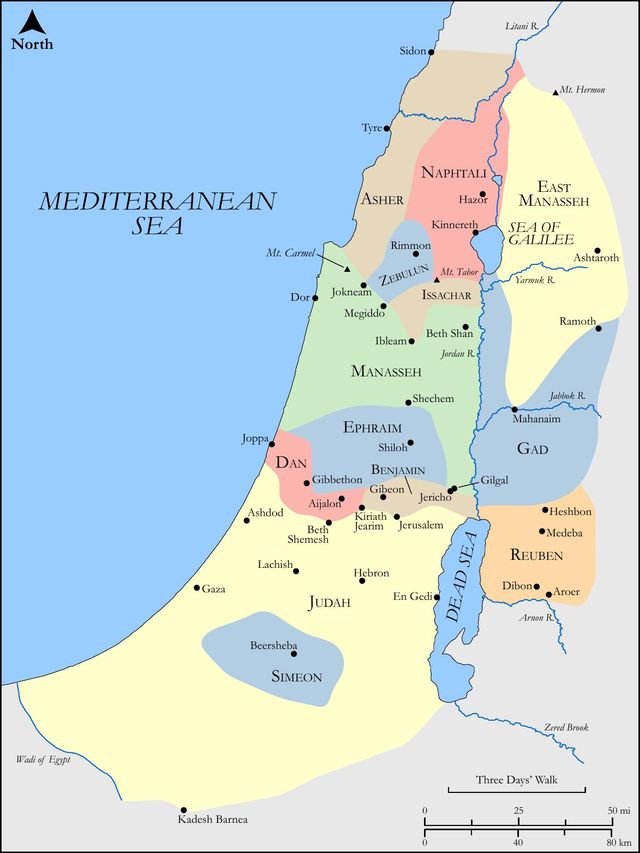
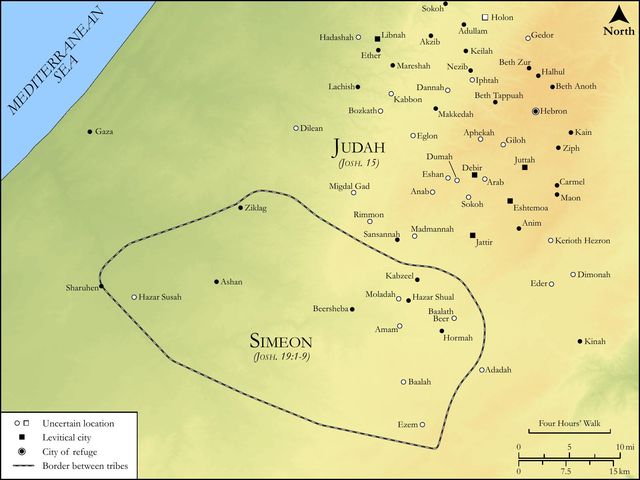
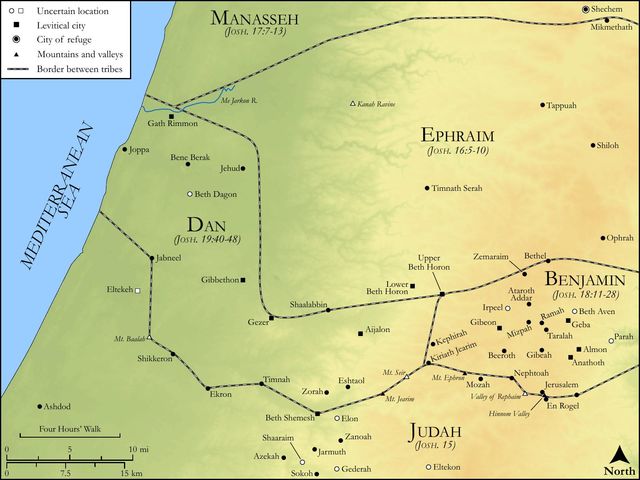
Study this verse
Public-domain commentary
Matthew Henry
From his Commentary on the Whole Bible. Henry comments on passages, not single verses — this entry covers Joshua 14:6–15. His four-level outline is real structure in the source text, so it is rendered as structure.
Before the lot was cast into the lap for the determining of the portions of the respective tribes, the particular portion of Caleb was assigned to him. He was now, except Joshua, not only the oldest man in all Israel, but was twenty years older than any of them, for all that were above twenty years old when he was forty were dead in the wilderness; it was fit therefore that this phoenix of his age should have some particular marks of honour put upon him in the dividing of the land. Now,
I.Caleb here presents his petition, or rather makes his demand, to have Hebron given him for a possession (this mountain he calls it, Jos 14:12), and not to have that put into the lot with the other parts of the country. To justify his demand, he shows that God had long since, by Moses, promised him that very mountain; so that God's mind being already made known in this matter it would be a vain and needless thing to consult it any further by casting lots, by which we are to appeal to God in those cases only which cannot otherwise be decided, not in those which, like this, are already determined. Caleb is here called the Kenezite, some think from some remarkable victory obtained by him over the Kenezites, as the Romans gave their great generals titles from the countries they conquered, as Africanus, Germanicus, etc. Observe,
1.To enforce his petition,
(1.)He brings the children of Judah, that is, the heads and great men of that tribe, along with him, to present it, who were willing thus to pay their respects to that ornament of their tribe, and to testify their consent that he should be provided for by himself, and that they would not take it as any reflection upon the rest of this tribe. Caleb was the person whom God had chosen out of that tribe to be employed in dividing the land (Num 34:19), and therefore, lest he should seem to improve his authority as a commissioner for his own private advantage and satisfaction, he brings his brethren along with him, and waiving his own power, seems rather to rely upon their interest.
(2.)He appeals to Joshua himself concerning the truth of the allegations upon which he grounded his petition: Thou knowest the thing, Jos 14:6.
(3.)He makes a very honourable mention of Moses, which he knew would not be at all unpleasing to Joshua: Moses the man of God (Jos 14:6), and the servant of the Lord, Jos 14:7. What Moses said he took as from God himself, because Moses was his mouth and his agent, and therefore he had reason both to desire and expect that it should be made good. What can be more earnestly desired than the tokens of God's favour? And what more confidently expected than the grants of his promise?
2.In his petition he sets forth,
(1.)The testimony of his conscience concerning his integrity in the management of that great affair on which it proved the fare of Israel turned, the spying out of the land. Caleb was one of the twelve that were sent out on that errand (Jos 14:7), and he now reflected upon it with comfort, and mentioned it, not in pride, but as that which, being the consideration of the grant, was necessary to be inserted in the plea,
[1.]That he made his report as it was in his heart, that is, he spoke as he thought when he spoke so honourably of the land of Canaan, so confidently of the power of God to put them in possession of it, and so contemptibly of the opposition that the Canaanites, even the Anakim themselves, could make against them, as we find he did, Num 13:30; Num 14:7-9. He did not do it merely to please Moses, or to keep the people quiet, much less from a spirit of contradiction to his fellows, but from a full conviction of the truth of what he said and a firm belief of the divine promise.
[2.]That herein he wholly followed the Lord his God, that is, he kept close to his duty, and sincerely aimed at the glory of God in it. He conformed himself to the divine will with an eye to the divine favour. He had obtained this testimony from God himself (Num 14:24), and therefore it was not vain-glory in him to speak of it, any more than it is for those who have God's Spirit witnessing with their spirits that they are the children of God humbly and thankfully to tell others for their encouragement what God has done for their souls. Note, Those that follow God fully when they are young shall have both the credit and comfort of it when they are old, and the reward of it for ever in the heavenly Canaan.
[3.]That he did this when all his brethren and companions in that service, except Joshua, did otherwise. They made the heart of the people melt (Jos 14:8), and how pernicious the consequences of it were was very well known. It adds much to the praise of following God if we adhere to him when others desert and decline from him. Caleb needed not to mention particularly Joshua's conduct in this matter; it was sufficiently known, and he would not seem to flatter him; it was enough to say (Jos 14:6), Thou knowest what the Lord spoke concerning me and thee.
(2.)The experience he had had of God's goodness to him ever since to this day. Though he had wandered with the rest in the wilderness, and had been kept thirty-eight years out of Canaan as they were, for that sin which he was so far from having a hand in that he had done his utmost to prevent it, yet, instead of complaining of this, he mentioned, to the glory of God, his mercy to him in two things: - [1.] That he was kept alive in the wilderness, not only notwithstanding the common perils and fatigues of that tedious march, but though all that generation of Israelites, except himself and Joshua, were one way or other cut off by death. With what a grateful sense of God's goodness to him does he speak it! (Jos 14:10). Now behold (behold and wonder) the Lord hath kept me alive these forty and five years, thirty-eight years in the wilderness, through the plagues of the desert, and seven years in Canaan through the perils of war! Note, First, While we live, it is God that keeps us alive; by his power he protects us from death, and by his bounty supplies us continually with the supports and comforts of life. He holdeth our soul in life. Secondly, The longer we live the more sensible we should be of God's goodness to us in keeping us alive, his care in prolonging our frail lives, his patience in prolonging our forfeited lives. Has he kept me alive these forty-five years? Is it about that time of life with us? Or is it more? Or is it less? We have reason to say, It is of the Lord's mercies that we are not consumed. How much are we indebted to the favour of God, and what shall we render? Let the life thus kept by the providence of God be devoted to his praise. Thirdly, The death of many others round about us should make us the more thankful to God for sparing us and keeping us alive. Thousands falling on our right hand and our left and yet ourselves spared. These distinguishing favours impose on us strong obligations to singular obedience. [2.] That he was fit for business, now that he was in Canaan. Though eighty-five years old, yet as hearty and lively as when he was forty (Jos 14:11): As my strength was then, so is it now. This was the fruit of the promise, and out-did what was said; for God not only gives what he promises, but he gives more: life by promise shall be life, and health, and strength, and all that which will make the promised life a blessing and comfort. Moses had said in his prayer (Psa 90:10) that at eighty years old even their strength is labour and sorrow, and so it is most commonly. But Caleb was an exception to the rule; his strength at eighty-five was ease and joy: this he got by following the Lord fully. Caleb here takes notice of this to the glory of God, and as an excuse for his asking a portion which he must fetch out of the giants' hands. Let not Joshua tell him he knew not what he asked; could he get the possession of that which he begged for a title to? "Yes," says he, "why not? I am as fit for war now as ever I was."
(3.)The promise Moses had made him in God's name that he should have this mountain, Jos 14:9. This promise is his chief plea, and that on which he relies. As we find it (Num 14:24) it is general, him will I bring into the land whereunto he went, and his seed shall possess it; but it seems it was more particular, and Joshua knew it; both sides understood this mountain for which Caleb was now a suitor to be intended. This was the place from which, more than any other, the spies took their report, for here they met with the sons of Anak (Num 13:22), the sight of whom made such an impression upon them, Jos 14:3. We may suppose that Caleb, observing what stress they laid upon the difficulty of conquering Hebron, a city garrisoned by the giants, and how thence they inferred that the conquest of the whole land was utterly impracticable, in opposition to their suggestions, and to convince the people that he spoke as he thought, bravely desired to have that city which they called invincible assigned to himself for his own portion: "I will undertake to deal with that, and, if I cannot get it for my inheritance, I will be without." "Well," said Moses, "it shall be thy own then, win it and wear it." Such a noble heroic spirit Caleb had, and so desirous was he to inspire his brethren with it, that he chose this place only because it was the most difficult to be conquered. And, to show that his soul did not decay any more than his body, now forty-five years after he adheres to his choice and is still of the same mind.
(4.)The hopes he had of being master of it, though the sons of Anak were in possession of it (Jos 14:12): If the Lord will be with me, then I shall be able to drive them out. The city of Hebron Joshua had already reduced (Jos 10:37), but the mountain which belonged to it, and which was inhabited by the sons of Anak, was yet unconquered; for though the cutting off of the Anakim from Hebron was mentioned Jos 11:21, because the historian would relate all the military actions together, yet it seems it was not conquered till after they had begun to divide the land. Observe, He builds his hopes of driving out the sons of Anak upon the presence of God with him. He does not say, "Because I am now as strong for war as I was at forty, therefore I shall drive them out," depending upon his personal valour; nor does he depend upon his interest in the warlike tribe of Judah, who attended him now in making this address, and no doubt would assist him; nor does he court Joshua's aid, or put it upon that, "If thou wilt be with me I shall gain my point." But, If the Lord will be with me. Here,
[1.]He seems to speak doubtfully of God's being with him, not from any distrust of his goodness or faithfulness. He had spoken without the least hesitation of God's presence with Israel in general (Num 14:9); the Lord is with us. But for himself, from a humble sense of his own unworthiness of such a favour, he chooses to express himself thus, If the Lord will be with me. The Chaldee paraphrase reads it, If the Word of the Lord be my helper, that Word which is God, and in the fulness of time was made flesh, and is the captain of our salvation.
[2.]But he expresses without the least doubt his assurance that if God were with him he should be able to dispossess the sons of Anak. "If God be with us, If God be for us, who can be against us, so as to prevail?" It is also intimated that if God were not with him, though all the forces of Israel should come in to his assistance, he should not be able to gain his point. Whatever we undertake, God's favourable presence with us is all in all to our success; this therefore we must earnestly pray for, and carefully make sure of, by keeping ourselves in the love of God; and on this we must depend, and from this take our encouragement against the greatest difficulties.
3.Upon the whole matter, Caleb's request is (Jos 14:12), Give me this mountain,
(1.)Because it was formerly in God's promise, and he would let Israel know how much he valued the promise, insisting upon this mountain, whereof the Lord spake in that day, as most desirable, though perhaps as good a portion might have fallen to him by lot in common with the rest. Those that live by faith value that which is given by promise far above that which is given by providence only.
(2.)Because it was now in the Anakim's possession, and he would let Israel know how little he feared the enemy, and would by his example animate them to push on their conquests. Herein Caleb answered his name, which signifies all heart.
II.Joshua grants his petition (Jos 14:13):
Joshua blessed him, commended his bravery, applauded his request, and gave him what he asked. He also prayed for him, and for his good success in his intended undertaking against the sons of Anak. Joshua was both a prince and a prophet, and upon both accounts it was proper for him to give Caleb his blessing, for the less is blessed of the better. Hebron was settled on Caleb and his heirs (Jos 14:14), because he wholly followed the Lord God of Israel. And happy are we if we follow him. Note, Singular piety shall be crowned with singular favours. Now,
1.We are here told what Hebron had been, the city of Arba, a great man among the Anakim (Jos 14:15); we find it called Kirjath-arba (Gen 23:2), as the place where Sarah died. Hereabouts Abraham, Isaac, and Jacob lived most of their time in Canaan, and near to it was the cave of Machpelah, where they were buried, which perhaps had led Caleb hither when he went to spy out the land, and had made him covet this rather than any other part for his inheritance.
2.We are afterwards told what Hebron was.
(1.)It was one of the cities belonging to priests (Jos 21:13), and a city of refuge, Jos 20:7. When Caleb had it, he contented himself with the country about it, and cheerfully gave the city to the priests, the Lord's ministers, thinking it could not be better bestowed, no, not upon his own children, nor that it was the less his own for being thus devoted to God.
(2.)It was a royal city, and, in the beginning of David's reign, the metropolis of the kingdom of Judah; thither the people resorted to him, and there he reigned seven years. Thus highly was Caleb's city honoured; it is a pity there should have been such a blemish upon his family long after as Nabal was, who was of the house of Caleb, Sa1 25:3. But the best men cannot entail their virtues.
Historical interpretation
Historical reception
2 surviving comments on this verse. Each one is dated, so this reads as a timeline rather than a list.
Select a marker to jump to its quote. Markers stagger vertically where authors wrote within a few decades of each other.
However, he [the Lord] said they should not come to that land which they had refused, as a penalty for their unbelief; but their children and wives, who had not murmured, and who, owing to their sex and age, were guiltless, should receive the promised inheritance of that land. So the bodies of those of twenty years old and upwards fell in the desert. The punishment of the rest was put aside. But they who had gone up with Joshua, and had thought fit to dissuade the people, died without delay of a great plague. Joshua and Caleb entered the land of promise together with those who were innocent by reason of age or sex. The better part, therefore, preferred glory to safety; the worse part safety to virtue. But the divine judgment approved those who thought virtue was above what is useful, while it condemned those who preferred what seemed more in accordance with safety than with what is virtuous.
A brother asked John, ‘What shall I do? A brother keeps coming and taking me away to help with the work which he is doing: but I am poor and ill, and too weak to do it. How can I obey God’s commandment?’ He answered him, ‘Caleb the son of Jephunneh said to Joshua the son of Nun, “I was forty years old when Moses the servant of the Lord sent me with you to that country and now I am eighty-five. Then I was strong: and I am still just as capable of beginning and ending a battle” (cf. Josh. 14:6, 10–11). So go with him and see if you finish the work as well as you begin it. If you can’t, sit in your cell and lament your sins. If they find you weeping when they come, they will not force you to go with them.’
Continue studying Joshua 14:9 across the web’s major study libraries — every link below opens this exact verse, chapter, or book on the destination site.
Read & Compare
 BibleGatewayThis verse in more than 200 translations and 70 languages.
 Bible.comThe YouVersion reader — hundreds of translations, reading plans, and highlights.
 ESV.orgCrossway's official English Standard Version reader.
 NET BibleThe NET translation with 60,000+ translators' notes on every rendering decision.
 STEP BibleTyndale House's free study tool — original text, vocabulary, and scholarly resources.
 BibliaLogos Bible Software's free web reader.
 USCCBThe New American Bible (Revised Edition) with the U.S. bishops' study notes.
Commentaries
 BibleHub CommentariesDozens of classic commentaries on this verse, gathered on one page.
 StudyLightMore than 100 commentary sets — the largest collection on the web.
 BibleRefPlain-English commentary on what this verse means, verse by verse.
 Enduring WordDavid Guzik's free commentary on this chapter, widely used by Bible teachers.
 Bible Study ToolsVerse commentary alongside Greek and Hebrew study aids.
Original Language & Research
- BibleHub InterlinearThe verse word by word — original language, transliteration, and English.
- BibleHub LexiconEvery word's original-language definition and Strong's entry.
 Blue Letter BibleDeep-study tools — Strong's numbers, concordance, and word studies.
 SefariaThe Hebrew text with Rashi and centuries of Jewish commentary.
Sermons, Hymns & Audio


TrulyRandomVerse is not affiliated with these sites and doesn’t control their content. They’re linked because they’re genuinely useful.
Summary
Joshua 14:9 records the solemn oath made by Moses to Caleb, promising him and his descendants a perpetual inheritance in the land of Canaan. This pivotal verse, recounted by an aged Caleb to Joshua decades later, serves as the foundational claim for his specific land allotment during the distribution of the Promised Land. It powerfully underscores the profound connection between unwavering, wholehearted devotion to the Lord and the faithful fulfillment of divine promises, highlighting God's steadfastness to those who fully commit to Him.
Context
ShowHideLiterary Context
Joshua 14:9 is strategically placed within the narrative of the land distribution, specifically at the beginning of the detailed tribal allotments (Joshua 14-19). It sets the stage for the entire process by presenting Caleb's unique case, which is rooted in a specific divine promise made 45 years prior during the wilderness wandering. Caleb, now 85 years old, approaches Joshua to claim the mountainous region of Hebron, a challenging area still inhabited by formidable Anakim. His appeal, based on Moses' oath, not only validates his personal inheritance but also serves as a powerful reminder of God's faithfulness to His word and to individuals who demonstrate exceptional loyalty. This narrative moment contrasts sharply with the earlier failures of the Israelite generation that perished in the wilderness, emphasizing the enduring reward for steadfast faith and courage in the face of daunting odds.
Historical & Cultural Context
The concept of land inheritance was absolutely central to Israelite identity and the fulfillment of God's covenant with Abraham, Isaac, and Jacob, as detailed in Genesis 12:1-3. Land represented not merely property but security, blessing, and the tangible manifestation of God's presence and covenant faithfulness among His people. Oaths, particularly those sworn by a divinely appointed leader like Moses, carried immense legal, moral, and theological weight in Israel, signifying an unbreakable commitment, often invoking divine witness or sanction. Caleb's claim, therefore, was not a mere personal request but an appeal to a divinely sanctioned promise made in the wilderness, a promise that transcended the general allocation of land and highlighted exceptional merit. His steadfastness stood in stark contrast to the faithlessness of the majority of his generation, underscoring the severe consequences of unbelief and the profound rewards of obedience within the covenant community.
Key Themes
ShowHideThis verse encapsulates several foundational theological and narrative themes. First, unwavering faithfulness is paramount, as Caleb's singular devotion to the Lord, even when the majority of his peers succumbed to fear and doubt (as recounted in Numbers 13:31-33), set him apart. This complete commitment is explicitly stated as the reason for Moses' oath, highlighting the immense value God places on wholehearted trust and obedience. Second, the theme of divine promise and covenant fulfillment is central, as Moses' oath was not a mere human pledge but a declaration rooted in God's own decree, demonstrating God's unwavering commitment to His word and His people. This promise, made decades earlier, now comes to fruition, affirming God's reliability and integrity. Third, the reward for steadfastness is vividly portrayed. Caleb's inheritance of Hebron, a challenging mountainous region, serves as a tangible testament to the blessings that accrue from persistent obedience and courage, illustrating the biblical principle that God honors those who honor Him, a truth echoed throughout scripture, such as in 1 Samuel 2:30.
Exposition and Analysis
ShowHideKey Word Analysis
ShowHideThis verb (H7650) signifies the taking of an oath, often with a solemn invocation of divine power to guarantee its fulfillment. When Moses "sware," it indicates that the promise to Caleb was not a casual declaration but a binding, divinely sanctioned commitment. This oath elevates the promise from a mere human word to one backed by the authority of God Himself, ensuring its eventual realization and underscoring the gravity and certainty of the declaration.
More than just property, "inheritance" (H5159) in biblical context refers to a divinely allotted portion, often land, that is passed down through generations. It is intrinsically linked to God's covenant promises to Israel regarding the land of Canaan, representing a secure and perpetual possession. For Caleb, this "inheritance" was a direct fulfillment of God's promise, signifying his rightful place and blessing within the covenant community, a tangible sign of God's favor and faithfulness that would extend to his descendants.
This crucial phrase, a combination of mālê' (H4390, "to fill" or "be full") and 'aḥar (H310, "after" or "behind"), literally conveys a sense of being "full after" or "to follow completely." It implies not just outward obedience but an inner alignment of heart, mind, and will with the Lord. Caleb's "wholly following" meant he pursued God's will without reservation, compromise, or deviation, setting him apart from the other spies and the doubting generation. This deep, internal commitment, a total devotion, was the fundamental reason for the extraordinary promise and subsequent blessing.
Verse Breakdown
ShowHide"And Moses sware on that day, saying,"
This opening clause establishes the solemnity and divine authority behind the promise. Moses, as God's chosen leader and prophet, delivers an oath that carries immense weight, indicating that this is not merely a human pledge but a declaration with God's backing and guarantee. The phrase "on that day" refers specifically to the time of the reconnaissance mission and the subsequent rebellion at Kadesh-Barnea, highlighting the immediate context of Caleb's faithfulness amidst widespread unbelief and the impending judgment on the faithless generation.
"Surely the land whereon thy feet have trodden shall be thine inheritance, and thy children's for ever,"
This is the core of the promise, detailing the specific blessing bestowed upon Caleb. The land he personally explored and stood upon would become his perpetual possession and that of his descendants. The emphatic "Surely" (or "Indeed") underscores the certainty of the promise, while "for ever" emphasizes the enduring nature of this inheritance, signifying a permanent and secure dwelling within the Promised Land, a tangible and lasting fulfillment of God's covenant with Israel.
"because thou hast wholly followed the LORD my God."
This final clause provides the explicit and singular reason for the extraordinary promise. Caleb's complete, unreserved, and unwavering faithfulness to the Lord is identified as the direct cause of this divine favor. It underscores the profound biblical principle that God honors those who honor Him, and that steadfast devotion, even in the face of widespread apostasy and fear, is met with specific and lasting blessing, setting Caleb apart from his peers.
Literary Devices
ShowHideJoshua 14:9 employs several potent literary devices to convey its profound message. Emphasis is achieved through the direct quotation of Moses' solemn oath, lending immediate gravitas and divine authority to Caleb's claim. The narrative's Repetition of the promise's origin (Moses' oath) throughout Joshua 14 underscores its foundational importance and the unwavering nature of God's word across decades. The verse also utilizes Contrast, implicitly setting Caleb's "wholly followed" against the faithlessness and rebellion of the other ten spies and the doubting generation, thereby highlighting his exceptional character and the unique favor he received. Furthermore, the land itself functions as powerful Symbolism, representing God's faithfulness, the fulfillment of covenant promises, and the tangible reward for obedience. The very act of Caleb recounting this promise decades later serves as a Retrospective Narrative, drawing the reader back to a pivotal moment in Israel's history and emphasizing the enduring nature of divine commitments and the long-term consequences of faith or unbelief.
Theological and Thematic Connections
ShowHideJoshua 14:9 stands as a powerful testament to the enduring principles of divine faithfulness and human obedience within the covenant relationship. Caleb's unwavering commitment to the Lord, even when faced with overwhelming opposition and fear, serves as a model of true faith that is both courageous and patient. This verse demonstrates unequivocally that God remembers and honors His promises, even across decades, to those who remain steadfastly loyal to Him. It underscores the profound theological truth that obedience is not merely a duty but a pathway to experiencing God's specific blessings and the fulfillment of His purposes in one's life. The inheritance of land, a central theme in the Old Testament, symbolizes the secure and abundant life God desires for His people, a life secured through covenant and sustained by faithfulness, demonstrating God's reciprocal commitment to those who fully commit to Him.
Reflection and Application
ShowHideJoshua 14:9 offers profound and enduring lessons for contemporary believers, challenging us to examine the depth and consistency of our own faith. Caleb's example urges us to cultivate a "wholehearted" devotion to God, one that is not swayed by popular opinion, challenging circumstances, or the passage of time. His perseverance reminds us that God is a promise-keeping God, and even when the fulfillment of His word seems delayed, His timing is perfect and His word is sure. This verse encourages us to stand firm in our convictions, trusting that our faithfulness, even in the face of adversity or the skepticism of others, is never in vain. Just as Caleb received his promised inheritance—a tangible blessing for his unwavering loyalty—we are assured that God honors those who honor Him, and our steadfastness in following Him will ultimately yield spiritual blessings and the realization of His divine purpose in our lives, far beyond what we can immediately perceive.
Questions for Reflection
ShowHideFAQ
ShowHideWhat does "wholly followed the LORD my God" truly mean in practice?
ShowHide"Wholly followed" (Hebrew: mālê' 'aḥar) signifies a complete, unreserved, and unwavering devotion to God. In practice, this means living a life where one's entire being—heart, mind, will, and actions—is aligned with God's commands and character. It implies an obedience that stems from a deep, internal trust and love for God, rather than mere external compliance, partial commitment, or a desire for personal gain. For Caleb, it meant standing firm in faith and giving a positive report when the vast majority of Israel doubted God's ability to deliver the Promised Land, as vividly recounted in Numbers 13-14. It involves prioritizing God's will above personal fear, convenience, or the opinions of others, demonstrating consistent loyalty and an undivided heart towards Him, even when it means walking a solitary path.
Why was Caleb singled out for this special promise and inheritance?
ShowHideCaleb was singled out for this special promise and inheritance precisely because of his unique and unwavering faithfulness, a distinction explicitly highlighted in Numbers 14:24. When Moses sent twelve spies into Canaan, only Caleb and Joshua returned with a positive and courageous report, expressing absolute confidence in God's power to grant them victory despite the formidable challenges. The other ten spies instilled fear and doubt, leading to Israel's rebellion and God's subsequent judgment that the entire generation, save Joshua and Caleb, would perish in the wilderness. Caleb's spirit was fundamentally different; the text states he had "a different spirit" and "wholly followed the LORD." This complete trust and obedience, a full commitment to God's word and power, distinguished him, making him worthy of God's specific and enduring blessing of inheritance in the Promised Land.
Christ-Centered Fulfillment
ShowHideJoshua 14:9, with its emphasis on Caleb's wholehearted faithfulness leading to a promised inheritance, finds its ultimate fulfillment and deeper meaning in Jesus Christ. Caleb's "wholly following the LORD" foreshadows the perfect, unwavering obedience of Christ, who perfectly fulfilled the Father's will in every aspect of His life and ministry, even to the point of death on the cross, as described in Philippians 2:8. Just as Caleb's inheritance was secured by a divine oath and his faithfulness, so too is the believer's spiritual inheritance—eternal life, adoption into God's family, and a place in God's eternal kingdom—secured by the perfect obedience and atoning sacrifice of Christ. He is the true and faithful Son who has secured for us an "inheritance that is imperishable, undefiled, and unfading, kept in heaven for you" (1 Peter 1:4). Caleb's long wait for his earthly inheritance points to the greater, spiritual "rest" and inheritance that believers enter into through faith in Christ, a rest that is promised to those who believe and persevere, as expounded in Hebrews 4:1-11. Ultimately, the land of promise for Caleb prefigures the new heavens and new earth, the eternal dwelling place with God, which is our ultimate inheritance through Christ, the faithful one who makes all things new and brings us into the fullness of God's presence (Revelation 21:1-4).