


Joshua 14:12
- וְעַתָּהve·'a·Tahand thereforeH6258Conj-w ¦ AdvAdverbוְandעַתָּהtherefore
- תְּנָהte·nahgive !H5414V-Qal-Imp-2ms ¦ SfxVerb Qal Imperative 2nd Singular Masculineתְּנָgiveה!
- לִּיlito <the> mePrep-l ¦ 1csSuffix Personal 1st Singular common genderלִּto <the>יme
- אֶת'et<obj.>H853DirObjMParticle Object Indicator
- הָהָרha·Harthe hill countryH2022Art ¦ N-msNoun Singular Masculine Absoluteהָtheהָרhill country
- הַזֶּהha·Zeh<the> thisH2088Art ¦ PrtParticle Demonstrativeהַ<the>זֶּהthis
- אֲשֶׁר'a·SherwhichH834RelParticle Relative
- דִּבֶּרdi·Berhe spokeH1696V-Piel-Perf-3msVerb Piel Perfect 3rd Singular Masculine
- יְהוָהYah·wehYahwehH3068N-properNoun Proper Title
- בַּיּוֹםbai·Yomon the dayH3117Prep-b ¦ N-msNoun Singular Masculine Absoluteבַּon theיּוֹםday
- הַהוּאha·Hu'<the> thatH1931Art ¦ Pro-3msPronoun Personal 3rd Singular Masculineהַ<the>הוּאthat
- כִּיkiforH3588PrtParticle Conditional
- אַתָּה'a·tahyouH859Pro-2msPronoun Personal 2nd Singular Masculine
- שָׁמַעְתָּsha·ma'·Tayou heardH8085V-Qal-Perf-2msVerb Qal Perfect 2nd Singular Masculine
- בַיּוֹםvai·Yomon the dayH3117Prep-b ¦ N-msNoun Singular Masculine Absoluteבַon theיּוֹםday
- הַהוּאha·Hu'<the> thatH1931Art ¦ Pro-3msPronoun Personal 3rd Singular Masculineהַ<the>הוּאthat
- כִּיkithatH3588PrtParticle Conditional
- עֲנָקִים'a·na·KimAnakitesH6062N-mpNoun Gentilic Plural Masculine Absolute
- שָׁםSham[were] thereH8033AdvAdverb
- וְעָרִיםve·'a·Rimand citiesH5892Conj-w ¦ N-mpNoun Plural Masculine Absoluteוְandעָרִיםcities
- גְּדֹלוֹתge·do·LotlargeH1419Adj-fpAdjective Plural Feminine Absolute
- בְּצֻרוֹתbe·tzu·RotfortifiedH1219Adj-fpAdjective Plural Feminine Absolute
- אוּלַי'u·LaiperhapsH194AdvAdverb
- יְהוָהYah·wehYahwehH3068N-properNoun Proper Title
- אוֹתִי'o·Tiwith <the> meH854Prep ¦ 1csPreposition Definiteאוֹתִwith <the>יme
- וְהוֹרַשְׁתִּיםve·Ho·rash·Timand I will dispossess themH3423Conj-w ¦ V-Hiphil-ConsecPerf-1cs ¦ 3mpVerb Hiphil Consecutive Perfect 1st Singular common genderוְandהוֹרַשְׁתִּיI will dispossessםthem
- כַּאֲשֶׁרka·'a·Sherjust asH834Prep-k ¦ RelParticle Relativeכַּjustאֲשֶׁרas
- דִּבֶּרdi·Berhe spokeH1696V-Piel-Perf-3msVerb Piel Perfect 3rd Singular Masculine
- יְהוָהYah·wehYahwehH3068N-properNoun Proper Title
English is a literal word-by-word gloss of the Hebrew, not the KJV's wording. Why?
This is the original text the KJV's translators worked from — each Hebrew word with its own literal English meaning in this verse, prepared by scholars at Tyndale House, Cambridge. The KJV translates whole sentences, not word by word, so its wording differs: one Hebrew word can become several English words, and the KJV may choose “the LORD” where the gloss reads “Yahweh”. Both are faithful — they answer different questions. For the KJV's own rendering, switch to the KJV text.
Details
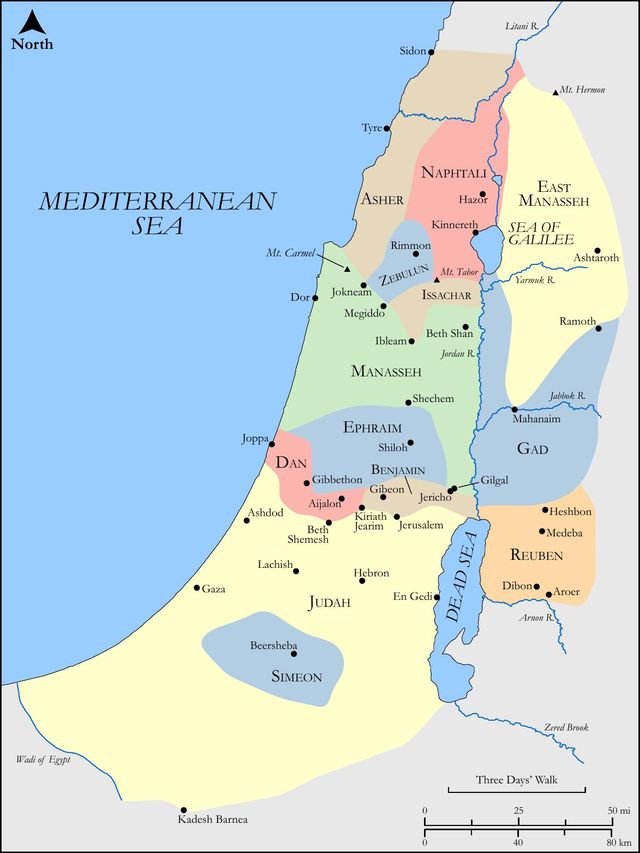
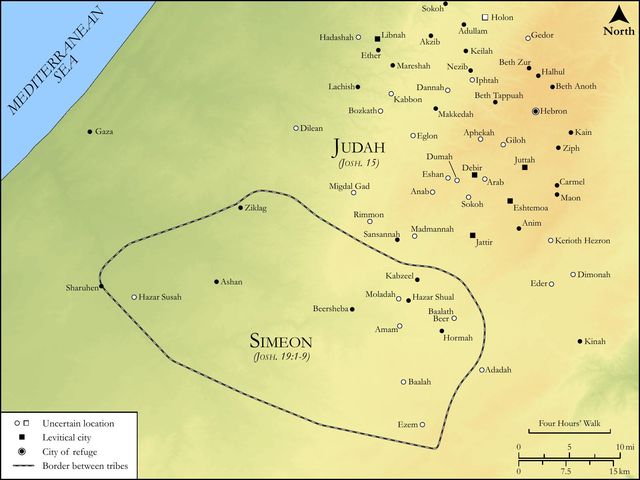
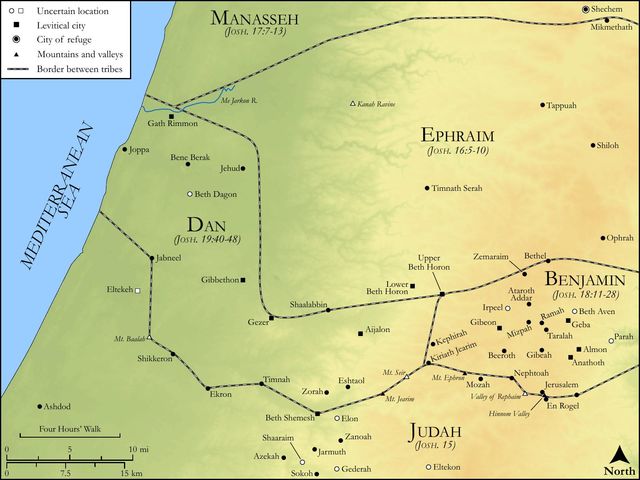
See on the biblical-era map
Study this verse
Public-domain commentary
Matthew Henry
From his Commentary on the Whole Bible. Henry comments on passages, not single verses — this entry covers Joshua 14:6–15. His four-level outline is real structure in the source text, so it is rendered as structure.
Before the lot was cast into the lap for the determining of the portions of the respective tribes, the particular portion of Caleb was assigned to him. He was now, except Joshua, not only the oldest man in all Israel, but was twenty years older than any of them, for all that were above twenty years old when he was forty were dead in the wilderness; it was fit therefore that this phoenix of his age should have some particular marks of honour put upon him in the dividing of the land. Now,
I.Caleb here presents his petition, or rather makes his demand, to have Hebron given him for a possession (this mountain he calls it, Jos 14:12), and not to have that put into the lot with the other parts of the country. To justify his demand, he shows that God had long since, by Moses, promised him that very mountain; so that God's mind being already made known in this matter it would be a vain and needless thing to consult it any further by casting lots, by which we are to appeal to God in those cases only which cannot otherwise be decided, not in those which, like this, are already determined. Caleb is here called the Kenezite, some think from some remarkable victory obtained by him over the Kenezites, as the Romans gave their great generals titles from the countries they conquered, as Africanus, Germanicus, etc. Observe,
1.To enforce his petition,
(1.)He brings the children of Judah, that is, the heads and great men of that tribe, along with him, to present it, who were willing thus to pay their respects to that ornament of their tribe, and to testify their consent that he should be provided for by himself, and that they would not take it as any reflection upon the rest of this tribe. Caleb was the person whom God had chosen out of that tribe to be employed in dividing the land (Num 34:19), and therefore, lest he should seem to improve his authority as a commissioner for his own private advantage and satisfaction, he brings his brethren along with him, and waiving his own power, seems rather to rely upon their interest.
(2.)He appeals to Joshua himself concerning the truth of the allegations upon which he grounded his petition: Thou knowest the thing, Jos 14:6.
(3.)He makes a very honourable mention of Moses, which he knew would not be at all unpleasing to Joshua: Moses the man of God (Jos 14:6), and the servant of the Lord, Jos 14:7. What Moses said he took as from God himself, because Moses was his mouth and his agent, and therefore he had reason both to desire and expect that it should be made good. What can be more earnestly desired than the tokens of God's favour? And what more confidently expected than the grants of his promise?
2.In his petition he sets forth,
(1.)The testimony of his conscience concerning his integrity in the management of that great affair on which it proved the fare of Israel turned, the spying out of the land. Caleb was one of the twelve that were sent out on that errand (Jos 14:7), and he now reflected upon it with comfort, and mentioned it, not in pride, but as that which, being the consideration of the grant, was necessary to be inserted in the plea,
[1.]That he made his report as it was in his heart, that is, he spoke as he thought when he spoke so honourably of the land of Canaan, so confidently of the power of God to put them in possession of it, and so contemptibly of the opposition that the Canaanites, even the Anakim themselves, could make against them, as we find he did, Num 13:30; Num 14:7-9. He did not do it merely to please Moses, or to keep the people quiet, much less from a spirit of contradiction to his fellows, but from a full conviction of the truth of what he said and a firm belief of the divine promise.
[2.]That herein he wholly followed the Lord his God, that is, he kept close to his duty, and sincerely aimed at the glory of God in it. He conformed himself to the divine will with an eye to the divine favour. He had obtained this testimony from God himself (Num 14:24), and therefore it was not vain-glory in him to speak of it, any more than it is for those who have God's Spirit witnessing with their spirits that they are the children of God humbly and thankfully to tell others for their encouragement what God has done for their souls. Note, Those that follow God fully when they are young shall have both the credit and comfort of it when they are old, and the reward of it for ever in the heavenly Canaan.
[3.]That he did this when all his brethren and companions in that service, except Joshua, did otherwise. They made the heart of the people melt (Jos 14:8), and how pernicious the consequences of it were was very well known. It adds much to the praise of following God if we adhere to him when others desert and decline from him. Caleb needed not to mention particularly Joshua's conduct in this matter; it was sufficiently known, and he would not seem to flatter him; it was enough to say (Jos 14:6), Thou knowest what the Lord spoke concerning me and thee.
(2.)The experience he had had of God's goodness to him ever since to this day. Though he had wandered with the rest in the wilderness, and had been kept thirty-eight years out of Canaan as they were, for that sin which he was so far from having a hand in that he had done his utmost to prevent it, yet, instead of complaining of this, he mentioned, to the glory of God, his mercy to him in two things: - [1.] That he was kept alive in the wilderness, not only notwithstanding the common perils and fatigues of that tedious march, but though all that generation of Israelites, except himself and Joshua, were one way or other cut off by death. With what a grateful sense of God's goodness to him does he speak it! (Jos 14:10). Now behold (behold and wonder) the Lord hath kept me alive these forty and five years, thirty-eight years in the wilderness, through the plagues of the desert, and seven years in Canaan through the perils of war! Note, First, While we live, it is God that keeps us alive; by his power he protects us from death, and by his bounty supplies us continually with the supports and comforts of life. He holdeth our soul in life. Secondly, The longer we live the more sensible we should be of God's goodness to us in keeping us alive, his care in prolonging our frail lives, his patience in prolonging our forfeited lives. Has he kept me alive these forty-five years? Is it about that time of life with us? Or is it more? Or is it less? We have reason to say, It is of the Lord's mercies that we are not consumed. How much are we indebted to the favour of God, and what shall we render? Let the life thus kept by the providence of God be devoted to his praise. Thirdly, The death of many others round about us should make us the more thankful to God for sparing us and keeping us alive. Thousands falling on our right hand and our left and yet ourselves spared. These distinguishing favours impose on us strong obligations to singular obedience. [2.] That he was fit for business, now that he was in Canaan. Though eighty-five years old, yet as hearty and lively as when he was forty (Jos 14:11): As my strength was then, so is it now. This was the fruit of the promise, and out-did what was said; for God not only gives what he promises, but he gives more: life by promise shall be life, and health, and strength, and all that which will make the promised life a blessing and comfort. Moses had said in his prayer (Psa 90:10) that at eighty years old even their strength is labour and sorrow, and so it is most commonly. But Caleb was an exception to the rule; his strength at eighty-five was ease and joy: this he got by following the Lord fully. Caleb here takes notice of this to the glory of God, and as an excuse for his asking a portion which he must fetch out of the giants' hands. Let not Joshua tell him he knew not what he asked; could he get the possession of that which he begged for a title to? "Yes," says he, "why not? I am as fit for war now as ever I was."
(3.)The promise Moses had made him in God's name that he should have this mountain, Jos 14:9. This promise is his chief plea, and that on which he relies. As we find it (Num 14:24) it is general, him will I bring into the land whereunto he went, and his seed shall possess it; but it seems it was more particular, and Joshua knew it; both sides understood this mountain for which Caleb was now a suitor to be intended. This was the place from which, more than any other, the spies took their report, for here they met with the sons of Anak (Num 13:22), the sight of whom made such an impression upon them, Jos 14:3. We may suppose that Caleb, observing what stress they laid upon the difficulty of conquering Hebron, a city garrisoned by the giants, and how thence they inferred that the conquest of the whole land was utterly impracticable, in opposition to their suggestions, and to convince the people that he spoke as he thought, bravely desired to have that city which they called invincible assigned to himself for his own portion: "I will undertake to deal with that, and, if I cannot get it for my inheritance, I will be without." "Well," said Moses, "it shall be thy own then, win it and wear it." Such a noble heroic spirit Caleb had, and so desirous was he to inspire his brethren with it, that he chose this place only because it was the most difficult to be conquered. And, to show that his soul did not decay any more than his body, now forty-five years after he adheres to his choice and is still of the same mind.
(4.)The hopes he had of being master of it, though the sons of Anak were in possession of it (Jos 14:12): If the Lord will be with me, then I shall be able to drive them out. The city of Hebron Joshua had already reduced (Jos 10:37), but the mountain which belonged to it, and which was inhabited by the sons of Anak, was yet unconquered; for though the cutting off of the Anakim from Hebron was mentioned Jos 11:21, because the historian would relate all the military actions together, yet it seems it was not conquered till after they had begun to divide the land. Observe, He builds his hopes of driving out the sons of Anak upon the presence of God with him. He does not say, "Because I am now as strong for war as I was at forty, therefore I shall drive them out," depending upon his personal valour; nor does he depend upon his interest in the warlike tribe of Judah, who attended him now in making this address, and no doubt would assist him; nor does he court Joshua's aid, or put it upon that, "If thou wilt be with me I shall gain my point." But, If the Lord will be with me. Here,
[1.]He seems to speak doubtfully of God's being with him, not from any distrust of his goodness or faithfulness. He had spoken without the least hesitation of God's presence with Israel in general (Num 14:9); the Lord is with us. But for himself, from a humble sense of his own unworthiness of such a favour, he chooses to express himself thus, If the Lord will be with me. The Chaldee paraphrase reads it, If the Word of the Lord be my helper, that Word which is God, and in the fulness of time was made flesh, and is the captain of our salvation.
[2.]But he expresses without the least doubt his assurance that if God were with him he should be able to dispossess the sons of Anak. "If God be with us, If God be for us, who can be against us, so as to prevail?" It is also intimated that if God were not with him, though all the forces of Israel should come in to his assistance, he should not be able to gain his point. Whatever we undertake, God's favourable presence with us is all in all to our success; this therefore we must earnestly pray for, and carefully make sure of, by keeping ourselves in the love of God; and on this we must depend, and from this take our encouragement against the greatest difficulties.
3.Upon the whole matter, Caleb's request is (Jos 14:12), Give me this mountain,
(1.)Because it was formerly in God's promise, and he would let Israel know how much he valued the promise, insisting upon this mountain, whereof the Lord spake in that day, as most desirable, though perhaps as good a portion might have fallen to him by lot in common with the rest. Those that live by faith value that which is given by promise far above that which is given by providence only.
(2.)Because it was now in the Anakim's possession, and he would let Israel know how little he feared the enemy, and would by his example animate them to push on their conquests. Herein Caleb answered his name, which signifies all heart.
II.Joshua grants his petition (Jos 14:13):
Joshua blessed him, commended his bravery, applauded his request, and gave him what he asked. He also prayed for him, and for his good success in his intended undertaking against the sons of Anak. Joshua was both a prince and a prophet, and upon both accounts it was proper for him to give Caleb his blessing, for the less is blessed of the better. Hebron was settled on Caleb and his heirs (Jos 14:14), because he wholly followed the Lord God of Israel. And happy are we if we follow him. Note, Singular piety shall be crowned with singular favours. Now,
1.We are here told what Hebron had been, the city of Arba, a great man among the Anakim (Jos 14:15); we find it called Kirjath-arba (Gen 23:2), as the place where Sarah died. Hereabouts Abraham, Isaac, and Jacob lived most of their time in Canaan, and near to it was the cave of Machpelah, where they were buried, which perhaps had led Caleb hither when he went to spy out the land, and had made him covet this rather than any other part for his inheritance.
2.We are afterwards told what Hebron was.
(1.)It was one of the cities belonging to priests (Jos 21:13), and a city of refuge, Jos 20:7. When Caleb had it, he contented himself with the country about it, and cheerfully gave the city to the priests, the Lord's ministers, thinking it could not be better bestowed, no, not upon his own children, nor that it was the less his own for being thus devoted to God.
(2.)It was a royal city, and, in the beginning of David's reign, the metropolis of the kingdom of Judah; thither the people resorted to him, and there he reigned seven years. Thus highly was Caleb's city honoured; it is a pity there should have been such a blemish upon his family long after as Nabal was, who was of the house of Caleb, Sa1 25:3. But the best men cannot entail their virtues.
Continue studying Joshua 14:12 across the web’s major study libraries — every link below opens this exact verse, chapter, or book on the destination site.
Read & Compare
 BibleGatewayThis verse in more than 200 translations and 70 languages.
 Bible.comThe YouVersion reader — hundreds of translations, reading plans, and highlights.
 ESV.orgCrossway's official English Standard Version reader.
 NET BibleThe NET translation with 60,000+ translators' notes on every rendering decision.
 STEP BibleTyndale House's free study tool — original text, vocabulary, and scholarly resources.
 BibliaLogos Bible Software's free web reader.
 USCCBThe New American Bible (Revised Edition) with the U.S. bishops' study notes.
Commentaries
 BibleHub CommentariesDozens of classic commentaries on this verse, gathered on one page.
 StudyLightMore than 100 commentary sets — the largest collection on the web.
 BibleRefPlain-English commentary on what this verse means, verse by verse.
 Enduring WordDavid Guzik's free commentary on this chapter, widely used by Bible teachers.
 Bible Study ToolsVerse commentary alongside Greek and Hebrew study aids.
Original Language & Research
- BibleHub InterlinearThe verse word by word — original language, transliteration, and English.
- BibleHub LexiconEvery word's original-language definition and Strong's entry.
 Blue Letter BibleDeep-study tools — Strong's numbers, concordance, and word studies.
 SefariaThe Hebrew text with Rashi and centuries of Jewish commentary.
Sermons, Hymns & Audio


TrulyRandomVerse is not affiliated with these sites and doesn’t control their content. They’re linked because they’re genuinely useful.
Summary
Joshua 14:12 powerfully encapsulates the unwavering faith and audacious courage of Caleb, an eighty-five-year-old patriarch, as he boldly claims his promised inheritance. Despite the formidable presence of the Anakim, a race of giants, and their heavily fortified cities in the rugged mountainous region of Hebron, Caleb expresses absolute confidence in the Lord's continued presence and power to enable him to conquer this challenging territory, fulfilling a divine promise made forty-five years prior. This verse stands as a testament to enduring trust in God's word, regardless of overwhelming obstacles or advanced age.
Context
ShowHideLiterary Context
This pivotal verse is situated within the broader narrative of the division of the land of Canaan among the Israelite tribes, following the initial conquests led by Joshua. Specifically, Joshua 14 details the special inheritance granted to Caleb, fulfilling a long-standing divine promise. Caleb's request for the most challenging territory, rather than an easier portion, serves as a profound example of faith and courage for the entire nation. It immediately precedes the general distribution of land to the other tribes, setting a high standard of courageous obedience and trust in God for the ongoing task of fully possessing the promised land, emphasizing that the initial victories were merely the beginning of the complete conquest.
Historical & Cultural Context
Caleb's request in Joshua 14:12 occurs approximately forty-five years after the Israelites' exodus from Egypt and the initial reconnaissance of Canaan. During that first scouting mission, Caleb, alongside Joshua, stood firm in faith against the ten fearful spies who magnified the strength of the land's inhabitants, particularly the Anakim, a formidable race of giants (Numbers 13:28). As a direct consequence of his unwavering trust, God promised Caleb that he would inherit the land upon which he had trodden (Numbers 14:24 and Deuteronomy 1:36). The city of Hebron, the specific "mountain" Caleb requests, was not only a strategic stronghold but also held immense historical and cultural importance as the burial place of Abraham, Isaac, and Jacob (Genesis 23:19), making its conquest deeply symbolic for Israel's heritage.
Key Themes
ShowHideCaleb's bold declaration in this verse powerfully encapsulates several foundational themes that resonate throughout the book of Joshua and the entire biblical narrative. First, it underscores the theme of unwavering faith in God's promises, demonstrating a trust that endures across decades and defies overwhelming odds. Caleb's confidence is not in his own strength or advanced age, but solely in the Lord's ability to fulfill His word, even against the formidable Anakim mentioned in Numbers 13:33. Second, it exemplifies courage and perseverance, as an octogenarian chooses the most challenging task rather than resting on past accomplishments, illustrating that God's call and empowerment are not limited by age or perceived physical limitations. Third, the phrase "if so be the LORD will be with me" is critical, emphasizing divine empowerment and absolute dependence. Caleb recognizes that success is entirely contingent on God's active presence and power, rather than human might. Finally, the verse illustrates the principle of inheriting God's promises through faithfulness, showing that consistent obedience and trust lead to the tangible fulfillment of divine covenant blessings, even if the fulfillment is delayed for many years, as was the case for the Israelites entering Canaan (Joshua 21:43-45).
Exposition and Analysis
ShowHideKey Word Analysis
ShowHideIn this context, "mountain" refers specifically to the rugged hill country surrounding Hebron, a region known for its strategic importance and formidable terrain. Mountains often symbolized significant obstacles and strongholds in ancient warfare. Caleb's request for "this mountain" is not for an easy inheritance but for the most challenging, indicating his extraordinary faith and desire to confront the very heart of the Anakim's power, turning a symbol of fear into a testament of conquest.
Patronymically from Anak, these were a race of formidable giants, renowned for their imposing stature and strength. Their presence was the primary reason the ten unfaithful spies instilled fear in the Israelite camp, leading to forty years of wilderness wandering (Numbers 13:33). Caleb's specific mention of them highlights the magnitude of the challenge he is willing to face, directly confronting the source of Israel's past fear and failure, and demonstrating his unwavering trust in God's superior power.
This verb, from a primitive root meaning "to occupy (by driving out previous tenants, and possessing in their place)," implies a complete and forceful removal of the current inhabitants, signifying total conquest and permanent occupation. It also carries connotations of inheriting or taking possession. Caleb's use of this strong verb underscores his conviction that, with God's help, he will achieve a decisive victory, not merely a temporary skirmish, but a full and lasting disinheritance of the Anakim.
Verse Breakdown
ShowHide"Now therefore give me this mountain, whereof the LORD spake in that day;"
Caleb, having reminded Joshua of God's specific promise to him made forty-five years prior, now makes his direct and bold claim. The "mountain" refers to the region of Hebron, which was known to be inhabited by the formidable Anakim. Caleb is not asking for just any land, but precisely the challenging territory that God had promised him personally due to his unwavering faithfulness. This demonstrates his meticulous remembrance of God's word and his desire for its precise and complete fulfillment.
"for thou heardest in that day how the Anakims [were] there, and [that] the cities [were] great [and] fenced:"
Caleb explicitly acknowledges the formidable nature of the challenge he is undertaking. He reminds Joshua that both of them were fully aware of the Anakim's imposing presence and the strength of their "great and fenced" (fortified) cities from their initial scouting mission. This is not a request born of ignorance or naivete, but a deliberate choice to confront the greatest obstacles, fully aware of their difficulty, yet utterly undeterred by them. It highlights the stark contrast between Caleb's faith and the fear that gripped the rest of Israel decades earlier.
"if so be the LORD [will be] with me, then I shall be able to drive them out, as the LORD said."
This concluding clause is the linchpin of Caleb's profound faith and the theological heart of the verse. The phrase "if so be the LORD will be with me" is not an expression of doubt or uncertainty, but rather a statement of absolute dependence and confident expectation in God's active presence and empowering might. It acknowledges that his ability to "drive them out" is not based on his own strength, youth, or military prowess, but entirely on the Lord's active participation and supernatural empowerment. The final phrase, "as the LORD said," reaffirms his unwavering belief in the divine promise and its ultimate, guaranteed fulfillment.
Literary Devices
ShowHideJoshua 14:12 masterfully employs several literary devices to convey Caleb's profound faith and courage, making his declaration resonate with power. Contrast is central, as Caleb's bold request for the most challenging territory stands in stark opposition to the fear and unbelief of the other ten spies who, forty-five years earlier, recoiled from the very giants Caleb now seeks to dispossess. This highlights Caleb's unique spiritual fortitude and singular focus on God's promises. The repetition of the phrase "in that day" emphasizes the remarkable longevity of God's promise and Caleb's enduring memory and trust in it, spanning nearly half a century and underscoring divine faithfulness across generations. The "mountain" itself functions as potent symbolism, representing not just a physical location but also the formidable challenges, seemingly insurmountable obstacles, and deeply entrenched spiritual strongholds that faith is called to confront and overcome. Furthermore, there's a subtle yet powerful irony in an eighty-five-year-old man volunteering for the toughest fight, subverting conventional expectations of age and capability, and underscoring that divine empowerment transcends all human limitations.
Theological and Thematic Connections
ShowHideCaleb's unwavering faith in Joshua 14:12 serves as a powerful testament to the enduring nature of God's promises and the transformative power of a life lived in complete dependence on Him. His willingness to confront the Anakim, despite their formidable reputation and his advanced age, illustrates that true spiritual strength is not found in human might but in divine presence and faithfulness. This passage underscores that God honors persistent faith, even when circumstances seem impossible, and that His faithfulness empowers believers to overcome obstacles that would otherwise be insurmountable. Caleb's example calls believers to embrace God's promises with courageous obedience, trusting that His presence guarantees victory over spiritual "giants" and enables the full inheritance of His blessings, reminding us that God's power is made perfect in our weakness.
Reflection and Application
ShowHideCaleb's story in Joshua 14:12 offers profound encouragement for believers navigating the challenges of life today. It reminds us that spiritual vitality and the capacity for God's work are not diminished by age, past failures, or the sheer magnitude of the obstacles before us. Just as Caleb, at 85, still possessed the same spirit and faith he had at 40, we are called to maintain a vibrant, active trust in God's promises throughout our lives, from youth to old age. This means identifying the "mountains" in our own lives—the seemingly insurmountable problems, the deeply ingrained sins, the intimidating challenges, the long-standing family issues, or the daunting professional tasks—and approaching them not with fear or resignation, but with the conviction that "if so be the LORD will be with me, then I shall be able to drive them out." Our confidence is not in our own strength, wisdom, or resources, but in the unfailing presence and omnipotent power of God, who enables us to claim the spiritual inheritance and victory He has promised. Caleb's example challenges us to live out our faith boldly, to confront our fears with God's promises, and to never retire from the spiritual battle until God's purpose is fully accomplished in and through us.
Questions for Reflection
ShowHideFAQ
ShowHideWhy did Caleb specifically ask for the mountain of Hebron, knowing it was inhabited by giants?
ShowHideCaleb's request for Hebron was a deliberate act of profound faith and a direct claim on a specific promise God had made to him. Forty-five years earlier, when the other spies instilled fear by focusing on the Anakim giants in Hebron, Caleb and Joshua alone declared that Israel could overcome them because God was with them (Numbers 13:28-33 and Numbers 14:6-9). As a reward for his unwavering faith, God promised Caleb that he would inherit the very land upon which he had trodden (Numbers 14:24). By requesting Hebron, Caleb was not only claiming his promised inheritance but also demonstrating his continued, undiminished trust in God's power to conquer the most formidable obstacles, directly confronting the source of Israel's past fear and unbelief, and proving that God's promises are always true.
What is the significance of Caleb being 85 years old when he makes this request?
ShowHideCaleb's age of 85 is highly significant, emphasizing that his strength and courage were supernaturally sustained by God, not diminished by the passage of time. He states, "As yet I am as strong this day as I was in the day that Moses sent me: as my strength was then, even so is my strength now, for war, both to go out, and to come in" (Joshua 14:11). This highlights that spiritual vitality and God's empowering presence are not limited by physical age or conventional human capabilities. It serves as a powerful example that faithfulness over a long period, even decades, is honored by God, and that His purposes for us can extend throughout our entire lives, regardless of our perceived limitations, demonstrating that God equips those He calls, regardless of their age.
Christ-Centered Fulfillment
ShowHideCaleb's audacious faith in conquering the Anakim-infested mountain of Hebron finds its ultimate and profound fulfillment in the person and work of Jesus Christ. Caleb's confidence that "if so be the LORD will be with me, then I shall be able to drive them out" foreshadows the ultimate victory achieved not by human might, but by the divine presence of God incarnate. While Caleb conquered physical giants and earthly strongholds, Christ faced and definitively triumphed over the spiritual "giants" of sin, death, and Satan, which held humanity captive (Colossians 2:15). The "mountain" Caleb sought to possess, a place of historical significance and formidable challenge, points to the spiritual inheritance and heavenly places that believers now possess in Christ (Ephesians 1:3 and Ephesians 2:6). Jesus, the true and greater Joshua, leads His people not into a physical land, but into eternal life and victory over all spiritual opposition. Our ability to overcome the "giants" of this world, whether they be fear, temptation, adversity, or the spiritual forces of darkness, is not based on our own strength or age, but solely on the indwelling presence of Christ and His completed work on the cross, enabling us to declare with confidence, "I can do all things through Christ who strengthens me" (Philippians 4:13).