


Joshua 14:13
- וַיְבָרְכֵהוּvay·va·re·Khe·huand he blessed himH1288Conj-w ¦ V-Piel-ConsecImperf-3ms ¦ 3msVerb Piel Consecutive Imperfect 3rd Singular Masculineוַandיְבָרְכֵhe blessedהוּhim
- יְהוֹשֻׁעַye·ho·Shu·a'JoshuaH3091N-proper-mNoun Proper Masculine
- וַיִּתֵּןvai·yi·Tenand he gaveH5414Conj-w ¦ V-Qal-ConsecImperf-3msVerb Qal Consecutive Imperfect 3rd Singular Masculineוַandיִּתֵּןhe gave
- אֶת'et<obj.>H853DirObjMParticle Object Indicator
- חֶבְרוֹןchev·RonHebronH2275N-properNoun Proper Location
- לְכָלֵבle·kha·Levto CalebH3612Prep-l ¦ N-proper-mNoun Proper MasculineלְtoכָלֵבCaleb
- בֶּןben[the] son ofH1121N-mscNoun Singular Masculine Construct
- יְפֻנֶּהye·fu·NehJephunnehH3312N-proper-mNoun Proper Masculine
- לְנַחֲלָהle·na·cha·Lahto an inheritanceH5159Prep-l ¦ N-fsNoun Singular Feminine Absoluteלְtoנַחֲלָהan inheritance
English is a literal word-by-word gloss of the Hebrew, not the KJV's wording. Why?
This is the original text the KJV's translators worked from — each Hebrew word with its own literal English meaning in this verse, prepared by scholars at Tyndale House, Cambridge. The KJV translates whole sentences, not word by word, so its wording differs: one Hebrew word can become several English words, and the KJV may choose “the LORD” where the gloss reads “Yahweh”. Both are faithful — they answer different questions. For the KJV's own rendering, switch to the KJV text.
Details
See on the biblical-era map
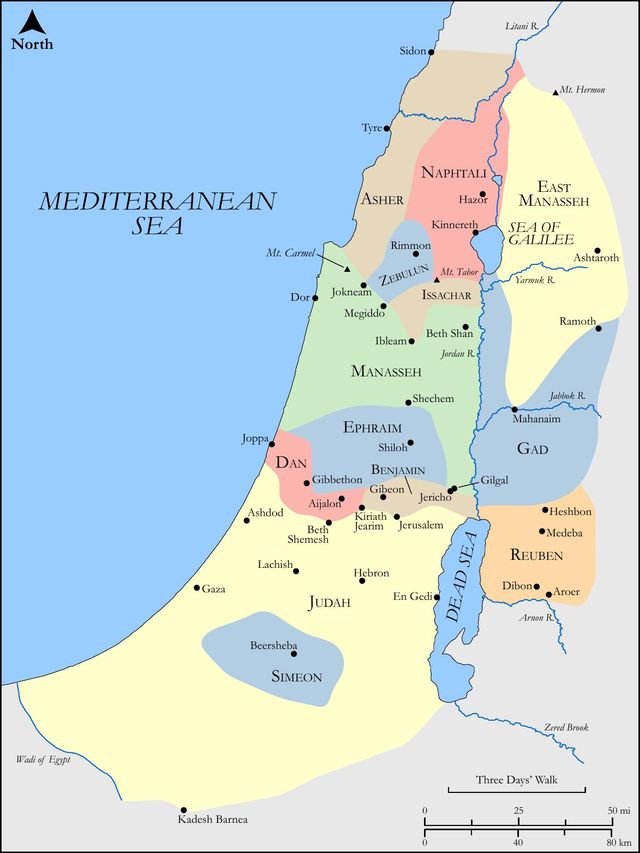
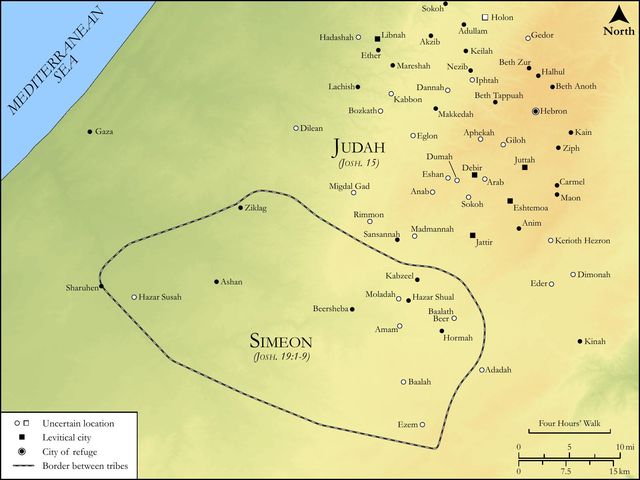
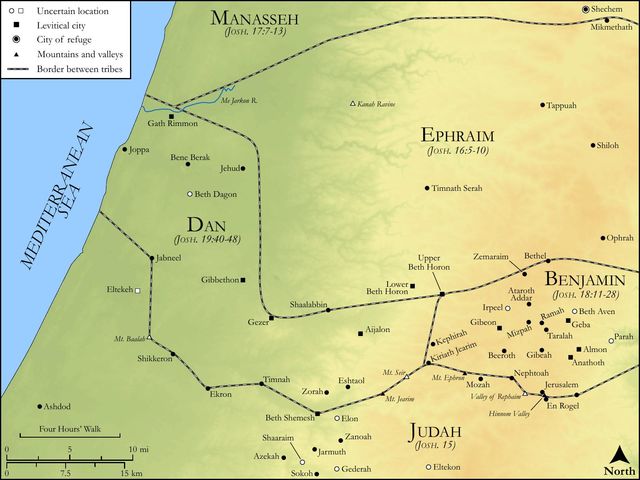
Study this verse
Public-domain commentary
Matthew Henry
From his Commentary on the Whole Bible. Henry comments on passages, not single verses — this entry covers Joshua 14:6–15. His four-level outline is real structure in the source text, so it is rendered as structure.
Before the lot was cast into the lap for the determining of the portions of the respective tribes, the particular portion of Caleb was assigned to him. He was now, except Joshua, not only the oldest man in all Israel, but was twenty years older than any of them, for all that were above twenty years old when he was forty were dead in the wilderness; it was fit therefore that this phoenix of his age should have some particular marks of honour put upon him in the dividing of the land. Now,
I.Caleb here presents his petition, or rather makes his demand, to have Hebron given him for a possession (this mountain he calls it, Jos 14:12), and not to have that put into the lot with the other parts of the country. To justify his demand, he shows that God had long since, by Moses, promised him that very mountain; so that God's mind being already made known in this matter it would be a vain and needless thing to consult it any further by casting lots, by which we are to appeal to God in those cases only which cannot otherwise be decided, not in those which, like this, are already determined. Caleb is here called the Kenezite, some think from some remarkable victory obtained by him over the Kenezites, as the Romans gave their great generals titles from the countries they conquered, as Africanus, Germanicus, etc. Observe,
1.To enforce his petition,
(1.)He brings the children of Judah, that is, the heads and great men of that tribe, along with him, to present it, who were willing thus to pay their respects to that ornament of their tribe, and to testify their consent that he should be provided for by himself, and that they would not take it as any reflection upon the rest of this tribe. Caleb was the person whom God had chosen out of that tribe to be employed in dividing the land (Num 34:19), and therefore, lest he should seem to improve his authority as a commissioner for his own private advantage and satisfaction, he brings his brethren along with him, and waiving his own power, seems rather to rely upon their interest.
(2.)He appeals to Joshua himself concerning the truth of the allegations upon which he grounded his petition: Thou knowest the thing, Jos 14:6.
(3.)He makes a very honourable mention of Moses, which he knew would not be at all unpleasing to Joshua: Moses the man of God (Jos 14:6), and the servant of the Lord, Jos 14:7. What Moses said he took as from God himself, because Moses was his mouth and his agent, and therefore he had reason both to desire and expect that it should be made good. What can be more earnestly desired than the tokens of God's favour? And what more confidently expected than the grants of his promise?
2.In his petition he sets forth,
(1.)The testimony of his conscience concerning his integrity in the management of that great affair on which it proved the fare of Israel turned, the spying out of the land. Caleb was one of the twelve that were sent out on that errand (Jos 14:7), and he now reflected upon it with comfort, and mentioned it, not in pride, but as that which, being the consideration of the grant, was necessary to be inserted in the plea,
[1.]That he made his report as it was in his heart, that is, he spoke as he thought when he spoke so honourably of the land of Canaan, so confidently of the power of God to put them in possession of it, and so contemptibly of the opposition that the Canaanites, even the Anakim themselves, could make against them, as we find he did, Num 13:30; Num 14:7-9. He did not do it merely to please Moses, or to keep the people quiet, much less from a spirit of contradiction to his fellows, but from a full conviction of the truth of what he said and a firm belief of the divine promise.
[2.]That herein he wholly followed the Lord his God, that is, he kept close to his duty, and sincerely aimed at the glory of God in it. He conformed himself to the divine will with an eye to the divine favour. He had obtained this testimony from God himself (Num 14:24), and therefore it was not vain-glory in him to speak of it, any more than it is for those who have God's Spirit witnessing with their spirits that they are the children of God humbly and thankfully to tell others for their encouragement what God has done for their souls. Note, Those that follow God fully when they are young shall have both the credit and comfort of it when they are old, and the reward of it for ever in the heavenly Canaan.
[3.]That he did this when all his brethren and companions in that service, except Joshua, did otherwise. They made the heart of the people melt (Jos 14:8), and how pernicious the consequences of it were was very well known. It adds much to the praise of following God if we adhere to him when others desert and decline from him. Caleb needed not to mention particularly Joshua's conduct in this matter; it was sufficiently known, and he would not seem to flatter him; it was enough to say (Jos 14:6), Thou knowest what the Lord spoke concerning me and thee.
(2.)The experience he had had of God's goodness to him ever since to this day. Though he had wandered with the rest in the wilderness, and had been kept thirty-eight years out of Canaan as they were, for that sin which he was so far from having a hand in that he had done his utmost to prevent it, yet, instead of complaining of this, he mentioned, to the glory of God, his mercy to him in two things: - [1.] That he was kept alive in the wilderness, not only notwithstanding the common perils and fatigues of that tedious march, but though all that generation of Israelites, except himself and Joshua, were one way or other cut off by death. With what a grateful sense of God's goodness to him does he speak it! (Jos 14:10). Now behold (behold and wonder) the Lord hath kept me alive these forty and five years, thirty-eight years in the wilderness, through the plagues of the desert, and seven years in Canaan through the perils of war! Note, First, While we live, it is God that keeps us alive; by his power he protects us from death, and by his bounty supplies us continually with the supports and comforts of life. He holdeth our soul in life. Secondly, The longer we live the more sensible we should be of God's goodness to us in keeping us alive, his care in prolonging our frail lives, his patience in prolonging our forfeited lives. Has he kept me alive these forty-five years? Is it about that time of life with us? Or is it more? Or is it less? We have reason to say, It is of the Lord's mercies that we are not consumed. How much are we indebted to the favour of God, and what shall we render? Let the life thus kept by the providence of God be devoted to his praise. Thirdly, The death of many others round about us should make us the more thankful to God for sparing us and keeping us alive. Thousands falling on our right hand and our left and yet ourselves spared. These distinguishing favours impose on us strong obligations to singular obedience. [2.] That he was fit for business, now that he was in Canaan. Though eighty-five years old, yet as hearty and lively as when he was forty (Jos 14:11): As my strength was then, so is it now. This was the fruit of the promise, and out-did what was said; for God not only gives what he promises, but he gives more: life by promise shall be life, and health, and strength, and all that which will make the promised life a blessing and comfort. Moses had said in his prayer (Psa 90:10) that at eighty years old even their strength is labour and sorrow, and so it is most commonly. But Caleb was an exception to the rule; his strength at eighty-five was ease and joy: this he got by following the Lord fully. Caleb here takes notice of this to the glory of God, and as an excuse for his asking a portion which he must fetch out of the giants' hands. Let not Joshua tell him he knew not what he asked; could he get the possession of that which he begged for a title to? "Yes," says he, "why not? I am as fit for war now as ever I was."
(3.)The promise Moses had made him in God's name that he should have this mountain, Jos 14:9. This promise is his chief plea, and that on which he relies. As we find it (Num 14:24) it is general, him will I bring into the land whereunto he went, and his seed shall possess it; but it seems it was more particular, and Joshua knew it; both sides understood this mountain for which Caleb was now a suitor to be intended. This was the place from which, more than any other, the spies took their report, for here they met with the sons of Anak (Num 13:22), the sight of whom made such an impression upon them, Jos 14:3. We may suppose that Caleb, observing what stress they laid upon the difficulty of conquering Hebron, a city garrisoned by the giants, and how thence they inferred that the conquest of the whole land was utterly impracticable, in opposition to their suggestions, and to convince the people that he spoke as he thought, bravely desired to have that city which they called invincible assigned to himself for his own portion: "I will undertake to deal with that, and, if I cannot get it for my inheritance, I will be without." "Well," said Moses, "it shall be thy own then, win it and wear it." Such a noble heroic spirit Caleb had, and so desirous was he to inspire his brethren with it, that he chose this place only because it was the most difficult to be conquered. And, to show that his soul did not decay any more than his body, now forty-five years after he adheres to his choice and is still of the same mind.
(4.)The hopes he had of being master of it, though the sons of Anak were in possession of it (Jos 14:12): If the Lord will be with me, then I shall be able to drive them out. The city of Hebron Joshua had already reduced (Jos 10:37), but the mountain which belonged to it, and which was inhabited by the sons of Anak, was yet unconquered; for though the cutting off of the Anakim from Hebron was mentioned Jos 11:21, because the historian would relate all the military actions together, yet it seems it was not conquered till after they had begun to divide the land. Observe, He builds his hopes of driving out the sons of Anak upon the presence of God with him. He does not say, "Because I am now as strong for war as I was at forty, therefore I shall drive them out," depending upon his personal valour; nor does he depend upon his interest in the warlike tribe of Judah, who attended him now in making this address, and no doubt would assist him; nor does he court Joshua's aid, or put it upon that, "If thou wilt be with me I shall gain my point." But, If the Lord will be with me. Here,
[1.]He seems to speak doubtfully of God's being with him, not from any distrust of his goodness or faithfulness. He had spoken without the least hesitation of God's presence with Israel in general (Num 14:9); the Lord is with us. But for himself, from a humble sense of his own unworthiness of such a favour, he chooses to express himself thus, If the Lord will be with me. The Chaldee paraphrase reads it, If the Word of the Lord be my helper, that Word which is God, and in the fulness of time was made flesh, and is the captain of our salvation.
[2.]But he expresses without the least doubt his assurance that if God were with him he should be able to dispossess the sons of Anak. "If God be with us, If God be for us, who can be against us, so as to prevail?" It is also intimated that if God were not with him, though all the forces of Israel should come in to his assistance, he should not be able to gain his point. Whatever we undertake, God's favourable presence with us is all in all to our success; this therefore we must earnestly pray for, and carefully make sure of, by keeping ourselves in the love of God; and on this we must depend, and from this take our encouragement against the greatest difficulties.
3.Upon the whole matter, Caleb's request is (Jos 14:12), Give me this mountain,
(1.)Because it was formerly in God's promise, and he would let Israel know how much he valued the promise, insisting upon this mountain, whereof the Lord spake in that day, as most desirable, though perhaps as good a portion might have fallen to him by lot in common with the rest. Those that live by faith value that which is given by promise far above that which is given by providence only.
(2.)Because it was now in the Anakim's possession, and he would let Israel know how little he feared the enemy, and would by his example animate them to push on their conquests. Herein Caleb answered his name, which signifies all heart.
II.Joshua grants his petition (Jos 14:13):
Joshua blessed him, commended his bravery, applauded his request, and gave him what he asked. He also prayed for him, and for his good success in his intended undertaking against the sons of Anak. Joshua was both a prince and a prophet, and upon both accounts it was proper for him to give Caleb his blessing, for the less is blessed of the better. Hebron was settled on Caleb and his heirs (Jos 14:14), because he wholly followed the Lord God of Israel. And happy are we if we follow him. Note, Singular piety shall be crowned with singular favours. Now,
1.We are here told what Hebron had been, the city of Arba, a great man among the Anakim (Jos 14:15); we find it called Kirjath-arba (Gen 23:2), as the place where Sarah died. Hereabouts Abraham, Isaac, and Jacob lived most of their time in Canaan, and near to it was the cave of Machpelah, where they were buried, which perhaps had led Caleb hither when he went to spy out the land, and had made him covet this rather than any other part for his inheritance.
2.We are afterwards told what Hebron was.
(1.)It was one of the cities belonging to priests (Jos 21:13), and a city of refuge, Jos 20:7. When Caleb had it, he contented himself with the country about it, and cheerfully gave the city to the priests, the Lord's ministers, thinking it could not be better bestowed, no, not upon his own children, nor that it was the less his own for being thus devoted to God.
(2.)It was a royal city, and, in the beginning of David's reign, the metropolis of the kingdom of Judah; thither the people resorted to him, and there he reigned seven years. Thus highly was Caleb's city honoured; it is a pity there should have been such a blemish upon his family long after as Nabal was, who was of the house of Caleb, Sa1 25:3. But the best men cannot entail their virtues.
Historical interpretation
Historical reception
2 surviving comments on this verse. Each one is dated, so this reads as a timeline rather than a list.
Thus, therefore, even now this very wise Caleb stands before Jesus [Joshua] and promises to be mighty for war and ready for battle. On that account he earnestly demands to be granted the faculty of disputation that he may contend with the dialecticians of the age who hold deceits for truth, to refute them and to subdue and to overthrow all the things that they have established with their false assertions. Moreover, finally, seeing his ardor, "Jesus [Joshua] blesses him," it says; doubtless because he demands and dares such things. But you too, if you are willing to give attention to studies and wisely to contemplate the law of God and to be made a "heart" in the law of God, you can overthrow these great and fortified towns, that is, the assertions of falsehood. Then you also may deserve to be blessed by Jesus and to receive Hebron from him.
And so, let us see who it is who first receives the inheritance from Jesus [Joshua]: "Caleb," it says, "the son of Jephunneh." For he requests first with certain fixed reasons and words that are described, words that are also able to instruct us for salvation.First of all, Caleb is interpreted "as a heart." Who, therefore, is "as a heart" if not the one who in all things has devoted effort to discernment, who is not said to be just any member of the body of the church but that one that is the more admirable in us, the heart? That is, he is the one who bears all things with reason and prudence and so arranges all things as if being none other than the heart.
But also Jephunneh, his father, is interpreted "conversion." Therefore, this Caleb is the son of conversion. Why, unless he were converted to God, could Jephunneh produce from himself such fruit that he begat a heart as a son? Thus Caleb is everyone who is devoted to divine understandings and who conducts all things wisely and reasonably.
Continue studying Joshua 14:13 across the web’s major study libraries — every link below opens this exact verse, chapter, or book on the destination site.
Read & Compare
 BibleGatewayThis verse in more than 200 translations and 70 languages.
 Bible.comThe YouVersion reader — hundreds of translations, reading plans, and highlights.
 ESV.orgCrossway's official English Standard Version reader.
 NET BibleThe NET translation with 60,000+ translators' notes on every rendering decision.
 STEP BibleTyndale House's free study tool — original text, vocabulary, and scholarly resources.
 BibliaLogos Bible Software's free web reader.
 USCCBThe New American Bible (Revised Edition) with the U.S. bishops' study notes.
Commentaries
 BibleHub CommentariesDozens of classic commentaries on this verse, gathered on one page.
 StudyLightMore than 100 commentary sets — the largest collection on the web.
 BibleRefPlain-English commentary on what this verse means, verse by verse.
 Enduring WordDavid Guzik's free commentary on this chapter, widely used by Bible teachers.
 Bible Study ToolsVerse commentary alongside Greek and Hebrew study aids.
Original Language & Research
- BibleHub InterlinearThe verse word by word — original language, transliteration, and English.
- BibleHub LexiconEvery word's original-language definition and Strong's entry.
 Blue Letter BibleDeep-study tools — Strong's numbers, concordance, and word studies.
 SefariaThe Hebrew text with Rashi and centuries of Jewish commentary.
Sermons, Hymns & Audio


TrulyRandomVerse is not affiliated with these sites and doesn’t control their content. They’re linked because they’re genuinely useful.
Summary
Joshua 14:13 marks a profound moment in Israel's history, signifying the culmination of Caleb's unwavering faith and perseverance as Joshua, acting under divine authority and fulfilling Moses' prior promise, formally bestows upon him the city of Hebron as a perpetual inheritance. This pivotal event not only represents the tangible fulfillment of God's covenant promises to a faithful individual but also powerfully illustrates the principle that steadfast devotion to the Lord is abundantly rewarded, even decades after the initial commitment. It stands as a vibrant testament to God's unfailing faithfulness in delivering on His word and His recognition of those who wholeheartedly follow Him, providing a model of enduring trust and divine recompense.
Context
ShowHideLiterary Context
Joshua 14:13 concludes a significant narrative segment spanning Joshua 14:6-15, which meticulously details Caleb's personal and impassioned appeal to Joshua for his promised inheritance. This passage immediately follows the initial distribution of land to the tribe of Judah, of which Caleb was a prominent and esteemed member. Caleb's request is far more than a mere petition; it is a forceful and faith-filled reminder of God's specific promise made through Moses forty-five years prior, following the crucial spying mission into Canaan. His recounting of his unwavering faith and the subsequent divine promise (as detailed in Joshua 14:7-9) sets the stage for Joshua's official act of blessing and granting Hebron. This act not only validates Caleb's legitimate claim but also powerfully demonstrates the fulfillment of God's word within the broader narrative of Israel's conquest and the precise distribution of the promised land. The specific mention of the formidable Anakim in Joshua 14:12 further highlights the challenging nature of the inheritance, emphasizing Caleb's continued strength, courage, and unwavering faith in God's enabling power.
Historical & Cultural Context
The division of the land of Canaan was a monumental undertaking, representing the ultimate fulfillment of the ancient covenant promises made by God to Abraham, Isaac, and Jacob centuries earlier. This period followed forty years of wilderness wandering, a divine consequence for Israel's lack of faith after the initial spy report from Kadesh-Barnea (Numbers 13-14). Caleb, along with Joshua, was one of only two spies who brought back a positive report, expressing unwavering trust in God's ability to deliver the land despite the giants. As a direct result of his singular faithfulness, God specifically promised Caleb an inheritance in the very place where his foot had trod (Numbers 14:24). Hebron, the designated inheritance, was not an easy prize; it was a strategically important city, one of the oldest in Canaan, and notoriously inhabited by the Anakim, a formidable race of giants. Granting Hebron to Caleb, an 85-year-old man, demonstrated profound trust in God's continued empowering presence and served as an undeniable, powerful example to the younger generation of Israelites regarding the enduring rewards of faithfulness. Culturally, the act of "blessing" by a leader like Joshua was a formal, authoritative pronouncement, often invoking divine favor, legitimizing a claim or action, and carrying the weight of a sacred decree.
Key Themes
ShowHideThis verse powerfully encapsulates several key themes prevalent throughout the book of Joshua and indeed, the entire Pentateuch. The most prominent is Faithfulness Rewarded, where Caleb's steadfast and singular devotion to the Lord, maintained over 45 years despite immense challenges, societal unbelief, and significant delays, is tangibly and publicly honored with his promised inheritance. This directly ties into the overarching theme of God's Covenant Faithfulness, demonstrating unequivocally that God always keeps His word, even across generations, and that His promises are absolutely sure for those who walk in obedience and trust. The theme of Perseverance and Strength is also strikingly evident in Caleb's remarkable vitality at 85 years old and his undiminished readiness to dispossess the Anakim, illustrating that divine strength empowers believers to overcome even the most formidable obstacles, as highlighted in Joshua 14:11. Finally, the granting of Inheritance and Possession is a central motif in Joshua, symbolizing the tangible realization of God's promises concerning the land and the establishment of Israel as a divinely appointed nation. Caleb's specific portion in Hebron serves as a microcosm of the larger fulfillment of God's grand plan for His people.
Exposition and Analysis
ShowHideKey Word Analysis
ShowHideThis primitive root signifies "to kneel," and by implication, "to bless God (as an act of adoration)" or "man (as a benefit)." When Joshua "blessed" Caleb, it was far more than a mere good wish or commendation. It was a formal, authoritative pronouncement of divine favor, prosperity, and empowerment, invoking God's continued blessing upon Caleb and officially legitimizing his claim to Hebron. It implies a sacred transfer of divine approval and the confirmation of a covenant promise, underscoring the spiritual and authoritative nature of the transaction.
This common Hebrew root means "to give," used with a wide latitude of application including "to put, make, appoint." In this specific context, it denotes a formal, legal act of bestowing possession and ownership. It emphasizes Joshua's divinely appointed authority as Israel's leader, acting as God's agent to distribute the promised land according to His will. The act of "giving" here is the tangible, decisive fulfillment of a long-standing divine promise, transforming a future hope into a present, concrete reality.
This term refers to "something inherited," "occupancy," or "an heirloom," generally an "estate, patrimony or portion." In the biblical context, it carries profound theological weight, signifying God's promised land to Israel as their divinely appointed heritage. For Caleb, Hebron was not merely a piece of real estate; it was his divinely designated portion, a tangible and permanent sign of God's faithfulness to His specific promise to him, and a secure possession for his descendants, embodying the enduring nature of God's covenant.
Verse Breakdown
ShowHide"And Joshua blessed him"
This phrase signifies Joshua's official and authoritative endorsement of Caleb's request and his life of unwavering faithfulness. As the leader and successor to Moses, Joshua's blessing carried immense weight, confirming God's favor upon Caleb and validating his legitimate claim to Hebron. It was a public and sacred acknowledgment of Caleb's steadfast devotion to the Lord and God's absolute faithfulness to His word, setting a powerful example for all Israel.
"and gave unto Caleb the son of Jephunneh"
This clause precisely identifies the recipient of the inheritance, Caleb, son of Jephunneh, emphasizing his specific identity as the faithful spy who "wholly followed the LORD." The act of "giving" here is the practical, decisive implementation of the divine promise, with Joshua acting as the direct instrument of God's will in the equitable and just distribution of the land. It highlights the direct, undeniable link between Caleb's past faithfulness and his present, tangible reward.
"Hebron for an inheritance"
This final clause explicitly identifies the specific land granted to Caleb. Hebron, a historically significant city and a notorious stronghold of the Anakim, was given as a permanent, perpetual possession. This was not a temporary grant or a lease, but an enduring "inheritance," ensuring that the land would belong irrevocably to Caleb and his descendants. It symbolizes the enduring nature of God's promises and the tangible, lasting fruit of a life lived in complete and unwavering devotion to the Lord.
Literary Devices
ShowHideThe verse employs several key literary devices to convey its profound meaning and theological significance. Fulfillment is central, as the narrative arc of Caleb's forty-five-year wait for his promised land culminates in this precise moment, underscoring God's unwavering commitment to His word and His meticulous attention to individual faithfulness. The act of Joshua blessing Caleb serves as a powerful Symbolic Act, representing divine affirmation, the official transfer of authority, and the legitimate bestowal of possession. The phrase "Hebron for an inheritance" functions as Metonymy, where the name of the city stands not only for the entire challenging territory but also for the arduous and faith-testing task of dispossessing its formidable inhabitants, thereby highlighting Caleb's continued readiness for battle and his trust in God's power. Furthermore, the entire episode functions as a Paradigm or Exemplar, presenting Caleb's life as a compelling model of unwavering faith, steadfast perseverance, and the ultimate certainty of divine reward for future generations of Israelites and believers.
Theological and Thematic Connections
ShowHideJoshua 14:13 stands as a profound theological truth, demonstrating that God is utterly faithful to His promises and that He unequivocally honors those who wholeheartedly follow Him. Caleb's story is a vivid, living illustration of delayed gratification and the ultimate certainty of divine reward for steadfast obedience, even when the path is long and fraught with challenges. It powerfully reinforces the covenantal nature of God's relationship with His people, where blessings are contingent upon faithfulness, yet God's sovereign grace always undergirds and ensures the fulfillment of His promises. This verse also resonates with the concept of spiritual inheritance, extending beyond mere physical land, reminding believers that a life of devotion to God yields not only temporal blessings but also eternal rewards and a secure spiritual dwelling in His presence.
Reflection and Application
ShowHideCaleb's story in Joshua 14:13 offers profound and enduring lessons for contemporary believers, challenging us to examine the depth of our own faith, patience, and perseverance, especially when God's promises seem delayed or the obstacles appear insurmountable. Caleb, at 85 years old, was as ready for battle and as full of vigor as he was at 40, not primarily because of his physical prowess, but because his spiritual vitality and unwavering trust in God were undiminished. His extraordinary example calls us to maintain our spiritual strength, zeal, and active pursuit of God's will throughout every season of our lives, trusting that God will equip us to face any "giants" that stand between us and His divine purposes. We are powerfully reminded that faithfulness is not merely a passive belief but an active, enduring trust that motivates us to press forward, knowing that God's timing is perfect and His rewards are absolutely sure. This verse encourages us to actively claim the spiritual inheritance God has promised us through Christ, diligently pursuing His will and confidently trusting in His power to overcome every spiritual, emotional, or physical obstacle.
Questions for Reflection
ShowHideFAQ
ShowHideWhy was Hebron so significant as an inheritance?
ShowHideHebron held immense historical, spiritual, and strategic importance. It was one of the oldest cities in Canaan, founded seven years before Zoan in Egypt (Numbers 13:22). More significantly, it was the revered burial place of Abraham, Sarah, Isaac, Rebekah, and Jacob in the Cave of Machpelah (Genesis 23:19, Genesis 49:31). Thus, Hebron was deeply connected to the patriarchs and the foundational covenant promises God made to them concerning the land of Canaan. Furthermore, it was a notorious stronghold of the Anakim, a formidable race of giants, making its conquest a true test of faith and a powerful demonstration of God's enabling power working through Caleb (Joshua 14:12). Its strategic location also made it a key city in the southern highlands of Judah, later becoming a city of refuge (Joshua 20:7) and David's first capital (2 Samuel 2:1-4).
Christ-Centered Fulfillment
ShowHideWhile Joshua 14:13 celebrates the tangible fulfillment of a specific earthly promise to Caleb, it ultimately points forward with profound typological significance to the greater, eternal inheritance and ultimate fulfillment found exclusively in Jesus Christ. Caleb's unwavering faith, which enabled him to receive his physical inheritance, powerfully foreshadows the spiritual inheritance believers receive through saving faith in Christ. Just as Caleb was promised a land where his foot had trod, believers are promised an eternal inheritance that is "imperishable, undefiled, and unfading, kept in heaven for you" (1 Peter 1:4). Jesus, the greater Joshua, leads His people not merely into a physical land of rest but into spiritual rest, eternal life, and communion with God, having conquered the ultimate giants of sin, death, and the devil through His victorious sacrifice on the cross (Hebrews 4:8-10). Caleb's remarkable strength at 85 years old to dispossess the Anakim reflects the spiritual strength believers receive through Christ to overcome the powers of darkness and the challenges of this fallen world (Ephesians 6:10-12). Ultimately, Caleb's inheritance in Hebron serves as a tangible type of the glorious, eternal inheritance that awaits all who, like Caleb, follow the Lord wholeheartedly, not by their own strength or merit, but by the indwelling power of the Holy Spirit given through the finished, redemptive work of Christ (Romans 8:17).