


1 Chronicles 6:56
- וְאֶתve·'Etand <obj.>H853Conj-w ¦ DirObjMParticle Object Indicatorוְandאֶת<obj.>
- שְׂדֵהse·Deh[the] field ofH7704N-mscNoun Singular Masculine Construct
- הָעִירha·'Irthe cityH5892Art ¦ N-fsNoun Singular Feminine Absoluteהָtheעִירcity
- וְאֶתve·'Etand <obj.>H853Conj-w ¦ DirObjMParticle Object Indicatorוְandאֶת<obj.>
- חֲצֵרֶיהָcha·tze·Rei·haits villagesH2691N-mpc ¦ 3fsNoun Plural Masculine Constructחֲצֵרֶיvillagesהָits
- נָתְנוּna·te·Nupeople gaveH5414V-Qal-Perf-3cpVerb Qal Perfect 3rd Plural common gender
- לְכָלֵבle·kha·Levto CalebH3612Prep-l ¦ N-proper-mNoun Proper MasculineלְtoכָלֵבCaleb
- בֶּןben[the] son ofH1121N-mscNoun Singular Masculine Construct
- יְפֻנֶּהye·fu·NehJephunnehH3312N-proper-mNoun Proper Masculine
English is a literal word-by-word gloss of the Hebrew, not the KJV's wording. Why?
This is the original text the KJV's translators worked from — each Hebrew word with its own literal English meaning in this verse, prepared by scholars at Tyndale House, Cambridge. The KJV translates whole sentences, not word by word, so its wording differs: one Hebrew word can become several English words, and the KJV may choose “the LORD” where the gloss reads “Yahweh”. Both are faithful — they answer different questions. For the KJV's own rendering, switch to the KJV text.
Details
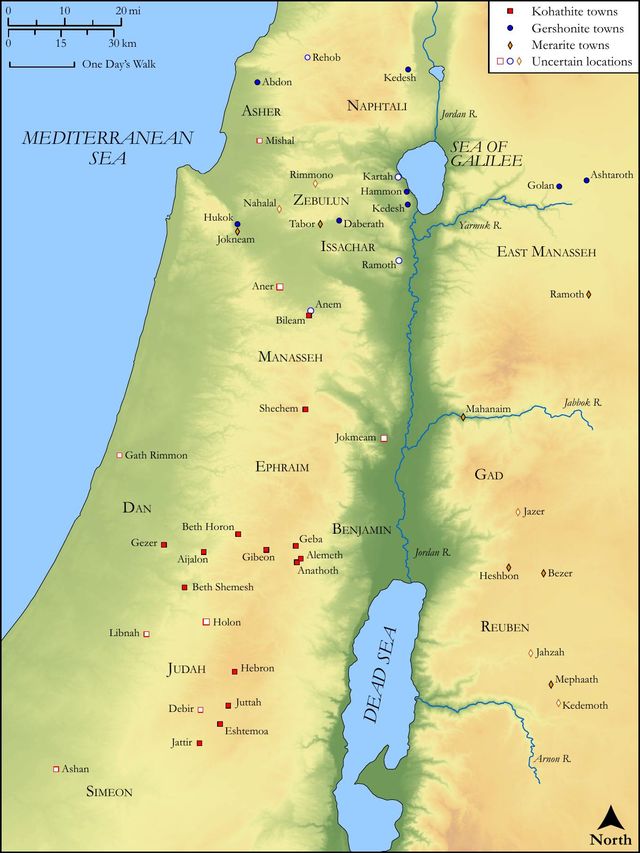
See on the biblical-era map
Study this verse
Public-domain commentary
Matthew Henry
From his Commentary on the Whole Bible. Henry comments on passages, not single verses — this entry covers 1 Chronicles 6:54–81.
We have here an account of the Levites' cities. They are here called their castles (Ch1 6:54), not only because walled and fortified, and well guarded by the country (for it is the interest of every nation to protect its ministers), but because they and their possessions were, in a particular manner, the care of the divine providence: as God was their portion, so God was their protection; and a cottage will be a castle to those that abide under the shadow of the Almighty. This account is much the same with that which we had, Jos. 21. We need not be critical in comparing them (what good will it do us?) nor will it do any hurt to the credit of the holy scripture if the names of some of the places be not spelt just the same here as they were there. We know it is common for cities to have several names. Sarum and Salisbury, Salop and Shrewsbury, are more unlike than Hilen (Ch1 6:58) and Holon (Jos 21:15), Ashan (Ch1 6:59) and Ain (Jos 21:16), Alemeth (Ch1 6:60) and Almon (Jos 21:18); and time changes names. We are only to observe that in this appointment of cities for the Levites God took care, 1. For the accomplishment of dying Jacob's prediction concerning this tribe, that it should be scattered in Israel, Gen 49:7. 2. For the diffusing of the knowledge of himself and his law to all parts of the land of Israel. Every tribe had Levites' cities in it; and so every room was furnished with a candle, so that none could be ignorant of his duty but it was either his own fault or the Levites'. 3. For a comfortable maintenance for those that ministered in holy things. Besides their tithes and offerings, they had glebe-lands and cities of their own to dwell in. Some of the most considerable cities of Israel fell to the Levites' lot. Every tribe had benefit by the Levites, and therefore every tribe must contribute to their support. Let him that is taught in the word communicate to him that teacheth, and do it cheerfully.
Historical interpretation
Historical reception
3 surviving comments on this verse. Each one is dated, so this reads as a timeline rather than a list.
The Chronicles also speak about the tabernacle because a temple of the Lord had not yet been built by either Samuel or David. The text also adds that that the holy services were held in the tabernacle. Worship was observed at that time according to the number of the days of the week. For it also says, “and their kindred who were in their villages were obliged to come in every seven days, in turn, to be with them.” With regard to the holy utensils it says, “Some of them had charge of the utensils of service, for they were required to count them when they were brought in and taken out. Others of them were appointed over the furniture, and over all the holy utensils, also over the choice flour, the wine, the oil, the incense and the spices.” And about the priests it says, “Others, of the sons of the priests, prepared the mixing of the spices.” With regard to the tomb of Saul the Chronicles gives us much information, and in the Book of Kings itself we read that his bones were gathered and buried in the land of Jabesh.
There is abundant information in the books of Chronicles which were written to continue the books of the Kings and to preserve the memory of such important events. The first book begins with a genealogy that sets out to demonstrate how the human race came from a single man. Since it focuses only on the single kingdom of Judah, it can tell us about its cities and the villages, and from where they took their names. Here we come to know Nathan, from whom the blessed Luke constructed the beginning of his genealogy of our Lord and Savior, Son of David and Solomon’s brother4 on his mother’s side: “The following children were born to him in Jerusalem: Shimeah, Shobab, Nathan and Solomon, that is, the four children he fathered with Bersabea, daughter of Ammiel.” And Rechab6 herself, who is mentioned in many books of Scripture, is said to have come from the tribe of Judah.It also clearly explains why Reuben lost his birthright and Joseph gained it and also, finally, the reason why the tribe of Judah obtained the highest honor: “The sons of Reuben the firstborn of Israel. He was the firstborn, but because he defiled his father’s bed his birthright was given to the sons of Joseph son of Israel, so that he is not enrolled in the genealogy according to the birthright; though Judah became prominent among his brothers and a ruler came from him, yet the birthright belonged to Joseph.” It also explains the reason why such a great honor was conceded to Joseph. By the will of God Judah had the dignity of receiving the Lord who was born from him according to the flesh. This is the sense tacitly expressed with the words “a leader from him.” Indeed the passage seems to assert that not only the kings of the earth derived from Judah, but also the eternal king himself who had no beginning and will never end.
It also describes the situation of the tribes beyond the Jordan, those of Reuben and Gad, and even the tribes of Manasseh which later were received into those of the Hagarites and the Itureans, and talks about the tribes of the Naphiseans, and all those peoples who entered into conflict with them. In addition the text relates how they fought and won, and made the Hagarites flee. And it also reports the reason for the victory: “When they received help against them, the Hagarites and all who were with them were given into their hands, for they cried to God in the battle, and he granted their entreaty because they trusted in him.” It also describes the amount of the spoils of war: “They captured their livestock: 50, of their camels, 250, sheep, 2, donkeys and 100, captives. Many were slain because the war was from God. And they lived in their territory until the exile.”
The genealogy of the priests and the Levites comes after this. It relates that Zadok, who was high priest at the time of David, had been the eleventh from Aaron; that Azariah, nephew of Zadok, had been the first to receive the priestly anointing in the temple built by Solomon. Among them there was also Jehozadak, who was brought to Babylon as a war prisoner. Jesus9 was his son, a high priest as well, who delivered the people from bondage together with Zerubbabel, and built a temple for the Lord. Here we also learn that Korah, who revolted against the great Moses, was a nephew of Isaar, son of Caath and brother of Amram, Aaron’s and Moses’ father. According to this lineage he was related to the first legislator. But he himself paid in the desert for his errors, although his children did not share the punishment of their father. From here Samuel13 came and then Aeman, who intoned Psalms and was a nephew of the prophet Samuel. In fact he was the son of Joel, son of Samuel. On the other hand, Asaph, one of the singers, came from the lineage of Gerson, son of Levi and brother of Caath. Aetham, who also belonged to the group of the singers, had Merari, the third son of Levi, as great-grandfather.The text also explains the difference between the priests and the Levites. It relates that the Levites were initiated into all the ministries of the holy altar of God: “But Aaron and his sons made offerings on the altar of burnt offering and on the altar of incense, doing all the work of the most holy place, to make atonement for Israel, according to all that Moses the servant of God had commanded.” It seems to me, in fact, that this book was written after the return from Babylon. For this reason it also talks about the bondage and explains its cause: “So all Israel was enrolled by genealogies; and these are written in the book of the Kings of Israel. And Judah was taken into exile in Babylon because of their unfaithfulness. Now the first to live again in their possessions in their towns were Israelites, priests, Levites, and temple servants.” These accounts show that the book was begun after the captivity. Indeed no historian ever relates facts that happened afterwards, but what happened before or during his times. And actually only the prophets have the power to foretell the future. In addition it says that also those who had inhabited that land before them had been enslaved. And actually many of them still live with them: the Canaanites, Chettites, Jebusites, who had been their companions in such a misfortune. Also the priests and the Levites were brought into captivity with the Israelites. I believe that those who were called “the saints’ servants” were then called Nathinim. Many of them, in fact, consecrated themselves to the ministries of the priests and the Levites. There were among them also those who were entrusted with the carrying of the water, the gathering of wood and other necessary duties. Indeed, if it was imposed to the Gabaonites, who were foreigners, to follow Joshua in the praises and to perform some works as porters or carpenters, this task was even more the duty of the Israelites. As a proof of this I have found in the interpretation of Hebrew names that this name means “house of Iaō,” that is, “of the God who is.” The text, in fact, mentions the children of Israel and among them Judah and Benjamin, and Ephraim18 and Manasseh. It also mentions the priests and the Levites, who inhabited those cities. About the Korēnites it says that they derived from Korah. It also says that among them there had been the guardians of the temple of God as well, and it seems that this custom had been introduced by Samuel and David. “All these, who were chosen as gatekeepers at the thresholds, were two hundred twelve. They were enrolled by genealogies in their villages. David and the prophet Samuel established them in their office of trust. So they and their descendants were in charge of the gates of the house of the Lord, that is, the house of the tent, as guards. The gatekeepers were on the four sides, east, west, north, and south.”
Continue studying 1 Chronicles 6:56 across the web’s major study libraries — every link below opens this exact verse, chapter, or book on the destination site.
Read & Compare
 BibleGatewayThis verse in more than 200 translations and 70 languages.
 Bible.comThe YouVersion reader — hundreds of translations, reading plans, and highlights.
 ESV.orgCrossway's official English Standard Version reader.
 NET BibleThe NET translation with 60,000+ translators' notes on every rendering decision.
 STEP BibleTyndale House's free study tool — original text, vocabulary, and scholarly resources.
 BibliaLogos Bible Software's free web reader.
 USCCBThe New American Bible (Revised Edition) with the U.S. bishops' study notes.
Commentaries
 BibleHub CommentariesDozens of classic commentaries on this verse, gathered on one page.
 StudyLightMore than 100 commentary sets — the largest collection on the web.
 BibleRefPlain-English commentary on what this verse means, verse by verse.
 Enduring WordDavid Guzik's free commentary on this chapter, widely used by Bible teachers.
 Bible Study ToolsVerse commentary alongside Greek and Hebrew study aids.
Original Language & Research
- BibleHub InterlinearThe verse word by word — original language, transliteration, and English.
- BibleHub LexiconEvery word's original-language definition and Strong's entry.
 Blue Letter BibleDeep-study tools — Strong's numbers, concordance, and word studies.
 SefariaThe Hebrew text with Rashi and centuries of Jewish commentary.
Sermons, Hymns & Audio


TrulyRandomVerse is not affiliated with these sites and doesn’t control their content. They’re linked because they’re genuinely useful.
Summary
Succinctly records the specific land allocation granted to Caleb, the son of Jephunneh, detailing that he received not only the city of Hebron but also its surrounding fields and villages. This seemingly brief genealogical note, strategically placed within the extensive records of tribal and Levitical land distributions, serves as a powerful confirmation of God's unwavering faithfulness in fulfilling His ancient promise to Caleb, highlighting his unique reward for steadfast faith and obedience amidst the skepticism of his generation.
Context
ShowHideLiterary Context
This verse appears immediately after a detailed enumeration of cities allotted to the Levites in 1 Chronicles 6:54-55, who, as the priestly tribe, did not receive a tribal land inheritance like the other tribes but rather specific cities scattered throughout Israel. The inclusion of 1 Chronicles 6:56 directly after this Levitical list creates a deliberate and significant contrast. While the Levites received cities for dwelling, they were explicitly not granted surrounding agricultural lands for sustenance. Caleb's inheritance, however, explicitly includes "the fields of the city, and the villages thereof," underscoring the completeness and productive nature of his possession. This also functions as a recapitulation of earlier, more detailed accounts in the book of Joshua, particularly Joshua 14, confirming the historical and divinely ordained land distribution for a post-exilic audience. The Chronicler's meticulous inclusion of such details serves to emphasize God's precise fulfillment of His promises and the enduring heritage of Israel.
Historical & Cultural Context
The giving of land was central to Israel's identity and covenant relationship with God, representing security, blessing, and the tangible fulfillment of God's promises to Abraham. Caleb's inheritance of Hebron was particularly significant. Hebron was an ancient and strategic city, originally called Kiriath-Arba, and held immense historical importance as the burial place of Abraham, Isaac, Jacob, Sarah, Rebekah, and Leah, as recorded in Genesis 23:19. Furthermore, it was famously inhabited by the formidable Anakim giants, whom Caleb, at 85 years old, courageously drove out, as narrated in Joshua 14:12-15. This act of extraordinary faith and valor stemmed directly from his positive report as one of the twelve spies sent into Canaan decades earlier, when he stood against the fearful majority, as recounted in Numbers 13:30. It was this unwavering trust and obedience that formed the basis for God's personal promise of this specific inheritance to him, as affirmed in Numbers 14:24. The chronicler's inclusion of this detail reaffirms the divine reward for exceptional faithfulness within the broader narrative of Israel's settlement and God's covenant keeping.
Key Themes
ShowHideThe primary theme highlighted by this verse is the Faithfulness of God in Fulfilling His Promises. Caleb's inheritance was a direct consequence of a divine promise made decades earlier due to his unwavering faith and obedience, underscoring God's meticulous attention to His word, even across generations. This intertwines profoundly with the theme of Divine Reward for Obedience and Faith, as Caleb's courage and trust in God, even when others despaired and rebelled (see Numbers 14:6-9), resulted in a unique and substantial inheritance that set him apart. Furthermore, the verse subtly emphasizes the Completeness and Value of God's Blessings, as Caleb received not just a city but also its surrounding fields and villages, signifying a full and productive possession, a stark contrast to the Levites' more restricted allocation. Finally, the inclusion of such specific details within the genealogies of Chronicles reinforces the theme of Historical Accuracy and God's Providential Ordering of Israel's settlement, assuring the post-exilic community of their heritage and God's enduring covenant. This detail serves as a tangible anchor for their hope, demonstrating God's consistent character throughout history.
Exposition and Analysis
ShowHideKey Word Analysis
ShowHideThis term (H7704) refers to open cultivated land, agricultural plots, or pastureland. Its inclusion here is crucial, distinguishing Caleb's inheritance from that of the Levites, who received cities but not the surrounding productive land. It signifies a complete and self-sustaining possession, vital for livelihood in an agrarian society, and underscores the generous and comprehensive nature of Caleb's reward, providing the means for prosperity and sustenance.
While the verse does not name the city, the immediate context and parallel accounts (e.g., Joshua 14:13) confirm it refers to Hebron. The term (H5892) denotes a guarded place or settlement. The city itself was a strategic and historically significant location, initially inhabited by formidable giants. Its capture and possession by Caleb, along with its surrounding territories, represented a significant victory and a testament to God's power working through a faithful individual.
This word (H2691) denotes unfortified settlements, hamlets, or outposts associated with a main city, often serving as satellite communities or agricultural extensions. The mention of "villages thereof" alongside the city and its fields emphasizes the comprehensive nature of Caleb's inheritance, indicating full dominion and control over the entire region, not just the urban center. This ensured the full economic and strategic viability of his allotted territory.
Verse Breakdown
ShowHide"But the fields of the city"
This phrase immediately sets up a deliberate contrast with the preceding verses (1 Chronicles 6:54-55) which describe the Levites' cities. Unlike the Levites, who received cities for dwelling but no surrounding land for sustenance (as the Lord was their inheritance), Caleb's inheritance explicitly included the productive agricultural lands. This highlights the unique and complete nature of his reward, providing him with the means to sustain himself and his family from the land, ensuring a full and prosperous possession.
"and the villages thereof"
This further clarifies and expands upon the extent of Caleb's possession. It wasn't just the main city and its immediate fields, but also the smaller, dependent settlements in the surrounding area. This indicates a comprehensive grant of territory, signifying full ownership and control over the entire region, consistent with a tribal or family inheritance meant for long-term prosperity, expansion, and security. It underscores the totality of God's blessing on Caleb.
"they gave to Caleb the son of Jephunneh"
The "they" refers to the leaders of Israel, primarily Joshua, who was responsible for the land distribution under divine guidance (see Joshua 14:6-15). This confirms the official, divinely sanctioned nature of the grant, emphasizing its legitimacy and permanence. Caleb is identified by his full name and patronymic, "the son of Jephunneh," which is consistent throughout the biblical narrative, emphasizing his distinct identity and the personal nature of God's promise to him. This phrase serves as a concise yet powerful historical confirmation of a significant event in Israel's land apportionment, highlighting God's faithfulness to a specific individual.
Literary Devices
ShowHideThe Chronicler employs several literary devices in this concise verse to convey its profound significance. Primarily, there is Contrast, as the verse immediately follows the detailed list of Levitical cities that specifically lacked surrounding fields, thereby highlighting the exceptional and complete nature of Caleb's inheritance. This stark differentiation underscores the unique favor shown to Caleb. This also functions as Recapitulation or Confirmation, as it briefly re-states a significant event previously detailed in the book of Joshua (e.g., Joshua 14). By including this detail in the genealogies, the Chronicler uses Emphasis to underscore God's faithfulness in fulfilling His promises and rewarding individual obedience, making Caleb's story a memorable and inspiring example within the broader historical record for the post-exilic community.
Theological and Thematic Connections
ShowHide1 Chronicles 6:56 serves as a powerful testament to God's unwavering faithfulness and His meticulous fulfillment of promises made to those who trust and obey Him wholeheartedly. Caleb's inheritance was not merely a territorial acquisition but a tangible manifestation of divine blessing, demonstrating that God remembers and honors the integrity, courage, and perseverance of His servants. This echoes the broader biblical principle that those who walk in complete obedience and faith, even when facing formidable challenges or widespread doubt, will ultimately experience God's promised provisions and blessings. The Chronicler's inclusion of this detail assures the post-exilic community that God's character remains constant, and His word is always reliable, providing immense hope and encouragement for their own future as they sought to re-establish themselves in the land. It underscores that God's promises are not abstract but find concrete fulfillment in the lives of His people.
Reflection and Application
ShowHideThe story of Caleb, encapsulated in this brief verse, offers profound and enduring lessons for contemporary believers. It reminds us that God is a promise-keeping God, and His faithfulness extends across generations, meticulously rewarding those who demonstrate unwavering trust and courageous obedience. In a world often characterized by pervasive doubt, fear, and compromise, Caleb's example calls us to cultivate a faith that dares to believe God's word implicitly, even when the obstacles seem insurmountable, the wait is long, or the majority opinion is against us. Just as Caleb, at 85, was still strong enough to claim his promised inheritance and drive out giants, we are encouraged to persevere in our spiritual battles, knowing that God empowers us to overcome any challenge through His strength. This verse challenges us to identify the "mountains" in our own lives—the daunting challenges, the long-standing issues, the areas where we need to step out in faith—and to boldly claim the spiritual inheritance and victory that God has promised through Christ. It assures us that our faithfulness, though imperfect, will never go unnoticed or unrewarded by our faithful God, who delights in honoring those who honor Him.
Questions for Reflection
ShowHideFAQ
ShowHideWhy is Caleb's inheritance mentioned here, amidst the Levite cities, and what is its significance?
ShowHideCaleb's inheritance is mentioned here precisely because it stands in stark contrast to the preceding list of cities allotted to the Levites. The Levites, as the priestly tribe, received cities for dwelling but no surrounding agricultural fields or villages, as the Lord Himself was their inheritance and portion (see Numbers 18:20). By immediately following this with Caleb's portion, which explicitly included "the fields of the city, and the villages thereof," the Chronicler emphasizes the unique and complete nature of Caleb's reward. Its significance lies in highlighting God's unwavering faithfulness in fulfilling a specific, personal promise made to Caleb for his exceptional faith and obedience (see Numbers 14:24). It serves as a powerful reminder that God honors those who honor Him, providing a tangible example of divine blessing and the meticulous fulfillment of His word within the historical record of Israel's land distribution. This detail would have been particularly encouraging to the post-exilic community, affirming God's continued commitment to His covenant people.
Christ-Centered Fulfillment
ShowHideCaleb's inheritance in 1 Chronicles 6:56, a tangible reward for his unwavering faith and obedience, serves as a powerful foreshadowing of the spiritual inheritance believers receive through Christ. Just as Caleb was promised and received a specific portion of the Promised Land because he "wholly followed the Lord" (see Numbers 32:12), so too are believers promised and receive an eternal inheritance through their union with Jesus Christ. Our ultimate "Promised Land" is not a physical territory but a spiritual reality in the kingdom of God, secured by the perfect obedience and sacrificial atonement of Christ. He is the true and faithful one, the ultimate "son of Jephunneh" who perfectly fulfilled the Father's will, conquering the ultimate "giants" of sin, death, and the powers of darkness (see Colossians 2:15). Through Him, we are granted an inheritance that is "imperishable, undefiled, and unfading, kept in heaven for you" (see 1 Peter 1:4). Caleb's physical possession of fields, city, and villages points to our spiritual possession in Christ, where we are made co-heirs with Him, receiving not merely earthly territories but eternal life, perfect righteousness, adoption as children of God, and a secure place in God's eternal dwelling (see Ephesians 1:11 and Romans 8:17). His faithfulness secures our eternal portion.