


Genesis 23:19
Bible text: King James Version (1769 Blayney text) · Public domain
Bible text: King James Version with Strong's numbers · Public domain
Bible text: Berean Standard Bible · Public domain
Bible text: American Standard Version (1901) · Public domain
Bible text: World English Bible, Messianic edition · Public domain
Bible text: Geneva Bible (1599) · Public domain
Bible text: Young's Literal Translation · Public domain
- וְאַחֲרֵיve·'a·cha·reiand afterH310Conj-w ¦ Adj-mpcAdjective Numerical Plural Masculine Constructוְandאַחֲרֵיafter
- כֵןkhenthusH3651AdvAdverb
- קָבַרka·Varhe buriedH6912V-Qal-Perf-3msVerb Qal Perfect 3rd Singular Masculine
- אַבְרָהָם'av·ra·HamAbrahamH85N-proper-mNoun Proper Masculine
- אֶת'et<obj.>H853DirObjMParticle Object Indicator
- שָׂרָהsa·RahSarahH8283N-proper-fNoun Proper Feminine
- אִשְׁתּוֹ'ish·Tohis wifeH802N-fsc ¦ 3msNoun Singular Feminine Constructאִשְׁתּwifeוֹhis
- אֶל'elintoH413PrepPreposition
- מְעָרַתme·'a·Rat[the] cave ofH4631N-fscNoun Singular Feminine Construct
- שְׂדֵהse·Deh[the] field ofH7704N-mscNoun Singular Masculine Construct
- הַמַּכְפֵּלָהha·makh·pe·Lah<the> MachpelahH4375Art ¦ N-properNoun Proper Locationהַ<the>מַּכְפֵּלָהMachpelah
- עַל'alonH5921PrepPreposition
- פְּנֵיpe·Nei[the] face ofH6440N-mpcNoun Plural Masculine Construct
- מַמְרֵאmam·Re'MamreH4471N-properNoun Proper Location
- הִואhi'thatH1931Pro-3fsPronoun Personal 3rd Singular Feminine
- חֶבְרוֹןchev·Ron[is] HebronH2275N-properNoun Proper Location
- בְּאֶרֶץbe·'E·retzin [the] land ofH776Prep-b ¦ N-fscNoun Singular Feminine Constructבְּinאֶרֶץ[the] land of
- כְּנָעַןke·Na·'anCanaanH3667N-properNoun Proper Location
English is a literal word-by-word gloss of the Hebrew, not the KJV's wording. Why?
This is the original text the KJV's translators worked from — each Hebrew word with its own literal English meaning in this verse, prepared by scholars at Tyndale House, Cambridge. The KJV translates whole sentences, not word by word, so its wording differs: one Hebrew word can become several English words, and the KJV may choose “the LORD” where the gloss reads “Yahweh”. Both are faithful — they answer different questions. For the KJV's own rendering, switch to the KJV text.
Details
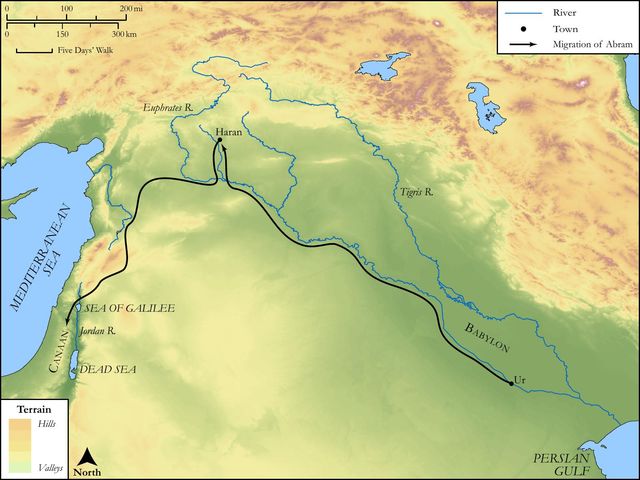
See on the biblical-era maps


Study this verse
Public-domain commentary
Matthew Henry
From his Commentary on the Whole Bible. Henry comments on passages, not single verses — this entry covers Genesis 23:16–20.
We have here the conclusion of the treaty between Abraham and Ephron about the burying-place. The bargain was publicly made before all the neighbours, in the presence and audience of the sons of Heth, Gen 23:16, Gen 23:17. Note, Prudence, as well as justice, directs us to be fair, and open, and above-board, in our dealings. Fraudulent contracts hate the light, and choose to be clandestine; but those that design honestly in their bargains care not who are witnesses to them. Our law countenances sales made in market - overt, and by deed enrolled. Observe, 1. Abraham, without fraud, covin, or further delay, pays the money, Gen 23:16. He pays it readily, without hesitation, - pays it in full, without diminution, - and pays it by weight, current money with the merchant, without deceit. See how anciently money was used for the help of commerce; and see how honestly money should be paid where it is due. Observe, Though all the land of Canaan was Abraham's by promise, yet, the time of his possessing not having come, what he had now occasion for he bought and paid for. Note, Dominion is not founded in grace. The saints' title to an eternal inheritance does not entitle them to the possessions of this world, nor justify them in doing wrong. 2. Ephron honestly and fairly makes him a good title to the land, Gen 23:17, Gen 23:18, Gen 23:20. The field, with all its appurtenances, is conveyed to Abraham and his heirs for ever, in open court, not by writing (it does not appear that writing was then used), but by such a public solemn declaration before witnesses as was sufficient to pass it. Note, As that which is bought must be honestly paid for, so that which is sold must be honestly paid for, so that which is sold must be honestly delivered and secured. 3. Abraham, thereupon, takes possession, and buries Sarah in the cave or vault (whether framed by nature or art is not certain) which was in the purchased field. It is probable that Abraham had buried servants out of his family since he came to Canaan, but the graves of the common people (Kg2 23:6) might suffice for them; now that Sarah was dead a peculiar place must be found for her remains. It is worth noting, (1.) That a burying-place was the first spot of ground Abraham possessed in Canaan. Note, When we are entering into the world it is good to think of our going out of it; for, as soon as we are born, we begin to die. (2.) That it was the only piece of land he ever possessed, though the country was all his own in reversion. Those that have least of this earth find a grave in it. Abraham provided, not cities, as Cain and Nimrod, but a sepulchre, [1.] To be a constant memorandum of death to himself and his posterity, that he and they might learn to die daily. This sepulchre is said to be at the end of the field (Gen 23:9); for, whatever our possessions are, there is a sepulchre at the end of them. [2.] To be a token of his belief and expectation of the resurrection; for why should such care be taken of the body if it be thrown away for ever, and must not rise again? Abraham, in this, said plainly that he sought a better country, that is, a heavenly. Abraham is content to be still flitting, while he lives, but secures a place where, when he dies his flesh may rest in hope.
Historical interpretation
Historical reception
1 surviving comment on this verse from the historical church.
This is the lodging place of the Lord, where an oak branch at Mamre
Covered the pastoral roof of the ancient seer; in this hospice
Sarah laughed at the joy of bearing a child in her old age
And at the faith her venerable husband could have in the marvel.
Abraham purchased a field wherein he might bury his wife’s bones,
Inasmuch as justice and faith on the earth dwell as strangers:
This is the cave for which he expended a great sum of money,
To prepare a fit resting place for his wife’s holy ashes.
Continue studying Genesis 23:19 across the web’s major study libraries — every link below opens this exact verse, chapter, or book on the destination site.
Read & Compare
 BibleGatewayThis verse in more than 200 translations and 70 languages.
 Bible.comThe YouVersion reader — hundreds of translations, reading plans, and highlights.
 ESV.orgCrossway's official English Standard Version reader.
 NET BibleThe NET translation with 60,000+ translators' notes on every rendering decision.
 STEP BibleTyndale House's free study tool — original text, vocabulary, and scholarly resources.
 BibliaLogos Bible Software's free web reader.
 USCCBThe New American Bible (Revised Edition) with the U.S. bishops' study notes.
Commentaries
 BibleHub CommentariesDozens of classic commentaries on this verse, gathered on one page.
 StudyLightMore than 100 commentary sets — the largest collection on the web.
 BibleRefPlain-English commentary on what this verse means, verse by verse.
 Enduring WordDavid Guzik's free commentary on this chapter, widely used by Bible teachers.
 Bible Study ToolsVerse commentary alongside Greek and Hebrew study aids.
Original Language & Research
- BibleHub InterlinearThe verse word by word — original language, transliteration, and English.
- BibleHub LexiconEvery word's original-language definition and Strong's entry.
 Blue Letter BibleDeep-study tools — Strong's numbers, concordance, and word studies.
 SefariaThe Hebrew text with Rashi and centuries of Jewish commentary.
Sermons, Hymns & Audio


TrulyRandomVerse is not affiliated with these sites and doesn’t control their content. They’re linked because they’re genuinely useful.
Summary
Genesis 23:19 meticulously records the burial of Sarah, Abraham's wife, in the cave of the field of Machpelah, situated before Mamre, a location explicitly identified as Hebron within the land of Canaan. This poignant act not only highlights Abraham's profound grief and respect for his beloved spouse but also serves as a pivotal moment in the unfolding of God's covenantal promises, marking Abraham's first tangible and legally secured acquisition of land in the very territory God had sworn to give to his descendants.
Context
ShowHideLiterary Context
This verse opens the closing burial scene of the significant narrative of Genesis 23, which opens with the death of Sarah at the advanced age of 127 years. The preceding verses detail Abraham's deep sorrow and his subsequent, meticulous efforts to secure a proper burial place. The entire chapter emphasizes Abraham's determination to purchase the field of Machpelah and its cave from Ephron the Hittite, despite offers of a free gift. The lengthy and public negotiation, culminating in the payment of 400 shekels of silver, underscores the legal and binding nature of this transaction, setting the stage for the solemn act of burial recorded in verse 19. This detailed account establishes the legitimacy of Abraham's claim to this specific parcel of land.
Historical & Cultural Context
In Scripture, securing a family burial plot was a matter of significant cultural and legal importance, often signifying permanent settlement and a claim to the land. The Hittites, known for their sophisticated legal codes and land transactions, were the dominant local power in Hebron at this time. Abraham's insistence on purchasing the land at full market value, rather than accepting it as a gift, was crucial. A gift could imply a temporary right of use, whereas a purchase established undeniable, permanent ownership, a critical act for a sojourner like Abraham in a foreign land. The cave itself, a common burial practice, provided a secure and dignified resting place, reflecting the cultural value placed on honoring the deceased. Mamre was a well-known landmark, and Hebron (also known as Kirjath-arba) was an ancient and significant city, lending weight and verifiable precision to the geographical identification.
Key Themes
ShowHideGenesis 23:19 powerfully contributes to several overarching themes within the book of Genesis and the broader biblical narrative. Firstly, it highlights the theme of God's Covenant and Land Promise. Despite God's promise of the entire land of Canaan to Abraham and his descendants (e.g., Genesis 12:7 and Genesis 15:18-21), Abraham's first tangible possession is merely a burial plot. This underscores the theme of Faith and Patience, demonstrating that the fulfillment of God's promises often unfolds gradually and requires enduring trust, even in the face of apparent delay or limited immediate realization. Secondly, the detailed account of the purchase emphasizes Legal Ownership and Inheritance, establishing a foundational claim to the Promised Land for Abraham's lineage. Finally, the narrative also portrays the profound human experience of Grief and Respect for the Deceased, showing Abraham's deep personal sorrow and his commitment to providing a dignified resting place for Sarah, a practice deeply embedded in ancient and biblical cultures.
Exposition and Analysis
ShowHideKey Word Analysis
ShowHideThis primitive root signifies "to inter" or "to bury." In this context, it denotes the solemn act of placing the deceased Sarah into the earth, specifically within the purchased cave. The use of this verb emphasizes Abraham's direct involvement and the finality of Sarah's earthly journey, while also highlighting the cultural importance of a proper burial for the deceased.
Derived from a root meaning "a fold" or "double," this proper noun refers to a specific place in Palestine, the field and cave Abraham purchased. The name itself might suggest a cave with multiple chambers or a field that was "doubled" in some topographical or agricultural sense. Crucially, Machpelah became the ancestral burial ground for the patriarchs and matriarchs, solidifying its symbolic importance as a tangible "down payment" on the promised land.
From a root meaning "seat of association" or "joining," Hebron is identified as the location of Machpelah. This ancient city held significant historical and theological weight. Its name suggests a place of confederacy or alliance, which is fitting given its later role in Israelite history. For Abraham, it was a place where he had previously dwelt and built an altar, and it would later become a key city in the conquest and the first capital of King David, further cementing its importance within the narrative of God's people.
Verse Breakdown
ShowHide"And after this,"
This opening phrase serves as a crucial temporal connector, linking the act of burial directly to the preceding detailed account in Genesis 23 of Sarah's death and Abraham's extensive negotiations for the burial plot. It signifies the culmination of the legal proceedings and the immediate subsequent action, emphasizing that the burial followed the successful acquisition of the land.
"Abraham buried Sarah his wife"
This clause highlights the personal and deeply emotional act performed by Abraham. It underscores his profound grief and his commitment to honoring his beloved spouse with a dignified interment. The act of burial, rather than abandonment, reflects the cultural value placed on the deceased and the sacredness of human life even in death, a common practice in Israel and among the nations round about.
"in the cave of the field of Machpelah before Mamre:"
This provides precise geographical details of the burial site. "The cave of the field of Machpelah" specifies the exact location of the tomb, emphasizing the legal purchase of both the field and its cave. "Before Mamre" further situates the location in relation to a well-known landmark, where Abraham had previously resided and built an altar to the Lord (Genesis 13:18). This detailed description ensures the exact identification of the sacred family burial plot.
"the same [is] Hebron in the land of Canaan."
This final explanatory clause provides a contemporary identification for the location. "Hebron" was a prominent city, and its inclusion serves to ground the narrative in a recognizable geographical context for future generations. The concluding phrase "in the land of Canaan" is profoundly significant, reiterating that this burial plot, though small, represents Abraham's first legal and permanent foothold in the very land God had promised to him and his descendants, a tangible act of faith in the divine covenant.
Literary Devices
ShowHideGenesis 23:19 employs several literary devices to convey its profound significance. Geographical Precision is paramount, as the verse meticulously names "Machpelah," "Mamre," "Hebron," and "Canaan." This detailed toponymy grounds the narrative in a verifiable reality, emphasizing the historical and legal authenticity of Abraham's land acquisition. The repeated and specific naming of these locations throughout Genesis 23 serves to underscore the importance of this particular plot of land as the patriarchs' future resting place. Furthermore, the act of purchasing the burial plot carries significant Symbolism. The cave, though a place of death, becomes a symbol of life and future inheritance. It represents a tangible "down payment" on the vast land promised by God, transforming an abstract divine pledge into a concrete, albeit small, reality. This act of acquisition also functions as Foreshadowing, pointing to the future possession of the entire land of Canaan by Abraham's descendants. The legal securing of this small parcel hints at the eventual, larger fulfillment of God's covenant, even if it would take generations to fully materialize.
Theological and Thematic Connections
ShowHideGenesis 23:19 is far more than a simple record of a burial; it is a profound theological statement wrapped in a historical event. Abraham's meticulous and costly purchase of the cave of Machpelah, despite being a wealthy man who could have likely received land as a gift, demonstrates his unwavering faith in God's covenantal promise. This act transforms the abstract promise of land into a tangible, legally owned piece of property, serving as a "down payment" on the future inheritance for his descendants. It underscores the reality that God's promises, while certain, often unfold incrementally and require patient, persistent faith. Furthermore, the establishment of this specific site as the ancestral burial ground for the patriarchs and matriarchs (Abraham, Sarah, Isaac, Rebekah, Jacob, and Leah) creates a powerful physical link between the covenant people and the promised land, even in death. It signifies a deep-rooted connection to the land and a continuous hope in the ultimate fulfillment of God's plan for Israel.
Reflection and Application
ShowHideGenesis 23:19 offers enduring lessons for believers today, particularly concerning faith, loss, and the nature of God's promises. Abraham's deep sorrow at Sarah's death reminds us that grief is a natural and profound human experience, even for those with unwavering faith. The Bible validates our mourning, acknowledging "a time to mourn, and a time to dance" (Ecclesiastes 3:4). Abraham's diligent and costly efforts to secure a proper burial place for Sarah underscore the importance of honoring the deceased and providing a dignified farewell, reflecting the biblical value placed on human life even in its earthly end. More profoundly, Abraham's act of purchasing the land, despite only needing a burial plot, teaches us about patient and persistent faith in God's promises. He claimed a small, tangible piece of the promised inheritance, demonstrating trust that God's word would be fully realized, even if the complete fulfillment would unfold gradually and in ways he might not immediately foresee. We are called to live by faith, trusting that God's word will be fulfilled in our lives, even when the full realization of His promises seems distant or incremental. This verse encourages us to make tangible acts of faith, however small, as expressions of our trust in God's ultimate faithfulness.
Questions for Reflection
ShowHideFAQ
ShowHideWhy was it so important for Abraham to buy the land for Sarah's burial?
ShowHideAbraham's insistence on purchasing the land, rather than accepting it as a gift from the Hittites, was crucial for several profound reasons. Firstly, it established a legal, undeniable, and permanent claim to a portion of the Promised Land, validating God's covenantal promise to him and his descendants. It was a tangible act of faith, demonstrating his belief that this land would indeed belong to his family as an inheritance. Secondly, it set a precedent for future generations, ensuring that the ancestral burial ground was undeniably Israelite property, not a borrowed or gifted plot that could be reclaimed. This legal ownership underscored the permanence of God's promise and the future possession of the land by his lineage, as seen in Genesis 23:16-18.
What is the significance of Machpelah becoming the ancestral burial place?
ShowHideThe cave of Machpelah became the burial site for Abraham, Sarah, Isaac, Rebekah, Jacob, and Leah (Genesis 49:30-31). This concentration of the patriarchs and matriarchs in one location served as a powerful physical symbol of the continuity of God's covenant with Abraham's family across generations. It was a constant, visible reminder of their heritage, their unbroken connection to the land God had promised, and the enduring nature of God's promises, even in death. Their resting place in the Promised Land affirmed their faith in a future inheritance and the eventual full possession of Canaan by their descendants, acting as a spiritual anchor for the nascent nation of Israel.
Christ-Centered Fulfillment
ShowHideThe purchase of Machpelah, a small, yet significant, piece of the Promised Land for a burial plot, profoundly foreshadows the greater, eternal inheritance secured by Christ. Abraham's act of faith in acquiring a temporary resting place in Canaan points to the ultimate rest and eternal dwelling place that Christ provides for His people. Just as Abraham's family was buried in the land of promise, believers now, through Christ's atoning death and triumphant resurrection, are promised not merely a physical plot of land but a heavenly inheritance that is "imperishable, undefiled, and unfading, kept in heaven for you" (1 Peter 1:3-4). Christ's own burial and subsequent resurrection transform the meaning of the grave, demonstrating His ultimate victory over death and securing the ultimate fulfillment of all God's promises, including the promise of an eternal home with Him in the new heavens and new earth (Revelation 21:1-4). The cave of Machpelah, a place of earthly rest and a down payment on a physical land, finds its glorious culmination in the spiritual and eternal rest and inheritance that believers receive through their union with Christ, the true Seed of Abraham (Galatians 3:16).