


Genesis 49:30
Bible text: King James Version (1769 Blayney text) · Public domain
Bible text: King James Version with Strong's numbers · Public domain
Bible text: Berean Standard Bible · Public domain
Bible text: American Standard Version (1901) · Public domain
Bible text: World English Bible, Messianic edition · Public domain
Bible text: Geneva Bible (1599) · Public domain
Bible text: Young's Literal Translation · Public domain
- בַּמְּעָרָהba·me·'a·Rahin the caveH4631Prep-b ¦ N-fsNoun Singular Feminine Absoluteבַּin theמְּעָרָהcave
- אֲשֶׁר'a·SherwhichH834RelParticle Relative
- בִּשְׂדֵהbis·Deh[is] in [the] field ofH7704Prep-b ¦ N-mscNoun Singular Masculine Constructבִּ[is] inשְׂדֵה[the] field of
- הַמַּכְפֵּלָהha·makh·pe·Lah<the> MachpelahH4375Art ¦ N-properNoun Proper Locationהַ<the>מַּכְפֵּלָהMachpelah
- אֲשֶׁר'a·SherwhichH834RelParticle Relative
- עַל'al[is] onH5921PrepPreposition
- פְּנֵיpe·nei[the] face ofH6440N-mpcNoun Plural Masculine Construct
- מַמְרֵאmam·Re'MamreH4471N-properNoun Proper Location
- בְּאֶרֶץbe·'E·retzin [the] land ofH776Prep-b ¦ N-fscNoun Singular Feminine Constructבְּinאֶרֶץ[the] land of
- כְּנָעַןke·Na·'anCanaanH3667N-properNoun Proper Location
- אֲשֶׁר'a·SherwhichH834RelParticle Relative
- קָנָהka·Nahhe boughtH7069V-Qal-Perf-3msVerb Qal Perfect 3rd Singular Masculine
- אַבְרָהָם'av·ra·HamAbrahamH85N-proper-mNoun Proper Masculine
- אֶת'et<obj.>H853DirObjMParticle Object Indicator
- הַשָּׂדֶהha·sa·Dehthe fieldH7704Art ¦ N-msNoun Singular Masculine Absoluteהַtheשָּׂדֶהfield
- מֵאֵתme·'Etfrom withH854Prep-m ¦ PrepPrepositionמֵfromאֵתwith
- עֶפְרֹן'ef·RonEphronH6085N-proper-mNoun Proper Masculine
- הַחִתִּיha·chi·Tithe HittiteH2850Art ¦ N-msNoun Gentilic Singular Masculine AbsoluteהַtheחִתִּיHittite
- לַאֲחֻזַּתla·'a·chu·zatto a possession ofH272Prep-l ¦ N-fscNoun Singular Feminine Constructלַtoאֲחֻזַּתa possession of
- קָבֶרKa·vera burial siteH6913N-msNoun Singular Masculine Absolute
English is a literal word-by-word gloss of the Hebrew, not the KJV's wording. Why?
This is the original text the KJV's translators worked from — each Hebrew word with its own literal English meaning in this verse, prepared by scholars at Tyndale House, Cambridge. The KJV translates whole sentences, not word by word, so its wording differs: one Hebrew word can become several English words, and the KJV may choose “the LORD” where the gloss reads “Yahweh”. Both are faithful — they answer different questions. For the KJV's own rendering, switch to the KJV text.
Details
See on the biblical-era maps


Study this verse
Public-domain commentary
Matthew Henry
From his Commentary on the Whole Bible. Henry comments on passages, not single verses — this entry covers Genesis 49:28–33. His two-level outline is real structure in the source text, so it is rendered as structure.
Here is, I. The summing up of the blessings of Jacob's sons, Gen 49:28. Though Reuben, Simeon, and Levi were put under the marks of their father's displeasure, yet he is said to bless them every one according to his blessing; for none of them were rejected as Esau was. Note, Whatever rebukes of God's word or providence we are under at any time, yet, as long as we have an interest in God's covenant, a place and a name among his people, and good hopes of a share in the heavenly Canaan, we must account ourselves blessed.
II.The solemn charge Jacob gave them concerning his burial, which is a repetition of what he had before given to Joseph.
See how he speaks of death, now that he is dying: I am to be gathered unto my people, Gen 49:29. Note, It is good to represent death to ourselves under the most desirable images, that the terror of it may be taken off. Though it separates us from our children and our people in this world, it gathers us to our fathers and to our people in the other world. Perhaps Jacob uses this expression concerning death as a reason why his sons should bury him in Canaan; for, says he, "I am to be gathered unto my people, my soul must go to the spirits of just men made perfect: and therefore bury me with my fathers, Abraham and Isaac, and their wives," Gen 49:31. Observe,
1.His heart was very much upon it, not so much from a natural affection to his native soil as from a principle of faith in the promise of God, that Canaan should be the inheritance of his seed in due time. Thus he would keep up in his sons a remembrance of the promised land, and not only would have their acquaintance with it renewed by a journey thither on that occasion, but their desire towards it and their expectation of it preserved.
2.He is very particular in describing the place both by the situation of it and by the purchase Abraham had made of it for a burying-place, Gen 49:30, Gen 49:32. He was afraid lest his sons, after seventeen years' sojourning in Egypt, had forgotten Canaan, and even the burying-place of their ancestors there, or lest the Canaanites should dispute his title to it; and therefore he specifies it thus largely, and the purchase of it, even when he lies a-dying, not only to prevent mistakes, but to show how mindful he was of that country. Note, It is, and should be, a great pleasure to dying saints to fix their thoughts upon the heavenly Canaan, and the rest they hope for there after death.
III.The death of Jacob, Gen 49:33.
When he had finished both his blessing and his charge (both which are included in the commanding of his sons), and so had finished his testimony, he addressed himself to his dying work.
1.He put himself into a posture for dying; having before seated himself upon the bed-side, to bless his sons (the spirit of prophecy bringing fresh oil to his expiring lamp, Dan 10:19), when that work was done, he gathered up his feet into the bed, that he might lie along, not only as one patiently submitting to the stroke, but as one cheerfully composing himself to rest, now that he was weary. I will lay me down, and sleep.
2.He freely resigned his spirit into the hand of God, the Father of spirits: He yielded up the ghost.
3.His separated soul went to the assembly of the souls of the faithful, which, after they are delivered from the burden of the flesh, are in joy and felicity: he was gathered to his people. Note, If God's people be our people, death will gather us to them.
Continue studying Genesis 49:30 across the web’s major study libraries — every link below opens this exact verse, chapter, or book on the destination site.
Read & Compare
 BibleGatewayThis verse in more than 200 translations and 70 languages.
 Bible.comThe YouVersion reader — hundreds of translations, reading plans, and highlights.
 ESV.orgCrossway's official English Standard Version reader.
 NET BibleThe NET translation with 60,000+ translators' notes on every rendering decision.
 STEP BibleTyndale House's free study tool — original text, vocabulary, and scholarly resources.
 BibliaLogos Bible Software's free web reader.
 USCCBThe New American Bible (Revised Edition) with the U.S. bishops' study notes.
Commentaries
 BibleHub CommentariesDozens of classic commentaries on this verse, gathered on one page.
 StudyLightMore than 100 commentary sets — the largest collection on the web.
 BibleRefPlain-English commentary on what this verse means, verse by verse.
 Enduring WordDavid Guzik's free commentary on this chapter, widely used by Bible teachers.
 Bible Study ToolsVerse commentary alongside Greek and Hebrew study aids.
Original Language & Research
- BibleHub InterlinearThe verse word by word — original language, transliteration, and English.
- BibleHub LexiconEvery word's original-language definition and Strong's entry.
 Blue Letter BibleDeep-study tools — Strong's numbers, concordance, and word studies.
 SefariaThe Hebrew text with Rashi and centuries of Jewish commentary.
Sermons, Hymns & Audio


TrulyRandomVerse is not affiliated with these sites and doesn’t control their content. They’re linked because they’re genuinely useful.
Summary
Genesis 49:30 records Jacob's precise instructions for his burial in the ancestral Cave of Machpelah, near Mamre in Canaan. This directive, given from his deathbed in Egypt, underscores his unwavering faith in God's covenant promises regarding the land and his family's enduring legacy within it, emphasizing the significance of Abraham's original purchase of this specific burial site as a tangible down payment on the Promised Land.
Context
ShowHideLiterary Context
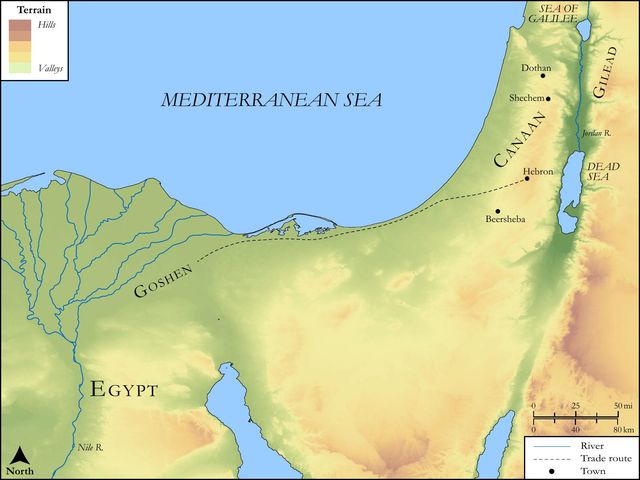
This verse is embedded within Jacob's final, prophetic blessings and instructions to his twelve sons, delivered from his deathbed in Egypt (Genesis 49). Having spent his last seventeen years under Joseph's care in Goshen, Jacob's thoughts turn to his ultimate resting place. His command in Genesis 49:29 sets the immediate stage, where he gathers his sons and charges them to bury him with his fathers. Verse 30 then provides the crucial details of the location, specifically naming the Cave of Machpelah and recalling its historical acquisition by Abraham, thereby establishing a profound connection to the patriarchal covenant and the Promised Land, even as the family resides outside of it.
Historical & Cultural Context
In the days of the patriarchs, burial practices were deeply significant, reflecting beliefs about lineage, land ownership, and the afterlife. Family tombs served as powerful symbols of continuity and identity. The purchase of the Cave of Machpelah by Abraham from Ephron the Hittite, detailed in Genesis 23, was a legally binding transaction, ensuring undisputed ownership in a foreign land. This act was not merely about securing a burial plot but about establishing a permanent, legal foothold in the land God had promised. Jacob's insistence on burial there, rather than in Egypt where he died, was a profound cultural and theological statement, rejecting the land of his sojourn in favor of the land of promise.
Key Themes
ShowHideGenesis 49:30 powerfully contributes to several overarching themes in the book of Genesis and the broader biblical narrative. It highlights the theme of Covenant Faithfulness, as Jacob's desire to be buried in Canaan demonstrates his unwavering belief in God's promise of the land to Abraham's descendants, despite their current residence in Egypt (Genesis 12:7). The verse also emphasizes Ancestral Continuity and Legacy, as the Cave of Machpelah was already the burial site for Abraham, Sarah, Isaac, Rebekah, and Leah (as noted in Genesis 49:31), signifying the unbroken line of the covenant people. Furthermore, it underscores the theme of the Promised Land as Inheritance, with Machpelah serving as the first tangible, legally acquired piece of that inheritance, a "down payment" on the future possession of the entire land by Israel (Genesis 15:13-14).
Exposition and Analysis
ShowHideKey Word Analysis
ShowHideThis feminine passive participle signifies "something seized," specifically referring to a possession, often of land. In Genesis 49:30, it emphasizes that Abraham's acquisition of the Cave of Machpelah was a legitimate, permanent ownership, not merely a temporary lease or gift. This "possession" was the first tangible piece of the Promised Land that the patriarchs truly owned, serving as a legal and symbolic anchor for the covenant.
This primitive root means "to erect" or "create," but by extension, "to procure, especially by purchase." The use of "bought" highlights the legal and economic reality of Abraham's transaction with Ephron the Hittite. It was a full, undisputed purchase, ensuring an unchallengeable claim to the land. This act of "buying" underscores the value and permanence of the acquisition, setting a precedent for future Israelite land claims.
This noun refers to a "sepulchre" or "grave." Its inclusion in the verse explicitly states the purpose of Abraham's purchase and Jacob's desired interment. More than just a practical necessity, a "buryingplace" for the patriarchs in the Promised Land was a profound act of faith, symbolizing their conviction that God's covenant promises, including the land, would ultimately be fulfilled. It was a place where the covenant family would rest together, awaiting the fulfillment of God's redemptive plan.
Verse Breakdown
ShowHide"In the cave that [is] in the field of Machpelah"
This phrase precisely identifies the specific location of the desired burial site. The "cave" (Hebrew, mᵉʻârâh) within the "field" (Hebrew, sâdeh) of Machpelah (Hebrew, Makpêlâh) points to a well-known and historically significant landmark. The name Machpelah, possibly meaning "double" or "portion," signifies its unique and sacred status as the ancestral tomb.
"which [is] before Mamre, in the land of Canaan"
This further pinpoints the geographical context, placing Machpelah near Mamre (Hebrew, Mamrêʼ), a significant Amorite settlement near Hebron, and firmly within the "land of Canaan" (Hebrew, Kᵉnaʻan). Jacob's insistence on burial here, rather than in Egypt, powerfully reinforces his spiritual and covenantal connection to the Promised Land, even from afar.
"which Abraham bought with the field of Ephron the Hittite for a possession of a buryingplace"
This crucial clause recalls the original transaction detailed in Genesis 23. It emphasizes that Abraham (Hebrew, ʼAbrâhâm) "bought" (Hebrew, qânâh) the "field" (Hebrew, sâdeh) from Ephron the Hittite (Hebrew, Chittîy) as a permanent "possession" (Hebrew, ʼăchuzzâh) for a "buryingplace" (Hebrew, qeber). This legal acquisition was the first tangible piece of the Promised Land acquired by the patriarchs, serving as a foundational act of faith and a secure, undisputed claim to a future inheritance.
Literary Devices
ShowHideThe verse employs several significant literary devices. Repetition of geographical markers ("field of Machpelah," "before Mamre," "land of Canaan") serves to firmly anchor the narrative in a specific, divinely promised location, emphasizing the importance of the land. The phrase "which Abraham bought" acts as a form of Anamnesis, a recalling of past events, specifically the detailed account in Genesis 23, which imbues the present command with historical weight and covenantal significance. Furthermore, the entire directive functions as Symbolism, where Jacob's physical burial choice symbolizes his spiritual conviction and the enduring hope of the patriarchal line in God's covenant promises, even when the family is in exile. His body, though dead, becomes a testament to the living promise of God.
Theological and Thematic Connections
ShowHideJacob's dying wish to be buried in the Cave of Machpelah is a profound theological statement, deeply rooted in the covenant God made with Abraham. It demonstrates his unwavering faith in the divine promise of the land of Canaan as the inheritance for his descendants, even though his family currently resided in Egypt. This act of faith transcends his immediate circumstances, looking forward to God's ultimate fulfillment of His word, serving as a powerful testament to the enduring nature of God's promises across generations.
Reflection and Application
ShowHideGenesis 49:30 offers a powerful lesson in steadfast faith and the enduring nature of God's promises. Jacob, at the end of his life, despite having lived years in Egypt, fixed his hope not on his present comfort but on God's future fulfillment of the covenant. His insistence on burial in Machpelah reminds us that our ultimate hope should be anchored in God's word, even when circumstances seem contrary to His promises. It challenges us to live with an eternal perspective, trusting that God's plans will ultimately prevail, and to make choices that reflect our belief in His faithfulness. This passage also underscores the importance of spiritual legacy and familial continuity in faith, encouraging us to honor and learn from the spiritual heritage passed down through generations, recognizing that we are part of a larger story of God's redemptive work.
Questions for Reflection
ShowHideFAQ
ShowHideWhy was Jacob so insistent on being buried in Canaan rather than Egypt?
ShowHideJacob's insistence on being buried in Canaan, specifically in the Cave of Machpelah, was a powerful act of faith and a symbolic declaration. It demonstrated his profound belief in God's covenant promise that the land of Canaan would be the eternal inheritance of his descendants (see Genesis 12:7). By choosing to be interred there, he was not only claiming his portion of the Promised Land but also expressing his conviction that his descendants would one day return to inhabit it, despite their current sojourn in Egypt. This act served as a prophetic sign of Israel's future return.
Who else was buried in the Cave of Machpelah?
ShowHideThe Cave of Machpelah served as the sacred burial site for the patriarchal family, signifying their unity in life and death within the covenant. Those interred there include Sarah (Genesis 23:19), Abraham (Genesis 25:9-10), Isaac (Genesis 35:29), Rebekah (Genesis 49:31), Leah (Genesis 49:31), and finally, Jacob himself (Genesis 50:13). This collective burial underscores the continuity of the covenant line.
What is the significance of Abraham having bought the field and cave?
ShowHideThe fact that Abraham bought the field and cave from Ephron the Hittite (Genesis 23:16-20) is profoundly significant. It established a legal, undisputed, and permanent claim to a piece of the Promised Land. This was not a gift or a temporary dwelling, but a full, legitimate transaction at market value, ensuring the patriarchs' ownership was beyond dispute. This act symbolized the first tangible fulfillment of God's promise of land to Abraham, serving as a "down payment" and a testament to the future, complete inheritance of his descendants. It rooted the covenant physically in the land.
Christ-Centered Fulfillment
ShowHideJacob's profound longing for burial in the purchased Cave of Machpelah in the Promised Land serves as a powerful foreshadowing of the ultimate fulfillment of God's promises in Jesus Christ. While Jacob's hope was tied to an earthly inheritance and a physical resting place, believers in Christ anticipate a far greater, heavenly inheritance and a spiritual dwelling. Christ's death and resurrection secure for us not merely a plot of land, but eternal life and a "better country—a heavenly one" (Hebrews 11:16). His own burial and subsequent glorious resurrection provide the ultimate hope for our own bodily resurrection, transforming the earthly desire for a secure burying place into the glorious promise of eternal life and an incorruptible inheritance in Him. He is the true "firstfruits" of God's promises (1 Corinthians 15:20), guaranteeing that just as He rose, so too will all who are in Him, inheriting not a physical plot, but the fullness of God's eternal kingdom through His finished work on the cross (Ephesians 1:11).