


Genesis 49:27
Bible text: King James Version (1769 Blayney text) · Public domain
Bible text: Berean Standard Bible · Public domain
Bible text: American Standard Version (1901) · Public domain
Bible text: World English Bible, Messianic edition · Public domain
Bible text: Geneva Bible (1599) · Public domain
Bible text: Young's Literal Translation · Public domain
- בִּנְיָמִיןbin·ya·MinBenjaminH1144N-proper-mNoun Proper Masculine
- זְאֵבze·'Ev[is] a wolfH2061N-msNoun Singular Masculine Absolute
- יִטְרָףyit·Raf[which] it tears to piecesH2963V-Qal-Imperf-3msVerb Qal Imperfect 3rd Singular Masculine
- בַּבֹּקֶרba·Bo·kerin the morningH1242Prep-b ¦ N-msNoun Singular Masculine Absoluteבַּin theבֹּקֶרmorning
- יֹאכַלYo·khalhe consumesH398V-Qal-Imperf-3msVerb Qal Imperfect 3rd Singular Masculine
- עַד'AdbootyH5706N-msNoun Singular Masculine Absolute
- וְלָעֶרֶבve·la·'E·revand to the eveningH6153Conj-w ¦ Prep-l ¦ N-msNoun Singular Masculine Absoluteוְandלָto theעֶרֶבevening
- יְחַלֵּקye·cha·Lekhe dividesH2505V-Piel-Imperf-3msVerb Piel Imperfect 3rd Singular Masculine
- שָׁלָלsha·LalplunderH7998N-msNoun Singular Masculine Absolute
English is a literal word-by-word gloss of the Hebrew, not the KJV's wording. Why?
This is the original text the KJV's translators worked from — each Hebrew word with its own literal English meaning in this verse, prepared by scholars at Tyndale House, Cambridge. The KJV translates whole sentences, not word by word, so its wording differs: one Hebrew word can become several English words, and the KJV may choose “the LORD” where the gloss reads “Yahweh”. Both are faithful — they answer different questions. For the KJV's own rendering, switch to the KJV text.
Details
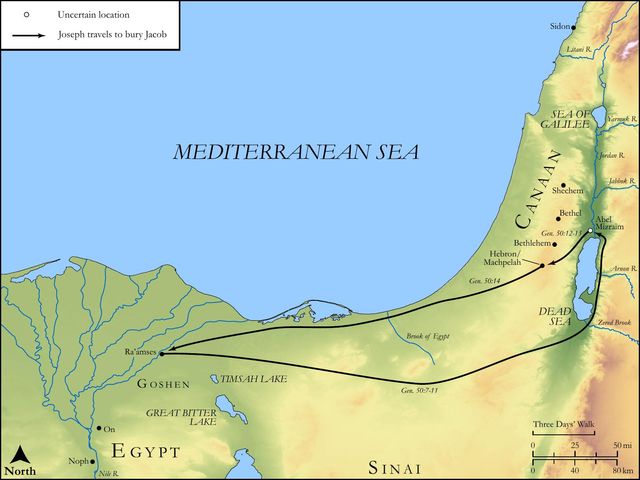
See on the biblical-era maps


Study this verse
Public-domain commentary
Matthew Henry
From his Commentary on the Whole Bible. Henry comments on passages, not single verses — this entry covers Genesis 49:22–27. His four-level outline is real structure in the source text, so it is rendered as structure.
He closes with the blessings of his best beloved sons, Joseph and Benjamin; with these he will breathe his last.
I.The blessing of Joseph, which is very large and full.
He is compared (Gen 49:22) to a fruitful bouth, or young tree; for God had made him fruitful in the land of his affliction; he owned it. Gen 41:52. His two sons were as branches of a vine, or other spreading plant, running over the wall. Note, God can make those fruitful, great comforts to themselves and others, who have been looked upon as dry and withered. More is recorded in the history concerning Joseph than concerning any other of Jacob's sons; and therefore what Jacob says of him is historical as well as prophetical. Observe,
1.The providences of God concerning Joseph, Gen 49:23, Gen 49:24. These are mentioned to the glory of God, and for the encouragement of Jacob's faith and hope, that God had blessings in store for his seed. Here observe (1.) Joseph's straits and troubles, Gen 49:23. Though he now lived at ease and in honour, Jacob reminds him of the difficulties he had formerly waded through. He had had many enemies, here called archers, being skilful to do mischief, masters of their art of persecution. They hated him: there persecution begins. They shot their poisonous darts at him, and thus they sorely grieved him. His brethren, in his father's house, were very spiteful towards him, mocked him, stripped him, threatened him, sold him, thought they had been the death of him. His mistress, in the house of Potiphar, sorely grieved him, and shot at him, when she impudently assaulted his chastity (temptations are fiery darts, thorns in the flesh, sorely grievous to gracious souls); when she prevailed not in this, she hated him, and shot at him by her false accusations, arrows against which there is little fence but the hold God has in the consciences of the worst of men. Doubtless he had enemies in the court of Pharaoh, that envied his preferment, and sought to undermine him. (2.) Joseph's strength and support under all these troubles (Gen 49:24): His bow abode in strength, that is, his faith did not fail, but he kept his ground, and came off a conqueror. The arms of his hands were made strong, that is, his other graces did their part, his wisdom, courage, and patience, which are better than weapons of war. In short, he maintained both his integrity and his comfort through all his trials; he bore all his burdens with an invincible resolution, and did not sink under them, nor do any thing unbecoming him. (3.) The spring and fountain of this strength; it was by the hands of the mighty God, who was therefore able to strengthen him, and the God of Jacob, a God in covenant with him, and therefore engaged to help him. All our strength for the resisting of temptations, and the bearing of afflictions, comes from God: his grace is sufficient, and his strength is perfected in our weakness. (4.) The state of honour and usefulness to which he was subsequently advanced: Thence (from this strange method of providence) he became the shepherd and stone, the feeder and supporter, of God's Israel, Jacob and his family. Herein Joseph was a type, [1.] Of Christ; he was shot at and hated, but borne up under his sufferings (Isa 50:7-9), and was afterwards advanced to be the shepherd and stone. [2.] Of the church in general, and particular believers; hell shoots its arrows against the saints, but Heaven protects and strengthens them, and will crown them.
2.The promises of God to Joseph. See how these are connected with the former: Even by the God of thy father Jacob, who shall help thee, Gen 49:25. Note, Our experiences of God's power and goodness in strengthening us hitherto are our encouragements still to hope for help from him; he that has helped us will help: we may build much upon our Eben-ezers. See what Joseph may expect from the Almighty, even the God of his father.
(1.)He shall help thee in difficulties and dangers which may yet be before thee, help thy seed in their wars. Joshua came from him, who commanded in chief in the wars of Canaan.
(2.)He shall bless thee; and he only blesses indeed. Jacob prays for a blessing upon Joseph, but the God of Jacob commands the blessing. Observe the blessings conferred on Joseph.
[1.]Various and abundant blessings: Blessings of heaven above (rain in its season, and fair weather in its season, and the benign influences of the heavenly bodies); blessings of the deep that lieth under this earth, which, compared with the upper world, is but a great deep, with subterraneous mines and springs. Spiritual blessings are blessings of heaven above, which we ought to desire and seek for in the first place, and to which we must give the preference; while temporal blessings, those of this earth, must lie under in our account and esteem. Blessings of the womb and the breasts are given when children are safely born and comfortably nursed. In the word of God, by which we are born again, and nourished up (Pe1 1:23; Pe1 2:2), there are to the new man blessings both of the womb and the breasts.
[2.]Eminent and transcendent blessings, which prevail above the blessings of my progenitors, Gen 49:26. His father Isaac had but one blessing, and, when he had given that to Jacob, he was at a loss for a blessing to bestow upon Esau; but Jacob had a blessing for each of his twelve sons, and now, at the latter end, a copious one for Joseph. The great blessing entailed upon that family was increase, which did not so immediately and so signally follow the blessings which Abraham and Isaac gave to their sons as it followed the blessing which Jacob gave to his; for, soon after his death, they multiplied exceedingly.
[3.]Durable and extensive blessings: Unto the utmost bounds of the everlasting hills, including all the productions of the most fruitful hills, and lasting as long as they last, Isa 54:10. Note, the blessings of the everlasting God include the riches of the everlasting hills, and much more. Well, of these blessings it is here said, They shall be, so it is a promise, or, Let them be, so it is a prayer, on the head of Joseph, to which let them be as a crown to adorn it and a helmet to protect it. Joseph was separated from his brethren (so we read it) for a time; yet, as others read it, he was a Nazarite among his brethren, better and more excellent than they. Note, It is no new thing for the best men to meet with the worst usage, for Nazarites among their brethren to be cast out and separated from their brethren; but the blessing of God will make it up to them.
II.The blessing of Benjamin (Gen 49:27):
He shall raven as a wolf; it is plain by this that Jacob was guided in what he said by a spirit of prophecy, and not by natural affection; else he would have spoken with more tenderness of his beloved son Benjamin, concerning whom he only foresees and foretels this, that his posterity should be a warlike tribe, strong and daring, and that they should enrich themselves with the spoils of their enemies - that they should be active and busy in the world, and a tribe as much feared by their neighbours as any other: In the morning, he shall devour the prey, which he seized and divided over night. Or, in the first times of Israel, they shall be noted for activity, though many of them left-handed, Jdg 3:15; Jdg 20:16. Ehud the second judge, and Saul the first king, were of this tribe; and so also in the last times Esther and Mordecai, by whom the enemies of the Jews were destroyed, were of this tribe. The Benjamites ravened like wolves when they desperately espoused the cause of the men of Gibeah, those men of Belial, Jdg 20:14. Blessed Paul was of this tribe (Rom 11:1; Phi 3:5); and he did, in the morning of his day, devour the prey as a persecutor, but, in the evening, divided the spoil as a preacher. Note, God can serve his own purposes by the different tempers of men; the deceived and the deceiver are his.
Historical interpretation
Two Centuries of Reception
5 surviving comments on this verse. Each one is dated, so this reads as a timeline rather than a list.
Select a marker to jump to its quote. Markers stagger vertically where authors wrote within a few decades of each other.
This thoroughly suits Paul, who was of the tribe of Benjamin. For when he was young, he was a ravening wolf; but when he believed, he "apportioned" food. This also is shown us by the grace of our Lord Jesus Christ, that the tribe of Benjamin is among the first persecutors, which is the sense of "in the morning." For Saul, who was of the tribe of Benjamin, persecuted David, who was appointed to be a type of the Lord.
[This refers to] Paul, who was a wolf to the wolves and snatched all souls away from the evil one. And “in the evening he will divide what he seizes,” that is, at the end of the world he will also rest with a reward greater than his labors.
The devil has many wolves, whom he directs towards the sheep of Christ; and therefore Joseph, being intelligent, snatched the wolf Paul, the enemy who came to plunder the sheep, in order to save his own sheep, making him a teacher from a persecutor. Concerning whom Jacob says, as it is written: Benjamin is a ravenous wolf; in the morning he shall devour prey, and in the evening he shall divide the spoil among the princes. The wolf was present when he scattered and devoured the sheep of the Church. But the one who was a wolf became a shepherd. The wolf was there when Saul entered houses and dragged men and women to prison. The wolf was there when he breathed threats and murder against the disciples of the Lord, seeking letters from the chief priests to capture the servants of Christ. But Jesus blinded him like a wolf wandering in the darkness of the night with the outpouring of His light. Therefore, when Rachel gave birth to Benjamin, she called his name Son of my sorrow, prophesying that from her would come the tribe of Paul, who would afflict the children of the Church during his time of persecution, and cause great pain to their mother. But nevertheless, at a later time he divided the same bread among the leaders, proclaiming the word of God to the Gentiles and calling many to faith. During this discussion, as we read, the proconsul Paul and the prince Publius received the grace of the Lord.
But beautifully also, when Moses blessed the tribe of Benjamin, he said: The beloved of the Lord shall dwell securely, and God shall overshadow him all the days, and the beloved of the Lord shall rest between his shoulders, who has also become a vessel of election. For he was converted to the Lord by the mercy and love of the Lord. Therefore, offering nothing to his own merit, but attributing everything to Christ, he says: For I am the least of the apostles, who am not worthy to be called an apostle, because I persecuted the Church of God. But by the grace of God I am what I am, and his grace towards me has not been in vain. He will dwell with confidence in the house that he previously laid waste, he will dwell in the tabernacles of Christ, who previously wandered like a wolf in the woods. And God overshadowed him when Christ appeared to him. Although he saw nothing with his open eyes, he still saw Christ. And he rightly saw the present one, whom he also heard speaking. This shadow is not of blindness, but of grace. Finally, Mary is told: The Holy Spirit will come upon you, and the power of the Most High will overshadow you.
“At evening he will divide the food.” The evening is that final time when Paul is converted. Thus we also call evening the time of our conversion in which we are now. Then he will divide the food, then he understands that in the law it is necessary to divide the letter from the spirit and will know that “the letter kills, but the Spirit gives life.” Since after being enlightened by the grace of the Lord, Paul begins to divide and separate in the law the spiritual realities from the corporeal ones, he is said to divide the food at evening. In fact, although meditating all day long on the law, he had not done that before.
(Verse 27.) Benjamin the ravenous wolf, in the morning he will still eat, and in the evening he will give food.
How clear is the prophecy about the Apostle Paul, it is evident to all that in his youth he persecuted the Church, but in his old age he preached the Gospel. However, it is written in Hebrew as follows: Benjamin, a ravenous wolf, in the morning he will devour the prey, and in the evening he will divide the spoils. The Hebrews interpret this as referring to the altar where sacrifices were offered and the blood of the victims was poured out at its base, which was located in the territory of the tribe of Benjamin. They say, therefore, that this signifies that the priests in the morning sacrifice the victims, and in the evening divide those things which have been conferred upon them by the people according to the Law, placing the bloody wolf, the voracious wolf, as an interpretation upon the altar, and the division of spoils upon the priests, who serve the altar and live off the altar.
Continue studying Genesis 49:27 across the web’s major study libraries — every link below opens this exact verse, chapter, or book on the destination site.
Read & Compare
 BibleGatewayThis verse in more than 200 translations and 70 languages.
 Bible.comThe YouVersion reader — hundreds of translations, reading plans, and highlights.
 ESV.orgCrossway's official English Standard Version reader.
 NET BibleThe NET translation with 60,000+ translators' notes on every rendering decision.
 STEP BibleTyndale House's free study tool — original text, vocabulary, and scholarly resources.
 BibliaLogos Bible Software's free web reader.
 USCCBThe New American Bible (Revised Edition) with the U.S. bishops' study notes.
Commentaries
 BibleHub CommentariesDozens of classic commentaries on this verse, gathered on one page.
 StudyLightMore than 100 commentary sets — the largest collection on the web.
 BibleRefPlain-English commentary on what this verse means, verse by verse.
 Enduring WordDavid Guzik's free commentary on this chapter, widely used by Bible teachers.
 Bible Study ToolsVerse commentary alongside Greek and Hebrew study aids.
Original Language & Research
- BibleHub InterlinearThe verse word by word — original language, transliteration, and English.
- BibleHub LexiconEvery word's original-language definition and Strong's entry.
 Blue Letter BibleDeep-study tools — Strong's numbers, concordance, and word studies.
 SefariaThe Hebrew text with Rashi and centuries of Jewish commentary.
Sermons, Hymns & Audio


TrulyRandomVerse is not affiliated with these sites and doesn’t control their content. They’re linked because they’re genuinely useful.
Summary
Jacob's prophetic pronouncement over his youngest son, Benjamin, vividly portrays the future tribe as a fierce and predatory wolf. This imagery signifies their formidable military character, depicting a people relentlessly active from dawn to dusk in securing victory and dividing the spoils of battle. The prophecy foreshadows Benjamin's historical reputation as a warlike and tenacious tribe, renowned for its prowess and success in conflict.
Context
ShowHideLiterary Context
Genesis 49 records Jacob's final prophetic blessings and pronouncements upon his twelve sons before his death, outlining the future characteristics and destinies of their respective tribes. This chapter serves as a foundational text for understanding the tribal identities and roles within ancient Israel. Benjamin, the youngest son of Jacob and Rachel, receives his prophecy after Joseph and before the concluding remarks, highlighting his unique and somewhat aggressive nature in contrast to some of his brothers. Each pronouncement, including Benjamin's, functions as a divinely inspired foretelling, shaping the narrative of the emerging nation.
Historical & Cultural Context
In Canaan, tribal identity was paramount, and warfare was a common reality for survival and expansion. Animal metaphors were frequently employed to describe the characteristics of individuals, clans, or nations, often reflecting their perceived strength, cunning, or ferocity. The wolf, known for its predatory nature, pack hunting, and territoriality, would have been a potent symbol of military might and aggression. Benjamin's birth was marked by tragedy, as his mother Rachel died in childbirth, naming him "Ben-oni" (son of my sorrow), which Jacob changed to "Benjamin" (son of my right hand), perhaps hinting at a future role of strength or favor, which this prophecy elaborates upon in a martial sense.
Key Themes
ShowHideThis verse contributes to several key themes within Genesis and the broader biblical narrative. It underscores the theme of divine sovereignty and foreknowledge, demonstrating God's comprehensive plan for the tribes of Israel, even down to their distinct characteristics. It highlights the diversity of roles and strengths within God's covenant people, where even a "wolf-like" ferocity is seen as a divinely ordained attribute for the defense and establishment of the nation. Furthermore, it sets the stage for the theme of prophecy and fulfillment, as the historical accounts of the Benjamite tribe, particularly their military exploits, would later confirm the accuracy of Jacob's words, as seen in passages like Judges 20 and the lineage of King Saul.
Exposition and Analysis
ShowHideKey Word Analysis
ShowHideFrom the primitive root H2963, meaning "to pluck off or pull to pieces; causatively to supply with food (as in morsels)." In this context, it vividly describes the aggressive, tearing action of a predator, emphasizing the tribe's fierce, decisive, and destructive nature in battle. It conveys a sense of violent acquisition.
Meaning "a wolf." This is the central simile of the prophecy, directly comparing the tribe of Benjamin to a wolf. The wolf symbolizes predatory instinct, ferocity, cunning, and an unyielding pursuit of its target, highlighting Benjamin's formidable and dangerous character in warfare.
From the primitive root H398, meaning "to eat (literally or figuratively); burn up, consume." Here, it signifies the complete consumption or destruction of the "prey" (the enemy or their resources). It emphasizes the effectiveness and totality of Benjamin's military actions, leaving nothing behind.
Verse Breakdown
ShowHide"Benjamin shall ravin as a wolf"
This opening clause establishes the core identity and nature of the tribe. The comparison to a wolf immediately conveys a powerful image of aggression, predatory instinct, and a fierce, unyielding character. It suggests that the Benjamites would be known for their military prowess, quick to attack, and formidable in conflict, embodying a spirit of decisive action.
"in the morning he shall devour the prey"
This phrase describes the initial, swift, and successful phase of Benjamin's military activity. "In the morning" suggests an early, decisive strike, while "devour the prey" emphasizes the complete and overwhelming victory over their enemies, consuming or destroying what they target. It speaks to their efficiency and effectiveness in battle.
"and at night he shall divide the spoil"
This concluding clause depicts the outcome and aftermath of their military endeavors. "At night" signifies the completion of the day's work, after the battle is won. "Divide the spoil" indicates the successful acquisition of plunder and its equitable distribution, underscoring their consistent success and the tangible rewards of their aggressive campaigns. This illustrates a continuous cycle of engagement and profitable victory.
Literary Devices
ShowHideThe prophecy in Genesis 49:27 employs several potent literary devices to convey its message. The most prominent is Simile, where Benjamin is directly compared to a wolf using the explicit "as" ("Benjamin shall ravin as a wolf"). This comparison is not merely descriptive but functions as a powerful Metaphor for the tribe's inherent character and future military reputation. The wolf, a creature known for its predatory nature, ferocity, and pack hunting, becomes a symbol of Benjamin's aggressive, courageous, and formidable spirit in warfare. Furthermore, the phrase "in the morning he shall devour the prey, and at night he shall divide the spoil" utilizes Merism, a rhetorical device where two contrasting parts represent a whole. "Morning" and "night" encompass the entire day, signifying the continuous, relentless, and comprehensive nature of Benjamin's military activities, from the initial attack to the final distribution of spoils. This highlights their persistent effectiveness and success in battle.
Theological and Thematic Connections
ShowHideThis vivid prophecy of Benjamin as a wolf underscores God's meticulous and sovereign foreknowledge, revealing the distinct character and destiny of a tribal group long before its historical manifestation. It demonstrates that God's divine plan encompasses the unique strengths and even aggressive tendencies of His people, equipping them with diverse attributes for His overarching purposes within the covenant. The "wolf" imagery, while seemingly harsh, highlights a necessary strength—a powerful, decisive, and protective ferocity—essential for the defense and establishment of Israel in a hostile world. It affirms that God uses all manner of human characteristics, redeemed and directed by His will, to achieve His redemptive ends.
Reflection and Application
ShowHideThe prophecy concerning Benjamin, though rooted in ancient tribal dynamics, offers profound insights for contemporary reflection. It reminds us that God's sovereign plan often unfolds through the unique, sometimes challenging, characteristics of individuals and groups. The "wolf" metaphor, while speaking of aggression, also conveys a necessary resolve, courage, and tenacity in the face of adversity. In our own lives, we are called to discern how our inherent abilities, passions, or even our more challenging tendencies can be consecrated and transformed by God's grace. Just as the Benjamite tribe's fierceness was utilized for Israel's defense, and individuals like King Saul and later the Apostle Paul (a Benjamite) were profoundly used by God (with Paul's zeal being radically transformed from persecution to fervent evangelism), we too can trust that God can redeem and redirect our strengths and weaknesses for His kingdom purposes. This calls us to engage in spiritual warfare against evil, diligently pursuing God's will with the same zeal and decisiveness, but with love and grace as our guiding principles, recognizing that our ultimate victory comes through Christ.
Questions for Reflection
ShowHideFAQ
ShowHideDoes the "wolf" imagery imply Benjamin was an evil tribe?
ShowHideThe imagery of a "wolf" in this context primarily signifies a fierce, predatory, and warlike nature, rather than an inherently evil one. It describes their military prowess, courage, and effectiveness in battle—qualities that were often necessary for the defense and expansion of Israel in a hostile environment. While the tribe later faced severe judgment for moral failures, particularly in the accounts of Judges 19-21, this specific prophecy in Genesis 49:27 focuses on their martial character, which was a strength within the larger tribal structure.
How was this prophecy fulfilled historically?
ShowHideThe tribe of Benjamin consistently demonstrated military strength and a fierce fighting spirit throughout Israel's history. They were known for their skilled warriors, including their famous left-handed slingers, as noted in Judges 20:16. The first king of Israel, Saul, was from the tribe of Benjamin and was renowned for his warrior capabilities. Even in later periods, Benjamites were noted for their martial abilities, fulfilling the prophetic description of a tribe that would "ravin as a wolf" in battle, from early conquests to defending against enemies.
Christ-Centered Fulfillment
ShowHideWhile Jacob's prophecy concerning Benjamin describes an earthly, warlike tribe, its ultimate spiritual transformation and fulfillment are found in Christ. Jesus, the true and ultimate King, far surpasses any earthly ruler like King Saul from Benjamin, establishing a kingdom that is not of this world (John 18:36). The ferocity and zeal prophesied for Benjamin find their perfected expression in the spiritual warfare waged by believers under Christ's command (Ephesians 6:12), where the "prey" is sin, spiritual darkness, and the forces of evil, and the "spoil" is the victory of salvation, the liberation of souls, and the spread of the Gospel (Colossians 2:15). The remarkable transformation of a Benjamite like the Apostle Paul, from a zealous persecutor of the church to a fervent evangelist for Christ (Philippians 3:5-8), powerfully illustrates how the aggressive zeal of Benjamin can be redeemed and redirected by God's grace to serve the Prince of Peace, bringing spiritual spoils to His eternal kingdom (2 Corinthians 10:4-5).